

How Hiring a Dedicated Python Team Lowers Total Delivery Cost Over 12 Months
How dedicated Python teams lower 12-month delivery cost in 2026: velocity compounding, real month-by-month TCO math, and why cohesion beats freelancer variance.

Mukesh Ram
Why 12-Month Cost Math Reveals the Dedicated Team Advantage
Most Python engagement decisions get made on Sprint 1 math and then get regretted by Sprint 6. Nominal rate comparisons look clean: a $50/hour freelancer beats a $70/hour dedicated engineer on paper. But by month 6, the freelancer has churned, the codebase has drifted, and the founder is watching sprint velocity fall while budget accelerates. The dedicated team engagement that looked expensive at Sprint 1 is meaningfully cheaper by Sprint 12 because velocity compounds with context. As Peter Drucker observed, "Efficiency is doing things right; effectiveness is doing the right things." In Python engagements over 6 months, the dedicated team model is not just efficient; it is effective at producing the compounding output that transactional models structurally cannot deliver. This framework aligns with the broader hiring discipline detailed in the complete guide to hiring Python developers.
The 2026 engineering data validates the compounding effect. According to the 2026 engineering velocity benchmark by KORE1, feature-branch throughput rose 59% year-over-year but main-branch throughput actually fell 7% for the median team, and only 5% of custom enterprise AI pilots reach production. What separates the teams shipping to customers from the teams shipping to feature branches is cohesion: dedicated Python engineers with 6-12 months of accumulated codebase context deliver measurably more shippable output per hour than rotating freelancers who require re-onboarding every engagement. This guide walks through the velocity compounding effect month-by-month, the 12-month cost comparison across engagement models, hidden savings that dedicated teams capture, why cohesion beats cheaper rate structurally, and the honest anti-patterns where dedicated teams do not win.
The Velocity Compounding Effect: Month 1 vs Month 12
Dedicated Python team velocity does not stay flat. It rises predictably with codebase context, team cohesion, and accumulated architectural knowledge. The month-by-month breakdown below is what Acquaint Softtech consistently observes across 1,300+ Python engagements.
Dedicated Python Team Velocity Compounding by Month
Month | Velocity vs Month 1 | What Drives It |
|---|---|---|
Month 1 | 100% baseline | Ramp-up: codebase orientation, tooling setup, first tasks |
Month 2 | 130 to 150% | Sprint integration, understanding common patterns |
Month 3 | 160 to 200% | Full context on architecture, know where issues live |
Month 6 | 220 to 280% | Independent architectural decisions, mentoring others |
Month 9 | 260 to 330% | Proactive refactoring, technical debt paydown discipline |
Month 12 | 300 to 400% | Institutional knowledge peer of any in-house senior engineer |
Why Velocity Compounds Predictably
Codebase context accumulates in Month 2-3. A dedicated Python developer learns which database queries are slow, which modules are fragile, why a particular design decision was made three sprints ago, and where the hidden complexity lives. This context makes them 30-50% faster than a marketplace developer who never accumulates the same context.
Architectural authority develops by Month 6. At the 6-month mark, dedicated engineers can make independent architectural decisions that align with the product's actual direction rather than generic patterns. This is where the velocity gap widens dramatically versus freelancer engagements.
Proactive technical debt paydown emerges Month 9+. Engineers who own the codebase notice and fix technical debt proactively. Rotating freelancers add to it. This is where the 25-33% engineering time loss to technical debt (Stripe research) starts to compound into permanent capacity difference.
By Month 12, dedicated engineers match in-house senior engineers. The institutional knowledge, product context, and architectural ownership become equivalent to a full-time in-house senior hire. The dedicated model captures this at approximately 40% of the fully-loaded US in-house cost.
The complete monthly retainer pricing analysis showing $3,200/month per dedicated Python developer producing $38,400 across 12 months with one onboarding cycle and continuously evolving scope is covered in monthly retainer vs project-based pricing for Python development, which walks through the specific pricing math that determines actual annual TCO.
The 12-Month Cost Comparison: Dedicated vs Freelance vs In-House
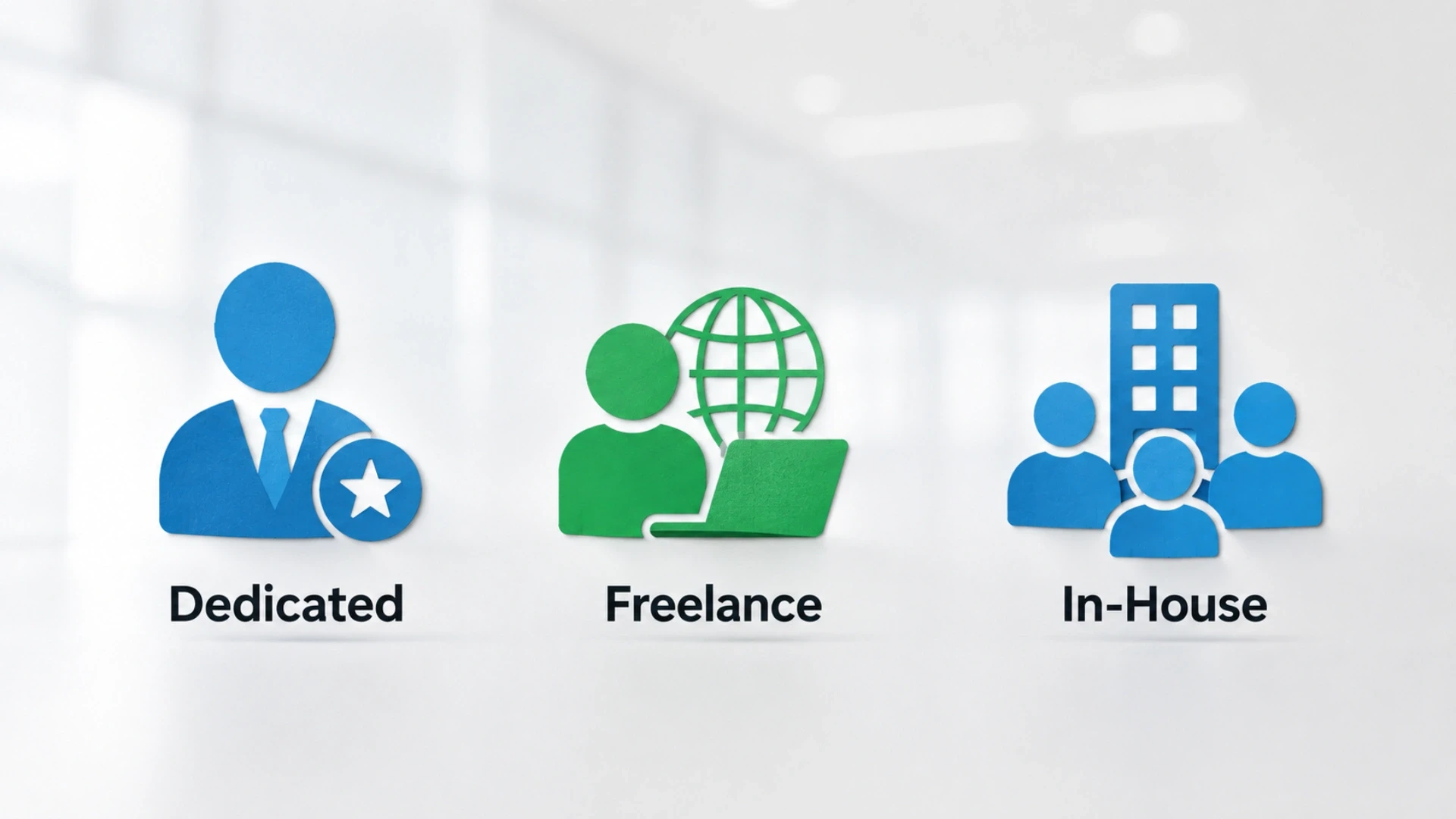
Real 12-month cost math surfaces the dedicated team advantage clearly. The comparison below uses realistic assumptions for a mid-complexity Python engagement (feature development, API work, database optimization, architecture evolution).
12-Month Cost Comparison for Mid-Complexity Python Engagement
Cost Category | Freelance ($50/hr) | Dedicated ($3,200/mo) | US In-House ($128K) |
|---|---|---|---|
Nominal engagement cost | $104,000 (2080 hrs) | $38,400 | $205,537 fully loaded |
Onboarding cycles (avg 2) | $16,000 (2 x 2 weeks) | $0 (one 48-hour cycle) | $25,000 recruitment |
Management overhead | $26,000 (25% senior time) | $4,000 (10% senior time) | $8,000 HR + management |
Rework and quality fixes | $45,000-$75,000 | $3,000-$5,000 | $8,000-$15,000 |
Continuity gap cost | $25,000 (1-2 events) | $0 (free replacement) | $15,000 (attrition risk) |
Documentation reconstruction | $15,000 | $0 (included) | $0 |
Total 12-month cost | $231,000-$261,000 | $45,400-$47,400 | $261,537-$268,537 |
Velocity output equivalent | 1.0x baseline | 1.5-2.0x baseline | 1.8-2.2x baseline |
Cost per unit velocity | $231K-$261K | $23K-$32K per unit | $122K-$149K per unit |
What the 12-Month Numbers Reveal
Dedicated team costs 80% less than freelance and 82% less than US in-house. $45K-$47K for dedicated vs $231K-$261K for freelance vs $261K-$268K for US in-house. This is the structural cost advantage that compounds over multi-year engagements.
Cost per unit velocity is where dedicated dominates. Freelance $231K-$261K per unit of velocity. Dedicated $23K-$32K per unit. US in-house $122K-$149K per unit. The dedicated model produces 5-8x better cost efficiency per unit of actual delivered output.
Onboarding cycles alone save $16,000. Freelance engagements average 2 onboarding cycles across 12 months (initial hire + mid-project replacement). Dedicated engagements have one 48-hour cycle. The onboarding cost differential is structural and compounds every engagement year.
Continuity guarantee eliminates the panic tax. Free replacement with structured handover means dedicated team engagements do not have the mid-project developer disappearance disruption that costs freelance engagements 6-10 weeks per event.
The complete freelancer vs dedicated agency cost comparison including the 6 hidden cost categories that push freelance true cost 3-5x above the advertised rate is covered in hidden costs of hiring a Python freelancer vs a dedicated agency, which walks through the specific failure mechanics driving the numbers above.
Book Sprint-Ready Dedicated Python Engineers in 48 Hours
Acquaint Softtech dedicated Python engineers cost $3,200/month per developer with 48-hour sprint-ready onboarding. Every engagement includes free replacement guarantee, structured documentation as deliverable, Day 1 IP assignment, and multi-stage vetting. 1,300+ Python projects delivered with verified 40% TCO savings vs US in-house.
Where Dedicated Teams Save Money That Never Shows Up on the Invoice

The most impactful savings from dedicated team engagements are the ones that never appear on any invoice. The categories below are what founders discover after 6-12 months of dedicated engagement that they never anticipated at the sign-up decision.
The 6 Hidden Savings Categories
Zero re-explanation cycles after Month 3. Rotating freelancers require repeated explanation of business context, architectural decisions, and product priorities. Dedicated engineers with accumulated context skip this overhead entirely. Typical savings: 8-12 hours per week of senior client team time.
Proactive technical debt paydown, not reactive rework. Engineers who own the codebase notice debt and fix it in the natural course of feature work. Rotating freelancers add to debt. The 25-33% engineering time loss to technical debt (Stripe research) drops to 5-10% under dedicated ownership.
Architecture decisions informed by product context. Dedicated engineers making decisions know what the product is building toward. Freelancers making decisions optimize for the immediate task. Compounded over 12 months, architectural quality diverges dramatically.
Faster onboarding of new team members. When a dedicated team grows from 2 to 4 engineers at Month 6, the existing engineers can onboard the new engineers directly. When a freelancer team grows, each freelancer requires separate client onboarding.
Better estimate accuracy over time. Sprint estimates become more reliable as the team accumulates context on how work actually flows through the codebase. This means product roadmap planning becomes reliable, which enables commitments to customers and stakeholders.
Reduced context switching for internal senior team. Managing rotating freelancers requires senior in-house team to context switch across engagements. Dedicated team engagements eliminate this switching cost. Typical savings: 15-25% of senior in-house time recovered.
As Warren Buffett has observed: "It's far better to buy a wonderful company at a fair price than a fair company at a wonderful price." Applied to Python engagements, it is far better to engage a dedicated senior engineer at a fair monthly rate than to engage a marketplace freelancer at a wonderful hourly rate. The wonderful hourly rate produces the failure modes that add hidden costs invisible at signing but painful at Month 6. The fair monthly rate produces the velocity compounding that becomes obvious by Month 3 and dominant by Month 12.
Why Cohesion Beats Cheaper Rate Every Time
The structural reason dedicated teams outperform is documented across 2026 engineering research. According to the 2026 dedicated team vs staff augmentation analysis by ElectroIQ, dedicated pods trade a slower initial takeoff (45-60 days to first output) for a steeper velocity slope that compounds throughput and drops attrition risk beyond 2 quarters. The cohesion advantage becomes decisive for organizations intent on scaling software teams past the twenty-engineer mark or roadmaps stretching beyond two quarters. CleverBit's 2026 research on scaling engineering teams shows dedicated teams unlock higher innovation rates because integration breeds understanding: engineers who participate in discovery sessions, customer interviews, and strategic planning contribute ideas beyond feature implementation.
The 4 Structural Advantages of Cohesion
Institutional knowledge that transfers between engineers. When one dedicated engineer knows the codebase deeply, they can transfer knowledge to teammates within the same engagement. Freelancers cannot transfer knowledge across separate engagements because there is no shared team context.
Shared architectural language and patterns. A dedicated team develops shared conventions for how code is structured, how errors are handled, how tests are written. This convention alignment makes code reviews faster and refactoring safer. Rotating engagements lack this alignment.
Compounding relationship trust. The senior client team trusts the dedicated engineers' judgment more over time as accuracy accumulates. Trust enables faster decisions, less oversight overhead, and more strategic collaboration. Freelance engagements never accumulate the same trust structurally.
Aligned incentive over multi-year horizon. Vetted dedicated agencies have reputational stakes in delivering high-quality outcomes because their business model depends on client retention. Freelancers optimizing on immediate engagement have different incentives. The incentive alignment predicts the outcome.
The complete comparison of why in-house Python teams outperform marketplace developers on 6, 9, and 12-month horizons including the 7 compounding advantages that develop with team continuity is covered in why in-house Python teams outperform marketplace developers, which walks through the specific structural differences that produce the cost outcomes above.
When Dedicated Teams Do Not Win: Honest Anti-Patterns

Dedicated team engagements do not fit every situation. Understanding when they structurally do not win is what separates informed engagement decisions from vendor pitches that overpromise. The 4 anti-patterns below are where dedicated teams honestly cost more than the alternatives.
The 4 Situations Where Dedicated Teams Do Not Win
Sub-3-month engagements with defined scope. If the engagement is truly under 3 months with a well-defined deliverable, the dedicated team's ramp-up investment (1-2 months) does not have time to pay back. Fixed-price project engagement often wins for these short engagements. Freelance can also fit if scope is genuinely narrow.
Genuinely isolated one-off tasks. A specific bug fix, a one-off script, an isolated feature addition that does not touch the core architecture. Freelance is the right choice here. The overhead of engaging a dedicated team for genuinely isolated work exceeds the benefit.
Sub-$5,000 total engagement budgets. Dedicated team engagements require enough budget to justify the model. Under $5,000 total, task-based engagements (fixed-price project or hourly freelance) fit the budget constraint better than a monthly retainer or dedicated team.
Genuinely temporary specialist skill needs. If you need a specific specialist (ML engineer for a 4-week pipeline build, DevOps engineer for a 6-week Kubernetes migration) without ongoing Python work, staff augmentation fits better than a dedicated team.
As Reid Hoffman, cofounder of LinkedIn, has observed: "The best way to build a company is to have a great team." Applied to Python engagements over 6 months, the great team is a dedicated Python team with cohesion, institutional knowledge, and accumulated codebase context. The engagement model that produces this outcome consistently is the dedicated team model at $3,200/month per engineer. The engagement models that structurally cannot produce this outcome are the marketplace freelancer models optimizing on hourly rate. Both are valid choices; both produce different outcomes at Month 12.
The Bottom Line
Hiring a dedicated Python team lowers total 12-month delivery cost through velocity compounding, not through nominal rate arbitrage. Sprint 1 velocity becomes 300-400% by Month 12 as codebase context accumulates, re-onboarding cycles disappear, and management overhead drops from 25% to 10% of senior time. Total 12-month cost typically runs 80% below marketplace freelance and matches or beats US in-house, while producing 5-8x better cost efficiency per unit of delivered velocity.
The pragmatic 2026 approach for Python engagements over 3 months is dedicated team at $3,200/month per developer with structured continuity guarantees, Day 1 IP assignment, and multi-stage vetting. Anti-patterns exist (sub-3-month engagements, isolated tasks, sub-$5,000 budgets, temporary specialist needs) where freelance or fixed-price wins. For everything else, dedicated team economics compound faster than the alternatives can match. Cohesion beats cheaper rate over any meaningful engagement horizon. Pick the dedicated model, engage for 6-12 months minimum, and Python delivery cost stops being a Sprint 1 comparison problem and becomes a Month 12 competitive advantage.
Turn 12-Month Delivery Into a Compounding Advantage
Book a free 30-minute dedicated team consultation with Acquaint Softtech. Share your Python engagement scope, current velocity, and 12-month roadmap, and we will model your specific velocity compounding projection and 12-month TCO across dedicated, freelance, and in-house alternatives. Get sprint-ready dedicated Python engineers in 48 hours with $3,200/month predictable pricing.
Frequently Asked Questions
-
How does hiring a dedicated Python team lower 12-month delivery cost?
Through velocity compounding: month 1 baseline becomes 300-400% by month 12 as codebase context accumulates. Dedicated teams eliminate re-onboarding cycles, reduce management overhead from 25% to 10% of senior time, eliminate mid-project developer disappearance costs, and produce zero re-explanation overhead after month 3. Total 12-month cost typically 80% lower than freelance and equivalent to US in-house.
-
What does a dedicated Python team cost per month in 2026?
Acquaint Softtech dedicated Python engineers cost $3,200/month per developer, equivalent to $18-22/hour at full utilization. Compare to $50-80/hour marketplace freelancer (nominal $8,000-$12,800/month + hidden costs) or $128K-$172K US in-house ($205K-$278K fully loaded). Dedicated model produces the lowest quality-adjusted rate for engagements over 3 months.
-
How long before dedicated team velocity compounds?
Month 1 is baseline ramp-up (codebase orientation, tooling, first tasks). Month 2 velocity typically hits 130-150% of baseline. Month 3-6 reaches 160-280%. Month 12 typically hits 300-400%. The compounding effect is why 6-12 month engagements produce dramatically better economics than short-term transactional models.
-
Why do freelancers not produce the same velocity compounding?
Marketplace freelancers manage 3-5 simultaneous clients and lack incentive to invest in accumulating context on any single codebase. Rotation between engagements resets the context. Sub-6-month engagements never reach the Month 3-6 compounding threshold. Structural incentives predict the velocity outcome, not developer capability.
-
When should I NOT hire a dedicated Python team?
Sub-3-month engagements with defined scope (ramp-up investment does not pay back), genuinely isolated one-off tasks like a specific bug fix, sub-$5,000 total engagement budgets, or temporary specialist needs like a 4-week ML pipeline. For these situations, fixed-price project, freelance, or staff augmentation fit better than dedicated team.
-
Does the dedicated team lock me into a specific vendor?
No, when contract terms are structured correctly. Acquaint Softtech engagements include 30-day notice, Day 1 IP assignment, structured knowledge transfer on exit, and no lock-in clauses. You own all code from Day 1, all documentation, all architectural decisions. Vendor switch costs are contained through the same 30-day handover framework that handles internal team transitions.
I love to make a difference. Thus, I started Acquaint Softtech with the vision of making developers easily accessible and affordable to all. Me and my beloved team have been fulfilling this vision for over 15 years now and will continue to get even bigger and better.
Table of Contents
Get Started with Acquaint Softtech
- 13+ Years Delivering Software Excellence
- 1300+ Projects Delivered With Precision
- Official Laravel & Laravel News Partner
- Official Statamic Partner
Related Blog
Designing Python Backends for Long-Term Growth
Design a Python backend that scales with your team and product over years. 2026 patterns for evolutionary architecture, technical debt, and modular growth.

Acquaint Softtech
May 7, 2026
Hidden Costs of Hiring a Python Freelancer vs a Dedicated Agency
That $50/hr Python freelancer may cost you more than a $3,200/month dedicated agency. We break down every hidden cost category with real 2026 data before you make your next hire.
Acquaint Softtech
March 14, 2026
Change Management During Python Development Adoption
How to get teams to actually use the Python software you built. ADKAR framework, champion networks, and the adoption anti-patterns that kill good software.
Acquaint Softtech
June 25, 2026India (Head Office)
203/204, Shapath-II, Near Silver Leaf Hotel, Opp. Rajpath Club, SG Highway, Ahmedabad-380054, Gujarat
USA
7838 Camino Cielo St, Highland, CA 92346
UK
The Powerhouse, 21 Woodthorpe Road, Ashford, England, TW15 2RP
New Zealand
42 Exler Place, Avondale, Auckland 0600, New Zealand
Canada
141 Skyview Bay NE , Calgary, Alberta, T3N 2K6