

Hospital Management System Development: Modules, Architecture, and Integration Map
A hospital management system (HMS) is integrated software that connects every operational and clinical function in a hospital: patient registration, appointment scheduling, EHR and EMR, pharmacy, laboratory, radiology, billing, and inventory, in a single platform with role-based access. Modern HMS builds in 2026 use microservices architecture, HL7 FHIR for integration, HIPAA-compliant cloud infrastructure, and role-based access control as the baseline.

Manish Patel

- You are a CTO or hospital IT leader scoping an HMS build or replacement.
- You need to understand which modules belong in Phase 1 vs Phase 2.
- You want to know what microservices and FHIR mean at the engineering level.
- You need real cost data before presenting an HMS budget to leadership.
- You are evaluating offshore HMS development teams and need a trust framework.
Introduction
Most hospital administrators discover the real problem with their current system not when it breaks but when it cannot do something the next phase of care requires. The scheduling system does not talk to the pharmacy. The billing module cannot pull lab results. The radiology department runs its own PACS that has never been connected to the EMR. Adding a telemedicine module reveals that the data model was never designed for multi-channel care delivery. These are not software bugs. They are the consequences of building a hospital management system without a unified integration architecture.
A hospital management system in 2026 is not a collection of connected tools. It is a single platform where patient data flows without friction from registration through discharge, billing, and follow-up. Understanding how to build a hospital management system that achieves that outcome is the purpose of this guide. For a complete engagement with a team that has delivered 60 or more HealthTech projects, start with Acquaint Softtech's custom healthcare software development services, which cover HMS development from discovery through enterprise deployment.
The global hospital information system market was valued at $152.72 billion in 2024 and is projected to reach $687.32 billion by 2033 at a CAGR of 18.44 percent (2026). The broader healthcare IT market is expected to reach $998.78 billion in 2026 (Groovy Web, 2026). These numbers reflect a structural shift: hospitals are replacing fragmented legacy systems with integrated platforms because the administrative cost of running disconnected software has become untenable.
This article covers the 10 core HMS modules, the 2026 microservices architecture pattern, the HL7 FHIR integration map that connects an HMS to external systems, the 5-phase development process, HIPAA compliance requirements, verified cost data, and a real case study from Acquaint Softtech's HealthTech delivery portfolio. For the full healthcare software development context across all eight product categories, start with the guide to healthcare software development, which situates HMS within the full landscape of healthcare software and covers the strategic decisions that precede any HMS engagement.
What Is a Hospital Management System and Why It Matters in 2026

A hospital management system (HMS) is the digital backbone of modern hospitals, connecting patient records, billing, pharmacy, appointments, and clinical operations into one unified platform. Instead of scattered spreadsheets and manual paperwork, hospitals get real-time data flow from patient admission to discharge.
Modern HMS platforms reduce registration time by up to 60%, minimize billing and medication errors, and provide live operational insights for faster decision-making. In 2026, AI-powered automation, smart bed management, and real-time revenue tracking are becoming standard features, not optional upgrades.
Why hospital management system matters for hospitals and clinics in 2026 comes down to one factor: the administrative cost of running disconnected software has exceeded the cost of replacing it. A hospital where the scheduling system cannot see pharmacy inventory, and the billing module cannot access lab results, spends more staff time on manual data reconciliation than on patient care. Acquaint Softtech's virtual CTO services include an HMS architecture review as the first deliverable for all hospital management system engagements, mapping the existing system landscape before any new development is scoped.
HMS Market Context: Why Hospitals Are Replacing Legacy Systems Now

The HMS replacement cycle in 2026 is being driven by three converging pressures: interoperability mandates from the US 21st Century Cures Act and ONC Final Rules, the unsustainable cost of maintaining legacy HL7 v2 interfaces that cannot support modern FHIR-based data exchange, and the clinical demand for AI-assisted workflows that legacy monolithic systems cannot accommodate. Many healthcare organizations are also exploring white label software development solutions to modernize faster without rebuilding entire healthcare platforms from scratch.
Market Metric | Figure |
Global hospital information system market (2024) | $152.72 billion |
Global HIS market projected (2033) | $687.32 billion, 18.44% CAGR |
Global healthcare IT market (2026) | $998.78 billion |
HMS adoption driver: interoperability mandates | 21st Century Cures Act (USA) mandating FHIR R4 |
Cost saving from reduced admin time | 40 to 60% reduction in registration time |
HMS planning compliance upfront vs retrofit | 25 to 30% reduction in development waste |
Modern HMS builds in 2026 are predominantly cloud-native or hybrid, with microservices architecture, HL7 FHIR integration, and role-based access control as the baseline. The era of monolithic HMS where all modules share a single codebase and database is ending. The replacement cycle is accelerating because monolithic systems cannot accommodate the real-time AI workflows that hospital administrators now require.
For hospitals evaluating custom development versus off-the-shelf systems, the decision framework is the same as in EHR development. The EHR vs EMR guide covers the build versus buy decision framework in depth, which applies equally to HMS scoping decisions.
The 10 Core Modules of a Hospital Management System
Hospital management system key features exist across 10 core modules. Every HMS build decision starts with determining which modules belong in Phase 1 (the MVP that must go live to deliver clinical value) and which are Phase 2 enhancements that extend and optimise the core system. Long-term scalability, upgrades, and operational stability also depend on reliable support and maintenance services after deployment.
Module | Core Function | Build Phase |
Patient Registration & ADT | Intake, insurance, admission/discharge | Phase 1 |
Appointment & Scheduling | Calendar, reminders, routing | Phase 1 |
EMR | Clinical records, diagnosis, care plans | Phase 1 |
Pharmacy Management | Medication tracking & dispensing | Phase 1 |
Laboratory System (LIS) | Lab orders and results | Phase 1 |
RIS & PACS | Imaging workflow and DICOM | RIS: Phase 1, PACS: Phase 2 |
Billing & RCM | Claims, payments, billing | Phase 1 |
Inventory Management | Supply and vendor tracking | Phase 2 |
Bed Management | Bed allocation and occupancy | Phase 2 |
Analytics Dashboard | KPIs, reports, performance data | Phase 2 |
The most common Phase 1 scoping mistake is including all 10 modules in the first release. A hospital that tries to launch all 10 modules simultaneously consistently delivers none of them well. The correct approach is launching the 6 Phase 1 modules, letting clinical staff adapt, and then building Phase 2 on top of a stable, used system.
For teams building the appointment and scheduling module as a standalone first delivery, the cluster article Building an Appointment Scheduling System That Handles 500+ Daily Bookings covers the scaling architecture for high-volume scheduling in hospital settings.
Acquaint Softtech's Laravel developers have built individual HMS modules for hospitals as standalone systems that later integrate into full platforms. This phased approach reduces initial development cost and allows clinical validation of each module before the next is built.
HMS Architecture: Microservices, HL7 FHIR, and the Integration Map

Hospital management system architecture and tech stack decisions made in 2026 determine whether the system can be extended in 2028 without a full rebuild. The architectural standard has shifted from monolithic HMS to microservices-based platforms with HL7 FHIR as the integration backbone. Building scalable healthcare platforms often requires experienced full stack teams, which is why many organizations choose to hire MEAN stack developers for modern HMS development. Understanding this shift is the prerequisite for any HMS development decision.
Microservices architecture for HMS
In a microservices HMS architecture, each module runs as an independent service with its own codebase, its own database, and its own deployment pipeline. The pharmacy module can be updated or scaled independently without touching the billing system. A failure in the laboratory module does not bring down the scheduling system. Each microservice exposes an API that other modules and external systems can consume.
The microservices pattern is not the right choice for every HMS build. A small clinic building a 4-module system that will serve a single location for 5 years is better served by a well-structured monolith that is faster to build and cheaper to maintain. Microservices are justified when: the system will serve multiple facilities, different modules have different scaling requirements (the scheduling system handles 10x more requests than the compliance reporting module), or different development teams are building different modules simultaneously.
Acquaint Softtech's DevOps engineers configure the containerisation infrastructure (Docker plus Kubernetes) and CI/CD pipelines for all microservices HMS builds. The infrastructure is defined as code (Terraform) so it is reproducible, auditable, and version-controlled — which matters during HIPAA audits and disaster recovery events.
HL7 FHIR: the HMS integration map
HL7 (Health Level Seven) is the international standard for health data exchange. The HMS integration map shows how FHIR resources flow between the HMS and every external system it must connect to.
Integration | Standard | Main FHIR Resources |
EMR ↔ Lab (LIS) | HL7 v2 / FHIR | ServiceRequest, Observation |
EMR ↔ Pharmacy | NCPDP / FHIR | MedicationRequest, MedicationDispense |
HMS ↔ External EHR | FHIR R4 + SMART | Patient, Encounter, Condition |
HMS ↔ Insurance | EDI 837/835 | Claim, ExplanationOfBenefit |
HMS ↔ HIE | FHIR R4 API | Patient, Encounter |
HMS ↔ Patient Portal | FHIR R4 | Appointment, DiagnosticReport |
RIS ↔ PACS | DICOM + HL7 | ImagingStudy, DiagnosticReport |
Key Insight
HL7 v2 still dominates internal hospital messaging for ADT (patient admit/discharge/transfer), lab orders (ORM), and lab results (ORU). FHIR R4 is the standard for external integrations, patient-facing APIs, and new system development. A 2026 HMS that only implements FHIR and ignores HL7 v2 will not integrate with the legacy subsystems still operating in most hospitals. Both must be supported.
For teams building FHIR integration as part of an HMS, the published guide on How Telemedicine Apps Work: Architecture, Data Flow, and System Design Explained covers the FHIR R4 resource model and SMART on FHIR authorization in detail, as these are the same integration patterns used in HMS external integrations. Teams implementing scalable healthcare APIs and backend interoperability workflows often also hire Python developers for building secure FHIR-based healthcare systems.
How to Build a Hospital Management System: The 5-Phase Process

Hospital management system development process step by step: the following 5-phase framework is drawn from Acquaint Softtech's HMS and clinical platform delivery experience. Each phase has a defined output that gates entry to the next phase.
Phase 1: Discovery and Architecture Design (4 to 8 weeks)
Map all current user roles (front desk, nurses, physicians, lab technicians, pharmacists, billing managers, administrators) and document the workflows each role performs.
Audit existing systems: which modules are currently in production, what data they hold, and what the migration or integration path looks like for each.
Define Phase 1 module scope explicitly. Get sign-off from clinical stakeholders on which modules must go live in the first release and which are Phase 2.
Choose architecture pattern: modular monolith for smaller single-facility builds, microservices for multi-facility or high-scale builds.
Design the HIPAA compliance architecture: data model for PHI, RBAC structure, audit log schema, and cloud infrastructure. This phase output is the technical specification that prevents scope overruns.
Phase 2: Core Module Development (12 to 24 weeks depending on scope)
Build Phase 1 modules in priority order based on clinical dependency. Patient registration and ADT must be live before scheduling. Scheduling must be live before the EMR module can be meaningfully tested.
HIPAA compliance implementation runs in parallel with module development, not after it.
Weekly sprint reviews with clinical stakeholders. Clinicians must validate feature behaviour before sprint sign-off, not during UAT.
Phase 3: Integration Development (8 to 16 weeks)
Build HL7 v2 interfaces for internal hospital messaging (ADT, ORM, ORU) between HMS modules.
Build FHIR R4 APIs for external integrations: EHR systems, insurance payers, patient portal, health information exchange.
Integration testing against real external systems in staging environments, not synthetic data.
Phase 4: UAT, Performance Testing, and Compliance Audit (4 to 8 weeks)
Clinical user acceptance testing with actual clinical staff performing real workflows in a staging environment loaded with de-identified patient data.
Performance testing for peak load scenarios: bed management during emergency department surge, billing batch processing at month end, concurrent EMR access during morning rounds.
Pre-launch HIPAA compliance QA audit and third-party penetration test.
Phase 5: Phased Deployment and Stabilisation (4 to 8 weeks)
Department-by-department rollout, not hospital-wide simultaneous go-live. Start with patient registration, move to scheduling, then EMR, then pharmacy and lab.
Parallel run period where both the old and new systems operate simultaneously for 2 to 4 weeks per module, until clinical staff are confident in the new system.
Post-go-live support team available around the clock for the first 30 days.
Acquaint Softtech's dedicated software development teams operate in 2-week sprints with clinical stakeholder review at every sprint end. The discovery workshop services deliver the Phase 1 technical specification as a fixed-scope, 2-week engagement before development begins.
HIPAA Compliance in HMS Development

Every HMS that handles patient data in the USA is subject to HIPAA's full Security Rule requirements. HMS systems have a larger HIPAA compliance surface than most healthcare apps because PHI flows through every module simultaneously: patient registration, clinical documentation, pharmacy, lab, billing, and reporting all handle PHI in different formats at different stages of the patient encounter. For healthcare organizations building secure cross-platform mobile workflows, hiring experienced React Native developers can help accelerate compliant HMS application development.
HMS-specific HIPAA technical requirements checklist
AES-256 encryption at rest for all PHI across all module databases, including the audit log database, backup storage, and any analytics or reporting data warehouses
TLS 1.3 for all PHI in transit between HMS modules (microservices API calls), between HMS and external systems (FHIR, HL7 v2), and between HMS and end users (web and mobile interfaces)
RBAC with minimum necessary access: front desk staff cannot view clinical documentation, pharmacists cannot view billing records, billing managers cannot view medication administration records
Multi-factor authentication for all HMS user accounts — shared credentials are prohibited under HIPAA Security Rule section 164.312(d)
Tamper-evident audit log capturing every PHI access event across all modules: user ID, timestamp, IP, module, resource, and action — retained for minimum 6 years
BAAs executed with all infrastructure providers and any third-party service handling PHI: cloud platform, email notification service, analytics platform, and the development firm
Documented risk analysis covering all PHI the HMS handles before development begins — the data model depends on this analysis
No grace period exists for HMS systems
An HMS that processes real patient data is subject to HIPAA from the moment the first patient record is created, not from when the system launches officially. A phased rollout department by department does not reduce the compliance obligation for the departments that are live. Configure HIPAA-compliant infrastructure before the first module accepts real patient data.
Acquaint Softtech's DevOps engineers configure HIPAA-eligible cloud infrastructure using Terraform for all HMS builds. The configuration is version-controlled and auditable — a critical requirement during OCR investigations where infrastructure evidence is required. Organizations looking to scale secure healthcare AI infrastructure can also hire AI/ML engineers with experience in regulated healthcare environments.
Tech Stack for HMS Development in 2026
What is the best tech stack for hospital management system development in 2026? The correct answer depends on scale, existing systems, and team capability. The following stack is drawn from Acquaint Softtech's production HMS and clinical platform deliveries.
Layer | Technology | Healthcare Reason |
Backend API | Laravel (PHP) | HIPAA-ready RBAC and audit support |
Real-time features | Node.js + Socket.io | Live alerts and bed management |
Frontend | React.js | Multi-role clinical dashboards |
Mobile apps | React Native | Shared iOS and Android codebase |
Database | PostgreSQL | Encrypted PHI storage |
Time-series data | InfluxDB / TimescaleDB | Vital signs and monitoring data |
FHIR Server | HAPI FHIR / Azure FHIR | Healthcare interoperability |
HL7 Integration | Mirth Connect | Legacy hospital system integration |
Cloud Infrastructure | AWS / Azure / GCP | HIPAA-compliant cloud services |
Message Queue | RabbitMQ / AWS SQS | Secure microservice communicatio |
Acquaint Softtech holds Official Laravel Partner status and deploys across Laravel, MERN, MEAN, Python, and React Native for HMS projects. The team's MERN stack developers have built real-time clinical dashboards for hospital operations, while the Laravel team handles the multi-module HMS backend APIs and billing engine.
Case Study: Clinical Analytics Platform for BIANALISI SPA, Italy (2025)
Client: BIANALISI SPA, Italy's largest integrated diagnostics group (1,001 to 5,000 employees)
Reviewer: Giovanni Gianolli, CEO, BIANALISI SPA
Project: Clinical Data Analysis and Predictive Health Intelligence Platform — connecting laboratory, diagnostic imaging, and outpatient service data across regional facilities
Technology: Python (pandas, scikit-learn, FastAPI), PostgreSQL, React.js dashboard, European-compliant cloud infrastructure, role-based API access
Duration: April to November 2025 | 7 months | All milestones delivered on schedule
Clutch Rating: 5.0 out of 5.0 across Overall, Quality, Schedule, and Cost | Verified: February 22, 2026
What this engagement demonstrates about HMS integration
BIANALISI SPA is Italy's largest integrated diagnostics group. Their challenge was structurally identical to the HMS integration problem that hospital IT teams face globally: data from laboratory testing, diagnostic imaging, and outpatient services existed in separate facility-level systems with no unified intelligence layer across the network. Regional medical directors had no visibility into cross-facility diagnostic trends until monthly manual reports were compiled. Clinical supervisors could not identify cohort-level risk patterns without weeks of data extraction work.
Acquaint Softtech built a cross-facility clinical data integration and predictive analytics platform that addressed three of the same architectural challenges present in any multi-facility HMS build: the data ingestion layer that connects heterogeneous source systems, the compliance layer that handles partially anonymised clinical datasets under European data protection law, and the dashboard layer that surfaces data in role-specific formats for different user types (medical directors versus clinical supervisors versus administrators). The platform was supported by scalable backend architecture expertise from hire Django developers experienced in building secure healthcare systems.
The validated outcomes map directly to the benefits that a correctly integrated HMS produces for a hospital network: clinical directors identified abnormal diagnostic clusters within the same reporting cycle instead of waiting for monthly audits. A supervisor identified an unusual spike in related indicators for a specific patient cohort and initiated immediate review instead of waiting for periodic analysis. Report preparation time was reduced dramatically by consolidating cross-facility trend analysis into a single operational dashboard.
Hospital management system development company India — Fixed-price proposal in 2 weeks.
Acquaint Softtech's discovery workshop delivers a fixed-scope HMS proposal, module phasing plan, integration architecture, and compliance cost breakdown in two weeks. 60 or more HealthTech projects. $25 to $49/hour, Clutch-verified. 95 percent on-time sprint delivery.
Hospital Management System Development Cost 2026
Hospital management system development cost 2026 varies more than almost any other healthcare software category because HMS scope ranges from a 4-module single-clinic system to a 10-module multi-facility enterprise platform. The following data is drawn from Acquaint Softtech's project portfolio and corroborated by Adamosoft (2026) and Taction Soft (2026).
HMS Tier | Cost & Timeline | Scope |
Basic HMS | $30k–$80k + GDPR costs • 3–6 months | Core modules for single facilities |
Standard HMS | $80k–$200k + EU interoperability costs • 6–10 months | Mobile apps, analytics, HL7 integrations |
Enterprise HMS | $200k–$500k + EU AI/GDPR compliance • 10–18 months | FHIR integration, AI, multi-facility setup |
Multi-facility Network HMS | $400k–$1M+ with enterprise EU compliance • 14–24 months | SaaS-scale architecture with 24/7 operations |
What HMS projects consistently underestimate
Legacy system data migration adds $20,000 to $80,000 independently of the new HMS build, depending on the quality of existing data and the complexity of the source schema.
Each EHR integration (Epic, Cerner, external lab system) adds $30,000 to $80,000 and 2 to 4 months to the project timeline independently of the core HMS build.
Mirth Connect HL7 v2 interface development for internal hospital messaging (ADT, ORM, ORU) is frequently underestimated at $10,000 to $30,000 per integration point.
Staff training and change management for clinical users adds 5 to 15 percent of the total development cost. A technically perfect HMS that clinical staff cannot use delivers zero clinical value.
Annual post-launch HIPAA compliance maintenance costs $10,000 to $40,000 per year for risk assessments, penetration testing, and policy updates.
Custom hospital management system software development services at Acquaint Softtech deliver at $25 to $49 per hour (Clutch-verified), representing 40 percent average cost savings versus Western agency rates. Hire developers for hospital management system projects through the staff augmentation model for flexible headcount across intensive integration phases.
Custom hospital management system development services: compliant from sprint one.
Hospital management system development company India: Acquaint Softtech delivers at $25 to $49/hour with HIPAA compliance, HL7 FHIR integration, and multi-module HMS experience. 4.9/5, 50+ Clutch reviews, Premier Verified. 1,300 or more projects in 13 or more years.
I lead technology and client success at Acquaint Softtech with one goal in mind. Deliver work that feels personal, reliable, and worthy of long term trust. I stay close to both our clients and our developers to make sure every project moves with clarity, quality, and accountability.
Table of Contents
Get Started with Acquaint Softtech
- 13+ Years Delivering Software Excellence
- 1300+ Projects Delivered With Precision
- Official Laravel & Laravel News Partner
- Official Statamic Partner
Related Blog
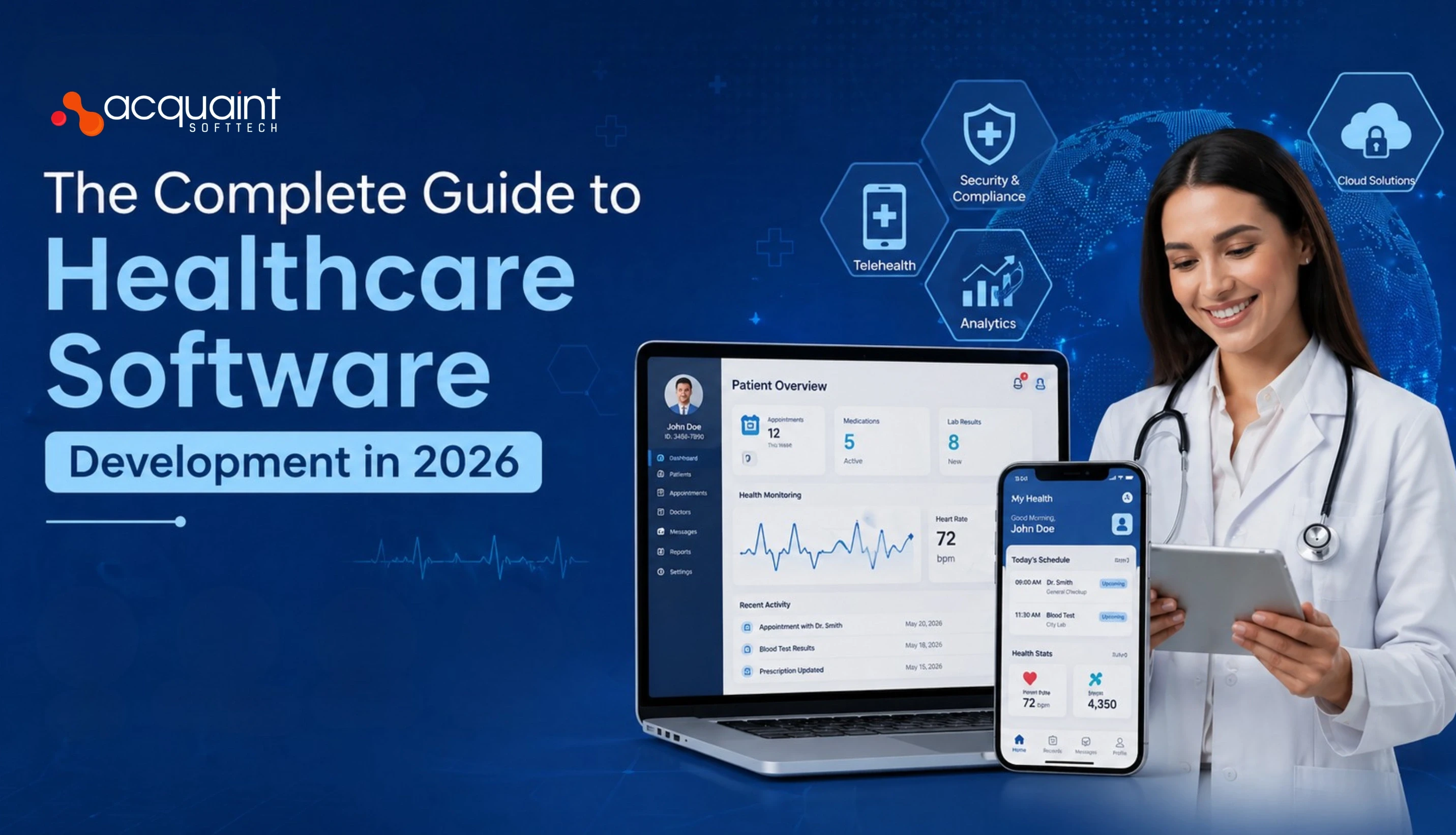
The Complete Guide to Healthcare Software Development in 2026
Healthcare software development in 2026 is not a single discipline. It is six distinct product categories, each with its own compliance perimeter, integration burden, and cost curve.

Acquaint Softtech
May 1, 2026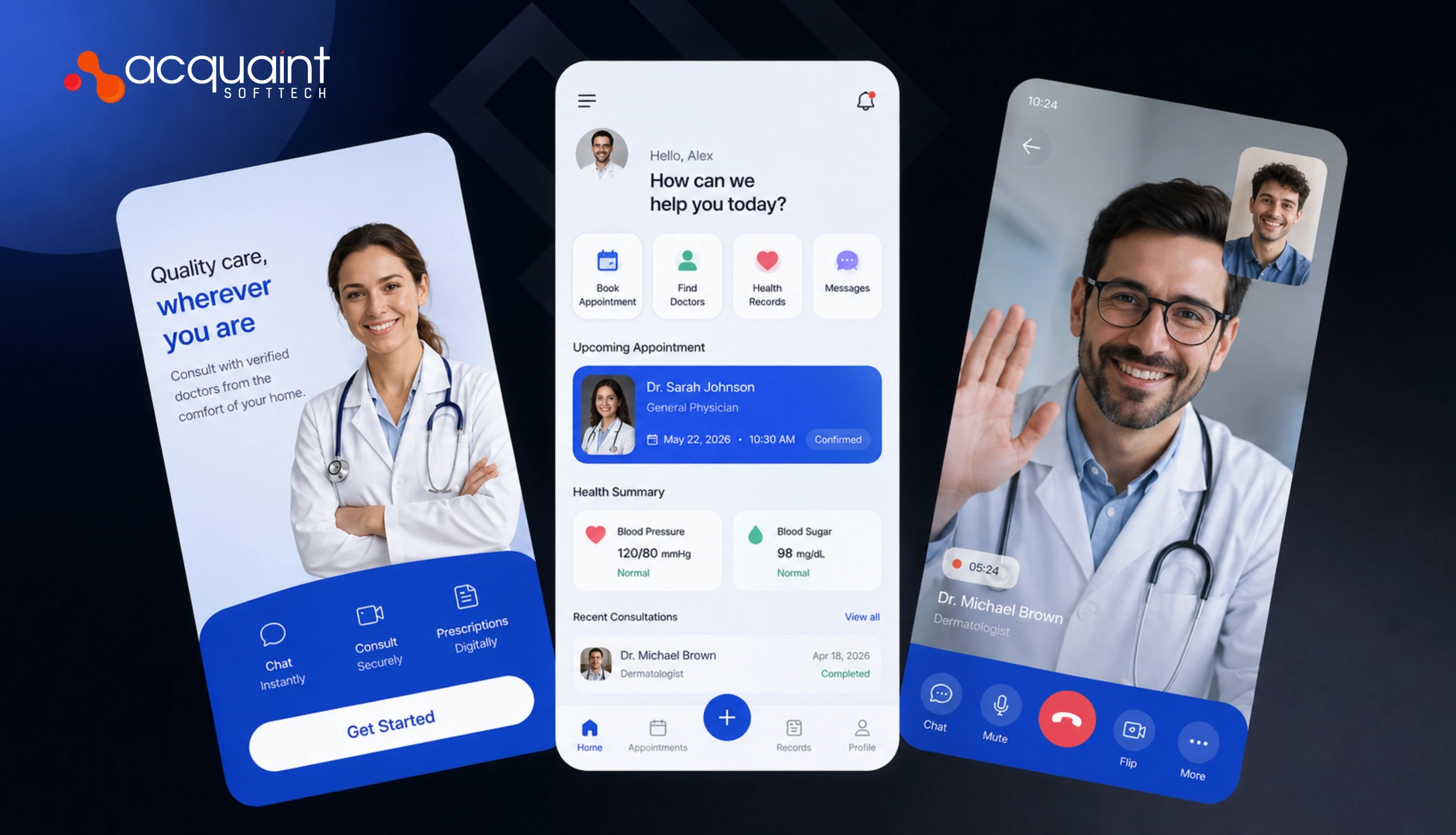
How Telemedicine Apps Work: Architecture, Data Flow, and System Design Explained
A telemedicine app is not a video call with a medical logo. It is a distributed system that moves protected health information between four environments in under 200 milliseconds while staying inside HIPAA boundaries. Here is exactly how it works, layer by layer, with the tech stack, the data flow, and the numbers that matter.
Manish Patel
May 8, 2026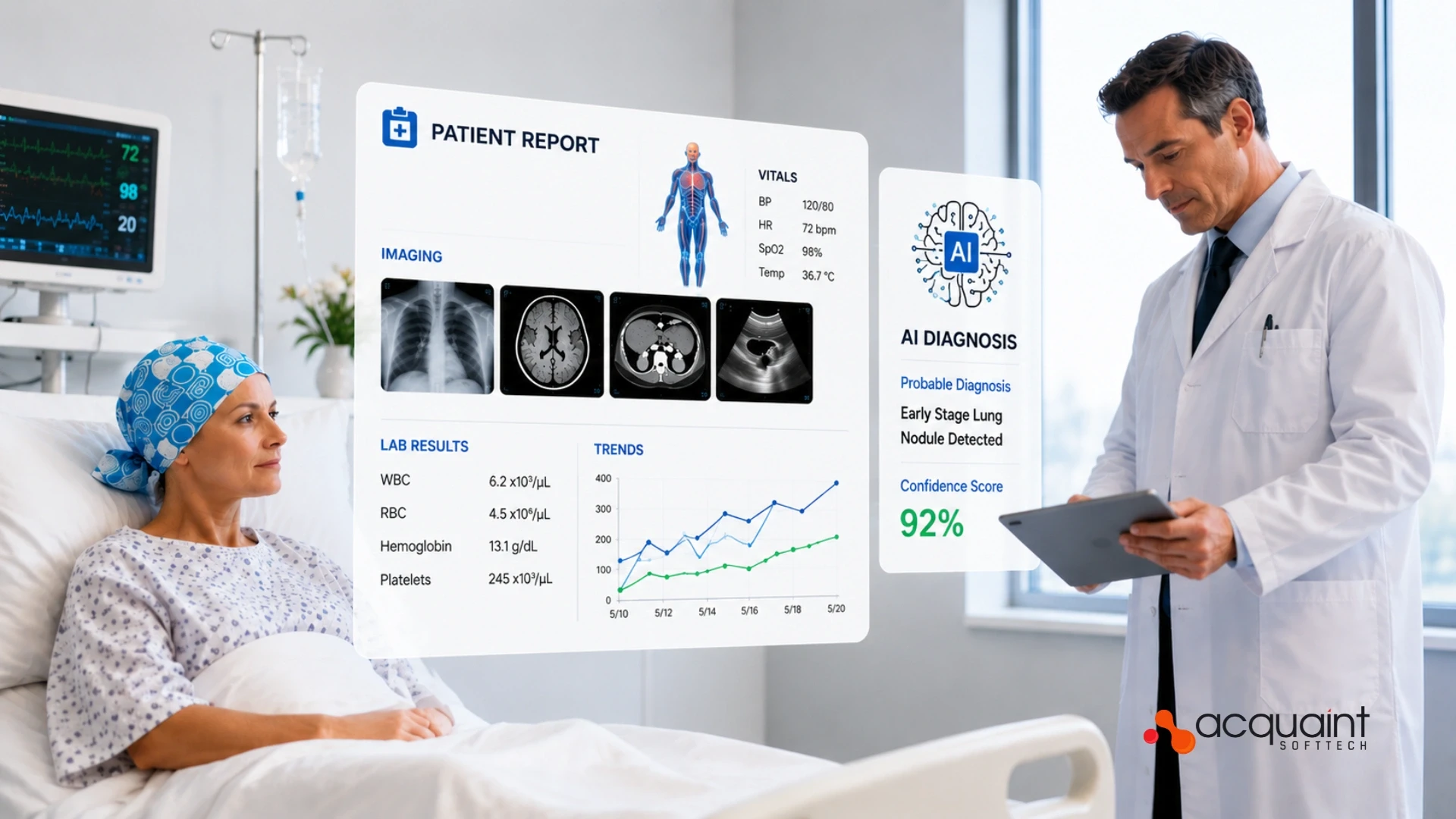
AI Diagnostic Tools: Building Medical Image Analysis Systems That Radiologists Trust
AI medical image analysis development is the engineering of deep learning systems that interpret X-rays, CT scans, MRI, and pathology slides to detect disease and support clinical decisions. In the USA, every system influencing clinical decisions requires FDA SaMD classification.

Sanjay Prajapati
June 5, 2026India (Head Office)
203/204, Shapath-II, Near Silver Leaf Hotel, Opp. Rajpath Club, SG Highway, Ahmedabad-380054, Gujarat
USA
7838 Camino Cielo St, Highland, CA 92346
UK
The Powerhouse, 21 Woodthorpe Road, Ashford, England, TW15 2RP
New Zealand
42 Exler Place, Avondale, Auckland 0600, New Zealand
Canada
141 Skyview Bay NE , Calgary, Alberta, T3N 2K6