

How to Build a BNPL Platform: Credit Engine, Installment Engine, and Merchant Integration
To build a BNPL platform, connect three systems: a credit engine that approves shoppers in about two seconds, an installment engine that schedules and auto-collects repayments, and a merchant layer of consumer, merchant, and admin APIs. In 2026, a BNPL MVP costs roughly $40,000 to $150,000, takes 4 to 7 months, and must launch with UK FCA and EU CCD2 compliance built in, not bolted on.

Ahmed Ginani
What actually happens in the two seconds between a shopper tapping Pay in 4 and seeing Approved?
That single moment is the real product, and the reason most buy-now-pay-later builds go wrong is that founders ship the consumer app first and treat the credit, collection, and settlement engines as an afterthought.
A BNPL platform pays the merchant upfront and recovers the money from the shopper over the following weeks, so the systems that decide who to approve and how to collect are where the business is won or lost. Acquaint Softtech's software product development teams build those three systems as the product from day one for lending and payment clients across the USA, UK, Europe, and UAE.

- You are a fintech founder, lender, or retailer planning to launch a buy-now-pay-later product.
- You want to understand the credit, installment, and merchant systems behind a working BNPL platform.
- You need to know how real-time credit decisioning and affordability checks run at checkout.
- You are scoping the feature set, tech stack, cost, and timeline before briefing a development team.
- You need to map 2026 BNPL rules such as the UK FCA regime and EU CCD2 before you launch.
The stakes changed in 2026. BNPL is no longer an unregulated checkout option: in the UK it becomes a regulated credit product from 15 July 2026, with mandatory affordability checks, clear disclosures, and access to the Financial Ombudsman, as set out in the FCA guidance on regulating Buy Now Pay Later. A platform that treats those rules as a late add-on ends up re-architecting its most sensitive systems, which is exactly the failure this guide helps you avoid.
This is the BNPL-focused companion to the complete guide to fintech software development, the master reference that covers neobanks, lending, payments, and every fintech vertical in depth.
Acquaint Softtech has delivered 1,300+ software projects across 20+ industries in 13+ years, with a team of 70+ in-house engineers, and clients in the USA, UK, Europe, Australia, and New Zealand regularly deploy dedicated teams within 48 hours of a brief.
Why most BNPL platforms fail their first compliance review
Most BNPL platforms do not fail because the market is missing. They fail because the team built a polished consumer app, wired credit and collections in at the end, and then could not pass an affordability or disclosure review without tearing the core apart. The failure is building before designing for the regulated systems underneath.
The pattern is predictable. Scope is set from a feature wishlist instead of the credit and repayment logic that actually carries risk, and no one owns the compliance map until a regulator or a bank partner asks for it. A structured discovery workshop fixes this by producing a validated scope, a regulatory checklist, and a system map before a single sprint starts. That is the difference between a costed plan and an expensive guess.
This is getting harder in 2026, not easier, because affordability checks now have to run on real income data inside the decisioning flow rather than as a back-office step.
Founders without a full-time technical leader often add virtual CTO services to own the compliance-aware architecture, and the compliance patterns that keep a regulated build defensible are covered in this guide to Laravel 12 for SaaS and fintech apps.
Not sure your BNPL build will survive its first compliance review?
Skip the rebuild. Book a meeting with our team and we will pressure-test your product against the 2026 FCA and CCD2 rules, map the credit, installment, and merchant systems you actually need, and hand you a costed, phased scope you can act on.
What a BNPL platform is and how it makes money

A BNPL platform lets a shopper buy now and pay later in scheduled installments, usually interest-free, with an instant approval decision at checkout. It pays the merchant in full upfront and collects repayments from the shopper over weeks or months, carrying the credit risk in between. Revenue comes mainly from merchant fees, plus interest on longer plans, late fees, and partnership income.
Because the platform settles with the merchant instantly and recovers money later, the working capital and risk engineering matter as much as the front end. Teams that hire remote developers with lending experience build around collection risk, not just the checkout UI, and a dedicated project manager keeps the risk model, funding logic, and merchant terms scoped before a single sprint begins.
For merchants, BNPL is a conversion tool that raises basket sizes and checkout completion, which is why it spread so fast across e-commerce. Under the hood, the money movement depends on the same rails a card platform uses, so understanding the settlement path is essential before you design your fee model. The guide to how payment gateways work breaks down the authenticate, route, score, and settle pipeline that every BNPL transaction rides on.
Revenue stream | Source | Notes |
|---|---|---|
Merchant fees | Commission per sale | Main BNPL revenue |
Interest | Longer-term plans | Optional, regulated |
Late fees | Missed payments | Now scrutinised |
Partnerships | Data and referrals | Secondary stream |
How does a BNPL platform make money?
A BNPL platform earns mainly from merchant fees, a commission charged on each sale because BNPL lifts conversion and order value. It adds interest on longer installment plans, late-payment fees, and partnership or data revenue. The platform pays the merchant upfront and profits on the spread between those fees and its funding and default costs.
Split pay vs installment loans: choosing your BNPL product
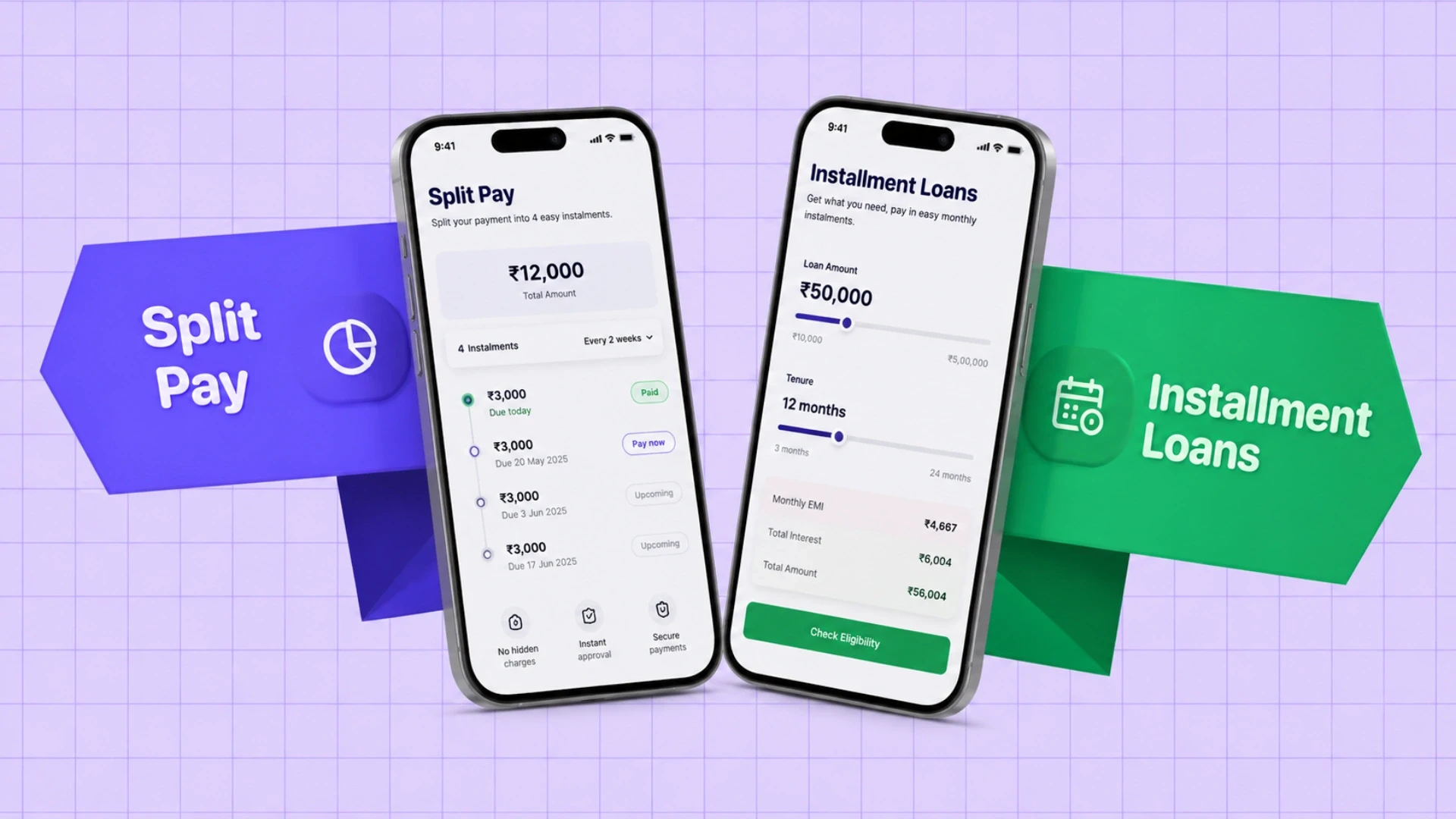
Before architecture, choose a product type, because it changes your credit logic, compliance load, and unit economics. Split payments, the classic pay-in-4, cover small-ticket items across four interest-free installments over about six weeks. Installment loans, for purchases over roughly $300, spread payment across six to 48 months and may charge interest.
The market is converging, with split-pay providers adding longer loans and lenders adding pay-in-4, so a configurable plan engine that supports both is the safer build. Offering a choice of plans measurably increases adoption, which is why the plan engine should be configurable rather than hard-coded. Acquaint Softtech's Laravel developers build the plan configuration and product logic that decides terms, tenure, and interest for either model.
Product choice also drives regulation, since longer interest-bearing loans attract heavier credit rules than short interest-free splits. The configurable plan and disclosure logic sits in the backend, so teams often hire Django developers for that Python-based service layer. The audit-logging and role-based patterns that keep a flexible plan engine maintainable are explained in this overview of why businesses choose Laravel for regulated products.
Type | Typical terms | Best for |
Split pay (pay-in-4) | 4 payments, ~6 weeks | Small-ticket, interest-free |
Installment loan | 6 to 48 months | Purchases over $300 |
Hybrid plan engine | Configurable both | Most 2026 launches |
What is the difference between pay-in-4 and BNPL installment loans?
Pay-in-4 splits a small purchase into four interest-free installments over about six weeks, usually with a soft credit check. BNPL installment loans cover larger purchases over roughly $300, spread payment across six to 48 months, and may charge interest with a fuller credit assessment. Most 2026 platforms support both through one configurable plan engine.
How the credit engine approves a shopper in two seconds
The credit engine decides, in about two seconds at checkout, whether to approve a shopper and on what terms. It pulls bureau data, analyses spending patterns, applies a risk-scoring model, and now runs an affordability check against real income data, all without breaking the checkout flow. A good engine keeps defaults low while keeping approval fast, because every second of delay costs conversion.
Modern engines blend a bureau score with alternative data and machine-learning models, and they feed fraud detection because BNPL is a frequent fraud target. Acquaint Softtech's Python developers build the decisioning and risk-scoring layer, while the model training, explainability, and drift monitoring are delivered through AI development services so every decline can produce a clear, compliant reason.
Speed and accuracy pull against each other, so the engine must be tuned to the product and market, and the affordability node has to be a first-class part of the pipeline rather than a manual step. The full architecture of a real-time scoring and decisioning stack, from feature store to sub-150ms inference, is documented in the guide to building a digital lending platform, which shares the same credit backbone a BNPL engine depends on.
Architecture insight
From July 2026, UK affordability checks must run against real income data inside the decisioning flow. Build the affordability check as a first-class node in the credit engine from day one, because bolting it on later means re-architecting the most latency-sensitive part of the platform.
How does a BNPL credit check work?
A BNPL credit check runs in about two seconds at checkout. The engine pulls bureau data, analyses spending patterns, applies a risk score, and, from 2026, runs an affordability check against real income data, then approves or declines without interrupting the purchase. Pay-in-4 often uses a soft check; longer installment loans use a fuller assessment.
How the installment engine schedules and collects repayments
Once a shopper is approved, the installment engine takes over. It generates the repayment schedule, stores the payment method, auto-collects each installment on its due date, sends reminders, applies penalties for missed payments, and reports to credit bureaus where required. This is the operational heart of BNPL, and one miscalculated schedule or failed collection hits revenue and compliance at once.
Flexibility drives both adoption and repayment success, so weekly, bi-weekly, and monthly options with clear due-date visibility reduce missed payments. The engine must handle retries, partial payments, refunds, and expired cards cleanly, which is where naive implementations break. Teams often hire MEAN stack developers to strengthen the ledger and recurring-collection logic that keeps cash flow predictable.
Credit-bureau reporting is expanding, so the engine must report repayment behaviour accurately, both to comply and to deter serial defaulters. Because collections run every day, the system needs reliable pipelines and monitoring, which is why ongoing support and maintenance services matter as much as the initial build. The compliance and audit-logging patterns behind a defensible repayment system are laid out in this guide to building a scalable fintech app with Laravel.
Function | What it does | Why it matters |
Schedule generation | Builds the plan | Accuracy and disclosure |
Auto-collection | Charges on due date | Cash flow |
Reminders and penalties | Reduces misses | Lower defaults |
Bureau reporting | Reports repayment | Compliance and risk |
How merchants plug in: consumer, merchant, and admin APIs
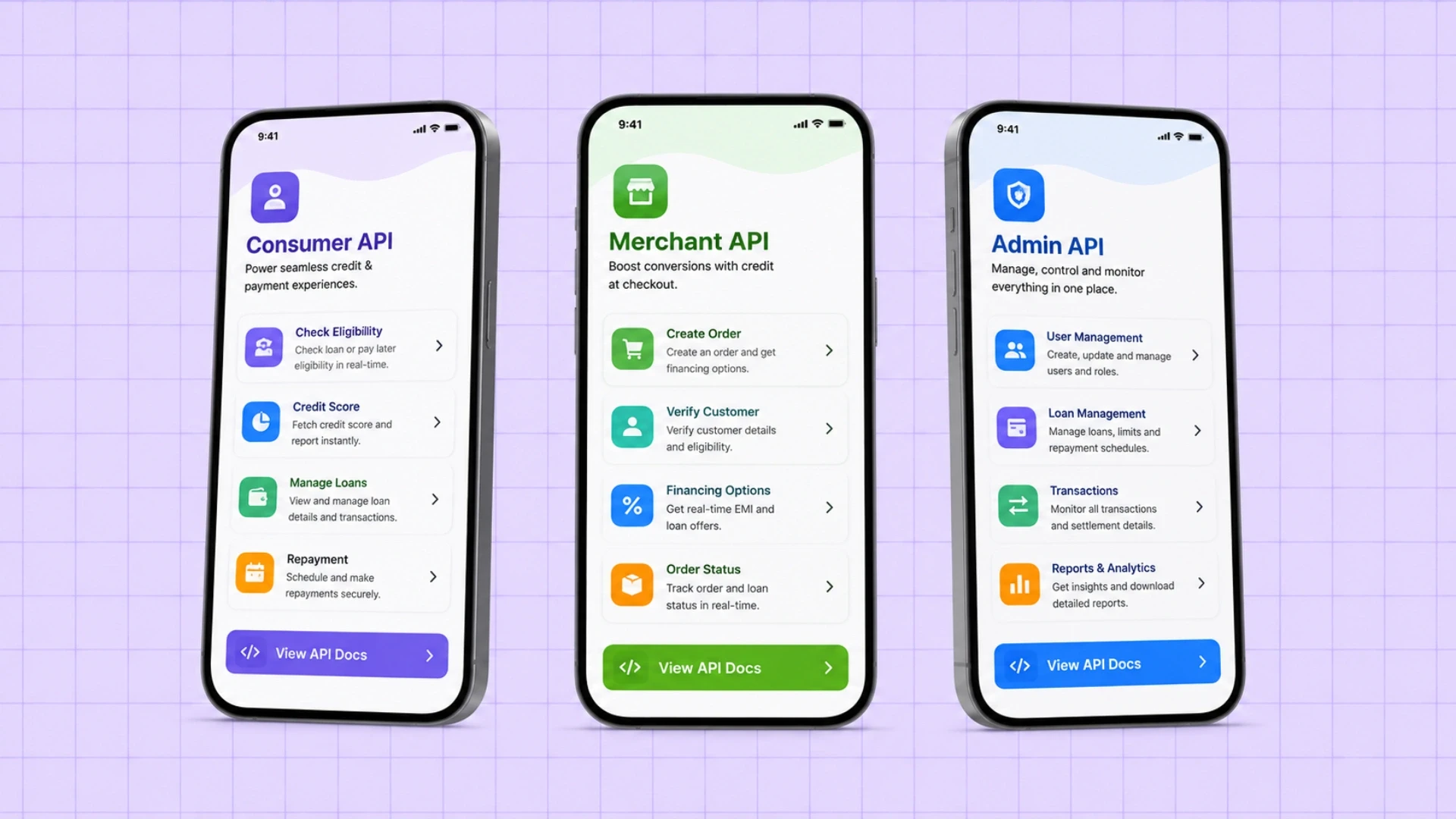
BNPL only works if merchants can offer it with almost no effort, so the integration layer is built from three API surfaces. The consumer API manages registration, credit checks, plans, and repayments; the merchant API lets retailers offer BNPL and see transactions in real time; and the admin API gives the platform control over permissions, fraud analysis, and reporting.
Integration must be effortless, with ready-made plugins for Shopify, Magento, and WooCommerce, a clean checkout SDK, and POS compatibility for in-store split payments. Acquaint Softtech's MERN stack developers build these three API layers as a modular architecture that supports rapid releases and third-party partnerships.
The smoother the integration, the faster the platform grows, because each merchant becomes a distribution channel. Embeddable checkout widgets and a mobile shopper app need a front-end team fluent in payment UX, which is why many builds hire React Native developers for the cross-platform layer. The component and API patterns behind this are covered in the complete MERN stack development guide.
How do merchants integrate BNPL into their store?
Merchants integrate BNPL through APIs and ready-made plugins for platforms like Shopify, Magento, and WooCommerce, or a custom checkout SDK, plus POS compatibility for in-store split payments. A well-built platform exposes a consumer API, a merchant API, and an admin API so retailers can switch BNPL on at checkout with minimal engineering effort.
BNPL compliance in 2026: FCA, CCD2, and the US patchwork
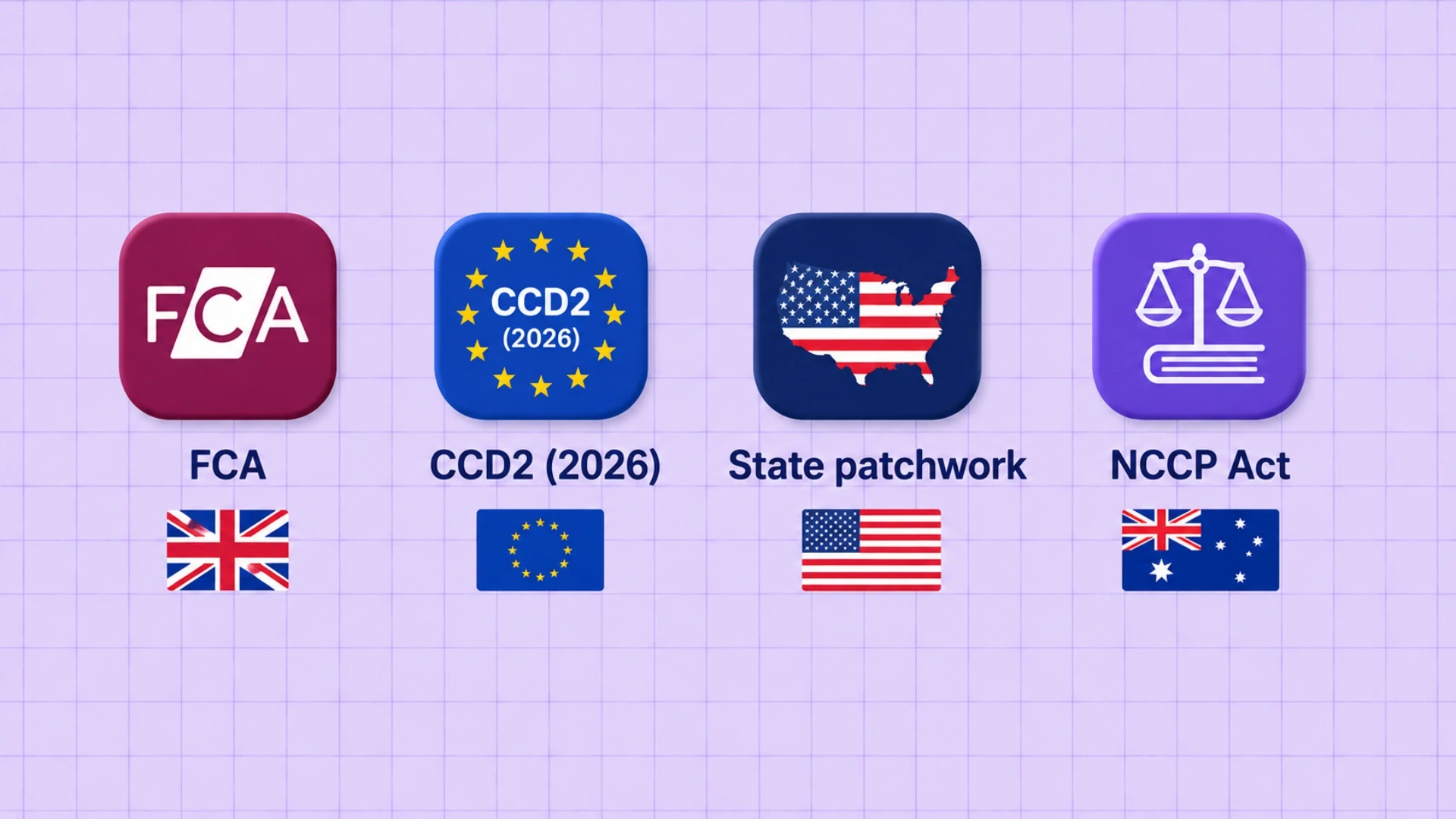
BNPL has moved from an unregulated checkout option to a regulated credit product, and compliance must be designed in from day one. The UK FCA regime takes effect on 15 July 2026 with authorisation, mandatory affordability checks, standard disclosures, credit-reference reporting, and Financial Ombudsman access. In the EU, the revised Consumer Credit Directive brings BNPL under regulated credit.
The US is the most fragmented: federal treatment shifted after the CFPB withdrew its 2024 interpretive rule, while states such as California and New York regulate BNPL as lending. The practical lesson is that regulatory change is permanent, so each new rule should be a targeted engineering change rather than a rewrite. Teams hire DevOps developers to build the audit-logging, disclosure, and reporting infrastructure these regimes require, with everything versioned and traceable.
As rules change, the platform will need frequent, controlled updates to disclosures and reporting, which is where version upgrade services keep the codebase current without regressions. The FCA has confirmed the shape of these protections, including affordability checks and complaints handling; the discipline this demands is exactly what verified clients highlight in this overview of Acquaint Softtech's Clutch recognition.
Region | Framework | Key requirement |
UK | FCA (from 15 Jul 2026) | Affordability, disclosures |
EU | CCD2 (2026) | Affordability, standard terms |
USA | State patchwork | Licensing varies by state |
Australia | NCCP Act | Credit license, AFCA |
Is BNPL regulated in 2026?
Yes, increasingly. The UK FCA regime starts on 15 July 2026 with authorisation, affordability checks, and standard disclosures, and the EU CCD2 brings BNPL under regulated credit. The US is fragmented, with several states regulating BNPL as lending, while Australia requires a credit license under the NCCP Act.
Treat compliance as a permanent engineering workflow. Build disclosures, audit logs, and reporting so each new rule is a change, not a rebuild.
What a BNPL platform costs and how long it takes to build
A BNPL MVP built on third-party credit and payment APIs typically costs $40,000 to $150,000 and takes 4 to 7 months. A full platform with proprietary scoring, multiple markets, and full FCA-grade compliance runs higher. Cost is driven by product type, the depth of the credit and fraud models, integrations, and compliance scope.
Build stage | Typical cost (India-based) | Timeline |
BNPL MVP (third-party APIs) | $40,000 to $90,000 | 4 to 6 months |
Full BNPL platform | $90,000 to $150,000 | 6 to 9 months |
Proprietary scoring, multi-market | $150,000 to $300,000+ | 9 to 15 months |
White-label BNPL | Lower upfront | Weeks |
The biggest cost lever is leaning on APIs instead of rebuilding commodities: rent credit checks, payments, and notifications, and build only your edge. Phased delivery, MVP first then integrations, controls spend, and lets you validate with real merchants before committing the full budget. Building from a Clutch-verified India-based team through software development outsourcing delivers Western-agency quality at up to 40 percent lower cost.
The most underestimated and permanent cost is regulatory maintenance, since each new FCA, CCD2, or state rule is an engineering sprint. To cut the upfront build cost further, a white label software development foundation can compress time-to-market while you keep the credit and installment logic custom, and the savings from this offshore, MVP-first approach are documented with real numbers in this story on how a startup saved $60K a year on remote hiring.
How much does it cost to build a BNPL platform?
A BNPL MVP typically costs $40,000 to $90,000 in India and $60,000 to $140,000 in Europe, and a full platform costs $90,000 to $150,000 in India.
Advanced platforms with proprietary scoring and multi-market compliance run $150,000 to $300,000 or more. India-based teams cut development cost by up to 40 percent versus US and UK agencies, at $25 to $49 per hour.
A BNPL MVP is $40,000 to $150,000 in 4 to 7 months. Budget per phase so you can pivot before spending the full amount.
Afraid a BNPL build will blow past budget? Get a fixed, phased quote first.
You should never sign a lump-sum BNPL contract. Tell us your product and get a transparent, phase-by-phase quote, plus a dedicated team at $25 to $49 per hour, so you can stop or pivot at any phase boundary and keep the code.
Case study: a UK fintech credit product built lean
The clearest proof of the design-the-systems-first path is a real founder-led build. This engagement, verified on Clutch, shows the model in action: start with the one credit-and-repayment workflow that matters most, ship it, then expand in phases instead of building everything at once.
Case study: SuperFi, a UK fintech credit and debt-management app
Problem
• Users needed one place to manage credit card debt and repayments, and the founder needed to validate the product before over-investing in a full build.
Challenge
• Pick a single core workflow to ship first, and build a credit-and-repayment product compliant with UK financial rules without an all-at-once platform that would stall.
Solution
• Built an MVP first around a minimalist single-page core workflow, then a full website and mobile app with credit card management, a debt-free calculator, credit-score guidance, and an admin panel.
Result
• Shipped and proved value early because the first release solved one real workflow, then layered on features once the core was validated, avoiding an expensive rebuild.
“They delivered our project on track to a high caliber of detail. Their communication is consistent with daily standups, and they have always been responsive to feature improvements or any feedback we have given them.” - Founder, SuperFi (UK)
What makes this instructive is the sequencing: ship the core workflow, prove it, then layer on the rest. For founders who want the same engineers from first release through scale, a dedicated team fits better than short-tenure contractors, and Acquaint Softtech's 24+ month average team tenure means the engineers who design your BNPL platform are the ones who refine it as you grow. The full delivery record is on the case studies page.
Build team options: outsource, augment, or dedicated team
Most BNPL founders cannot staff a full senior in-house team at the MVP stage, so the realistic choice is outsourcing the build, augmenting a small core team, or a hybrid. The right answer depends on whether you already have technical leadership and how fast you need to ship a compliant first release.
Model | Best for | What you get |
Outsourcing | Non-technical founders | A full managed team and delivery |
Staff augmentation | Founders with a tech lead | Vetted engineers added fast |
Dedicated team | Lean core scaling up | Same engineers through scale |
Outsourcing suits non-technical founders who need a whole team and managed delivery, and a full crew is available through software development outsourcing. Founders scaling a lean core toward a funded platform usually prefer dedicated software development teams because the engineers who learn your credit rules and merchant edge cases are the ones who should refine them as volume grows.
Whichever model you choose, keep control of scope, validation, and compliance rather than handing everything over, and value team stability over the lowest hourly rate.
Founders with a technical lead who only need to add specific skills fast use staff augmentation, with vetted engineers deployed within 48 hours. For how startups and enterprises structure these teams differently, this roundup of the top software development outsourcing companies breaks down the trade-offs.
Ready to turn your BNPL idea into a launched, compliant product?
You do not need a year and a full payroll to prove a BNPL product; you need the right first workflow, a credit engine designed for the FCA regime, and a team that ships. Book a meeting, hire your dedicated developers, and deploy your first engineer within 48 hours of the brief.
Frequently Asked Questions
-
How do you build a BNPL platform?
Build a BNPL platform with a credit engine, installment system, and merchant API. Launch an MVP first, then scale with compliance built in.
-
How much does it cost to build a BNPL platform?
A BNPL MVP typically costs $40,000–$150,000, while a full platform costs $90,000–$250,000. Development costs vary by features, compliance, and location.
-
How long does BNPL platform development take?
A BNPL MVP takes 4–6 months, while a full platform usually takes 6–9 months. Enterprise solutions may require 9–15 months.
-
How does a BNPL credit check work?
A BNPL credit check analyzes credit history, spending behavior, and affordability within seconds. It then approves or declines the transaction.
-
What is the best tech stack for a BNPL platform?
A common BNPL tech stack includes Laravel or Node.js, Python, PostgreSQL, and React Native or Flutter with API-first architecture.
-
Is BNPL regulated in 2026?
Yes. BNPL is regulated in many regions, with rules covering authorisation, affordability checks, and consumer disclosures.
-
How do I vet a BNPL development team?
Review the team's experience, verified client reviews, technical expertise, and long-term developer retention before hiring.
-
How does Acquaint Softtech build BNPL platforms?
Acquaint Softtech builds BNPL platforms through discovery, MVP development, agile sprints, and phased scaling, with optional CTO support.
I help agencies and founders scale their tech teams with the right developers at the right time. At Acquaint Softtech, I focus on building long term partnerships and making remote hiring simple, predictable, and results driven. My goal is straightforward to help businesses grow faster with reliable dedicated developers.
Table of Contents
Get Started with Acquaint Softtech
- 13+ Years Delivering Software Excellence
- 1300+ Projects Delivered With Precision
- Official Laravel & Laravel News Partner
- Official Statamic Partner
Related Blog
How to Build a Neo Bank: Licensing, Architecture, KYC AML, and Launch Roadmap
Building a neo-bank in 2026 starts with one decision that determines everything else: BaaS consumer or direct licence. This guide covers both paths, licensing, ledger design, KYC/AML, feature roadmap, tech stack, and real cost data.

Manish Patel
May 18, 2026
Clutch-Verified Laravel Case Studies by Acquaint Softtech
These laravel project case studies demonstrate how Acquaint Softtech modernized enterprise systems, strengthened fintech backends, optimized payment platforms, and built scalable real estate infrastructure with measurable impact.

Acquaint Softtech
March 3, 2026
Top 10 Software Product Engineering Companies in 2026
As businesses continue to shift toward digital-first strategies, partnering with a software product development company to build scalable and reliable software products has become essential for staying competitive. Companies across industries now rely on product engineering partners to accelerate innovation, shorten development cycles, and deliver high-quality digital experiences that meet evolving user expectations.
With increasing investments in cloud, AI, and platform modernization, demand for product engineering expertise is growing rapidly. Recent market insights indicate the global engineering services market is projected to surpass $1 trillion by 2030, highlighting the critical role engineering partners play in driving product innovation and long-term growth.

Zubair Pateljiwala
March 7, 2025India (Head Office)
203/204, Shapath-II, Near Silver Leaf Hotel, Opp. Rajpath Club, SG Highway, Ahmedabad-380054, Gujarat
USA
7838 Camino Cielo St, Highland, CA 92346
UK
The Powerhouse, 21 Woodthorpe Road, Ashford, England, TW15 2RP
New Zealand
42 Exler Place, Avondale, Auckland 0600, New Zealand
Canada
141 Skyview Bay NE , Calgary, Alberta, T3N 2K6