

How to Build a Home Services Marketplace App Like UrbanClap & TaskRabbit in 2026
A home services app is a three-sided marketplace that connects customers with vetted local professionals for cleaning, plumbing, beauty, and repairs in real time. Building one requires a customer booking app, a provider job-management app, and an admin panel sharing a backend with geofencing, slot scheduling, provider verification, and split payments.

Manish Patel

- You are building a home services marketplace like UrbanClap or TaskRabbit
- You need architecture tech stack and cost clarity before development
- Your existing platform is not scaling and needs senior engineering support
- You are comparing high cost Western agencies with more affordable alternatives
- You are considering dedicated teams or staff augmentation to speed up delivery
The concept sounds straightforward. The engineering behind it is not. A home services platform must manage real-time slot availability across dozens of service categories, match customers to providers within a geofenced radius, verify provider credentials before every job, and settle split payments automatically at completion. Every one of those functions requires a distinct system design decision.
Urban Company (formerly UrbanClap) and TaskRabbit proved the model at scale. Urban Company serves over 50 cities across India, the UAE, and Southeast Asia. TaskRabbit, owned by IKEA Group, operates across the USA, UK, Canada, France, Germany, and other European markets, connecting customers with Taskers for more than 100 task categories. The global online on-demand home services market grew from $5.92 billion in 2025 to $6.79 billion in 2026 at a 14.8% CAGR, according to The Business Research Company, with the market projected to reach $11.78 billion by 2030.
The growth is driven by rising urbanisation, dual-income households, and the normalisation of app-based booking for professional services. According to the International Telecommunication Union (ITU), approximately 6.0 billion people used the internet in 2025, representing 74% of the global population. That digital foundation is what makes home services marketplaces viable at city and national scale today in a way they simply were not a decade ago.
For founders deciding whether to build or adapt, Acquaint Softtech's software product development team begins every home services engagement with a platform-type mapping session to confirm which architecture fits the business before writing a single line of code.
This article is the sub-pillar for the complete guide to on-demand app development, the master reference for Uber-style platforms, marketplaces, and gig economy apps. Readers who want the broader on-demand ecosystem context should start there.
What Is a Home Services App?
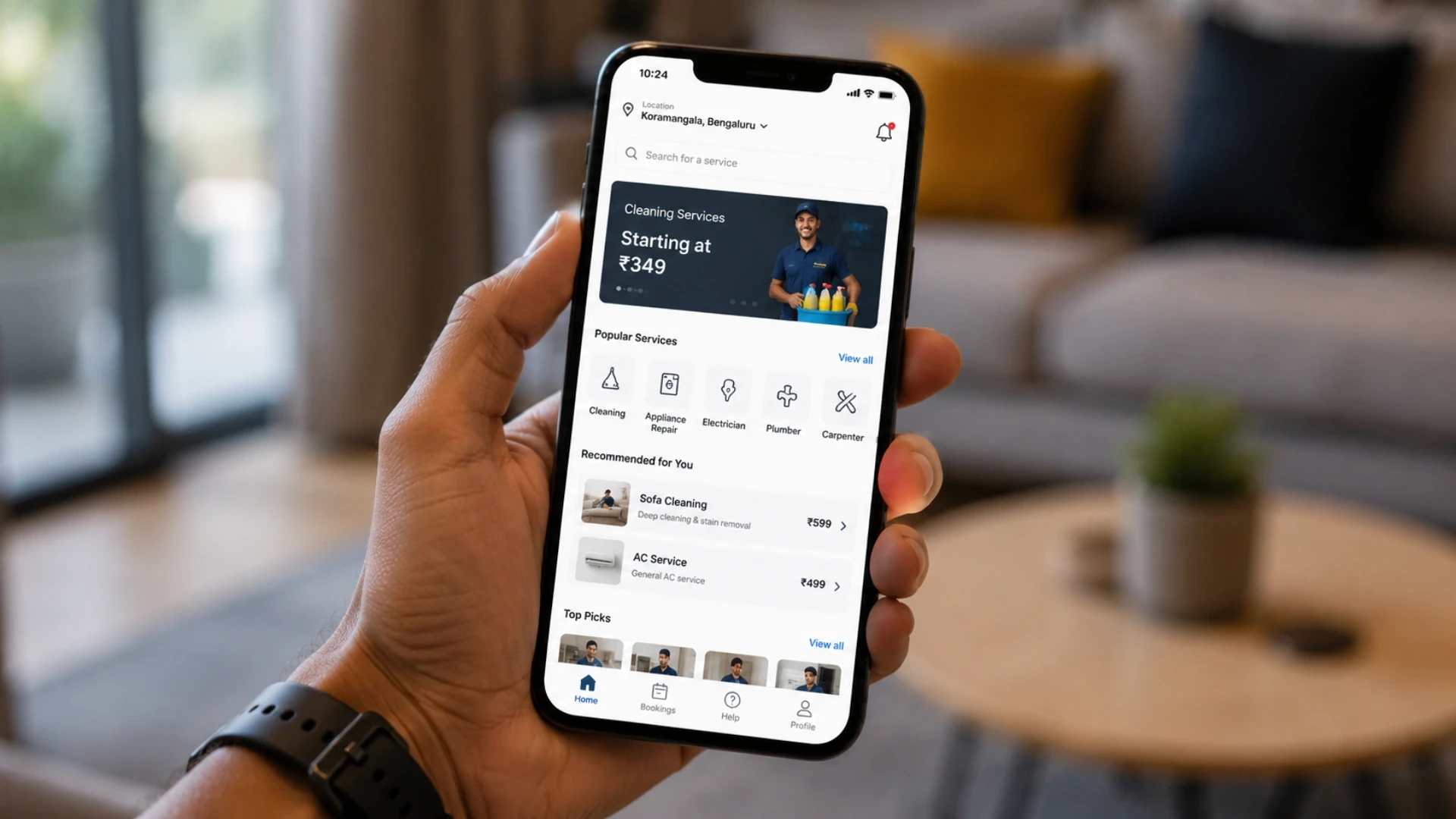
A home services app is an on-demand marketplace that connects customers with background-verified local professionals for household tasks. The platform manages slot booking, real-time provider tracking, payment processing, and service reviews inside a single three-sided system serving customers, providers, and the platform operator.
It typically works in a few simple steps:
Users browse and select the required service from different categories
Transparent pricing is shown upfront to avoid negotiation
A background-verified professional is assigned and scheduled
The service is tracked and completed at the user’s location
Secure cashless payment is made through the app after completion
Market Size and Opportunity in 2026
The market size and opportunity for home services platforms in 2026 is driven by three major shifts.
First, customer expectations have reset: users now expect live tracking, instant confirmation, and digital receipts for services that previously required a phone call and a two-day wait.
Second, AI-powered matching and scheduling are no longer expensive luxuries; they are accessible through well-priced APIs.
Third, the home services category remains highly fragmented in most European and Australian markets, creating genuine opportunity for regional platforms.
For a market-by-market overview of on-demand platform archetypes, Acquaint Softtech's published guide on on-demand home services app development provides geography-specific context for teams targeting specific regions. Teams that need to move quickly from market research to a validated specification can use Acquaint Softtech's discovery workshop services to complete platform scoping in five working days with engineering estimates attached.
UrbanClap vs TaskRabbit: Business Model Comparison
Understanding how the leading platforms generate revenue and manage supply determines what your architecture must support before you commit to a build. Urban Company and TaskRabbit operate on meaningfully different models, and those differences flow directly into feature requirements and engineering complexity.
Dimension | Urban Company (UrbanClap) | TaskRabbit |
Revenue | 15–25% commission per booking | Lead fee + service commission |
Supply Control | Fully managed, trained professionals | Peer-to-peer freelancers |
Pricing Model | Fixed platform pricing | Tasker-defined hourly rates |
Trust Layer | Background checks + training | Background checks + reviews |
Key Market | India, UAE, Southeast Asia | USA, UK, Canada, Europe |
Category Depth | 100+ service categories | 65+ task categories |
The Urban Company model gives the platform tighter quality control because it owns the service standard and sets the price. The trade-off is a heavier provider onboarding process and greater operational overhead per city launch. The TaskRabbit model scales faster because it relies on self-supply, but it requires a robust review and dispute system to maintain customer trust when service quality varies.
A third model, the lead-generation marketplace used by Thumbtack and Angi, is worth understanding even if you are not building it. Providers pay per quote rather than per booking in that model. For new platforms targeting the UK or European market, a hybrid of the Urban Company managed model with TaskRabbit-style flexible rates typically delivers the best early-stage traction. The MVP development services team at Acquaint Softtech helps founders validate the right model through a lean prototype before committing to full-scale architecture.
MERN stack developers are effective for building the dual-portal architecture both models require. Acquaint Softtech's MERN stack development team has delivered provider-facing portals for multiple home services platforms, including earnings dashboards, job management interfaces, and document verification flows.
For platforms that need a flexible backend handling multiple service categories, Laravel development services provide a battle-tested foundation. Laravel's queue system, Sanctum API authentication, and Cashier billing library together handle the booking, payment, and notification logic common to all home services marketplaces.
Not Sure Which Model Fits Your Market?
Acquaint Softtech's Discovery Workshop maps your target geography to the right platform architecture and revenue model in five working days. 1,300+ projects delivered. Teams deployable within 48 hours of brief.
Three-Sided Marketplace Architecture for Home Services
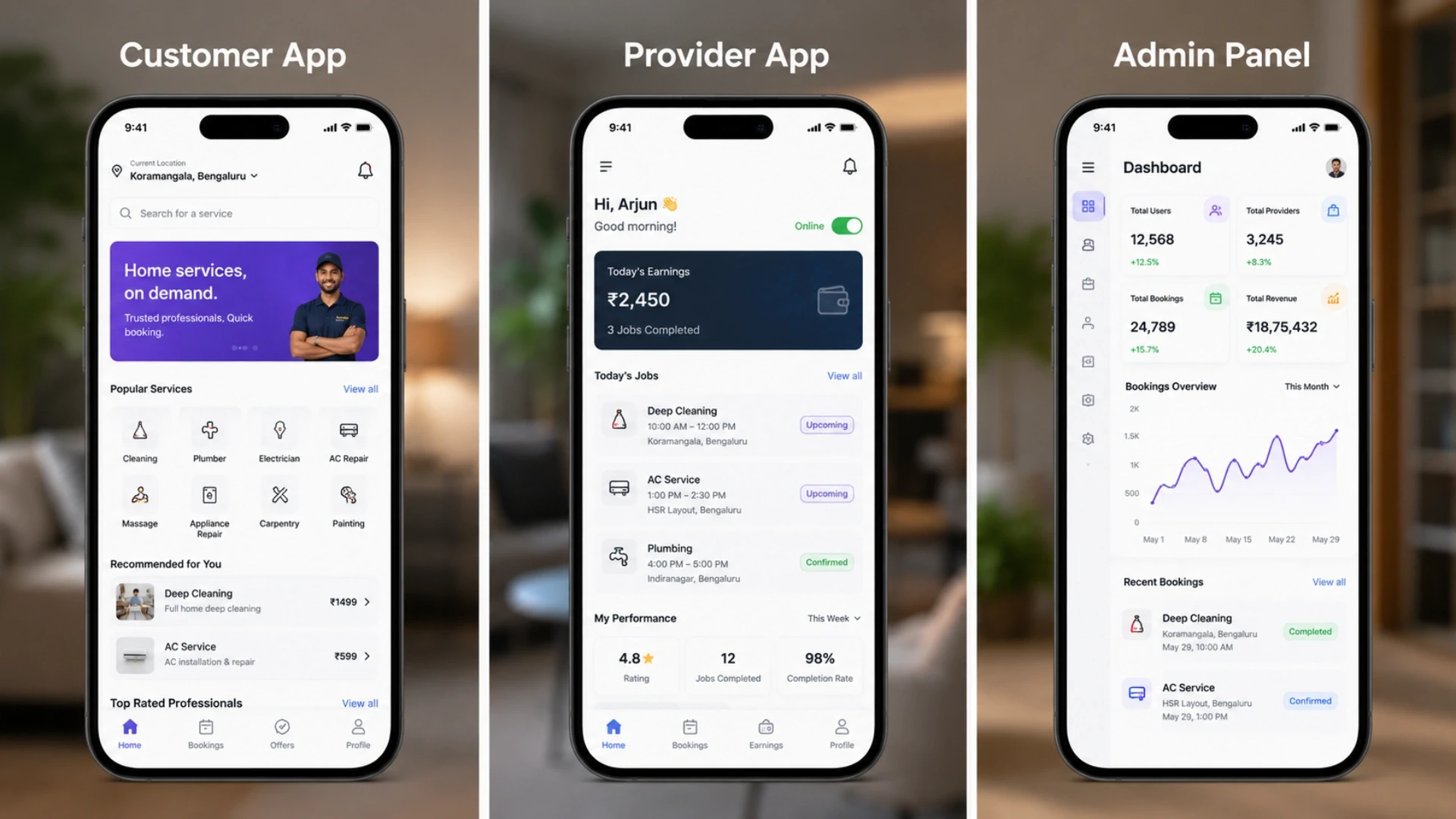
Every production-grade home services platform runs three distinct surfaces on a shared backend: a customer booking app, a provider job-management app, and an operator admin panel. The three surfaces serve entirely different workflows, permission levels, and real-time data requirements but read and write to the same core database.
Surface | Primary User | Core Responsibilities |
Customer App | Homeowner / Service Buyer | Browse, book slots, track provider, pay, review |
Provider App | Cleaner, Plumber, Technician | Accept jobs, navigate, manage earnings, update status |
Admin Panel | Platform Operator | Onboard providers, resolve disputes, set pricing, view analytics |
Geofencing and Service Radius Logic
Location logic is the most critical engineering component in any home services platform. When a customer books a cleaning service in a London postcode, the matching engine must query only providers within a configurable service radius, ranked by availability, rating, and distance. This requires PostGIS-enabled geospatial queries on the provider database, not a simple distance calculation. The standard implementation uses geohash partitioning to divide the city map into queryable cells, returning the nearest available, highest-rated provider in under two seconds at normal load.
Acquaint Softtech's Python development team has implemented geofencing and service-radius logic for multiple local services platforms across the UK, India, and Australia, using PostGIS with Redis caching to keep query latency below 800ms at peak. The same engineers build the AI-powered service provider matching layer for platforms that need ML-ranked results rather than distance-only dispatch.
Slot Scheduling vs Real-Time Dispatch
Home services platforms differ from ride-hailing in one critical way: the customer books a time slot in advance, not an immediate dispatch. This means the architecture must manage slot availability grids per provider, per service category, and per geography simultaneously. The slot management system must prevent double-booking across all channels, handle cancellations with provider notification logic, and support recurring bookings for services like weekly cleaning or monthly AC maintenance.
For platforms offering home services subscription plans, the recurring booking engine must integrate with the payment processor's subscription billing module, adding a separate service to the architecture. This subscription layer is what separates a basic booking app from a platform capable of generating predictable monthly recurring revenue from long-term customer relationships.
React Native is the correct mobile framework for this architecture. A single codebase serves both iOS and Android for the customer app and the provider app, reducing mobile development cost by 35 to 40% compared to native builds. Acquaint Softtech's React Native development team delivers both apps in the same sprint cycle, ensuring the booking state machine on the customer side stays in sync with job status on the provider side.
Core Features for a Home Services Marketplace
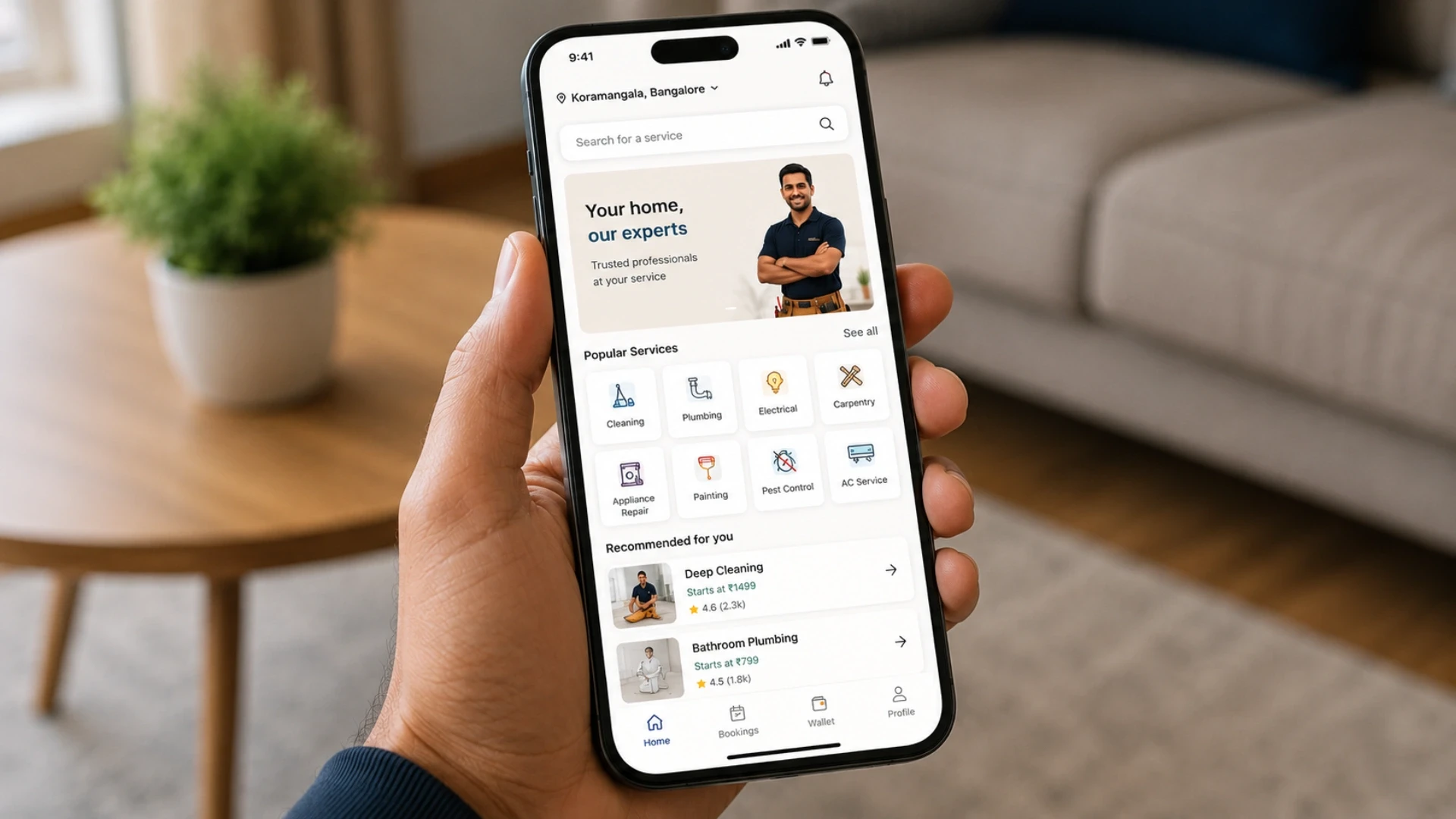
The features below are the structural minimum for a platform that can handle real customers, real disputes, and real provider churn. Omitting any of these in the name of launch speed creates technical debt that compounds with every new booking.
Customer App Features
1. Category browsing with service-type filters for cleaning, plumbing, electrical, beauty, and repairs
2. Provider profile preview with ratings, completed jobs count, and service specialisations
3. Slot booking calendar with real-time availability pulled from the provider schedule
4. Live provider tracking from confirmed booking through to job start
5. In-app chat between customer and provider with read receipts
6. Secure checkout with card, digital wallet, and cash-on-delivery options
7. Post-service review with structured prompts for quality, punctuality, and behaviour
8. Recurring booking scheduler for home cleaning app features and subscription-based service plans
Provider App Features
9. Job request notifications with configurable accept or decline timeout
10. Shift and slot availability manager: set working hours by day, category, and zone
11. Service provider earnings dashboard with daily, weekly, and monthly breakdowns plus tip tracking
12. Document upload for identity, background check, and trade certification
13. Navigation integration from confirmed booking location to customer address
14. In-app SOS and emergency reporting for safety-critical situations
15. Attendance and check-in system for cleaning services app architecture with recurring job management
Admin Panel Features
16. Real-time provider heatmap showing availability, active jobs, and idle time by zone
17. Provider onboarding queue with document review, background check status, and activation controls
18. Dispute resolution workflow with customer complaint intake, provider response, and escalation tiers
19. Dynamic pricing controls with base rates, surge multipliers, and promotional overrides by category
20. Home services subscription platform management for package creation, auto-renewal, and priority-queue routing
21. Revenue analytics covering GMV, commission earned, refund rate, and category-level performance
22. Promotional tools for coupon codes, referral tracking, and service-area expansion controls
For the payments layer, the platform must support split settlements: when a booking completes, the system routes the platform commission to the operator account and the remainder to the provider's registered bank or wallet. Acquaint Softtech's published analysis of the complete process of on-demand delivery app development covers the payment split architecture in detail, with decisions that apply directly to home services marketplaces.
Teams building nanny booking, babysitter, or childcare platforms require additional compliance logic for background checks and parental consent workflows. The white label software development model is particularly suited to founders who want to launch a branded home services platform across multiple cities without rebuilding the core for each deployment.
Platforms targeting enterprise clients or corporate facility management should also consider virtual CTO services during the architecture phase. An experienced CTO-as-a-service can validate the technical direction, de-risk the architecture decisions, and provide board-level technology reporting before the first line of production code is written.
Get a Feature Specification for Your Home Services Platform
Acquaint Softtech clients save up to 40% compared to Western agency rates. 95% on-time sprint delivery. 4.9/5 Clutch rating from 50+ verified reviews. Teams deployable in 48 hours. Book a scoping call and receive a detailed feature estimate within 48 hours.
Tech Stack for Home Services Apps in 2026
Technology choices for a home services platform are more standardised than they were five years ago. The combinations below balance developer availability, operational cost, and long-term maintainability for platforms targeting 10,000 to 500,000 monthly active users.
Layer | Recommended Technology | Why It Fits Home Services |
Mobile Apps | React Native | Single codebase saves 35 to 40% vs native for dual-app platforms |
Backend API | Node.js plus Python | Node for real-time, Python for ML matching and scheduling |
Database | PostgreSQL plus PostGIS | Native geospatial queries for radius and geofencing |
Cache and Sessions | Redis | Sub-second slot availability checks |
Real-Time Events | WebSockets plus Firebase | Live provider tracking and job status push notifications |
Payments | Stripe or Razorpay | Split-payment support and PCI DSS compliance |
Cloud | AWS or GCP | Auto-scaling and managed Kubernetes |
Background Checks | Checkr or IDfy API | Automated identity and criminal background verification |
The background check integration deserves special attention. Urban Company uses automated identity verification at onboarding and periodic re-verification for long-tenure providers. Platforms targeting the UK and Europe must comply with GDPR when storing identity documents. UK platforms serving regulated trade categories must verify Gas Safe or NICEIC certification. Acquaint Softtech's staff augmentation services can supplement a client's in-house team with compliance-specialist engineers for the verification layer without requiring a full dedicated team.
For platforms that need to scale quickly from city-level to national coverage, home services app scalability architecture must include horizontal scaling of the matching service, database read replicas for high-read query patterns, and a CDN layer for provider profile assets. Acquaint Softtech's DevOps engineering team handles containerisation, CI/CD pipelines, and cloud cost optimisation as a standalone engagement or as part of a full dedicated team.
For platforms requiring advanced data processing and machine learning for provider scoring or demand forecasting, Django developers provide strong Python-native backend options that pair well with PostgreSQL and Redis in the home services stack. Django REST Framework with Celery for background jobs handles the asynchronous task processing that recurring booking and provider re-verification workflows require.
"The biggest architecture mistake we see in home services platforms is treating slot scheduling as a simple calendar problem. It is not. You need a constraint-satisfaction engine that accounts for travel time between jobs, category-specific setup time, and real-time cancellations simultaneously. Getting that right in the first sprint saves weeks of rework later." - Manish Patel, CIO, Acquaint Softtech
Home Services App Development Cost in 2026
Home services app development cost is one of the most variable figures in software. A $15,000 MVP and a $150,000 full-platform build are both legitimate answers for different scopes. The table below maps scope to realistic budget ranges based on Acquaint Softtech's actual project economics.
Scope | Estimated Cost (India Team) | Timeline |
MVP: 1 category, 3-sided | $18,000 to $35,000 | 10 to 14 weeks |
Multi-category marketplace | $40,000 to $75,000 | 18 to 26 weeks |
AI matching plus subscription billing | $75,000 to $130,000 | 26 to 36 weeks |
Multi-city enterprise platform | $130,000 to $220,000+ | 36 to 52+ weeks |
Western agency rates for the same scope run 40 to 60% higher. A UK-based agency charging $130 to $150 per hour would price the multi-category build at $90,000 to $160,000. The quality difference is in the overhead structure, not the engineering output.
What Drives Cost Up in Home Services Specifically?
Provider verification integration adds 2 to 3 weeks and $3,000 to $6,000 to the base build, depending on which API is used and how many document types must be processed.
Slot scheduling across multiple service categories requires a custom availability engine. Off-the-shelf calendar libraries do not handle geofenced, category-scoped slot logic.
Trade certification verification for UK and European regulated categories, including gas, electrical, and structural work, requires manual review workflows in the admin panel.
Recurring booking and AMC subscription platform development adds a billing integration layer that is separate from standard per-booking payments.
Multi-language and multi-currency support for platforms targeting both India and Europe adds 10 to 15% to the base cost.
For a detailed comparison of cost factors across adjacent on-demand categories, Acquaint Softtech's published article on the cost to develop an on-demand courier services app provides per-feature cost ranges with tech-stack specifics that map directly to home services platforms. Platforms that want to reduce total cost without reducing scope should consider the dedicated software development team model. For home services platforms, where scope evolves with early user feedback, time-and-materials consistently produces better outcomes than fixed-price contracts.
Startups who need to validate the business model before committing to a full build should look at software development outsourcing combined with a lean MVP sprint. This approach lets the founding team test provider supply and customer demand in a single city before investing in multi-category or multi-city architecture.
Case Study: Field Services Platform for a Home Services Business
The following case study draws on a verified Acquaint Softtech client engagement. Full project details and additional outcomes are available at acquaintsoft.com/case-studies.
Case Study: Pest Control Operations Platform, USA (Verified Clutch Review)
Client: 1st Choice Pest Solutions, Eau Claire, Wisconsin
Challenge: The client needed a field operations mobile app covering technician scheduling, route management, digital service checklists, and customer communication, along with a customer-facing tracking experience.
Approach: A team of 6 to 10 engineers from Acquaint Softtech covered mobile app development, UX design, and IT staff augmentation. The engagement began with a discovery phase interviewing field technicians and customer support staff before any code was written.
Results: The platform transformed field operations and dispatch coordination. Every milestone was delivered on schedule, including a late-requested module added without disrupting the launch date. Clutch rating: 5.0/5 across quality, schedule, cost, and willingness to refer.
Architecture Relevance: This engagement uses the same three-sided architecture pattern as UrbanClap-style platforms: a provider-facing mobile app with job management and navigation, a customer-facing tracking experience, and a backend connecting field operations to the admin system. The decisions made here transfer directly to any home services marketplace build.
Acquaint Softtech understood the unique nature of field-service operations from day one. They asked smart questions about how our technicians work in the real world rather than building to a generic specification. That made the final product feel like it was built for us, not just for the category." - Mike Ness, Owner/CEO, 1st Choice Pest Solutions (Verified Clutch Review)
Acquaint Softtech is a Clutch Premier Verified company with a 4.9/5 rating from 50+ verified client reviews.
Why Acquaint Softtech for Home Services App Development
Choosing the right engineering partner is crucial because early decisions like scheduling, geofencing, and payments are hard to change later and define scalability. Acquaint Softtech has 13+ years of experience and 1,300+ projects building real on-demand platforms worldwide with proven architecture.
Second, team stability: the average team tenure across Acquaint Softtech engagements is 24+ months. For a platform that will evolve significantly in its first two years of operation, institutional knowledge of the codebase is a genuine competitive asset. Engagements that rotate engineers every six months lose that knowledge and pay for it in rework. The hire remote developers service provides pre-vetted senior engineers who integrate with the client workflow within 48 hours and stay for the duration of the build.
Third, speed: a dedicated team deploys within 48 hours of a signed brief. The first sprint review happens in two weeks. For founders racing to a market window, that timeline is materially faster than the four to eight week onboarding cycle typical of Western agencies. Acquaint Softtech's support and maintenance services also ensure the platform stays performant after launch without the client needing to build an internal DevOps team from day one.
For teams supplementing an existing engineering group, Acquaint Softtech's AI and ML engineers provide the specialist coverage needed for plumber and electrician booking app matching algorithms and demand-forecasting models. The automation engineers team handles the QA automation layer that keeps home services platforms stable as new service categories are added.
For food delivery and logistics platforms looking to expand into home services, Acquaint Softtech's experience delivering the on-demand food delivery app like Uber Eats and adjacent on-demand categories means the team can reuse tested architecture patterns rather than designing from scratch, saving 4 to 6 weeks on a standard home services build.
Ready to Build Your Home Services Platform?
Join 200+ technology companies that scaled with Acquaint Softtech. 1,300+ projects delivered. 4.9/5 Clutch rating. 50+ verified reviews. Teams deployable in 48 hours. The fastest path from idea to production-ready marketplace.
Frequently Asked Questions
-
How does Urban Company work?
Urban Company connects customers with trained, background-checked service professionals through a mobile app. Customers browse categories, choose a time slot, and pay a platform-set price. The platform handles matching, live tracking, and automatic payment settlement. Providers pay a commission of 15 to 25% per completed booking.
-
How to build a home services app?
Build a three-sided platform with a customer booking app, a provider job-management app, and an admin panel on a shared backend. Use React Native for mobile, Node.js and Python for backend services, PostgreSQL with PostGIS for geospatial matching, and Stripe or Razorpay for split payments. Start with a single service category MVP before expanding.
-
How much does an UrbanClap clone cost?
Home Services Platform Type
Estimated Cost
Single Category Home Services MVP
$18,000 to $35,000
Multi Category Platform with AI Matching & Subscriptions
$75,000 to $130,000
Western agencies typically charge around 40% more for a similar scope and feature set.
-
What is the architecture of home services apps?
Home services apps use a three-sided marketplace architecture. A shared backend serves a customer booking app, a provider job app, and an admin panel. Core components include a geofenced slot scheduling engine, a provider matching service, a payment split processor, a notification service, and a review and dispute system.
-
How do I verify service providers in a home services app?
Integrate an automated background check API at onboarding. Require identity document upload, trade certification proof, and face-match verification. Run periodic re-verification for active providers. Store all documents encrypted and GDPR-compliant for European deployments.
-
What features does a home services app need?
Core features include category-based service browsing, slot booking with real-time availability, live provider tracking, in-app chat, split-payment checkout, recurring booking for subscription services, a provider earnings dashboard, and an admin panel with dispute resolution and revenue analytics.
-
What is the best tech stack for home services apps in 2026?
React Native for mobile, Node.js plus Python for backend, PostgreSQL with PostGIS for geospatial data, Redis for caching, Stripe or Razorpay for payments, Checkr or IDfy for background checks, and AWS or GCP for cloud infrastructure.
I lead technology and client success at Acquaint Softtech with one goal in mind. Deliver work that feels personal, reliable, and worthy of long term trust. I stay close to both our clients and our developers to make sure every project moves with clarity, quality, and accountability.
Table of Contents
Get Started with Acquaint Softtech
- 13+ Years Delivering Software Excellence
- 1300+ Projects Delivered With Precision
- Official Laravel & Laravel News Partner
- Official Statamic Partner
Related Blog
.jpg "On-demand home service apps: A Complete Development Guide")
On-demand home service apps: A Complete Development Guide
Unveil the top features and trends driving the popularity of home service apps in today’s fast-paced world.

Mukesh Ram
August 22, 2024
From Concept to Launch - On-Demand Delivery App Development
Transform an idea into a successful on-demand delivery app with a well-defined process. Conceptualizing features, designing, developing, & launching the app, are all crucial.
Mukesh Ram
October 24, 2024.webp "How To Create an On-Demand Food Delivery App Like Uber Eats (2026 USA Guide)")
How To Create an On-Demand Food Delivery App Like Uber Eats (2026 USA Guide)
Building an app like Uber Eats means creating a multi-sided ecosystem of four interfaces: a customer app, a delivery driver app, a restaurant dashboard, and a central admin panel. A custom-coded MVP typically costs $75,000 to $120,000 (much less with no-code tools), and success depends on smart market positioning, core feature implementation, and US legal compliance. The proven path is to pick a niche, handle legal requirements, choose your build approach, ship a focused MVP, then test rigorously.
Mukesh Ram
October 16, 2019India (Head Office)
203/204, Shapath-II, Near Silver Leaf Hotel, Opp. Rajpath Club, SG Highway, Ahmedabad-380054, Gujarat
USA
7838 Camino Cielo St, Highland, CA 92346
UK
The Powerhouse, 21 Woodthorpe Road, Ashford, England, TW15 2RP
New Zealand
42 Exler Place, Avondale, Auckland 0600, New Zealand
Canada
141 Skyview Bay NE , Calgary, Alberta, T3N 2K6