

Building a SaaS With Node.js: Architecture Patterns That Actually Scale
A scalable Node.js SaaS architecture is an event-driven, multi-tenant backend that serves many customers from shared infrastructure. Node.js suits SaaS because its asynchronous, non-blocking model handles thousands of concurrent tenant connections with low overhead. The core decisions are the multi-tenant data model, how requests are routed to the right tenant, stateless services, a billing and auth layer, and background workers, sequenced so the system grows without a rebuild.

Manish Patel
As the Chief Information Officer at Acquaint Softtech, where I focus on product and platform engineering, I get one recurring question from founders: will this stack still hold up at 100,000 users. For a huge share of them the answer is Node.js, and the work usually starts with a hiring MERN Stack Developers who have shipped multi-tenant products before, not just single-instance apps.
Here is the honest framing. Node.js SaaS explained in one line: it is a multi-tenant subscription product built on Node's asynchronous, non-blocking runtime, which handles thousands of concurrent tenant connections with minimal resource overhead. Because a SaaS holds other companies' data, it must be built against a recognised baseline such as the NIST definition of cloud computing, which frames how multi-tenant services isolate and protect each tenant.

- You are choosing a stack for a new multi-tenant SaaS and Node.js is on the shortlist.
- You need a clear rule for tenant isolation, routing, billing and auth, not just theory.
- You want honest 2026 cost and timeline ranges before you commit a budget.
- You are a CEO, CTO, COO, founder or agency owner shipping a SaaS product.
This guide walks the whole build: the multi-tenant data model, tenant routing, the core auth and billing modules, the tech stack, scaling patterns, and what it all costs. It sits inside our wider SaaS product development guide, so you can branch into any related engineering topic from here.
Everything below reflects delivery experience. Acquaint Softtech has built Node.js platforms with real-time dashboards, event-driven workers and clean multi-tenant data models, and this guide strips the concept down to what actually has to be engineered rather than what a boilerplate landing page promises.
Node.js SaaS explained: what it is and why it scales
Node.js SaaS is a multi-tenant subscription application built on Node's event-driven runtime. What is Node.js SaaS in practice: one codebase that serves every customer's workload at once from shared infrastructure, using non-blocking I/O to keep thousands of concurrent connections cheap. That efficiency is why so much serious Software Product Development on JavaScript starts with Node rather than a heavier, thread-per-request stack.
Why Node.js wins for SaaS
The Node.js SaaS benefits come from concurrency and one language across the stack. A single event loop handles many tenants without a thread per request, front-end and back-end share JavaScript, and the package ecosystem covers almost every SaaS need. Teams that want this velocity without hiring permanently often use IT Staff Augmentation to add senior Node capacity for the build phase.
Node is also a durable bet. Node.js SaaS trends 2026 point to event-driven services, queue-backed background workers and stateless containers, a pattern that scales horizontally rather than churning every release. Owning that stack outright is a strategic choice, which is why our software dedicated teams treat a SaaS as a product to own, not a template to rent.
Multi-tenant data models: how to isolate customers
The most critical decision in a Node.js SaaS is how tenant data is isolated. This choice defines your Node.js SaaS architecture, your cost and your security posture, so make it deliberately in week one. There are three models on a spectrum from cheapest to most isolated.
Data strategy | How it works | Trade-off |
Shared database, shared schema | One database and table pool; every table has a tenant identifier column to filter data. | Cheapest and simple to migrate, but risk of data bleeding and noisy-neighbour effects. |
Shared database, separate schemas | One database, but each tenant gets a logical schema. | Better separation and per-tenant backup, but migrations must scale across many schemas. |
Separate databases | Each tenant gets a fully isolated database instance. | Highest security and no noisy neighbours, but expensive and high maintenance. |
Shared schema is the pragmatic default: one database, a tenant identifier on every row, and rigorous filtering on every query. It is cheap to run and easy to scale for most products. The catch is that one missing tenant filter is a data-leak incident, which is where seasoned Software Development Outsourcing partners earn their keep by enforcing isolation at the database engine, not just in code.
Separate databases give the strongest boundary and zero noisy-neighbour risk, at real cost and operational load. It is the right call for enterprise or regulated buyers, and the extra provisioning is why teams pair the build with proper hire DevOps Engineers so database creation, migrations and connection pooling stay automated and safe.
Tenant routing and the request lifecycle
Once you pick a data model, every incoming request has to be routed to the right tenant context. In Node.js this is done with dynamic middleware that identifies the tenant and attaches the correct database connection before any business logic runs. Get this wrong and multi-tenant isolation breaks before your code even executes.
How tenant identification works
The request flows from an API gateway or reverse proxy into your Express or NestJS app, through a tenant-context middleware, and then to the isolated tenant database. Identification usually happens by subdomain, such as customer.yourapp.com parsed from the host header, or by a tenant claim embedded securely inside a JSON Web Token sent with each request. This is core Node.js SaaS architecture and it is easy to get subtly wrong, which is where hire MEAN Stack Developers with real multi-tenant experience save weeks.
The tenant-context pattern in practice
Extract the tenant: middleware reads the subdomain or JWT claim on every request and rejects any request with no tenant identity.
Fetch or build the connection: a cached pool of tenant database connections is retrieved, or created once and reused, for fast lookups.
Attach and continue: the connection and tenant id are attached to the request object, then passed down the chain to controllers.
Caching those connection pools matters: rebuilding a database connection on every request wastes resources fast. Testing this routing and pooling logic under load is exactly the work hire Automation Engineers own, because a routing bug here is both a performance problem and a security one. Our published multi-tenant architecture guide goes deeper on the isolation choices underneath this.
Core modules: auth, billing, and background workers
A robust Node.js SaaS separates its operational modules cleanly, whether you run a modular monolith or microservices. These are the Node.js SaaS features every platform needs, and each maps to a proven part of the ecosystem.
Authentication, RBAC and billing
Authentication answers who the user is; authorization answers what they can do inside their tenant, and the two must never be conflated. Map user accounts to multiple workspaces or organisations, and enforce role-based access control middleware for admin, manager and viewer roles. A valid token for one tenant must never reach another tenant's data. Wiring this correctly is where hire Laravel Developers or Node specialist with SaaS experience prevents the most dangerous class of bugs.
Billing is the second load-bearing wall. Subscription webhooks, using Stripe or a similar processor, should instantly toggle tenant access based on account tier, seats or feature flags, so a failed payment or upgrade reflects in the product immediately. For platforms that layer AI features by plan, this is also where AI Development Services plug in, gating model access to the right subscription tier.
Background worker pools
Long-running jobs, report generation, video processing, bulk email, third-party syncs, must never block the main thread. Use a queue such as BullMQ backed by Redis to run these as background workers that scale independently of the API layer.
This event-driven separation keeps the user's request fast even when heavy work is happening, and keeping those dependencies current over time is why planned Version Upgrade Services matter as the platform grows.
Multi-tenancy and billing edge cases slowing you down?
Tenant routing, RBAC and subscription webhooks are easy to get subtly wrong and expensive to fix later. Our engineers can take a Node.js SaaS from prototype to production-ready without cutting corners.
The recommended Node.js SaaS tech stack
There is no single right stack, only the right fit for your team. The strongest Node.js SaaS architecture pairs a modular framework with a type-safe ORM and Redis-backed state. The table maps each layer to a proven choice and why it fits SaaS.
Layer | Strong choice | Why it fits SaaS |
Framework | NestJS, or Express / Fastify | NestJS gives modular structure and dependency injection; Express and Fastify suit lean, fast services. |
ORM | Prisma or Drizzle | Type-safe access and multi-tenant connection switching built in. |
State and queues | Redis | Distributed session cache, rate limiting, and a broker for background workers. |
Billing and auth | Stripe webhooks plus RBAC | Instant tier toggling and tenant-scoped role enforcement. |
Framework choice by team shape
NestJS is the enterprise default: modular, opinionated, with dependency injection and clean architectural patterns that keep a growing codebase sane. Express or Fastify suit small, highly performant services where you want minimal overhead. Choosing well early avoids a costly rewrite, which is why a Virtual CTO Services is worth having in the room before the framework is locked. A downloadable node js saas architecture pdf or a quick node js saas architecture tutorial will show the happy path, but production needs the isolation and scaling work covered here.
State belongs in Redis, never in application memory, so any request can land on any server instance. That statelessness is what makes horizontal scaling clean. For the frontend that consumes these APIs, a decoupled React app is common, and our React development companies guide covers how to choose the team that builds it while your Node services own the core.
Node.js SaaS cost, timeline and who builds it
Read Node.js SaaS development cost as a function of scope: how many isolation models, billing tiers and integrations you need. A focused shared-schema MVP is modest; a full multi-tier platform with dedicated enterprise databases costs more. The table gives honest 2026 ranges.
Scope | What it includes | Indicative year 1 |
Focused MVP | Shared-schema multi-tenancy, auth, one billing tier, basic UI | $18,000 to $45,000 |
Full platform | Enterprise isolation, multi-tier billing, workers, dashboards | $55,000 to $150,000+ |
Ongoing ops | Hosting, upgrades, monitoring, support | $2,000 to $9,000 / mo |
How long Node.js SaaS development takes
A focused MVP with shared-schema multi-tenancy, auth and one billing tier is typically a four to eight week build. A full platform with enterprise isolation, background workers and a decoupled frontend is more often three to five months. Location changes the maths too: a Node.js SaaS development company India, and the wider option to hire developers for Node.js SaaS offshore, can cut engineering spend by up to 40 percent without lowering quality. Our cost-saving software development tips show how to do that without piling up technical debt.
Who should build it
A custom Node.js SaaS solution still needs senior direction to make the right tenancy, billing and scaling trade-offs. Bring data-heavy or AI-adjacent work to specialists such as hire AI/ML Engineers when your platform layers analytics or model features on top of the core. If you are still choosing a partner, our roundup of MVP development companies is a useful reference for judging real SaaS delivery experience.
How Acquaint Softtech builds scalable Node.js platforms
Here is a real example rather than a hypothetical one. Astound Broadband, a large United States telecommunications provider, hired Acquaint Softtech to build a scalable backend and real-time operations platform that could evolve as the company expanded into new regions and services. It is the same multi-tenant, event-driven pattern this guide describes, applied at real operational scale.
Scaling requirement | What Acquaint Softtech built | Outcome |
Scalable backend that evolves | A backend engineered to add new regions and service offerings without a rebuild. | Platform grew with the business, not against it. |
Real-time operations | A support and dispatch system with live technician status and case tracking. | Fewer handoffs; faster ticket-to-dispatch. |
Reporting and visibility | A performance dashboard for service insights, workload and audit logs. | Leadership got real-time operational insight. |
Change without disruption | A late-stage photo-upload feature added mid-project. | Delivered on schedule, no timeline slip. |
The measurable shift was operational: support agents resolved issues with fewer handoffs, automated scheduling cut unnecessary technician travel, and the delay between ticket creation and dispatch dropped noticeably. That is what a well-architected Node-style backend delivers, throughput and clarity under real load, not just a working demo.
Delivery discipline is what turns an ambitious build into a shipped, trusted system. Assigning a dedicated hire Project Managers is how Acquaint Softtech sustains a 95 percent on-time sprint record across more than 1,300 projects, and long-term Support and Maintenance keeps a platform healthy as usage and tenant count climb.
Ready to build a Node.js SaaS that scales?
Guessing at tenancy, routing and scope is where SaaS builds go wrong. A short discovery turns this playbook into a concrete architecture, timeline and budget you can act on.
Frequently asked questions
-
Which architecture does Node.js use?
Node.js uses an event-driven, single-threaded, non-blocking I/O architecture built on an event loop. Instead of one thread per request, it processes many concurrent operations asynchronously, delegating heavy work to background workers. For SaaS, this maps naturally onto an event-driven, multi-tenant backend with queue-based workers and stateless services.
-
What is SaaS architecture?
SaaS architecture is the server-side design of a Software-as-a-Service application: how data is isolated per tenant, how requests are routed, how workloads are processed, and how it deploys. Its defining feature is multi-tenancy, serving every customer from shared infrastructure while keeping each tenant's data separate and secure.
-
Which is better, FastAPI or Node?
Neither is universally better. Node.js excels at real-time, event-driven SaaS with a single JavaScript stack across front and back end. FastAPI excels at Python-based, data and AI-heavy APIs with strong typing. Choose Node for JavaScript teams and real-time features; choose FastAPI when your core is Python and machine learning.
-
Is Node.js a backend or frontend?
Node.js is primarily a backend runtime. It runs JavaScript on the server to handle APIs, business logic, authentication and database access. It also powers frontend build tooling, but in a SaaS its core role is server-side, where multi-tenancy, billing and scaling live. Frontends like React consume its APIs.
-
How much does Node.js SaaS cost to build?
A focused Node.js SaaS MVP with shared-schema multi-tenancy, authentication and one billing tier typically costs about $18,000 to $45,000. A full platform with enterprise isolation, background workers and multi-tier billing usually runs $55,000 to $150,000 or more in year one, plus hosting. Building offshore can cut these figures by up to 40 percent.
-
What features does Node.js SaaS need?
Every Node.js SaaS needs a multi-tenant data model, tenant routing middleware, authentication with tenant-scoped RBAC, subscription billing via webhooks, and background worker pools for heavy jobs. Redis handles caching and queues, a type-safe ORM manages data access, and stateless services make horizontal scaling clean.
-
How long does Node.js SaaS development take?
A focused MVP with shared-schema multi-tenancy, auth and one billing tier is typically a four to eight week build. A full platform with enterprise isolation, event-driven workers and a decoupled frontend is more often three to five months. Timeline depends on how many isolation models, tiers and integrations you need.
-
What tech stack is best for Node.js SaaS?
A strong Node.js SaaS stack is NestJS for structure, or Express and Fastify for lean services, with Prisma or Drizzle as the ORM, PostgreSQL for data, Redis for caching and queues, BullMQ for background workers, and Stripe webhooks with RBAC for billing and access. Choose what your team can maintain long term.
I lead technology and client success at Acquaint Softtech with one goal in mind. Deliver work that feels personal, reliable, and worthy of long term trust. I stay close to both our clients and our developers to make sure every project moves with clarity, quality, and accountability.
Table of Contents
Get Started with Acquaint Softtech
- 13+ Years Delivering Software Excellence
- 1300+ Projects Delivered With Precision
- Official Laravel & Laravel News Partner
- Official Statamic Partner
Related Blog
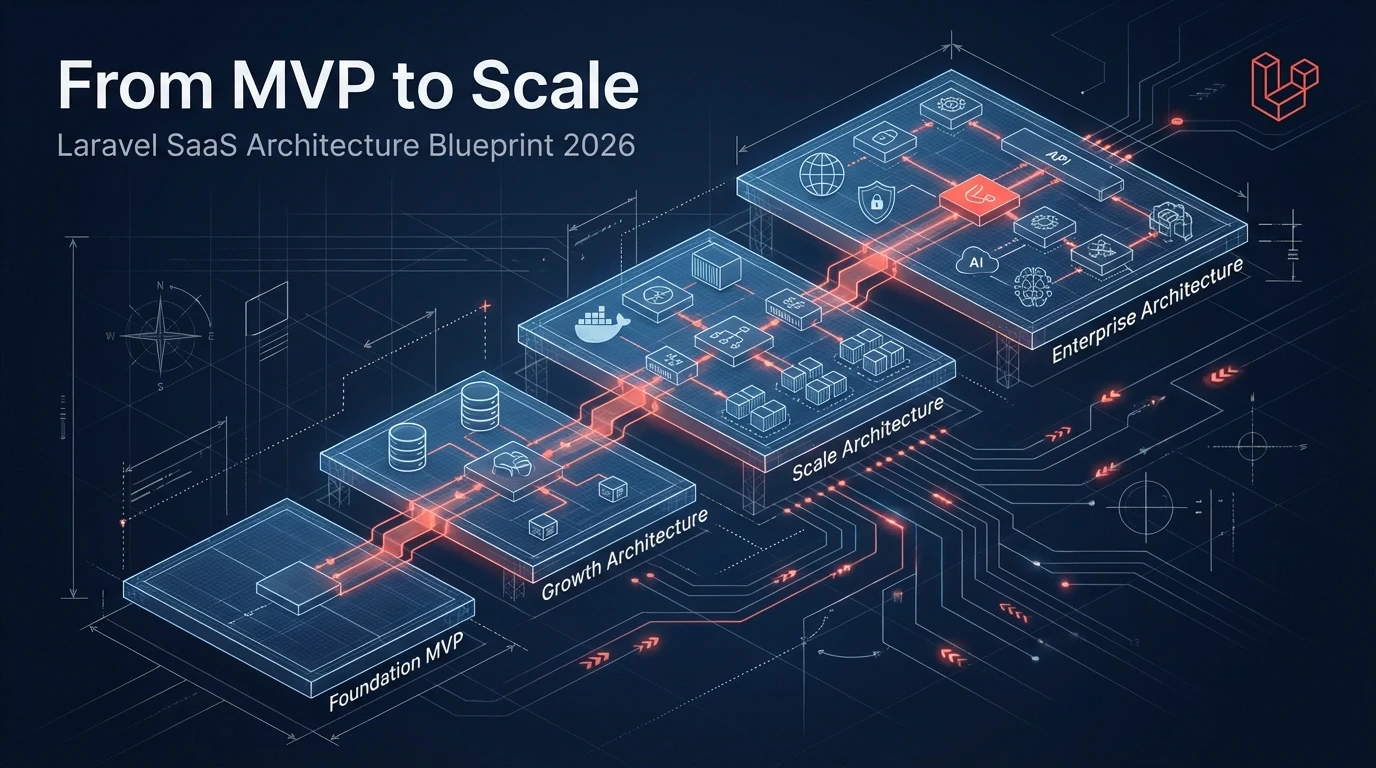
From MVP to Scale: The Laravel SaaS Architecture Blueprint for 2026
From MVP to 100K users, the architecture decisions that felt small at month one become expensive at month twelve. Here is the Laravel SaaS blueprint we use across 200+ Laravel projects.

Acquaint Softtech
March 10, 2026
Node.js - What makes it the best for IoT development?
Leverage Node.js for IoT projects to benefit from its event-driven architecture, ensuring efficient and scalable solutions in modern applications.

Mukesh Ram
August 20, 2024
PHP vs Python vs Node.js for SaaS in 2026: The Stack Decision You Make Before You Hire
The stack debate in 2026 is not about which framework is technically superior. It is about talent depth, hiring cost, and ecosystem maturity against your runway. Here is the real comparison.

Chirag Daxini
April 15, 2026India (Head Office)
203/204, Shapath-II, Near Silver Leaf Hotel, Opp. Rajpath Club, SG Highway, Ahmedabad-380054, Gujarat
USA
7838 Camino Cielo St, Highland, CA 92346
UK
The Powerhouse, 21 Woodthorpe Road, Ashford, England, TW15 2RP
New Zealand
42 Exler Place, Avondale, Auckland 0600, New Zealand
Canada
141 Skyview Bay NE , Calgary, Alberta, T3N 2K6