

How to Build a Logistics Tech Startup: From Idea Validation to MVP and Beyond
To build a logistics tech startup, validate the idea with real users first, scope a lean MVP around one painful workflow, pick a scalable stack, and launch in 3 to 6 months before spending on extras. A focused MVP costs roughly $40,000 to $60,000 and survives far better than a year-long build that nobody asked for.

Chirag Daxini
Why do so many logistics startups raise a round, build for a year, and then launch to complete silence?
As a Technical Project Manager at Acquaint Softtech, a software product development partner, I have watched the same painful pattern repeat with founders across the USA, UK, and Europe. The idea felt so obvious that validation got skipped, and the build began before a single real user confirmed they would pay. Learning how to build a logistics tech startup the lean way starts with one discipline: prove demand before you write production code, not after.

- You are a technical or non-technical founder with a logistics idea and want to validate it before you build.
- You are a CTO or COO scaling a delivery, freight, warehouse, or fleet product and need a clear path from concept to MVP.
- You have been quoted six figures by a Western agency and want the same quality at a lower, phased cost.
- You are targeting the USA, UK, Europe, UAE, India, or a fast-growing emerging market.
- You need to know what to build first, what to skip, and what a real MVP will cost.
- You want to launch fast without an expensive rebuild the moment you start scaling.
That mistake is expensive, because every week spent building the wrong product burns runway you cannot get back. Around 42 percent of startups fail because there is no real market need, yet demand for logistics software keeps climbing: the US Bureau of Labor Statistics reports the transportation and warehousing sector employed 6.6 million people in June 2024, about 5 percent of all private-sector jobs. The opportunity is real, but so is the risk of building for a market you have not tested. Teams that ship an MVP inside 90 days validate demand faster, cut risk, and pivot before costs spiral.
This article gives you the full path in the order that works: validate the idea, pick the niche, scope the right MVP, choose a stack, launch in months, then grow toward funding and scale. It is the startup-focused companion to the guide to logistics and Supply Chain Software Development, the pillar that covers WMS, TMS, OMS, fleet, and last-mile builds in depth.
Why most logistics startups fail before they launch
Most logistics startups do not fail because the market is missing or a competitor moved faster. They fail because the founder spent a seed round building a polished, feature-heavy platform that almost nobody actually needed, and ran out of money before learning that. The core problem is building before validating.
The pattern is predictable. Scope is set from a feature wishlist instead of a proven workflow, integrations are bolted on at the end instead of designed in, and the team is planned as engineers only, with no operations lead. Across 1,300+ delivered projects, the logistics founders who reach us most often have already lost months trying to build everything at once. The fix is to treat the first release as an experiment and bring in a product engineering partner that ships the smallest thing that proves the idea first.
This is getting harder in 2026, not easier, because customer expectations have risen while budgets have not. Same-day and next-day delivery are now baseline, warehouse labour is under wage pressure, and at least one AI feature is expected in most logistics products. For a full picture of how these forces reshape build decisions, the last-mile delivery software guide breaks down dispatch, routing, and tracking in depth. The founders who win validate first and build lean, which is exactly where the next section starts.
Not sure your logistics idea is worth building yet? Book a call and validate it first.
Skip the year-long build and the wasted seed round. Book a meeting with our team and we will pressure-test your idea, map the one workflow worth building first, and hand you a cost MVP scope you can act on. Say yes and your first dedicated developer deploys within 48 hours.
How to validate a logistics startup idea before building

You validate a logistics startup idea by confirming, with real prospective users, that a specific painful workflow exists and that they will pay to fix it, all before you write production code. Validation is interviews, a landing page, a clickable prototype, and pre-orders or letters of intent, not a finished product.
The discipline is simple: talk to 50 or more potential users and define the core value in one or two sentences before building anything. Test willingness to pay early, because that is the strongest signal you can get. A structured discovery workshop compresses this into a few focused weeks and produces a validated scope, so the work starts with the real problem instead of a feature list.
How long does it take to validate a logistics idea?
Validation usually takes two to six weeks, far less than the months lost building the wrong thing. Run user interviews in week one, stand up a landing page and prototype in weeks two and three, then chase letters of intent.
Founders who want a technical partner to build that prototype fast often hire MERN stack developers for the job. For how validated MVPs turn into launched products, the on-demand app development guide walks through the same lean sequence for real-time platforms.
How to choose your logistics niche and business model
Choose a logistics niche where you have an unfair advantage, a pain you understand deeply, and a clear path to your first customers. Logistics is broad, so winners pick one wedge and own it before expanding. The revenue model you choose shapes everything that follows.
Common wedges each map to a focused build, and each carries its own economics. A delivery management system suits fast urban and grocery delivery, while a crowd-sourced network like Lalamove or Uber Freight suits a marketplace play. Pricing is its own decision, so weigh per-shipment, per-user, and usage-based SaaS models against marketplace commission and transaction fees. A clear model is what turns interest into a fundable pitch.
Locking the wedge and model early is where software development outsourcing earns its keep, because a partner that has shipped these builds spots the dead ends before you fund them. Founders scaling a specialised operation such as fleet or telematics can study how those platforms are structured in the fleet management systems guide before deciding where their wedge sits. The model decides your payment architecture, your pricing page, and your investor story.
Which logistics niche is easiest to start with?
The easiest niche is the one where you already have distribution or domain access, not the largest market on paper. A founder with grocery relationships should start with quick-commerce delivery; a founder from freight should start with a carrier tool. To move fast on whichever wedge you pick, many founders hire dedicated teams who stay with the platform as it grows.
What to build first: the logistics MVP feature set
A logistics MVP should solve one core workflow end to end, not many workflows partially. For most platforms that means real-time tracking, a driver or operator app, a dispatcher dashboard, and basic order management, and nothing else until those prove out. Successful startups launch with 3 to 5 core features, not 20.
The hard part is resisting the nice-to-haves, because over-featuring is the top cause of blown scope and timelines. Decide deliberately what to skip, and put the MVP feature set on paper before any sprint begins.
Layer in advanced capability only after validation, guided by strong UI and UX for the three distinct users a logistics product serves. A focused build engagement ships that first release in a few months, run in two-week sprints so you see progress every fortnight, with each sprint reviewed against the validated scope.
What features should a logistics MVP include?
A logistics MVP needs four things: live tracking, an operator or driver app, a dispatcher dashboard, and basic order management. Everything else, from route optimization to a customer portal, is a phase-two decision. Teams that need offline-capable driver apps often hire React Native developers for the mobile layer, and the last-mile delivery software guide shows how those modules connect in production.
How to choose the right tech stack for a logistics platform
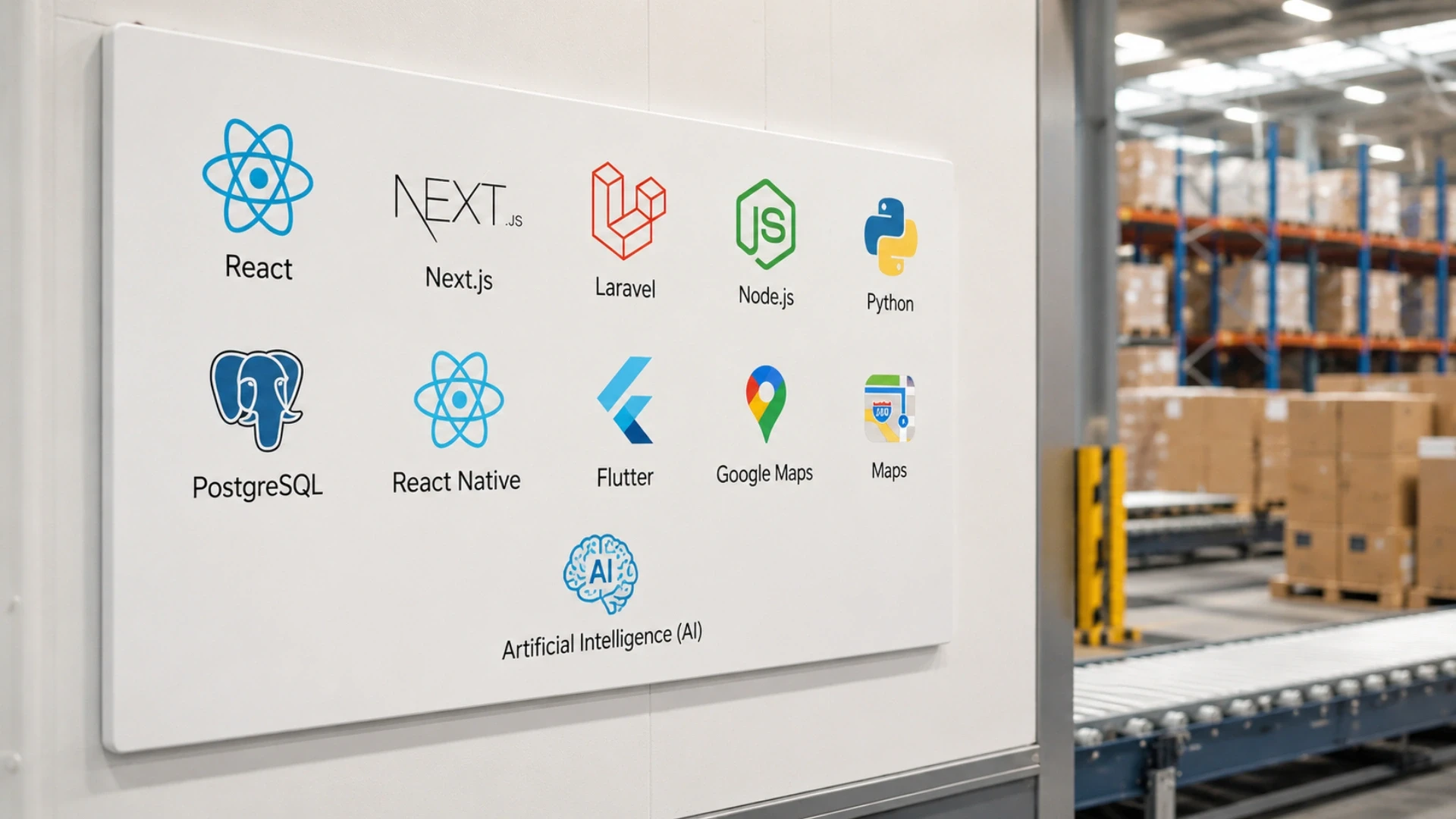
The right tech stack for a logistics startup is a boring, well-supported one with a large talent pool, chosen for the next two years rather than the next decade. In 2026, that commonly means a React or Next.js frontend, a Laravel, Node, or Python backend, PostgreSQL, and React Native or Flutter for mobile, on cloud infrastructure that scales without a rebuild.
Avoid trendy or niche technology that is hard to hire for, since a stack you cannot staff will stall your roadmap. Make the build-versus-buy call deliberately: rent commodities like auth, payments, and maps, and build only your edge. Scalable logistics backends are commonly built when you hire Laravel developers on this proven stack, with data and routing services handled when you hire Python developers.
Stack fit matters less than team experience with the stack, so pick technologies your team, or your partner's team, has shipped before. Mapping is a decision on its own, because its cost and accuracy shape the whole product economics. For how AI and real-time systems layer onto this stack in production, the fleet management systems guide details the telematics and streaming pipeline that high-read logistics products depend on.
Architecture that launches fast and scales later
The right architecture for a logistics startup launches fast today while keeping the door open to scale tomorrow. For most early-stage products that means a modular monolith, clean module boundaries inside one deployable app, rather than premature microservices that slow a small team down.
Design for swap-ability and clean data from day one, because migrating messy data later drains your growth phase. As volume grows, you move toward microservices, event-driven design, and API-first integration, then handle load through sharding, caching, and performance tuning. Founders with a technical lead who only need to add specific architecture skills can extend the team through staff augmentation rather than hiring a full crew.
Building these layers in the right order is what avoids an expensive rebuild later, and it also keeps your infrastructure spend predictable. For a deeper view of how architecture choices differ across WMS, TMS, and OMS builds, the logistics and supply chain software development guide maps each category's integration surface and event throughput.
How much a logistics MVP costs and how long it takes

A focused logistics MVP covering core tracking, a driver app, and a dispatcher dashboard typically costs $40,000 to $60,000 and takes 3 to 5 months. A full-featured platform with route optimization, a customer portal, and integrations runs $70,000 to $150,000 and takes 7 to 12 months. Cost is driven by feature count, integrations, team, and region.
Build stage | Typical cost | Timeline |
Focused MVP | $40,000 to $60,000 | 3 to 5 months |
Mid-range platform | $70,000 to $100,000 | 5 to 8 months |
Full platform | $100,000 to $150,000+ | 7 to 12 months |
Phased delivery, MVP first then integrations, is the standard way to control spend and validate with real users before committing the full budget. Budget per module rather than as one lump sum, so you can stop or pivot at any phase boundary. A Clutch-verified India-based team delivers Western-agency quality at up to 40 percent lower cost, backed by a 95 percent on-time sprint delivery rate.
How much does it cost to hire a team for a logistics MVP?
A dedicated Acquaint Softtech logistics team runs at $25 to $49 per hour, publicly listed on Clutch, which is up to 40 percent below Western agency rates. Founders who need a full managed crew hire remote developers, while those who only need specialised delivery ownership add a virtual CTO.
For region-by-region cost tables across every logistics category, the on-demand app development guide includes a comparable breakdown.
Worried the budget will blow up mid-build? Get a fixed, phased cost first.
You should never sign a lump-sum logistics contract. Book a meeting and get a transparent, phase-by-phase quote, plus a dedicated team at $25 to $49 per hour, up to 40 percent below Western agency rates and 95 percent on-time delivery. Hire the team, keep the code, and stop or pivot at any phase boundary.
Go-to-market: solving the chicken-and-egg problem
Your go-to-market plan has to solve the logistics marketplace chicken-and-egg problem: you need carriers or drivers to attract shippers or customers, and the reverse. The standard answer is to seed the supply side first with incentives, then bring demand to a network that can already fulfil it.
Pick a narrow beachhead, a single city, corridor, or customer type, and dominate it before expanding. Validate weekly with beta users, because launching without feedback drives high early churn, and instrument the product so you can see exactly what is working. Founders who want to add intelligent matching or demand prediction early often hire AI/ML engineers for that specific layer. If you are targeting fast-growing regions, plan for the connectivity and payment behaviour that differ in emerging markets.
Keeping the platform reliable through a launch spike is easier with ongoing support and maintenance in place. The on-demand app development guide covers the exact cold-start sequence that separates launches that work from those that stall.
Case study: from idea to a working multi-country platform
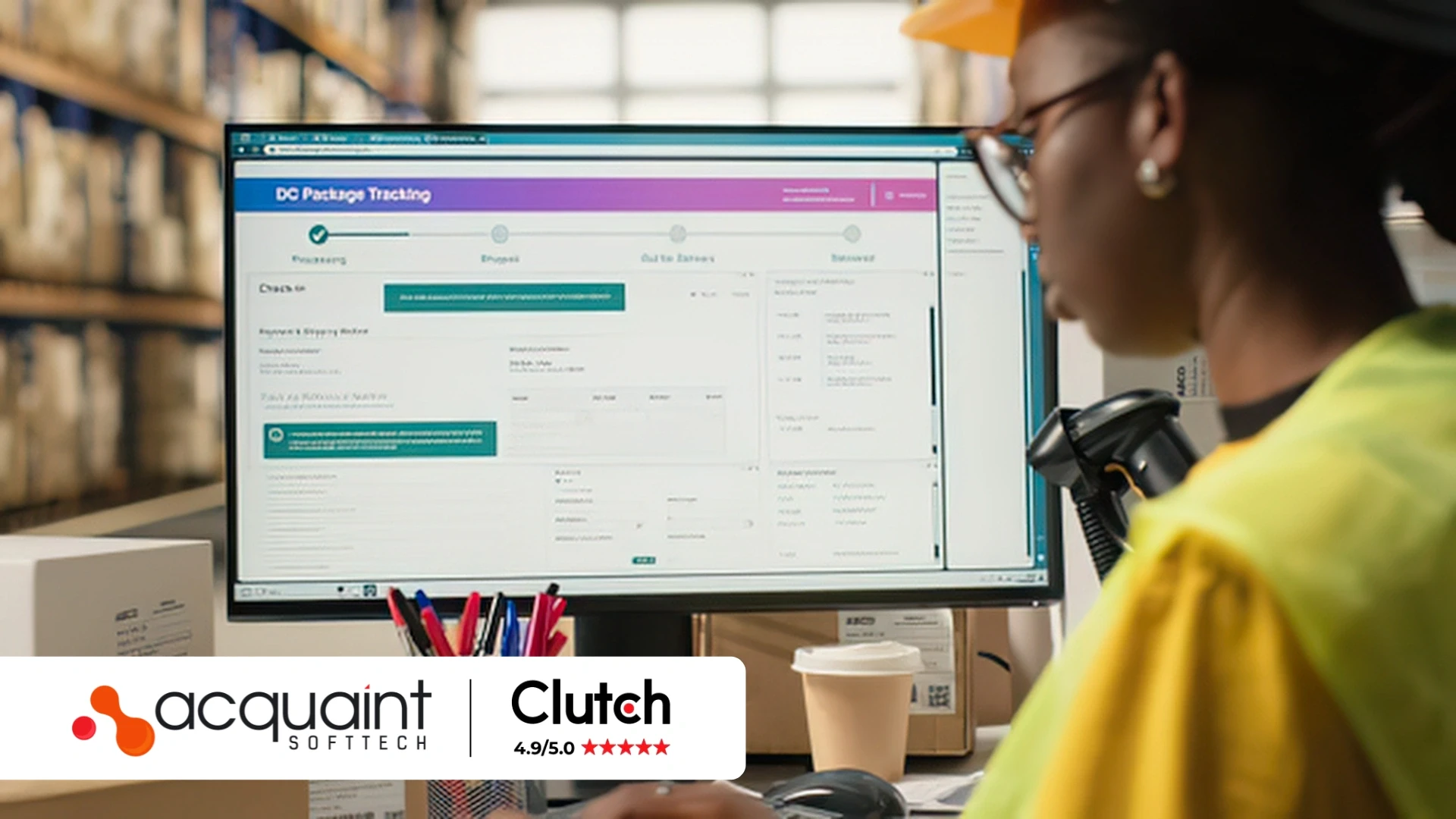
The clearest proof of this validate-then-build path is a real founder-led build. This engagement, verified on Clutch, shows the startup playbook in action: start with the one workflow that matters most, then expand in phases instead of building everything at once.
Case Study: From Idea to a Working Multi-Country Operations Platform
Founder-led custom manufacturer building one platform to run operations across a UK factory, US showrooms, a Brooklyn warehouse, and a Poland finishing facility | Verified on Clutch (5.0/5)
Problem
→ Work tracked on spreadsheets and email across five locations, with no single view of what was made or shipped where.
→ A founder who needed to validate the build before over-investing.
Challenge
→ Pick a single first workflow to digitise before touching everything else.
→ Avoid an all-at-once platform that would stall before proving value.
Solution
→ Started with the core workflow, production and order tracking, as the MVP.
→ Added a centralised data layer shared across all four locations.
→ Expanded in phases to logistics and warehouse coordination.
Result
→ Shipped and proved value early because the first release solved one real workflow.
→ Layered on logistics, warehouse, and quality modules once the core proved out, avoiding an expensive rebuild.
“Their ability to translate a real operational idea into a working product stood out. We had worked with agencies before who struggled to understand how a multi-location operation actually runs. Acquaint Softtech picked this up surprisingly well, started with what mattered most, and delivery milestones were met consistently.” - CEO and Founder, Custom Manufacturing Company (UK, USA, and EU operations)
What makes this instructive is the sequencing: the team shipped the core workflow first, proved it, then layered on logistics, warehouse, and quality modules. That is exactly the lean-then-scale approach from sections 04 and 06, and the founder kept the same engineers throughout, which Acquaint Softtech's 24+ month average team tenure makes possible. The 5.0/5 Clutch review is verified on the Acquaint Softtech Clutch profile, alongside a 4.9/5 rating from 50+ reviews.
Build team options: in-house, outsource, or augment
Most logistics founders cannot afford a full senior in-house team at the MVP stage, so the realistic choice is outsourcing the build, augmenting a small core team, or a hybrid of the two. The right answer depends on whether you already have technical leadership in-house and how fast you need to move.
Model | Best for | What you get |
Outsourcing | Non-technical founders | A fully managed team and delivery |
Staff augmentation | Founders with a tech lead | Vetted engineers added fast |
Hybrid | Lean core team scaling up | In-house control plus vendor bench |
Outsourcing suits non-technical founders who need a whole team and managed delivery. Founders with a technical lead who need to add specific skills fast can hire project managers and specialist engineers to top up an existing team, with vetted people deployed within 48 hours.
Whichever model you choose, stay in control of scope and validation rather than handing everything over. Team stability matters more than a low hourly rate, because the engineers who learn your carrier relationships and edge cases are the ones who should refine them as you scale. To compare how startups and enterprises structure these teams differently, the logistics and supply chain software development guide shows the same staffing trade-offs across every logistics category.
Ready to turn your logistics idea into a launched product? Book a meeting and hire your team.
You do not need a year and a full payroll to prove a logistics idea; you need the right first workflow and a team that ships. Join 200+ companies that scaled with Acquaint Softtech: 1,300+ projects, 70+ engineers, and a 4.9/5 Clutch rating from 50+ verified reviews.
Frequently asked questions
-
How do you build a logistics tech startup?
To build a logistics tech startup, validate the idea with 50 or more real users, pick one focused niche and business model, scope a lean MVP around a single workflow, choose a scalable stack, then launch in 3 to 6 months and iterate. Validate willingness to pay before writing production code.
-
What features should a logistics MVP have?
A logistics MVP should cover one workflow end to end: real-time tracking, a driver or operator app, a dispatcher dashboard, and basic order management. Successful startups launch with 3 to 5 core features, not 20, and add advanced capability such as route optimization only after validation.
-
How much does a logistics app MVP cost?
A focused logistics MVP with core tracking, a driver app, and a dispatcher dashboard typically costs $40,000 to $60,000 and takes 3 to 5 months. A full platform runs $70,000 to $150,000. A Clutch-verified India team delivers the same quality at up to 40 percent lower cost, at $25 to $49 per hour.
-
How long does it take to build a logistics MVP?
A focused logistics MVP takes 3 to 5 months from kickoff to launch, and a full-featured platform with integrations takes 7 to 12 months. Phased delivery, MVP first then integrations, is the standard way to launch fast and validate before committing the full budget.
-
How do I vet a logistics development team?
Check verified reviews, team tenure, and whether the same engineers stay with your product. Acquaint Softtech holds a 4.9/5 Clutch rating from 50+ verified reviews, Premier Verified status, and a 24+ month average team tenure, so the engineers who design your platform are the ones who refine it as you scale.
-
Dedicated team vs freelancers for a logistics MVP?
A dedicated team gives you managed delivery, shared context, and accountability, while freelancers suit small isolated tasks. For an MVP that must ship one coherent workflow, a dedicated team or staff augmentation model reduces coordination risk. Acquaint Softtech deploys vetted engineers within 48 hours of a brief.
-
How does Acquaint Softtech onboard a logistics team?
Acquaint Softtech starts with a discovery workshop to validate and scope, then builds a focused MVP in two-week sprints and scales it in phases, with optional virtual CTO support. The first engineer deploys within 48 hours, backed by 1,300+ projects and a 4.9/5 Clutch rating from 50+ reviews.
-
What is the best tech stack for a logistics platform?
A boring, well-supported stack wins: React or Next.js frontend, a Laravel, Node, or Python backend, PostgreSQL, and React Native or Flutter for mobile, on cloud infrastructure. Choose technologies with a large talent pool and avoid trendy tools that are hard to hire for.
With over 11 years of experience in web application development and project management, I excel in leading cross-functional teams to deliver innovative digital solutions. My expertise spans eCommerce platforms, ERP systems, and JS & PHP-based frameworks, including WordPress, React JS, and Laravel. As a Technical Project Manager, I specialize in strategic planning, system design, and end-to-end project execution, transforming complex ideas into scalable, high-impact applications.
Table of Contents
Get Started with Acquaint Softtech
- 13+ Years Delivering Software Excellence
- 1300+ Projects Delivered With Precision
- Official Laravel & Laravel News Partner
- Official Statamic Partner
Related Blog
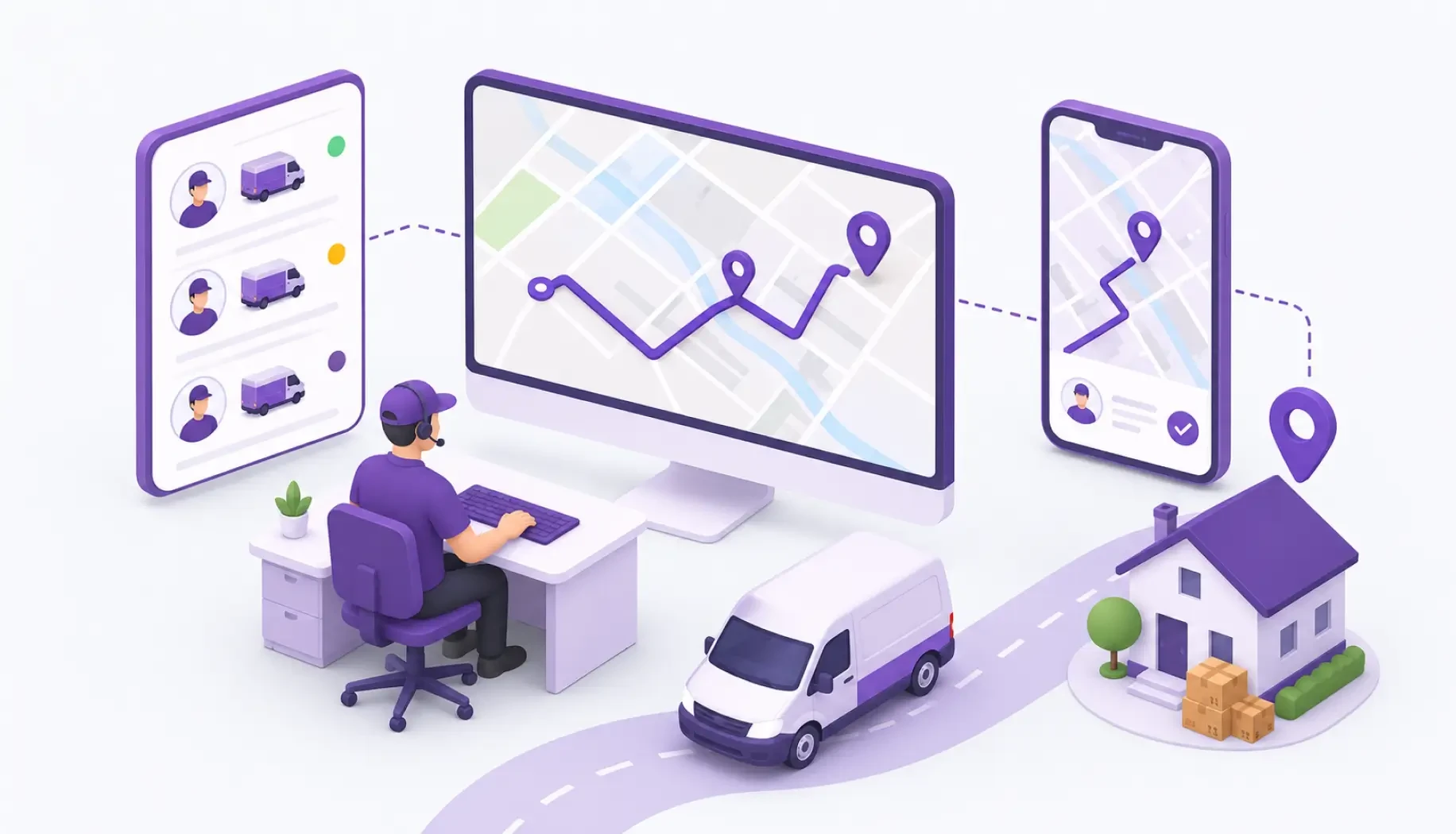
How Last Mile Delivery Software Works: Dispatch, Routing, Tracking, and Customer Notifications
Last-mile delivery software is a platform that manages the final leg of the delivery journey from a dispatch hub to the customer's door. It covers four interconnected systems: automated dispatch that assigns orders to the right driver, route optimization that sequences stops for minimum fuel and time, real-time GPS tracking that surfaces live delivery status to dispatchers and customers, and automated notifications that send ETAs, delays, and delivery confirmations across SMS, email, and push.

Manish Patel
June 5, 2026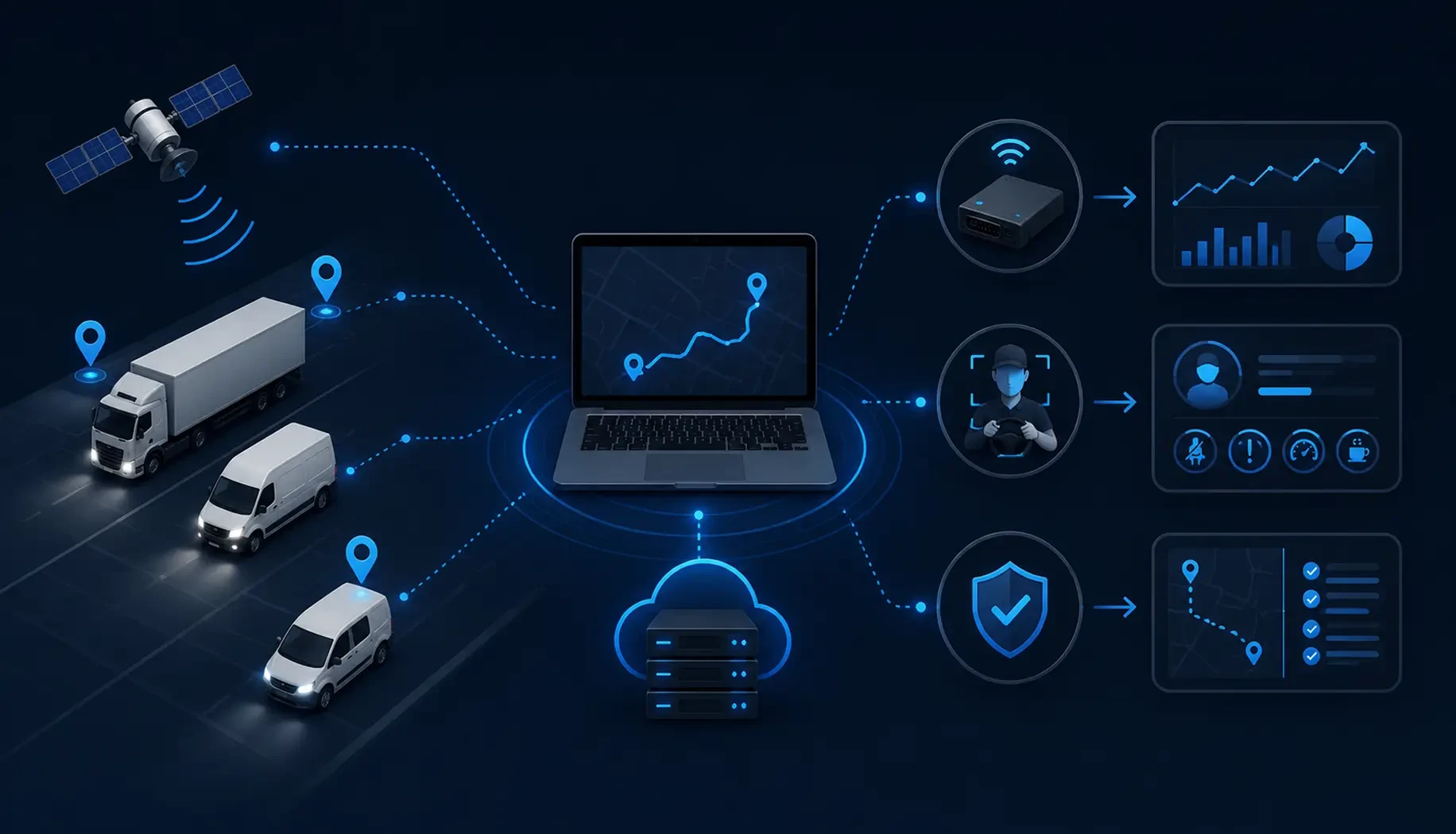
How Fleet Management Systems Work: GPS Tracking, Vehicle Telematics, and Driver Monitoring
A Fleet Management System is not a map with moving dots. It is the operational control layer that connects GPS position, engine diagnostics, driver behaviour, maintenance schedules, and compliance records into a single decision surface. Most fleet software projects fail because they build the map first and the data pipeline last.
Manish Patel
May 26, 2026
The Complete Guide to On-Demand App Development in 2026
Not every on-demand app is Uber. Not every marketplace is Amazon. This 2026 guide maps every platform type, its architecture, real cost, and the cold-start sequence that separates launches that work from those that fail.

Acquaint Softtech
May 7, 2026India (Head Office)
203/204, Shapath-II, Near Silver Leaf Hotel, Opp. Rajpath Club, SG Highway, Ahmedabad-380054, Gujarat
USA
7838 Camino Cielo St, Highland, CA 92346
UK
The Powerhouse, 21 Woodthorpe Road, Ashford, England, TW15 2RP
New Zealand
42 Exler Place, Avondale, Auckland 0600, New Zealand
Canada
141 Skyview Bay NE , Calgary, Alberta, T3N 2K6