

Multi-Warehouse Inventory Sync: How to Build Centralized Stock Management Across Locations
A multi-warehouse inventory management system is a centralized digital platform that tracks stock levels, orders, and movements across several storage facilities in real time. It gives you one accurate view of every SKU in every location, then routes each order, transfer, and reorder from that single source of truth, so you sell what you actually have and ship from the site closest to the customer.

Manish Patel
As the Chief Information Officer and Production Head at Acquaint Softtech, I have watched more multi-location retailers lose money to bad inventory data than to bad products, which is why our software product development team treats stock sync as an architecture problem first and a feature checklist second.
The stakes are structural, not cosmetic. Warehousing and storage already account for 27 percent of all jobs in the US transportation and warehousing sector, per US Bureau of Labor Statistics data, and once a business splits inventory across sites, a single number that is wrong by a few units cascades into overselling, emergency transfers, and refunds.

- A CEO, CTO, COO, or technical founder who has outgrown spreadsheets and a single stockroom.
- Weighing whether to buy an off-the-shelf tool or build a custom multi-location system.
- An agency owner or product leader who needs the architecture, database, and cost picture, not just a feature list.
- Operating across the USA, UK, Europe, Australia, or New Zealand and syncing stock across two or more sites.
This article is the multi-warehouse chapter of our broader guide to logistics and supply chain software development, and it stays deliberately build-focused: how the sync engine is architected, which database holds the truth, how conflicts are resolved, what it costs, and who you need to build it.
The top-ranking pages for this topic are product tours and buyer checklists that stop where engineering begins. This guide is the opposite: it reads like a build brief, so by the end you can scope the system, pick the stack, and brief a team with confidence.
Multi-warehouse inventory sync in one minute

What is a multi-warehouse inventory management system?
It is centralized software that holds one live count of every SKU across every location and keeps that count correct as stock moves, giving you true multi-location inventory visibility. Instead of each warehouse guarding its own spreadsheet, the system owns a shared ledger, and every sale, receipt, pick, and transfer updates that ledger the moment it happens.
In practice, it delivers five things: a centralized dashboard that shows total and per-location quantities on one screen; smart order routing that assigns each order to the nearest site with stock; digital stock transfers between facilities; automated reordering with custom minimum and maximum triggers per warehouse; and barcode or RFID scanning that updates counts instantly during receiving, picking, and packing.
The payoff is equally concrete: lower shipping costs because you ship from the closest location, fewer stockouts because inventory is balanced to local demand, and resilience because one site going down does not halt the whole operation.
What is centralized inventory management?
Centralized inventory management means every location reads from and writes to one authoritative record rather than reconciling separate systems after the fact. Each warehouse still has its own shelf reality, but the truth about how much exists, where, and what is promised to customers lives in a single place that every channel queries.
How is this different from a single-warehouse setup?
A single warehouse only answers one question: is this unit here or not? A multi-warehouse system must also answer where the unit is, which site should fulfil the order, whether a transfer is cheaper than a reorder, and how to stop two channels from selling the last unit at once. That extra set of decisions is the whole engineering problem, and it is the class of system Acquaint Softtech builds for multi-location clients.
Planning a build, not a purchase?
If you are scoping a centralized inventory platform rather than shopping for an off-the-shelf tool, a short discovery session will save weeks of rework.
The centralized architecture: where the sync engine sits
What are the core components of a centralized stock system?
A dependable multi-location system has four moving parts: an inventory ledger service that owns the master count, an event bus that carries every stock change as a message, location adapters that connect each warehouse, channel, and scanner to the bus, and a dashboard that reads the aggregated view. Keeping those responsibilities separate is the heart of sound multi-warehouse architecture design, and it keeps the system debuggable as you add sites.
The ledger service is the heart, and it is the piece we build first. Our hire Python developers typically implement it as an append-only record where every movement is an immutable event, so the current quantity is a running total rather than a value that gets overwritten and lost.
Distributed inventory database: one truth, many locations
A distributed inventory database keeps a single logical source of truth while physically serving many locations at once. The master count stays authoritative and transactional; per-location read replicas keep dashboards fast without letting any site quietly diverge from the shared total.
Because the ledger is append-only, you also get a full audit trail for free, which is what auditors and finance teams want. For teams that need senior architectural direction here, our Virtual CTO services help set the consistency model before a line of production code is written.
Should stock live in one database or one per warehouse?
For almost every business under a few dozen sites, one master database with strong consistency beats a database per warehouse. A database per site feels autonomous but forces you to reconcile counts constantly, which reintroduces the exact drift you set out to remove. Split the data only when regulation or scale genuinely demands it.
How to sync stock in real time
Here is how to sync inventory across warehouses in real time: make every change an event the instant it happens, publish it to a message bus, and let the ledger and every dashboard react in under a second. Real-time stock sync between locations is event-driven, not a schedule you poll, and dependable inventory sync across warehouses stands or falls on this choice.
Event-driven sync versus polling
Polling asks every few minutes whether anything changed, so it is always slightly wrong and gets slower as you grow. Event-driven sync pushes each change as it occurs, so a sale in one channel updates availability everywhere before the next customer can add the same unit to a cart.
The real-time layer is where a strong backend team pays for itself. Our hire Laravel developers build the event contracts and queue workers that keep the bus reliable, and Acquaint Softtech runs this as an Official Laravel Partner with more than 70 in-house engineers.
Reservations and locking: how to stop overselling
The trick that prevents overselling is reserving stock at the moment of intent, not at the moment of payment. When a unit enters a cart or an order is created, the system places a short-lived reservation against the ledger, so the same physical unit can never be promised twice even across channels and sites.
Conflict resolution when two locations touch the same unit
Conflicts are resolved by a clear, deterministic rule set applied at the ledger, so the outcome never depends on luck or timing. The table below shows how the engine decides in the cases that break naive systems.
Scenario | Rule the engine applies | Result |
Two channels sell the last unit at once | First reservation to commit wins; second is rejected atomically | No oversell; second order is backordered or rerouted |
Sale lands mid stock-transfer | In-transit stock is a distinct state, not available | Transfer completes; count stays correct at both sites |
Scanner offline during picking | Events queue locally, then replay in order on reconnect | Ledger converges to one correct total |
Reorder and manual edit collide | Ledger is append-only, so both are recorded and netted | Full audit trail; no silent overwrite |
Best database for multi-warehouse inventory
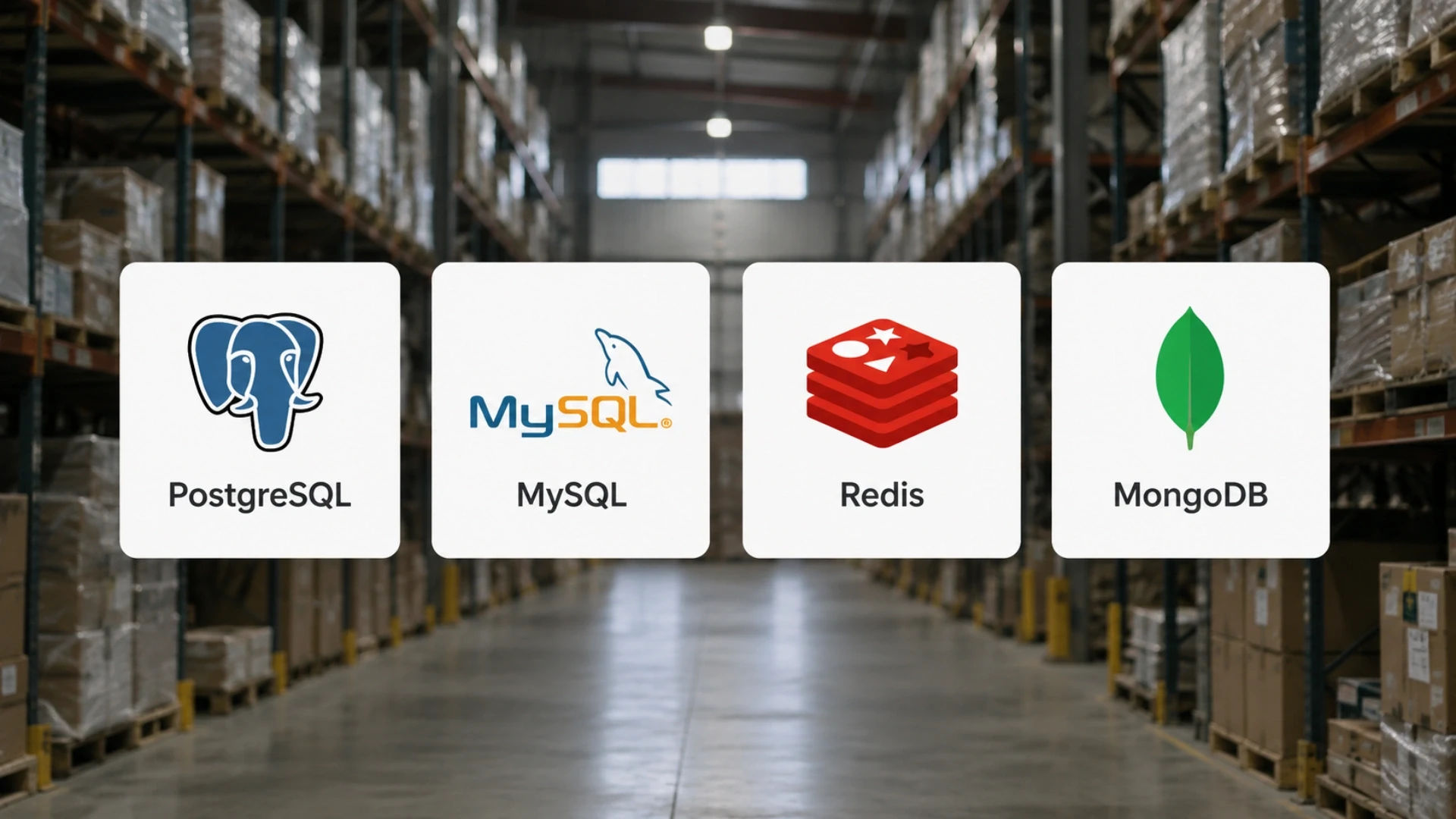
The best database for multi-warehouse inventory is a strongly consistent relational store, usually PostgreSQL, as the master ledger, supported by an in-memory cache for hot reads and a message broker for events. Availability numbers matter far less than transactional correctness when money and stock are on the line.
Option | Best role in the system | Watch-out |
PostgreSQL | Master ledger and reservations, where consistency is non-negotiable | Plan indexing and partitioning early for high write volume |
MySQL | Viable master ledger for simpler catalogs and teams already on it | Fewer advanced concurrency features than Postgres |
Redis | Fast availability cache and short-lived reservation locks | Not the source of truth; it is a speed layer |
MongoDB | Flexible product and location metadata, event history | Weak fit for the transactional count itself |
A sound pattern is Postgres for truth, Redis for speed, and a broker such as RabbitMQ or Kafka for the event stream. Teams that want this validated against their real traffic can bring in our hire DevOps engineers to load-test the design before launch.
Smart order routing across locations
How does order routing pick a warehouse?
Smart order routing automatically assigns each order to the best location using availability, distance to the customer, and shipping cost, with business rules layered on top. The goal is fewer split shipments, lower freight, and faster delivery, decided by the system rather than a person.
Order situation | Routing rule | Outcome |
One site has full stock nearby | Ship complete from the closest site with availability | Lowest cost, fastest delivery |
Nearest site is short a few units | Compare split shipment cost against a single farther site | Cheapest total, not just nearest |
High-demand SKU low everywhere | Reserve, trigger reorder, and flag for rebalancing | Prevents repeat stockouts |
Priority or same-day customer | Rule overrides default cost logic | Service level protected |
Routing and reordering are where automation removes the most manual work. Our hire automation engineers wire the reorder triggers so each facility gets its own minimum and maximum thresholds instead of one blunt company-wide rule.
Want the routing rules mapped to your business?
Every catalog routes differently. We can translate your margins, sites, and service levels into concrete engine rules through a dedicated build team.
A practical build path
Build in phases so you can validate each layer with real stock before adding the next. This is the sequence we use on multi-location engagements.
Discovery and data model. Map SKUs, sites, channels, and the routing rules that make your business specific before any code.
Ledger and event bus. Stand up the append-only master count and the message bus that carries every change.
Channel and location adapters. Connect each warehouse, marketplace, and store so events flow in and availability flows out.
Reservations and routing. Add intent-time reservations, conflict rules, and the routing engine.
Centralized dashboard. Build the single screen for total and per-location visibility, transfers, and alerts.
Scanning, mobile, and forecasting. Layer barcode and RFID scanning, mobile picking, and demand-based reordering last.
The dashboard is usually a real-time single-page app, and our hire MERN stack developers build the centralized inventory dashboard on it. Teams that prefer Angular can instead hire MEAN stack developers for the same live view.
Warehouse floor scanning needs a rugged mobile app, so our hire React Native developers build the offline-capable scanner that keeps counts live during receiving and picking.
What a multi-warehouse system costs to build

A custom multi warehouse inventory management system cost depends on scope, integrations, and team, and multi-warehouse system development is best budgeted per phase rather than as one lump sum.
Businesses that hire developers for inventory sync usually begin with the core MVP below, then fund each later phase only after the previous one proves out. The ranges below are indicative build costs, not licence fees, and let you stop or pivot at any phase boundary.
Scope | Indicative build cost | Typical timeline |
Core MVP: ledger, sync, 2 to 3 sites, basic dashboard | 45,000 to 65,000 USD / 36,000 to 52,000 GBP / 42,000 to 60,000 EUR | 3 to 4 months |
Growth build: routing, reservations, channel adapters, transfers | 70,000 to 110,000 USD / 56,000 to 88,000 GBP / 65,000 to 100,000 EUR | 5 to 7 months |
Full platform: scanning, mobile, forecasting, deep ERP integration | 120,000 to 180,000 USD / 96,000 to 145,000 GBP / 110,000 to 165,000 EUR | 8 to 12 months |
Region drives a large part of that number, and a Clutch-verified team can deliver Western-agency quality at a meaningfully lower cost, which is why many clients hire remote developers rather than staff the whole build locally. Agencies that resell the platform under their own brand use our white label software development instead.
Keeping the phased budget on track is a job in itself, so clients who want a single accountable owner hire project managers to run the sprint cadence end to end.
The WMS landscape: types, examples, and software
The meaning of warehouse management system is simple: a WMS is software that runs the operations inside a warehouse, from receiving to putaway, picking, packing, and shipping. A warehouse management system in logistics is the layer that keeps stock accurate and moving, which is exactly what your sync engine depends on.
What are the four types of WMS?
The four types of warehouse management systems are standalone, ERP-integrated, cloud-based, and supply-chain-module WMS. Different warehouse management systems suit different stages: standalone for focused control, ERP-integrated for enterprises already on SAP or Oracle, cloud-based for multi-site access and fast scaling, and supply-chain modules for planning-led operations.
Warehouse management system examples and a short list of software
A useful list of warehouse management software and examples includes Infios warehouse management systems (formerly Korber), SAP Extended Warehouse Management, Manhattan Active, Blue Yonder, Oracle NetSuite WMS, and cloud tools such as Veeqo and Qoblex for smaller sellers. The best warehouse management system for small business is usually a cloud-based option with per-location visibility and no on-premises overhead.
Federal classifications reinforce why this layer matters: the US Bureau of Labor Statistics lists inventory control and management as a core logistics service of warehousing establishments, not an optional extra.
Is SAP an ERP or WMS?
SAP is primarily an ERP, but it also offers a dedicated WMS through SAP Extended Warehouse Management. So SAP can act as both: the ERP runs finance, procurement, and orders, while its EWM module runs warehouse execution, and the two share data inside one ecosystem.
Whichever WMS you run, your sync engine talks to it through adapters, and across 1,300+ projects, Acquaint Softtech has built these connectors against both cloud and enterprise systems. If your storefront is WooCommerce, our hire WooCommerce developers build the channel adapter that keeps listing stock in step with the ledger. When you are migrating off a legacy or unsupported WMS, our version upgrade services move the data across without losing history.
Hiring the team to build it
A multi-warehouse build needs a specific mix of skills, and the fastest way to de-risk it is to assemble that mix deliberately rather than hope generalists cover every layer.
For the transactional core, teams hire Django developers when they want a batteries-included Python framework for the ledger and admin. Demand-based reordering is where machine learning earns its place, so clients hire AI/ML engineers to forecast per-location demand from sales history and seasonality. Businesses running a WordPress front end hire WordPress developers to connect the customer-facing site, while the core sync engine stays on the transactional stack above.
Proof: fixing online and in-store stock mismatch for an 11-store retailer
Client: DIMCO, a lighting supplier in Cyprus.
Scope: e-commerce rebuild with a centralized inventory API.
Engagement: October 2025 to February 2026, 10,000 to 49,999 USD band.
Clutch rating: 5.0 overall.
DIMCO operates 11 stores across Cyprus alongside its e-commerce site and imports lighting products from more than 50 suppliers. It came to Acquaint Softtech with a familiar multi-location problem: inventory inconsistencies between the website, the physical stores, and external systems. During seasonal promotions, those gaps turned into stock mismatches that had to be corrected by hand.
Rather than patch the old system, Acquaint Softtech designed a headless commerce setup with a React progressive web app on the front end and a Node API on the back end.
The core deliverable was a centralized product and inventory API, wired into the client's ERP, inventory, and marketplace systems, with a Redis caching layer so thousands of shoppers did not hammer the primary database. That centralized API is the same single-source-of-truth pattern this guide argues for.
The measurable change showed up in the next sales peak, as summarised below.
Area | Before the rebuild | After the rebuild |
Online vs in-store stock | Recurring mismatches during promotions | Held up through a full seasonal promotion |
Order processing at peak | Manual corrections after the fact | Processed smoothly, no usual manual fixes |
Storefront performance | Lag on heavy catalog pages | Near-instant page loads, especially on mobile |
Catalog and campaign updates | Developer-dependent | Managed in-house via structured workflows |
As the client's director put it in a five-star review, the team “stayed involved to ensure stability when it mattered most.” Reviewer: Alexis Demetriou, Director, DIMCO. Verified on the Acquaint Softtech Clutch profile.
Ready to scope your multi-warehouse build?
Bring your SKU count, sites, and channels, and we will map the architecture, database, and phased cost with you before you commit.
Frequently Asked Questions
-
How to manage inventory across warehouses?
Manage it from one centralized system that holds a single live count of every SKU across every site. Each sale, receipt, and transfer updates that shared ledger in real time, and a routing engine decides which warehouse fulfils each order so stock stays balanced.
-
What is centralized inventory management?
It is the practice of keeping one authoritative inventory record that every location and channel reads from and writes to. Instead of reconciling separate systems, all counts, reservations, and movements resolve against a single source of truth.
-
How to sync stock in real time?
Make every stock change an event and publish it to a message bus the instant it happens, rather than polling on a schedule. The ledger and dashboards react in under a second, and intent-time reservations stop two channels from selling the same unit.
-
Best database for multi-warehouse inventory?
A strongly consistent relational database such as PostgreSQL is best for the master ledger, because correctness matters more than raw speed. Pair it with Redis for fast availability caching and a broker like Kafka or RabbitMQ for the event stream.
-
What are the four types of WMS?
The four types are standalone, ERP-integrated, cloud-based, and supply-chain-module warehouse management systems. Standalone suits focused control, ERP-integrated suits large SAP or Oracle shops, cloud-based suits multi-site scaling, and modules suit planning-led operations.
-
What is the best software for warehouse inventory management?
There is no single winner; the best software matches your scale and channel mix. Enterprises lean on SAP EWM, Manhattan, Blue Yonder, or Infios, while smaller multi-site sellers often prefer cloud tools, and businesses with unusual routing rules build custom.
-
What is the 80/20 rule in inventory?
The 80/20 rule, or Pareto principle, says roughly 80 percent of sales come from about 20 percent of your SKUs. In multi-warehouse setups, you stock those high-velocity items close to demand at every site and manage the long tail more centrally.
-
Is SAP an ERP or WMS?
SAP is primarily an ERP, but it also provides a full WMS through SAP Extended Warehouse Management. It can therefore serve as both, running finance and orders in the ERP while EWM handles warehouse execution.
-
How much does a multi warehouse inventory management system cost to build?
A core MVP typically runs in the region of 45,000 to 65,000 USD, a growth build with routing and adapters more, and a full platform with scanning and forecasting more again. Budget per phase, since region, integrations, and SKU count drive the final figure.
I lead technology and client success at Acquaint Softtech with one goal in mind. Deliver work that feels personal, reliable, and worthy of long term trust. I stay close to both our clients and our developers to make sure every project moves with clarity, quality, and accountability.
Table of Contents
Get Started with Acquaint Softtech
- 13+ Years Delivering Software Excellence
- 1300+ Projects Delivered With Precision
- Official Laravel & Laravel News Partner
- Official Statamic Partner
Related Blog
How Order Management Systems Work: Order Lifecycle, Routing, and Multi-Channel Fulfillment
An order management system (OMS) works by managing the full life of an order, from the moment a customer buys to the moment the parcel arrives, across every sales channel. It captures and validates each order, reserves inventory, decides which location should fulfill it through routing rules, releases it to the warehouse, and tracks it to delivery and returns. The OMS is the control layer that keeps online, marketplace, and in-store orders synchronized against one real-time view of stock.
Manish Patel
June 25, 2026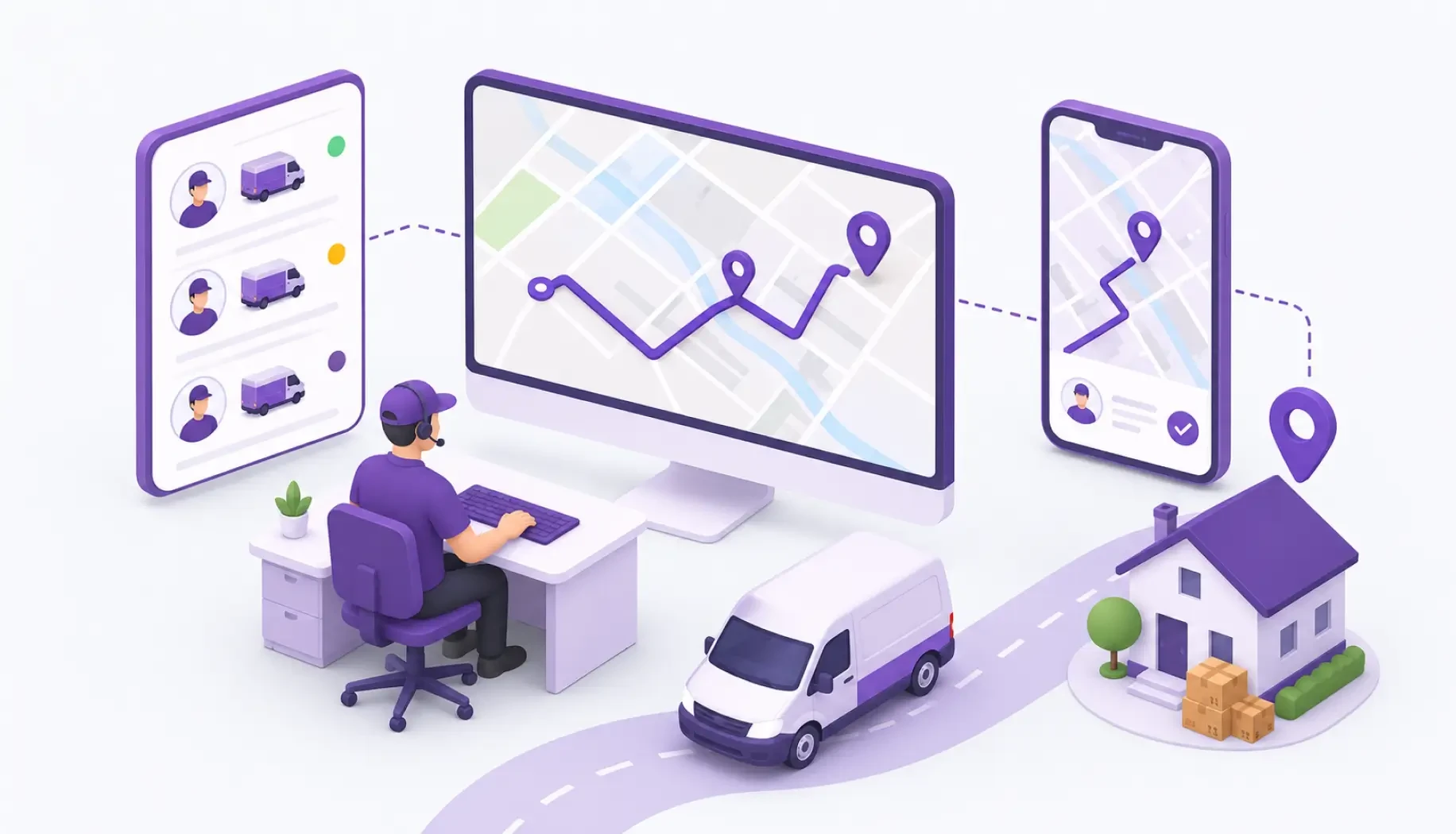
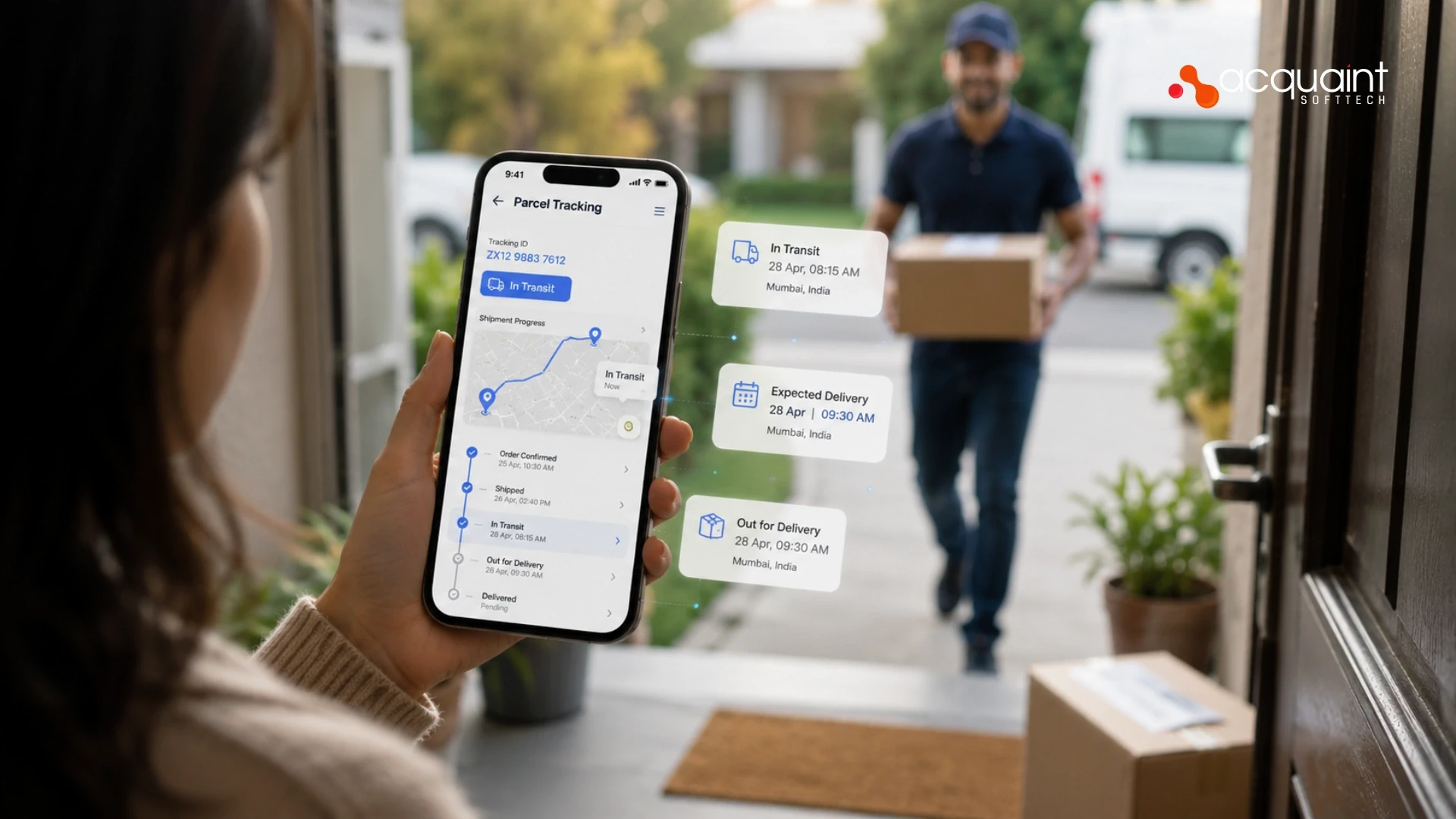
How Last Mile Delivery Software Works: Dispatch, Routing, Tracking, and Customer Notifications
Last-mile delivery software is a platform that manages the final leg of the delivery journey from a dispatch hub to the customer's door. It covers four interconnected systems: automated dispatch that assigns orders to the right driver, route optimization that sequences stops for minimum fuel and time, real-time GPS tracking that surfaces live delivery status to dispatchers and customers, and automated notifications that send ETAs, delays, and delivery confirmations across SMS, email, and push.
Manish Patel
June 5, 2026
The Future of Logistics Technology 2026-2030: Trends, Predictions, and What to Build Now
Logistics technology is shifting toward AI-powered, self-healing supply chains with real-time automation and decision-making. Key trends include agentic AI, digital twins, IoT, blockchain, and autonomous systems built on connected data.

Mukesh Ram
July 13, 2026India (Head Office)
203/204, Shapath-II, Near Silver Leaf Hotel, Opp. Rajpath Club, SG Highway, Ahmedabad-380054, Gujarat
USA
7838 Camino Cielo St, Highland, CA 92346
UK
The Powerhouse, 21 Woodthorpe Road, Ashford, England, TW15 2RP
New Zealand
42 Exler Place, Avondale, Auckland 0600, New Zealand
Canada
141 Skyview Bay NE , Calgary, Alberta, T3N 2K6