

Building a SCORM and xAPI Compliant LMS: Content Interoperability Standards Explained
SCORM and xAPI are complementary e-learning technical standards that define how digital learning content and Learning Management Systems (LMS) interoperate, communicate, and track learner data. SCORM packages and launches a course inside an LMS and tracks basic completion and scores. xAPI records any learning experience anywhere and stores it in a Learning Record Store. cmi5 bridges the two. A modern compliant LMS supports all three.

Sanjay Prajapati
As a developer and Head of Business at Acquaint Softtech, I get one version of this question from almost every EdTech founder: will my content actually run in a client's system, and can I trust the data it sends back. That is the whole point of interoperability standards, and it is why custom software product development for education always starts with SCORM and xAPI, not with the shiny features on top.
Here is the short version. SCORM (Sharable Content Object Reference Model) packages a course so any compliant LMS can launch and track it. xAPI (Experience API) records learning that happens anywhere and stores it in a Learning Record Store. These two standards were both created by the U.S. Advanced Distributed Learning (ADL) Initiative, the same body that has shaped e-learning interoperability for two decades.

- You are building or buying an LMS and need it to be SCORM and xAPI compliant.
- You want a plain-English take on SCORM vs xAPI vs cmi5.
- You are a CTO, founder or product leader who has to make a standards decision.
- You need real build cost, architecture and proof, not just definitions.
This technical guide explains what each standard does, shows the interoperability differences, and then walks through how to actually engineer a compliant LMS. It is part of our wider EdTech software development guide, so you can branch into any related module from here.
Everything below reflects delivery experience, not theory. Acquaint Softtech has built education platforms with course packaging, third-party integrations and tracking, and this article distils what compliance really takes once the marketing language is stripped away.
SCORM and xAPI explained: what the standards actually do
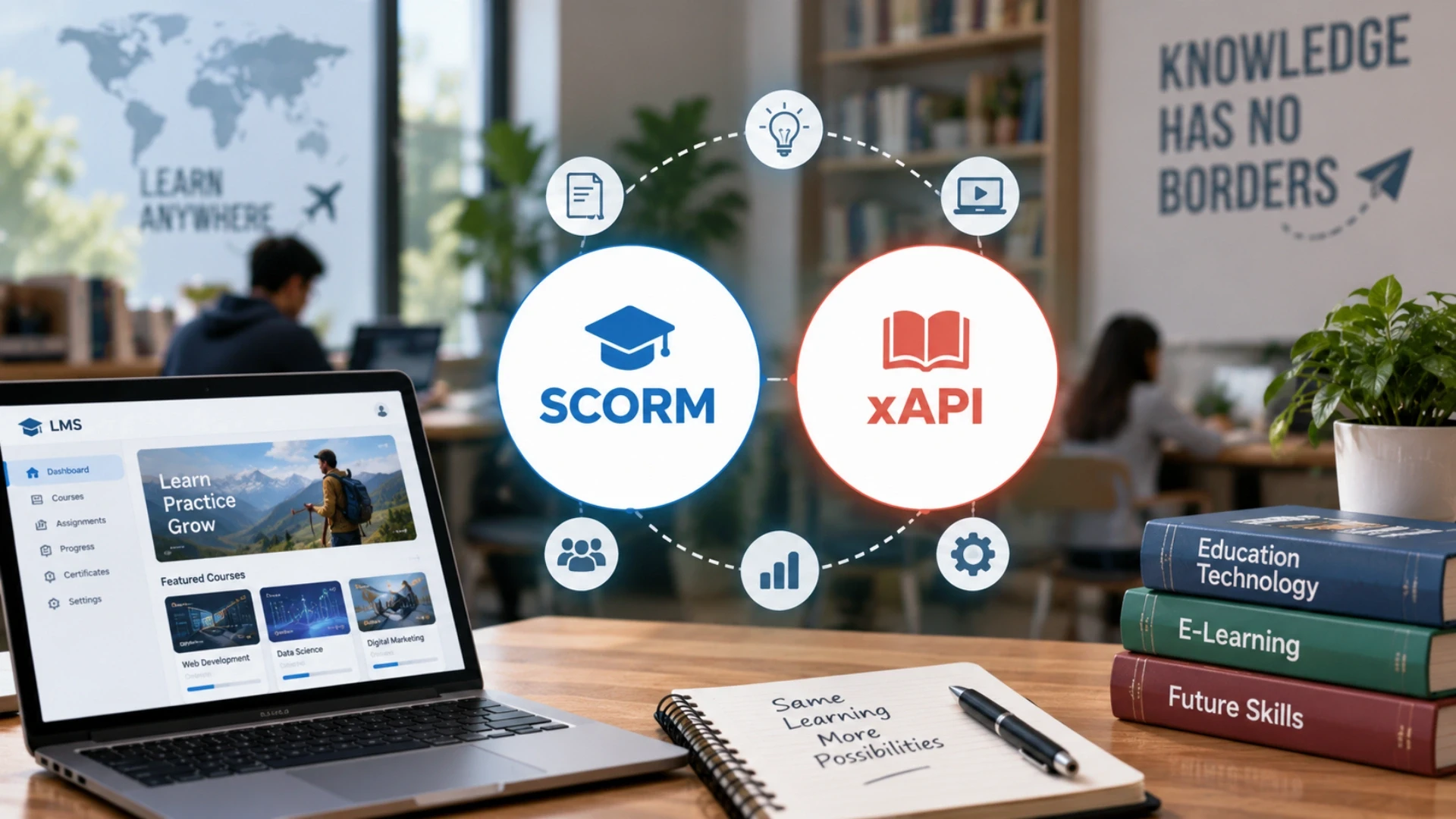
SCORM and xAPI are the two standards that let e-learning content and an LMS understand each other. SCORM handles packaging and launching a course with basic tracking. xAPI handles recording rich learning activity from anywhere. Understanding what is a SCORM LMS starts with knowing that a SCORM LMS is simply any platform that can import, launch and track a SCORM course package.
What does SCORM stand for. It stands for Sharable Content Object Reference Model, and that name is the whole idea: content is a sharable object that any conforming system can reference and run. The scorm compliant meaning is exactly this, that a course built once will launch and report consistently on any SCORM-compliant LMS.
Core definitions
SCORM (Sharable Content Object Reference Model) is the traditional industry standard for structuring and launching e-learning courses. It tracks basic runtime data such as course completion, pass or fail status, scores, and time spent, inside a web browser hosted on the same domain as the LMS.
xAPI (Experience API) is the modern successor standard. It records a diverse range of learning experiences, including mobile apps, simulations and virtual reality, through Actor, Verb, Object statements sent to an external Learning Record Store (LRS). That is what is xAPI in one sentence: a way to record any learning event, anywhere.
cmi5 is an xAPI-based profile that bridges traditional LMS course-launching rules with xAPI's flexible, cloud-native data tracking. Building this correctly is real AI software development work, not a plugin install.
Why the standard you choose shapes the build
The standard decides your data model, your hosting rules and your analytics ceiling. SCORM keeps everything simple but shallow. xAPI unlocks deep telemetry but demands governance. Choosing well up front is why teams bring in hire Python developers who have shipped tracking engines before, rather than learning the runtime API on your budget.
For the broader engineering picture of owning a standards-based platform, our overview of software product engineering companies shows the layers you take on when the LMS is your own product.
SCORM vs xAPI vs cmi5: the interoperability comparison
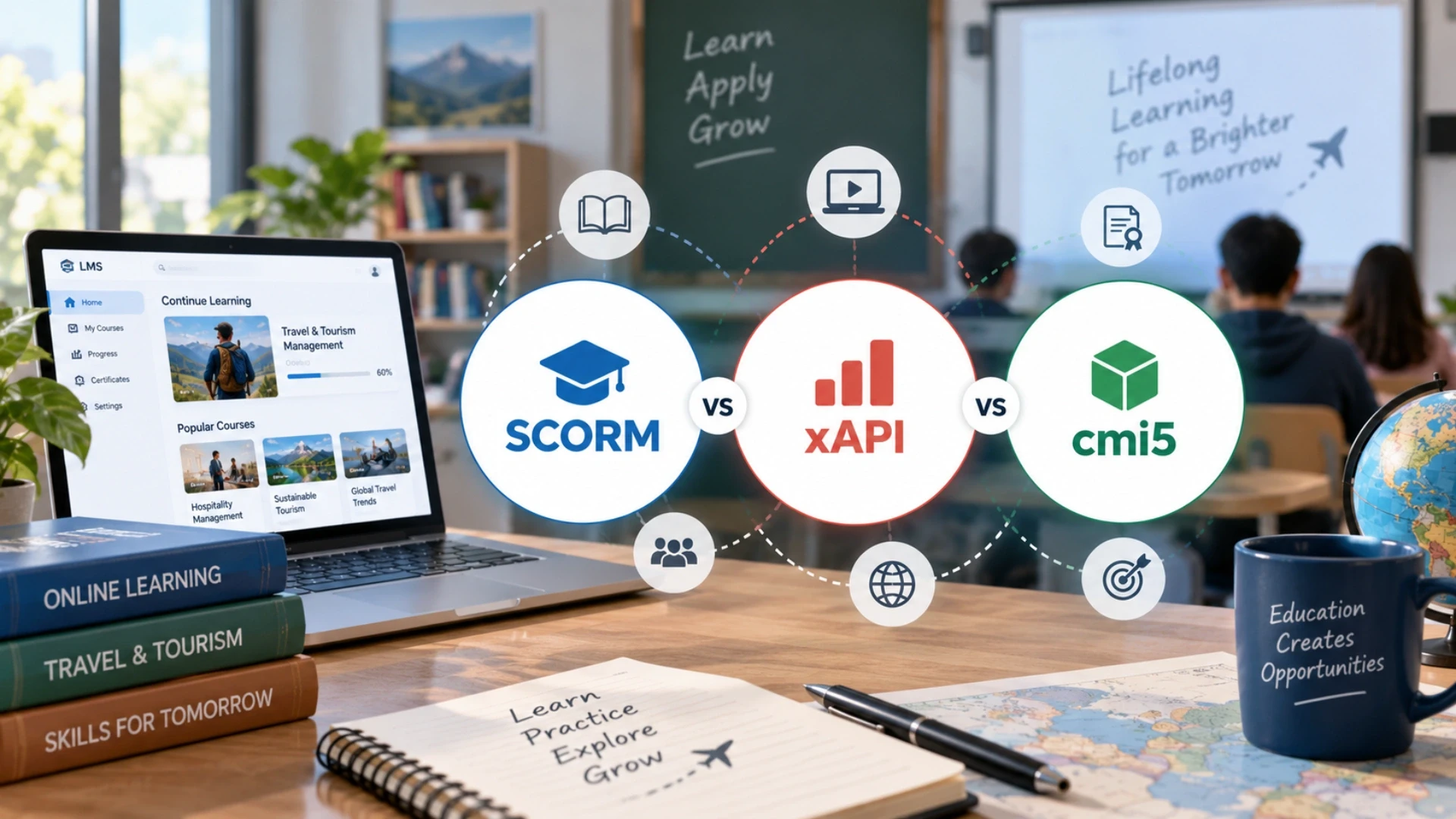
The scorm vs xapi vs cmi5 decision comes down to four questions: what data you need, how content talks to the system, where content can live, and which environments you must support. The table below is the side-by-side view you can use in planning.
Feature | SCORM (1.2 / 2004) | xAPI (Experience API) |
Primary data focus | Basic completion, score, time | Granular actions per learner |
Communication | Browser-to-LMS runtime API | REST API calls sent to an LRS |
Hosting rules | Same server or domain as LMS | Content and data can live anywhere |
Environment | Web browser sessions only | Browser, mobile, AR or VR, offline |
Where cmi5 fits
cmi5 sits between the two. It keeps SCORM-style launch rules and normalized completion, while sending xAPI statements to an LRS. That makes cmi5 the natural target when you want SCORM's structure and xAPI's flexibility at once. Teams often reach this design through software development outsourcing when they lack in-house standards expertise.
What a SCORM-compliant LMS must handle
A SCORM-compliant LMS must import a course zip, read its manifest, launch the content, and capture completion, score and time through the runtime API. A modern platform extends that to xAPI and cmi5 as well. Because the reference tracking engines are often Python or Django services, hire Django developers are a common choice for this layer.
If you are staffing a Python-first build, our guide to hiring Python developers covers what strong candidates look like for education and data-tracking work specifically.
Inside a SCORM package: how compliance really works
A SCORM package is just a zip file with a defined structure, and compliance means your LMS can read and run it correctly. At the centre is imsmanifest.xml, the manifest that tells the LMS what content is inside, how it is organized, and which file to launch. That manifest is the single most useful scorm file example to understand.
A SCORM file example, decoded
Open any SCORM zip and you will find HTML, JavaScript and media, plus imsmanifest.xml at the root. The manifest lists resources, defines the course organization, and points to the launch file. When a learner opens the course, the content runs in the browser and talks to the LMS through a JavaScript runtime API, reading and writing values like completion status, score and session time.
Getting this reader right is precise work. The LMS has to locate the API in the window hierarchy, respond to initialize, get, set and commit calls, and persist that data reliably. This is where hire DevOps and cloud engineers matter, because the runtime has to stay fast and consistent under real traffic.
SCORM Cloud and conformance testing
You do not have to guess whether your content or your LMS conforms. SCORM Cloud, a hosted service from Rustici, plays and validates SCORM, xAPI and cmi5 content, and is the de facto testing ground the industry uses. Running your packages through SCORM Cloud early catches conformance gaps before a client ever does.
Supporting both SCORM 1.2 and 2004 also means handling their differences in sequencing and data models. When older content has to move to newer standards, planned version upgrade services prevent the silent tracking failures that plague rushed migrations. Our note on Python development architecture and frameworks goes deeper on structuring these services cleanly.
How to build a SCORM and xAPI compliant LMS
To build a SCORM and xAPI compliant LMS, you engineer four things: a package importer and manifest parser, a runtime API for SCORM tracking, an LRS or LRS connection for xAPI, and a cmi5 launcher that ties them together. Everything else in the platform sits on top of that spine. This is the core of how to build SCORM xAPI support rather than bolting it on.
The compliance spine, module by module
Good edtech module design separates each concern. The importer unpacks and validates the package. The player launches content and hosts the runtime API. The tracking service normalizes SCORM data and xAPI statements. The LRS stores statements and answers queries. Keeping these as discrete services is sound learning platform engineering because you can scale or replace one without touching the others.
For the LRS, you either integrate a certified store or build one against the xAPI specification. A conformant LRS is what lets you build a learning ecosystem beyond the LMS. A dedicated software development team is usually the right model here, because standards work rewards continuity over a rotating cast.
Frontend, mobile and offline
xAPI is what makes modern education tech implementation possible on mobile and offline, because statements can be stored and forwarded when a device reconnects. A React or React Native client paired with an xAPI service delivers that experience cleanly. When mobile matters, hire MERN stack developers give you one JavaScript stack across the API and the app.
The safe way to build education software is to ship a thin compliant slice first, one course that imports, launches, tracks and reports end to end, then expand. Our Laravel SaaS architecture blueprint shows the same MVP-to-scale discipline applied to a full platform.
Implementation patterns, bridging and pitfalls
Most modern platforms do not choose one standard; they support several through proven patterns. The two that matter most are dual support and bridging. Getting these right is what separates a genuinely compliant LMS from one that merely claims it.
Dual support and bridging technologies
Dual support means the platform functions as a SCORM-compliant LMS, xAPI and cmi5 system at once, processing legacy compliance packages alongside modern event-driven telemetry. Bridging technologies let a legacy SCORM-only LMS ingest xAPI or cmi5 content by using packaging wrappers or delegate mechanisms. These feed fundamental completion metrics to the LMS gradebook while routing deep interaction data to an external LRS.
This bridging pattern is how organisations modernise without discarding a catalogue of SCORM courses. Keeping both paths healthy over time is exactly what ongoing support and maintenance services are for, since each LMS upgrade can disturb plugin and wrapper behaviour.
The pitfalls that quietly break compliance
The common failures are predictable: treating SCORM as plug and play without conformance testing, ignoring the data-model gap between an LMS and an LRS, failing to validate xAPI statements, and running xAPI content on a platform with no LRS. Governance is the deeper trap, because with xAPI your team must agree on verbs, objects and what completion means. Learner records also carry privacy duties, and in the United States that means aligning with FERPA student-privacy guidance from the design stage.
A phased rollout avoids most of this: prove one tracked workflow, add xAPI statements for key outcomes, then standardize vocabularies and dashboards. Our overview of MVP development done well applies the same sequencing so you validate value before scaling scope.
Stuck bridging legacy SCORM with modern xAPI tracking?
Most teams can wrap a package; few get the data model, identity and completion logic to line up across both. That alignment is where compliant analytics is won or lost.
SCORM xAPI LMS development cost and who builds it

A compliant LMS build is best read as a range, not a single figure. A focused MVP with SCORM import, a runtime player, xAPI statements and an LRS connection typically runs from about $60,000 to $140,000 in year one, with hosting on top. Adding cmi5, native mobile and deep analytics moves you toward the upper end. That is the honest shape of SCORM xAPI LMS development cost in 2026.
Build scope | What it includes | Indicative year-1 |
Compliant MVP | SCORM import, player, xAPI, LRS link | $60,000 to $90,000 |
Full platform | cmi5, mobile, analytics, dashboards | $90,000 to $140,000 |
Ongoing ops | Hosting, upgrades, conformance | $3,000 to $8,000 / mo |
Where location changes the maths
Edtech development cost in India, and the wider option to hire developers for SCORM and xAPI work offshore, can reduce build spend by up to 40 percent versus Western agencies without lowering quality. Many teams add education engineers through IT staff augmentation only for the standards-heavy phase, then scale down once the spine is stable.
A custom learning platform India-built or globally-built still needs senior technical direction. A virtual CTO service gives you that oversight without a full-time hire, which matters most when you build education software that must pass conformance and privacy review. Our cost-saving software development tips show how to trim spend without creating technical debt.
How Acquaint Softtech builds compliant learning platforms

Standards are only credible with delivery behind them. A Singapore-based e-learning company hired Acquaint Softtech to build its online education portal from the ground up, and the engagement holds a verified 5.0 out of 5 rating on Clutch across quality, schedule and cost. It shows the same discipline a SCORM and xAPI build demands: clean content structure, reliable tracking, and careful third-party integration.
Stage | What Acquaint Softtech did | Client outcome |
Discovery | Mapped course structure, admin roles and third-party needs | Clear scope for a course portal |
Build | Engineered database architecture and CMS on Django, Python and PostgreSQL | Structured, maintainable platform |
Integrations | Connected Zoom for live sessions, Stripe for payments, Accredible for credentials | One product, not stitched tools |
Assurance | Ran full testing, course configuration and bug fixing | Reliable launch, no rework |
Result | Delivered on time with clear communication and updates | 5.0 / 5 verified on Clutch |
The client, a Singapore e-learning company teaching business skills, needed a portal where students could browse courses, register and pay, plus an admin console to manage courses and users. The stack was Django, Python and PostgreSQL, with Zoom, Stripe and Accredible integrated as first-class parts of the product. That is the same foundation a compliant LMS needs before SCORM and xAPI ever enter the picture: a clean content model and dependable integrations.
Delivery discipline is what makes standards work land on time. Assigning a dedicated project manager for your learning platform is how Acquaint Softtech keeps a 95 percent on-time sprint record across more than 1,300 projects, including data-sensitive education builds.
For teams that want to de-risk a compliant build before committing, a short product discovery workshop turns interoperability requirements into a scoped plan. Our roundup of MVP development companies is a useful reference if you are still choosing a partner.
Need an LMS that passes SCORM, xAPI and privacy review?
Compliance and conformance are where learning platforms stall before launch. A short scoping call turns the standards into a concrete architecture, timeline and budget you can act on.
Frequently asked questions
-
What is the difference between SCORM and xAPI?
SCORM packages and launches a course inside an LMS and tracks basic data like completion, score and time, all within a browser on the LMS domain. xAPI records any learning experience anywhere, including mobile, simulations and offline, as Actor-Verb-Object statements sent to a Learning Record Store. SCORM is structure and portability; xAPI is flexible, granular tracking.
-
How do you create SCORM-compliant content?
Author the course in a SCORM-capable tool, then export it as a zip containing your HTML, JavaScript and media plus an imsmanifest.xml file that defines the structure and launch point. Choose SCORM 1.2 or 2004, then validate the package on a conformance service such as SCORM Cloud before uploading it to your LMS. Testing early prevents tracking failures in production.
-
Which SCORM-compliant LMS is the best?
There is no single best SCORM-compliant LMS; it depends on your goal. Off-the-shelf platforms like TalentLMS or Moodle suit standard training. When the platform is the product you sell, or you need cmi5, deep xAPI analytics and full data ownership, a custom-built compliant LMS is usually the stronger long-term choice. Match the platform to your roadmap, not to a feature list.
-
Is SCORM still relevant?
Yes. SCORM remains widely used for corporate and compliance training because of its portability and near-universal LMS support, and large legacy course catalogues still ship in SCORM format. xAPI and cmi5 extend tracking beyond SCORM's limits, but most organisations run SCORM and xAPI together rather than replacing one with the other. SCORM support is often non-negotiable in real deals.
-
How does SCORM and xAPI work in EdTech?
In EdTech, SCORM lets a course built once run and report on any compliant LMS, while xAPI captures richer learning events across apps, devices and simulations into a Learning Record Store. Together they give portability plus deep analytics, so platforms can prove completion for compliance and also measure how learners actually behave, which supports personalization and outcome reporting.
-
What is the best implementation approach?
Build the compliance spine first: a package importer, a runtime player, an xAPI or LRS connection, and a cmi5 launcher. Ship one course that imports, launches, tracks and reports end to end, validate it on a conformance service, then expand. Decide early who owns the learning record and what completion means, because those choices drive architecture more than the spec itself.
-
What are the best practices for learning platforms?
Keep the importer, player, tracking service and LRS as separate modules, validate every package against a conformance service, and define your xAPI vocabulary before you scale. Design privacy and audit logging in from day one, support both SCORM 1.2 and 2004, and treat interoperability as product work with clear metrics rather than plumbing. These practices prevent costly rebuilds later.
-
How much does a compliant LMS cost to develop?
A focused SCORM and xAPI compliant MVP typically runs from about $60,000 to $90,000 in year one, and a fuller platform with cmi5, mobile and analytics reaches roughly $90,000 to $140,000, plus hosting of about $3,000 to $8,000 per month. Building offshore can reduce those figures by up to 40 percent while keeping quality high. Scope and standards depth drive the final number.
I am Sanjay Parjapati, a developer at heart and a Head of business by work. My journey started with coding and helped me grow towards becoming a head of business which led me to focus on dual skills, i.e. technical know-hows and the business know-hows. My journey of 10+ years has helped me grow immensely from a professional viewpoint.
Table of Contents
Get Started with Acquaint Softtech
- 13+ Years Delivering Software Excellence
- 1300+ Projects Delivered With Precision
- Official Laravel & Laravel News Partner
- Official Statamic Partner
Related Blog
.webp "MVP Chapter #9: MVP Development Cost")
MVP Chapter #9: MVP Development Cost
A typical MVP development cost ranges from $10,000 to $60,000 for basic to medium-complexity applications, while complex or AI-enabled builds often exceed $100,000. A simple MVP runs about $8,000 to $25,000, a medium MVP $25,000 to $60,000, and a complex or AI MVP $60,000 to $150,000+. At Acquaint Softtech, fixed-project MVP development starts from $5,000, and hiring a remote team can cut your costs by 40 to 60%.

Mukesh Ram
October 31, 2022.webp "MVP Chapter #5: MVP - Meaning, Purpose & Real-life Examples")
MVP Chapter #5: MVP - Meaning, Purpose & Real-life Examples
An MVP (Minimum Viable Product) is the most basic version of a new product that has just enough core features to work, solve a primary user problem, and satisfy early customers. Famous MVP examples include Dropbox (a demo video), Airbnb (air mattresses and a simple site), Amazon (a bare-bones online bookstore), and Uber (a basic iPhone app for a few black-car drivers). The pattern is the same: test demand cheaply, then scale.
Mukesh Ram
August 25, 2022
Top React Native App Development Companies
React Native is an open-source JavaScript framework developed by Meta, widely used for building high-performance. According to Statista, React Native holds a 32% market share, making it the most widely used cross-platform mobile framework globally with brands like Facebook, Instagram, and Shopify relying on it for production-grade mobile experiences. This growing adoption has made finding a reliable React Native development company a top priority for businesses aiming to deliver scalable, native-like applications faster.
However, searching for the top React Native app development companies often surfaces hundreds of vendors claiming similar expertise - making evaluation frustrating for founders and product teams. To simplify this, we reviewed 100+ React Native service providers across Clutch, GoodFirms, and industry directories, shortlisting firms with 10+ years of experience, verified client feedback, and proven large-scale mobile project delivery.

Acquaint Softtech
April 8, 2026India (Head Office)
203/204, Shapath-II, Near Silver Leaf Hotel, Opp. Rajpath Club, SG Highway, Ahmedabad-380054, Gujarat
USA
7838 Camino Cielo St, Highland, CA 92346
UK
The Powerhouse, 21 Woodthorpe Road, Ashford, England, TW15 2RP
New Zealand
42 Exler Place, Avondale, Auckland 0600, New Zealand
Canada
141 Skyview Bay NE , Calgary, Alberta, T3N 2K6