

How to Manage Remote Teams? (2027 Update)
Effective remote team management focuses on results over physical presence, clear communication norms, and structured digital workflows. Measure success by outcomes, not hours; embrace asynchronous communication; build a documentation-first culture; nurture trust and autonomy; and create intentional connection. Pair this with the right tools for chat, task tracking, video, and cloud docs, and a remote team can match or beat an in-house one.

Mukesh Ram
As the Founder and CEO at Acquaint Softtech, a leading IT staff augmentation and remote team company, I have helped businesses across the USA, UK, Europe, Australia, and New Zealand build and manage remote teams for over a decade. Managing remote developers is different from managing an on-site team and requires a specific skill set. A remote team is a group of professionals working from another location, sometimes another country, and in many ways it is comparable to outsourcing.
Managing a remote team covers the same work as managing an on-site one, such as project management, deadlines, and work culture. On top of that come challenges like geographic separation, limited face-to-face contact, time-zone gaps, and building trust. A good remote manager is self-aware, proactive, detail-oriented, and able to build rapport, no matter where the team sits.

- You manage, or plan to manage, a remote or distributed team.
- You are a CEO, CTO, COO, or founder scaling with remote talent.
- You want practical tips, tools, and best practices that work.
- You want to reduce meetings and move to async workflows.
- You want to build trust and accountability across time zones.
- You want a proven remote-team partner to extend your bench.
If you have searched how to manage remote teams on Reddit, read an all-remote handbook, or looked at a remote work handbook and remote work policy from well-known distributed companies, you already know the patterns repeat: write things down, trust your people, and measure output. Even structured learning, like a strategic management course or a leading people and teams' course, points to the same core ideas.
A simple remote work policy format, agreed up front, removes most day-to-day friction. If you would rather get a ready-to-run team instead of building the playbook alone, our dedicated software development teams come with proven remote processes built in.
Want a remote team that just works?
Share your needs with Acquaint Softtech. You get vetted developers, proven remote workflows, and clear communication, deployable within 48 hours, with no obligation.
What is Remote Team Management?

Remote team management is the practice of leading, coordinating, and supporting a team that works from different locations rather than a shared office. It covers the usual management work, project planning, deadlines, and culture, plus the extra realities of distance, time zones, and trust. The demand for it keeps growing, as these numbers show:
The global business outsourcing market is expected to grow to $525 billion by 2030.
IT Services account for over 72% of the global outsourcing contracts.
92% of G2000 companies prefer hiring remote developers.
60% of firms trust remote developers for the development of their mobile app.
Core Principles and Strategies
Effective remote management rests on five principles: outcomes over hours, async communication, documentation-first culture, trust and autonomy, and intentional connection.
Focus on outcomes: measure success by deliverables, impact, and completed tasks rather than hours logged at a desk.
Embrace asynchronous communication: cut constant meetings and video fatigue with documented updates, shared trackers, and flexible response windows, such as a four-hour reply to expectation.
Build a documentation-first culture: store workflows, decisions, and processes in one central place so people work independently across time zones.
Nurture trust and autonomy: avoid micromanaging, set clear expectations, let people manage their energy peaks, and step in early if performance slips.
Intentional connection: start syncs with brief socializing, schedule regular one-on-ones, and keep a channel for recognition or casual talk.
These principles are exactly how our software development outsourcing model keeps distributed projects on track.
Types of Challenges in Managing Remote Teams

Managing a remote team brings a specific set of challenges that an on-site manager rarely faces. Knowing them in advance is half the battle:
Adapting to the lack of face-to-face communication and using a suitable tool instead.
Ensuring you hire a remote team with the right skills.
Accountability.
Allowing for more flexibility with schedules.
Performance tracing.
Culture.
Team building.
Difference in time zones of the remote team.
Security and privacy.
Technical issues.
Conflict resolution.
It is more challenging to enforce your rules.
Communicating the company values and mission.
Find a project management tool that simplifies remote team management.
Conflict resolution in particular is a skill worth investing in, and short conflict management training for your leads pays for itself. If you would rather extend your team with people already used to remote work, our staff augmentation services place vetted engineers within 48 hours.
Struggling to manage a remote team alone?
Tell Acquaint Softtech your goals, and we will give you a remote team with built-in processes, clear reporting, and a manager who keeps delivery on track.
12 Tips to Be a Great Remote Manager

Here are twelve practical tips for managing remote teams effectively.
Define boundaries: agree on working hours, overlap windows, and when people are off, so no one burns out.
Preventive measures for technical issues: plan for outages, backups, and access problems before they happen.
Embrace diversity: respect cultural differences across a global team and make them a strength.
Clarify your preferences in advance: set communication and reporting expectations from day one.
Set up video chat infrastructure: use video for the conversations that need a human face.
Availability: be reachable within a known window so people are not blocked.
Establish trust: give autonomy and judge results, not screen time.
Build a rapport: use team activities and check-ins to build real relationships. Even simple virtual activities tied to a milestone anniversary - such as team recognition moments, online trivia, or digital awards - can help remote employees feel more connected. Companies marking a company's founding year often use these moments to reinforce culture, recognize contributions, and maintain engagement across remote teams.
Project management tools: pick a tool that makes work, deadlines, and ownership visible.
Use technology wisely: adopt tools that help and avoid tool overload.
Communicate frequently and prioritize accountability: good communication is the single biggest driver of a successful remote project.
Motivate and stay alert for red flags: recognize good work, and watch for poor communication, irregular reporting, chronic overwork, and low motivation.
Best Practices for Remote Team Management
Beyond day-to-day tips, these best practices keep a remote team healthy over the long run:
Build a good rapport: relationships are the foundation of trust.
Appreciate the good effort: give regular feedback and recognition.
Preventive measures: anticipate problems before they grow.
Stress the need for security: set up security rules and compliance early.
Hire a team that is easy to work with: fit with your organization matters as much as skill.
Check in frequently: regular check-ins keep everyone aligned.
Take advantage of technology: let tools do the heavy lifting.
Make the most of your dedicated team: give them ownership and the full picture.
Avoid communication confusion: one source of truth, clear channels.
Software and tools: standardize the stack so everyone works the same way.
Culture also travels across distance when you mark shared milestones together, like celebrating a company's founding year, so remote teammates still feel part of the story.
A written remote work policy, in a simple shared format, turns these practices into habits the whole team follows. Our virtual CTO services can set up that playbook and the tech standards for you.
Essential Remote Management Tools
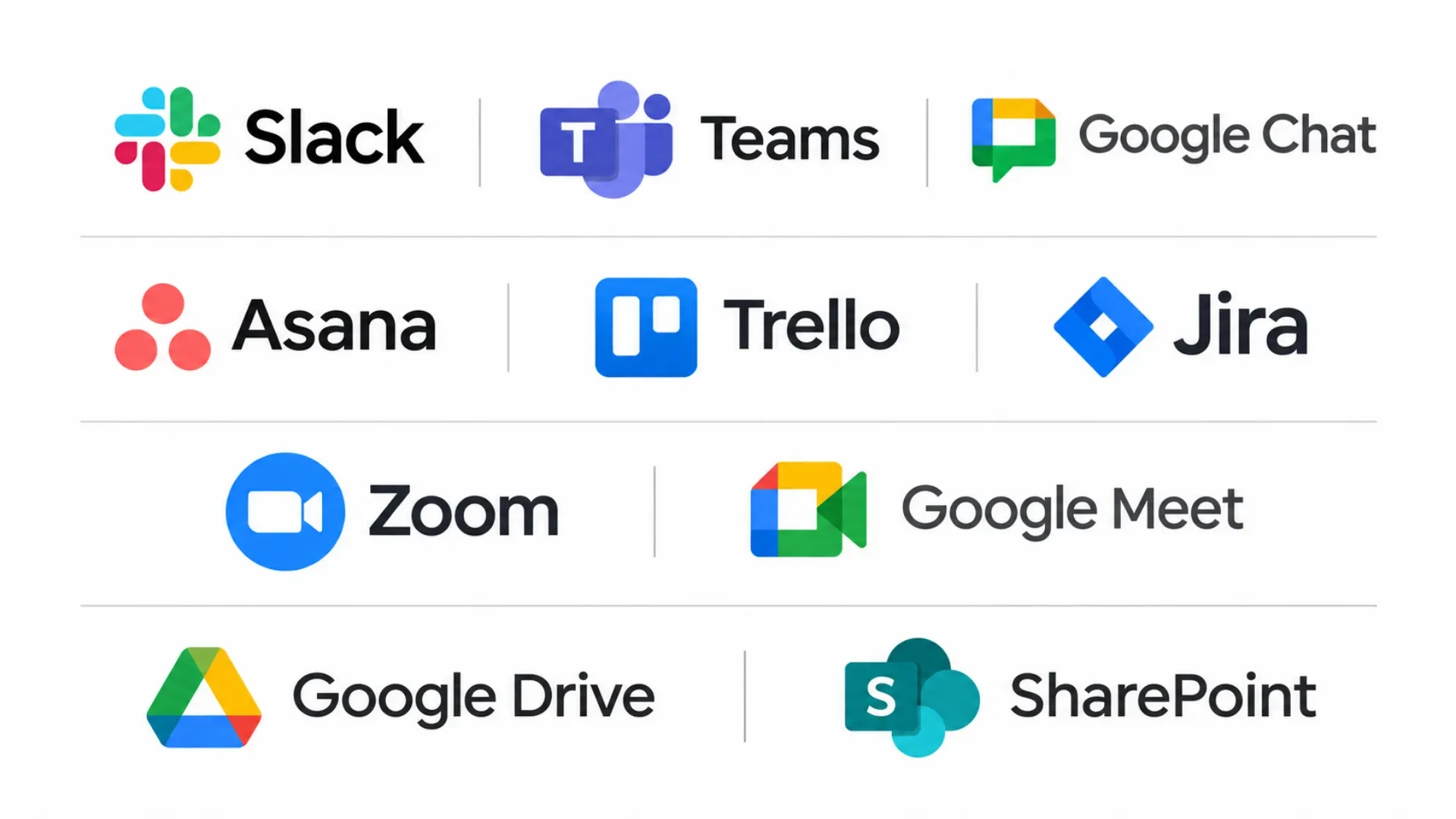
The best tools for managing remote teams fall into four groups: real-time chat, task tracking, video, and cloud docs.
Category | Examples | What It Does |
Real-time communication | Slack, Teams, Google Chat | Daily chat and group discussion |
Project and task tracking | Asana, Trello, Jira | Visualize workflows and deadlines |
Video conferencing | Zoom, Google Meet | Face-to-face syncs and screen share |
Cloud storage and docs | Google Drive, SharePoint | Real-time collaboration and versions |
Pick one tool per category and stick with it; tool sprawl creates the confusion you are trying to avoid. If you want the people as well as the process, you can hire remote developers from Acquaint Softtech who already work this way.
The 5 C's of a Team
The 5 C's of a team are communication, coordination, cooperation, commitment, and conflict resolution. They matter even more on a remote team, where none of them happen by accident.
Communication: clear, frequent, and mostly written so nothing gets lost.
Coordination: aligned goals, owners, and deadlines across time zones.
Cooperation: people help each other instead of working in silos.
Commitment: shared ownership of outcomes, not just tasks.
Conflict resolution: disagreements handled openly and early, before they fester.
How to Communicate with Remote Teams
To communicate effectively with a remote team, default to written and asynchronous communication, use video for the hard conversations, and keep one source of truth.
Write it down: document decisions and updates so anyone can catch up anytime.
Set response norms: agree on reply windows, such as four hours, instead of expecting instant replies.
Use the right channel: chat for quick things, docs for detail, video for nuance and conflict.
Over-communicate context: remote teams miss hallway cues, so share the why, not just the what.
Close the loop: confirm understanding and next steps in writing after every key talk.
Want proven remote communication built in?
Tell Acquaint Softtech your project, and our teams bring documented workflows, clear reporting, and a manager who keeps everyone aligned across time zones.
Case Study: A Verified Remote-Team Partnership
The real proof of remote management is a partnership that lasts. Since our founding in 2013, Acquaint Softtech has run long-term remote teams for clients worldwide, with processes refined over more than a decade. Here is a simple snapshot, drawn from our verified reputation on Clutch.
Client | Founders and CTOs needing a reliable remote dev team. |
What we provided | Dedicated remote developers with a manager and clear reporting. |
How we worked | Outcome-based delivery, async updates, and documented workflows. |
Why it worked | Vetted talent, built-in processes, and overlap across time zones. |
Result | Long-term partnerships, on-time delivery, and up to 60% cost savings. |
Company-wide proof: Acquaint Softtech has delivered 1,300+ projects over 13+ years with 70+ in-house engineers and a 5-star rating across 80+ reviews on Clutch, as an Official Laravel and Statamic Partner. Explore more partnerships on the case studies page.
Why Choose Acquaint Softtech for Your Remote Team

Choose a partner that has run remote teams since 2013 and has the processes to prove it, and Acquaint Softtech is exactly that. Most clients save 60 to 75% versus hiring equivalent talent locally, without losing control.
Proven remote processes: documented workflows, clear reporting, and time-zone overlap.
Verified trust: 5-star Clutch rating across 80+ reviews and 1,300+ delivered projects.
In-house talent: 70+ full-time engineers, deployable within 48 hours.
Global reach: serving founders across the USA, UK, Europe, Australia, and New Zealand.
If you want to try the model before scaling, you can hire Laravel developers from Acquaint Softtech and expand once you see the fit.
To Sum Up
Effective remote management is not a one-time setup; it is an ongoing practice that rewards adaptability, clear communication, and trust. Focus on outcomes, write things down, give your people autonomy, and keep the human connection alive, and distance stops being a disadvantage.
If you would rather not build and manage a remote team from scratch, Acquaint Softtech can provide one that is already productive from day one. We have the developers, the processes, and the experience to make remote work work for your business.
Ready to make remote work for your business?
Talk directly with Acquaint Softtech's founder in a free 30-minute session. You will leave with a clear plan, the right team model, a realistic budget, and honest advice.
Frequently Asked Questions
-
What are 12 tips for managing remote teams effectively?
Define boundaries, plan for technical issues, embrace diversity, clarify preferences in advance, set up video chat, stay available, establish trust, build rapport, use project management tools, use technology wisely, communicate frequently with accountability, and motivate your team while watching for red flags.
-
What tools are best for managing remote teams?
Use one tool per category: Slack, Microsoft Teams, or Google Chat for real-time chat; Asana, Trello, or Jira for task tracking; Zoom or Google Meet for video; and Google Drive or SharePoint for cloud docs and version control. Standardizing the stack avoids confusion.
-
What are the 5 C's of a team?
The 5 C's are communication, coordination, cooperation, commitment, and conflict resolution. On a remote team, each one must be built deliberately, because none of them happen on their own without a shared office.
-
How do I effectively communicate with remote teams?
Default to written, asynchronous updates, agree on response windows such as four hours, use the right channel for each message, over-communicate context, and confirm next steps in writing. Save video for nuanced or difficult conversations.
-
How do you best manage a remote team?
Offer flexibility with working hours, motivate and reward team members, clarify terms of availability, communication, and reporting from the start, and invest in professional project management tools.
-
What are some best practices for setting expectations in remote teams?
Define roles, responsibilities, and deadlines clearly, agree on communication and reporting norms up front, and put them in a simple written remote work policy so everyone follows the same rules.
-
What are the key challenges in managing remote teams?
The main challenges include a lack of face-to-face contact, hiring the right skills, accountability, performance tracking, time-zone differences, security, technical issues, conflict resolution, and communicating company values across distance.
-
What is the role of a remote manager in promoting work-life balance?
A remote manager should respect non-working hours, encourage flexible schedules, discourage chronic overwork, and watch for burnout, so the team stays healthy and productive over the long term.
-
How do I handle conflicts and disagreements in a remote team?
Handle conflicts through open, early communication, ideally over video so tone is clear. Short conflict-management training for your leads helps, and documenting decisions prevents many disputes in the first place.
-
Why is it important to manage a remote team?
Good remote management turns a distributed group into a high-performing team. It keeps delivery on time, protects quality and security, builds trust, and lets you access global talent at a lower cost than local hiring.
I love to make a difference. Thus, I started Acquaint Softtech with the vision of making developers easily accessible and affordable to all. Me and my beloved team have been fulfilling this vision for over 15 years now and will continue to get even bigger and better.
Table of Contents
Get Started with Acquaint Softtech
- 13+ Years Delivering Software Excellence
- 1300+ Projects Delivered With Precision
- Official Laravel & Laravel News Partner
- Official Statamic Partner
Related Reading

How much will your web app development cost?
Web application development cost typically ranges from $15,000 to $200,000+ globally (roughly £15,000 to £150,000+ in the UK), depending on scope, features, and team location. A simple MVP runs $10,000 to $50,000, a mid-scale business web app $50,000 to $150,000, and a complex or enterprise platform $150,000 to $300,000+. Hiring a remote team can cut labor costs sharply, and at Acquaint Softtech, an MVP can reduce your project cost by up to 60%.
Mukesh Ram
November 11, 2022
Is Laravel Fit For Your Web Development Project?
Laravel website development involves using a powerful PHP framework to build fast, secure, and custom web applications. Its key features include the Eloquent ORM, Blade templating, strong built-in security, and a rich ecosystem (Livewire, starter kits). It is a great fit for custom business portals, online stores, SaaS platforms, and APIs, which is why it remains the most popular PHP framework in 2026.
Mukesh Ram
November 9, 2022
An Ultimate Guide To Develop Your Own Online Marketplace
Online marketplace development is the process of building a multi-vendor digital platform where third-party buyers and sellers interact, list products or services, and complete transactions. To build one, define your niche, solve the chicken-and-egg problem by acquiring sellers first, choose your technology (turnkey or custom), integrate secure split payments, then test and launch. Popular examples include Amazon, eBay, and Etsy.
Mukesh Ram
November 16, 2022India (Head Office)
203/204, Shapath-II, Near Silver Leaf Hotel, Opp. Rajpath Club, SG Highway, Ahmedabad-380054, Gujarat
USA
7838 Camino Cielo St, Highland, CA 92346
UK
The Powerhouse, 21 Woodthorpe Road, Ashford, England, TW15 2RP
New Zealand
42 Exler Place, Avondale, Auckland 0600, New Zealand
Canada
141 Skyview Bay NE , Calgary, Alberta, T3N 2K6