

Industry-Specific Python Development Why One Size Fails
Why generic Python development fails across industries in 2026. How healthcare, FinTech, SaaS, and other verticals demand domain-specific architecture.

Acquaint Softtech
Introduction: The Most Expensive Assumption in Software Development
There is a quiet assumption behind most failed software projects: that a good engineering team can build a good product in any industry. The logic feels reasonable. Python is Python. A REST API is a REST API. Databases store data the same way whether the data is medical records or shipping manifests. So a team that built a solid eCommerce platform should be able to build a solid healthcare platform, and a developer who shipped a logistics dashboard should be able to ship a FinTech transaction system. This assumption is wrong, and it is one of the most expensive mistakes a company can make. The technology is genuinely transferable. The domain knowledge that determines whether the technology is applied correctly is not.
The broader software industry has already reached this conclusion. According to a 2026 analysis of why vertical SaaS is winning published by BalTech, generic software is breaking under industry complexity, and while over 80% of organizations now rely on multiple SaaS tools, businesses increasingly find that generic tools no longer meet industry-specific requirements. The same analysis stresses that security in regulated verticals is regulation-driven rather than generic, and that security-by-design has become mandatory in 2026. The market is moving away from one-size-fits-all software precisely because the cost of generic approaches in specialized industries has become impossible to ignore.
This guide explains why one-size-fits-all Python development fails, how requirements actually differ across industries, what the hidden cost of generic development looks like in real numbers, and what genuine industry-specific Python development involves. It is written for founders, CTOs, and technology decision-makers choosing a Python development partner or team, and trying to understand why the cheapest generalist quote almost always turns into the most expensive project once the domain-specific requirements surface.
If you are evaluating who should build your industry-specific Python product, the complete guide to hiring Python developers in 2026 sets the wider framework for evaluating engineers, engagement models, and the domain depth that industry work requires.
Why One-Size-Fits-All Python Development Fails
The failure of generic development is not just a quality problem. It is an economics problem. According to a 2026 analysis of vertical specialization by GTM Playbooks, vertical-focused companies spend roughly half as much on sales and marketing per dollar of revenue as horizontal providers, and industry-specialized service firms command higher pricing power because the combination of domain expertise and implementation track record is genuinely scarce. The same analysis observes that generic capability is becoming a commodity, while deep, compounding, industry-specific knowledge is what creates durable competitive advantage. Generic Python development competes on price. Industry-specific Python development competes on outcomes, and outcomes are what regulated, complex industries actually pay for.
The Five Ways Generic Python Development Breaks Down
It misses the compliance requirements until it is too late. A generalist builds a healthcare analytics platform without designing in HIPAA audit logging, then discovers the entire data layer must be reworked before it can be used commercially. The compliance was never optional. It just was not known.
It models the domain wrong. A logistics platform built without understanding multi-carrier reconciliation, or a FinTech system built without double-entry ledger discipline, encodes wrong assumptions into the schema. Schema mistakes are the most expensive to fix because they touch everything built on top.
It optimizes for the wrong constraints. A generalist optimizes a medical platform for the wrong thing, building elaborate features while underinvesting in the de-identification boundary and audit trail that the domain actually requires. Effort goes where the team is comfortable, not where the domain needs it.
It cannot anticipate what will break. Domain experience is largely the accumulated knowledge of what goes wrong. A team that has shipped FinTech knows that idempotency prevents double charges. A team that has not will learn it during a production incident.
It produces a product that fails review. The platform demos well and then fails the compliance audit, the security review, or the first real-world stress test, because the requirements that matter in that industry were invisible to a team without domain context.
How Python Requirements Actually Differ by Industry
The clearest way to see why one size fails is to look at how dramatically the actual engineering requirements differ across industries. The Python language is the same in each. The architecture, compliance posture, data model, and operational priorities are almost completely different. The table below maps the defining requirement of each industry that Acquaint Softtech builds in, and each links to a detailed breakdown of that vertical.
Table : How the Defining Python Requirement Changes by Industry
Industry | Defining Requirement | What Breaks Without Domain Knowledge |
|---|---|---|
Healthcare | HIPAA/GDPR, de-identification, audit | PHI leaks, failed audits, data access loss |
FinTech | Idempotency, double-entry ledger, PCI | Double charges, lost money, compliance failure |
SaaS | Multi-tenancy, subscription billing | Tenant data leaks, billing chaos at scale |
EdTech | Multi-role, video delivery, live cohorts | Broken permissions, cohort-day outages |
Logistics | Carrier APIs, real-time pipelines | Stale data, sync failures, oversells |
eCommerce | Payments, inventory, reconciliation | Oversells, payout disputes, lost revenue |
PropTech | MLS/RESO, IDX rules, geospatial | Stale listings, IDX violations, lost MLS access |
Healthcare is the clearest example. A medical analytics platform lives or dies on compliance-first architecture: de-identification at a hard boundary, audit logging on every read, and encryption everywhere. The Python healthcare analytics case study for BIANALISI, a GDPR-compliant predictive diagnostics platform delivered for Italy's largest diagnostics group, shows how compliance-first design produced earlier-than-expected cluster detection rather than a platform that failed its first regulatory review.
FinTech, SaaS, logistics, eCommerce, and PropTech each carry their own defining constraint, and each demands a different architectural foundation. The framework that maps these patterns across verticals is covered in the Python development architecture and frameworks guide, which walks through how Django, FastAPI, and the broader Python stack adapt to the specific demands of healthcare, FinTech, SaaS, EdTech, and logistics rather than applying one generic template to all of them.
Need a Python Partner With Real Depth in Your Industry?
Acquaint Softtech has shipped production Python platforms across healthcare, FinTech, SaaS, EdTech, logistics, eCommerce, and PropTech, with senior engineers who carry the domain knowledge each vertical demands: HIPAA and GDPR compliance, PCI-aligned transaction systems, multi-tenant SaaS, MLS integration, and real-time logistics pipelines. Profiles in 24 hours. Onboarding in 48.
The Hidden Cost of Generic Development
The reason generalist quotes look attractive is that they price the visible work and ignore the domain-specific work that has not surfaced yet. By the time the compliance requirements, the domain edge cases, and the industry-specific integrations become visible, the cheap generalist project has become the expensive rework project. The numbers below are the ones that consistently surprise companies who chose the lowest quote.
Table : The Real Cost Difference Between Generic and Industry-Specific Python
Cost Factor | Impact | Source / Benchmark |
|---|---|---|
Regulated industry premium | 20 to 35% more than non-regulated | TechAhead 2026 enterprise analysis |
Healthcare software premium | 30 to 50% more than comparable apps | Industry custom software data |
Compliance retrofit cost | 2 to 3x the cost of designed-in | Acquaint engagement data |
FinTech/healthcare floor | $40,000 to $60,000 minimum regardless of scope | Compliance-driven minimum |
Specialization rate premium | 20 to 40% over baseline developer rates | PCI-DSS, HIPAA, AI/ML expertise |
The regulated-industry premium is real and well documented. A Python FinTech or healthcare application requiring HIPAA, GDPR, PCI-DSS, or SOC 2 compliance architecture should cost meaningfully more than a comparable non-regulated application, and a vendor who quotes the same price for both is either absorbing the cost or, far more dangerously, not designing the compliance in at all. The full breakdown of this pricing signal is covered in the analysis on when Python development is too expensive and the pricing red flags to watch, which explains why a suspiciously low quote in a regulated industry is the most expensive option on the table.
The same logic applies to developer rates. Industry-specific expertise commands a premium because it prevents the failures that cost exponentially more than the rate difference saved. The detail on how compliance and domain specialization affect what you pay is covered in the analysis on what you are actually paying for in a Python developer hourly rate, which shows why a developer who has shipped in your specific industry is worth more than one who knows the framework from a tutorial.
What Industry-Specific Python Development Looks Like in Practice
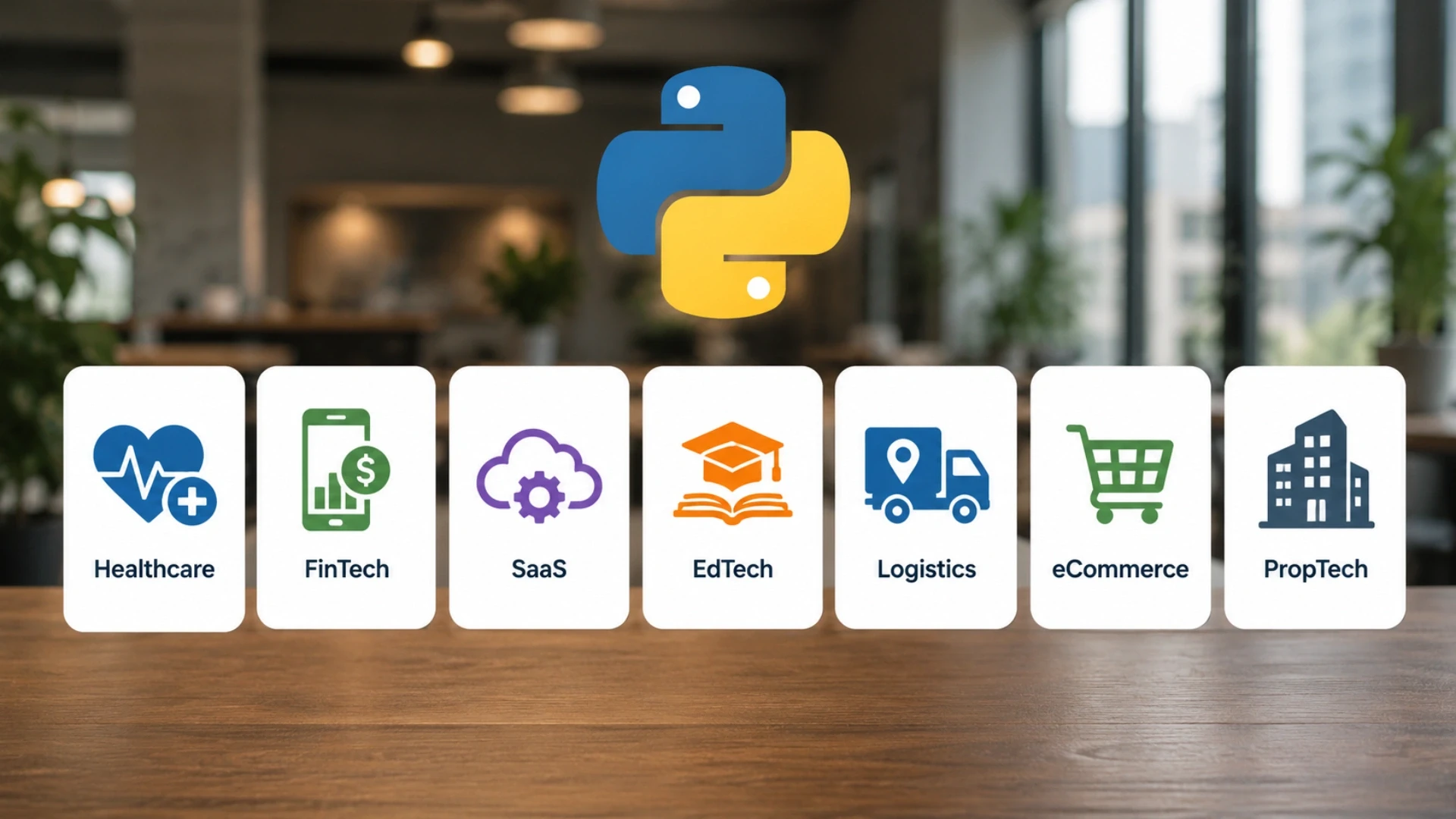
Industry-specific Python development is not about using different libraries. It is about a team that carries the accumulated knowledge of what matters and what breaks in a specific domain, and applies that knowledge from the first architectural decision. The difference shows up in five concrete ways that a generalist team cannot easily replicate.
Compliance designed in, not retrofitted. The team knows the regulatory framework (HIPAA, PCI-DSS, GDPR, RESO, COPPA) before the first schema is drawn, and builds the audit logging, access control, and data handling into the architecture from day one. This alone saves the 2 to 3x cost of retrofitting compliance later.
Domain-correct data models. Double-entry ledgers in FinTech. Canonical MLS models in PropTech. De-identified analytical stores in healthcare. Multi-tenant isolation in SaaS. The data model reflects how the industry actually works, not a generic template adapted under deadline pressure.
The right integrations done right. Carrier APIs in logistics, payment providers in eCommerce, EHR and FHIR in healthcare, MLS and IDX in PropTech. The team knows the integration landscape, the failure modes, and the abstractions that make adding the next provider a two-day task instead of a six-week refactor.
Anticipation of the domain edge cases. Idempotency before the double-charge incident. Inventory locking before the oversell. Freshness SLAs before the stale-listing complaint. Domain experience is largely the knowledge of what goes wrong, applied before it does.
Outcome-aligned architecture. The platform is designed around the actual question the industry asks (early cluster detection in diagnostics, transaction success in FinTech, occupancy and cap rate in PropTech) rather than around a generic dashboard that surfaces everything and answers nothing fast.
This is why specialization is a quality signal when choosing a Python development partner. A company that claims to do everything has made no choices about where to build depth. The framework for evaluating genuine domain depth versus surface-level breadth is covered in the analysis on what to look for when hiring a Python development company, which explains why deliberate specialization in specific verticals consistently produces better outcomes than a generalist who treats every industry the same.
How Acquaint Softtech Delivers Industry-Specific Python Development
Acquaint Softtech is a Python development and IT staff augmentation company based in Ahmedabad, India, with 1,300+ software projects delivered globally across healthcare, FinTech, SaaS, EdTech, eCommerce, logistics, and PropTech. Our engagements follow the framework described in the complete guide to hiring Python developers, with senior engineers who carry genuine domain depth in specific verticals rather than treating every industry as a generic web project.
Domain depth across seven major verticals. Healthcare (GDPR-compliant diagnostics for BIANALISI, Italy's largest diagnostics group), FinTech (PCI-aligned transaction systems), SaaS (multi-tenant platforms), EdTech (multi-role learning platforms), logistics (carrier API pipelines), eCommerce (custom marketplaces), and PropTech (MLS-integrated platforms).
Compliance-first engineering as a default. HIPAA, GDPR, PCI-DSS, and SOC 2 patterns built into the architecture from day one, with the audit-grade discipline that regulated industries require and the 2 to 3x retrofit cost they avoid.
Senior engineers with shipped-in-the-industry experience. Not framework familiarity from a tutorial, but production experience shipping in the specific vertical, which is the difference between anticipating the domain edge cases and learning them during a production incident.
Transparent pricing from $20/hour. Dedicated Python engineering teams from $3,200/month per engineer. Industry-specific architecture audits and compliance reviews from $5,000.
To bring senior Python engineers with genuine depth in your specific industry onto your project quickly, you can hire Python developers with profiles shared in 24 hours and a defined onboarding plan within 48.
The Bottom Line
One size fails in Python development because the language is the smallest part of the problem. The architecture, compliance, data model, integrations, and operational priorities differ so dramatically across industries that a team without domain depth encodes wrong assumptions into the foundation, misses the requirements that matter, and produces a platform that demos well and then fails the audit, the security review, or the first real-world stress test. The technology is transferable. The domain knowledge that determines whether the technology is applied correctly is not.
The companies that get the most from Python in specialized industries are the ones that stopped looking for the cheapest generalist and started looking for genuine depth in their specific vertical. They pay the specialization premium because it is the cheapest insurance against the failures that domain-blind development guarantees. Generic capability is becoming a commodity. Deep, compounding, industry-specific knowledge is the scarce thing that determines whether a regulated, complex product succeeds. In Python development, as in the industries it serves, one size does not fit all, and pretending otherwise is the most expensive assumption a company can make.
Building Something in a Specialized Industry?
Book a free 30-minute consultation. Tell us your industry and what you are building, and we will give you a straight assessment of the domain-specific requirements that matter, the compliance and architecture decisions that cannot wait, and how a team with real depth in your vertical approaches the build. No sales pitch. Just senior engineers who have shipped in your industry before.
Frequently Asked Questions
-
Why does industry-specific Python development matter if Python is the same language everywhere?
Because the language is the smallest part of the problem. The architecture, compliance posture, data model, integrations, and operational priorities differ dramatically across industries. A healthcare platform needs de-identification and audit logging. A FinTech system needs idempotency and double-entry ledgers. A PropTech platform needs MLS integration and IDX compliance. The Python is transferable; the domain knowledge that determines whether the Python is applied correctly is not, and that knowledge is what separates a platform that passes review from one that fails it.
-
Can a generalist Python team build a good product in any industry?
They can build a product that demos well and then fails the compliance audit, security review, or first real-world stress test, because the requirements that matter in that industry were invisible to a team without domain context. Domain experience is largely the accumulated knowledge of what goes wrong, applied before it does. A generalist team learns the domain edge cases during production incidents. A specialized team designed around them from the first architectural decision.
-
How much more does industry-specific Python development cost?
A regulated industry application (healthcare, FinTech) should cost 20 to 35% more than a comparable non-regulated application, and healthcare software specifically often costs 30 to 50% more, because of the compliance architecture, security hardening, and senior domain expertise required. FinTech and healthcare Python platforms carry a compliance-driven minimum of roughly $40,000 to $60,000 regardless of feature scope. A vendor quoting the same price for regulated and unregulated work is usually not designing the compliance in at all.
-
Why is a suspiciously cheap quote in a regulated industry a red flag?
Because the compliance work is not optional, so a quote that omits it means one of two things: either the vendor is absorbing the cost into their margin, or far more commonly, they are not building the compliance in at all and will deliver an application that cannot be used commercially in a regulated industry. Retrofitting compliance later costs 2 to 3 times what designing it in would have, because it requires touching code across every layer. The cheap quote becomes the most expensive project.
-
What industries does Acquaint Softtech have Python depth in?
Healthcare (including GDPR-compliant diagnostics for BIANALISI, Italy's largest diagnostics group), FinTech (PCI-aligned high-volume transaction systems), SaaS (multi-tenant platforms scaling to large subscriber bases), EdTech (multi-role e-learning platforms), logistics and supply chain (carrier API and real-time pipeline systems), eCommerce (custom marketplaces and automation), and PropTech (MLS-integrated real estate platforms). Each vertical carries its own defining requirement and architectural foundation, built by engineers with production experience in that domain.
-
How do I tell if a Python development company has real depth in my industry?
Ask for case studies in your specific vertical, and probe whether they understood the domain-specific requirements (compliance frameworks, data models, integrations, edge cases) or just the technology. A company that claims to do everything has made no choices about where to build depth, which is itself a signal. Genuine specialization shows up in how quickly they identify the requirements that matter in your industry, and whether they can describe the failures they have seen and prevented in that domain.
-
Is it worth paying the industry-specialization premium?
Almost always, in regulated or complex industries. The 20 to 40% premium for domain expertise prevents failures that cost exponentially more: failed compliance audits, security breaches, schema rewrites, and the 2 to 3x cost of retrofitting compliance that was never designed in. In a non-regulated, conventional application, a generalist may be perfectly adequate. In healthcare, FinTech, PropTech, or any industry where domain-specific requirements determine whether the product can be used at all, the premium is the cheapest insurance available.
We’re Acquaint Softtech, your technology growth partner. Whether you're building a SaaS product, modernizing enterprise software, or hiring vetted remote developers, we’re built for flexibility and speed. Our official partnerships with Laravel, Statamic, and Bagisto reflect our commitment to excellence, not limitation. We work across stacks, time zones, and industries to bring your tech vision to life.
Table of Contents
Get Started with Acquaint Softtech
- 13+ Years Delivering Software Excellence
- 1300+ Projects Delivered With Precision
- Official Laravel & Laravel News Partner
- Official Statamic Partner
Related Blog
How to Hire Python Developers Without Getting Burned: A Practical Checklist
Avoid costly hiring mistakes with this practical checklist on how to hire Python developers in 2026. Compare rates, vetting steps, engagement models, red flags, and more.
Acquaint Softtech
March 30, 2026
Total Cost of Ownership in Python Development Projects: The Full Financial Picture
The build cost is just the beginning. This guide breaks down the complete TCO of Python development projects across every lifecycle phase, with real benchmarks, a calculation framework, and 2026 data.
Acquaint Softtech
March 23, 2026
Python Developer Hourly Rate: What You're Actually Paying For
Python developer rates range $20-$150+/hr in 2026. See what experience, specialisation & hidden costs actually determine the price. Save 40% with vetted offshore talent.
Acquaint Softtech
March 9, 2026India (Head Office)
203/204, Shapath-II, Near Silver Leaf Hotel, Opp. Rajpath Club, SG Highway, Ahmedabad-380054, Gujarat
USA
7838 Camino Cielo St, Highland, CA 92346
UK
The Powerhouse, 21 Woodthorpe Road, Ashford, England, TW15 2RP
New Zealand
42 Exler Place, Avondale, Auckland 0600, New Zealand
Canada
141 Skyview Bay NE , Calgary, Alberta, T3N 2K6
Your Project. Our Expertise. Let’s Connect.
Get in touch with our team to discuss your goals and start your journey with vetted developers in 48 hours.