

KYC Automation: Building Identity Verification Workflows That Take Seconds, Not Days
KYC automation is the end-to-end digital process of verifying a customer's identity without manual review at every step. A workflow chains document capture and OCR, tamper and authenticity checks, biometric liveness and face matching, AML and sanctions screening, and automated risk scoring, routing only uncertain cases to a human.

Sanjay Prajapati

- You run a fintech, bank, or crypto platform where slow onboarding is losing you customers.
- You want to understand the verification pipeline behind a seconds-not-days KYC workflow.
- You need to know how OCR, liveness, AML screening, and risk scoring fit together.
- You are scoping the feature set, tech stack, cost, and timeline before briefing a development team.
- You are weighing a build-your-own KYC workflow against buying a third-party verification vendor.
Introduction
Every hour a new customer waits for verification is an hour they can change their mind. Manual KYC, with its document uploads, back-office review queues, and days-long turnaround, quietly bleeds revenue at the exact moment a user is most ready to commit. Worse, it costs a fortune to run: KYC compliance can reach 3% of a bank's total operating expenses, and traditional processes cost large institutions tens to hundreds of millions of dollars a year. The fix is not more reviewers; it is a verification workflow that decides in seconds. Acquaint Softtech's software product development services build exactly these automated identity-verification pipelines for fintech, banking, and crypto clients across the USA, UK, Europe, and UAE.
The savings are real and measurable. PwC estimates that optimizing KYC through automation, waterfall verification, and event-driven monitoring can recover 60 to 80% of compliance costs, according to compliance industry research. Acquaint Softtech has delivered 1,300+ software projects across 20+ industries in 13+ years, with 70+ in-house engineers, and clients in the USA, UK, Europe, Australia, and New Zealand deploy fintech and compliance products within 48 hours of a brief. That blend of RegTech-domain depth and rapid deployment is what turns a slow, manual onboarding funnel into a seconds-fast one without creating new fraud holes.
This article breaks down the verification pipeline step by step, from document OCR to liveness to AML screening, plus the perpetual-KYC model now reshaping compliance, the feature build order, tech stack, and real cost data before you brief a development partner. For the broader context on building and scaling fintech products end to end, start with the complete guide to software product development, the master pillar this article supports.
According to PwC, organizations can recover 60–80% of KYC processing costs through automation. In 2026, automated identity verification enables 35–55% straight-through processing rates for individual customers, reducing the need for manual intervention. As a result, customer verification can often be completed in seconds rather than the days required for traditional manual reviews, improving onboarding speed, compliance efficiency, and customer experience.
The Real Cost of Manual KYC, and What Automation Fixes

Manual KYC is expensive in three directions at once: lost customers from onboarding friction, high staffing costs from manual review, and regulatory penalties from inconsistent checks. KYC automation fixes all three by replacing repetitive human steps with software that captures, verifies, screens, and scores an identity in seconds, escalating only the genuinely uncertain cases to an analyst. Teams that hire dedicated developers with compliance experience build this as an orchestrated pipeline rather than a pile of disconnected vendor calls.
The waste is concrete. A meaningful share of KYC cost comes from solvable inefficiencies: redundant data collection, manual review that automation could handle, and the overhead of managing multiple disconnected identity-verification providers. Money laundering is estimated at 2 to 5% of global GDP, up to $2 trillion a year, which is why regulators keep tightening the rules and why a fragmented manual process is no longer survivable. Consolidating these checks into one workflow is a core software product engineering services task.
Done well, KYC stops being a cost center and becomes a growth lever: faster, smoother onboarding converts more legitimate customers while catching more fraud. For a wider view of how fintech and compliance delivery partners are evaluated, this roundup of top MERN stack development companies in India, published on acquaintsoft.com, breaks down the criteria that matter for regulated builds.
What is KYC automation and how does it work?
KYC automation uses AI, machine learning, and API integrations to verify a customer's identity without manual review at every step. A workflow captures the ID document, extracts and validates the data with OCR, confirms the person is live with biometric checks, screens them against sanctions and watchlists, scores the risk, and approves automatically or routes uncertain cases to a human reviewer.
The Verification Pipeline: Six Steps From Selfie to Approved
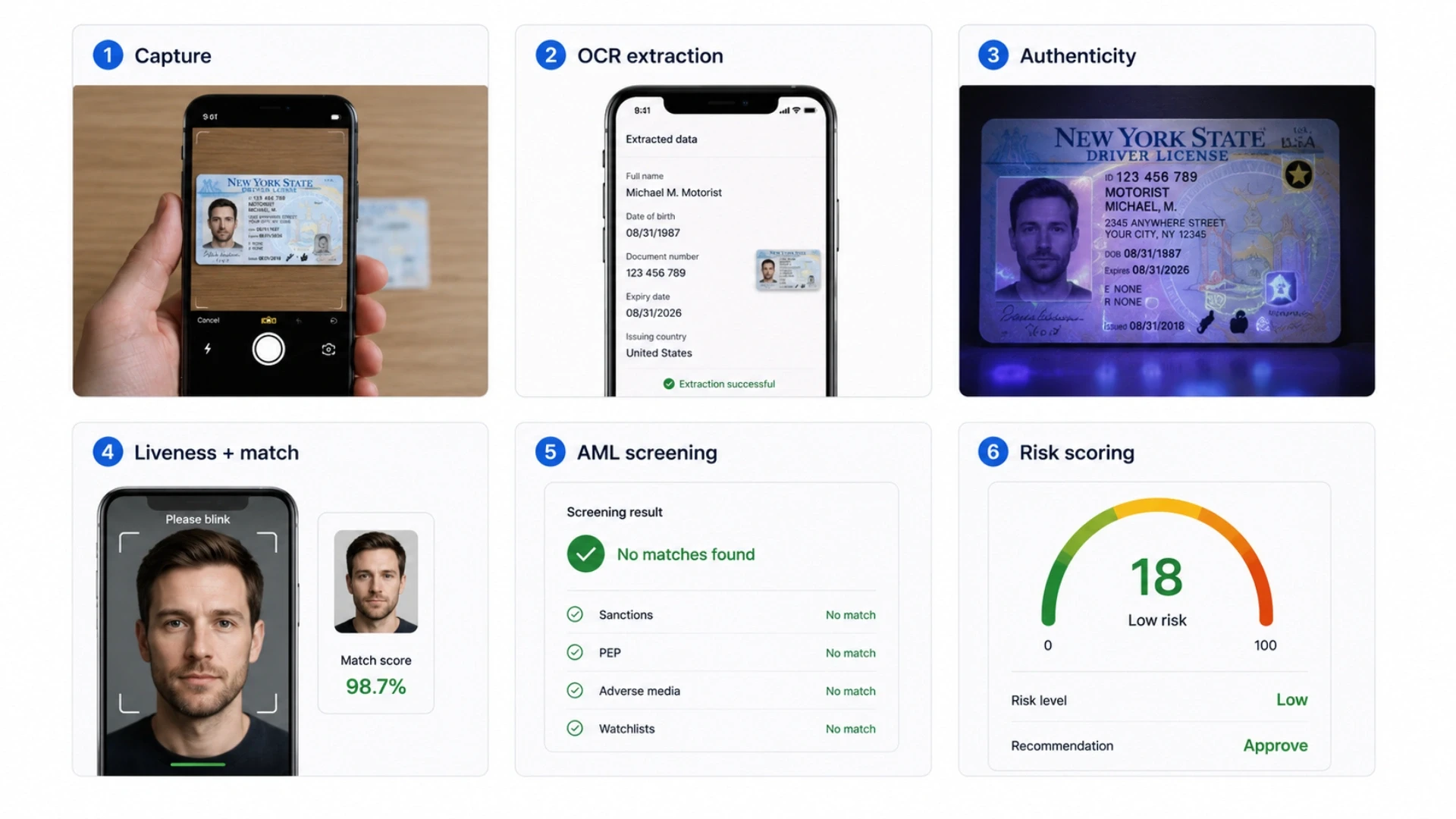
A KYC automation workflow is a pipeline of six steps, each handled independently but orchestrated by a central compliance engine: document capture, OCR extraction, authenticity and tamper checks, biometric liveness and face matching, AML and sanctions screening, and automated risk scoring with approval or escalation routing. The orchestration is the product; the individual checks are commodities. Acquaint Softtech's Python developers build the orchestration engine that sequences these steps and decides what happens at each junction.
The smartest pipelines use waterfall logic: run the cheapest, fastest checks first, and only invoke expensive ones when needed. A low-risk retail customer with a clean document and a confident liveness match can pass straight through, while an anomaly triggers deeper checks. This sequencing is the single biggest lever on both cost and speed, and it is delivered through software development outsourcing with a team that has built real onboarding funnels.
Each step must log its decision in a structured, auditable form, because a regulator will ask why any given customer was approved or declined. The data-engineering patterns behind an event-driven, fully logged pipeline are covered in this MERN stack complete guide (part 2).
Step | What It Does | Outcome |
Capture | Collects ID and selfie | Clean source images |
OCR extraction | Reads document fields | Structured data |
Authenticity | Detects tampering | Genuine or flagged |
Liveness + match | Confirms live person | Same person check |
AML screening | Checks watchlists | Clear or hit |
Risk scoring | Decides and routes | Approve or escalate |
What are the steps in a KYC verification workflow?
A KYC verification workflow has six steps: capturing the ID document and a selfie, extracting the document data with OCR, checking the document for tampering and authenticity, confirming a live person with biometric liveness and face matching, screening the identity against sanctions and watchlists, and scoring the risk to approve automatically or escalate to a human reviewer.
Document Capture and OCR: Reading the ID in Milliseconds

The pipeline begins with document capture and optical character recognition (OCR), which reads the data from passports, national IDs, and driver's licences and converts it into structured fields the system can validate. Strong OCR runs tamper detection alongside extraction, catching forgeries and expired documents before they progress. Leading engines support thousands of document types across nearly every country, which matters because the documents a system rejects become the manual-review queue. Acquaint Softtech's Python developers build and integrate the OCR and document-forensics layer that turns an image into trusted data.
After extraction, the system cross-checks the document fields against the data the customer entered and against trusted databases, flagging mismatches. The challenge in 2026 is that fraudsters use AI to generate fake documents, so advanced document forensics, not just text reading, is now mandatory. Building this resilience is an AI and ML development services task as much as a software-integration one.
Wide document coverage is what keeps straight-through processing high: every document type a system cannot read is a customer pushed into a slow manual queue. The front-end capture patterns that produce clean, OCR-ready images are explained in this complete MERN stack development guide.
How does OCR work in KYC verification?
In KYC, OCR scans an ID document and extracts its text fields, such as name, date of birth, and document number, into structured data the system can validate. It runs tamper detection alongside extraction to catch forgeries and expired documents, then cross-checks the extracted data against what the customer entered and against trusted databases to confirm the document is genuine.
Biometric Liveness: Beating Deepfakes and Spoofing
Biometric verification confirms that the person presenting the document is its rightful owner and is physically present. It does two things: face matching compares the selfie to the ID photo, and liveness detection confirms a live human rather than a printed photo, a replayed video, or a mask. As of 2026, iBeta Level 1 and Level 2 certification is the benchmark regulators and procurement teams reference for liveness quality. Acquaint Softtech's DevOps engineers build the secure capture, device-integrity, and session controls that keep this step tamper-resistant.
The threat has escalated. Fraudsters now use generative AI to create synthetic identities and deepfakes, and NIST has warned that face morphing can deceive recognition systems by blending two faces into one image. Alongside biometric and liveness checks, an AI image detector can help identify images that may have been artificially generated or manipulated, providing another signal when assessing suspicious visual content. Deepfake-resilient biometrics is therefore a baseline requirement, not a premium feature, which is why this layer is best delivered through software development outsourcing with a team that integrates certified, current liveness technology rather than legacy selfie checks.
Liveness is also where friction and security collide: too many prompts and users abandon, too few and fraud slips through. The gold standard is invisible KYC, where background device fingerprinting and behavioral analysis run silently and only prompt the user when an anomaly appears. The framework decision that shapes how maintainable these capture flows stay is compared in this guide on Laravel vs MERN stack for startups.
Architecture insight: Treat liveness as a confidence score, not a yes/no gate. A high-confidence pass should flow straight through; a borderline score should trigger a step-up check or human review rather than an outright reject. Hard binary gates are what create both false declines that lose good customers and false passes that let fraud in.
How do KYC systems detect deepfakes?
KYC systems detect deepfakes using certified liveness detection that confirms a live, in-frame person rather than a photo, video, or mask, backed by anti-spoofing models trained on synthetic-identity and face-morphing attacks. They add device and session integrity checks and behavioral signals, and treat liveness as a confidence score so borderline cases get a step-up check rather than an automatic pass.
Get a KYC Automation Cost and Timeline Estimate
Acquaint Softtech delivers KYC and compliance workflow builds at up to 40% lower cost than Western agencies, at $25 to $49 per hour, with 95% on-time sprint delivery and a 4.9/5 rating from 50+ verified Clutch reviews. Deploy your first compliance engineer within 48 hours of brief.
AML Screening and Risk Scoring: The Decision Layer
Once identity is confirmed, the workflow screens the verified person against global sanctions lists, politically exposed person (PEP) databases, and adverse-media sources simultaneously, then scores the overall risk. This decision layer is where compliance lives: a clean, low-risk customer is approved automatically, a hit or anomaly is routed for enhanced due diligence, and the reasoning is logged for audit. Acquaint Softtech's Python developers build the screening orchestration and the risk-scoring model that turns raw signals into a decision.
Screening produces false positives, and reducing them is a major source of saved cost: ML-enhanced name matching and NLP-based adverse-media triage can cut false positives by 40 to 55%, sending only genuinely uncertain cases to analysts. A risk-based approach calibrates effort to actual risk rather than treating every customer the same, which is the principle behind every efficient compliance program and a core software product engineering deliverable.
Risk scoring must be explainable, because a regulator or auditor will ask why a decision was made, and an unexplainable model is a liability. This audit-ready discipline is exactly what verified clients highlight about Acquaint Softtech, as covered in this overview of the company's Clutch recognition and verified results, published on acquaintsoft.com.
Check | Source | Action on Hit |
Sanctions | Global watchlists | Block or escalate |
PEP | Politically exposed lists | Enhanced due diligence |
Adverse media | News and NLP triage | Analyst review |
Risk score | Combined signals | Approve or route |
What is AML screening in KYC automation?
AML screening checks a verified customer against global sanctions lists, politically exposed person databases, and adverse-media sources to flag financial-crime risk. In an automated workflow, it runs these checks simultaneously, scores the combined risk, approves clean low-risk customers automatically, and routes hits for enhanced due diligence.
Businesses often leverage white label software development solutions such as Acquaint Softtech's services to accelerate the development of AML and compliance automation platforms, using ML name matching and NLP triage to reduce false positives while maintaining regulatory compliance.
Perpetual KYC: From One-Time Check to Living Profile
The biggest shift in 2026 is the move to perpetual KYC (pKYC), where customer profiles are continuously monitored instead of being reviewed only during scheduled checks. Event-driven systems automatically trigger re-verification when risk signals change, such as unusual transactions or location changes. Acquaint Softtech's DevOps engineers build the infrastructure behind these systems, while businesses that hire MEAN stack developers can accelerate the development of scalable, real-time compliance platforms. This approach improves both efficiency and risk detection compared to traditional periodic reviews.
Maturity is still early: only a small share of institutions have any pKYC deployed, so the practical path is to pilot it with high-risk segments first. The deployment and event-streaming patterns that support continuous monitoring at scale are detailed in this MERN stack app deployment guide, published on acquaintsoft.com.
What is perpetual KYC (pKYC)?
Perpetual KYC replaces one-time, periodic verification with continuous, event-driven monitoring. Instead of reviewing every customer on a fixed schedule, the system refreshes a customer's risk profile automatically when a trigger fires, such as a device change, a move to a high-risk jurisdiction, unusual transaction velocity, or a new sanctions hit. It is more efficient and more accurate than blanket periodic review.
KYC Automation Features and the Best Tech Stack
A KYC automation MVP must contain the full verification pipeline: document capture and OCR, authenticity checks, biometric liveness and face matching, AML and sanctions screening, automated risk scoring, a human-review console, and audit logging. A no-code workflow builder, perpetual-KYC monitoring, and KYB business verification are phase-two features. This build order is defined for every engagement by Acquaint Softtech's dedicated development teams, who scope the MVP around one customer segment and one jurisdiction first.
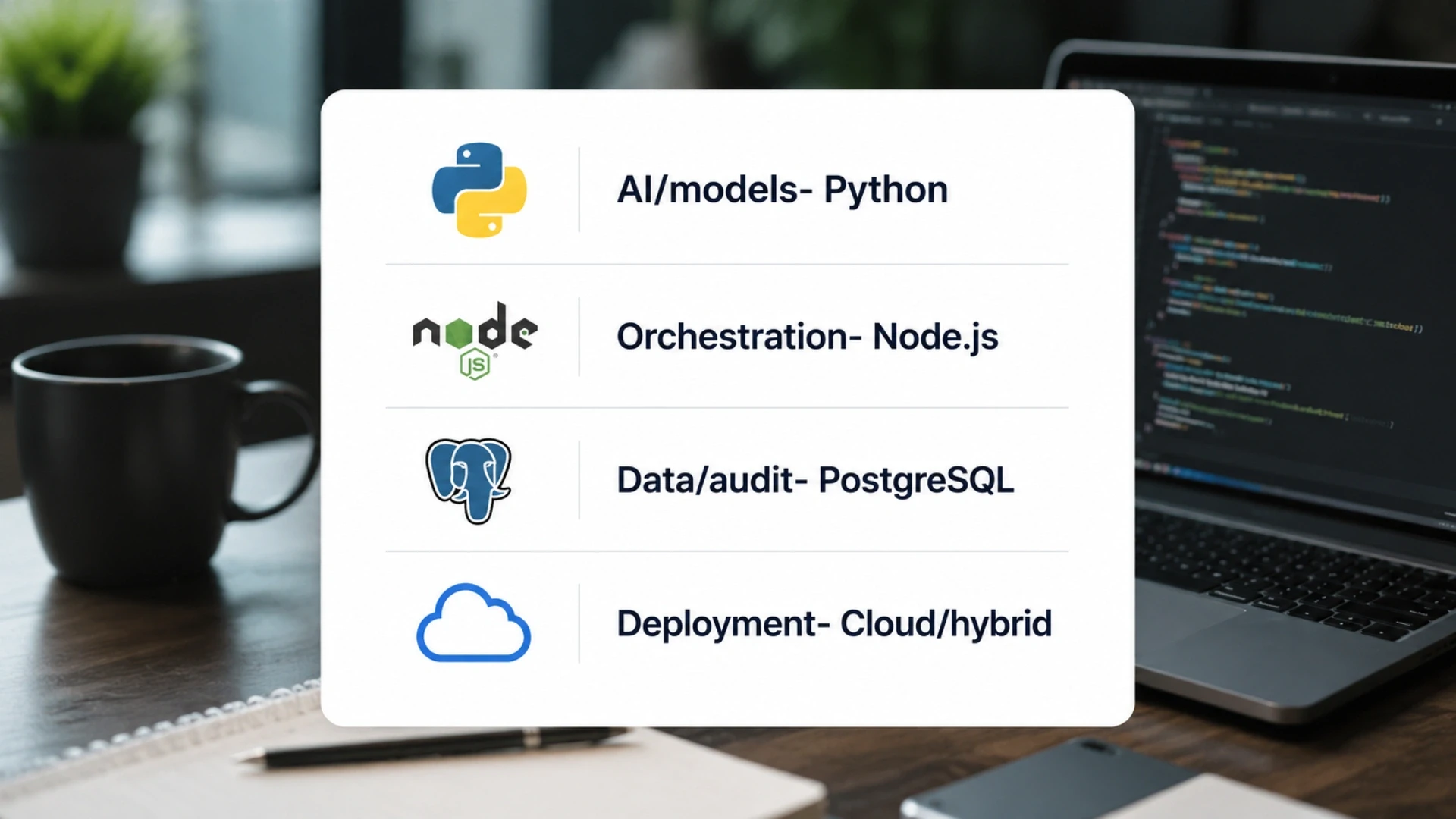
The tech stack is driven by AI-heavy processing, secure data handling, and API orchestration. Python leads for the OCR, biometric, and risk-scoring models, paired with Node.js for the orchestration and API layer, PostgreSQL for auditable records, and an API-first architecture with cloud, on-premises, or hybrid deployment to meet data-residency rules. Founders choose software product development services with this stack because the model layer and the orchestration layer are designed to work together from the start.
AI and models: Python for OCR, document forensics, liveness integration, name matching, and risk scoring.
Orchestration and APIs: Node.js for the workflow engine, with REST and webhook APIs and an API-first design.
Data and audit: PostgreSQL for structured, auditable decision records, with encryption at rest and in transit.
Deployment: cloud, on-premises, or hybrid to satisfy regional data-residency and regulatory requirements.
The patterns for connecting a Node.js orchestration layer to Python model services are explained step by step in this complete MERN stack development guide, published on acquaintsoft.com.
Layer | Recommended Tech | Why |
AI/models | Python | OCR, biometrics, scoring |
Orchestration | Node.js | Workflow and APIs |
Data/audit | PostgreSQL | Auditable records |
Deployment | Cloud/hybrid | Data-residency rules |
What is the best tech stack for KYC automation?
The best KYC automation tech stack in 2026 uses Python for the OCR, document forensics, biometric, and risk-scoring models, Node.js for the workflow orchestration and API layer, and PostgreSQL for auditable decision records with encryption throughout. The architecture is API-first with cloud, on-premises, or hybrid deployment options to meet data-residency and regulatory requirements across jurisdictions.
Development Cost, Timeline, and Build-vs-Buy
KYC automation development cost in 2026 depends on how much you build versus integrate, the number of jurisdictions and document types, and the depth of AI in document forensics, liveness, and risk scoring. A custom orchestration layer on top of best-in-class verification APIs typically costs $40,000 to $120,000, while a deeper build with proprietary models and perpetual KYC runs $120,000 to $200,000 or more. India-based teams deliver the same quality at up to 40% lower total cost, which is why founders choose product engineering services for these builds.
The build-vs-buy decision is the key lever. Most teams should not rebuild commodity checks like liveness or OCR; they should build the orchestration, risk logic, and audit layer that ties best-in-class providers together and owns the customer experience. Sequenced deployment beats big-bang automation: institutions that ship high-ROI components first reach break-even in 8 to 12 months versus 18 to 24 for all-at-once builds, a sequencing discipline best scoped through software development.
The pragmatic path is to start narrow: automate document verification, database checks, and sanctions screening first, since those deliver the highest immediate ROI and lowest risk, then layer in ML scoring and perpetual KYC. The case for this offshore, phased approach, with a real example of the savings, is documented in this story on how a startup saved $60K a year on remote hiring.
Build Type | Cost (USD / EUR) | Timeline |
Orchestration on Vendor APIs | $40K–$120K / €60K–€180K | 10–18 weeks |
Custom Models + Risk Engine | $120K–$200K+ / €180K–€300K+ | 5–9 months |
Perpetual KYC Monitoring | Add-on Phase | Phased Rollout |
Buy KYCaaS (No Build) | Per-verification Fee | Days to Weeks |
How much does KYC automation cost to build?
A custom KYC orchestration layer built on top of leading verification APIs typically costs $40,000–$120,000 (€60,000–€180,000 in Europe). A more advanced solution with proprietary risk models, automated decisioning, and perpetual KYC monitoring generally costs $120,000–$200,000+ (€180,000–€300,000+ in Europe).
Organizations that purchase a KYC-as-a-Service (KYCaaS) platform avoid upfront development costs and instead pay a per-verification fee. India-based development teams charging $25–$49 per hour can reduce total project costs by up to 40% compared to US and European agencies.
How Acquaint Softtech Builds KYC Automation
Acquaint Softtech has delivered 1,300+ software projects across 20+ industries in 13+ years, with 70+ in-house engineers across Python, Node.js, React, Laravel, and DevOps. RegTech and compliance engineering is a core capability, spanning document OCR, biometric liveness integration, AML and sanctions screening, and risk scoring for fintech, banking, and crypto clients across the USA, UK, Europe, and UAE. Engagements begin with a discovery and scoping phase that maps the verification pipeline and the regulatory surface before development starts.
Real case study: Hybopay Finance, Dublin, audit-ready compliance
Hybopay Finance, a Dublin-based financial-technology client led by CEO Gerhard Drobits, engaged Acquaint Softtech to build an AI-driven financial platform with the compliance, explainability, and audit-ready decisioning that regulated institutions demand, the same disciplines a KYC automation workflow lives or dies by. The engagement sits among Acquaint Softtech's verified banking and fintech projects, collected in the Laravel and fintech case studies with the full library.
Read all 50+ verified client reviews, where Acquaint Softtech holds a 4.9/5 rating with Premier Verified status, and for context on how the company ranks among engineering partners, see this list of the best software product engineering companies.
The Acquaint Softtech 4-Phase KYC Automation Framework
Discovery and pipeline mapping (weeks 1 to 2): fix the jurisdictions, document types, risk policy, and verification pipeline before any code is written.
Capture, OCR, and liveness (sprints 1 to 3): build document capture, OCR and forensics, and certified biometric liveness with confidence scoring.
Screening, scoring, and review (sprints 3 to 5): build AML and sanctions screening, the risk-scoring engine, the analyst console, and audit logging.
Testing, launch, and perpetual KYC (sprints 5 onward): test against fraud cases, launch with human-in-the-loop, and layer in event-driven monitoring.
Start Your KYC Automation Build with Acquaint Softtech
From document OCR and liveness to AML screening, risk scoring, and perpetual KYC, this is the workflow that turns days into seconds. Join 200+ tech companies who scaled with Acquaint Softtech: 4.9/5 on Clutch from 50+ verified reviews, 95% on-time delivery, and compliance engineers deployed within 48 hours of brief.
Frequently Asked Questions
-
How much does KYC automation cost to build?
Build Type
India Cost
Europe Cost
API-based KYC Platform
$40K–$120K
$65K–$180K
Advanced AI & pKYC Platform
$120K–$200K+
$180K–$350K+
KYC-as-a-Service
Usage-based
Usage-based
-
What features does KYC automation need?
KYC automation needs document capture and OCR, authenticity and tamper detection, biometric liveness and face matching, AML and sanctions screening, automated risk scoring, a human-review console, and audit logging as the phase-one core. A no-code workflow builder, perpetual-KYC monitoring, and KYB business verification are phase-two features added after the core pipeline is validated.
-
How long does KYC automation development take?
A custom KYC orchestration layer built on verification APIs typically takes 10 to 18 weeks, while a deeper build with proprietary models takes 5 to 9 months. Sequenced deployment, shipping document verification and sanctions screening first, reaches break-even in 8 to 12 months versus 18 to 24 for big-bang builds. Perpetual KYC is added as a later phase.
-
What is the best tech stack for KYC automation?
The best KYC automation tech stack uses Python for OCR, document forensics, biometric, and risk-scoring models, Node.js for the workflow orchestration and API layer, and PostgreSQL for auditable decision records with encryption throughout. The architecture is API-first with cloud, on-premises, or hybrid deployment to meet data-residency and regulatory requirements.
-
How fast can automated KYC verify a customer?
Automated KYC can verify a low-risk customer in seconds rather than the days a manual review takes, with leading flows averaging just a few seconds end to end. In 2026, expect 35 to 55% of individual customers to pass through fully automatically, while the rest are routed to a human reviewer, so design for human-in-the-loop rather than 100% automation.
-
Should I build my own KYC workflow or buy a vendor?
Do not rebuild commodity checks like OCR or liveness; the leading providers are hard to beat. Instead, build the orchestration, risk logic, and audit layer that ties best-in-class providers together and owns your customer experience and data. A full KYC-as-a-service platform is fastest for low volumes, while a custom orchestration layer pays off as volume and customization needs grow.
-
What is the difference between KYC and AML?
KYC (Know Your Customer) is the process of verifying who a customer is through identity documents, biometrics, and database checks. AML (Anti-Money Laundering) is the broader program of detecting and preventing financial crime, which includes screening customers against sanctions and watchlists, monitoring transactions, and reporting suspicious activity. KYC is one input into an AML program.
I am Sanjay Parjapati, a developer at heart and a Head of business by work. My journey started with coding and helped me grow towards becoming a head of business which led me to focus on dual skills, i.e. technical know-hows and the business know-hows. My journey of 10+ years has helped me grow immensely from a professional viewpoint.
Table of Contents
Get Started with Acquaint Softtech
- 13+ Years Delivering Software Excellence
- 1300+ Projects Delivered With Precision
- Official Laravel & Laravel News Partner
- Official Statamic Partner
Related Blog
.webp "The Complete Guide to FinTech Software Development in 2026")
The Complete Guide to FinTech Software Development in 2026
Complete guide to fintech software development 2026: all five verticals, compliance architecture, real build sequences, AI capabilities, and fintech development cost, from 1,300+ delivered projects.

Acquaint Softtech
May 6, 2026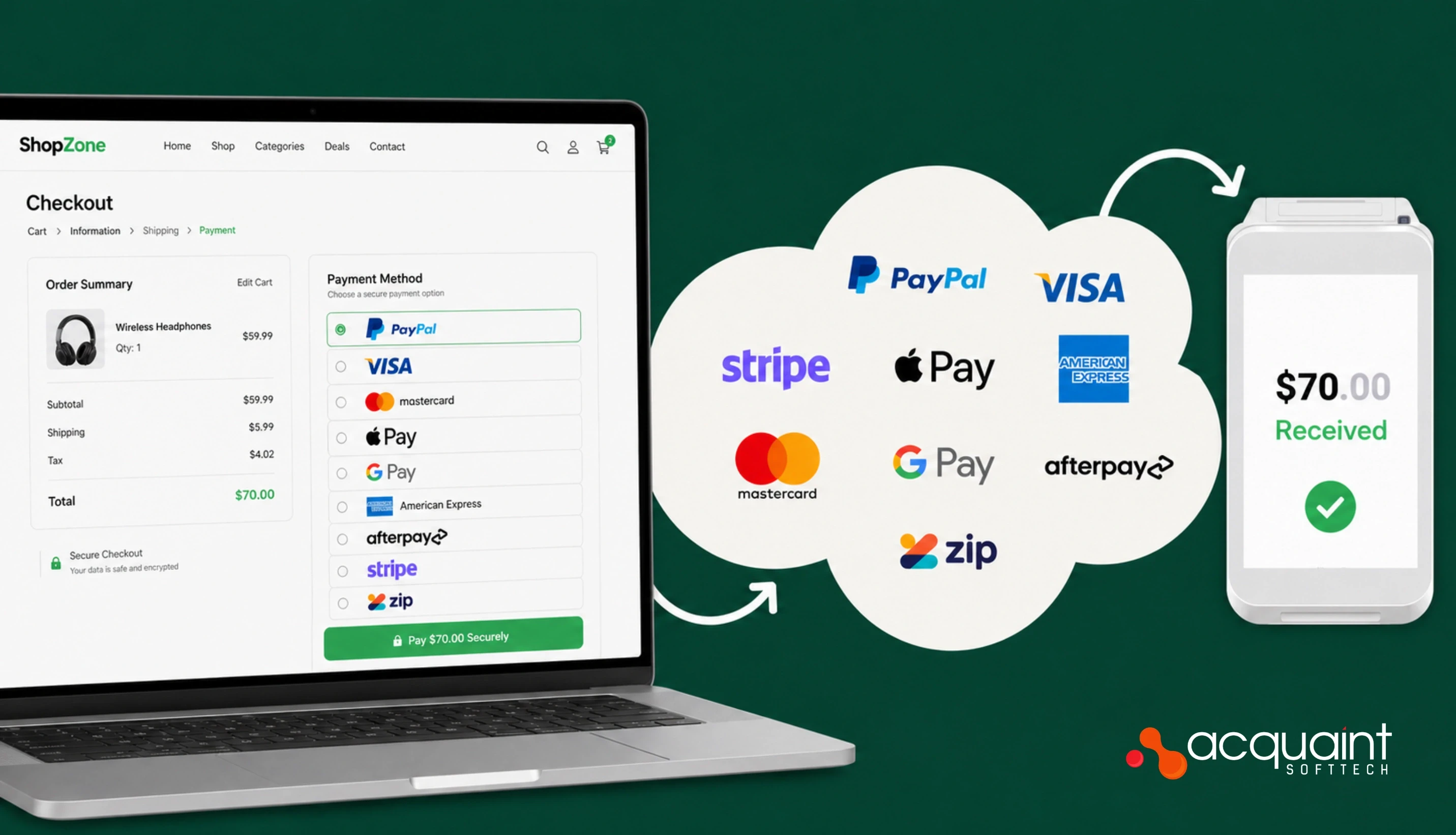
How Payment Gateways Work: Transaction Flow, APIs, and Settlement Explained
A payment gateway is not a checkout button. It is a 7-step transaction pipeline that authenticates, routes, scores, and settles every card payment in under 2 seconds. Here is exactly how it works.

Ahmed Ginani
May 11, 2026
How to Build a Neo Bank: Licensing, Architecture, KYC AML, and Launch Roadmap
Building a neo-bank in 2026 starts with one decision that determines everything else: BaaS consumer or direct licence. This guide covers both paths, licensing, ledger design, KYC/AML, feature roadmap, tech stack, and real cost data.

Manish Patel
May 18, 2026India (Head Office)
203/204, Shapath-II, Near Silver Leaf Hotel, Opp. Rajpath Club, SG Highway, Ahmedabad-380054, Gujarat
USA
7838 Camino Cielo St, Highland, CA 92346
UK
The Powerhouse, 21 Woodthorpe Road, Ashford, England, TW15 2RP
New Zealand
42 Exler Place, Avondale, Auckland 0600, New Zealand
Canada
141 Skyview Bay NE , Calgary, Alberta, T3N 2K6