

An Ultimate Guide To Develop Your Own Online Marketplace
Online marketplace development is the process of building a multi-vendor digital platform where third-party buyers and sellers interact, list products or services, and complete transactions. To build one, define your niche, solve the chicken-and-egg problem by acquiring sellers first, choose your technology (turnkey or custom), integrate secure split payments, then test and launch. Popular examples include Amazon, eBay, and Etsy.

Mukesh Ram
As the Founder and CEO at Acquaint Softtech, a leading software product development company, I have helped founders across the USA, UK, Europe, Australia, and New Zealand launch platforms that scale. Today I am going to show you how you can build your own online marketplace; not just that, I will also explain how to attract customers, make money, and scale your marketplace.
This is a step-by-step guide, and no matter how hard and overwhelming it seems to you, developing an online marketplace and succeeding can be relatively easy with the correct instructions and the right team.

- You want to build a multi-vendor online marketplace like Amazon or Etsy.
- You are a founder, CEO, or CTO planning a marketplace platform.
- You want the key steps, features, and business models.
- You want to compare turnkey builders vs custom development.
- You want to know if marketplaces are profitable and what they cost.
- You want a proven partner to build your marketplace affordably.
Whether you search for it as online marketplace development, web development marketplace, or building a multi-vendor platform, the fundamentals are the same: connect buyers and sellers, take a cut of each transaction, and grow both sides of the market. The hard part is doing it in the right order.
If you want expert help scoping it, our discovery workshop services turn your marketplace idea into a validated, build-ready plan in days.
The Definition Of A Marketplace

A marketplace is essentially a place where buyers and sellers connect. For example, your local market where you may purchase groceries. Now, if you take it online from a physical place, it is called an online marketplace. In the modern day, you can buy almost anything online, from a pen to a private jet.
You commonly have two options when it comes to purchasing a product. Either you go around looking for a shop/seller or buy it online. The former used to be the most common way earlier, but in the past couple of decades, with the rise of online marketplaces like Amazon and Flipkart, buying online is transforming into the new normal.
What is a digital marketplace?
A digital marketplace or online marketplace is typically a website or mobile app that serves as an independent platform for buyers and sellers to trade goods. The responsibility of an online marketplace is to moderate the platform, collect payment from buyers, and deliver items promptly.
Key Steps to Build a Marketplace
To build a marketplace: define your niche, solve the chicken-and-egg problem, choose your technology, integrate secure payments, then test and launch.
Define your niche: focus on a specific target audience or product category to validate demand before writing code.
Solve the chicken-and-egg problem: focus heavily on acquiring initial sellers first to build a solid supply base before attracting buyers.
Choose your technology: select between fast, subscription-based turnkey builders or custom development depending on your budget and scaling needs.
Integrate secure payments: set up split-payment infrastructure (such as Stripe Connect) to handle commissions, fees, and seller payouts automatically.
Test and launch: perform rigorous user-experience testing, onboard initial vendors, and iterate based on early user feedback.
You can review payment and platform options through guides like the Stripe Marketplace Guide, and for the build itself, our dedicated software development teams handle the heavy engineering.
What Are The Benefits of an Online Marketplace?
The trend of purchasing products online is growing rapidly.
A channel to market and sell your product alongside others.
Requires less marketing budget to grow.
Online marketplaces work day and night, so buyers can buy anytime.
You can sell products to anyone in the world with internet access.
It improves your brand and thus, customer loyalty.
It provides buyers the convenience to shop anytime, anywhere.
Transparent reviews help you judge any product.
Marketplace vs eCommerce Store
An ecommerce store represents an online store of a single seller. Whereas an online marketplace is where multiple sellers can sell their own goods. This table shows more differences between them.
Aspect | Online Marketplace | eCommerce Store |
Development | Needs advanced programming | Easier, DIY, like Shopify |
Audience | Wider, more products | Smaller, small range |
Promotion | Sellers help promote it | You promote it yourself |
Time to build | Takes longer | Takes less time |
Advantages of the Online Marketplace Model
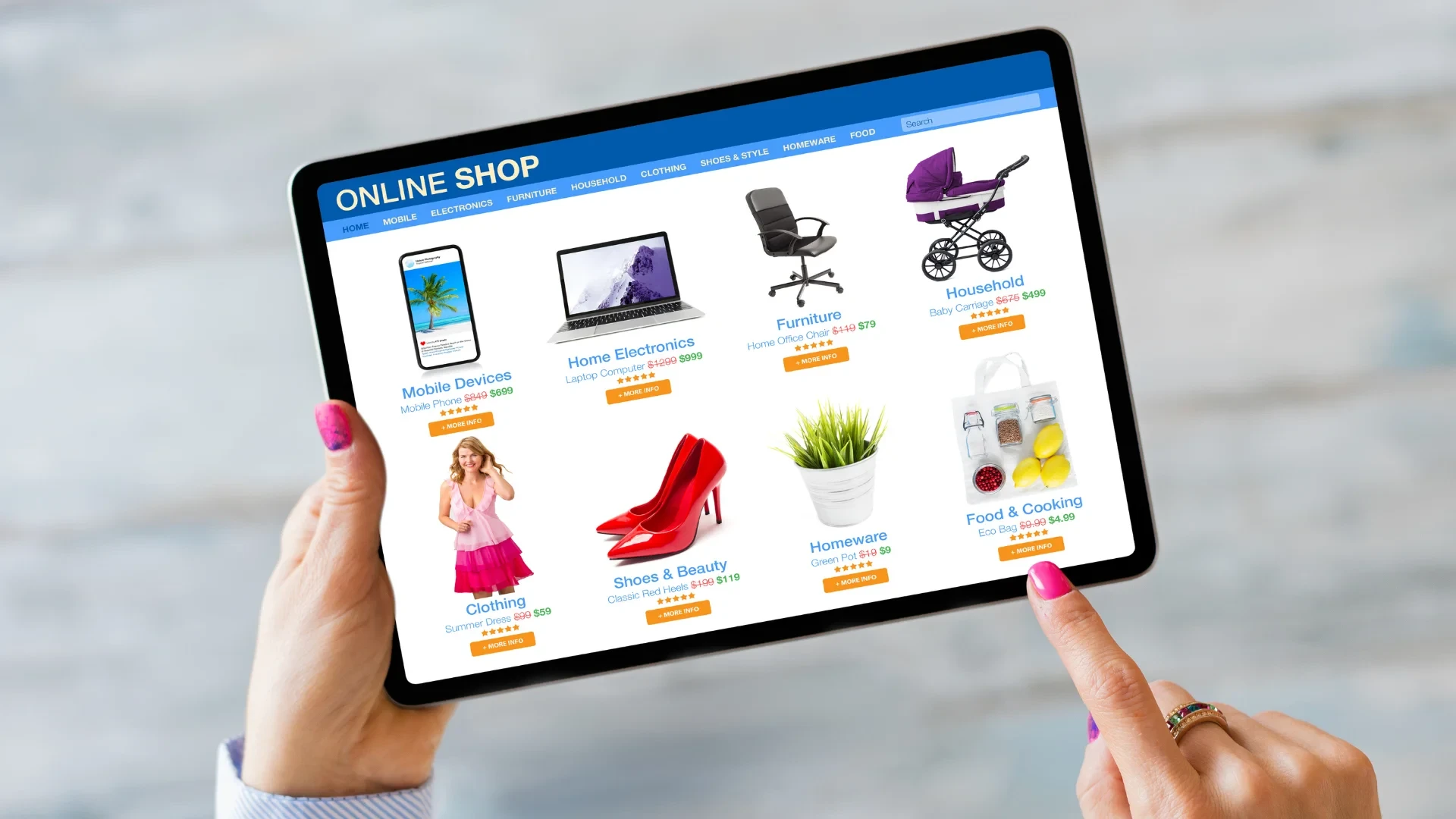
Better system in place: When you start an online store, you have to worry about everything like maintaining an inventory, selling, marketing, shipping, payment, returns, etc. But with an online marketplace, you need to maintain a good, functional portal for the vendors to list their products and ensure customers are able to buy the products with ease.
More sources of revenue: There is a single primary source of income for an e-commerce store: selling goods online. A marketplace has multiple sources like selling your own products, sponsored ads, and commissions from other sellers.
Bigger scale: With the online marketplace being a one-stop shop to buy almost anything, it enjoys a bigger scale of customers and revenue.
Snowball effect: It is human nature for customers to share details about their good deal on social media networks. With an online marketplace, there will be more customers; thus, your marketplace is more likely to enjoy this snowball effect, where your customers become part of your promotion strategy.
Cost-effective: It is a lower financial risk and also easier to maintain. It is also simpler to set up, configure, and manage.
What are the Good eCommerce Business Models?
Commission
In this model, the online marketplace charges a fixed commission for each transaction that happens between a buyer and a seller. The online marketplace takes care of everything from platform management to delivery. Whereas a seller to easily sell products online. eBay and Etsy are common examples of marketplaces using this model.
Subscription
The subscription model charges sellers for using the platform to sell their products regardless of how many they can sell. The challenge with this model is that the sellers need to trust the platform to turn a profit for them, or else they won't subscribe to it. Thus, you need to attract a large enough audience to make it a win-win for all.
Freemium
Freemium means a combination of free and paid versions of what you offer. So the ones who are new to your marketplace can try out its free basic features. But if the demand exceeds, they have the option to try out the premium features. You need to take care of what you offer for free and paid plans so both can find the appropriate value.
Listing
Listings are popular in the real estate industry. Here you can find many online websites that allow you to put your property on their websites for sale, either for free or with a charge. For paid listing websites, you can charge to facilitate the sale of their product by putting up an ad on your platform. You can charge further by boosting their ad to get more targeted viewers. This model can be applied to other industries as well.
Featured ad placement
This isn't a standalone business model but a complementary one to the models above. Featured ad is like skipping the queue to be shown to the audience first. But first, you need a big enough audience so that sellers find it worth it to spend money on featured ads on your website.
Want a marketplace built at an affordable cost?
Tell Acquaint Softtech your model and niche, and we will scope the platform, the right tech stack, a timeline, and a cost within 48 hours.
Online Marketplaces Ecosystem: Types And Examples
Online marketplaces are growing at such a pace that we see niche e-commerce websites starting every day. You can find many types of e-commerce websites these days, B2B, B2C, D2C, etc., that serve different sections of the economy. Now, let's take a look at various types of marketplaces.
Horizontal marketplaces
Horizontal marketplaces are the ones that offer a wide variety of products. As the name suggests, "Horizontal" refers to the breadth of the number of products offered. Thus, these kinds of marketplaces don't focus on a particular niche and target a group of niches. Let's break it down further.
B2B: business-to-business. Here, the focus is to sell goods wholesale to businesses at a lower price than to the end customers. This business model was popularized online by Alibaba.
B2C: here businesses target the end consumers, and this is the most popular way of doing business. The most common example is a business owner with an eCommerce website that stocks products they sell directly to consumers.
C2C: customer-to-customer is when an end consumer sells a product to another consumer. Classified sites like OLX and Craigslist are perfect examples of this.
B2B2C: an interesting model where a company serving other businesses develops a marketplace for other businesses whose primary focus is end consumers. Amazon is an example of B2B2C.
Vertical Marketplaces
Vertical marketplaces are the ones that focus on a particular industry or a niche as opposed to a wide variety of products in horizontal marketplaces. Vertical marketplaces instead provide product options from a variety of sellers.
Transportation services: Uber is a classic example, connecting taxi drivers to end users.
Professional services and skills: The Urban Company for everyday services, and Upwork for skilled remote professionals.
Short-term accommodation: Airbnb is a good example of this.
Fashion: marketplaces like Myntra bring a wide range of fashion clothing from different designers.
Used cars: marketplaces like Cars24 provide quality-assured used cars.
Healthcare: connect doctors and medical stores with patients for medicine and appointments.
Travel: a congregation of transport authorities, hotels, and travel agents for a complete trip.
Agriculture B2B: provides businesses with seeds, fertilizers, tools, etc. An example is Agrimp.
Recruitment: connects recruiters with job seekers. Indeed is a good example.
Furniture and handmade goods: Etsy is an example of an online store for handmade products.
Real estate and prop tech: Zillow lets you buy or sell property from thousands of listings.
For innovative ideas: Kickstarter is the most common website for funding innovative ideas.
Marketplace for everything: dedicated marketplaces exist for games, tea, custom clothes, calendars, and more.
There are also other models. Managed marketplaces provide both parties with additional services to facilitate the sale, like a used-car guarantee. Community-based marketplaces are built on a sense of community where people also interact with each other around the theme of the website.
Steps to take before starting your own marketplace

Validate your idea
Validating your idea means checking its feasibility. Is it actually something that you can build, and is it feasible? Can your business be profitable? To validate your idea, you need to see if your idea solves a problem that is faced by many people and if they will be willing to pay to get it solved. If yes, this is a green signal.
Ask for feedback
Nothing beats asking your target audience about the online marketplace. However, having an MVP will really help you to get more accurate feedback. Thus, I recommend you look for an MVP development company that can provide you with an affordable MVP for your online marketplace.
Examine your target audience
Not understanding your target audience is a mistake that many startups make and thus suffer. So don't let that happen to you. Examining your target audience requires you to define it first, find their needs or pain points, understand their purchasing behavior, etc. This will help you craft your online marketplace according to their needs.
Analyze with SWOT
SWOT stands for Strengths, Weaknesses, Opportunities, and Threats. This is a very common method used to understand any given scenario. It will help you to play to your strengths and opportunities with a focus on minimizing or nullifying weaknesses and threats.
Research your competition and the market
Understanding the market is like understanding the playground. It is very important to know what is currently working, the gaps in the market, how you can make your place in it, etc. Also, see how your competitors are underserving their customers and how you can take advantage of it by providing better services.
Find finance
Running out of money is one of the main reasons why startups go out of business. Secure your finance so you can run your marketplace till it starts making money that you can reinvest in it. Seeking investors and validating an idea with good future potential is essential. A rapidly developed MVP is the ideal solution. You also need reliable hosting, such as ScalaHosting VPS hosting, and a domain, and you must budget for acquiring both merchants and customers, at least at first, by offering your services for free so sellers have nothing to lose.
Top Features to Include in a Marketplace
At this stage, it is necessary not to stuff up your marketplace with unnecessary features, as they will make it slow and costlier to develop. So here are the features I recommend you have in your online marketplace:
Recommended products: help customers find other products based on their preferences.
Discounts and offers: a special section for sales, loyalty or rewards points, and discounts.
Common payment options: integrate all common online payment methods into your website.
Online support and documentation: help customers or merchants with any feature or issue.
Create pages, content, and forms: handy if you offer merchants their own store to manage.
Grow website, site security, and customizable design: support merchant growth, keep data safe, and let merchants stand out.
User account, messages, and wish lists: keep information in order, connect buyers and merchants, and save products for later.
Product catalog and customer reviews: help buyers scan products and trust their purchase.
Ways to Develop an Online Marketplace Platform
Now there are many ways to build an online marketplace platform. And each one has its pros and cons and serves various needs. So let's have a look at how each one of them will help you based on ease of development, quality, cost, scalability, and customization.
Write your own code
This is the simplest yet hardest of all. Writing your own code can be a feasible option if you know how to code well and have the time to do so. The problem is that it is very time-consuming and prone to bugs. On the other hand, it will save you money upfront while giving you a fully customized online marketplace as per your needs.
Build using an open-source framework
Instead of writing your code from scratch, you use an open-source framework like Laravel Bagisto to build your own online marketplace. Here you can find pre-built code so you can reuse it in your project, saving a lot of development time. But sometimes it may be complicated to understand the documentation of other frameworks.
Use a website builder
There are many website builders like Shopify, Wix, and WordPress using WooCommerce. Here you can take advantage of easy customizations and complete your project faster. But remember that everything comes at a price.
Using a no-code marketplace builder
Many SaaS and marketplace builders do not require you to write code. This is a great option if you want to create your marketplace fast, usually with a drag-and-drop builder. But if you are looking to build a highly scalable platform, this isn't the way to go, as customization options are very limited and you depend on the service provider.
Create on top of an API-based marketplace SaaS tool
This method requires some technical skills, but if you have them, it can be a great option. You can find many API-based tools to build a quality website. This path offers more flexibility at the expense of more development time. If you are not confident doing this yourself, you can always hire remote developers from a web development agency like us to get it done at an affordable price.
Technology stacks for building a marketplace
You need to choose the technology wisely, because if you don't, your tech stack may not be reliable and scalable. With a long-term focus, I recommend you develop your online marketplace with expert developers in Laravel, Bagisto, or Python and Django. You can consider our Laravel development services to build your quality website in no time.
How Much Does It Cost to Start an Online Marketplace?

A custom online marketplace typically costs $15,000 to $100,000+, depending on features, scale, and your development path. Coding it yourself or using no-code builders is cheap but limiting, while hiring expert developers costs more yet gives the scalability, customization, and quality a real marketplace needs.
Development Path | Relative Cost | Best For |
No-code builder | Low | Fast, simple tests |
Website builder | Low to medium | Small stores |
Custom / remote team | Medium to high | Scalable marketplaces |
You can lower the cost of a custom build by outsourcing software development to a vetted team, or by using an MVP-first approach that our developers can deliver at up to 60% less cost.
Prefer to extend your own team? Our IT staff augmentation services place vetted engineers within 48 hours.
6 Things to Consider While Developing Your Marketplace
Research and SWOT analysis: market research shows what is working; SWOT is an analysis of self versus the market.
Validate your idea: talk to your target audience; having competitors is a good sign of a market.
Planning: decide your development path as per your strengths; usually go for remote developers.
Form your team of reliable developers: an experienced marketplace development company can start immediately with quality developers.
MVP stage: focus only on the most required features to start faster and reduce risk.
Form your marketing strategy: content marketing and paid ads are common ways startups market themselves.
After development, do not launch immediately. First, gather initial merchants: create a pre-launch landing page with great copy, collect emails of interested sellers, post in relevant communities, and use content marketing and social media.
Then bring in potential buyers to kickstart your marketplace. To grow and scale, define clear selling points for both buyers and sellers, smooth out your system, and create loyalty programs. Our client Elite is an example of an online marketplace doing very well, providing merchants with their own customized websites to sell goods online.
Common Challenges With Digital Marketplaces
Branding: finding and keeping alive your unique essence is a challenge.
Keeping it profitable: you are likely to lose money early while acquiring buyers and sellers, then must break out into profit.
Security: you need high-quality, bug-free code loaded with common security features.
Keeping it up-to-date: developing your MVP is just the beginning; you need to constantly evolve.
Ready to build your own marketplace?
Assemble your team of quality developers instantly with Acquaint Softtech and start your project. You get scalable, secure marketplace development at up to 60% less cost.
Case Study: A Verified Marketplace Build
The real proof of marketplace development is a platform that keeps attracting vendors. As an Official Laravel Partner, Acquaint Softtech built a multi-vendor marketplace with a white-label engine and a payment framework supporting over 20 payment systems. Here is a simple snapshot, drawn from our verified reputation on Clutch.
Client | Elite, an online marketplace serving many vendors. |
What we built | A multi-vendor platform giving merchants their own customized stores. |
Key features | White-label engine, 20+ payment systems, roles and permissions, analytics. |
Why it worked | Quality service attracted a large and growing base of vendors. |
Result | A thriving, scalable marketplace that keeps winning new merchants. |
Company-wide proof: Acquaint Softtech has delivered 1,300+ projects over 13+ years with 70+ in-house engineers and a 5-star rating across 60+ reviews on Clutch, as an Official Laravel and Statamic Partner.
Our Expertise in Online Marketplace Development
As per my recommendation, it is the best option for you to find a marketplace development company and hire remote developers to build your platform. This way, you can save on your development costs while getting a high-quality project done. Have a look at our expertise in online marketplace development:
An advanced white-label customization engine.
A complex payment framework that supports over 20 payment systems.
Cart and wish list, plus roles and permissions for users.
Virtual money support, reporting, and sales analytics.
Single sign-on integration with a client website.
Fraud prevention and detection functionality.
Integration of subscription and email services.
Loyalty functionality, promotional campaigns, affiliate programs, automated discounts and coupons, and a custom framework for cross-client product sales.
Agencies that want to resell a finished marketplace can use our white label software development to launch under their own brand.
To Sum Up
I have tried to cover almost every aspect of marketplace development. But our web development experts are always available to you for a free consultation. Whether you need to hire a team of developers or have any doubts, just contact us and our team will reach out to you quickly. I wish you all the best in your journey of marketplace development.
Ready to start your marketplace journey?
Talk directly with Acquaint Softtech's founder in a free 30-minute session. You will leave with a clear plan, the right tech stack, a realistic budget, and honest advice.
Frequently Asked Questions
-
How to develop an online marketplace?
Define your niche, validate the idea, and do market and SWOT research. Acquire initial sellers first to solve the chicken-and-egg problem, choose your technology (turnkey builder or custom development), integrate secure split payments like Stripe Connect, build an MVP with only the core features, then test, launch, and iterate.
-
Are online marketplaces profitable?
Yes, marketplaces can be very profitable because they earn from multiple sources: commissions on transactions, seller subscriptions, sponsored ads, and extra services. They usually lose money early while acquiring both sides, then become profitable as volume grows, since they hold no inventory of their own.
-
How much does it cost to start an online marketplace?
It depends on your path. Coding it yourself or using no-code builders is cheap but limited. A custom, scalable marketplace built by a remote team typically costs $15,000 to $100,000+, with the final figure driven by features, scale, and technology. An MVP-first approach keeps the initial cost low.
-
What are the top 3 online marketplaces?
The three largest and best-known global marketplaces are Amazon, eBay, and Alibaba. Other major players include Etsy for handmade goods and Walmart Marketplace, but Amazon leads by a wide margin in most regions.
-
Is it easy to build a marketplace?
It depends upon the scale of your project. Building an online store is very easy; WordPress and Shopify are great DIY options. However, you should consult with marketplace development experts if you want a full-scale e-commerce website.
-
What is the best way to build a marketplace?
Hiring remote developers is the best way to go, as it provides you with more scalability along with better customization options. This will cost you more than any DIY tools, but if done right, you will find it worth it.
-
Do I need a developer to build a marketplace?
Yes. To build a quality and customized marketplace, it is better to go with expert developers.
-
How do online marketplaces make money?
There are many ways: selling your own products, charging a commission from merchants, sponsored ads to boost sales on your platform, and extra services for merchants.
-
How much time and cost will it take to build a marketplace platform?
Time and cost depend on the scope of your project and the technologies you choose. If you go for frameworks like Laravel, you can develop it relatively faster and at a lower cost. Developing from scratch will cost you more time and money.
I love to make a difference. Thus, I started Acquaint Softtech with the vision of making developers easily accessible and affordable to all. Me and my beloved team have been fulfilling this vision for over 15 years now and will continue to get even bigger and better.
Table of Contents
Get Started with Acquaint Softtech
- 13+ Years Delivering Software Excellence
- 1300+ Projects Delivered With Precision
- Official Laravel & Laravel News Partner
- Official Statamic Partner
Related Blog
How much will your web app development cost?
Web application development cost typically ranges from $15,000 to $200,000+ globally (roughly £15,000 to £150,000+ in the UK), depending on scope, features, and team location. A simple MVP runs $10,000 to $50,000, a mid-scale business web app $50,000 to $150,000, and a complex or enterprise platform $150,000 to $300,000+. Hiring a remote team can cut labor costs sharply, and at Acquaint Softtech, an MVP can reduce your project cost by up to 60%.
Mukesh Ram
November 11, 2022
Is Laravel Fit For Your Web Development Project?
Laravel website development involves using a powerful PHP framework to build fast, secure, and custom web applications. Its key features include the Eloquent ORM, Blade templating, strong built-in security, and a rich ecosystem (Livewire, starter kits). It is a great fit for custom business portals, online stores, SaaS platforms, and APIs, which is why it remains the most popular PHP framework in 2026.
Mukesh Ram
November 9, 2022
Empowering Single-Service Businesses: The Role of Custom Online Solutions
Develop a next-generation custom solution for your single-service business to gain an upper edge
Mukesh Ram
September 18, 2023India (Head Office)
203/204, Shapath-II, Near Silver Leaf Hotel, Opp. Rajpath Club, SG Highway, Ahmedabad-380054, Gujarat
USA
7838 Camino Cielo St, Highland, CA 92346
UK
The Powerhouse, 21 Woodthorpe Road, Ashford, England, TW15 2RP
New Zealand
42 Exler Place, Avondale, Auckland 0600, New Zealand
Canada
141 Skyview Bay NE , Calgary, Alberta, T3N 2K6