

Python for Enterprise How Mid-Market and Large Companies Use Python for Internal Systems
How US mid-market and enterprise companies use Python for internal systems, automation, and data tooling in 2026, plus the stack, governance, and staffing.
Acquaint Softtech
Introduction: The Quiet Workhorse Inside Every Large Company
Walk into the engineering organization of almost any US mid-market or enterprise company in 2026 and you will find Python running quietly in the background of operations that nobody outside the building ever sees. The internal dashboard that finance checks every morning. The automation that reconciles data between Salesforce and the data warehouse overnight. The data pipeline that feeds the executive reporting layer. The internal API that ties together three legacy systems that were never meant to talk to each other. None of this is the company's flagship product. All of it is mission-critical to how the company actually runs. And an enormous share of it is written in Python.
This is not anecdotal. According to the Fortune 500 Technology Stack Directory 2026 published by Salt Technologies AI, which maps the technology choices of America's largest companies from job postings, partnership announcements, and SEC filings, Python and Java are the most common programming languages across the Fortune 500, with more than 80% of these companies running on AWS and 90% using Microsoft Cloud services. Python sits at the center of how the largest US enterprises build internal systems, automate operations, and run their data and AI platforms. It earned that position not through marketing but through two decades of quietly being the most productive choice for the internal engineering work that keeps large companies running.
This guide covers how mid-market and large companies use Python for internal systems: why enterprises standardize on it, where it actually runs inside the organization, what the enterprise-grade Python stack and governance model look like, and how companies staff this work without ballooning their internal headcount. It is written for engineering leaders, IT directors, and technology decision-makers at US mid-market and enterprise companies evaluating Python for internal tooling, automation, and data platforms, or trying to scale the Python work they already have.
If you are building or scaling the team that will own these internal systems, the complete guide to hiring Python developers in 2026 sets the wider hiring context, including how to evaluate engineers for enterprise work, which engagement models fit internal-systems projects, and how to scale capacity without permanent headcount commitments.
Why Enterprises Standardize on Python for Internal Systems
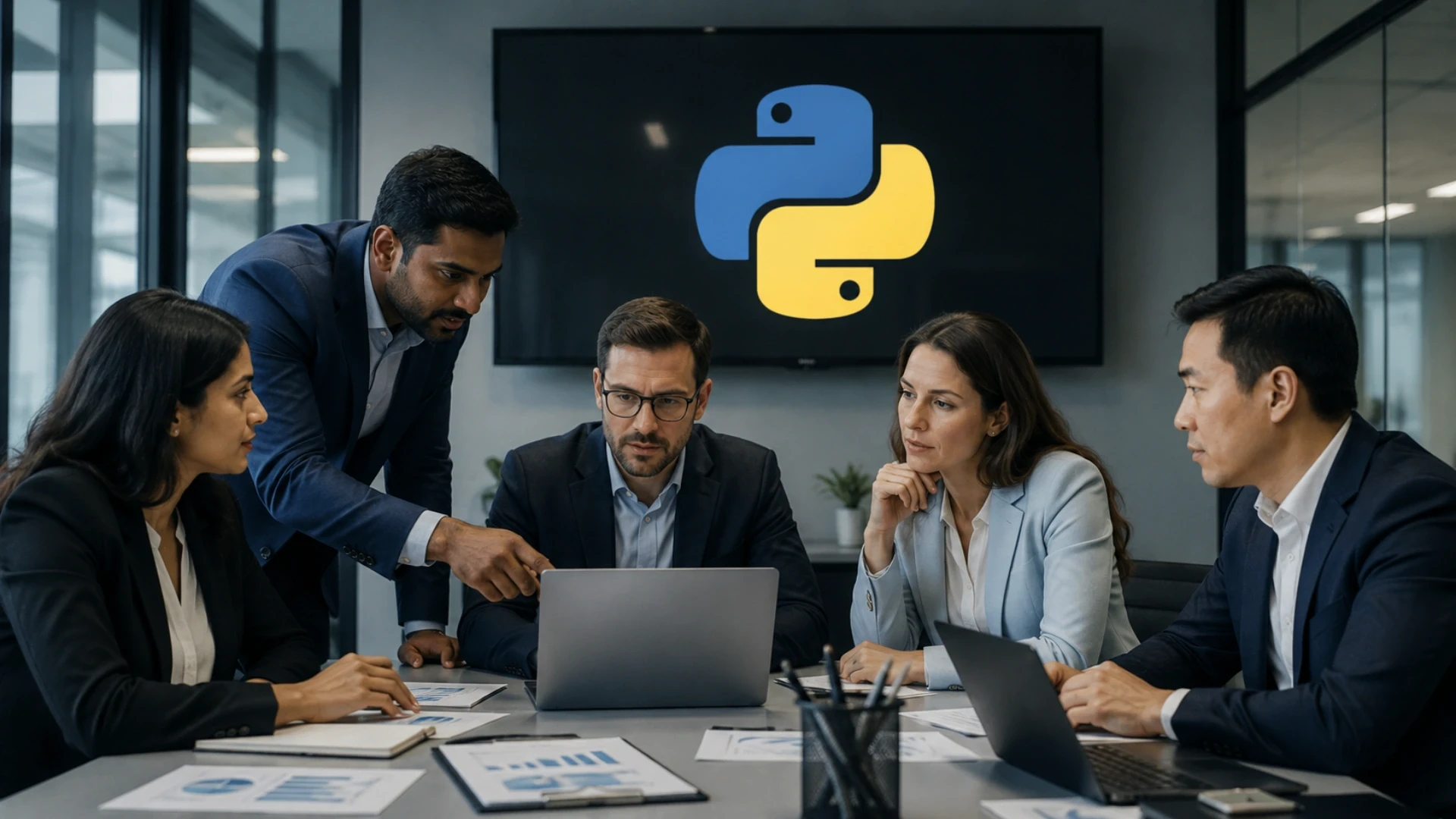
The enterprise case for Python is increasingly an automation and efficiency case. According to a 2026 analysis of AI automation tools for Fortune 500 companies by Bitcot, McKinsey data shows that US sectors with high AI exposure record three times higher revenue growth per worker compared to those slower to adopt, and large enterprises now focus their automation investments on three measurable wins: boosting operational efficiency across departments, reducing costs through intelligent automation of repetitive tasks, and freeing skilled talent to focus on high-value strategic work. Python is the language that underpins most of this internal automation and data work, which is why enterprises standardize on it rather than maintaining a fragmented mix of internal scripting languages.
The Six Reasons Enterprises Pick Python for Internal Work
One language across automation, data, and AI. Internal tooling, ETL pipelines, data analysis, ML models, and infrastructure automation can all live in Python. Standardizing on one language reduces the operational and hiring cost of maintaining a polyglot internal toolchain.
The deepest talent pool of any backend language. Enterprises need to hire and replace engineers at scale. Python's talent pool is the widest available, which lowers hiring risk and reduces the single-engineer-dependency problem that plagues internal systems written in niche languages.
Mature integration with enterprise systems. Python has battle-tested clients for Salesforce, SAP, Oracle, Workday, ServiceNow, every major cloud, and every major database. Internal systems are integration problems first, and Python integrates with everything the enterprise already runs.
Readability that protects against turnover. Internal systems outlive the engineers who build them. Python's readability means the next engineer can understand and maintain code they did not write, which is exactly the property internal tooling needs over a ten-year lifespan.
The data and AI ecosystem enterprises now require. Pandas, scikit-learn, PyTorch, and the entire data engineering stack are Python-first. As internal analytics and AI move from optional to expected, Python is the language that already has the tooling.
Lower total cost of ownership. Faster development, easier maintenance, and a wider talent pool combine into a lower long-term cost than most enterprise-internal alternatives, even accounting for Python's higher infrastructure cost on raw compute.
Where Python Runs Inside Mid-Market and Large Companies
Enterprise Python is rarely the customer-facing product. It is the layer of internal systems that makes the business run efficiently. Understanding the categories helps engineering leaders see where Python investment produces the highest return inside their own organization. Across US mid-market and enterprise companies, internal Python work clusters into six recognizable categories.
Table : Where Python Runs Inside Enterprises
Internal System Type | What It Does | Typical Python Tools |
|---|---|---|
Internal tools and dashboards | Ops, finance, support line-of-business apps | Django, FastAPI, Streamlit, Plotly |
Automation and scripting | Replace manual recurring operational work | Celery, Airflow, custom scripts |
Data pipelines and ETL | Move and transform data across systems | Airflow, Pandas, Polars, dbt |
Internal APIs and integration | Connect legacy systems and SaaS tools | FastAPI, Django REST Framework |
Analytics and reporting | Executive and departmental reporting | Pandas, Jupyter, Superset, dashboards |
ML and AI internal services | Forecasting, classification, internal copilots | scikit-learn, PyTorch, LangChain |
The Internal Systems Where Python Delivers the Highest Return
Internal tools and line-of-business dashboards. Operations, finance, HR, and support teams all need internal apps that no off-the-shelf SaaS covers exactly. Django for full internal apps, Streamlit or Plotly Dash for fast internal dashboards. These pay for themselves in saved staff hours within months.
Automation that replaces manual recurring work. Month-end reconciliation, report generation, data syncs, compliance checks. Each automation pipeline removes hours of recurring manual work and the human error that comes with it. This is the fastest-ROI category of enterprise Python.
Data pipelines and ETL. Moving data between source systems, the data warehouse, and the reporting layer. Apache Airflow orchestrating Python tasks is the enterprise standard for batch data movement, with Pandas and Polars for transformation.
Internal APIs that integrate legacy and SaaS systems. Enterprises run dozens of systems that need to talk to each other. FastAPI internal services act as the integration layer, exposing clean contracts over messy legacy systems and orchestrating data flow between SaaS platforms.
Scaling Python for Internal Systems Without Growing Headcount?
Acquaint Softtech provides senior Python engineers who integrate directly into enterprise teams for internal tooling, automation, data pipelines, and integration work. Django and FastAPI internal systems, Airflow data pipelines, and SOC 2-aligned engineering discipline, available through staff augmentation at 40 to 60% of equivalent US cost. Profiles in 24 hours. Onboarding in 48.
The Enterprise Python Stack and Governance Model
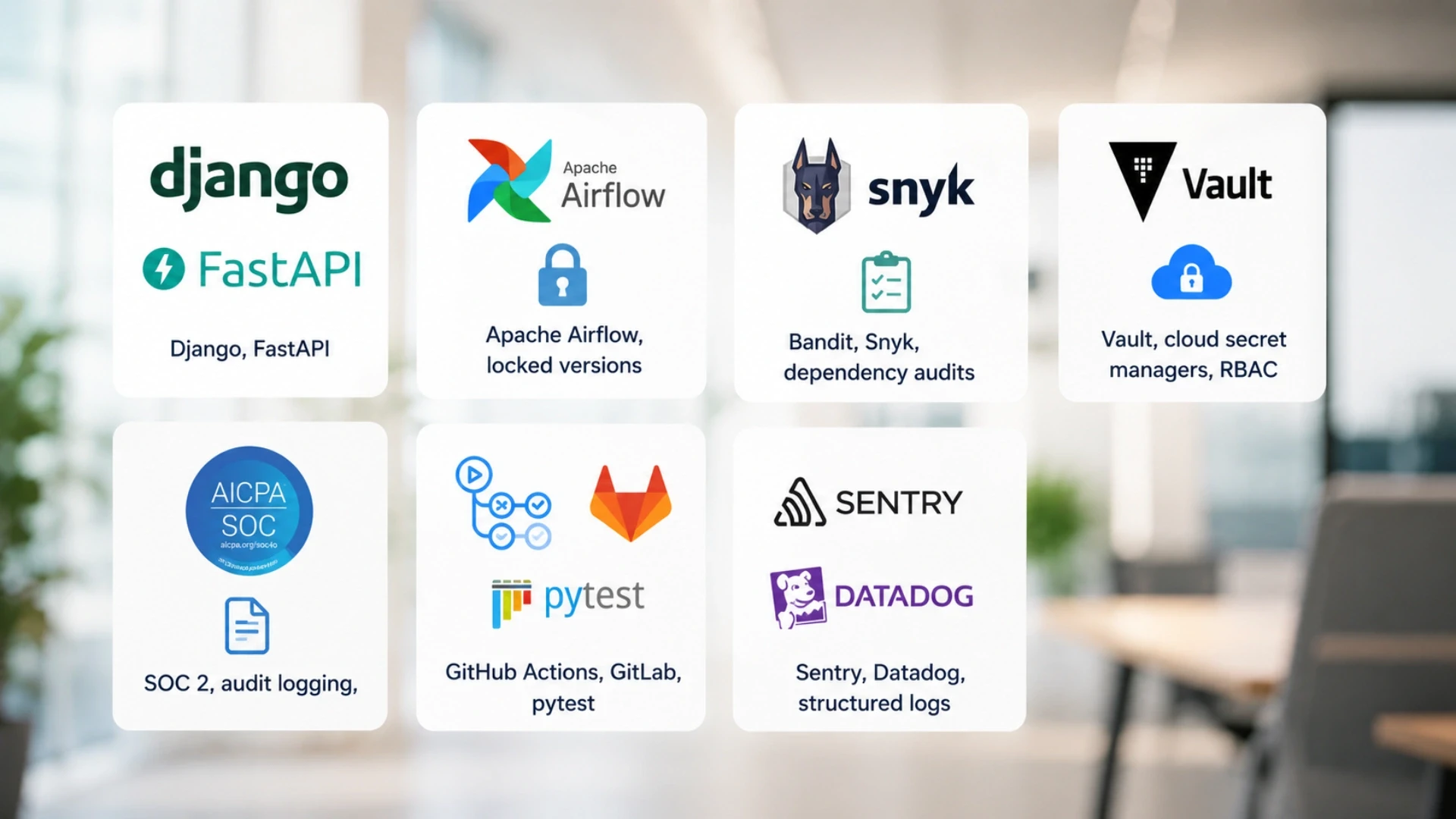
Enterprise Python differs from startup Python in one critical dimension: governance. A startup optimizes for speed. An enterprise optimizes for speed within guardrails, because internal systems touch sensitive data, integrate with regulated systems, and must satisfy security and compliance reviews. The stack is similar to what any serious Python team uses. The governance layer around it is what makes it enterprise-grade.
Table : Enterprise Python Stack and Governance Layer
Concern | Enterprise Standard | Why It Matters |
|---|---|---|
Web frameworks | Django, FastAPI | Mature, auditable, well-supported |
Data orchestration | Apache Airflow, dbt | Reliable, observable batch pipelines |
Dependency management | uv or Poetry, locked versions | Reproducible, audited builds |
Security scanning | Bandit, Snyk, dependency audits | Catch vulnerabilities before production |
Access and secrets | Vault, cloud secret managers, RBAC | No credentials in code, least privilege |
Compliance posture | SOC 2, audit logging, data governance | Pass internal and external audits |
CI/CD and testing | GitHub Actions or GitLab, pytest | Gated deployments, test coverage |
Observability | Sentry, Datadog, structured logs | Diagnose internal system issues fast |
The Governance Practices That Make Python Enterprise-Ready
Locked, audited dependencies. Enterprises cannot ship unaudited third-party code. uv or Poetry with locked versions, plus automated dependency scanning, ensure every library in production has been reviewed and every build is reproducible.
Secrets out of code, access least-privilege. Credentials live in Vault or a cloud secret manager, never in the codebase. Role-based access control limits what each internal system can reach. This is non-negotiable for systems touching financial, customer, or employee data.
SOC 2 and audit-grade logging. Internal systems that touch sensitive data need audit trails showing who accessed what and when. Building this into the architecture from the start is far cheaper than retrofitting it before a SOC 2 audit.
Gated CI/CD with real test coverage. Internal systems fail quietly and cost the business when they do. Automated testing with pytest, gated deployments, and code review requirements catch failures before they reach the finance team's morning dashboard.
The architectural foundation that supports enterprise-grade internal systems is covered in depth in the Python development architecture and frameworks guide, which walks through how Django, FastAPI, and the broader Python stack support the modularity, auditability, and integration patterns that enterprise internal systems require.
How Enterprises Staff Python Internal Systems Work
Internal systems work has a staffing problem that enterprises consistently underestimate. The work is essential but rarely glamorous, which makes it hard to attract and retain top internal engineers who would rather work on the flagship product. It comes in bursts, a quarter of heavy build followed by maintenance, which makes permanent headcount inefficient. And it requires senior judgment on security and integration, which means junior hires often create more risk than they remove. This combination is why most enterprises staff internal Python work through a blend of internal engineers and external augmentation rather than pure internal headcount.
The Three Staffing Models and When Each Fits
Staff augmentation for capacity and specialization. When the enterprise has an internal engineering team and a sprint structure but needs additional Python capacity or specific specialization (data engineering, ML, integration) for a defined period. Augmented engineers integrate into existing tools, sprint cadence, and processes without changing ownership.
Dedicated team for sustained internal platform work. When the internal systems portfolio is large enough to justify a standing team that accumulates institutional context. A dedicated team owns the internal tooling and data platform roadmap over multi-quarter horizons.
Full outsourcing for bounded internal projects. When the outcome matters but internal bandwidth to manage the build does not exist. A specific internal tool, automation system, or integration delivered end to end by an external partner, then handed back for internal maintenance.
The full decision framework for choosing between these models, with the trade-offs each carries for enterprise internal work, is covered in the staff augmentation vs dedicated team vs outsourcing comparison, which breaks down which model fits which internal-systems scenario and what each costs in practice.
For enterprises specifically weighing whether to extend their internal team through a vetted partner or source from developer marketplaces, the analysis on why in house Python teams outperform marketplace developers walks through why the structured augmentation model consistently outperforms marketplace sourcing for internal systems that need continuity and institutional knowledge.
How Acquaint Softtech Supports Enterprise Python Internal Systems
Acquaint Softtech is a Python development and IT staff augmentation company headquartered in Ahmedabad, India, with 13 years of delivery experience and 1,300 or more projects completed for clients across the US, UK, Europe, and Australia. Production-grade enterprise data engineering, AI and ML capability, and compliance experience are all available through the India offshore market at 40 to 60% of the equivalent US cost, as detailed in the analysis on Python development cost for mid-sized businesses, which breaks down enterprise-level system costs in detail.
Senior Python engineers with enterprise internal-systems depth. Hands-on with Django and FastAPI internal tools, Apache Airflow data pipelines, Salesforce, SAP, and ServiceNow integration, ML internal services, and SOC 2-aligned engineering discipline.
Staff augmentation built for enterprise integration. Engineers integrate into your existing Jira, GitHub, and Slack, follow your sprint process, and work under your oversight, with full NDA and IP assignment from day one and a free replacement guarantee on dedicated engagements.
Verified delivery track record. Five-star ratings across Clutch (35 or more reviews) and a 98% job success rate across 1,293 or more Upwork reviews. Every Python developer is a permanent in-house employee, not a marketplace contractor.
Transparent pricing from $20/hour. Dedicated Python engineering teams from $3,200/month per engineer. Enterprise internal-systems audits and architecture reviews from $5,000.
To extend your internal engineering team with senior Python developers who integrate into your existing structure without permanent headcount commitments, explore Python staff augmentation services with profiles shared in 24 hours and onboarding within 48.
The Bottom Line
Python became the quiet workhorse inside US mid-market and enterprise companies because it is the most productive choice for the internal engineering work that keeps large organizations running. It standardizes automation, data, integration, and AI on one language. It hires from the deepest talent pool. It integrates with every enterprise system that already exists. It stays maintainable across the engineer turnover that internal systems inevitably outlive. And with the right governance layer, locked dependencies, secrets management, SOC 2-aligned logging, gated deployments, it satisfies the security and compliance requirements that enterprise internal systems demand.
The companies getting the most from enterprise Python are not the ones with the most novel internal architecture. They are the ones who standardized on Python for internal systems, applied enterprise governance discipline around it, and staffed the work through a smart blend of internal engineers and external augmentation rather than trying to carry it all on permanent headcount. The internal systems are not the product. But they are how the product gets built, sold, supported, and reported on. Get the internal systems right, and the whole company runs better. Python is how most large companies get them right.
Planning Enterprise Python Internal Systems or Automation?
Book a free 30-minute consultation. We will look at your internal systems portfolio, integration requirements, compliance scope, and capacity needs, and tell you straight how to staff and architect the work. No sales pitch. Just senior engineers who have built enterprise internal systems for US, UK, and European companies.
Frequently Asked Questions
-
Why do enterprises use Python for internal systems instead of their main product language?
Because internal systems have different requirements than the flagship product. They are integration-heavy, change frequently, must be maintainable across engineer turnover, and increasingly need data and AI capabilities. Python's deep integration ecosystem, readability, wide talent pool, and dominant data and AI tooling make it the most productive choice for this work. Fortune 500 tech stack data confirms Python and Java are the most common languages across America's largest companies, with Python especially dominant in internal automation, data, and AI work.
-
What internal systems do enterprises typically build in Python?
Six categories dominate: internal tools and line-of-business dashboards for ops, finance, and support; automation that replaces manual recurring work like month-end reconciliation; data pipelines and ETL moving data between systems and the warehouse; internal APIs that integrate legacy and SaaS systems; analytics and reporting for executives and departments; and ML or AI internal services like forecasting, classification, and internal copilots. The highest-ROI category is usually automation, because each pipeline directly removes recurring manual labor and human error
-
Is Python secure and compliant enough for enterprise internal systems?
Yes, when the governance layer is in place. The language itself is no less secure than alternatives. Enterprise readiness comes from locked and audited dependencies, secrets management through Vault or cloud secret managers, role-based access control, SOC 2-aligned audit logging, gated CI/CD with test coverage, and security scanning with tools like Bandit and Snyk. Python supports all of these patterns. The discipline applied around the code, not the code itself, is what makes internal systems enterprise-grade.
-
How do enterprises staff Python internal systems work cost-effectively?
Most use a blend of internal engineers and external augmentation. Staff augmentation adds Python capacity or specialization to an existing team for a defined period without permanent headcount. A dedicated team owns a large internal-systems portfolio over multi-quarter horizons. Full outsourcing handles bounded internal projects end to end. Offshore augmentation through a vetted partner delivers production-grade enterprise capability at 40 to 60% of equivalent US cost, which is why many US enterprises use it for internal systems work specifically.
-
What is the cost range for an enterprise Python internal system?
Project Type
Estimated Cost
Mid Complexity Internal Tool or Data Driven App
$15,000 to $60,000
Enterprise Systems or ML Platforms
$50,000 to $150,000+
-
How does Python handle integration with enterprise systems like Salesforce, SAP, and ServiceNow?
Python has mature, battle-tested client libraries and REST API support for every major enterprise platform, including Salesforce, SAP, Oracle, Workday, and ServiceNow, plus every major cloud and database. Internal systems are integration problems first, and Python integrates with everything the enterprise already runs. FastAPI internal services commonly act as the integration layer, exposing clean contracts over legacy systems and orchestrating data flow between SaaS platforms.
-
Should an enterprise use Django or FastAPI for internal tools?
Django for full internal applications that need an admin interface, user management, complex permissions, and content workflows, since its batteries-included approach covers internal app needs with minimal boilerplate. FastAPI for internal APIs, integration services, and high-throughput endpoints where async I/O and typed contracts matter. Many enterprises run both: Django for internal line-of-business apps and FastAPI for the integration and API layer. For fast internal dashboards specifically, Streamlit or Plotly Dash often beat both.
We’re Acquaint Softtech, your technology growth partner. Whether you're building a SaaS product, modernizing enterprise software, or hiring vetted remote developers, we’re built for flexibility and speed. Our official partnerships with Laravel, Statamic, and Bagisto reflect our commitment to excellence, not limitation. We work across stacks, time zones, and industries to bring your tech vision to life.
Table of Contents
Get Started with Acquaint Softtech
- 13+ Years Delivering Software Excellence
- 1300+ Projects Delivered With Precision
- Official Laravel & Laravel News Partner
- Official Statamic Partner
Related Blog
How to Hire Python Developers Without Getting Burned: A Practical Checklist
Avoid costly hiring mistakes with this practical checklist on how to hire Python developers in 2026. Compare rates, vetting steps, engagement models, red flags, and more.
Acquaint Softtech
March 30, 2026
Total Cost of Ownership in Python Development Projects: The Full Financial Picture
The build cost is just the beginning. This guide breaks down the complete TCO of Python development projects across every lifecycle phase, with real benchmarks, a calculation framework, and 2026 data.
Acquaint Softtech
March 23, 2026
Python Developer Hourly Rate: What You're Actually Paying For
Python developer rates range $20-$150+/hr in 2026. See what experience, specialisation & hidden costs actually determine the price. Save 40% with vetted offshore talent.
Acquaint Softtech
March 9, 2026India (Head Office)
203/204, Shapath-II, Near Silver Leaf Hotel, Opp. Rajpath Club, SG Highway, Ahmedabad-380054, Gujarat
USA
7838 Camino Cielo St, Highland, CA 92346
UK
The Powerhouse, 21 Woodthorpe Road, Ashford, England, TW15 2RP
New Zealand
42 Exler Place, Avondale, Auckland 0600, New Zealand
Canada
141 Skyview Bay NE , Calgary, Alberta, T3N 2K6
Your Project. Our Expertise. Let’s Connect.
Get in touch with our team to discuss your goals and start your journey with vetted developers in 48 hours.