

Python for Startups Why Early-Stage Companies Choose Python to Build Their First Product
Why early-stage startups choose Python to build their first product in 2026. Speed, cost, talent, scalability, and the MVP stack that ships fast and scales.

Acquaint Softtech
Introduction: The Tech Decision That Quietly Decides Whether a Startup Ships
Every early-stage founder makes a technology decision before they have enough information to make it well. The product is not built yet. The team is not hired yet. The market is not validated yet. And yet, somewhere in the first month, somebody picks the language and framework that the entire first product will be built on. That decision quietly determines how fast the MVP ships, how cheaply it gets built, how easily the team can hire, and how painful the eventual scaling will be. Get it wrong and the startup spends its scarce runway fighting its own stack. Get it right and the technology fades into the background where it belongs. For a large and growing share of startups in 2026, getting it right means choosing Python.
The data on startup technology choices makes the trend clear. According to a 2026 Python development guide for startups published by Meduzzen, Python powers over 60% of new startup tech stacks in 2026 and ranks among the top three programming languages globally, particularly dominant in startup environments where speed and versatility drive competitive advantage. Startups use Python for rapid MVP development, then scale those same codebases into production systems serving millions of users. Companies like Instagram and Dropbox run Python at massive scale, and performance bottlenecks typically occur at infrastructure layers rather than in Python execution speed. The language that gets a startup to its first hundred users is the same language that carries it to its first million.
This guide covers why early-stage companies choose Python to build their first product, what the Python startup stack actually looks like in 2026, what it costs and how fast you can ship, and the mistakes that sink startup Python projects before they reach product-market fit. It is written for non-technical founders evaluating their first technology decision, technical founders weighing Python against alternatives, and early CTOs setting the foundation that the next three years of the company will be built on.
If you are at the point of building the team that will ship your first product, the complete guide to hiring Python developers in 2026 sets the wider hiring context, including how to evaluate engineers, which engagement models fit early-stage budgets, and how to avoid the hiring mistakes that cost startups their runway.
The Six Reasons Startups Choose Python for Their First Product
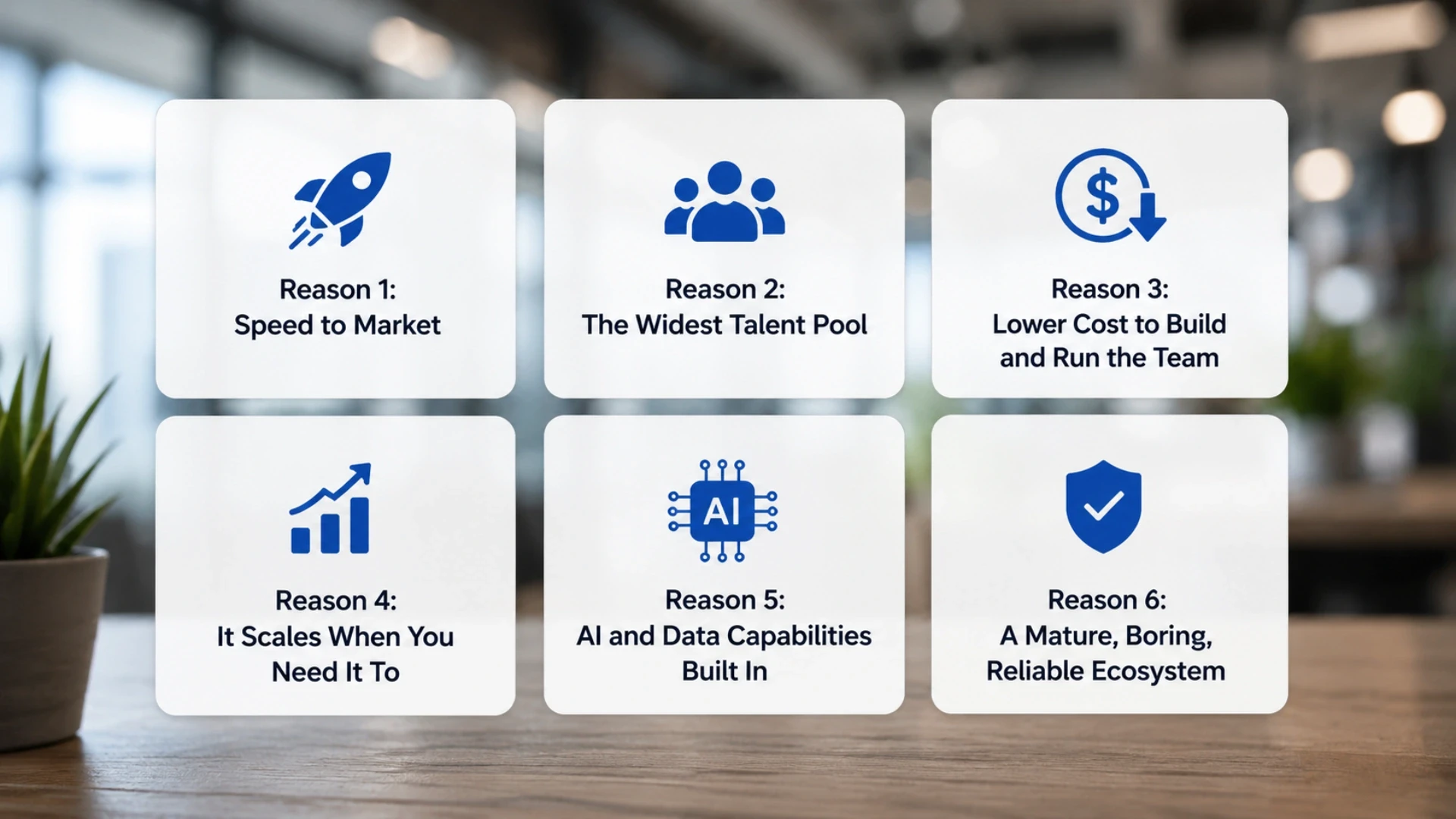
The case for Python in startups is not about any single advantage. It is about how several advantages compound during the exact phase when a startup has the least money, the smallest team, and the most uncertainty. According to a 2026 analysis of Python for business by Softjourn, the global number of Python developers reached approximately 8.2 million as of late 2025, surpassing the estimated 7.6 million Java developers worldwide, and Python's development speed advantage translates directly into shorter MVP cycles and faster response to market changes. For a startup, that combination of the widest talent pool and the fastest iteration speed is exactly what the early phase demands.
Reason 1: Speed to Market
Python lets a small team ship a working MVP in weeks rather than months. The syntax is concise, the standard library is deep, and frameworks like Django and FastAPI handle authentication, database access, admin interfaces, and API documentation out of the box. A startup using Python writes meaningfully fewer lines of code to achieve the same functionality than it would in many other languages, which directly compresses the time between idea and first user feedback.
Reason 2: The Widest Talent Pool
With 8.2 million developers globally, Python has the deepest hiring pool of any major backend language. For a startup, this matters in two ways. First, it is easier and cheaper to find engineers. Second, it is easier to replace them when people inevitably leave, which protects the company from the single-engineer-holds-the-keys risk that kills early-stage products when a key hire departs.
Reason 3: Lower Cost to Build and Run the Team
A smaller team ships the same product in Python, and a smaller team costs less. Python's productivity means a startup can validate a product idea with two or three engineers where other stacks might need four or five. For a company counting runway in months, that team-size difference is often the difference between reaching the next milestone and running out of money before it.
Reason 4: It Scales When You Need It To
The old objection that 'Python does not scale' is a myth that production systems disproved years ago. Instagram, Dropbox, Spotify, Netflix, Uber, and Pinterest all run Python at enormous scale. Modern async frameworks like FastAPI handle millions of concurrent requests through non-blocking I/O. The startup that builds its MVP in Python is not choosing a throwaway prototype language. It is choosing a language that grows with the company from the first user to the millionth.
Reason 5: AI and Data Capabilities Built In
In 2026, an increasing share of startups have an AI or data component in their first product. Python owns the AI and data ecosystem outright: PyTorch, TensorFlow, scikit-learn, Pandas, and the entire LLM tooling landscape are Python-first. A startup that builds in Python can add AI features without switching languages or maintaining a polyglot stack, which is a meaningful advantage when AI is increasingly table stakes rather than a differentiator.
Reason 6: A Mature, Boring, Reliable Ecosystem
Startups should spend their innovation budget on their product, not on their infrastructure. Python's ecosystem is mature and boring in the best possible way. Battle-tested frameworks, well-documented libraries, and a vast body of solved problems mean a startup rarely hits a wall where it has to invent infrastructure. The boring parts stay boring, and the team's energy goes into the product that actually differentiates the business.
The Python Stack for a Startup MVP in 2026
The startup Python stack in 2026 has converged on a small set of well-understood choices. The goal at MVP stage is not the most powerful possible architecture. It is the stack that ships fastest, hires easiest, and scales without a rewrite when the startup finds traction. Over-engineering at this stage is as dangerous as under-engineering, because every hour spent building infrastructure the startup does not yet need is an hour not spent finding product-market fit.
Table : Recommended Python Startup MVP Stack
Layer | Recommended Choice | Why for a Startup |
|---|---|---|
Web framework | Django (full product) or FastAPI (API-first) | Batteries-included or async-native |
Database | PostgreSQL | Reliable, scales far, free |
Cache and queue | Redis | Sessions, caching, Celery broker |
Background work | Celery or Dramatiq | Emails, jobs, async tasks |
Frontend | React or Vue (or Django templates early) | Largest talent pool |
Hosting | Managed (Render, Railway, Fly, or AWS) | Skip DevOps overhead early |
Payments | Stripe (provider abstraction layer) | Fast integration, PCI handled |
Auth | Django auth or managed (Auth0, Clerk) | Do not build auth from scratch |
Observability | Sentry from day one | Catch errors before users report |
The single most consequential framework decision for a startup is Django versus FastAPI, and the right answer depends on your product profile rather than on which framework is trendier. The Django vs FastAPI vs Flask comparison guide walks through the trade-offs in detail, but the short version for startups is Django for content-heavy products with admin needs, FastAPI for API-first or AI-powered products, and both together once the product surface grows.
Building Your First Product and Need Senior Python Engineers Fast?
Acquaint Softtech provides senior Python engineers who have shipped startup MVPs from scratch: Django and FastAPI products, Stripe integration, scalable PostgreSQL architecture, and the discipline to build a first product that does not need a rewrite when you find traction. Profiles in 24 hours. Onboarding in 48.
What a Python MVP Actually Costs and How Fast You Can Ship

Founders consistently underestimate two things and overestimate a third. They underestimate how cheaply a lean MVP can be built, underestimate how much budget they will need after launch for improvements, and overestimate how many features the first version needs. Getting these three numbers right is the difference between a startup that validates its idea on its first budget and one that runs out of money building features nobody asked for.
The Real Numbers for a Python MVP
Table : Python MVP Cost and Timeline Reality (2026)
Build Type | Cost Range | Timeline |
|---|---|---|
Clickable prototype (Figma) | $3,000 to $5,000 | 1 to 2 weeks |
Lean MVP (3 to 5 core features) | $15,000 to $25,000 | 6 to 10 weeks |
Complete MVP (auth, billing, polish) | $25,000 to $45,000 | 10 to 16 weeks |
SaaS MVP (multi-tenant, subscriptions) | $50,000 to $80,000 | 16 to 24 weeks |
These figures come from verified 2026 benchmarks, and the budget reality has a critical second half that most founders miss. Research from Startup Genome shows that successful startups spend roughly 50% of their initial development budget on improvements in the first year after launch. The full breakdown, including the three consistent reasons startups fail their Python projects, is covered in the analysis on the minimum budget required to start a Python development project in 2026, which is essential reading before committing a development budget.
The speed advantage is just as concrete as the cost advantage. A lean Python MVP with three to five core features ships in 6 to 10 weeks with an experienced team. That speed is not a luxury. It is survival. The faster a startup gets real product in front of real users, the faster it learns whether the idea works, and the more runway it preserves for the improvements that come after the first version teaches the team what the market actually wants.
Mistakes That Sink Startup Python Projects
Most startup Python projects do not fail because Python was the wrong choice. They fail because of decisions made around the technology: scope, sequencing, spending, and team structure. The mistakes below are the ones that consistently appear in post-mortems of early-stage products that ran out of money before reaching product-market fit.
Building too many features before validating the core. The most common startup failure. Every feature added before the core hypothesis is validated burns runway on something the market may not want. Ship the smallest product that tests the core assumption, then expand based on real feedback.
Over-engineering the architecture for scale you do not have. Building microservices, Kubernetes clusters, and elaborate caching for 50 users wastes the budget that should fund product discovery. Start with a boring Django or FastAPI monolith. Add complexity only when measurement proves you need it.
Spending the entire budget on the first version. Successful startups reserve roughly half their budget for post-launch improvements. A startup that spends everything on the MVP has no runway left to act on the feedback the MVP generates, which is the entire point of building it.
Building auth, billing, and infrastructure from scratch. Use Stripe for payments, a managed auth provider or Django's built-in auth, and managed hosting. Building these from scratch is months of engineering that produces a worse result than the off-the-shelf option and adds nothing the customer values.
Hiring the wrong engagement model for the stage. A solo freelancer who disappears mid-build, or a large agency with enterprise overhead, both hurt early-stage startups. The right model is usually a small dedicated team or staff augmentation with senior engineers who have shipped MVPs before.
Ignoring the path from MVP to scale. The opposite of over-engineering is also dangerous. Choosing a stack or schema that cannot scale at all means a forced rewrite the moment the startup finds traction. The goal is a stack that ships fast now and scales later without a teardown, which is exactly what the Python stack above provides.
For startups specifically weighing how much product to build before launch, the framework of MVP versus MLP versus MCP (minimum viable, lovable, and complete products) matters more than the technology choice. The FinTech SaaS launch strategy guide walks through how to balance speed, compliance, and scalable growth when deciding what to ship first, which applies well beyond FinTech to any startup making the launch-scope decision.
How Acquaint Softtech Helps Startups Ship Their First Product
Acquaint Softtech is a Python development and IT staff augmentation company based in Ahmedabad, India, with 1,300+ software projects delivered globally across healthcare, FinTech, SaaS, EdTech, eCommerce, and early-stage startup products. Our startup engagements follow the architectural framework described in the complete guide to hiring Python developers, with senior Python engineers who have shipped MVPs from zero, and the discipline to build a first product that validates fast without locking the startup into an architecture it has to tear down at the first sign of traction.
Senior Python engineers with MVP experience. Hands-on with Django and FastAPI MVPs, Stripe integration, PostgreSQL architecture, Celery background work, and the judgement to build the right amount of product for the validation stage.
Engagement models that fit early-stage budgets. Small dedicated teams for the full build, or staff augmentation to extend a founder's existing technical capacity, without the enterprise overhead that drains startup runway.
Fast time to first profile and onboarding. Profiles in 24 hours, onboarding in 48. For a startup counting runway in months, the speed of getting the right engineers working matters as much as the engineers themselves.
Transparent pricing from $20/hour. Dedicated Python engineering teams from $3,200/month per engineer. MVP scoping and architecture consultations from $5,000, structured to fit a startup's validation budget.
To bring senior Python engineers onto your first product quickly, with the seniority profile that early-stage products need to avoid expensive early mistakes, you can hire Python developers with profiles shared in 24 hours and a defined onboarding plan within 48.
The Bottom Line
Early-stage startups choose Python because its advantages compound during exactly the phase when a startup can least afford to get its technology decision wrong. It ships the fastest MVP, hires from the widest talent pool, costs the least to build and run, scales from the first user to millions without a rewrite, owns the AI and data ecosystem, and runs on a mature, boring, reliable foundation that lets the team spend its innovation budget on the product instead of the infrastructure.
The technology choice is not what makes a startup succeed. Product-market fit, distribution, and execution do that. But the wrong technology choice can absolutely make a startup fail, by burning runway on a rewrite, slowing iteration, or making hiring impossible at a critical moment. Python is the choice that gets out of the way and lets the team focus on the only thing that matters early: finding out whether anyone wants what they are building. Ship fast. Spend carefully. Validate ruthlessly. Build the smallest product that tests the idea, and let Python carry you from the first user to whatever scale the market rewards you with.
Ready to Build Your First Product in Python?
Book a free 30-minute MVP consultation. We will look at your idea, your budget, and your timeline, and give you a straight assessment of what your first version should include, what it should cost, and how fast you can ship. No sales pitch. Just senior engineers who have built startup MVPs that found product-market fit.
Frequently Asked Questions
-
Why do so many startups choose Python for their first product?
Python combines the fastest path to a working MVP, the widest developer talent pool (8.2 million globally, surpassing Java), the lowest team cost for equivalent output, and a proven ability to scale from the first user to millions. It also owns the AI and data ecosystem, which matters increasingly as AI features become table stakes. Python powers over 60% of new startup tech stacks in 2026 because these advantages compound during exactly the phase when a startup has the least money and the most uncertainty.
-
Is Python fast enough to scale my startup if it succeeds?
Yes. The 'Python does not scale' objection was disproven years ago by production systems. Instagram, Dropbox, Spotify, Netflix, Uber, and Pinterest all run Python at enormous scale. Modern async frameworks like FastAPI handle millions of concurrent requests through non-blocking I/O. Performance bottlenecks in scaled Python systems almost always occur at the database or infrastructure layer, not in Python execution speed, and those are solvable with caching, read replicas, and standard scaling patterns.
-
How much does it cost to build a Python MVP in 2026?
MVP Stage
Estimated Cost
Clickable Prototype
$3,000 to $5,000
Lean MVP with Core Features
$15,000 to $25,000
Advanced MVP with Billing and Polish
$25,000 to $45,000
SaaS MVP with Multi Tenancy
$50,000 to $80,000
Successful startups typically spend an additional 50% of the initial development budget on post launch improvements and scaling.
-
Should I use Django or FastAPI for my startup MVP?
Django for content-heavy products that need an admin interface, user management, and a fast path from idea to functional product, since its batteries-included approach removes weeks of boilerplate. FastAPI for API-first products, AI-powered features, and async-heavy workloads where typed contracts and automatic documentation matter. Many startups use Django for the main product and add FastAPI for specific high-performance or AI endpoints. The framework matters less than shipping fast and not over-engineering.
-
How much does a real Python PropTech platform cost to build?
A lean Python PropTech MVP with one MLS integration, basic search, and a simple admin interface typically starts at $40,000 to $80,000. A more complete platform with multi-MLS coverage, AVM integration, investor analytics dashboards, and operational tooling runs $120,000 to $300,000. Enterprise-grade PropTech with multi-region MLS, advanced AVMs, complex compliance, and high-volume analytics pushes the range to $300,000 and above. The variable is integration scope, not the underlying Python stack.
-
How fast can a startup ship a Python MVP?
A lean Python MVP with three to five core features ships in 6 to 10 weeks with an experienced team. A complete MVP with billing and polish takes 10 to 16 weeks. The speed comes from Python's concise syntax, deep standard library, and frameworks that handle auth, database access, and admin interfaces out of the box. Shipping fast is survival for a startup: the faster you get real product to real users, the faster you learn whether the idea works and the more runway you preserve.
-
What is the biggest mistake startups make with their first Python product?
Building too many features before validating the core hypothesis. Every feature added before the core assumption is tested burns runway on something the market may not want. The fix is ruthless prioritisation: ship the smallest product that tests whether the core idea works, get it in front of real users, and expand based on actual feedback rather than assumptions. Over-engineering the architecture for scale you do not yet have is a close second.
We’re Acquaint Softtech, your technology growth partner. Whether you're building a SaaS product, modernizing enterprise software, or hiring vetted remote developers, we’re built for flexibility and speed. Our official partnerships with Laravel, Statamic, and Bagisto reflect our commitment to excellence, not limitation. We work across stacks, time zones, and industries to bring your tech vision to life.
Table of Contents
Get Started with Acquaint Softtech
- 13+ Years Delivering Software Excellence
- 1300+ Projects Delivered With Precision
- Official Laravel & Laravel News Partner
- Official Statamic Partner
Related Blog
How to Hire Python Developers Without Getting Burned: A Practical Checklist
Avoid costly hiring mistakes with this practical checklist on how to hire Python developers in 2026. Compare rates, vetting steps, engagement models, red flags, and more.
Acquaint Softtech
March 30, 2026
Total Cost of Ownership in Python Development Projects: The Full Financial Picture
The build cost is just the beginning. This guide breaks down the complete TCO of Python development projects across every lifecycle phase, with real benchmarks, a calculation framework, and 2026 data.
Acquaint Softtech
March 23, 2026
Python Developer Hourly Rate: What You're Actually Paying For
Python developer rates range $20-$150+/hr in 2026. See what experience, specialisation & hidden costs actually determine the price. Save 40% with vetted offshore talent.
Acquaint Softtech
March 9, 2026India (Head Office)
203/204, Shapath-II, Near Silver Leaf Hotel, Opp. Rajpath Club, SG Highway, Ahmedabad-380054, Gujarat
USA
7838 Camino Cielo St, Highland, CA 92346
UK
The Powerhouse, 21 Woodthorpe Road, Ashford, England, TW15 2RP
New Zealand
42 Exler Place, Avondale, Auckland 0600, New Zealand
Canada
141 Skyview Bay NE , Calgary, Alberta, T3N 2K6
Your Project. Our Expertise. Let’s Connect.
Get in touch with our team to discuss your goals and start your journey with vetted developers in 48 hours.