

Python for Logistics & Supply Chain Automation, APIs, and Real-Time Data Pipelines
Python for logistics and supply chain in 2026. Automation patterns, API integration, real-time data pipelines, and the architecture that scales operations.

Acquaint Softtech
Introduction: Why Logistics Engineering Quietly Became a Python Engineering Problem
Most people outside the industry think of logistics as trucks and warehouses. The people inside it know that modern logistics is an integration problem with a software layer that happens to move physical things. Every package moving from a Shenzhen warehouse to a Berlin doorstep generates dozens of data events across at least five different systems: the warehouse management system that picked it, the transportation management system that routed it, the carrier API that confirmed pickup, the customs platform that cleared it, and the customer-facing tracking page that showed updates. When any one of those handoffs breaks or runs slowly, deliveries are late and customers cancel.
The architectural reality of this complexity is documented in production case studies. According to a February 2026 logistics data pipeline analysis by Syntora, modern logistics operations generate massive amounts of data across warehouses, transportation systems, inventory management platforms, and supplier networks, and the engineering response is increasingly custom Python-based pipelines that automatically connect transportation management systems, warehouse platforms, carrier APIs, and inventory databases into unified data flows. Without automation, supply chain teams spend countless hours manually consolidating shipment tracking, inventory levels, and performance metrics from disconnected systems. With automation done well, the same teams gain real-time visibility and act on optimization opportunities while they are still actionable.
This guide covers how Python solves the three core engineering problems of logistics and supply chain in 2026: automation of repetitive operational work, integration with the dozens of APIs that move data between systems, and real-time data pipelines that turn raw operational events into decisions worth making. It is written for CTOs, founders, operations leaders, and senior engineers building logistics technology, freight platforms, last-mile delivery products, or supply chain analytics layers on top of existing ERP and TMS systems. Every pattern below is grounded in production architecture, not theoretical pipelines.
If you are still building the team that will execute a Python logistics platform, the complete guide to hiring Python developers in 2026 sets the wider hiring context. Logistics engineering combines API integration depth, data pipeline maturity, and operational stability requirements that tend to push the seniority bar higher than generic Python work.
Why Python Wins in Logistics and Supply Chain Engineering
Python is not the only language used in logistics technology. Java is common in older WMS and TMS systems. Go shows up in high-throughput route planners. JavaScript dominates the dashboards that operations teams use day to day. But across the work that actually defines modern supply chain platforms, automation scripts, ETL pipelines, API integrations, optimisation models, predictive analytics, Python is the language that lets teams ship faster than any direct competitor. The reasons are structural, not aesthetic.
The library ecosystem is the deepest in the industry. Pandas and Polars for tabular data. SQLAlchemy and asyncpg for database integration. Requests and httpx for API integration. NetworkX for graph problems like route planning. PuLP and SciPy for optimisation models. No other language matches this for general supply chain engineering.
Integration with everything that already exists. Logistics teams rarely start greenfield. They integrate with existing WMS, TMS, ERP, carrier APIs, and customer portals. Python plays well with all of them through mature client libraries, ODBC connectors, and well-documented HTTP patterns.
ML and predictive analytics in the same language. Demand forecasting, anomaly detection on shipment events, ETA prediction with machine learning models. Python lets the same team that built the data pipeline build the model that consumes the data. No cross-language handoff cost.
Hiring depth that holds up under pressure. Logistics engineering teams rarely operate at large scale. The hiring pool for Python is wide enough that scaling a team from 3 to 12 engineers does not introduce bottlenecks the way it would with niche languages.
Polyglot integration where measurement justifies. When a specific hot path (route solver, real-time tracking endpoint) genuinely needs lower latency than Python comfortably delivers, the architecture cleanly drops in a Go or Rust service. The Python application stays primary.
These same patterns show up consistently across production Python systems at scale. For broader architectural lessons drawn from production Python case studies, the analysis on backend architecture lessons from real Python case studies walks through how Instagram, Spotify, Netflix, and others approached the same engineering questions of integration, caching, and async processing at meaningful scale.
The Three Pillars: Automation, APIs, and Real-Time Data Pipelines
Across modern supply chain engineering, three problem types account for most of what Python is actually used for. According to a January 2026 review of Python in supply chain analytics by CertLibrary, real production patterns use Pandas, SQLAlchemy, and Requests for automated data pulls from ERP systems, APIs, spreadsheets, and web sources; NetworkX and SciPy for route optimisation across road networks and traffic data; and Streamlit and Dash for the dashboards that operations teams actually use. One referenced case showed a logistics company implementing NetworkX plus SciPy to optimise delivery routes across urban areas, analysing road networks and traffic data to develop routing algorithms that reduced travel time and fuel consumption. The pattern is consistent: Python handles the engineering, the operations team gets the outcome.
Pillar 1: Automation That Replaces Manual Operational Work
Most operational logistics work that gets called 'manual' is actually script-shaped. Pulling daily inventory snapshots from the WMS. Reconciling carrier invoices against shipment records. Generating end-of-day reports for warehouse managers. Sending exception alerts when a shipment misses its SLA window. Each of these is a Python script away from automation, and each saves operations staff hours per day once it ships.
Scheduled batch jobs with Celery Beat or APScheduler. Daily inventory reconciliation. Weekly carrier performance summaries. Monthly P&L extracts. Python scripts running on a schedule cover most operational automation needs without overengineering.
Event-driven automation with queues. When a shipment status changes, when an inventory level drops below threshold, when a delivery exception fires. Celery, RQ, or Dramatiq workers process events as they happen and trigger downstream actions.
Document parsing with Python OCR plus LLM extraction. Bills of lading, customs declarations, proof of delivery forms. The combination of Tesseract for OCR and a structured extraction pass through an LLM API turns paper-based logistics work into structured data.
Pillar 2: API Integration With Everything Logistics Touches
Modern logistics architecture is API integration architecture. Every shipment that moves through your system passes through multiple external APIs: the carrier's shipping API, the customs platform's classification API, the payment provider's invoice API, the customer notification API. The platform's value is not in any single integration. It is in the orchestration across all of them.
HTTP client discipline matters. httpx for async outbound calls. Retry logic with exponential backoff for transient failures. Circuit breakers around unreliable third-party APIs so one carrier's outage does not bring down the rest of the system.
Webhook handlers must be idempotent. Carriers retry status update webhooks. A handler that creates duplicate shipment records on retry corrupts the operational database. Use idempotency keys at the database level so retries are safe by default.
API contracts at the platform edge. FastAPI with Pydantic for the platform's own outbound API, documenting expected request and response shapes for partners. OpenAPI specs that auto-generate client SDKs reduce integration friction with customers and downstream consumers.
Provider abstraction from day one. A single Carrier interface with implementations for FedEx, DHL, UPS, regional carriers. Adding a new carrier is a 2-day task, not a 6-week refactor. The same pattern applies to payments, customs, and notification providers.
The choice between REST, GraphQL, and gRPC for logistics APIs is itself an architectural decision worth thinking through carefully. The REST vs GraphQL in Python decision framework walks through how to evaluate that decision for production systems where API contracts will outlive the original team and integration partners drive performance requirements.
Pillar 3: Real-Time Data Pipelines That Power Operational Visibility
Logistics decisions have a short half-life. Knowing yesterday that 8% of shipments were late does not help. Knowing right now that an entire region's deliveries are running 90 minutes behind schedule because of weather lets the operations team reroute drivers, alert customers, and prevent the next 200 shipments from compounding the delay. Real-time data pipelines are the architectural layer that closes the gap between event and decision.
Streaming ingestion with Kafka or managed equivalents. Shipment events, GPS updates, scan events, exception alerts. Kafka, AWS Kinesis, or Google Pub/Sub absorb high-volume event streams from carrier systems and route them into downstream consumers without blocking source systems.
Stream processing with Faust, Bytewax, or PySpark Structured Streaming. Python-native stream processors that consume Kafka topics, transform events, detect patterns, and write results to operational stores. The right tool depends on volume, but Python options span small to very large scale cleanly.
Hot operational store plus cold analytical store. PostgreSQL plus Redis for the current operational state that dashboards and APIs read from. S3 plus Parquet plus a query engine (Athena, BigQuery, Snowflake) for the historical analytical layer. Two stores, two purposes, both populated by the same pipeline.
Backpressure and replay are non-optional. Pipelines fail. Source systems go down. The architecture must absorb a 6-hour outage at the warehouse system and replay events cleanly when it comes back, without duplicating work or losing data.
Need Senior Python Engineers Who Have Built Logistics Platforms?
Acquaint Softtech provides senior Python engineers with hands-on production experience in WMS and TMS integration, carrier API orchestration, Kafka-based event pipelines, Celery worker automation, FastAPI services for partner-facing APIs, and operational dashboards for logistics teams that handle real shipment volume. Profiles in 24 hours. Onboarding in 48.
The Reference Architecture We Build for Python Logistics Platforms
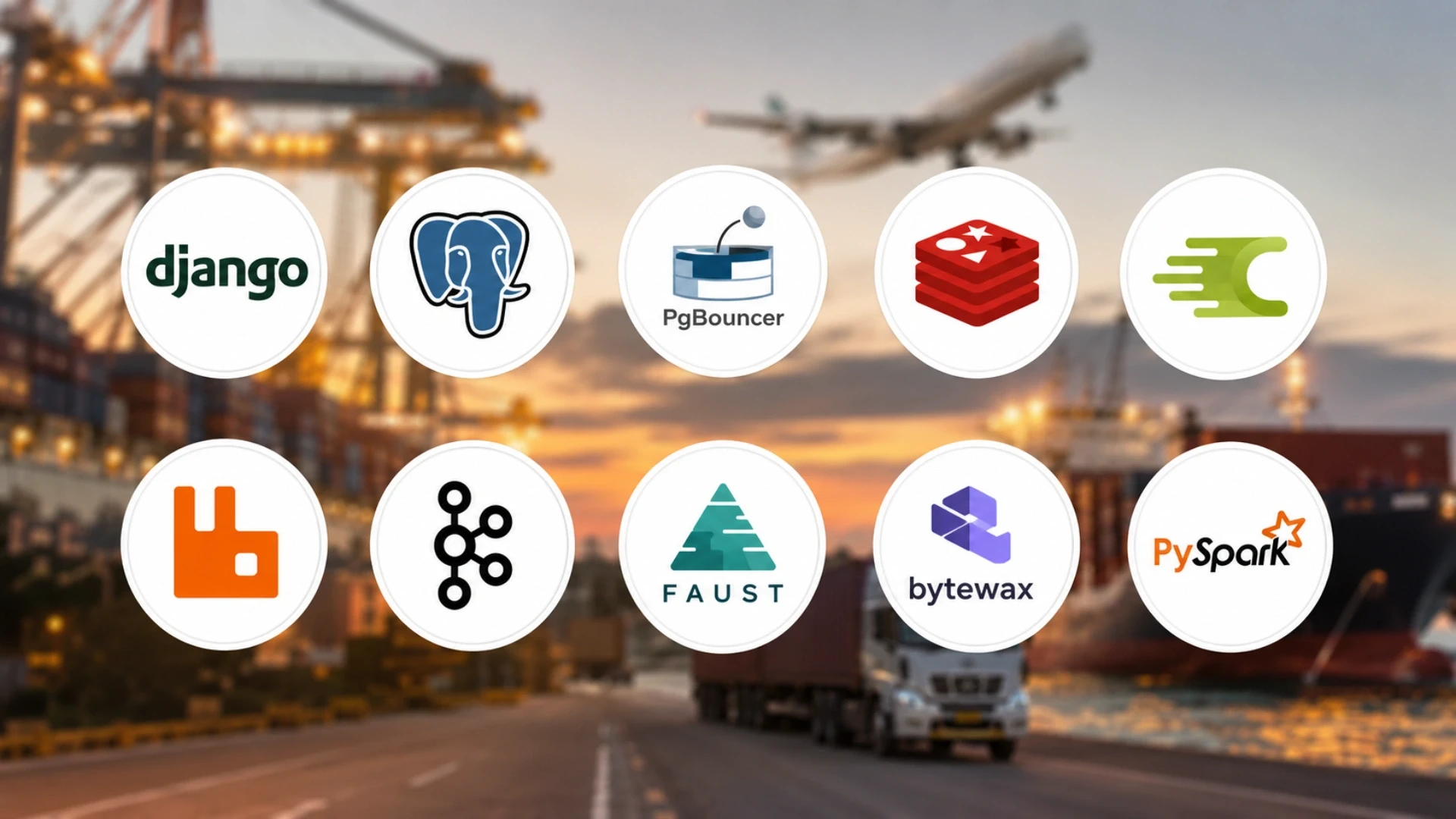
Most production Python logistics platforms converge on a similar architecture because the constraints converge. Multiple external systems to integrate. Event streams to process. Operational dashboards to keep responsive. Historical analytics to compute. Compliance reporting to generate. The specific technology choices vary by team and scale, but the structural layers are consistent.
Table : Reference Python Stack for a Logistics and Supply Chain Platform
Layer | Technology | Why It Was Chosen |
|---|---|---|
Web framework | Django for admin, dashboards, reporting | Mature, batteries-included for operations UX |
High-throughput API | FastAPI for partner APIs and webhooks | Async, type-safe contracts, OpenAPI native |
Database (operational) | PostgreSQL + PgBouncer | Strong relational model, audit-friendly |
Hot store and queues | Redis | Sessions, rate limits, idempotency, Celery broker |
Background work | Celery + Redis or RabbitMQ | Scheduled jobs, webhook handlers, retries |
Streaming layer | Kafka or managed alternative | Carrier events, GPS updates, exception alerts |
Stream processing | Faust, Bytewax, or PySpark Streaming | Python-native event transformation |
Analytical store | S3 + Parquet + query engine | Historical analysis, regulatory reporting |
Observability | Sentry, structured logs, APM | Tenant and partner-slice diagnostics |
Why Django Plus FastAPI Is the Right Default for Most Logistics Platforms
Logistics platforms have a heavy operations UX. Dispatchers, warehouse managers, finance teams, and customer support all need different views of the same data, with different permissions and different workflows. Django's batteries-included approach (admin, auth, ORM, forms, role-based access) covers this layer with weeks less engineering than rolling the same capability in a leaner framework. FastAPI sits alongside Django for the partner-facing API surface and webhook handlers where async I/O and typed contracts matter. The two frameworks share a PostgreSQL database, with Django owning writes and FastAPI handling read-optimised and high-throughput paths.
The choice of FastAPI for high-throughput parts of a logistics platform is defensible against alternatives, but the trade-offs matter when planning capacity for peak shipping volume. The FastAPI vs Node.js vs Go performance benchmarks guide walks through the real RPS numbers, cold start behaviour, and operational cost trade-offs that determine whether FastAPI is enough or whether specific hot paths justify a polyglot extension.
Common Mistakes That Break Python Logistics Pipelines
Some logistics engineering mistakes are catastrophic. They surface at the worst possible moments: peak shipping seasons, customs deadline windows, or regulatory audits. The patterns below are the ones experienced logistics architects catch in code review and growing teams ship without realising.
Synchronous calls to slow carrier APIs in request handlers. A carrier's tracking API takes 3 seconds to respond on a bad day. Your endpoint blocks for 3 seconds. Operations dashboards time out. The fix is non-negotiable: any external API call goes through a background worker or an async task, never through a synchronous request handler.
No idempotency on webhook handlers. Carriers retry status update webhooks aggressively. A handler that creates duplicate shipment records on retry corrupts the operational database. Idempotency keys at the database level make retries safe by default.
Floating point arithmetic for monetary amounts. Use Decimal or integer cents. Floats introduce rounding errors that accumulate into invoice discrepancies and customs declaration mismatches, both of which cost real money to investigate.
No circuit breakers around external APIs. When one carrier's API goes down, the rest of the platform should continue functioning. A circuit breaker pattern prevents one failure from cascading into a full outage. Without it, every team relearns the lesson during peak season.
Storing event streams in PostgreSQL. Event volume in logistics outgrows PostgreSQL's comfortable write throughput quickly. Use Kafka or managed equivalents for the stream itself. Use PostgreSQL for the materialised operational state derived from the stream.
Tightly coupling to a single carrier or ERP. FedEx-specific tracking code scattered through the codebase. SAP-specific data formats hardcoded in pipelines. Wrap external systems behind abstractions from day one. Future-you will thank past-you when the contract with that carrier or ERP vendor changes.
For the budget reality of building a Python logistics platform with the architectural patterns above, including how integration scope, real-time pipeline requirements, and compliance needs affect total investment, the analysis on minimum budget required to start a Python development project in 2026 walks through the verified 2026 cost ranges by project type and engagement model.
How Acquaint Softtech Approaches Python Logistics Engagements
Acquaint Softtech is a Python development and IT staff augmentation company based in Ahmedabad, India, with 1,300+ software projects delivered globally across healthcare, FinTech, SaaS, EdTech, and logistics platforms. Our logistics engagements follow the architectural framework described in the complete guide to hiring Python developers, with senior Python engineers experienced in WMS and TMS integration, carrier API orchestration, real-time data pipelines, and the operational discipline that logistics platforms require to stay stable through peak shipping seasons.
Senior Python engineers with logistics integration depth. Hands-on with Django plus FastAPI hybrid stacks, carrier API integration (FedEx, DHL, UPS, regional carriers), customs and compliance APIs, Kafka-based event pipelines, Celery automation, and PostgreSQL plus PgBouncer scaling for operational dashboards.
Data pipeline and ML engineering experience. ETA prediction models, demand forecasting, route optimisation with NetworkX and PuLP, anomaly detection on shipment streams, and dashboards built with Streamlit, Dash, or production frontends.
Compliance experience that translates to logistics. GDPR-compliant Python platforms delivered for European clients, with the audit-grade discipline that logistics platforms increasingly need for customs reporting, regulatory disclosure, and partner-facing data governance.
Transparent pricing from $20/hour. Dedicated Python engineering teams from $3,200/month per engineer. Logistics architecture audits and pipeline reviews from $5,000.
To bring senior Python engineers onto your logistics project quickly, you can hire Python developers with profiles shared in 24 hours and a defined onboarding plan within 48.
The Bottom Line
Python is genuinely the right choice for most logistics and supply chain engineering work in 2026. The architectural choices that determine whether a logistics platform absorbs operational pressure or breaks under it are not exotic. Use Django for the operations UX. Use FastAPI for partner APIs. Move every external call to a background worker. Use Kafka or managed equivalents for event streams. Make webhook handlers idempotent. Wrap carriers, customs, and ERP behind abstractions from day one. Build the dashboard your operations team will actually use, not the dashboard your slide deck shows.
None of these are clever. All of them are the difference between a logistics platform that keeps shipments moving and one that becomes the bottleneck the operations team works around. The teams that ship the best Python logistics platforms in 2026 are not the ones with the most novel architecture diagrams. They are the ones who applied disciplined, well-understood patterns consistently while the rest of the industry chased fashionable tooling. Build for the volume you actually have. Operate for the integration surface you actually maintain. Let the architecture compound in your favour over years instead of working against the operations team every quarter.
Building a Python Logistics or Supply Chain Platform?
Book a free 30-minute architecture review. We will look at your integration scope, event volume, and operational dashboard requirements, and tell you straight how a Python logistics platform of this kind fits your situation. No sales pitch. Just senior engineers who have shipped real logistics pipelines in production.
Frequently Asked Questions
-
Why is Python a good choice for logistics and supply chain platforms?
Python combines the deepest library ecosystem for data engineering, optimisation, and machine learning with mature web frameworks (Django and FastAPI) that ship operational dashboards quickly. The same language covers automation scripts, API integration, real-time pipelines, ETA prediction models, and route optimisation, which eliminates the cross-language handoff cost that other stacks pay. The hiring pool is wide enough to staff multi-quarter logistics engagements without bottlenecks.
-
Django or FastAPI for a new Python logistics platform?
Both, in most cases. Django handles the operations UX heavy lifting: admin panels, role-based access, complex forms, reporting workflows. FastAPI handles partner-facing APIs, webhook receivers, and high-throughput endpoints where async I/O and type-safe contracts matter. Many production logistics stacks run both against a shared PostgreSQL database. Picking only one is defensible if the platform is genuinely API-first or genuinely dashboard-heavy, but the hybrid pattern handles most logistics cases best.
-
How do I handle carrier API outages without breaking the rest of the platform?
Three patterns that work together. First, all carrier API calls go through background workers, not synchronous request handlers, so a slow carrier never blocks operational dashboards. Second, circuit breakers around each carrier integration trip after a threshold of failures and fail fast instead of compounding latency. Third, idempotent webhook handlers and replay capability mean that when a carrier comes back online, the platform catches up cleanly without duplicating shipments or losing events.
-
What is the right way to build real-time pipelines for shipment events in Python?
Kafka or a managed equivalent (AWS Kinesis, Google Pub/Sub) for the stream itself. Python-native stream processors like Faust, Bytewax, or PySpark Structured Streaming consuming the topics, transforming events, and writing results into PostgreSQL for the hot operational state and S3 plus Parquet for the cold analytical layer. The dashboards read from PostgreSQL. The historical analytics read from the analytical store. Both populated by the same pipeline.
-
How much does a real Python logistics platform cost to build?
A lean Python logistics MVP with one carrier integration and basic operational dashboards typically starts at $30,000 to $60,000. A more complete platform with multiple carrier integrations, real-time event pipelines, customs API integration, and operational dashboards for multiple user roles runs $80,000 to $200,000. Enterprise-grade logistics with regulatory reporting, advanced optimisation models, and high-volume event processing pushes the range to $200,000 and above. The variable is integration scope, not the underlying Python stack.
-
Can Python handle the data volumes that real logistics platforms generate?
Yes, with the right architecture. The bottleneck is rarely Python itself. It is the database connection layer, the streaming infrastructure, or external API latency. With Kafka for streaming, PostgreSQL plus PgBouncer for operational state, Redis for hot data, and stream processing in Faust or PySpark, Python logistics platforms handle the volume that even large freight networks generate. For the genuinely extreme volumes (hundreds of millions of events per day), a polyglot extension to Go or Rust for specific hot paths is a defensible architectural move.
-
What engagement model works best for building a Python logistics platform?
A dedicated team is almost always the right answer for a multi-quarter logistics build. The integration scope expands continuously as new carriers, customs platforms, and customer requirements get added. Fixed-price contracts anchor the team to assumptions that will not survive the first 1,000 production shipments. A 6 to 10 engineer dedicated team is the typical pattern for serious logistics engagements through the first 12 to 18 months, with staff augmentation for capacity expansion during peak buildout phases.
We’re Acquaint Softtech, your technology growth partner. Whether you're building a SaaS product, modernizing enterprise software, or hiring vetted remote developers, we’re built for flexibility and speed. Our official partnerships with Laravel, Statamic, and Bagisto reflect our commitment to excellence, not limitation. We work across stacks, time zones, and industries to bring your tech vision to life.
Table of Contents
Get Started with Acquaint Softtech
- 13+ Years Delivering Software Excellence
- 1300+ Projects Delivered With Precision
- Official Laravel & Laravel News Partner
- Official Statamic Partner
Related Blog

How to Hire Python Developers Without Getting Burned: A Practical Checklist
Avoid costly hiring mistakes with this practical checklist on how to hire Python developers in 2026. Compare rates, vetting steps, engagement models, red flags, and more.
Acquaint Softtech
March 30, 2026
Total Cost of Ownership in Python Development Projects: The Full Financial Picture
The build cost is just the beginning. This guide breaks down the complete TCO of Python development projects across every lifecycle phase, with real benchmarks, a calculation framework, and 2026 data.
Acquaint Softtech
March 23, 2026
Python Developer Hourly Rate: What You're Actually Paying For
Python developer rates range $20-$150+/hr in 2026. See what experience, specialisation & hidden costs actually determine the price. Save 40% with vetted offshore talent.
Acquaint Softtech
March 9, 2026India (Head Office)
203/204, Shapath-II, Near Silver Leaf Hotel, Opp. Rajpath Club, SG Highway, Ahmedabad-380054, Gujarat
USA
7838 Camino Cielo St, Highland, CA 92346
UK
The Powerhouse, 21 Woodthorpe Road, Ashford, England, TW15 2RP
New Zealand
42 Exler Place, Avondale, Auckland 0600, New Zealand
Canada
141 Skyview Bay NE , Calgary, Alberta, T3N 2K6
Your Project. Our Expertise. Let’s Connect.
Get in touch with our team to discuss your goals and start your journey with vetted developers in 48 hours.