

Python in Medical Data Analytics Architecture & Compliance
How to architect Python medical data analytics platforms with HIPAA and GDPR compliance built in. De-identification, encryption, audit trails, and the stack.

Acquaint Softtech
Introduction: In Medical Analytics, Compliance Is Not a Feature
Most data analytics platforms treat compliance as something you add before launch. A consent banner here, an access log there, an encryption checkbox in the deployment config. In medical data analytics, that approach does not just produce a weaker product. It produces a platform that fails its first audit, loses its data access agreements, and exposes the organization to regulatory penalties measured in millions. Medical data analytics is a different engineering discipline, one where compliance is an architectural input from the first schema design, not a feature bolted on before go-live. Python has become the dominant language for this work, not because it is the fastest, but because its ecosystem covers the entire medical analytics pipeline while supporting the compliance patterns that regulated health data demands.
The clinical value of getting this right is now well established. According to DataCamp's analysis of Python applications in healthcare, the principal applications of Python in healthcare are built on machine learning and natural language processing, including image diagnostics, processing of medical documents, and disease prediction using patient data. The same analysis reports that the accuracy of Python-based machine learning for medical image analysis is about 92%, slightly below the 96% accuracy of senior clinicians, but rising to 99.5% when pathologists vet the machine learning models. Medical analytics is no longer experimental. It is delivering clinical-grade results, which makes the architecture and compliance around it a matter of patient safety, not just engineering hygiene.
This guide covers how to architect a Python medical data analytics platform with compliance built into every layer: the layered architecture that separates ingestion, de-identification, analytics, and reporting; how HIPAA, GDPR, and audit-grade design shape the architecture; the de-identification, encryption, and access control patterns Python supports; and the anti-patterns that fail medical data audits. It is written for healthcare CTOs, clinical data leaders, and senior engineers building analytics platforms for hospitals, diagnostic groups, health plans, research institutions, and digital health companies where protected health information flows through Python code.
If you are building the team that will own a medical analytics platform, the complete guide to hiring Python developers in 2026 sets the wider hiring context. Medical analytics requires engineers who combine Python depth with healthcare compliance knowledge, a rarer and more senior profile than generic data engineering.
The Layered Architecture of a Medical Data Analytics Platform
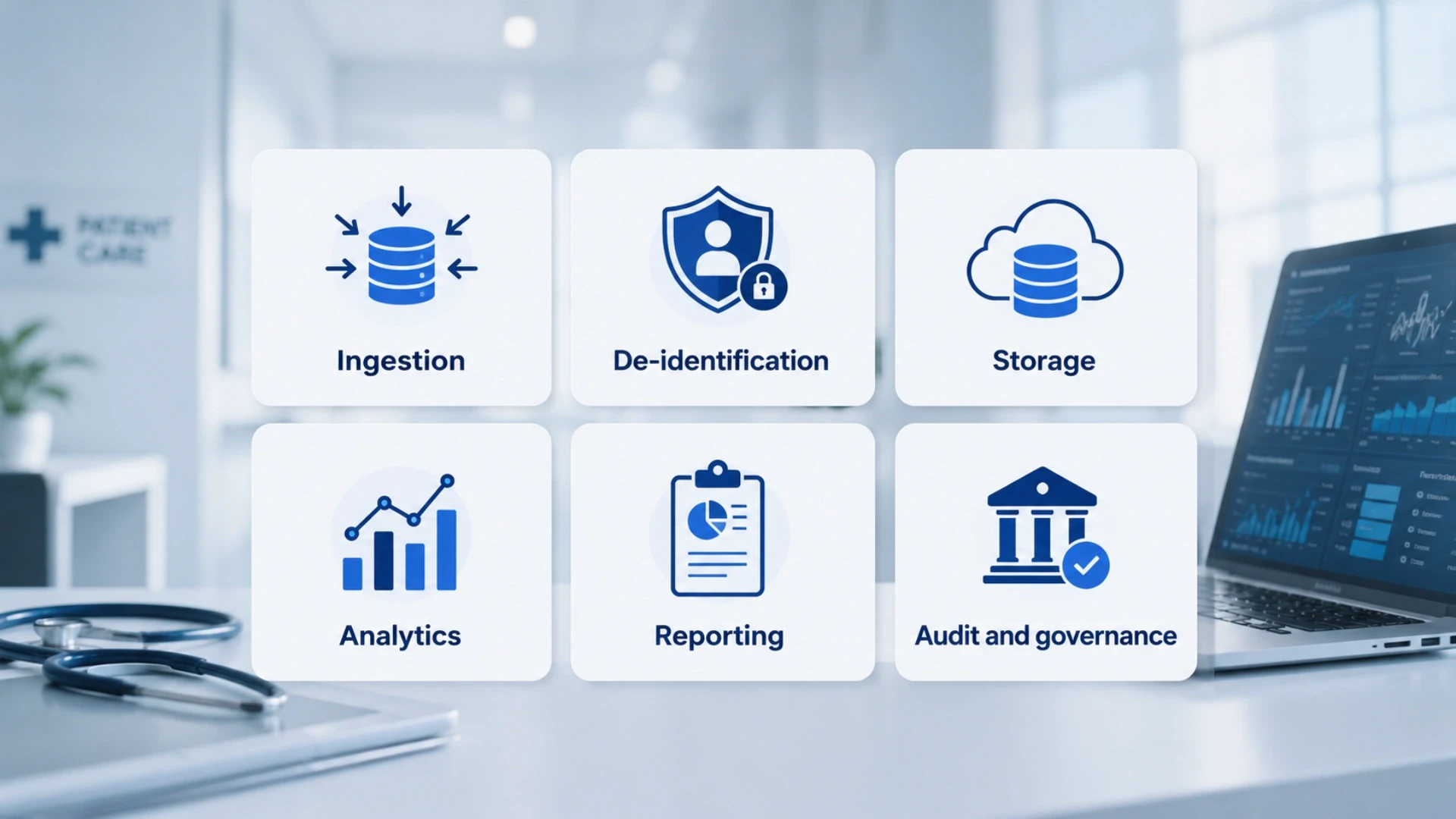
Medical analytics platforms converge on a layered architecture because the compliance constraints force separation of concerns. Raw protected health information cannot flow freely into the analytical layer. De-identification must happen at a defined boundary. Audit logging must capture access at every layer, not just at the database. The architecture below is the pattern that consistently passes both technical review and compliance audit, because each layer has a single responsibility and a clear data-handling contract with the layers around it.
Table 1: Layered Architecture of a Python Medical Data Analytics Platform
Layer | Responsibility | Compliance Boundary |
|---|---|---|
Ingestion | Pull from EHR, HL7/FHIR, lab systems | Audit log every read, validate at edge |
De-identification | Strip or hash PHI, tokenize identifiers | PHI removed before analytical layer |
Storage | PostgreSQL primary, separate audit store | Encryption at rest, row-level access |
Analytics | Cluster detection, prediction, trends | Operates on de-identified data only |
Reporting | Dashboards, clinical surfacing, exports | Role-based access per clinician |
Audit and governance | Immutable access log, retention policy | Append-only, separately backed up |
Why Each Layer Earns Its Place
Ingestion abstracts source heterogeneity. Medical data arrives from EHR systems, HL7 and FHIR interfaces, lab information systems, and imaging archives, each in its own format. The ingestion layer validates and normalizes into a canonical internal model, so downstream layers never depend on the quirks of any single source.
De-identification is a hard boundary, not a step. Patient identifiers are stripped, hashed, or tokenized at the earliest possible point, before data reaches the analytical layer. The result is an analytical store that can be queried freely because it no longer contains protected health information in identifiable form.
Storage separates operational and audit data. The audit log is its own append-only store. Operational queries cannot pollute it, and compliance reviews can read it without depending on operational system uptime. This separation is what makes audit responses a query rather than a forensic investigation.
Analytics operates only on de-identified data. Cluster detection, predictive modeling, and trend analysis run against the de-identified store. This is the architectural property that lets data scientists work productively without every query becoming a compliance risk.
The broader architectural patterns that support this layered design, including how Python data pipelines, audit logging, and modular boundaries fit into a complete platform, are covered in the Python development architecture and frameworks guide, which walks through the framework and data-layer decisions that underpin compliance-grade analytics systems.
Compliance Is the Architecture: HIPAA, GDPR, and Audit-Grade Design
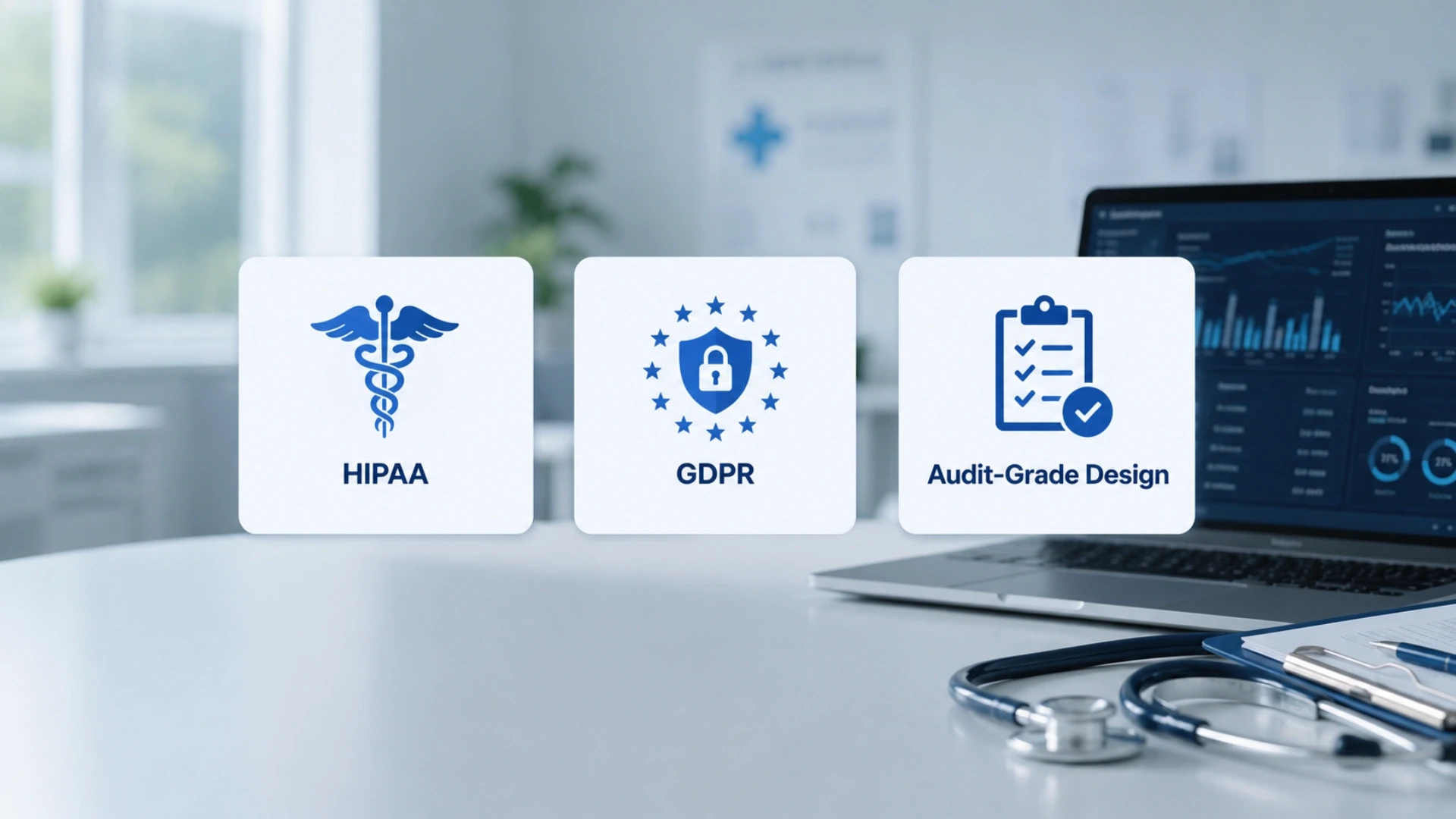
The regulatory frameworks define the architecture more than any technical preference does. According to a guide to HIPAA compliance for biomedical data in Python by NumberAnalytics, HIPAA was enacted in 1996 to establish national standards for protecting individually identifiable health information, known as protected health information or PHI, and applies to covered entities including healthcare providers, health plans, and clearinghouses. The same guide confirms that Python supports HIPAA compliance through cryptography libraries for secure data handling, de-identification and anonymization techniques, access controls and authentication, and logging and auditing mechanisms that track and monitor access to sensitive data. The frameworks dictate what the architecture must prove, and Python provides the tools to prove it.
What HIPAA, GDPR, and Audit Frameworks Demand From the Architecture
Demonstrable access control. You must be able to prove that only authorized users accessed specific data. This means role-based access control enforced at the database layer, not just the application layer, so a misconfigured query path cannot leak protected data.
Audit logging on reads, not just writes. HIPAA and GDPR both require demonstrating who accessed which data and when, including read access. Most systems log writes by default. Medical analytics platforms must log every read against PHI as well, with the querying user, timestamp, and result scope.
Proper de-identification or anonymization. Data used for analytics should be de-identified to the standard the framework requires. HIPAA defines Safe Harbor (removing 18 specific identifiers) and Expert Determination methods. GDPR distinguishes anonymization from pseudonymization. The architecture must implement the right standard for the use case.
Data retention and right-to-erasure handling. Retention policies aligned with regulatory minimums, and for GDPR, the ability to honor erasure requests. The architecture must track data lineage well enough to locate and remove an individual's data on request.
Encryption at rest and in transit. PHI encrypted in the database, in backups, and over every network hop. Python's cryptography library and TLS everywhere are the baseline, not the exception.
Need Python Engineers Who Understand Medical Data Compliance?
Acquaint Softtech provides senior Python engineers with hands-on experience building HIPAA and GDPR-compliant medical analytics platforms: layered de-identification pipelines, row-level access control, audit logging on every read, encryption at rest, and the compliance-first architecture that passes both technical review and regulatory audit. Profiles in 24 hours. Onboarding in 48.
De-Identification, Encryption, and Access Control in Python
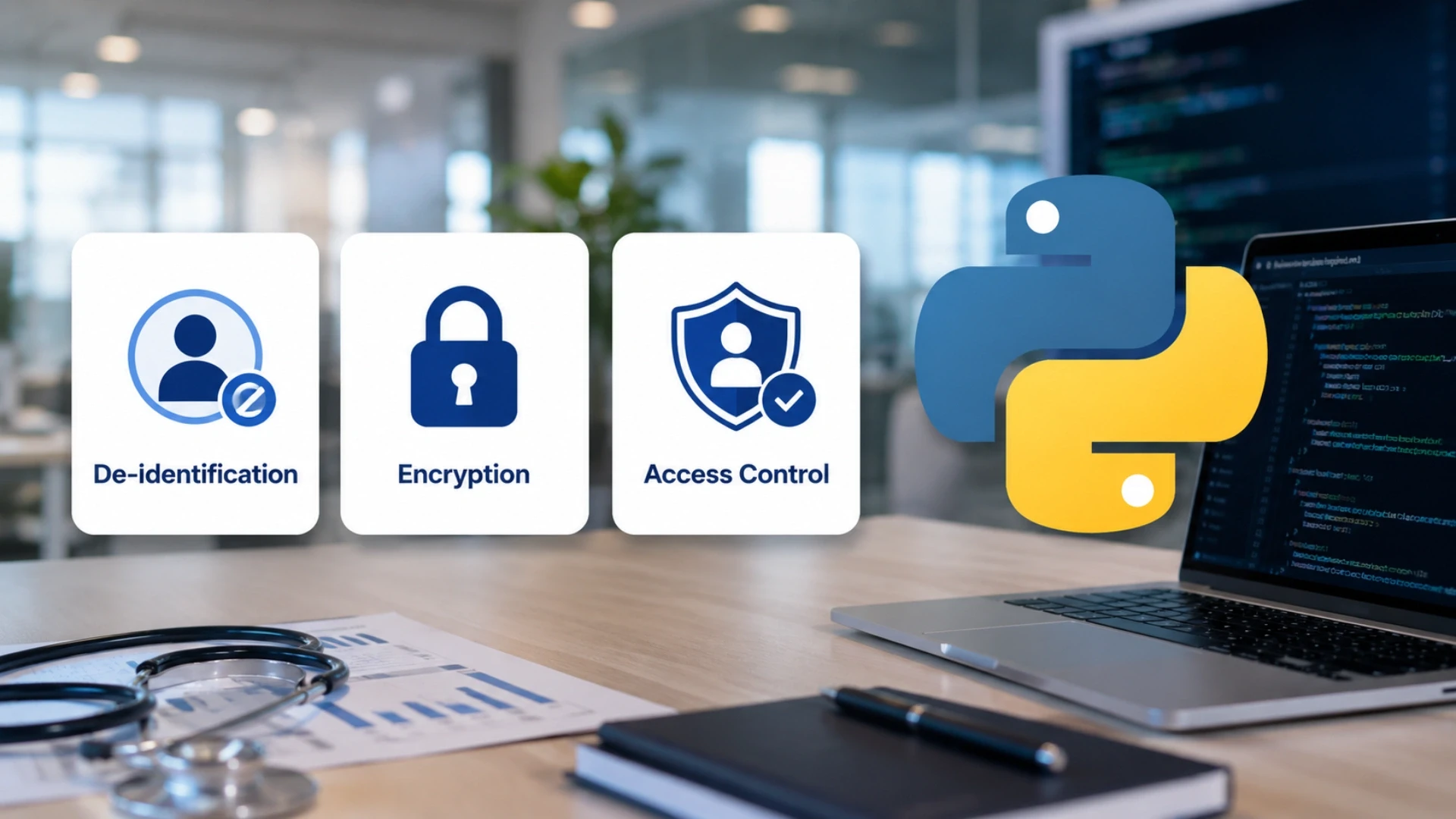
The three technical pillars of medical data compliance all have mature Python implementations. The discipline is not in finding the tools. It is in applying them at the right architectural boundaries so that protected health information is never exposed where it should not be, and every access is provable after the fact. Getting these three right is what separates a platform that passes audit from one that fails it.
Table : Compliance Techniques and Their Python Implementations
Technique | Python Implementation | Where It Applies |
|---|---|---|
Encryption at rest | cryptography, database-native encryption | Storage layer, backups |
Encryption in transit | TLS everywhere, certificate management | Every network hop |
De-identification | Safe Harbor field removal, hashing | De-identification boundary |
Tokenization | Hashed surrogate keys, token vault | Linking without exposing identity |
Access control | Row-level security, RBAC, OAuth 2.0 | Database and application layer |
Audit logging | Append-only logs, structured events | Every read and write of PHI |
Secrets management | Vault, cloud secret managers | Credentials, keys, tokens |
The Three Pillars Done Correctly
De-identification that preserves analytical value. Naive de-identification strips everything useful. Correct de-identification removes the 18 HIPAA Safe Harbor identifiers (or applies Expert Determination) while retaining the structure analytics needs: hashed patient IDs that allow linking records without exposing identity, retained statistical features, and anonymized group membership. The analytics works, the identity does not leak.
Access control at the database, not just the API. Row-level security in PostgreSQL enforces access regardless of how data is reached. A query that should not return a row simply does not, at the database layer. API-level controls alone can be bypassed by a misconfigured query path, which is exactly the failure mode that surfaces during an audit.
Audit logging that survives scrutiny. Every access to PHI writes a structured, append-only audit entry: who, what, when, and the scope of the result. The audit store has no UPDATE or DELETE operations and is separately backed up. When a regulator asks who accessed a patient's data, the answer is a query, not a multi-week investigation across systems.
Anti-Patterns That Fail Medical Data Audits
Some medical analytics mistakes are invisible until the audit. Others surface as breaches that make the news. The patterns below are the ones experienced healthcare data architects catch in review and well-meaning teams ship without realizing the regulatory exposure they create.
PHI in log files. The most common medical data failure. A debug log captures a full patient record, the log shipper carries it to a third-party log aggregator outside the compliance boundary, and the breach is complete. Sanitize logs at the source. Never log raw PHI, even in development.
De-identification done in the analytical layer instead of before it. If raw PHI reaches the analytical store and is de-identified there, every analytical query touches identifiable data, and the entire analytical environment falls inside the compliance scope. De-identify at the boundary, before data lands in the analytical store. To further safeguard sensitive data before it enters analytical systems, addressing potential document fraud at the ingestion stage helps ensure that only validated and trustworthy information is processed, reducing compliance exposure and security risks.
Logging only writes, not reads. HIPAA and GDPR require demonstrating read access to PHI. A system that logs only mutations cannot answer the regulator's most basic question: who looked at this patient's data. Log reads against PHI as a first-class requirement.
Access control in the application but not the database. Application-layer-only access control fails the moment a query path is misconfigured or a new service connects directly to the database. Row-level security at the database is the enforcement that holds regardless of how data is reached.
Mutable audit logs. If the audit log can be updated or deleted, it is not an audit log, and no regulator will treat it as one. The audit store must be append-only, with write-only-then-read semantics enforced at the database level.
Treating de-identified data as if it can never be re-identified. Weak de-identification plus an external dataset can re-identify individuals. The architecture must apply de-identification to the actual standard required (Safe Harbor or Expert Determination), not a casual approximation that looks anonymized but is not.
These patterns are not theoretical. A real example from the Acquaint Softtech portfolio is the GDPR-compliant Python analytics platform built for BIANALISI, Italy's largest diagnostics group, to detect clusters of abnormal diagnostic trends across patient data with audit-grade query logging. The architecture and lessons are covered in the analysis on backend architecture lessons from real Python case studies, which walks through how compliance-first design produced earlier-than-expected cluster detection without compromising data governance.
How Acquaint Softtech Builds Compliant Medical Analytics Platforms
Acquaint Softtech is a Python development and IT staff augmentation company based in Ahmedabad, India, with 1,300+ software projects delivered globally across healthcare, FinTech, SaaS, EdTech, and enterprise platforms. Our healthcare analytics work involves building HIPAA-compliant data pipelines with specialized compliance architecture, which requires senior developers with both Python expertise and healthcare data knowledge, as detailed in the breakdown of what a Python development project actually costs, where the medical analytics case study illustrates how domain context shapes both architecture and investment.
Senior Python engineers with medical data compliance depth. Hands-on with HIPAA and GDPR-compliant pipelines, de-identification at the boundary, row-level access control in PostgreSQL, audit logging on every read, encryption at rest and in transit, and reproducible analytics for regulated environments.
Predictive analytics and ML for healthcare. Scikit-learn, TensorFlow, PyTorch, Pandas, and Polars used in production medical analytics, including the GDPR-compliant diagnostic trend platform delivered for BIANALISI, Italy's largest diagnostics group.
Compliance-first engineering discipline. Compliance built into the schema and pipeline from day one, not retrofitted before audit. Audit-grade logging, data governance, and access controls are architectural defaults in every healthcare engagement.
Transparent pricing from $20/hour. Dedicated Python engineering teams from $3,200/month per engineer. Medical analytics architecture audits and compliance reviews from $5,000.
For the budget reality of building a compliant medical analytics platform, particularly for mid-sized healthcare organizations and diagnostic groups balancing capability and cost, the analysis on Python development cost for mid-sized businesses walks through enterprise data engineering economics and engagement models in detail.
To bring senior Python engineers with healthcare compliance experience onto your medical analytics project quickly, you can hire Python developers with profiles shared in 24 hours and a defined onboarding plan within 48.
The Bottom Line
In medical data analytics, compliance is not a feature you add before launch. It is the architecture. De-identify at a hard boundary before data reaches the analytical layer. Enforce access control at the database, not just the application. Log every read of protected health information, not just every write. Keep the audit store append-only and separate from operational data. Encrypt at rest and in transit. Apply de-identification to the actual standard the framework requires, not a casual approximation. These are not optional refinements. They are the structural requirements that determine whether a platform passes audit or fails it.
Python is the right language for this work because its ecosystem covers the entire medical analytics pipeline while supporting every one of these compliance patterns natively. But the language is not the differentiator. The discipline applied around it is. The teams that build medical analytics platforms that earn clinical trust and pass regulatory audit are the ones who treated compliance as an architectural input from the first schema design, hired engineers who combine Python depth with healthcare compliance knowledge, and built the audit trail before they needed it. Design for the audit you will eventually face, and the platform compounds in trust over years instead of collapsing at the first regulatory review.
Planning a HIPAA or GDPR-Compliant Medical Analytics Platform?
Book a free 30-minute architecture review. We will look at your data sources, compliance scope, de-identification requirements, and analytics goals, and tell you straight how a compliant Python medical analytics platform fits your situation. No sales pitch. Just senior engineers who have built compliance-grade healthcare platforms before.
Frequently Asked Questions
-
Why is Python the dominant language for medical data analytics?
Python combines the deepest ecosystem for data engineering, machine learning, and statistical analysis with mature libraries for the compliance patterns medical data requires: cryptography for encryption, de-identification and anonymization tooling, access control frameworks, and audit logging. The same language covers the entire pipeline from ingestion through analytics to reporting, and its readability keeps regulated codebases maintainable across the long lifespans medical platforms have. This combination is why healthcare organizations standardize on Python for analytics.
-
How is HIPAA compliance built into a Python analytics architecture?
Through five architectural patterns, not features added later. Role-based access control enforced at the database layer so unauthorized queries return nothing. Audit logging on every read of PHI, not just writes. De-identification at a hard boundary before data reaches the analytical layer. Encryption at rest and in transit using Python's cryptography library and TLS everywhere. And an append-only audit store separated from operational data. HIPAA defines what the architecture must prove, and these patterns prove it.
-
What is the difference between de-identification and anonymization in medical data?
De-identification, under HIPAA, means removing or obscuring identifiers so data cannot reasonably be linked to an individual, via Safe Harbor (removing 18 specified identifiers) or Expert Determination. Anonymization, emphasized under GDPR, means data that can never be re-identified, which removes it from GDPR scope entirely. Pseudonymization, also a GDPR concept, replaces identifiers with surrogate keys but remains in scope because re-identification is possible with the key. The architecture must implement the standard the use case and jurisdiction require, not a casual approximation.
-
Where should de-identification happen in the pipeline?
At a hard boundary, before data reaches the analytical layer. If raw PHI lands in the analytical store and is de-identified there, every analytical query touches identifiable data and the entire analytical environment falls inside the compliance scope, which makes data science work slow and risky. De-identifying at the ingestion-to-analytics boundary means the analytical store contains no identifiable PHI, so data scientists can query freely without each query becoming a compliance event.
-
How do I make an audit log that satisfies a HIPAA or GDPR auditor?
Make it append-only with no UPDATE or DELETE operations, enforced at the database level. Log every read and write of PHI as a structured event capturing who accessed the data, what they accessed, when, and the scope of the result. Store the audit log separately from operational data so an operational outage cannot affect it, and back it up independently. Align retention with regulatory requirements. When an auditor asks who accessed a patient's record, the answer should be a single query, not a forensic investigation.
-
Can Python machine learning models be used for clinical decisions safely?
Yes, with the right discipline and human oversight. Python ML achieves roughly 92% accuracy on medical image analysis, below the 96% of senior clinicians but rising to 99.5% when clinicians vet the model output. The safe pattern is augmentation, not replacement: the model surfaces candidates and confidence levels, and a qualified clinician makes the decision. Explainability, confidence intervals, and clear accountability mechanisms are required, and the model must be validated and monitored continuously rather than deployed and forgotten.
-
What engagement model works best for building a medical analytics platform?
A dedicated team, almost always. Healthcare analytics with compliance constraints requires continuity, domain learning, and audit readiness that staff augmentation rotates through too quickly and fixed-price contracts cannot accommodate. A dedicated team accumulates the healthcare compliance context and diagnostic data knowledge that no documentation fully captures, and operates with the continuity that regulatory audits require. A 6 to 12 engineer dedicated team is typical for serious medical analytics engagements through the first 12 to 18 months.
We’re Acquaint Softtech, your technology growth partner. Whether you're building a SaaS product, modernizing enterprise software, or hiring vetted remote developers, we’re built for flexibility and speed. Our official partnerships with Laravel, Statamic, and Bagisto reflect our commitment to excellence, not limitation. We work across stacks, time zones, and industries to bring your tech vision to life.
Table of Contents
Get Started with Acquaint Softtech
- 13+ Years Delivering Software Excellence
- 1300+ Projects Delivered With Precision
- Official Laravel & Laravel News Partner
- Official Statamic Partner
Related Blog

How to Hire Python Developers Without Getting Burned: A Practical Checklist
Avoid costly hiring mistakes with this practical checklist on how to hire Python developers in 2026. Compare rates, vetting steps, engagement models, red flags, and more.
Acquaint Softtech
March 30, 2026
Total Cost of Ownership in Python Development Projects: The Full Financial Picture
The build cost is just the beginning. This guide breaks down the complete TCO of Python development projects across every lifecycle phase, with real benchmarks, a calculation framework, and 2026 data.
Acquaint Softtech
March 23, 2026
Python Developer Hourly Rate: What You're Actually Paying For
Python developer rates range $20-$150+/hr in 2026. See what experience, specialisation & hidden costs actually determine the price. Save 40% with vetted offshore talent.
Acquaint Softtech
March 9, 2026India (Head Office)
203/204, Shapath-II, Near Silver Leaf Hotel, Opp. Rajpath Club, SG Highway, Ahmedabad-380054, Gujarat
USA
7838 Camino Cielo St, Highland, CA 92346
UK
The Powerhouse, 21 Woodthorpe Road, Ashford, England, TW15 2RP
New Zealand
42 Exler Place, Avondale, Auckland 0600, New Zealand
Canada
141 Skyview Bay NE , Calgary, Alberta, T3N 2K6
Your Project. Our Expertise. Let’s Connect.
Get in touch with our team to discuss your goals and start your journey with vetted developers in 48 hours.