

Python for SaaS Architecture Patterns That Scale from 0 to 100,000 Subscribers
Python SaaS architecture patterns that scale from 0 to 100,000 subscribers. Multi-tenancy, frameworks, billing, and decisions that survive growth in 2026.

Acquaint Softtech
Introduction: The Architecture Decisions That Decide Whether You Reach 100,000 Users
architectural decisions made when the team had 50 paying users were never revisited when the team had 5,000, and by the time those decisions started hurting at 50,000, fixing them required a rebuild the business could not afford to schedule. The path from 0 to 100,000 subscribers is not a single problem. It is four distinct engineering problems, each with its own constraints, and each requiring decisions that lock the next stage into either a smooth scaling curve or a cliff.
The economics of SaaS scaling are unforgiving and well documented. According to a 2026 multi-tenant architecture analysis published by Ariel Software citing Zylo's 2026 SaaS Management Index, the global SaaS market is forecast to hit $465.03 billion in 2026, over 70% of modern SaaS vendors now use some form of multi-tenancy, and the average enterprise now manages 305 SaaS applications. Running single-tenant instances for 305 products would be financially impossible. Multi-tenant architecture is not a competitive advantage anymore. It is the floor below which SaaS economics simply do not work.
This guide walks through the Python-specific architectural decisions that determine whether a SaaS product scales smoothly from 0 to 100,000 subscribers or hits a wall at 5,000, 20,000, or 50,000. It covers the four growth stages every SaaS goes through, the multi-tenancy decision that compounds for years, the framework and database choices that lock in your scaling trajectory, and the subscription billing architecture that either supports growth or constrains it. It is written for CTOs, founders, and engineering leads building Python SaaS products with multi-year horizons, where the wrong call at month 6 becomes the constraint at month 36.
If you are still building the team that will execute these decisions, the complete guide to hiring Python developers in 2026 sets the wider hiring context. SaaS engineering at scale is one of the most demanding Python engagement types, and the seniority bar starts higher than most other domains.
The Four Growth Stages and What Each Demands From the Architecture
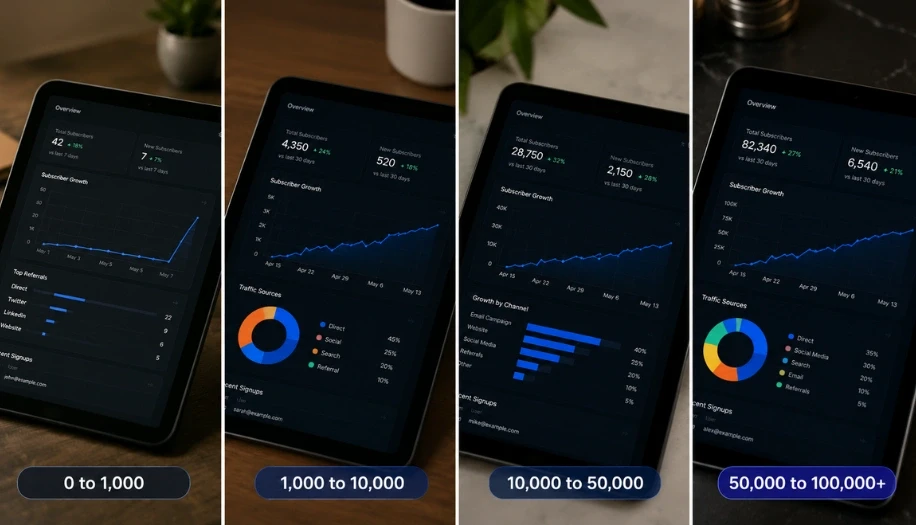
Every Python SaaS product passes through four predictable scaling stages between 0 and 100,000 subscribers. Each stage has different bottlenecks, different operational priorities, and different architecture decisions that pay off or punish later. The teams that scale successfully recognise which stage they are in and adjust before the stage's pain becomes a crisis.
Table : The Four Growth Stages of a Python SaaS Product
Stage | Subscribers | Main Constraint | Architecture Priority |
|---|---|---|---|
Foundation | 0 to 1,000 | Product-market fit, ship fast | Boring monolith, defer optimisation |
Traction | 1,000 to 10,000 | Onboarding, billing, tenant isolation | Multi-tenancy decision, billing architecture |
Scale | 10,000 to 50,000 | Database load, queue depth, churn | Read replicas, caching, async patterns |
Maturity | 50,000 to 100,000+ | Operational cost, enterprise features | Hybrid tenancy, observability depth |
Each stage demands different things. At Foundation, the wrong move is over-engineering: building elaborate microservices for 200 users wastes capital that should fund product discovery. At Traction, the wrong move is the opposite: deferring multi-tenancy decisions because they feel premature creates a tenant-data-leakage incident or a multi-quarter migration when you cross 5,000 users. At Scale, the database becomes the constraint and the patterns that worked at 1,000 users (single PostgreSQL primary, every query hitting the database, naive Celery setup) start producing 3 AM pages. At Maturity, enterprise customers begin asking for compliance certifications, dedicated infrastructure, and SLAs that your architecture either supports through hybrid tenancy or fights every quarter.
The Multi-Tenancy Decision That Locks In Years of Architecture
The single most consequential SaaS architecture decision is how tenant data is isolated. This is not a 'we will figure it out later' question. The choice at week one constrains every subsequent decision: how queries are written, how schemas are migrated, how customer churn is handled, how compliance scopes are reviewed. Three patterns dominate Python SaaS in 2026.
Shared schema with tenant_id (pool model). All tenants share the same tables, with a tenant_id foreign key on every relevant row. Simplest to operate, easiest to migrate, but every query must filter by tenant correctly to prevent data leakage. Django-tenants and django-multitenant middleware handle this pattern well.
Schema-per-tenant (silo model). Each tenant gets a dedicated PostgreSQL schema. Better isolation, easier per-tenant backups, and cleaner compliance story. Operational complexity grows linearly with tenant count, which becomes painful past 1,000 tenants.
Hybrid tenancy. Self-serve and standard tier customers share a pooled schema. Enterprise customers with compliance requirements get isolated schemas or dedicated databases. This is the pattern most mature 2026 platforms land on after starting with one of the first two and outgrowing it.
The Framework Decision That Compounds Across Every Stage
Python framework choice for SaaS is rarely an aesthetic question once you commit. Django wins for SaaS products with admin interfaces, complex permissions, and content-heavy workflows because its batteries-included philosophy reduces per-feature development time and Django REST Framework plus Django Ninja handle the API surface cleanly. FastAPI wins for API-first SaaS, AI-powered platforms, and async-heavy workloads. The detailed framework selection trade-offs are covered in the Django vs FastAPI vs Flask comparison guide, but for SaaS specifically the practical 2026 answer is Django for the application layer and FastAPI for performance-critical microservices, deployed together against a shared PostgreSQL database.
The Architectural Decisions That Determine Whether You Survive Past 10,000 Subscribers
Past 10,000 subscribers, a Python SaaS becomes a database problem disguised as an application problem. Latency spikes, queue depth growing, observability gaps surfacing as 'random' incidents. Every one of these traces back to architectural decisions made at lower scale. Five decisions determine whether the platform absorbs the next 10x or fights it.
The performance ceiling is real and measurable. According to a 2026 multi-tenant architecture strategies guide by GainHQ, proper database partitioning can improve query response times by over 50% in high-volume multi-tenant applications, while multitenancy itself improves hardware utilisation by over 60% compared to single tenancy. The lesson is not that partitioning is magic. It is that the decisions about caching, indexing, async work, and tenant isolation that look invisible at 1,000 users become the dominant performance levers at 50,000.
The Five Architectural Levers That Matter Most From 10,000 Onwards
PostgreSQL with PgBouncer connection pooling. Past 5,000 concurrent users, PostgreSQL's default 100-connection limit becomes a hard wall. PgBouncer in transaction-pooling mode absorbs thousands of client connections into a small server-side pool. Without it, you hit the wall and do not know why.
Read replicas with Django database routers or SQLAlchemy session binds. In most SaaS workloads, reads outnumber writes 5:1 to 10:1. Routing read queries to replicas can cut primary database load by 70 to 90% with minimal code changes if the routing pattern is in place from the start.
Redis as the second-tier database. Session storage, rate limits, idempotency keys, hot configuration, billing throttles, feature flag caches. Anything sub-millisecond goes here. The primary database stays focused on transactional work.
Celery for any work over 200 milliseconds. Welcome emails, invoice generation, webhook dispatch, billing reconciliation, data exports, scheduled reports. Synchronous request handlers stay fast because the slow work happens elsewhere. Without this pattern, response times degrade exponentially with traffic.
Per-tenant observability from day one. Tenant ID in every log line, every trace, every metric. When a customer reports slow performance, you can answer in minutes what is slow for that tenant specifically rather than digging through aggregate dashboards that hide tenant-specific issues.
Subscription Billing Architecture That Survives Pricing Changes
Subscription billing is the most under-engineered part of most SaaS products at launch and the most expensive to refactor later. SaaS pricing changes constantly: plan tiers shift, add-ons emerge, usage-based pricing layers on top of seat-based pricing, enterprise contracts require custom terms. The billing architecture either supports these changes through clean abstractions or fights them with every pricing experiment.
Use a billing provider from day one. Stripe, Chargebee, Paddle, or Recurly. The cost of integrating one is far lower than the cost of building subscription state machines, dunning logic, and invoice generation yourself. The provider also handles compliance complexity (PCI DSS, tax calculation, EU VAT) that you should not be building in year one.
Store subscription state as an event log, not as mutable rows. Every plan change, every renewal, every cancellation writes an audit row. Current state is derived from the event log. This pattern makes pricing migrations sane and customer support investigations trivial.
Webhook handlers are idempotent. Stripe and similar providers retry webhooks. A handler that creates duplicate records on retry corrupts customer data. Use idempotency keys at the database level to make webhook retries safe by default.
Usage tracking aligned with the billing model. If you bill per API call, log API calls. If you bill per active user, instrument active sessions. The wrong granularity at launch becomes the reason the team cannot run a usage-based pricing experiment at year two.
For real examples of how SaaS companies across industries solved these architectural questions and the business outcomes their choices produced, the analysis on learning to build successful SaaS applications with case studies walks through Slack, Dropbox, Shopify, and other SaaS platforms whose architecture decisions defined their scaling success or constraint.
Building a Python SaaS That Needs to Scale Cleanly to 100,000 Subscribers?
Acquaint Softtech provides senior Python engineers with hands-on production experience in multi-tenant SaaS architecture, Django plus FastAPI hybrid stacks, PostgreSQL plus PgBouncer scaling, subscription billing integration, and the operational discipline that determines whether a SaaS platform scales smoothly or fights its own architecture. Profiles in 24 hours. Onboarding in 48.
Anti-Patterns That Kill Python SaaS Before It Reaches 100,000 Subscribers

Some architectural mistakes look reasonable at launch and become catastrophic at scale. The patterns below are the ones experienced SaaS architects catch in code review and growing teams ship without realising. They share a common signature: they trade short-term simplicity for long-term flexibility, and the bill arrives exactly when the business is trying to scale fastest.
Deferring the multi-tenancy decision past 1,000 users. Retrofitting tenant isolation onto a single-tenant codebase is a multi-quarter project that produces customer-visible incidents during migration. Decide the multi-tenancy pattern before the first paying customer, even if you implement it gradually.
Premature microservices. Splitting a 50-user product into 8 services multiplies operational cost without earning the benefits. The 2026 answer for early SaaS is a modular Django or FastAPI monolith with clean domain boundaries. Extract services later when measurement shows a specific scaling problem the monolith cannot solve.
Synchronous billing operations in request handlers. Invoice generation, dunning email dispatch, plan upgrade calculations should never block an API response. Move them to Celery. Synchronous billing is the most common cause of mysterious checkout latency spikes.
No tenant ID in observability data. Logs and traces aggregate across all tenants. When a single enterprise customer reports degraded performance, the team cannot reproduce the issue because their dashboards have no tenant slice. Add tenant ID to every log line from week one.
Custom billing engines instead of provider integration. Building a subscription state machine, dunning system, tax calculation, and invoice generator is six months of engineering that produces a worse outcome than a $300/month Stripe integration. Build product. Buy billing.
Coupling tightly to a specific cloud's proprietary services. DynamoDB-specific schema patterns. Lambda-specific handler signatures. Cloud Run-specific routing. Migration cost grows quietly until the day a customer demands a multi-cloud SLA you cannot deliver. Wrap proprietary services behind interfaces from day one.
Hiring and Engagement Realities for Python SaaS
Python SaaS engineering at scale is one of the more demanding Python disciplines because the engineer needs to combine application development skills with database tuning, distributed systems intuition, billing integration experience, and multi-tenancy thinking. Hiring for this profile is harder than hiring for generic Python work, and the wrong engagement model amplifies the cost of every mis-hire.
For the realistic budget reality of building a Python SaaS MVP and scaling it through the four growth stages described above, including how multi-tenancy, subscription billing, and compliance requirements affect total investment, the analysis on minimum budget required to start a Python development project in 2026 walks through the verified 2026 cost ranges by project type and engagement model.
How Acquaint Softtech Approaches Python SaaS Engagements
Acquaint Softtech is a Python development and IT staff augmentation company based in Ahmedabad, India, with 1,300+ software projects delivered globally across healthcare, FinTech, SaaS, EdTech, and enterprise platforms. Our Python SaaS engagements follow the architectural framework described in the Python development architecture and frameworks guide, which explicitly covers the multi-tenancy decisions, Django plus FastAPI hybrid stacks, and growth-stage architecture patterns described above.
Senior Python engineers with SaaS scaling experience. Hands-on production experience with Django multi-tenant patterns, FastAPI microservices, PostgreSQL plus PgBouncer scaling, Redis cluster integration, Celery worker pipelines, and subscription billing integration across Stripe, Chargebee, and Paddle.
Full-stack SaaS delivery across the growth stages. From Foundation-stage MVPs to Maturity-stage enterprise features, including hybrid tenancy migrations, observability platforms, and operational dashboards that scale with tenant count.
Healthcare and FinTech compliance experience that translates to SaaS. GDPR-compliant Python platforms delivered for European clients, with the audit-grade discipline that enterprise SaaS customers increasingly demand.
Transparent pricing from $20/hour. Dedicated Python engineering teams from $3,200/month per engineer. SaaS architecture audits and growth-stage roadmap reviews from $5,000.
To bring senior Python engineers onto your SaaS project quickly, with the seniority profile that multi-stage scaling work demands, you can hire Python developers with profiles shared in 24 hours and a defined onboarding plan within 48.
The Bottom Line
Python is genuinely suited to SaaS at any scale a real product is likely to reach. The architecture choices that determine whether a platform scales smoothly from 0 to 100,000 subscribers are not exotic. Pick multi-tenancy before the first paying customer. Use Django plus FastAPI together, not one over the other. Put PgBouncer in front of PostgreSQL. Move work over 200 milliseconds to Celery. Add tenant ID to every log line. Buy your billing instead of building it. Defer microservices until measurement justifies them.
None of these are clever. All of them are the difference between a SaaS platform that compounds in your favour across four growth stages and one that fights you at every transition. The teams that ship the best Python SaaS products in 2026 are not the ones with the cleverest architecture diagrams. They are the ones who made disciplined, well-understood decisions early and held them while everyone around them chased the next hype cycle. Build for the next 10x. Operate for the current 1x. Let the architecture earn its complexity rather than starting with complexity that costs you years to remove
Stuck Between Growth Stages on Your Python SaaS?
Book a free 30-minute SaaS architecture review. We will look at your current architecture, your subscriber growth trajectory, and the constraints showing up in your operational dashboards, and give you a written remediation plan with sequenced priorities. No sales pitch. Just senior engineers who have shipped Python SaaS platforms across the full 0 to 100,000 subscriber arc.
Frequently Asked Questions
-
Can a Python SaaS realistically scale to 100,000 subscribers?
Yes, comfortably. Instagram and Pinterest run on Django at scales far above 100,000 users, and most Python SaaS platforms that struggle at this level have architectural issues that are not language-specific. PostgreSQL with PgBouncer, Redis for hot data, Celery for async work, and clean multi-tenant patterns handle 100,000 subscribers with significant headroom remaining. The challenge is rarely Python's capability. It is the architectural decisions made at lower scale.
-
Should I use Django, FastAPI, or both for a new SaaS product?
Both, in most cases. Django for the main application layer because its batteries-included philosophy reduces per-feature development time and handles admin, auth, and ORM cleanly for SaaS workflows. FastAPI for high-throughput API endpoints, ML model serving, and async-heavy work where Django's strengths matter less. Many production 2026 SaaS stacks run both against a shared PostgreSQL database. Picking only one is defensible if your product is genuinely API-first or genuinely admin-heavy, but the hybrid pattern handles most cases best.
-
When should multi-tenancy be implemented in a Python SaaS?
Before the first paying customer, even if implemented gradually. The shared-schema-with-tenant-id pattern is the simplest starting point and adds minimal overhead at the Foundation stage. Retrofitting multi-tenancy after launching as single-tenant is a multi-quarter project with customer-visible incidents during migration. The decision compounds across every subsequent architectural choice, so make it deliberately at week one rather than by accident at month 18.
-
How do I handle subscription billing without building a billing engine?
Use Stripe, Chargebee, Paddle, or Recurly from day one. These providers handle subscription state machines, dunning, invoice generation, tax calculation, EU VAT, and PCI DSS compliance for far less than building any of it yourself. Integrate them through webhooks with idempotent handlers, store subscription state as an event log on your side, and align usage tracking with whatever billing model you plan to support in the next 24 months.
-
What is the single most common mistake in scaling Python SaaS architecture
Skipping PgBouncer until PostgreSQL connection exhaustion becomes a production incident. The default 100-connection limit becomes a hard wall around 5,000 concurrent users, and the symptoms (mysterious timeout patterns, connection-refused errors during traffic spikes) point at the application before they point at the connection pool. Adding PgBouncer in transaction-pooling mode at week one is one of the highest-leverage decisions a Python SaaS team makes.
-
How much does it cost to build a Python SaaS MVP that can scale?
Roughly $25,000 to $45,000 for a lean build with subscription billing and basic multi-tenancy, and $50,000 to $80,000 for a more complete product. Adding compliance requirements (GDPR, HIPAA, SOC 2) pushes the floor to $40,000 to $60,000. Trying to compress these budgets below the floor typically produces SaaS platforms that pass the demo and fail at scale, at which point the rebuild cost dwarfs the original savings.
-
What engagement model works best for building and scaling a Python SaaS?
A dedicated team for the multi-quarter build through Foundation and Traction stages, with staff augmentation for capacity expansion during Scale and Maturity. Fixed-price contracts rarely fit SaaS work because the product roadmap is continuously refined based on customer behaviour, and fixed-scope contracts anchor the team to assumptions that will not survive the first 1,000 paying customers. A dedicated 6 to 10 engineer team is the typical pattern for serious SaaS engagements through the first two stages.
We’re Acquaint Softtech, your technology growth partner. Whether you're building a SaaS product, modernizing enterprise software, or hiring vetted remote developers, we’re built for flexibility and speed. Our official partnerships with Laravel, Statamic, and Bagisto reflect our commitment to excellence, not limitation. We work across stacks, time zones, and industries to bring your tech vision to life.
Table of Contents
Get Started with Acquaint Softtech
- 13+ Years Delivering Software Excellence
- 1300+ Projects Delivered With Precision
- Official Laravel & Laravel News Partner
- Official Statamic Partner
Related Blog

How to Hire Python Developers Without Getting Burned: A Practical Checklist
Avoid costly hiring mistakes with this practical checklist on how to hire Python developers in 2026. Compare rates, vetting steps, engagement models, red flags, and more.
Acquaint Softtech
March 30, 2026
Total Cost of Ownership in Python Development Projects: The Full Financial Picture
The build cost is just the beginning. This guide breaks down the complete TCO of Python development projects across every lifecycle phase, with real benchmarks, a calculation framework, and 2026 data.
Acquaint Softtech
March 23, 2026
Python Developer Hourly Rate: What You're Actually Paying For
Python developer rates range $20-$150+/hr in 2026. See what experience, specialisation & hidden costs actually determine the price. Save 40% with vetted offshore talent.
Acquaint Softtech
March 9, 2026India (Head Office)
203/204, Shapath-II, Near Silver Leaf Hotel, Opp. Rajpath Club, SG Highway, Ahmedabad-380054, Gujarat
USA
7838 Camino Cielo St, Highland, CA 92346
UK
The Powerhouse, 21 Woodthorpe Road, Ashford, England, TW15 2RP
New Zealand
42 Exler Place, Avondale, Auckland 0600, New Zealand
Canada
141 Skyview Bay NE , Calgary, Alberta, T3N 2K6
Your Project. Our Expertise. Let’s Connect.
Get in touch with our team to discuss your goals and start your journey with vetted developers in 48 hours.