

Post-Launch Support Models for Python Web Applications
Post-launch support models for Python web applications in 2026. SLA tiers, retainer vs T&M vs dedicated team, and what an honest support contract includes.

Acquaint Softtech
Introduction: Launch Day Is Not the Finish Line
Every Python web application has a launch day that feels like the finish line. The team ships. The product is live. The contract closes. Champagne metaphorically opens. Then Monday morning arrives, a user reports that the payment flow occasionally fails, a third-party API silently changed its response shape, the database is approaching connection pool exhaustion at peak hours, and the application that was supposed to be done is suddenly producing the work nobody planned for.
The economics of post-launch are well documented and consistently undervalued by buyers. According to a 2026 enterprise buying guide on software maintenance and support packages by API Pilot, 60% of software costs occur after the initial launch, not during the build, and enterprises relying on ad-hoc fixes face 42% more in emergency repair costs and 15% more downtime than those with structured maintenance and support packages. The same analysis notes that emergency hourly rates for ad-hoc support often exceed $300 per hour, with no guaranteed response time, meaning a critical production issue can wait 24 to 48 hours before an available developer picks it up. The choice between a structured support model negotiated upfront and an ad-hoc reactive model discovered after the first incident is the choice between predictable post-launch cost and the unpredictable kind that catches founders and CTOs by surprise.
This guide covers the post-launch support models that actually work for Python web applications in 2026. It walks through the four categories of post-launch work, the three dominant support engagement models (time and materials, monthly retainer, dedicated team) with concrete cost ranges and trade-offs, the SLA tiers that distinguish serious support contracts from cosmetic ones, what an honest post-launch contract includes versus the red flags that hide future surprises, and how to staff the post-launch phase so it produces predictable cost rather than unpredictable fire drills.
If you are also evaluating the broader engineering team that will deliver the build alongside the post-launch model, the complete guide to hiring Python developers sets the wider context. The team that built the product is almost always the right team to maintain it, which means the post-launch model is largely decided by the engagement model chosen at build time.
The Four Categories of Post-Launch Work
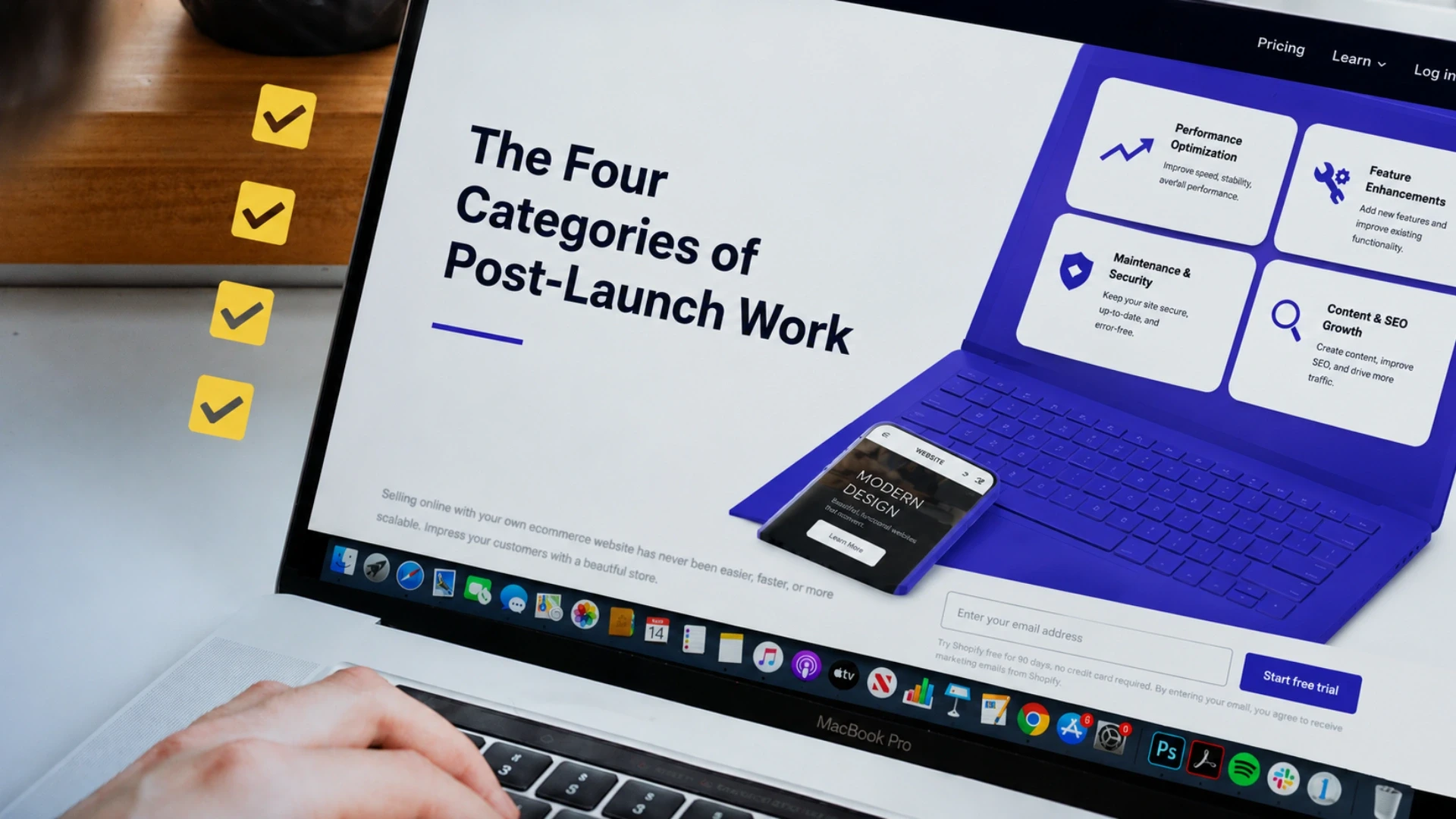
Post-launch work is not a single activity. It splits into four formally recognized categories that have different cost profiles, different urgency levels, and different staffing requirements. According to a 2026 app maintenance and SLA expectations guide by App Development Authority, these four categories are: corrective maintenance (defects discovered post-deployment including crash fixes, logic errors, and broken integrations), adaptive maintenance (modifications required by external change such as operating system updates, third-party API deprecations, or regulatory compliance shifts), perfective maintenance (feature enhancements based on user feedback and product evolution), and preventive maintenance (technical debt management, security hardening, dependency updates, performance optimization before problems surface). The US Bureau of Labor Statistics formally classifies ongoing software support under NAICS code 541519, separating it from initial custom programming under NAICS 541511, which means even the federal classification recognizes maintenance as a distinct service category with its own discipline.
The Four Categories of Python Post-Launch Work
Category | What It Covers | Typical Share of Maintenance Budget |
|---|---|---|
Corrective | Bug fixes, broken integrations, production incidents | 10 to 20% |
Adaptive | Python/Django/library upgrades, OS changes, API updates | 15 to 25% |
Perfective | Feature improvements, user-requested enhancements | 40 to 55% (largest band) |
Preventive | Tech debt paydown, security hardening, performance tuning | 15 to 25% |
Why This Categorization Matters for Contract Design
Most contracts cover corrective and adaptive by default. Bug fixes and library upgrades are the standard inclusions of any reasonable post-launch contract. If your support contract does not explicitly cover both, ask why. Asking after a critical bug surfaces is the worst time to discover an exclusion.
Perfective is the largest category but often billed separately. Feature work after launch (new functionality, user-requested improvements, product evolution) is typically the biggest post-launch budget category. Some contracts include a fixed monthly hour bucket for perfective work; others bill it separately as feature development. Know which model applies before signing.
Preventive is the most underinvested and highest-leverage. Industry benchmarks show every $1 spent on preventive maintenance saves $3 to $5 in corrective fixes. Teams that allocate sprint capacity to dependency updates, tech debt paydown, and performance tuning have dramatically lower emergency response costs over the product's lifetime.
Annual maintenance benchmark: 15 to 25% of original build cost. Per Gartner, over 60% of total software budget goes into maintenance, not initial development. Plan for 15 to 20% of build cost annually for typical Python web applications, 17 to 30% for AI/ML-integrated systems where model retraining and serving infrastructure compound the maintenance cost.
The detailed budget breakdown for post-launch operations across project types, including infrastructure costs and the maintenance reserve that belongs in any minimum budget calculation, is covered in the analysis on the minimum budget required to start a Python development project, which walks through realistic cost ranges by project type from MVP through enterprise platforms.
The Three Post-Launch Support Models for Python Applications
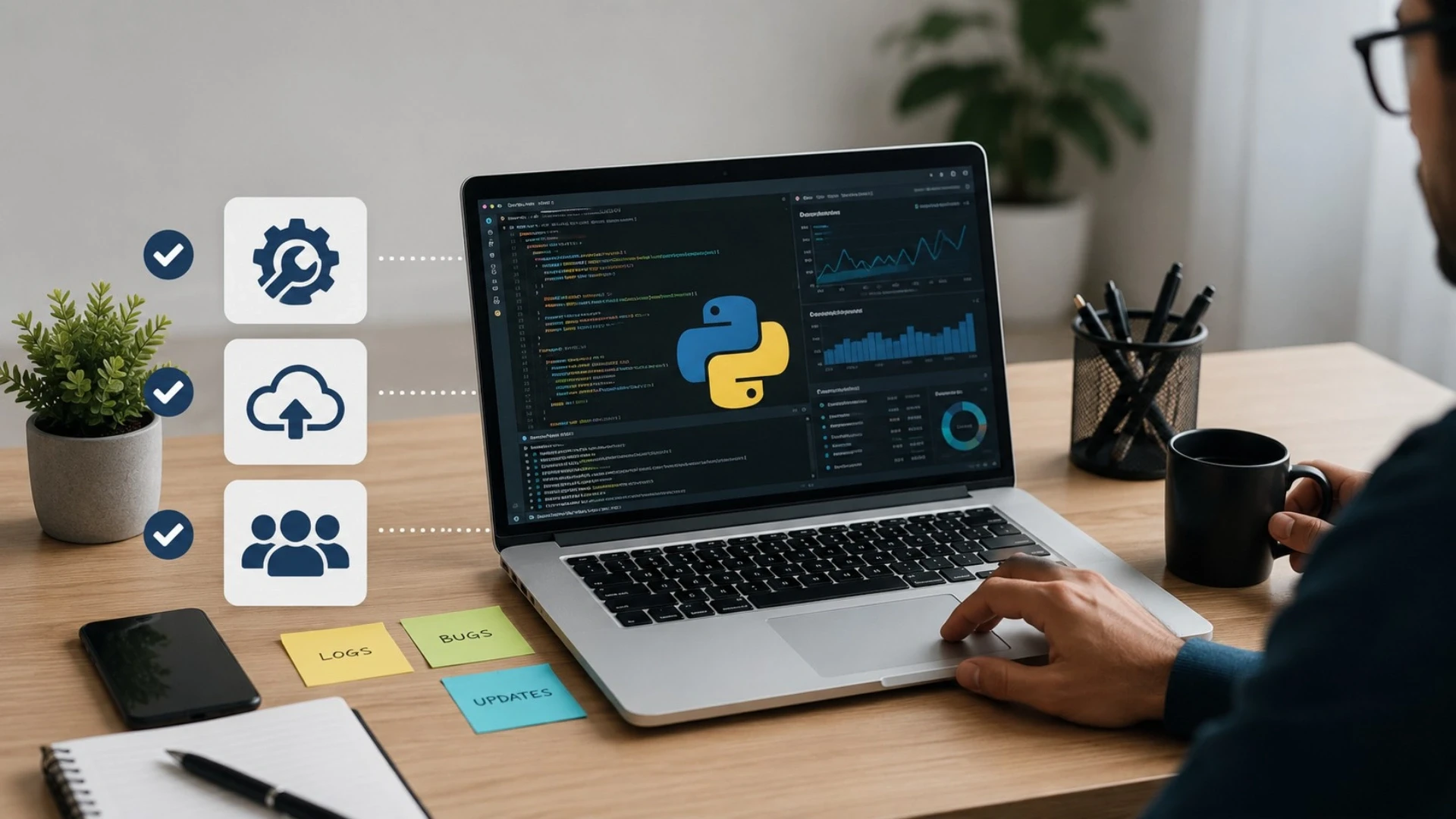
Post-launch engagements in 2026 follow one of three dominant models. Each has legitimate use cases, predictable cost profiles, and specific trade-offs. The choice depends on whether the application is stable with low expected change (time and materials wins), in active iteration with moderate change (retainer wins), or in continuous evolution with significant change (dedicated team wins). Choosing wrong produces the same outcomes: overpaying for stability you do not need, or underbuying for change you cannot avoid.
Python Post-Launch Support Model Comparison
Model | Cost Range | Best For |
|---|---|---|
Time and Materials (T&M) | $25 to $80/hour, billed as used | Stable applications with low expected change |
Monthly Retainer | $2,000 to $20,000/month, fixed hours | Active iteration, predictable monthly capacity |
Dedicated Team | $3,200 to $12,000/engineer/month | Continuous evolution, multi-quarter roadmap |
Hybrid (Retainer + on-demand) | Base retainer + T&M overflow | Mixed steady work plus occasional spikes |
Time and Materials: When It Works (and When It Does Not)
Works for: Stable Python applications with predictable, low-volume maintenance needs. Mature products that ship features rarely, well-documented codebases, and use cases where the cost of a guaranteed response time exceeds the value of having one. T&M is the cheapest option for genuinely stable applications.
Fails for: Anything customer-facing or revenue-generating. T&M typically carries no guaranteed response time, no SLA, and emergency rates that exceed $300/hour. When a critical production issue surfaces at 2 AM on a Saturday, the lack of a structured contract becomes very expensive very quickly. Per the API Pilot 2026 analysis, organizations relying on ad-hoc fixes face 42% higher emergency repair costs.
Monthly Retainer: The Most Common Model for SaaS
Predictable monthly cost. Fixed hours per month (20, 40, 80, 160) at a discounted rate compared to T&M. Hours can be applied across corrective, adaptive, perfective, and preventive work as the priority shifts month to month.
Defined SLA with response time guarantees. Critical issues get same-day response, non-critical issues get next-business-day. The retainer relationship justifies the SLA commitment from both sides.
Same team continuity, no knowledge reconstruction cost. The engineers who built the Python application continue maintaining it, which eliminates the knowledge reconstruction cost that catches teams using a separate post-launch vendor. Django applications particularly benefit from team continuity because the codebase accumulates ORM schema decisions, business logic rules, and admin configurations that require deep understanding to modify safely.
The structural advantages of monthly retainer engagements for Python work specifically, including the cost comparison against project-based pricing and the scenarios where each model wins, are covered in the analysis on monthly retainer vs project-based pricing for Python development, which walks through real cost scenarios with concrete numbers.
Dedicated Team: The Right Model for Continuous Evolution
Same engineers for the entire product lifetime. Named engineers work exclusively on your Python product, maintaining full context across sprints. Adoption-aware delivery, sprint-based maintenance, and feature development all happen in the same engagement rather than fragmenting across separate teams.
Best for SaaS, enterprise platforms, AI/ML systems. Products that continue evolving for years with significant ongoing feature work, compliance updates, and infrastructure investment. The dedicated team model becomes the cost-efficient choice once monthly engineering effort exceeds roughly 60 to 80 hours.
Acquaint Softtech rate: $3,200/month per senior engineer. Dedicated Python engineering teams at $3,200 to $12,000 per engineer per month depending on seniority and specialization, roughly 40% less than equivalent US in-house hiring. Full IP assignment, NDA from day one, and free replacement guarantee.
The decision framework for choosing between staff augmentation, dedicated team, and project outsourcing models for Python work is covered in the analysis on Python staff augmentation vs dedicated team vs outsourcing, which walks through the dimensions that determine which model fits which post-launch reality.
Need a Python Post-Launch Support Partner You Can Actually Trust?
Acquaint Softtech offers all three post-launch support models: time and materials starting at $20/hour, monthly retainers starting at $2,000, and dedicated Python engineering teams from $3,200/month per engineer. Senior engineers, named resource commitment, SLA-backed response times, full IP assignment, and free replacement guarantee on dedicated engagements. The team that built it can maintain it.
SLA Tiers and Response Time Expectations
A Service Level Agreement (SLA) is the contractual document that distinguishes a serious post-launch engagement from a brochure. It defines measurable performance thresholds, response time obligations by issue priority, and escalation procedures. The industry-standard SLA structure for app development specifies three tiers of incident severity with distinct response windows, and the absence of an SLA (or the presence of an SLA without enforceable response commitments) is the single biggest red flag in post-launch support contracts.
The Industry-Standard 3-Tier SLA Structure
Priority 1 (Critical): Application down or data loss. Response time commonly 1 to 4 hours with 24/7 coverage. Examples: production server unreachable, authentication completely broken, payment processing failed, database corruption, security breach. Mature contracts also specify start of work time (not just acknowledgement) and escalation procedures if Tier 1 cannot resolve.
Priority 2 (High): Major feature failure affecting significant user segment. Response within 8 business hours. Examples: search broken for a subset of users, reports generating incorrect data, email notifications failing, slow page loads degrading user experience materially. Business hours coverage typically sufficient but 24/7 available for an additional premium.
Priority 3/4 (Medium/Low): Minor functional issues or cosmetic defects. Resolution windows ranging from 3 to 10 business days. Examples: small UI inconsistencies, edge case bugs affecting few users, minor performance suboptimization, documentation gaps. These get prioritized into normal sprint planning rather than emergency response.
Uptime Guarantees: What the Percentages Actually Mean
Uptime guarantees expressed as annual availability percentages have a specific operational meaning that buyers should understand before negotiating. The math is unforgiving: 99.9% uptime translates to a maximum of approximately 8.7 hours of allowable downtime per year. 99.99% uptime permits roughly 52 minutes per year. 99.999% (five nines) caps annual downtime at about 5 minutes. Each additional nine roughly doubles the cost of the infrastructure and engineering investment required to achieve it. Most B2B SaaS Python applications target 99.9%; mission-critical applications target 99.99%; only systems where downtime produces seven-figure losses justify 99.999%.
Response Time vs Resolution Time: A Critical Distinction
Response time is acknowledgement, not fix. 'P1 response within 15 minutes' usually means a human acknowledged the issue within 15 minutes, not that the issue is fixed. The actual resolution SLA might be 'best effort' or measured in days. This distinction becomes critical during incidents and must be clarified before signing.
Start-of-work time is the meaningful metric. 'Engineer actively working on the issue within 30 minutes of P1 trigger' is a serious commitment. 'Email acknowledgement within 15 minutes' is mostly cosmetic. Negotiate the metric that matters: when actual engineering work starts.
Escalation paths between tiers should have time limits. 'Tier 1 must escalate to Tier 2 within 30 minutes for P1 issues' prevents ticket purgatory where issues bounce between support tiers without making progress. Strong SLAs include these escalation time bounds explicitly.
Financial consequences for SLA breach matter. Service credits, contract review rights, or exit clauses triggered by consistent SLA breach distinguish enforceable contracts from aspirational ones. An SLA without consequences for breach is not an SLA. It is a brochure.
What an Honest Post-Launch Contract Includes (and the Red Flags That Hide)
Post-launch contracts vary widely in quality. The same contract length and price can mean very different things depending on what is explicitly included, explicitly excluded, and quietly omitted. The framework below distinguishes a serious post-launch engagement from one that will produce surprises after the first quarter.
What an Honest Python Post-Launch Contract Includes
Defined scope inclusions and exclusions. Specifically: is new feature development included or billed separately? Does the agreement cover third-party API failures or only code-level issues? Are database schema changes included or classified as feature development? Does the provider handle OS, Python version, and Django/FastAPI framework upgrades? Vague scope is the most common post-launch contract failure.
Response time tiers with enforceable commitments. P1 critical response within 1 to 4 hours with 24/7 coverage. P2 high within 8 business hours. P3/P4 within 3 to 10 business days. Start-of-work time defined, not just acknowledgement. Financial consequences specified for SLA breach.
Uptime commitment with measurement methodology. 99.9% or 99.99% targets stated explicitly with how uptime is measured (synthetic monitoring, real user monitoring, infrastructure metrics). Without measurement methodology, the uptime percentage is unverifiable.
Personnel continuity guarantees. Named developers, with provider obligation to maintain knowledge continuity if a team member transitions. The cost of knowledge reconstruction when a key engineer leaves is real and should be contractually addressed.
Full IP assignment and clear data security obligations. All code and work product belongs to the client unambiguously. NDA covers source code, business logic, and sensitive data. Data handling obligations, breach notification timelines, and access controls all specified.
Termination and transition terms. Notice periods, documentation delivery requirements during transition, and provider obligations to support handover to another vendor or internal team without holding the client hostage to continued engagement.
Reporting cadence and metrics. Monthly or quarterly maintenance reports covering tickets resolved, SLA compliance, uptime achieved, dependency updates applied, security patches deployed. Without reporting, the client cannot verify they received what they paid for.
The Post-Launch Contract Red Flags That Predict Future Surprises
Annual rate increases not defined at signature. Software maintenance fees typically increase 3 to 10% per year. Contracts that do not define annual rate adjustment at signature produce renewal negotiations where the vendor has all the leverage. The escalation trigger should be benchmarked (e.g., consumer price index, defined cap) and agreed in writing.
'Market rate adjustment' clauses without ceiling. Open-ended escalation clauses with no upper bound are a structural red flag. Even with good intentions, they create the option for the vendor to extract surplus during renewal.
Post-launch fees that escalate with usage volume. Support contracts that scale arbitrarily with user count, transaction volume, or data size produce the situation where a successful Python application becomes expensive to support specifically because it is successful. Volume-linked escalation should have defined caps.
Vague scope around what counts as new feature work. If the contract does not explicitly define the boundary between maintenance and new development, every iteration becomes a negotiation. Vendors with ambiguous scope tend to interpret ambiguity in their favor when billing.
No defined exit terms or data export. Contracts that do not define how the engagement ends, what documentation is delivered, and how source code/credentials transfer create vendor lock-in. Honest vendors provide clear exit terms.
The complete catalogue of post-launch pricing red flags, including the specific contract clauses that hide future surprises and what fair Python maintenance pricing looks like in 2026, is covered in the analysis on Python development pricing red flags, which walks through the structural patterns that predict expensive post-launch surprises.
How Acquaint Softtech Structures Python Post-Launch Support
Acquaint Softtech is a Python development and IT staff augmentation company based in Ahmedabad, India, with 1,300+ Python projects delivered globally and ongoing post-launch support engagements across SaaS, FinTech, healthcare, EdTech, eCommerce, and enterprise platforms. Our post-launch model follows the framework in the complete guide to hiring Python developers and the engagement structure designed to keep the build team available for the maintenance phase, eliminating the knowledge reconstruction cost that catches teams using separate post-launch vendors.
Three support model options to fit project reality. Time and Materials starting at $20/hour for stable applications with low change rate. Monthly retainers starting at $2,000 with defined hour buckets, SLA-backed response times, and same-team continuity. Dedicated Python engineering teams from $3,200/month per engineer for continuous evolution.
SLA-backed response commitments. P1 critical issues response within 4 hours with 24/7 coverage on retainer and dedicated team engagements. P2 high within 8 business hours. P3/P4 within 3 to 10 business days. Start-of-work time defined explicitly, not just acknowledgement. Monthly reporting on tickets, SLA compliance, and dependency updates applied.
Same team that built it maintains it. The engineers who built your Python application continue maintaining it under retainer or dedicated team engagements. Zero knowledge reconstruction cost. Django applications particularly benefit from this continuity given the accumulation of ORM, business logic, and admin configuration decisions that require deep codebase context to modify safely.
Full IP assignment from day one with clear exit terms. Every Acquaint Softtech engagement gives clients full ownership of codebase, infrastructure configuration, database schema, and API documentation. No vendor lock-in or ongoing access fees. Clients can independently manage the platform or transition to another vendor without restriction.
Transparent rate structure with no surprise escalation. Annual rate increases defined at contract signature. No unilateral 'market rate adjustment' clauses. Change order rates published, not negotiated mid-engagement. Volume-linked escalation, where applicable, capped and disclosed.
The structural alignment between retainer-based engagement and post-launch reality is well documented for Python work specifically, and the cost comparison framework for choosing the right model is covered in the analysis on monthly retainer vs project-based pricing for Python development, with the broader hiring company evaluation framework covered in what to look for when hiring a Python development company.
To get senior Python engineers on a post-launch support engagement that fits your application's actual maintenance reality, with profiles shared in 24 hours and onboarding within 48, you can hire Python developers through Acquaint Softtech.
Want a Python Post-Launch Engagement That Does Not Produce Surprises?
Book a free 30-minute post-launch consultation. Tell us your application stack, current maintenance reality, expected change rate, and the support gaps you anticipate, and we will give you an honest answer: which support model fits your application, what realistic SLA tiers should look like, what an honest contract includes for your specific situation, and how Acquaint Softtech engineers integrate into your post-launch operations.
The Bottom Line
Post-launch is not the phase after the project. It is the phase that contains 60% of the total software budget per Gartner, and it determines whether the Python web application produces the value the business case promised or quietly degrades into a maintenance burden. The four categories of post-launch work (corrective, adaptive, perfective, preventive) each have different cost profiles, and the support model that fits depends on application change rate: time and materials for stable applications with predictable low-volume needs, monthly retainer for active iteration, dedicated team for continuous evolution.
Serious post-launch contracts include three-tier SLAs with enforceable response time commitments (P1 within 1 to 4 hours with 24/7 coverage, P2 within 8 business hours, P3/P4 within 3 to 10 business days), uptime guarantees with measurement methodology, personnel continuity provisions, full IP assignment, clear exit terms, and reporting cadence. Red flags include undefined annual rate increases, market rate adjustment clauses without ceilings, volume-linked escalation without caps, vague scope around new feature work, and missing exit terms. Annual maintenance benchmark sits at 15 to 25% of original build cost, with AI/ML-integrated systems at 17 to 30%.
Frequently Asked Questions
-
What does post-launch support for a Python web application actually include?
Four categories of work. Corrective maintenance (bug fixes, broken integrations, production incidents). Adaptive maintenance (Python/Django/library version upgrades, OS changes, third-party API updates, compliance shifts). Perfective maintenance (feature improvements based on user feedback, the largest category by budget share). Preventive maintenance (technical debt paydown, security hardening, dependency updates, performance optimization).
-
What is the difference between time and materials, retainer, and dedicated team for Python support?
Three distinct models. Time and Materials ($25 to $80 per hour, billed as used) works for stable applications with predictable low-volume needs but typically carries no SLA and emergency rates exceeding $300/hour. Monthly Retainer ($2,000 to $20,000/month, fixed hours) works for active iteration with predictable monthly capacity, SLA-backed response times, and same-team continuity.
-
What SLA tiers should a Python post-launch contract include?
Industry-standard three-tier structure. P1 Critical (application down, data loss, security breach): response within 1 to 4 hours with 24/7 coverage. P2 High (major feature failure affecting significant user segment): response within 8 business hours. P3/P4 Medium/Low (minor issues, cosmetic defects): resolution within 3 to 10 business days.
-
What does 99.9% uptime actually mean for a Python web application?
99.9% uptime translates to a maximum of approximately 8.7 hours of allowable downtime per year. 99.99% uptime permits roughly 52 minutes per year. 99.999% (five nines) caps annual downtime at about 5 minutes. Each additional nine roughly doubles the infrastructure and engineering investment required. Most B2B SaaS Python applications target 99.9%; mission-critical applications target 99.99%; only systems where downtime produces seven-figure losses justify 99.999%.
-
How much should a Python post-launch support engagement cost?
Annual maintenance benchmark is 15 to 25% of original development cost (ScienceSoft, McKinsey). For a Python application that cost $50,000 to build, budget $7,500 to $12,500 per year in ongoing maintenance. Monthly retainers typically range $2,000 to $20,000 depending on application complexity, response time tier, and hour bucket size. Dedicated engineering teams from $3,200 to $12,000 per engineer per month with offshore partners like Acquaint Softtech, roughly 40% less than equivalent US in-house hiring.
-
Should the team that built my Python application also maintain it?
Almost always yes. The team that built the application has the deepest understanding of the codebase, architectural decisions, third-party integrations, and business logic. Knowledge reconstruction with a new team costs real engineering hours and produces gaps that surface as defects. Django applications particularly benefit from build-team continuity because the codebase accumulates ORM schema decisions, business logic rules, and admin configurations that require deep understanding to modify safely.
-
What red flags should I avoid in a Python post-launch contract?
Five common ones. Annual rate increases not defined at signature (renewal negotiations where vendor has all leverage). 'Market rate adjustment' clauses without ceiling or benchmark (open-ended escalation). Post-launch fees that scale with user volume, transaction count, or data size without defined caps (success becomes expensive). Vague scope around what counts as new feature development versus maintenance (every iteration becomes a billing negotiation). No defined exit terms or data export provisions (vendor lock-in).
We’re Acquaint Softtech, your technology growth partner. Whether you're building a SaaS product, modernizing enterprise software, or hiring vetted remote developers, we’re built for flexibility and speed. Our official partnerships with Laravel, Statamic, and Bagisto reflect our commitment to excellence, not limitation. We work across stacks, time zones, and industries to bring your tech vision to life.
Table of Contents
Get Started with Acquaint Softtech
- 13+ Years Delivering Software Excellence
- 1300+ Projects Delivered With Precision
- Official Laravel & Laravel News Partner
- Official Statamic Partner
Related Blog
How to Hire Python Developers Without Getting Burned: A Practical Checklist
Avoid costly hiring mistakes with this practical checklist on how to hire Python developers in 2026. Compare rates, vetting steps, engagement models, red flags, and more.
Acquaint Softtech
March 30, 2026
Total Cost of Ownership in Python Development Projects: The Full Financial Picture
The build cost is just the beginning. This guide breaks down the complete TCO of Python development projects across every lifecycle phase, with real benchmarks, a calculation framework, and 2026 data.
Acquaint Softtech
March 23, 2026
Python Developer Hourly Rate: What You're Actually Paying For
Python developer rates range $20-$150+/hr in 2026. See what experience, specialisation & hidden costs actually determine the price. Save 40% with vetted offshore talent.
Acquaint Softtech
March 9, 2026India (Head Office)
203/204, Shapath-II, Near Silver Leaf Hotel, Opp. Rajpath Club, SG Highway, Ahmedabad-380054, Gujarat
USA
7838 Camino Cielo St, Highland, CA 92346
UK
The Powerhouse, 21 Woodthorpe Road, Ashford, England, TW15 2RP
New Zealand
42 Exler Place, Avondale, Auckland 0600, New Zealand
Canada
141 Skyview Bay NE , Calgary, Alberta, T3N 2K6
Your Project. Our Expertise. Let’s Connect.
Get in touch with our team to discuss your goals and start your journey with vetted developers in 48 hours.