

Python vs Java for Enterprise Applications: A CTO-Level Comparison
Python vs Java for enterprise applications 2026. CTO-level comparison of performance, cost, hiring, ecosystems, and the decision framework for your stack.

Mukesh Ram
Introduction: The Enterprise Language Question CTOs Actually Face
Every enterprise CTO hits this decision at some point. A new platform is being commissioned. A legacy system needs replacement. An AI capability is being built into a Java-heavy stack. Someone in the room asks the question: Python or Java? What follows is usually three weeks of vendor pitches, whitepaper reads, and internal debates that rarely resolve because both languages are excellent, both are entrenched at Fortune 500 scale, and both are winning meaningfully different workloads in 2026. The right question is not which language is better. It is which language matches the specific workload, team, and cost profile of the specific enterprise application you are building.
The philosophies behind the languages matter for enterprise decisions. As Guido van Rossum, the creator of Python, put it: "Code is read much more often than it is written." Python's design optimizes for developer velocity and readability, which is why the language dominates AI, data engineering, and scientific computing in 2026. James Gosling, the creator of Java, framed his language's design differently: "Java is C++ without the guns, knives, and clubs."
The 2026 data on Python vs Java adoption tells a specific story. According to a 2026 comparison analysis by Tech-Insider on Java vs Python, the TIOBE Index for April 2026 shows Python at 20.97% and Java at 7.79%, a 13.18 percentage-point gap that represents the widest spread between the two languages in TIOBE's 25-year history. Python usage reached 57.9% among developers in the 2025 Stack Overflow Developer Survey, while Java held steady at around 30% supported by enterprise adoption.
This guide covers Python vs Java for enterprise applications in 2026 with a CTO-level framework grounded in production experience across 1,300+ projects. It walks through adoption data, real performance benchmarks, when each language wins for enterprise workloads, cost and hiring comparisons, and a decision framework that survives scrutiny in a boardroom. If you are also evaluating the engineering team that will execute the enterprise application, the complete guide to hiring Python developers sets the wider context on engagement models and senior engineer profiles for enterprise-scale delivery.
Python vs Java Adoption in 2026: The Numbers That Matter
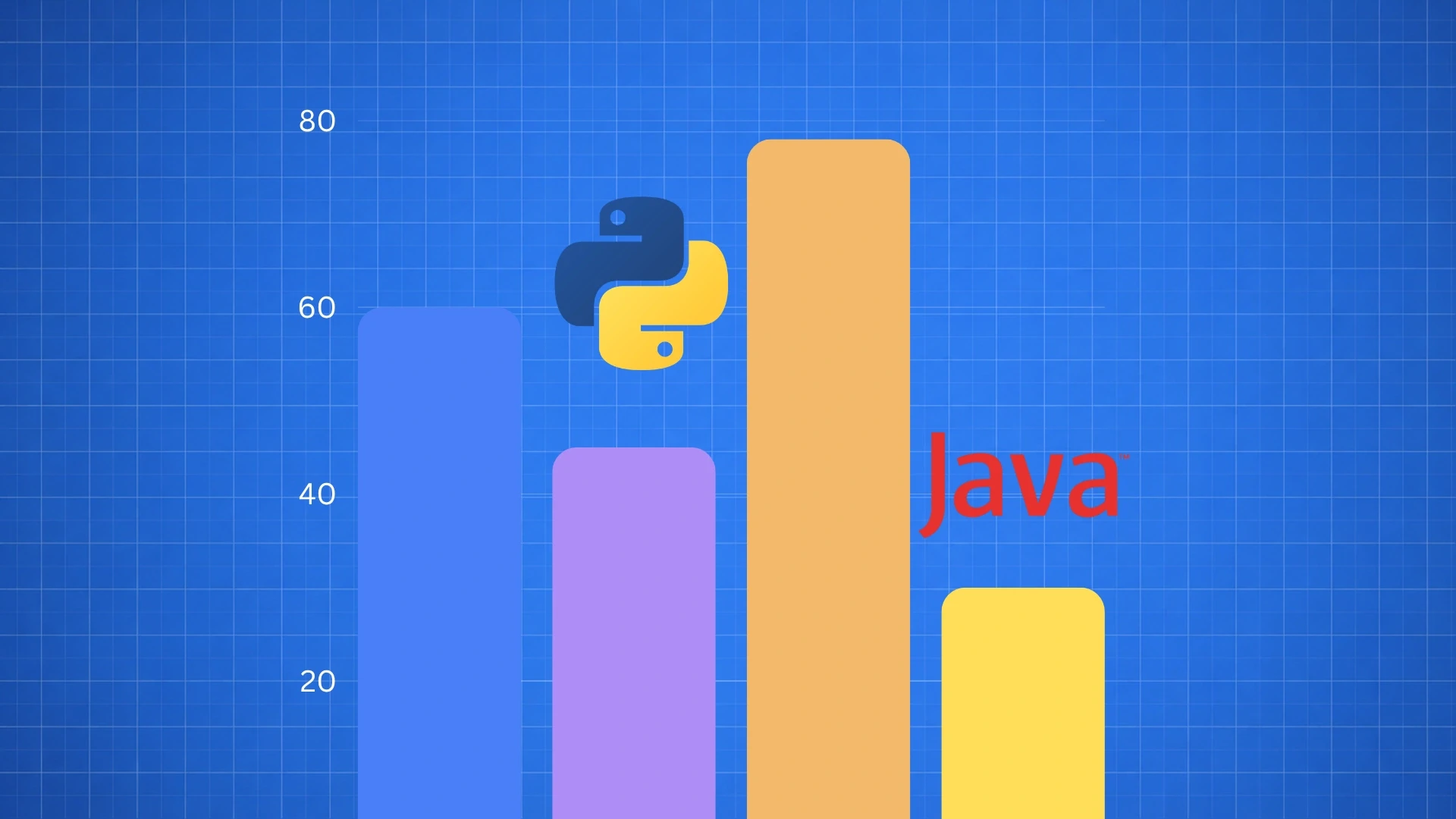
Adoption tells a story that raw popularity rankings miss. According to the 2026 Java Trends analysis by Keyhole Software, Java ranked #3 on the TIOBE Index in January 2026 at 8.71%, behind Python at 22.61% and C at 10.99%. However, per Azul's 2025 State of Java Survey, 99% of surveyed organizations actively use Java, and nearly 70% report that more than half of their applications are built with Java or run on the JVM. 62% of enterprises now use Java to power AI functionality, and 81% are migrating all or part of their Oracle Java environments to OpenJDK distributions. Red Hat's 2026 Java Ecosystem Report notes that 62% of Fortune 500 companies use Java, though its share among startups and cloud-native teams has dropped by 15% since 2020. Two structural realities are simultaneously true: Python has more developer mindshare, and Java has deeper enterprise deployment footprint.
Python vs Java Enterprise Adoption Snapshot 2026
Metric | Python | Java |
|---|---|---|
TIOBE Index (April 2026) | 20.97% (#1) | 7.79% (#4) |
Stack Overflow developer usage | 57.9% | ~30% |
Fortune 500 enterprise deployment | Growing (AI, data) | 62% actively using |
Active enterprise organizations (Azul) | N/A (broad) | 99% use Java |
Apps running on runtime/JVM | Broad, single language | 70% of enterprise apps |
AI enterprise usage | Primary language 75%+ | 62% now integrating |
Financial transaction volume | Growing (data, ML) | Trillions of dollars daily |
Top-tier household examples | Instagram, Netflix, Spotify, OpenAI | Netflix backend, Goldman Sachs, Airbnb |
What This Adoption Data Means for CTO Decisions
Python is winning new project starts. Startups, cloud-native teams, and AI-first enterprises consistently pick Python as the default backend for new products in 2026. The ecosystem, hiring depth, and MVP velocity make it the pragmatic first choice for greenfield work where AI or data workloads are anywhere on the roadmap.
Java is winning legacy modernization and mission-critical systems. The 99% enterprise usage rate reflects Java's deep entrenchment in banking cores, insurance claims processing, trading platforms, and multi-decade enterprise systems where stability, static type safety, and 20-year backward compatibility matter more than developer trend cycles.
Hybrid stacks are the enterprise pattern of 2026. Netflix, Spotify, Airbnb, and most Fortune 500 companies now run polyglot architectures. Java for transactional backbones, Python for data science and AI, with each language serving the workload it fits best. The 62% of enterprises using Java to integrate AI capabilities are almost always Python and Java hybrid stacks, not Python replacing Java.
The Python-specific framework and architecture choices that support enterprise scale, including Django, FastAPI, and the modular monolith pattern that fits enterprise workloads better than premature microservices, are covered in the Python development architecture and frameworks guide, which walks through when each framework is the right choice for enterprise Python applications.
Performance and Scalability: Where Each Language Actually Wins
Raw performance benchmarks are the most misused data in enterprise language decisions. Java is faster than Python on CPU-bound workloads, sometimes 5 to 10 times faster. However, most enterprise applications are I/O-bound (waiting on databases, APIs, and file systems), not CPU-bound. The 5x gap that looks devastating in a synthetic test becomes invisible in a real backend spending 80% of its time waiting on PostgreSQL. Understanding which type of workload you actually have is the entire performance conversation.
Python vs Java Performance Characteristics 2026
Workload Type | Python (FastAPI/Django) | Java (Spring Boot) |
|---|---|---|
Simple REST API RPS per core | 20,000 to 22,000 | 40,000 to 60,000 |
CPU-bound computation | Weak (GIL limits) | Strong (JVM optimization) |
I/O-bound async operations | Strong (asyncio, FastAPI) | Strong (virtual threads, Java 25) |
ML training and inference | Industry-leading | Requires DJL or external service |
Enterprise transaction throughput | Good with tuning | Excellent (trading, banking scale) |
Memory footprint per instance | 80 to 120 MB | 300 to 500 MB (JVM overhead) |
Startup time (cold start) | 0.5 to 1 second | 3 to 10 seconds (or AOT: 0.1s) |
p99 latency guarantees | Under 100ms typical | Under 50ms achievable |
What These Numbers Mean for Enterprise Applications
Java's raw throughput advantage matters at extreme scale only. For enterprise applications handling under 20,000 requests per second per service (which is most enterprise workloads), both languages perform comfortably. Java's 2 to 3x throughput advantage becomes meaningful only when the system genuinely runs at 40,000+ RPS per service, which is the operational domain of high-frequency trading, ad tech bidding platforms, and telecom real-time systems.
Java 25 virtual threads have closed the async gap significantly. Java's virtual threads (Project Loom) released with Java 21 LTS and matured in Java 25 provide async I/O throughput comparable to Python's asyncio while retaining Java's static type safety. This narrows one of Python's historic advantages in I/O-bound workloads meaningfully.
Python code is 3 to 5x shorter than Java for equivalent functionality. Per Emergen Research industry analysis, Python codebases require 3 to 5 times less code than Java equivalents for the same feature scope. This translates directly to faster development cycles, easier maintenance, and lower engineering hours over the product lifecycle. For enterprise applications where iteration speed matters, this is a real advantage.
JVM garbage collection is a specific enterprise consideration. Java's JVM garbage collection can produce sub-millisecond pauses with modern collectors (ZGC, Shenandoah), which matters for latency-sensitive systems. Python's interpreter has different pause characteristics that are usually fine for enterprise SaaS but can matter for high-frequency systems where microseconds count.
As Linus Torvalds, the creator of Linux, has observed about system design: "Talk is cheap. Show me the code." Applied to the Python vs Java decision for enterprise applications, the honest question is not which language wins benchmarks. It is which language your team can actually ship maintainable production code with, at the scale your enterprise application actually operates at, within the budget your enterprise actually allocates. Talk about theoretical performance advantages evaporates when the code has to ship.
The detailed patterns that determine whether a Python backend holds enterprise scale, including load testing, Redis clustering, PostgreSQL replicas, and observability from day one, are covered in the analysis on how to build a scalable Python backend, which walks through the specific architectural decisions that support enterprise workloads.
Need Senior Enterprise Engineers Who Understand Both Python and Java?
Acquaint Softtech delivers enterprise applications on Python (Django, FastAPI, Flask) with engineers who understand Java hybrid integration patterns, JVM interop, and the migration realities from Java to Python or Python-alongside-Java architectures. Senior engineers, transparent pricing from $20/hour, dedicated Python development teams from $3,200/month per engineer, roughly 40% less than equivalent US in-house hiring.
When Python Wins for Enterprise Applications
Python is the correct enterprise choice for a specific set of workloads, and choosing it for those workloads produces meaningfully better outcomes than forcing the same work through Java. Being honest about where Python wins is the first step in a serious CTO-level comparison.
The Enterprise Scenarios Where Python Consistently Wins
AI, machine learning, and data science are core to the application. Python's AI ecosystem (PyTorch, TensorFlow, scikit-learn, Hugging Face, LangChain, LlamaIndex) has no realistic Java equivalent. When the enterprise application includes recommendations, NLP, computer vision, predictive analytics, LLM integration, or any ML workflow, Python belongs somewhere in the stack. Even Java-heavy enterprises consistently add Python for the AI layer.
Data engineering and ETL pipelines at enterprise scale. Apache Airflow, Dagster, Prefect, and the Pandas plus NumPy plus Polars data stack are Python-native. Enterprise data platforms built in Java exist but pay significant productivity taxes. Data warehouse ETL, real-time analytics pipelines, and feature engineering for ML consistently favor Python.
Rapid enterprise MVP and greenfield application delivery. Django's admin panel alone saves weeks on any enterprise application with user management, content management, or role-based access. Python codebases run 25 to 35% shorter for equivalent functionality, accelerating MVP delivery. Enterprise proof-of-concept work consistently ships faster in Python than Java.
Scientific computing and financial modeling within enterprise. SciPy, NumPy, statsmodels, and QuantLib have 30+ years of scientific computing depth. Bioinformatics, quantitative finance, risk modeling, signal processing, and physics simulation within enterprise domains are Python-native.
Enterprise SaaS and analytics platforms with compliance requirements. Django's mature ecosystem includes battle-tested libraries for HIPAA, GDPR, PCI-DSS, and SOC 2 compliance. Enterprise SaaS built for healthcare, FinTech, and other regulated industries consistently benefits from Python's ecosystem depth in compliance patterns.
Real Enterprise Python Case Study: BIANALISI Healthcare Analytics
BIANALISI: Italy's Largest Diagnostic Group
Enterprise Client: Italy's largest diagnostic group with multi-lab operations
Application: GDPR-compliant predictive analytics platform detecting abnormal diagnostic clusters across patient data
Stack: Python (Django + FastAPI), PostgreSQL, Redis, audit-grade query logging
Enterprise Constraints: Multi-year GDPR compliance operations, multiple lab data sources, patient data isolation, audit trails for regulatory inspection
Why Python Won Here: Statistical analytics, ML clustering algorithms, HL7 and FHIR compliance libraries, mature scientific stack. Building the same platform in Java would have required 3+ external services and significantly more engineering hours.
Read the full BIANALISI enterprise case study →
The framework-specific decisions that determine whether a Python enterprise application delivers on its promises, including when Django is the right choice versus when FastAPI or a hybrid fits better, are covered in the Django vs FastAPI vs Flask comparison guide, which walks through 12 enterprise scenarios with concrete recommendations for each.
When Java Wins for Enterprise Applications
Java is the correct enterprise choice for a different set of workloads, and honest recommendations acknowledge where it dominates. The 99% enterprise usage rate reported by Azul reflects real strengths, not just legacy inertia. Serious CTO-level comparisons treat both languages honestly, not as tribes.
The Enterprise Scenarios Where Java Consistently Wins
Mission-critical transactional systems with p99 latency under 50ms. Banking cores, high-frequency trading, insurance claims processing, and telecom billing systems where sub-50ms p99 latency is a hard business requirement. The JVM's optimization maturity, virtual threads, and mature garbage collectors deliver latency characteristics that Python struggles to match at the same infrastructure spend.
Fortune 500 legacy modernization projects. When the existing enterprise stack is Java, the pragmatic modernization path is often Java modernization (Spring Boot from legacy Spring, Java 25 from Java 8) rather than language migration. The 81% of enterprises migrating from Oracle Java to OpenJDK are choosing Java continuity, not Python migration.
Enterprise teams exceeding 30 to 50 engineers on a single platform. Java's stronger static type safety, mature IDE tooling (IntelliJ IDEA), and 25 years of enterprise coding conventions become genuinely valuable when the engineering team is very large. Type safety catches integration bugs across large teams that Python's type hints, while improving rapidly, still catch less aggressively.
Android backend services and mobile-heavy enterprise stacks. Java (and Kotlin on the JVM) remain the native path for Android development and mobile-heavy enterprise stacks. When the mobile app is Java or Kotlin, backend continuity with Java delivers ecosystem alignment.
Compliance-heavy sectors with 10+ year system lifetimes. Government systems, defense contracting, insurance policy administration, and other domains where the software must run for 10 to 20 years with predictable long-term support. Oracle's Java LTS commitments and the JVM ecosystem's backward compatibility discipline serve these lifetimes better than Python's more evolutionary approach.
Where Java Struggles for Enterprise Applications
AI and ML integration requires external services or heavy compromise. DJL, Deeplearning4j, Tribuo, and Apache Spark MLlib exist but cover a fraction of the AI territory Python owns. Java teams building AI-heavy enterprise applications routinely add Python services, not because they want to, but because the ecosystem gap is unavoidable.
Startup and greenfield agility. Enterprise MVPs, proof-of-concept applications, and greenfield initiatives consistently ship faster in Python. Java's ceremony and boilerplate slow the first six weeks of a project, which is where enterprise validation happens. Python wins the greenfield phase almost every time. For teams evaluating a Java alternative, Python offers a faster path from proof of concept to production, particularly when rapid iteration and developer productivity are priorities.
Junior developer productivity and hiring pipeline. Python is now the most-taught introductory language globally. New enterprise engineering hires increasingly come out of universities and bootcamps fluent in Python and cursory in Java. The hiring pipeline for entry-level and mid-level Java engineers is meaningfully harder than for Python in 2026.
Cost, Hiring, and Long-Term TCO Comparison
Language choice affects enterprise cost across three dimensions: developer hiring cost, infrastructure operational cost, and long-term total cost of ownership. Focusing on any single dimension produces misleading conclusions. A cheaper hourly rate does not save money if the ecosystem forces 30% more engineering hours or 40% more infrastructure spend.
Python vs Java Enterprise Cost and Hiring 2026
Dimension | Python | Java |
|---|---|---|
US senior salary (median TC) | $255,000 (AI premium) | $240,000 |
US mid-level rate (per hour) | $55 to $95 | $60 to $100 |
India offshore rate (per hour) | $20 to $45 | $22 to $50 |
Hiring pipeline availability | Deep, growing rapidly | Deep, but shrinking at entry-level |
Enterprise framework depth | Django, FastAPI, Celery, Airflow | Spring Boot, Spring Security, Spring Cloud |
Time to enterprise MVP | 8 to 14 weeks | 12 to 20 weeks |
Code length for equivalent feature | 3 to 5x shorter than Java | Baseline |
Enterprise infrastructure per instance | 80 to 120 MB memory | 300 to 500 MB memory |
Regional Enterprise Developer Rates 2026 (per hour)
Region | Python | Java |
|---|---|---|
United States | $80 to $150 | $85 to $160 |
Western Europe | $60 to $110 | $65 to $115 |
Eastern Europe | $35 to $65 | $38 to $70 |
India (vetted enterprise partner) | $20 to $45 | $22 to $50 |
Latin America | $40 to $80 | $42 to $85 |
Total Cost of Ownership Reality for Enterprise CTOs
Java's slightly higher hourly rate is offset by different factors. Java developers cost 5 to 10% more per hour than Python developers, but Java codebases require 3 to 5x more code for equivalent functionality per Emergen Research. Over an enterprise application's 5-year lifecycle, the total engineering hours matter more than the hourly rate. Python's shorter codebases typically produce lower total engineering cost despite similar rates.
Java infrastructure runs heavier per instance. JVM memory footprint of 300 to 500 MB per instance versus Python's 80 to 120 MB translates directly to infrastructure cost at scale. For containerized deployments where each pod carries JVM overhead, the difference compounds. This is not a language weakness, it is a tradeoff for the JVM's optimization capability.
Vetted offshore Python and Java teams deliver US-comparable quality at 40 to 60% cost. India-based enterprise-grade Python and Java teams from vetted partners like Acquaint Softtech deliver production quality equivalent to US in-house engineering at meaningful cost savings. The differential is structural, not quality-based, when the partner has documented vetting and multi-year enterprise experience.
The complete Python developer cost breakdown across seniority, regions, and engagement models, including the 40% cost savings that vetted offshore Python developer teams consistently deliver for enterprise engagements, is covered in the 2026 Python developer cost guide, with the engagement model comparison walking through fixed-price versus dedicated team versus staff augmentation trade-offs in detail through the Python hiring models comparison analysis.
How Acquaint Softtech Helps Enterprise CTOs

Acquaint Softtech is a Python development and IT staff augmentation company based in Ahmedabad, India, with 1,300+ Python and enterprise projects delivered globally across FinTech, healthcare, SaaS, EdTech, eCommerce, and enterprise platforms. Our enterprise engagement model spans both greenfield Python enterprise applications and Java-alongside-Python hybrid stacks that Fortune 500 companies routinely deploy in 2026, following the framework in the complete guide to hiring Python developers with senior engineers experienced in enterprise-scale delivery.
Honest enterprise stack recommendations. Our engagement starts with a structured discovery phase that produces the right stack recommendation for your enterprise application. Python for AI, data, and compliance-heavy enterprise workloads. Java integration where the existing enterprise stack demands it. Hybrid architecture where the workload actually justifies the operational complexity of running both.
Senior Python engineers with enterprise experience. Multi-year hands-on with Django plus PostgreSQL plus Redis plus PgBouncer stacks, FastAPI microservices with async patterns, Celery worker pipelines, GDPR and HIPAA compliance patterns, and audit-grade logging that enterprise applications require. Case study production experience across BIANALISI healthcare analytics, FinTech transaction platforms, and enterprise SaaS operations.
Compliance-aware enterprise architecture. SOC 2, HIPAA, PCI-DSS, GDPR patterns designed into the enterprise application architecture from Day 1, not retrofitted after audit findings. Full IP assignment and NDA from day one for enterprise procurement compliance.
Transparent enterprise pricing from $20 per hour. Dedicated Python development teams from $3,200 per month per engineer, roughly 40% less than equivalent US in-house hiring. Free replacement guarantee on dedicated engagements. Direct communication with your enterprise engineers through your tools.
48-hour engagement start. Vetted Python engineer profiles shared within 24 hours of receiving your enterprise brief. Engineers in your sprint within 48 hours of profile approval. No lengthy procurement, no agency intermediaries, no translation layers.
The full Acquaint Softtech enterprise credibility profile, including verified Clutch reviews, case studies across regulated industries, and the engagement model options that fit enterprise procurement, is covered in the 2026 top Python development companies analysis, which walks through the criteria that distinguish serious Python development companies for enterprise engagements.
The Bottom Line
Python vs Java for enterprise applications in 2026 is not a debate that produces a single winner. It is a workload decision that produces different winners for different enterprise contexts. Python wins the AI, data engineering, greenfield enterprise MVP, and compliance analytics segments. Java wins the mission-critical transactional systems, Fortune 500 legacy modernization, large-team enterprise platforms, and 10+ year lifetime segments. The TIOBE mindshare gap (Python 20.97% versus Java 7.79%) tells one story.
The pragmatic 2026 answer for most enterprise CTOs is not choosing one language. It is designing a polyglot architecture where each language serves the workload it fits best, with clean integration boundaries between them. Java for transactional backbones and mission-critical latency-sensitive services. Python for AI, data engineering, ML model serving, and analytics workloads. Netflix, Spotify, Airbnb, and most Fortune 500 enterprises operate this pattern.
Not Sure Whether Python or Java Fits Your Enterprise Application?
Book a free 30-minute CTO consultation. Share your enterprise application scope, existing stack, compliance requirements, expected scale, and integration constraints, and we will give you an honest CTO-level answer: which stack fits your specific enterprise workload, why, what realistic cost and timeline look like, and how Acquaint Softtech engineers integrate into your enterprise delivery.
Frequently Asked Questions
-
Python vs Java for enterprise applications: which one wins in 2026?
Depends on the enterprise workload. Python wins for AI, machine learning, data engineering, greenfield enterprise MVPs, and compliance-heavy analytics platforms. Java wins for mission-critical transactional systems with sub-50ms p99 latency requirements, Fortune 500 legacy modernization, engineering teams exceeding 30 to 50 developers on a single platform, and 10+ year system lifetimes.
-
Is Python or Java better for AI in enterprise applications?
Python is significantly better for AI in enterprise applications in 2026. Python is the primary language for 75%+ of machine learning practitioners, and its AI ecosystem (PyTorch, TensorFlow, scikit-learn, LangChain, LlamaIndex, Hugging Face Transformers) has no realistic Java equivalent. Per Azul's 2026 State of Java Survey, 62% of enterprises now use Java to power AI functionality, but these are almost always Python and Java hybrid stacks where Python handles the model training and inference layers while Java anchors the transactional backbone.
-
Which is faster for enterprise backend: Python or Java?
Java is faster on raw benchmarks. Java on Spring Boot handles roughly 40,000 to 60,000 requests per second per core versus Python on FastAPI at 20,000 to 22,000. However, most enterprise applications are I/O-bound (waiting on databases, external APIs), not CPU-bound, and both languages handle I/O-bound workloads similarly well.
-
How much does it cost to hire Python developers versus Java developers for enterprise?
Python developer rates run $55 to $95 per hour in the US and $20 to $45 per hour with vetted offshore partners like Acquaint Softtech. Java developer rates run slightly higher at $60 to $100 per hour in the US and $22 to $50 per hour offshore. Senior Python engineers command a premium in the US (median TC $255,000 versus $240,000 for Java) driven by AI/ML specialization.
-
Can I use Python and Java together in one enterprise application?
Yes, and this hybrid pattern is the dominant enterprise architecture in 2026. Netflix, Spotify, Airbnb, and most Fortune 500 companies run polyglot stacks. Typical enterprise split: Java (Spring Boot, Spring Security, Spring Cloud) for the transactional backbone, banking cores, and mission-critical services with strict SLAs. Python (FastAPI, Django, or Flask) for AI services, data pipelines, ML model serving, and analytics workloads.
-
Is Java dying? Should we migrate our enterprise application from Java to Python?
Java is not dying. Java's TIOBE share has declined from 17% in 2020 to 7.79% in April 2026, but Azul's 2025 State of Java Survey found 99% of surveyed enterprises actively use Java with 70% of applications running on the JVM. Red Hat's 2026 report shows 62% of Fortune 500 companies use Java. Java 25 introduced virtual threads and AOT compilation, closing historic gaps with async languages. Enterprise migrations from Java to Python are almost never wholesale replacements.
I love to make a difference. Thus, I started Acquaint Softtech with the vision of making developers easily accessible and affordable to all. Me and my beloved team have been fulfilling this vision for over 15 years now and will continue to get even bigger and better.
Table of Contents
Get Started with Acquaint Softtech
- 13+ Years Delivering Software Excellence
- 1300+ Projects Delivered With Precision
- Official Laravel & Laravel News Partner
- Official Statamic Partner
Related Blog
How to Hire Python Developers Without Getting Burned: A Practical Checklist
Avoid costly hiring mistakes with this practical checklist on how to hire Python developers in 2026. Compare rates, vetting steps, engagement models, red flags, and more.

Acquaint Softtech
March 30, 2026
Total Cost of Ownership in Python Development Projects: The Full Financial Picture
The build cost is just the beginning. This guide breaks down the complete TCO of Python development projects across every lifecycle phase, with real benchmarks, a calculation framework, and 2026 data.
Acquaint Softtech
March 23, 2026
Python Developer Hourly Rate: What You're Actually Paying For
Python developer rates range $20-$150+/hr in 2026. See what experience, specialisation & hidden costs actually determine the price. Save 40% with vetted offshore talent.
Acquaint Softtech
March 9, 2026India (Head Office)
203/204, Shapath-II, Near Silver Leaf Hotel, Opp. Rajpath Club, SG Highway, Ahmedabad-380054, Gujarat
USA
7838 Camino Cielo St, Highland, CA 92346
UK
The Powerhouse, 21 Woodthorpe Road, Ashford, England, TW15 2RP
New Zealand
42 Exler Place, Avondale, Auckland 0600, New Zealand
Canada
141 Skyview Bay NE , Calgary, Alberta, T3N 2K6
Your Project. Our Expertise. Let’s Connect.
Get in touch with our team to discuss your goals and start your journey with vetted developers in 48 hours.