

Technology Staff Augmentation: Roles, Models and When It Works
Technology staff augmentation is a hiring model where you add vetted external engineers to your in-house team for as long as you need them, while you keep control of the work. You can augment developers, QA, DevOps, data and AI/ML engineers. With an experienced partner, augmented engineers can start within 48 hours.

Ahmed Ginani
When a band is about to record an album and the bass player falls ill, nobody cancels the session. They call a session musician. That musician walks into a studio they have never seen, reads the charts, plays the band's songs the band's way, and the album ships on time. I think of that scene every time a client asks me how our IT staff augmentation services actually work, because technology staff augmentation is exactly that idea applied to software teams.
So here is the direct answer. Technology staff augmentation is a way to add skilled external engineers to your existing team, for weeks, months or years, without hiring them permanently. They work inside your sprints, follow your processes and report to your leads. You keep control of what gets built; the partner handles recruitment, vetting, employment and replacement. It is used to fill skill gaps, meet deadlines and add specialist roles, including AI and machine learning engineers, much faster than traditional hiring.

- You need more engineering capacity than your team can hire in time.
- You are missing a specific skill, such as AI, DevOps or a framework, for a project.
- You want to know which roles and models are available and how fast people can start.
- You want to know when staff augmentation works, and when it is the wrong choice.
Much of my work at Acquaint Softtech is matching engineers to client teams, often in the middle of a project, and following how those placements turn out. The ones that go well have little to do with luck. They have a clear lead on the client side, a defined backlog and the right person sent the first time. The ones that struggle are missing at least one of those three.
In this guide, I explain what technology staff augmentation is, which roles can be augmented (including AI), the engagement models available, how quickly augmented staff can start, what it costs, when it works and when it does not, and how to make augmented engineers productive from their first week.
EXPERT INSIGHT "An augmented engineer is only as fast as the onboarding you give them. Have the repository access, the first ticket and a named buddy ready before they join, and most good engineers contribute in their first week." Ahmed Ginani, Acquaint Softtech |
Struggling to fill a role right now?
Tell us the role and the deadline you are working to. We will tell you honestly whether augmentation is the right fit and, if it is, share matched profiles within hours.
What a Session Musician Teaches About Technology Staff Augmentation

They play your song, not theirs
A session musician does not rewrite the band's music. They play the arrangement the band has chosen, in the key the band sings in, with the feel the producer wants. That is the heart of staff augmentation. The augmented engineer works in your codebase, follows your coding standards and builds what your product owner prioritises. The skill is theirs; the direction is yours.
They arrive ready to play
A band does not teach a session bassist how to play bass. They expect someone who already knows the instrument deeply and only needs to learn the songs. In the same way, you should not be training an augmented engineer in Python, Laravel or machine learning. A good partner sends engineers who already know the technology and only need to learn your product, your architecture and your way of working.
Someone still has to lead the session
Even the best session musician needs a producer who knows what the song should sound like. Without one, the recording drifts. Staff augmentation has the same requirement. Someone on your side, usually a tech lead or product owner, has to set priorities, review work and make decisions. When that person exists, augmentation works remarkably well. When nobody is leading, even excellent engineers lose time.
The band keeps the recording
When the session ends, the music belongs to the band, not the session musician. In staff augmentation, the code, documentation and knowledge stay with your company, under contracts that assign you full ownership of the work.
What Is Technology Staff Augmentation?
Technology staff augmentation, also called technical staff augmentation or IT staff augmentation, is an outsourcing model in which a partner provides skilled technology professionals who join your team temporarily and work under your management. You pay for their time, typically monthly or hourly, and you can scale the number of people up or down as your needs change.
How technology staff augmentation works
Define the need: the role, skills, seniority, time zone overlap and expected duration.
Review matched profiles: the partner shares pre-vetted engineers who fit the brief.
Interview and select: you interview candidates and choose who joins.
Sign and onboard: NDA, contract and access to your tools, repositories and channels.
Work as one team: the engineer joins your standups, sprints and code reviews.
Scale or exit: add people, swap skills or end the engagement with agreed notice.
How it differs from hiring and outsourcing
Model | Who directs the work | Best for |
In-house hiring | You | Permanent, core roles |
Staff augmentation | You | Fast capacity and skill gaps |
Project outsourcing | The vendor | Defined builds with fixed scope |
Managed services | The provider, to SLAs | Ongoing, stable operations |
If you are weighing these options side by side, our guide to IT outsourcing vs software outsourcing vs staff augmentation explains how accountability changes in each model.
Which Roles Can Be Augmented, Including AI?

Almost any technology role that can work as part of a software team can be augmented. The most common are developers, but demand for AI, data and DevOps roles has grown quickly.
Role | Typical work | When teams add it |
Backend developers | APIs, business logic, databases | Feature backlog grows |
Frontend developers | Web interfaces, performance | UI work piles up |
Full-stack developers | End-to-end features | Small teams need range |
Mobile developers | iOS, Android, cross-platform apps | Launching or scaling apps |
AI/ML engineers | LLMs, RAG, models, MLOps | Adding AI features |
Data engineers | Pipelines, warehouses, ETL | Reporting or AI needs data |
DevOps engineers | CI/CD, cloud, infrastructure | Releases slow down |
QA engineers | Manual and automated testing | Bugs reach production |
Project managers | Delivery, planning, reporting | Coordination breaks down |
Software developers by technology
Most augmentation requests are for developers in a specific stack. For PHP products, teams often add Laravel engineers who can work inside an existing codebase from the start. You can hire Laravel developers with AI integration experience for features such as search, assistants and automation.
Python is the other common request, because it covers web backends, automation, data and AI. When you hire Python developers through augmentation, look for production experience with Django or FastAPI, not just scripting.
AI and machine learning engineers on demand
Can AI roles be augmented? Yes, and this is one of the fastest-growing uses of staff augmentation in 2027. Few companies can justify a permanent AI team before they know which AI features will pay off, and experienced AI engineers are scarce and expensive to hire. Augmentation lets you add that skill for a project, prove the value, and then decide whether to build an internal team.
Typical augmented AI work includes integrating large language models, building retrieval-augmented generation (RAG) pipelines, natural language processing, computer vision, predictive analytics, chatbots, AI agents and MLOps for deploying and monitoring models.
If that is the skill you are missing, you can hire AI/ML engineers who work as full-time, in-house employees of the partner rather than freelancers, with a one-week risk-free trial.
Support roles that make teams faster
QA, DevOps and project management roles are often overlooked, but they can unlock more speed than another developer. A QA engineer who builds automated tests, or a DevOps engineer who fixes a slow release pipeline, can make every existing developer more productive.
Technology Staff Augmentation Models
Technology staff augmentation is not one fixed arrangement. The right model depends on how long you need help and how specific the skill is.
Model | How it works | Best for |
Short-term | Engineers for weeks or a few months | Deadlines and peaks |
Long-term | Engineers for six months or more | Ongoing product work |
Skill-based | A specialist for a specific need | AI, DevOps, security gaps |
Team or pod | A small cross-functional group | A release or workstream |
Short-term augmentation
Short-term augmentation adds engineers for a defined burst of work, such as a launch, a migration or a busy season. It is the fastest way to protect a deadline without committing to permanent headcount.
Long-term augmentation
Long-term augmentation keeps the same engineers on your team for many months, so they build deep knowledge of your product. Many long-term augmented engineers become as productive as internal staff.
Skill-based augmentation
Skill-based augmentation brings in a specialist, such as an AI engineer, a security expert or a DevOps lead, for as long as that skill is needed. The engagement ends naturally when the work is done or the skill has been transferred to your team.
Pods and dedicated teams
When you need several roles working together, a small pod of developers, QA and a project manager can take on a whole workstream while still following your priorities. For long-term product work, our dedicated software development teams give you a team focused only on your roadmap, with less day-to-day management on your side.
How Fast Can Augmented Staff Start?

With an experienced partner, augmented engineers can usually start within 48 hours of you confirming a hire. Traditional hiring for the same role often takes weeks or months once you include sourcing, interviews, notice periods and onboarding.
Step | Typical timing | What happens |
Matched profiles | Within hours | Pre-vetted engineers shared |
Interviews | Day 1 | You meet and choose |
NDA and setup | Days 1 to 2 | Contracts, access, tools |
First contribution | First week | First ticket or pull request |
Full productivity | Two to four weeks | Depends on product complexity |
What makes the start fast or slow
Speed depends as much on you as on the partner. Engineers start fastest when the role is clearly defined, interviews happen quickly, and access to repositories, environments and communication tools is ready on day one. Delays in approvals and security access are the most common reason a 48-hour start turns into two weeks.
Why partners can move faster than recruiters
A staff augmentation partner with in-house engineers is not searching the market from scratch. It already employs vetted engineers, knows their skills and can match them to your brief immediately. That is very different from a recruiter who starts sourcing only after you place an order.
How Much Does Technology Staff Augmentation Cost?
Technology staff augmentation is usually priced per engineer, either hourly or as a monthly rate for full-time work. Rates depend on the role, seniority, technology and the partner's location.
Role at Acquaint Softtech | Part-time | Full-time (176 hours) |
Developers (e.g. Laravel, Python) | From $22/hr | $3,200/month |
AI/ML engineers | From $30/hr | $4,400/month |
Team or fixed project | Custom | Fixed projects from $5,000 |
What is included in the rate
A good augmentation rate is all-inclusive: salary, benefits, equipment, office, management overhead and replacement if an engineer leaves. You should not see extra charges for onboarding, account management or hardware.
How it compares with hiring
Our staff augmentation page puts the monthly cost of a senior in-house engineer in the US at roughly $10,000 to $15,000 once salary and employment costs are included, before recruitment fees and the time it takes to hire. Augmentation removes recruitment costs, notice-period delays and the cost of idle capacity when a project ends. It is not always cheaper over many years for a permanent core role, which is why many companies use augmentation alongside, not instead of, internal hiring.]\
Adding AI to your roadmap?
Bring in AI/ML engineers from $30 an hour or $4,400 a month. They are full-time, in-house employees, not freelancers, and start with a one-week risk-free trial.
When Technology Staff Augmentation Works and When It Does Not

When technology staff augmentation works
You have a product owner or tech lead who can direct the work.
You need capacity or a skill faster than you can hire.
The work changes often and needs to stay inside your team.
You want to test a new skill area, such as AI, before building an internal team.
You want to scale up for a project and scale down afterwards without layoffs.
When it is not the right choice
Nobody on your side can lead the engineers or review their work.
You want a vendor to own a fixed outcome, budget and deadline. Project outsourcing fits better.
The work is stable operations measured by service levels. A managed service may fit better.
The role is core to your company's long-term identity and needs a permanent hire.
The common mistakes I see
The most common mistake is treating augmented engineers as outsiders. Teams that keep them out of standups, planning and code reviews get the speed of a contractor and none of the context of a teammate. The second is choosing on rate alone. A slightly cheaper engineer who needs heavy supervision costs more than the right engineer who works independently. The third is skipping documentation, so knowledge leaves when the engagement ends.
How to Make Augmented Engineers Productive From Week One
This is the part I ask every client to plan before an engineer joins. A simple onboarding routine turns a new augmented engineer into a contributing teammate within days rather than weeks.
Before day one
Prepare repository, environment and communication tool access.
Share architecture notes, coding standards and the definition of done.
Pick a small, real first ticket and name an internal buddy.
In the first week
Include the engineer in every standup, planning session and code review.
Pair them with the buddy on the first ticket.
Agree how and when they will overlap with your working hours.
In the first month
Review progress weekly with clear, simple goals.
Ask for documentation of what they learn and build.
Give feedback early, and ask the partner to adjust quickly if the fit is wrong.
None of this is complicated. But skipping it is the main reason augmentation feels slow, and doing it well is the main reason augmented engineers feel like part of the team within days.
Engineering Support in Practice: A Banking Example

Here is technology staff augmentation in a demanding environment. Armenia's largest universal bank, offering corporate, investment and retail banking, needed more engineering capacity to keep its customer-facing web platforms fast and reliable during peak financial activity, while still shipping improvements. It also wanted to move transaction monitoring beyond static rules. Read the full banking engineering support case study.
How the augmented engineers worked
A team of 6 to 10 professionals, investing 1,392 hours, ran two workstreams in parallel. Embedded web developers joined the bank's product squads and worked in production alongside in-house engineers, refining service portal user flows, optimising how data was fetched and displayed, and stabilising APIs that connected several backend services. A smaller specialist group built behaviour-based transaction scoring, transaction stream pipelines, compliance review dashboards and more secure communication between services.
What it delivered
The bank reported improved system responsiveness during high-activity periods, and internal monitoring showed fewer performance bottlenecks where services interacted. Customer support teams reported fewer complaints about delayed transaction updates, and compliance teams moved from repetitive rule-triggered alerts to alerts with behavioural context, which made investigations faster.
Why this is a good example
This engagement shows two augmentation models working together: embedded developers adding capacity to existing squads, and a skill-based group bringing specialist expertise for a defined problem. The bank kept control of priorities throughout. Its CEO noted the team's ability to balance performance, security and usability without overcomplicating the system.
How to Choose a Technology Staff Augmentation Company
The partner you choose decides most of the outcome. A session musician booked through a reliable studio arrives prepared; one found through a random listing may or may not show up. The same is true of an IT staff augmentation company.
Questions to ask every partner
Question | Good answer | Warning sign |
Are engineers your employees? | Yes, full-time, in-house | Freelancers or subcontractors |
How fast can someone start? | Days, with named profiles | Weeks of sourcing |
Can I interview before hiring? | Always | You get whoever is free |
What if the fit is wrong? | Free replacement with handover | New fees or long delays |
Who owns the code? | You, from day one | Vague or shared IP terms |
What is the notice period? | Weeks, no exit penalties | Long lock-in contracts |
Check the engineers, not just the company
A strong sales pitch says little about the person who will join your team. Interview the actual engineers, ask them to walk through something they built in production, and give them a short, realistic task in your stack. For AI roles, ask how they evaluated a model, handled bad data or controlled the cost of model calls, not just which libraries they know.
Look for evidence of continuity
Ask how long engineers usually stay on client teams and how replacements are handled. Continuity matters more than most buyers realise, because every change of engineer costs context. A partner with long average tenure and a written replacement process is protecting your roadmap as well as its own reputation.
Check security and working practices
Confirm how the partner handles access to your systems, devices and data, whether it holds recognised security certification such as ISO 27001, and how engineers use AI coding tools with your code. Clear answers here prevent most of the risks people associate with external engineers.
How Acquaint Softtech Delivers Technology Staff Augmentation
At Acquaint Softtech, we have built our staff augmentation model around the lessons in this guide.
What you get | Detail | Why it matters |
Speed | Profiles in hours, start in 48 hours | Protect your deadlines |
In-house engineers | 70+ full-time employees | No freelancers, real continuity |
Flexibility | 2 weeks to 1 month notice | Scale without penalties |
Replacement | Free, with handover | No sprint disruption |
Ownership | NDA first, full IP to you | Code and knowledge stay yours |
We are ISO 27001 certified, have delivered more than 1,300 projects since 2013, and our average client team tenure is more than 24 months. Our engineers work in your tools and sprints, with 4 to 6 hours of overlap with US Eastern time and strong overlap with UK and European teams.
If you are not sure whether augmentation is the right model, ask us. If a dedicated team, a fixed project or another arrangement fits better, we will tell you.
Need engineers who can start this week?
Tell us the roles and skills you need, including AI. We will share matched profiles within hours, and your chosen engineers can start within 48 hours. Free 30-minute consultation.
Frequently Asked Questions
-
What is technology staff augmentation?
Technology staff augmentation adds vetted external engineers to your in-house team for a period of time. They work under your direction while the partner handles hiring and employment.
-
Which roles can be augmented, including AI?
Developers, QA, DevOps, data engineers, project managers and AI/ML engineers can all be augmented, including LLM, RAG, NLP and MLOps specialists.
-
How fast can augmented staff start?
With an experienced partner, matched profiles arrive within hours and engineers can start within 48 hours of a confirmed hire.
-
Is technical staff augmentation the same as outsourcing?
No. Outsourcing hands the work and outcome to a vendor. Staff augmentation adds people to your team while you keep control of the work.
-
How much does technology staff augmentation cost?
At Acquaint Softtech, developers start from $22 an hour or $3,200 a month, and AI/ML engineers from $30 an hour or $4,400 a month.
-
Who owns the code built by augmented engineers?
You do. Contracts should assign full IP ownership to you, with an NDA signed before any discussion.
-
What happens if an augmented engineer is not a good fit?
A good partner replaces them at no extra cost, with a handover so your sprint is not disrupted.
I help agencies and founders scale their tech teams with the right developers at the right time. At Acquaint Softtech, I focus on building long term partnerships and making remote hiring simple, predictable, and results driven. My goal is straightforward to help businesses grow faster with reliable dedicated developers.
Table of Contents
Get Started with Acquaint Softtech
- 13+ Years Delivering Software Excellence
- 1300+ Projects Delivered With Precision
- Official Laravel & Laravel News Partner
- Official Statamic Partner
Related Blog
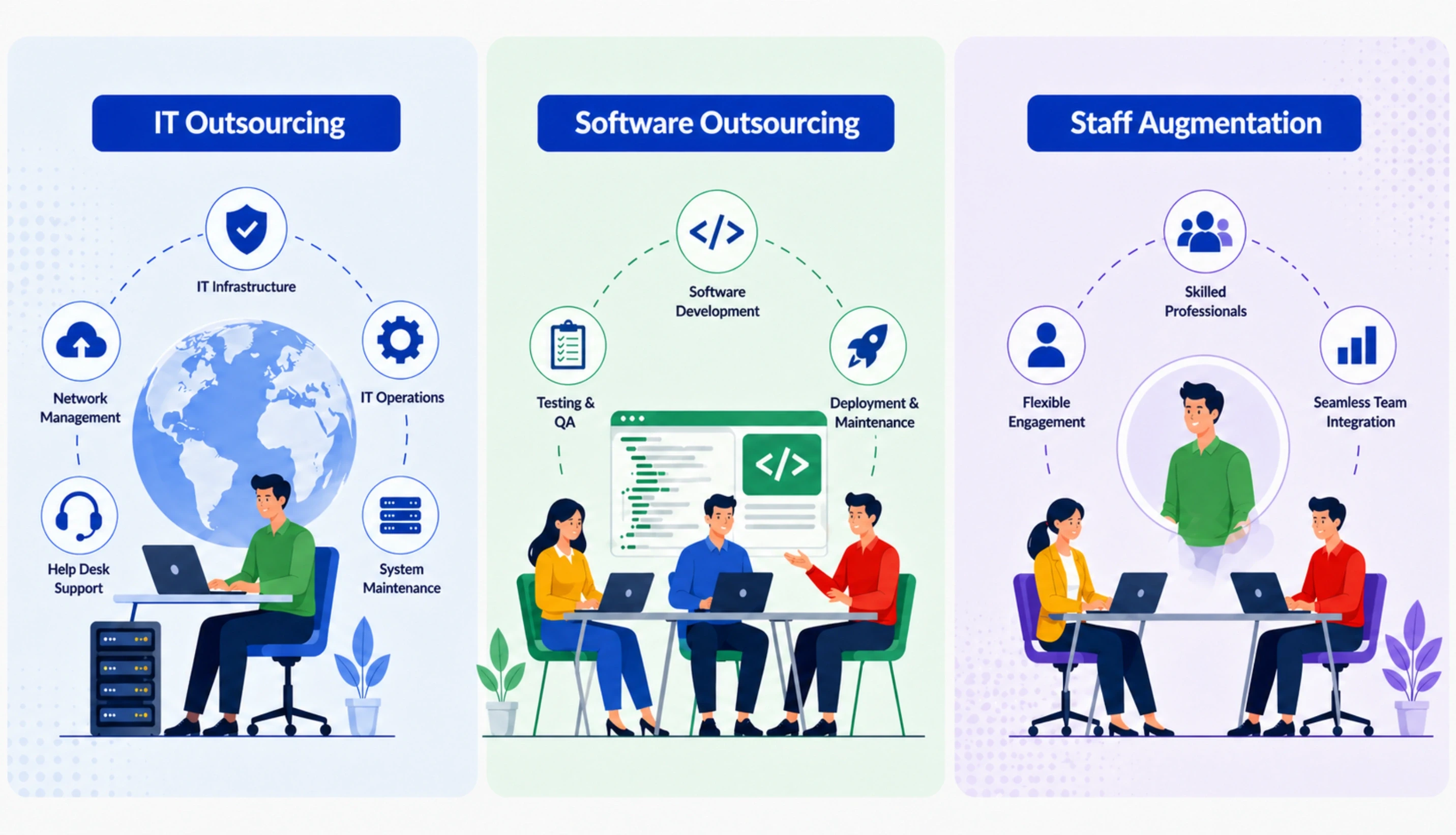
IT Outsourcing vs Software Outsourcing vs Staff Augmentation
IT outsourcing, software outsourcing, and staff augmentation are used interchangeably. They are not the same thing. This plain-English guide explains the difference in under 10 minutes.
Ahmed Ginani
April 29, 2026
Staff Augmentation vs Dedicated Team vs Outsourcing: Which Python Model Is Right for You?
Compare Python staff augmentation, dedicated team, and project outsourcing models. Real 2026 data on cost, control, speed, and IP risk. Find which model fits your project stage.

Acquaint Softtech
April 6, 2026
The Complete Guide to Hiring Python Developers in 2026: Rates, Models, Vetting and Red Flags
A complete guide to hiring Python developers in 2026. Compare real hourly rates across India, Eastern Europe and the US, choose the right engagement model, vet candidates correctly, and avoid the red flags that cost companies months of wasted budget.
Acquaint Softtech
March 4, 2026India (Head Office)
203/204, Shapath-II, Near Silver Leaf Hotel, Opp. Rajpath Club, SG Highway, Ahmedabad-380054, Gujarat
USA
7838 Camino Cielo St, Highland, CA 92346
UK
The Powerhouse, 21 Woodthorpe Road, Ashford, England, TW15 2RP
New Zealand
42 Exler Place, Avondale, Auckland 0600, New Zealand
Canada
141 Skyview Bay NE , Calgary, Alberta, T3N 2K6