

14 Best Tools for iOS Development in 2026
The essential iOS tools in 2026 are Xcode, Swift Package Manager, SwiftUI, Swift Testing, Instruments, Xcode Cloud and TestFlight, with fastlane and Sentry filling the gaps. The urgent item is dependencies: the CocoaPods registry becomes permanently read-only on 2 December 2026, so any app still using pods needs a migration plan to Swift Package Manager. Xcode plugin managers such as Alcatraz stopped working years ago and were replaced by Xcode Extensions.

Mukesh Ram
As the Founder and CEO at Acquaint Softtech, I keep this article around as a reminder of how quickly a tooling list decays. It recommended Alcatraz, an Xcode plugin manager, in 2018, two years after Apple had already removed plugin support from Xcode entirely. It recommended a blog whose author had stopped writing in 2014, and it said so in the entry. That is not carelessness so much as the nature of the category, and it is why our mobile app development teams treat toolchain choices as decisions with expiry dates rather than as settled facts.
There is one item on the list that has become genuinely urgent. CocoaPods, recommended twice in the original, is shutting its registry. On 2 December 2026, the CocoaPods trunk becomes permanently read-only, which is roughly four months from now. Existing apps keep building and existing pods stay downloadable, but no new versions are published after that date, which means no security patches and no compatibility fixes for future Xcode releases. If you ship an iOS app, that date belongs on your roadmap whether or not anyone has raised it yet.

- You have an iOS app that still uses CocoaPods for dependencies.
- You learned iOS with UIKit and storyboards and want to know what changed.
- Your app was rejected at review for something privacy-related.
- You are setting up an iOS project and want the current default stack.
- You are budgeting an iOS build in the US, UK, Europe or Australia.
The article organised fourteen tools into seven categories: editors, language resources, libraries, plugins, video tutorials, ad networks and a miscellaneous group. The categories themselves reveal the era. An entire section was devoted to Xcode plugins, a feature that no longer exists, and another to YouTube channels that have long since stopped publishing.
So this rewrite keeps fourteen tools and replaces the ones that died, leads with the deadline that matters this year, and adds the two things the original never covered: how modern iOS projects are actually tested and shipped, and the privacy requirements that now decide whether your app passes review.
Swap List: What to Replace and How Urgently
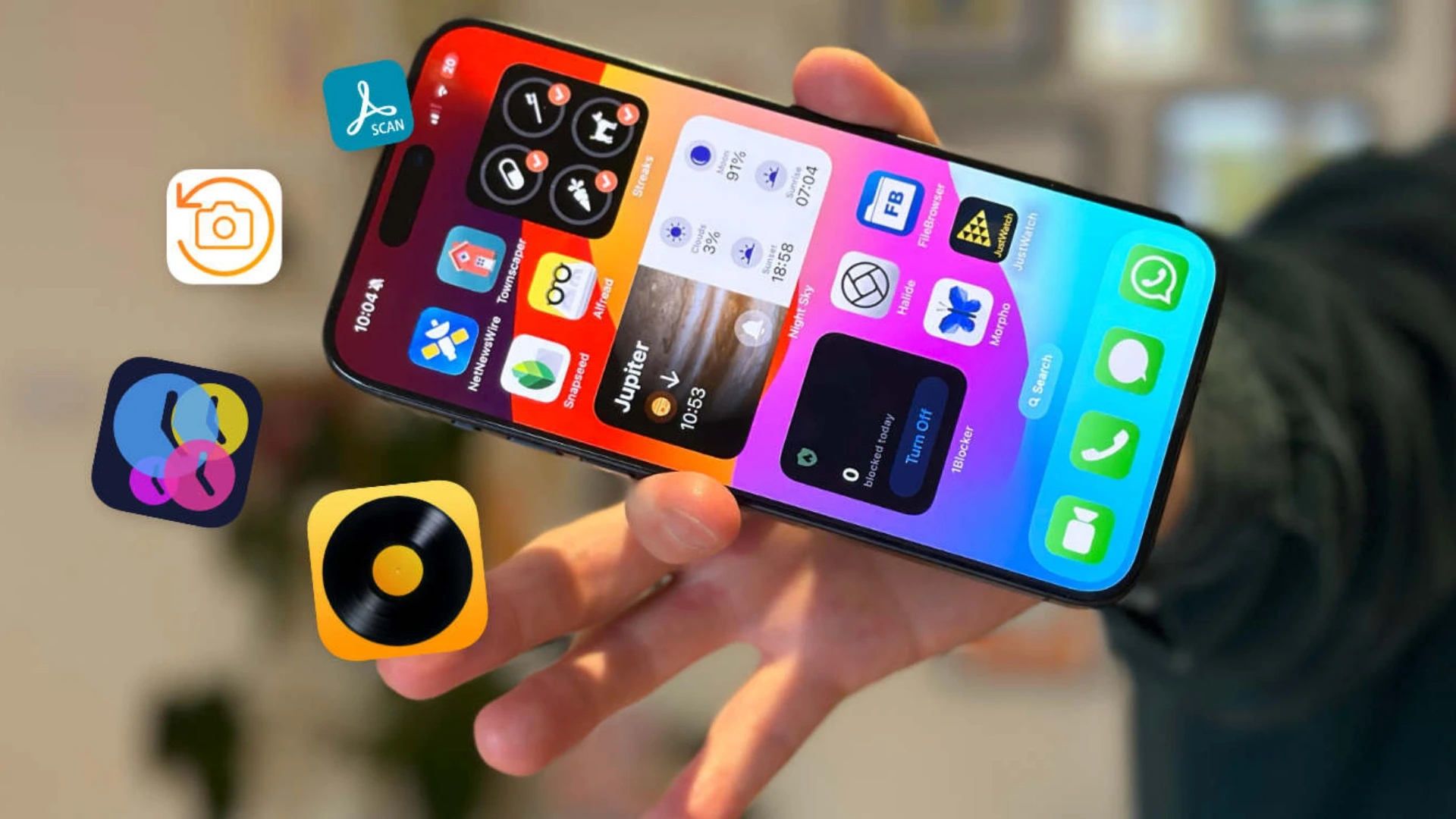
If your project still uses anything in the left column, this table tells you what replaces it and how soon you need to act. Only one row is genuinely time-critical.
If you still use | Replace with | Urgency |
CocoaPods | Swift Package Manager | Urgent, December 2026 |
Xcode plugins or Alcatraz | Xcode Extensions | Already broken, no rush |
Storyboards for new screens | SwiftUI | Plan it, not urgent |
XCTest only | Swift Testing alongside it | Adopt gradually |
Jenkins on a Mac in a cupboard | Xcode Cloud or hosted CI | When it next breaks |
Manual App Store uploads | fastlane or Xcode Cloud | Whenever you have a day |
No crash reporting | Sentry or similar | Do this week |
Objective-C for new code | Swift 6 | New files only, no rewrite |
The bottom row deserves a note, because it is where teams waste the most money. Objective-C code that works does not need rewriting. Swift and Objective-C interoperate comfortably, so the sensible rule is to write new code in Swift and convert old files only when you are already changing them for another reason. Wholesale rewrites of working code rarely survive a cost-benefit conversation, and we say so during discovery workshop services even when the rewrite would be the larger engagement.
The December 2026 CocoaPods Deadline
CocoaPods entered maintenance mode in 2024, and its central registry becomes read-only on 2 December 2026. It powers dependencies in a very large share of existing iOS apps, so this affects native Swift projects, React Native apps and Flutter apps alike.
What actually stops working
Less than people fear, and more than is comfortable. Your app keeps building. Existing pods remain downloadable from the CDN and mirrors. What ends is publication: no new pod versions, no new podspecs, and therefore no security patches or compatibility updates for the libraries you depend on. An app still on CocoaPods in 2027 is an app whose dependencies are frozen, which becomes a problem the first time Apple ships an Xcode release that requires a library change.
Why it is happening
Three reasons, all reasonable. The project has been maintained by volunteers at a scale that stopped being sustainable. Security researchers demonstrated supply-chain weaknesses in the way podspecs could execute arbitrary scripts during installation. And Apple's own Swift Package Manager became the first-class option built directly into Xcode, which removed the reason the community tool existed.
How to plan the migration
Migrate incrementally rather than in one release. Most projects can run both managers side by side, so move the dependencies that already publish a Swift package, leave the stragglers on CocoaPods, and revisit them as they migrate. Start with an inventory: list every pod, check whether it offers a Swift package, and flag any that are unmaintained, because those are the ones that will need replacing rather than moving.
Budget one to three weeks for a typical app and longer where you depend on abandoned libraries. Cross-platform projects have their own timelines, since the React Native and Flutter ecosystems are moving to Swift packages on their own schedules, which is worth checking before you plan a native migration around them.
Still on CocoaPods with four months to go?
Send me your Podfile, and I will list which dependencies already ship Swift packages, which are abandoned, and exactly what the migration takes.
Scorecard: What Happened to the Original 14
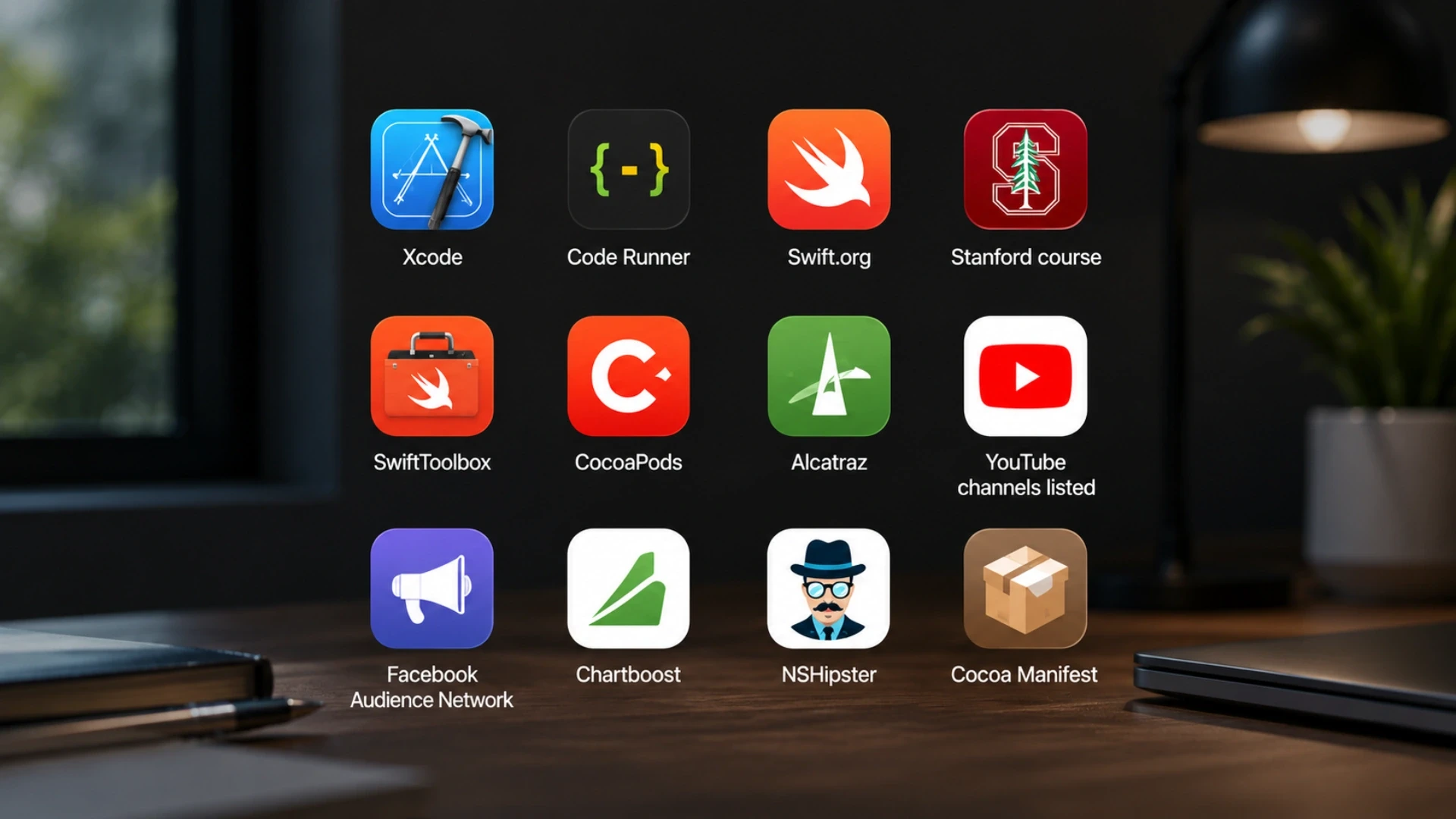
Four of the original fourteen are still current recommendations. Here is the honest state of each, because several are still linked from articles across the web.
2018 tool | Category | Status in 2026 |
Xcode | IDE | Still the only real option |
Code Runner | Editor | Still available and useful |
Swift.org | Language | Still the official source |
Stanford course | Learning | Still excellent, now SwiftUI-based |
SwiftToolbox | Libraries | Defunct |
CocoaPods | Dependencies | Registry read-only from Dec 2026 |
Alcatraz | Plugins | Dead since Xcode 8 removed plugins |
YouTube channels listed | Learning | Long inactive |
Facebook Audience Network | Ads | Active, but ATT changed targeting |
Chartboost | Ads | Active under new ownership |
NSHipster | Reference | Still publishing, still worth reading |
Cocoa Manifest | Reference | Inactive since 2014 |
The plugins category is the clearest lesson. Apple removed third-party plugin support from Xcode for security reasons and replaced it with Xcode Extensions, a sanctioned but far narrower mechanism. Anything built on the old system stopped working at once, and no amount of community effort could bring it back. When a platform owner closes an extension point, tools built on it do not migrate; they end.
The 14 Tools Worth Using in 2026
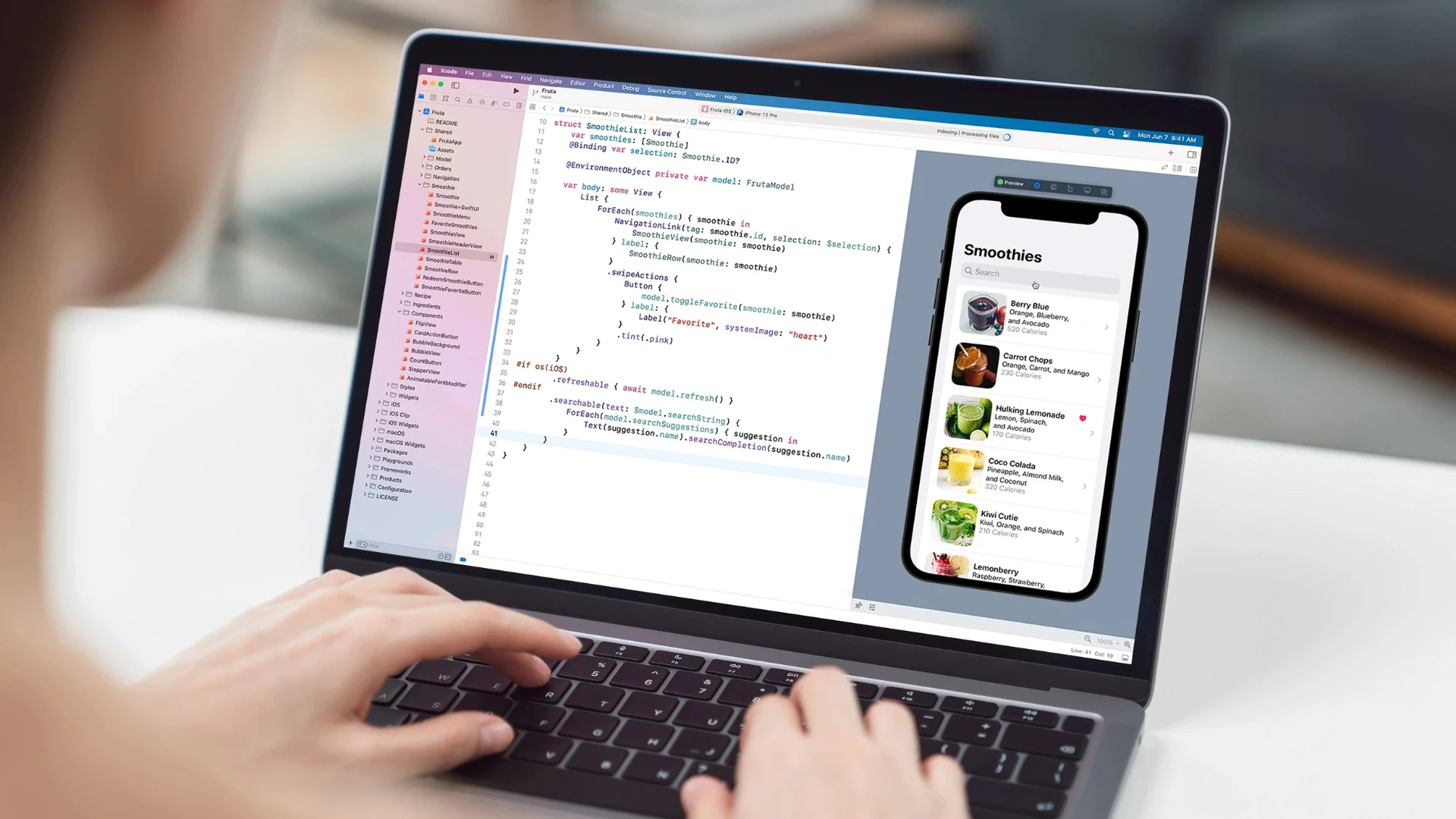
These fourteen cover the full path from writing code to watching it run in production. Ten come from Apple, which is itself the biggest change since 2018.
Building and writing code
Xcode remains the only complete option for building, signing, and submitting iOS apps, and every alternative editor still relies on its toolchain underneath. Swift 6 is the language, with strict concurrency checking that catches data races at compile time rather than in production.
Swift Package Manager is the dependency manager, built into Xcode, requiring no Ruby and no workspace file. Instruments handles profiling for memory, energy, animation, and launch time, and it is consistently the most underused tool on this list.
Interface
SwiftUI is Apple's declarative framework for building interfaces across iPhone, iPad, Mac, Watch, and TV from one codebase, and it is where Apple invests each year. UIKit has not gone anywhere and remains necessary for fine-grained control and for maintaining older apps. The practical position is to build new screens in SwiftUI and keep UIKit where it already works, since the two interoperate in both directions.
Testing
Swift Testing is the modern framework, using ordinary Swift expressions and macros rather than the older assertion style, and it runs alongside XCTest rather than replacing it overnight. XCTest still handles UI testing and remains in every existing project.
The iOS Simulator covers most day-to-day work, though performance, camera and background behaviour still need real devices, which is the point where teams discover their device matrix is a purchase rather than an afterthought.
Shipping
Xcode Cloud is Apple's hosted continuous integration, building and testing on every commit and distributing to TestFlight without you maintaining a build machine. Fastlane automates the parts that remain tedious, particularly signing, screenshots, and metadata, and remains the standard even alongside Xcode Cloud. TestFlight distributes builds to internal and external testers and is the only sanctioned route to beta users. Setting all three up properly is usually a short engagement for whoever you hire DevOps engineers own delivery.
After release
Sentry, or an equivalent crash and performance monitoring service, tells you what broke on which device and build, which is information Apple's own reports give you slowly and incompletely. App Store Connect analytics covers acquisition, retention, and the conversion rate of your store listing, which is the number most teams ignore while optimising the app itself.
If you are also building for Android or considering a shared codebase, the trade-offs are covered in our comparison of React Native development companies, and the decision usually comes down to how much device-specific behaviour your product depends on.
Need iOS engineers who know the current toolchain
Tell me what you are building and I will introduce the specific engineers who would work on it, with their Swift, SwiftUI and App Store experience.
Privacy Rules That Now Gate App Review
Privacy requirements are now the most common reason an otherwise finished iOS app fails review. None of this existed when the original article was written, and it affects your build plan rather than just your legal page.
Privacy manifests and required reason APIs
Apple requires a privacy manifest describing the data your app collects and the reasons it uses certain APIs, and third-party SDKs must supply their own. As set out in Apple's privacy manifest documentation, some commonly used system APIs must be accompanied by an approved reason. In practice, this means auditing every SDK you include, because one unmaintained analytics library without a manifest can hold up your release.
App Tracking Transparency
Tracking users across other companies' apps and websites requires explicit permission through the ATT prompt. Most users decline, which is why advertising attribution changed so dramatically and why the ad networks recommended in the original article now behave differently from how they did in 2018. Plan measurement around aggregated attribution rather than assuming device-level tracking.
Nutrition labels and third-party SDKs
Your App Store listing declares what data you collect and whether it is linked to the user. The declaration must match what your app and its SDKs actually do, and inaccuracies are treated seriously. The practical control is to keep a written inventory of every SDK, what it collects and why, and to review it before each release rather than reconstructing it under review pressure.
Keeping that inventory current is ongoing work rather than a launch task, particularly as SDK versions change, and it is one of the things we fold into support and maintenance services rather than leaving it to be rediscovered each year.
What iOS Development Costs

The same iOS app costs three to five times more to build in New York or Sydney than offshore, for identical scope. These are prevailing market ranges rather than fixed quotes.
Location | Senior iOS rate | Relative cost |
New York, USA | USD 110 to 200 / hour | Highest |
United States (national) | USD 90 to 170 / hour | Very high |
Australia | AUD 110 to 200 / hour | High |
United Kingdom | GBP 65 to 130 / hour | High |
Europe (EU) | EUR 70 to 140 / hour | High |
India (Acquaint Softtech) | USD 25 to 49 / hour | Up to 40% lower |
Project | Typical timeline | Estimated cost (USD) |
Simple app, few screens | 6 to 10 weeks | 18,000 to 45,000 |
Standard app with backend | 3 to 5 months | 45,000 to 120,000 |
Complex app, payments, offline | 5 to 9 months | 120,000 to 320,000 |
CocoaPods to SPM migration | 1 to 3 weeks | 4,000 to 15,000 |
Annual OS compatibility work | 2 to 4 weeks per year | 6,000 to 20,000 |
iOS carries one cost Android does not: Apple ships a major OS release every September, and users adopt it faster than on any other platform. That means compatibility work is an annual certainty rather than a risk, and apps that skip it accumulate visual and behavioural bugs quickly. Budget for it deliberately, alongside the developer programme fee and the device matrix you will need for testing.
For the wider sequence of an app project, our guide to the 10 steps of the mobile app development process covers the stages before code, and for products where the app is one channel among several, our guide to building a mobile app for SaaS starts with the integration questions instead.
Get a real number for your iOS app
Book a free 30-minute call, and I will scope your app, give you a fixed cost and timeline in your own currency, and show you comparable work we have delivered.
Frequently Asked Questions
-
Is CocoaPods being discontinued?
The registry becomes permanently read-only on 2 December 2026. Existing pods stay downloadable, and apps keep building, but no new versions or security patches will be published.
-
What should I use instead of CocoaPods?
Swift Package Manager. It is built into Xcode, needs no Ruby, and adds packages directly to your project without a separate workspace file.
-
How long does a CocoaPods to SPM migration take?
One to three weeks for a typical app. Longer if you depend on unmaintained libraries that have never published a Swift package, since those need replacing rather than moving.
-
Should I learn SwiftUI or UIKit?
SwiftUI for new work, since that is where Apple invests. Learn enough UIKit to maintain existing screens, because the two interoperate and most real codebases contain both.
-
Do Xcode plugins still work?
No. Apple removed third-party plugin support in Xcode 8 for security reasons. Xcode Extensions replaced them, with a much narrower set of capabilities.
-
What tools do I need to start iOS development?
Xcode, a Mac, and an Apple Developer account to ship. Everything else, including Swift Package Manager, SwiftUI, Swift Testing, and Instruments, is already included with Xcode.
-
Why was my iOS app rejected for privacy reasons?
Usually, a missing privacy manifest, an SDK without one, or a nutrition label that does not match what the app collects. Audit every third-party SDK before submitting.
-
How much does it cost to build an iOS app?
A simple app runs about USD 18,000 to 45,000, and a standard app with a backend runs USD 45,000 to 120,000. Complex apps run USD 120,000 to 320,000. Offshore delivery cuts these by up to 40 percent.
-
Do I need to rewrite my Objective-C code in Swift?
No. The two interoperate well. Write new code in Swift and convert older files only when you are already changing them for another reason.
-
What ongoing costs does an iOS app have?
The annual developer programme fee, test devices, and two to four weeks of compatibility work each year because Apple ships a major OS release every September.
I love to make a difference. Thus, I started Acquaint Softtech with the vision of making developers easily accessible and affordable to all. Me and my beloved team have been fulfilling this vision for over 15 years now and will continue to get even bigger and better.
Table of Contents
Get Started with Acquaint Softtech
- 13+ Years Delivering Software Excellence
- 1300+ Projects Delivered With Precision
- Official Laravel & Laravel News Partner
- Official Statamic Partner
Related Blog

Mobile Commerce Development: Native Apps, React Native, and PWAs for E-Commerce
Mobile commerce development is the practice of building shopping experiences for mobile devices through native apps, cross-platform React Native apps, or Progressive Web Apps. Native apps offer the highest performance and retention, React Native delivers both platforms from one codebase at 40 to 60 percent lower cost, and PWAs give app-like speed in the browser with zero install friction.

Manish Patel
June 26, 2026
How much will your web app development cost?
Developing your web application can turn out to be costly. So determine here beforehand how much will it cost and how you can save on your development cost.
Mukesh Ram
November 11, 2022
Rome Was Not Built in a Day: The Journey to Developing a Unicorn SaaS
Building a unicorn SaaS company is a marathon, not a sprint. Just like Rome, great products aren’t built overnight. From refining your MVP to scaling for growth.
Mukesh Ram
September 26, 2024India (Head Office)
203/204, Shapath-II, Near Silver Leaf Hotel, Opp. Rajpath Club, SG Highway, Ahmedabad-380054, Gujarat
USA
7838 Camino Cielo St, Highland, CA 92346
UK
The Powerhouse, 21 Woodthorpe Road, Ashford, England, TW15 2RP
New Zealand
42 Exler Place, Avondale, Auckland 0600, New Zealand
Canada
141 Skyview Bay NE , Calgary, Alberta, T3N 2K6