

Building a Home Healthcare Management Platform: Scheduling, Routing, and Documentation
A home healthcare management platform manages patient care, caregiver scheduling, EVV, documentation, and billing. Development typically costs $80,000–$500,000 depending on features and agency size.

Acquaint Softtech
Home healthcare is one of the fastest-growing segments of US healthcare delivery. By 2026, home health spending will exceed $136.77 billion in the United States alone, driven by an ageing population, lower cost of care compared to institutional settings, and patient preference for receiving care at home. Yet the operational complexity of running a home health agency without purpose-built software has become untenable: schedulers manually matching caregivers to patients across time zones, route planning on spreadsheets, paper visit logs subject to Medicaid audit failure, and billing that lags weeks behind the visits it should reimburse.
The 21st Century Cures Act's Electronic Visit Verification mandate, now enforced in all US states, makes paper-based or manual visit tracking a compliance failure rather than just an operational inefficiency. A home healthcare management platform built for 2026 automates the complete cycle from patient intake through billing, while giving field caregivers an offline-capable mobile tool that works in rural and low-connectivity areas.

- You are building or modernising a home health or home care agency platform.
- You need to understand EVV federal mandates and state-specific compliance before scoping.
- You want to know how GPS route optimisation works in a caregiver scheduling system.
- You need verified cost data before presenting a platform budget to agency leadership.
- You are choosing between a custom build and an off-the-shelf home health platform.
Acquaint Softtech's custom healthcare software development services cover home healthcare platform development from EVV integration and GPS scheduling through OASIS-compliant documentation, caregiver mobile apps, and HIPAA-compliant cloud infrastructure.
This article covers the complete home healthcare management platform: the operational workflow from intake to invoice, caregiver scheduling intelligence, GPS route optimisation, EVV compliance architecture, OASIS-E2 clinical documentation, offline-first mobile design, billing and payroll, HIPAA compliance, tech stack, and verified cost data. For the full healthcare software development context, read the complete guide to Healthcare Software Development. For HIPAA compliance architecture that all home health PHI systems must implement.
The Home Healthcare Market in 2026: Why $130 Billion in Spending Demands Better Software
What is home healthcare management platform in operational terms? It is the digital infrastructure that replaces the combination of scheduling spreadsheets, paper visit logs, phone-call coordination, and manual billing that still runs many home health agencies today.
Why businesses need a home healthcare management platform is both a compliance and financial survival issue: agencies that fail to meet EVV requirements risk Medicaid reimbursement loss, and those lacking OASIS-compliant documentation face Medicare audit penalties, while manual scheduling at scale quickly increases operational costs and reduces margins. To build scalable and compliant systems efficiently, many providers choose to hire MEAN stack developers for robust, scalable healthcare platform development.
Market Metric | Figure | Source |
US home health spending (2026) | $130 billion+ | MedSoftwares, February 2026 |
Home healthcare software market share (clinical management) | 35.2% held by clinical management systems | Future Market Insights, January 2026 |
EVV federal mandate status | Enforced in all US states, condition of Medicaid reimbursement | CMS 21st Century Cures Act compliance, 2026 |
OASIS-E2 effective date | April 1, 2026, mandatory for Medicare-certified agencies | CMS, March 2026 |
Caregiver scheduling optimisation benefit | AI-assisted routing reduces drive time by 15 to 30% | AlayaCare 2026, SoftwareFinder 2026 |
Home healthcare management platform market trends 2026 include AI-predictive scheduling that matches caregivers to patients based on skill, location, and schedule compatibility before the scheduler reviews the assignments; real-time GPS geofencing for EVV that eliminates manual clock-in and clock-out fraud; offline-first mobile apps that work in rural and low-connectivity areas without losing visit data; and integration with remote patient monitoring (RPM) devices that feed vitals data directly into the clinical documentation system.
Benefits of home healthcare management platform extend directly to margin: agencies using automated scheduling and EVV report 15 to 30 percent reduction in caregiver drive time (which is typically uncompensated), 40 percent reduction in billing cycle time (from visit completion to claim submission), and near-elimination of EVV compliance failures that trigger Medicaid audit and recoupment. Acquaint Softtech's AI development services build the intelligent scheduling optimisation layer that produces these outcomes.
The Home Healthcare Platform Workflow: From Intake to Invoice
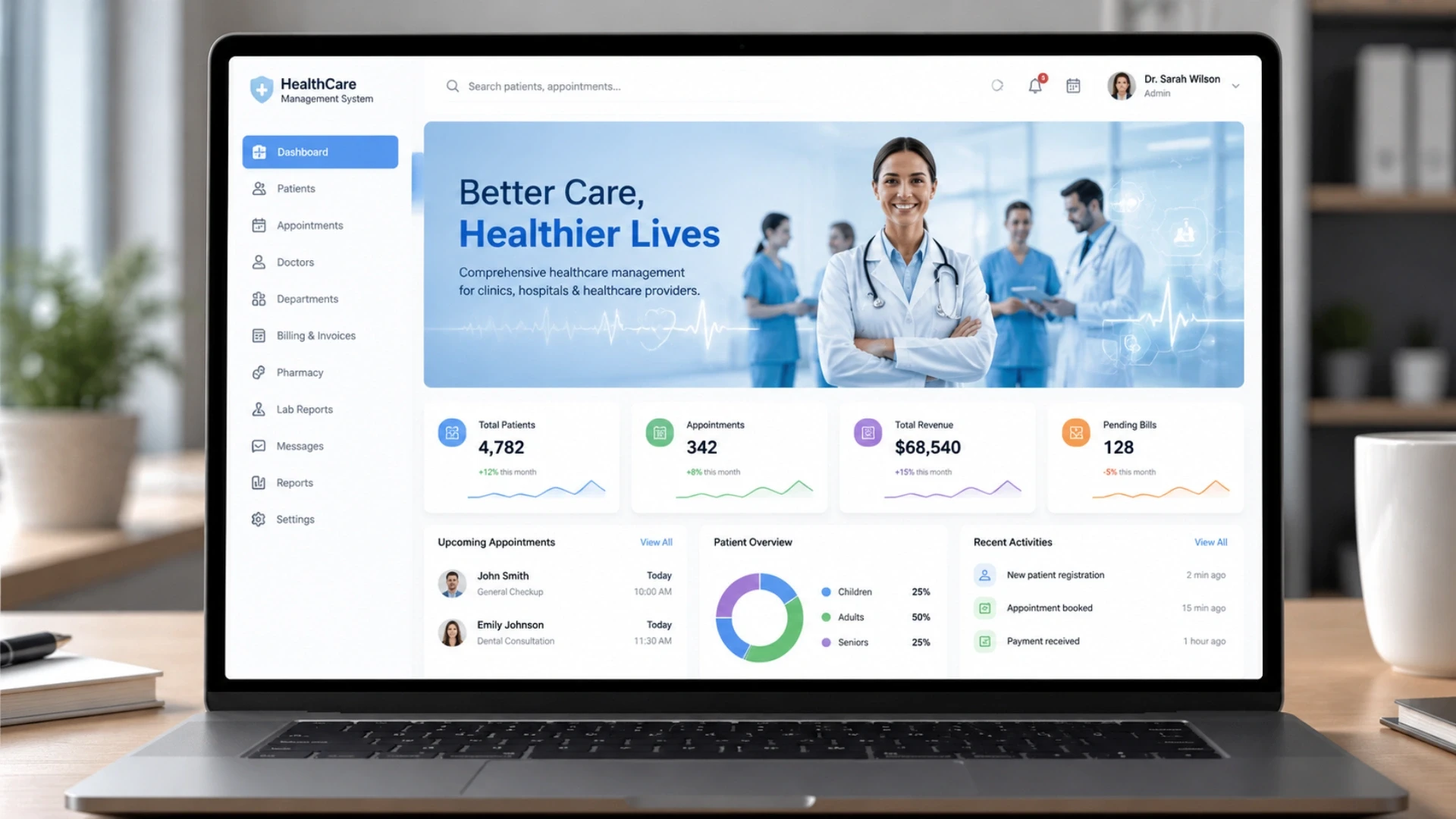
How to build a home healthcare management platform starts with mapping the operational workflow that every home health agency runs, regardless of size. Each platform module exists to support a specific workflow stage. Building modules without a workflow map produces systems with gaps that schedulers fill manually.
The Home Healthcare Operational Workflow: Platform Module Map
Patient Intake and Authorisation: New patient referral received, demographic and insurance data captured, care plan authorisation requested from the payer (Medicare, Medicaid, or commercial insurer). Prior authorisation is verified and visit limits are entered into the system. Without authorisation tracking, agencies authorise more visits than the payer approves and absorb the financial loss.
Initial OASIS Assessment: For Medicare-certified agencies, a registered nurse or physical therapist completes an OASIS-E2 Start of Care assessment in the patient's home, documenting functional status, diagnosis, medication profile, living situation, and care needs. The OASIS data determines the home health episode payment rate under the Patient-Driven Groupings Model (PDGM).
Care Plan Creation: A physician-signed Plan of Care (485 form) is generated from the OASIS assessment data and sent for physician signature. The care plan specifies the disciplines required (skilled nursing, physical therapy, occupational therapy, home health aide), frequency of visits, and duration of the episode.
Caregiver Scheduling: The scheduler assigns caregivers to patient visits based on discipline required, caregiver availability, patient location, caregiver proximity, language and preference matching, and shift length. Optimised scheduling reduces drive time and improves caregiver utilisation across the agency's territory.
GPS Route Optimisation: For agencies managing large caregiver fleets, route optimisation sequences each caregiver's visits for the day to minimise total drive time. Real-time traffic integration adjusts routes for unexpected delays. Turn-by-turn navigation is surfaced in the caregiver mobile app.
Electronic Visit Verification (EVV): The caregiver's mobile app records visit start and end times, patient location (GPS coordinates), caregiver identity, and services delivered, fulfilling the 21st Century Cures Act EVV mandate. EVV data is transmitted to the state Medicaid EVV aggregator in real time or batched at visit end.
Clinical Documentation: The caregiver completes a visit note in the mobile app documenting observations, interventions delivered, medication administration (eMAR), patient response, and any changes to condition. OASIS Resumption of Care and Follow-up assessments are completed at required time points.
Billing and Payroll: Visit data from EVV and documentation feeds directly into the billing engine, generating UB-04 claims (institutional) or CMS-1500 claims (professional) for Medicare, Medicaid, and commercial payers. Caregiver hours from verified EVV records feed directly into payroll calculation, eliminating manual timesheet reconciliation.
Every gap in this workflow is a revenue risk. Missing an OASIS assessment means Medicare cannot calculate the PDGM payment rate. Missing an EVV record means Medicaid cannot reimburse the visit. A documentation gap in a visit note is a compliance finding in a CMS audit. The platform's job is to make it impossible for field staff to complete a visit without completing the required data capture.
The remote patient monitoring covers the RPM device integration architecture that connects with home healthcare platforms, feeding continuous biometric data from patient homes into the clinical documentation system.
Caregiver Scheduling: Intelligence, Matching, and Conflict Resolution
Caregiver scheduling is the operationally most complex module in a home healthcare platform. A home health agency with 200 caregivers and 800 patient visits per day is managing an optimisation problem with thousands of variables: caregiver availability, skill level, language, patient preference, geographic proximity, visit duration, travel time, and care plan authorisation limits.
The scheduling matching dimensions
Discipline and skill matching. A skilled nursing visit must be assigned to a registered nurse or licensed practical nurse. A physical therapy visit must be assigned to a licensed physical therapist. The scheduling engine must enforce these credential requirements and alert when caregivers have upcoming credential expirations before assigning them to visits.
Geographic proximity and territory assignment. Caregivers are typically assigned to a geographic territory. The scheduling engine optimises within territories first, then crosses territory boundaries when no in-territory caregiver is available. Crossing territories adds drive time and cost that the scheduling analytics dashboard should track.
Patient and caregiver preference matching. Some patients request caregivers who speak a specific language, who are of a specific gender, or who have previously cared for them. These preferences must be recorded in the patient profile and surfaced as matching criteria, not ignored in favour of pure scheduling efficiency.
Continuity of care prioritisation. Research consistently confirms that patient outcomes improve when the same caregiver provides repeated visits. The scheduling engine should weight continuity of care in its matching algorithm, not just geographic proximity.
Availability and shift conflict detection. Real-time conflict detection prevents double-booking a caregiver, scheduling a visit when the caregiver has logged unavailability, or extending a caregiver's shift beyond legal duty hour limits.
Acquaint Softtech's software product development team builds the scheduling engine as a configurable rules-based system with an API that the AI optimisation layer queries for constraint-satisfying assignments. The rules layer enforces hard constraints like credential requirements and duty hour limits, while the AI layer optimises for drive time, continuity, and preferences. You can also hire experienced developers for such scalable builds through Hire MERN Stack Developers.
GPS Route Optimisation: Reducing Drive Time and Fuel Costs
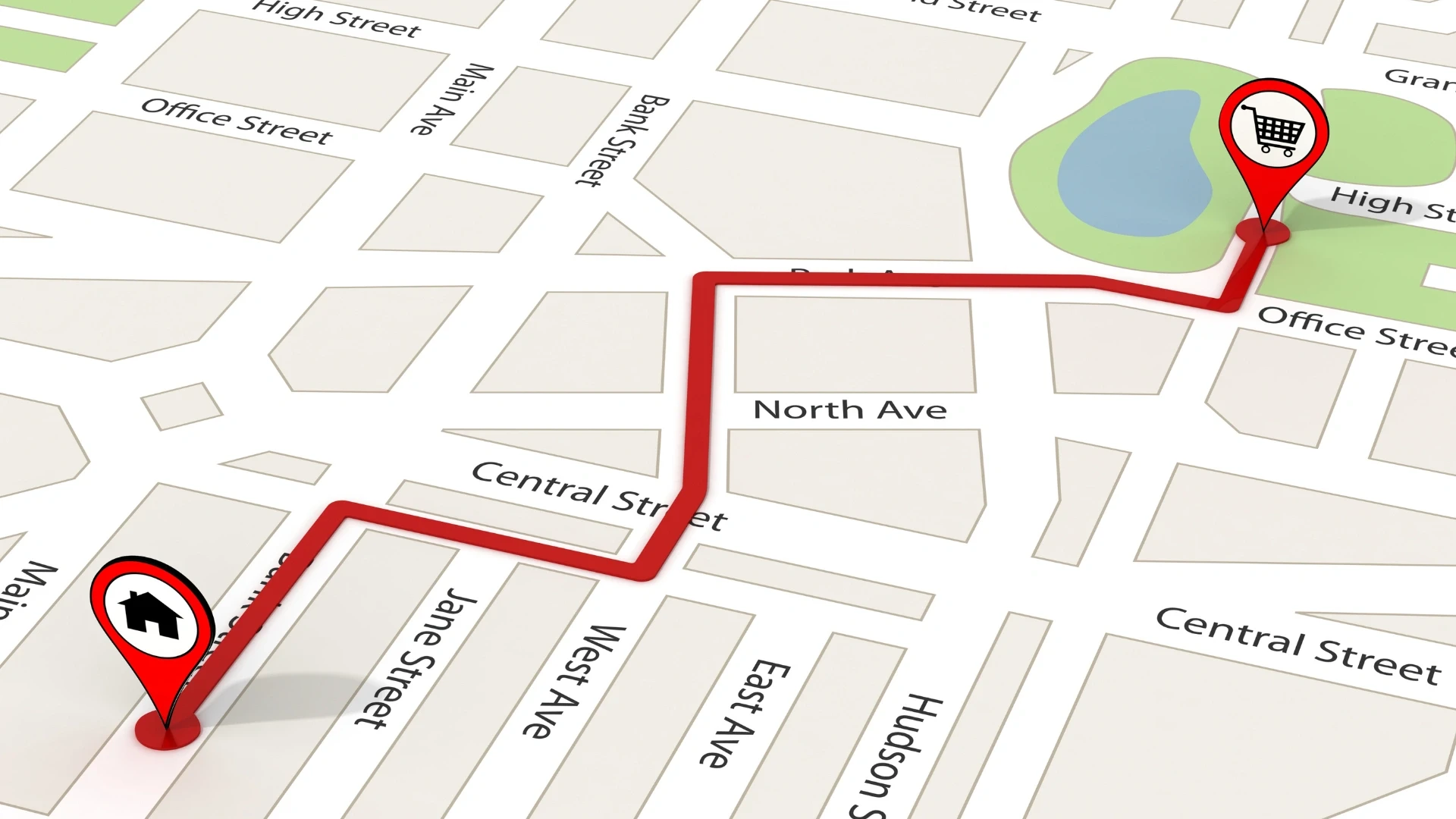
Route optimisation for home healthcare is not the same as standard logistics routing. A food delivery driver completes each stop in minutes. A home health caregiver spends 45 to 90 minutes at each patient's home. The route must be optimised for the total day across all visits, not just the shortest path to the next stop. This is a Vehicle Routing Problem (VRP) variant with time windows, skill constraints, and real-time traffic.
What route optimisation must handle in home health
Time window constraints per patient. Many patients can only receive visits in specific time windows (Mrs Chen can only be visited between 9 and 11 AM; Mr Patel needs his wound care before his afternoon physical therapy session). The route optimisation must satisfy all time windows simultaneously across the caregiver's day.
Multi-caregiver global optimisation. Optimising one caregiver's route in isolation produces a globally suboptimal and locally optimal result. True fleet-level optimisation reassigns visits across caregivers to find the globally optimal assignment.
Real-time re-routing on schedule changes. When a patient cancels, a caregiver calls in sick, or an emergency visit is inserted into the schedule, the route optimisation must recalculate all affected caregiver routes in real time — not as an overnight batch job.
Mileage tracking for payroll and reimbursement. Many agencies reimburse caregivers for business mileage. The GPS tracking that drives route optimisation also produces the mileage logs that feed into payroll. This eliminates manual mileage reporting, a significant source of timesheet disputes.
Acquaint Softtech's React Native developers build the caregiver navigation interface as part of the cross-platform mobile app, integrating Google Maps Platform or HERE for turn-by-turn navigation with embedded mileage tracking. The GPS coordinates captured during routing also serve as the EVV location verification record, eliminating the need for separate EVV location capture at visit start and end.
Electronic Visit Verification (EVV): The Federal Mandate Every Platform Must Meet
Electronic Visit Verification (EVV) is not a platform feature but a federal legal requirement. The 21st Century Cures Act mandates EVV for Medicaid personal care and home health services, and non-compliance can reduce state FMAP funding and block reimbursement for providers. For teams building compliant systems, strategic guidance like Virtual CTO services can help align architecture, compliance workflows, and implementation planning from the start.
What EVV must capture for every visit (21st Century Cures Act requirements)
Type of service performed (matched to the authorised care plan service codes)
Individual who provided the service (caregiver identity — authenticated session in the mobile app)
Individual who received the service (patient identity — confirmed at visit start)
Date of service (calendar date of the visit, not the documentation date)
Location of service delivery (GPS coordinates from the caregiver's mobile device at visit start and end)
Time the service began and ended (visit start time and end time, GPS-timestamped)
State EVV aggregator integration
EVV Aggregator Model | States Using It | Platform Integration Requirement |
State-mandated EVV system (provider model) | States where Medicaid agency runs EVV system | API integration with state-specific EVV portal |
Managed care EVV system | States where Medicaid MCOs manage EVV | Integration with each managed care plan EVV system |
Open model (provider choice) | States allowing any CEVV-compliant system | Any compliant system sending required data to state aggregator |
Telephony backup is not optional for EVV platforms
GPS-based EVV fails when a caregiver's mobile device has no GPS signal, has a dead battery, or the patient refuses to let caregivers use phones during visits. A production EVV system must include telephony backup: a landline or mobile call-in method that captures visit start and end times via IVR when the primary app-based EVV cannot be completed. States accept telephony as a secondary EVV modality. Platforms without telephony backup will have uncompliant visits every day. Source: CareSmartz360 EVV guide 2026, AlayaCare EVV 2026.
Acquaint Softtech's DevOps engineers build the EVV data transmission pipeline to state aggregators using the state-specific API specifications, with Twilio-based telephony IVR as the backup EVV modality. All EVV data is stored in an immutable, timestamped record store that satisfies the HIPAA audit trail requirement and the CMS EVV data retention rules.
Clinical Documentation: OASIS-E2, Visit Notes, and Care Plan Management
Clinical documentation is the regulatory backbone of a Medicare-certified home health agency. Incomplete, inaccurate, or late documentation is the primary trigger for CMS audit findings and Medicare recoupment demands. A home healthcare platform must enforce documentation completion at the point of care, not as a back-office catch-up task.
Visit note documentation for field staff
Structured visit note templates by discipline (skilled nursing, physical therapy, occupational therapy, speech therapy, home health aide, social work). Each template includes the required documentation elements for the discipline.
Medication Administration Record (eMAR) integrated into the visit note, capturing each medication administered, dose, route, time, and caregiver signature.
Vital signs entry integrated with remote patient monitoring device data where available, pulling vitals from connected devices rather than requiring manual entry.
Wound care documentation with photo capability, HIPAA-compliant photo capture within the app, stored encrypted in the patient record.
Exception documentation for care plan deviations: whenever a caregiver cannot complete a planned intervention, the exception must be documented with reason for clinical supervisory review.
The clinical documentation system must support offline completion (Section 7) because many home visit environments have limited or no connectivity. During the documentation module design, Acquaint Softtech’s software product development team works with clinical experts to ensure CMS-compliant data capture, and ongoing improvements are supported through their version upgrade services to keep the system aligned with regulatory and workflow changes.
Offline-First Mobile Architecture: The Engineering Decision That Determines Field Adoption
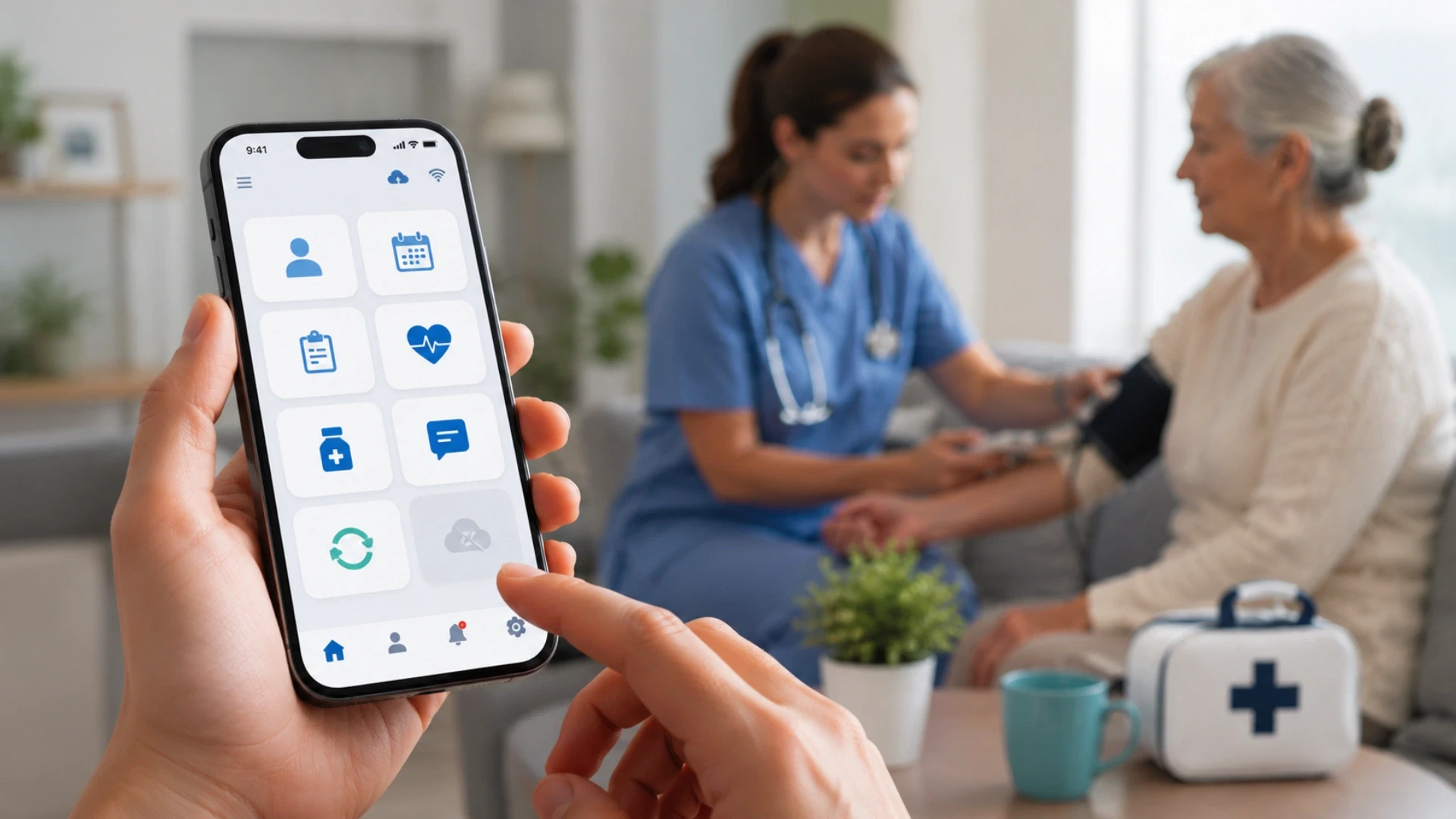
Home healthcare management platform tech stack guide begins with one non-negotiable architectural decision: the caregiver mobile app must work offline. Caregivers visit patients in rural areas, basements, and buildings with poor signal. A platform that requires internet connectivity for every visit note, EVV record, or medication administration will have field adoption failure regardless of how well the rest of the platform is built.
What offline-first means in engineering terms
All clinical forms and care plan data are downloaded to the device before the caregiver's shift starts. A caregiver who loses connectivity mid-shift still has access to all patient information, assessment forms, and medication records.
All data entered during offline periods is stored in a local encrypted database (SQLite or Realm) on the device. The local store is AES-256 encrypted at rest, satisfying HIPAA requirements for PHI stored on mobile devices.
Bidirectional sync runs automatically when connectivity is restored. Conflict resolution logic handles cases where the same patient record was updated by both the field caregiver and the back-office system while the caregiver was offline.
EVV records created offline are queued for transmission when connectivity is restored. The timestamp used for EVV compliance is the device-captured timestamp at the time of the GPS event, not the transmission timestamp. This prevents offline periods from creating EVV time gaps.
GPS coordinates are captured at visit start and end even offline, using the device's native GPS hardware. The coordinates are stored locally and transmitted with the EVV record when connectivity returns.
React Native with WatermelonDB or Realm is a production-ready offline-first stack for home healthcare caregiver apps in 2026, supporting encrypted local storage, conflict resolution, and background sync. Acquaint Softtech has implemented similar architectures for field healthcare apps using WatermelonDB sync systems as part of its white-label software development services, optimized for large-scale offline healthcare data handling.
Billing, Payroll, and Revenue Cycle for Home Health Agencies
Home health billing is one of the most complex reimbursement environments in US healthcare. Medicare home health is reimbursed under the Patient-Driven Groupings Model (PDGM), which calculates a 30-day payment amount from the OASIS assessment data, the primary diagnosis, and the patient's prior care setting. Medicaid home health reimbursement varies by state. Private payer reimbursement varies by contract.
Billing Type | Claim Format | Platform Requirement |
Medicare home health (SN, PT, OT, SLP) | UB-04 (CMS-1450) / 837I | PDGM episode grouping, OASIS-based billing, LUPA tracking |
Medicaid personal care services | State-specific (UB-04 / CMS-1500) | EVV-linked billing, state-specific codes |
Commercial & private payer | CMS-1500 (professional) / UB-04 | Contract rates, prior authorization, visit limits |
Private pay (self-pay) | Proprietary invoice | Fee schedule-based billing, payment portal integration |
Payroll in a home health agency is complex because it is driven by EVV-verified visit data, not fixed schedules. A caregiver who completes 7 visits instead of a scheduled 8 is paid for 7 visits. A caregiver who has travel time between visits may be entitled to mileage reimbursement. The payroll engine must consume EVV records, calculate hours by visit type and pay code, apply overtime rules, and export to the agency's payroll provider.
Acquaint Softtech's Laravel developers build the billing and payroll engines, with PDGM grouping logic for Medicare claims and state-specific Medicaid billing adapters.
HIPAA Compliance Architecture for Home Healthcare Platforms

Home healthcare platforms handle PHI across a larger attack surface than most healthcare applications: clinical documentation created in patients' homes, EVV GPS coordinates that are location PHI, caregiver mobile devices that store offline patient data, and billing data that moves between agency, clearinghouse, and payer. Each surface requires its own HIPAA technical safeguard.
HIPAA technical safeguards by platform surface
Caregiver mobile app: AES-256 encryption of all PHI stored in the local offline database. Remote wipe capability if the device is lost or stolen. Session timeout requiring MFA re-authentication after 15 minutes of inactivity.
Data transmission: TLS 1.3 for all PHI in transit between the mobile app and the backend API, between the backend and the EVV state aggregator, and between the billing engine and the clearinghouse.
Backend database: column-level AES-256 encryption for all PHI fields. Separate encryption keys for clinical documentation, billing data, and EVV location records.
EVV GPS data: GPS coordinates at a patient's home address are PHI under HIPAA. They must be encrypted at rest and in transit, access-controlled to only the users with clinical oversight of the patient, and included in the HIPAA audit log.
Photo documentation (wound care, etc.): photos of patients or patient conditions are PHI. Encrypted upload direct from the mobile app to the encrypted cloud storage (AWS S3 with server-side AES-256). No photo data passes through unencrypted temporary storage.
Role-based access control: schedulers see schedules and caregiver assignments but not clinical documentation. Billing staff see claims and payment data but not clinical notes. Field caregivers see their own assigned patients only, not the agency's full patient roster.
Tamper-evident audit log: every PHI access, every EVV record, every documentation submission, every billing action, logged with timestamp, user ID, IP, action, and outcome, retained for a minimum 6 years.
Acquaint Softtech’s DevOps engineers configure HIPAA-eligible AWS infrastructure for all home health platform builds as a first-sprint deliverable, using Terraform-defined compliance controls that are fully auditable and reproducible. Their engineering teams, including experienced Django specialists available through hire Django developers, ensure secure backend development aligned with healthcare compliance and scalable architecture needs.
Tech Stack for Home Healthcare Management Software in 2026
Home healthcare management platform tech stack guide: the platform stack must support a mobile-first field experience for caregivers, a web-based operations centre for schedulers and clinical supervisors, offline-capable data persistence, EVV state API integrations, and HIPAA-compliant cloud infrastructure.
Layer | Technology | Home Health Reason |
Caregiver mobile app | React Native | Single codebase reduces cost; offline-first + GPS routing |
Offline local database | WatermelonDB + SQLite + AES-256 | Stores care plans, EVV, OASIS data offline with secure sync |
Backend API | Laravel (modular) | Scheduling engine, OASIS validation, RBAC, care workflows |
GPS & routing | Google Maps / HERE API | Route optimization, mileage tracking, real-time navigation |
EVV transmission | State APIs + Twilio IVR backup | CMS-compliant visit verification with fallback for offline scenarios |
OASIS validation | CMS HAVEN / iQIES format | Ensures CMS-compliant clinical assessment submission |
Billing engine | Laravel + 837I / CMS-1500 + clearinghouse | PDGM billing, Medicaid adapters, insurance claim processing |
Database | PostgreSQL + AES-256 | Secure PHI storage with audit trails and compliance |
Cloud infrastructure | AWS HIPAA-eligible services | Secure storage, logging, and scalable healthcare infrastructure |
AlayaCare, one of the leading home care platforms globally, uses a similar architecture with React Native mobile, HIPAA-compliant cloud infrastructure, and built-in EVV compliance. The open-source approach to EVV state integration, building per-state adapters rather than depending on a single EVV vendor, is the architecture that survives the frequent changes in state EVV programme requirements.
Acquaint Softtech's Python developers build the OASIS validation engine and data analytics layer, while the React Native team builds the caregiver field app and the Laravel team builds the backend scheduling and billing API. The full home health platform is delivered as a managed engagement through Acquaint Softtech's software product development service with a dedicated cross-functional team.
Case Study: Verified Healthcare Platform Delivery Experience
Client Type: Healthcare platform with multi-facility, multi-role data management and complex compliance requirements
Highlighted Project: BIANALISI SPA, Italy's largest integrated diagnostics group — cross-facility clinical analytics with role-specific dashboards and European data protection compliance
Relevant Expertise: Multi-role RBAC for field and administrative users, offline-capable mobile field tools, HIPAA-equivalent compliance infrastructure, GPS and location data handling, clinical documentation workflow design
Clutch Rating: 4.9/5 from 50 or more verified reviews — Premier Verified, clutch.co/profile/acquaint-softtech-private
Team: 70 or more in-house engineers across Laravel, React Native, Python, DevOps, and AI/ML disciplines
Three engineering lessons from clinical field platform delivery
Offline-first is not a feature you add later. Field clinical data capture, whether in a patient's home or a remote diagnostic facility, is the primary function of the caregiver app. An app that requires connectivity to complete a visit note will have rejection rates of 40 to 60 percent among field staff from day one. Offline architecture must be the design starting point, not a post-MVP enhancement.
Multi-role access control must be designed before the data model. In a home health platform, a field caregiver, a clinical supervisor, a scheduler, a billing coder, and an administrator all interact with overlapping subsets of the same patient record. Designing RBAC as an afterthought produces a data model that exposes PHI beyond the HIPAA Minimum Necessary standard. The RBAC schema must be designed in the discovery phase, before any database table is defined.
Compliance integration (EVV state APIs, OASIS CMS submission) has no mercy for incomplete implementations. A state EVV aggregator that receives malformed data does not reject individual visits; it rejects the entire agency's submission batch. An OASIS record with a logic violation does not receive a partial Medicare payment - it produces a CMS error that requires correction and resubmission. Compliance integration must be tested against real state and CMS test environments before go-live, not against synthetic mock data.
Home healthcare management platform development company: scoped in 2 weeks.
Acquaint Softtech delivers home health platforms: React Native offline-first caregiver app, EVV state integration (45+ states), GPS scheduling optimisation, OASIS-E2 documentation, PDGM billing, and HIPAA AWS infrastructure. $25 to $49/hour. 50 or more Clutch reviews.
Home Healthcare Management Platform Development Cost in 2026
Home healthcare management platform development cost 2026 ranges from $80,000 for a simple scheduling and documentation tool to $500,000 or more for a full-featured platform with AI scheduling optimisation, multi-state EVV integration, OASIS documentation, PDGM billing, and remote patient monitoring integration. The following data is drawn from Acquaint Softtech's project portfolio and corroborated by ScienceSoft's home health software development cost analysis.
Platform Tier | Scope & Cost | Timeline |
Basic platform | Patient records, scheduling, single-state EVV, HIPAA/GDPR setup ($80K–$180K / €70K–€165K) | 4–8 months |
Mid-tier platform | GPS routing, multi-state EVV, OASIS-E2, eMAR, PDGM billing, payroll integration ($180K–$350K / €165K–€320K) | 8–14 months |
Enterprise platform | AI scheduling, 10+ state EVV, RPM integration, analytics, multi-payer billing, telephony backup ($350K–$500K+ / €320K–€460K+) | 14–24 months |
What home health platform projects consistently underestimate
State EVV integration: each state's EVV aggregator API has its own specification, authentication method, and data format. A platform operating in 10 states needs 10 separate EVV adapter integrations. Each adds $8,000 to $20,000 and 3 to 6 weeks.
OASIS validation logic: OASIS-E2 has hundreds of item-level logic rules that must be validated in the mobile app before submission. Building compliant OASIS validation from CMS item manuals adds 4 to 8 weeks of clinical informatics engineering time.
Telephony EVV backup: Twilio IVR integration for telephony EVV backup adds $10,000 to $25,000 but is non-negotiable for agencies serving rural populations.
PDGM grouping logic: Medicare PDGM calculates 30-day payment rates from a combination of diagnosis, comorbidity, prior care setting, and OASIS functional score. This grouping logic is complex to implement correctly and must be validated against CMS PDGM grouper software before billing any Medicare claims.
Offline sync conflict resolution: building a robust offline sync that handles conflicts correctly (caregiver edits offline while supervisor edits in back office) adds 6 to 10 weeks of engineering and testing time to the mobile development phase.
Outsource home healthcare management platform development India: Acquaint Softtech delivers at $25 to $49 per hour (Clutch-verified), representing 40 percent average cost savings versus US agency rates. Hire developers for home healthcare management platform through the staff augmentation model for flexible team scaling across intensive EVV integration and OASIS validation phases.
Custom home healthcare management software — HIPAA-compliant, EVV-ready, offline-first.
Acquaint Softtech builds home health platforms with offline-first React Native caregiver apps, GPS route optimisation, multi-state EVV integration, OASIS-E2 documentation, PDGM billing, and HIPAA AWS infrastructure. 4.9/5, 50 or more Clutch reviews. Premier Verified. $25 to $49/hour.
Frequently Asked Questions
-
How much does a healthcare app cost?
A healthcare app costs $40,000 to $500,000+ depending on complexity. Basic apps are $40K–$80K, mid-tier $80K–$200K, and enterprise AI apps $250K–$500K+. HIPAA compliance increases cost. Cost varies mainly based on features and integrations.
-
What features does a healthcare app need?
Core features include appointments, patient records, secure chat, video consultation, and prescriptions. Advanced apps add AI, EHR integration, and wearable support. These features improve clinical efficiency and patient engagement.
-
How long does healthcare app development take?
It takes 2 to 14 months. MVP apps take 2–4 months, mid apps 4–8 months, and enterprise apps 8–14+ months with compliance testing. Timelines also depend on integration complexity.
-
What is the best tech stack for healthcare apps?
A common stack includes React Native, Node.js or Laravel, PostgreSQL with AES-256, AWS HIPAA cloud, Twilio for video, and Python for AI. This stack supports scalability and compliance.
-
Do healthcare apps need HIPAA compliance?
Yes, if they handle patient health data (PHI). Even wellness apps follow HIPAA standards to support hospital partnerships and reduce legal risk. Compliance also builds user trust.
-
What are the 4 types of apps?
Native apps are built for iOS/Android separately, web apps run in browsers, hybrid apps combine web and native, and PWAs behave like mobile apps. Each type suits different business needs.
-
What drives healthcare app cost?
Key cost drivers are AI features, EHR integration, HIPAA compliance, video systems, and strong data security requirements. Integration complexity has the biggest impact on cost.
-
How much does AI increase healthcare app cost?
AI healthcare apps cost $150,000 to $500,000+. Advanced predictive or diagnostic AI systems can exceed $1M. Data preparation is often the most expensive part.
-
What types of healthcare apps exist?
Main types include wellness apps, telemedicine apps, clinical apps, and AI healthcare platforms. Clinical apps require stricter regulation. Each type serves a different healthcare use case.
We’re Acquaint Softtech, your technology growth partner. Whether you're building a SaaS product, modernizing enterprise software, or hiring vetted remote developers, we’re built for flexibility and speed. Our official partnerships with Laravel, Statamic, and Bagisto reflect our commitment to excellence, not limitation. We work across stacks, time zones, and industries to bring your tech vision to life.
Table of Contents
Get Started with Acquaint Softtech
- 13+ Years Delivering Software Excellence
- 1300+ Projects Delivered With Precision
- Official Laravel & Laravel News Partner
- Official Statamic Partner
Related Blog
The Complete Guide to Healthcare Software Development in 2026
Healthcare software development in 2026 is not a single discipline. It is six distinct product categories, each with its own compliance perimeter, integration burden, and cost curve.
Acquaint Softtech
May 1, 2026
How Telemedicine Apps Work: Architecture, Data Flow, and System Design Explained
A telemedicine app is not a video call with a medical logo. It is a distributed system that moves protected health information between four environments in under 200 milliseconds while staying inside HIPAA boundaries. Here is exactly how it works, layer by layer, with the tech stack, the data flow, and the numbers that matter.

Manish Patel
May 8, 2026
HIPAA Compliance for Software Developers: The Complete 2026 Checklist
HIPAA is not a security features module you bolt on before launch. It is a pattern of engineering decisions that starts at repository creation and never stops. This checklist is the one Acquaint Softtech applies to every healthcare build: 12 rules, 7 technical safeguards, and the 2026 penalties for ignoring them.

Sanjay Prajapati
May 25, 2026India (Head Office)
203/204, Shapath-II, Near Silver Leaf Hotel, Opp. Rajpath Club, SG Highway, Ahmedabad-380054, Gujarat
USA
7838 Camino Cielo St, Highland, CA 92346
UK
The Powerhouse, 21 Woodthorpe Road, Ashford, England, TW15 2RP
New Zealand
42 Exler Place, Avondale, Auckland 0600, New Zealand
Canada
141 Skyview Bay NE , Calgary, Alberta, T3N 2K6