

Dynamic Pricing for Hotels: Building Revenue Management Systems That Adjust Rates in Real Time
A hotel dynamic pricing revenue management system (RMS) is an automated software tool that adjusts room rates in real time based on current demand, competitor pricing, and market trends. It ingests booking history, live occupancy, events, and weather, uses machine learning to forecast demand, then pushes the ideal rate to every channel through the property management system, all without manual spreadsheets.

Sanjay Prajapati
As Head of Business at Acquaint Softtech, I spend most of my time with founders who already know their room rates are wrong; they just cannot change them fast enough, which is exactly the gap that custom AI development services are built to close. A dynamic pricing revenue management system is the difference between a hotel that reacts to demand a day late and one that captures it in the same hour.
This is a build article, not a software roundup. Most articles on dynamic pricing exist to sell you a subscription. This one explains how the system actually works underneath: the algorithm, the data pipeline, the competitor monitoring, and the rules engine, so a technical team can scope and build one that fits their own inventory and market.

- A hotel or travel founder who wants pricing that moves with the market, not a static rate sheet.
- A CTO scoping a demand-based pricing algorithm, competitor rate monitoring, and PMS integration.
- A product owner mapping the data, forecasting, and rules a real-time rate adjustment engine needs.
- A revenue leader weighing an off-the-shelf tool against a custom hotel RMS build.
- A team deciding whether to build in-house or hire ML engineers for revenue management.
For the wider architecture this sits inside, our complete guide to travel and hospitality software development maps how booking engines, PMS, and pricing systems connect. Dynamic pricing is one layer of that stack, and it is the layer with the most direct line to revenue.
If you want the broader data-science context first, our guide on AI and data analytics in travel covers demand forecasting and price optimization across the whole guest journey. Below, we go deep on the rate engine itself.
What is a hotel dynamic pricing revenue management system?
A hotel dynamic pricing revenue management system is software that sets the right room rate for every date automatically, using live demand signals instead of a fixed price list. Known platforms include RoomPriceGenie, PriceLabs, IDeaS, Duetto, and Cloudbeds.
Under the hood, an RMS joins four parts: a data layer that collects signals, a forecasting model that predicts demand, a decision engine that calculates the optimal rate, and an integration layer that pushes that rate to your booking channels. Off-the-shelf tools bundle these, but they are hard to bend to an unusual room mix, a resort's seasonality, or a group's multi-property logic.
That is the point where teams move to a custom build and often hire Python developers to own the pricing logic end to end. Acquaint Softtech treats the forecasting and rate-decision layer as the core of the product, not a plugin bolted on at the end.
How does hotel dynamic pricing work?

Hotel dynamic pricing works in three stages: it ingests live and historical data, forecasts demand with machine learning, then pushes an updated rate to every channel automatically through the PMS.
How it works
Data ingestion: the system collects historical bookings, current occupancy, local events, weather forecasts, and competitor rates.
Algorithmic forecasting: AI and machine learning models analyze this live data to predict future booking demand.
Automated updates: the software calculates the ideal room rate and pushes it across booking channels via a connection with the property management system (PMS).
Speed is the whole value. A manual team might notice a demand surge the next day; an automated engine reprices within the hour. Building that reliable, low-latency loop is machine-learning work, which is why teams hire AI/ML engineers who have shipped real-time inference systems rather than demo notebooks.
What algorithm powers a revenue management system?
There is no single algorithm. A production RMS layers three: demand forecasting (time-series or gradient-boosted models), price elasticity estimation, and an optimization step that picks the rate maximizing expected revenue within your rules.
Forecasting predicts how many rooms will sell at each price for a future date, using booking pace, seasonality, and events. Elasticity estimates how sensitive demand is to price, so the engine knows whether a small increase will hold or scare bookings away. Optimization then searches for the rate that maximizes occupancy multiplied by rate, bounded by your floors and ceilings.
For a lean team, a gradient-boosted forecasting model on a clean feature store beats a flashy deep-learning approach that no one can debug. Acquaint Softtech builds these in Python, and teams that standardize on that stack often hire Django developers to wrap the models in a stable API and admin layer.
How to build a hotel RMS, step by step

To build a hotel RMS, assemble a data pipeline, a forecasting model, a rules engine, a rate optimizer, and channel integration, then wrap it in a dashboard. Here is the build in six steps.
Build the data pipeline. Ingest bookings, occupancy, competitor rates, events, and weather into one clean feature store the model can read on schedule.
Train the demand forecast. Use historical pickup and pacing to predict demand per room type and date, and retrain as new bookings arrive.
Add the rules engine. Encode rate floors, ceilings, minimum-stay logic, and seasonal or segment rules the algorithm must respect.
Build the rate optimizer. Combine forecast and elasticity to pick the revenue-maximizing rate inside those rules for every date.
Integrate with the PMS and channels. Push approved rates to the PMS, channel manager, and OTAs so pricing stays consistent everywhere.
Ship the dashboard and controls. Give revenue managers overrides, alerts, and reporting on RevPAR, ADR, occupancy, and pickup.
This is a genuine software product development effort, not a weekend script, because the data layer and the integrations are where most builds overrun.
Scoping the model and rules up front is exactly what a product discovery workshop is for. Many groups then hire remote developers to build the pipeline and API while their in-house revenue team owns the pricing strategy.
Worried a custom RMS will overrun on cost and time?
Most pricing builds slip because the data pipeline and PMS integration were underscoped, not because the model was hard. We hand you a fixed scope with milestones, the exact feeds and connectors mapped, and IP that belongs to you from day one. You interview the engineers before you commit.
How to monitor competitor rates
Competitor rate monitoring means continuously collecting rival rates for your compset, normalizing them by room type and date, and feeding them into the pricing model as a signal, not a rule to blindly match.
You collect rates through a rate-shopping data provider or a compliant scraping layer, then align each competitor's room to a comparable of yours so the numbers mean something. The model treats the compset as one input among many; matching a rival blindly ignores that your location, reviews, or amenities may justify a premium.
Because this feed must run on a reliable schedule and never break the pipeline, teams hire automation engineers to keep the collection, retries, and monitoring tested. A competitor rate monitoring feed that silently fails is worse than none, because it prices you on stale data.
Seasonal and event pricing: the rules engine
A seasonal pricing rules engine lets revenue managers set the boundaries the algorithm must respect: peak and shoulder rates, event surcharges, minimum-stay rules, and segment prices, while automation handles the tactics inside them.
The engine is what keeps a self-driving pricing system accountable. It encodes that a bank-holiday weekend never drops below a floor, that a festival date triggers a minimum two-night stay, and that loyalty members keep a consistent member rate regardless of surge.
Well-built, the rules engine is the interface revenue managers actually trust, because they set strategy and let the model move rates within it. Teams that run a JavaScript-heavy admin often hire MEAN stack developers to build that control surface cleanly on top of the Python pricing core.
Key benefits and the RevPAR proof
Dynamic pricing maximizes revenue, saves staff dozens of hours a month, and lifts RevPAR and occupancy. Hotels adopting revenue management software report RevPAR gains commonly cited between 7% and 20%.
Key benefits
Maximizes revenue: raises prices during high-demand surges and lowers them strategically to fill empty rooms in slow periods.
Saves time: eliminates manual spreadsheet tracking and updates, saving staff dozens of hours each month.
Boosts performance: properties using automated pricing frequently report significant increases in RevPAR (revenue per available room) and occupancy.
The numbers back this up. Accor reported an 18.4% RevPAR increase after moving from manual methods to an RMS, and vendors such as Atomize cite up to 35% higher RevPAR and 20 to 30 hours of manual pricing work saved per property per month. A dedicated build makes those gains durable, which is why groups set up a dedicated software development team to own the system past launch.
Hotel RMS tech stack
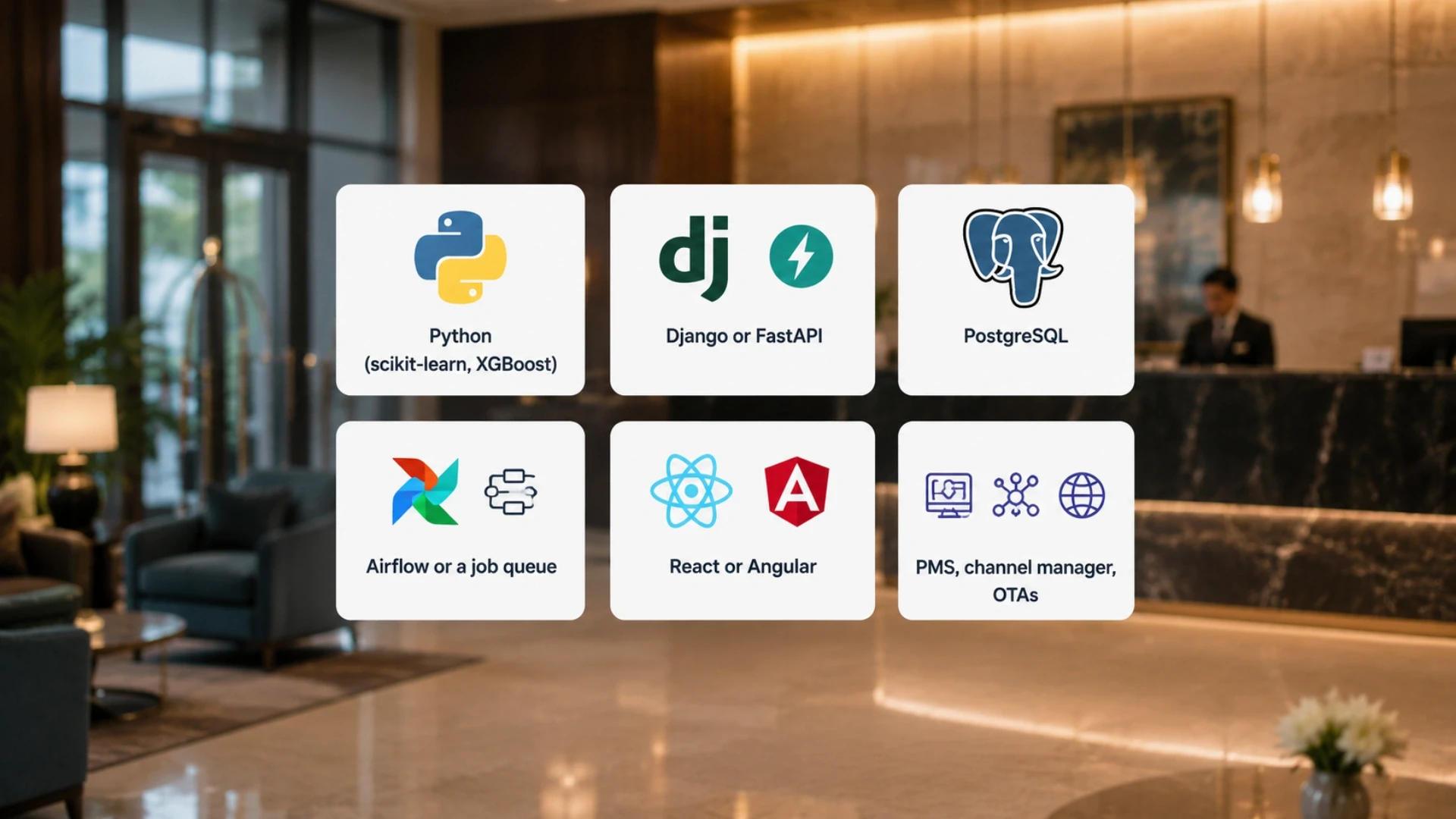
A dependable hotel RMS stack pairs Python for the models with a durable database, a scheduler for the pipeline, and a fast admin front end. Correctness and reliability matter more than novelty.
Layer | Common choice | Why |
Models | Python (scikit-learn, XGBoost) | Forecasting and rate optimization |
Backend / API | Django or FastAPI | Serve rates and rules reliably |
Database | PostgreSQL | Clean feature store and rate history |
Scheduler | Airflow or a job queue | Repeatable data and retrain jobs |
Front end | React or Angular | Revenue-manager dashboard and overrides |
Integration | PMS, channel manager, OTAs | Push rates everywhere at once |
For the dashboard, teams often hire MERN stack developers to build a fast React front end over the pricing API.
Because the pipeline runs on a schedule and must never quietly break, it pays to hire DevOps engineers who set up monitoring, retries, and safe deploys around the model.
Is dynamic pricing worth it for small hotels?
Yes. Dynamic pricing often benefits small and independent hotels the most, because it processes market data a two-person team cannot watch manually. Popular fits include RoomPriceGenie for small independents, PriceLabs for short-term rentals and boutique spaces, and IDeaS for larger hotels.
For a small property, the honest first step is usually an affordable off-the-shelf tool, not a custom build. A custom RMS earns its cost when your room mix, packages, or multi-property logic outgrow what a subscription can express, or when pricing becomes a competitive edge you want to own.
Between those points, many operators use software development outsourcing to build a lean pricing layer on top of tools they already run. Acquaint Softtech often starts small properties here, capturing most of the upside without a full platform.
Is dynamic pricing legal? Compliance and the CMA
Dynamic pricing is legal in the UK and is not illegal in the US, but it is regulated. UK consumer law does not prohibit it; the Competition and Markets Authority (CMA) requires that pricing be transparent and that headline prices be realistic and attainable.
The CMA opened its dynamic pricing project in November 2024 and, in June 2025, published findings confirming the practice can be consistent with fair competition when customers understand it. The concern is hidden or misleading pricing, not real-time rates themselves.
Alongside that, the CMA issued tips for businesses using dynamic pricing under the Digital Markets, Competition and Consumers Act 2024: tell customers prices can change, keep records that explain how the model works, and avoid changing a price mid-checkout. Building that explainability in from the start is a design decision, and a virtual CTO service can set that compliance approach before the first sprint.
Hotel RMS development cost by market

Hotel RMS development cost depends on scope and where your team sits. A pricing MVP with a forecast and one channel is far cheaper than a full platform with elasticity modeling, competitor monitoring, and multi-property rules.
The ranges below are 2026 planning estimates at local agency rates, not fixed quotes. Offshore delivery from India typically lands well below these numbers.
Target market | Pricing MVP | Full custom RMS |
United States / New York | $25,000 to $55,000 | $90,000 to $220,000+ |
United Kingdom | GBP 20,000 to 44,000 | GBP 72,000 to 176,000+ |
Europe (EU) | EUR 23,000 to 50,000 | EUR 82,000 to 200,000+ |
Australia | AUD 38,000 to 82,000 | AUD 135,000 to 330,000+ |
New Zealand | NZD 40,000 to 86,000 | NZD 145,000 to 350,000+ |
The biggest lever is engineering rate, not the feature list, which is why many teams add IT staff augmentation from India to build the same system at a fraction of local cost.
Real case study: a real-time ML decision engine
No two builds are identical, but the closest documented parallel from our own work is Kandy, an e-commerce growth company for which Acquaint Softtech built a Python machine-learning engine that ingests live behavioral data and returns real-time decisions through an API. That is the same architecture a dynamic pricing RMS uses; it optimizes a rate instead of a product recommendation.
| Kandy (Python real-time ML decision engine) |
Client | Kandy, an e-commerce growth company scaling multiple partner brands. |
Issue faced | Needed personalization driven by live user behavior, not static catalog rules, with no analytics infrastructure of its own. |
Challenge | Process live behavioral data at scale and serve real-time decisions without a heavy infrastructure lift, avoiding over-engineered ML that looks good in demos but fails in production. |
How we solved it | Built a Python behavioral data pipeline, an ML similarity and interest model, and real-time recommendation APIs served into store pages and checkout, plus monitoring dashboards, delivered in phases from discovery to rollout. |
How it helped | Brands added personalization without building separate analytics infrastructure, and could test each feature in a controlled environment before wider rollout. |
Result | Higher customer engagement, higher average order value, and more repeat purchases, delivered on schedule across staged releases. |
Why Acquaint Softtech | Chose the right production solution over the flashy demo, combined ML depth with domain awareness, and kept clean, monitored code from day one. |
The relevance is direct: a real-time data pipeline, an ML prediction model, an automated decision served over an API, and a monitoring dashboard are the exact building blocks of a hotel RMS. You can see this and other projects on our case studies page and read verified reviews on our Clutch profile.
Why teams struggle, and what to check before you hire
Most RMS builds do not fail at the model. They fail at the data pipeline and the integrations, where a stale competitor feed or a broken PMS push quietly prices your rooms wrong for days before anyone notices.
Before you commit to a partner for a dynamic pricing build, check for these:
Do they build a reliable data pipeline and feature store, not just a model in a notebook?
Is competitor rate monitoring scheduled, retried, and monitored so it never prices you on stale data?
Does a rules engine give revenue managers floors, ceilings, and overrides?
Do they have verifiable machine-learning and real-time delivery experience?
That last point is where track record matters. Acquaint Softtech has delivered 1,300 or more projects over 13 or more years with 70 or more in-house engineers and 50 or more Clutch reviews, and can deploy vetted developers within 48 hours. After launch, pricing models drift as demand patterns shift, so ongoing support and maintenance services keep the forecasts, feeds, and integrations accurate season to season.
Not sure whether to buy a tool or build your own RMS?
The wrong call here costs either years of subscription fees or a stalled custom build. Share your property size, room mix, and channels, and we will give you a straight read on whether an off-the-shelf tool, a lean pricing layer, or a full custom RMS fits, with the scope and cost to match. No sales pitch, just honest engineering advice.
Frequently Asked Questions
-
How does hotel dynamic pricing work?
It ingests live data such as bookings, occupancy, events, weather, and competitor rates, uses machine learning to forecast demand, then calculates and pushes the ideal room rate across channels through the PMS, automatically and in real time.
-
What algorithm is used for revenue management?
No single one. A production RMS combines demand forecasting (often gradient-boosted or time-series models), price elasticity estimation, and an optimization step that picks the revenue-maximizing rate within your rate floors, ceilings, and rules.
-
How do you monitor competitor rates?
Collect rival rates for your compset through a rate-shopping data feed or a compliant scraping layer, normalize them by room type and date, then feed them into the pricing model as one signal among many rather than a rule to blindly match.
-
Is dynamic pricing worth it for small hotels?
Yes. Small and independent hotels often gain the most, because automated pricing watches market data a tiny team cannot. Most start with an affordable tool like RoomPriceGenie and move to custom only when their room mix or strategy outgrows it.
-
Is dynamic pricing illegal in the UK?
No. UK consumer law does not prohibit dynamic pricing. The CMA requires transparency: customers should know prices can change, headline prices must be realistic, and prices should not change mid-checkout under the Digital Markets, Competition and Consumers Act 2024.
-
What is a CRM for hotels?
A hotel CRM (customer relationship management) system stores guest profiles, booking history, and preferences to personalize marketing and service. It is distinct from an RMS: a CRM manages the guest relationship, while an RMS sets the room rate.
-
What is the best hotel revenue management software?
There is no single best. IDeaS and Duetto suit larger hotels and groups, RoomPriceGenie fits small independents, PriceLabs suits short-term rentals and boutiques, and Cloudbeds or Mews work well when you want pricing inside an existing platform.
-
How is revenue management used in hotels?
Hotels use revenue management to sell the right room to the right guest at the right price and time. An RMS analyzes demand, pace, and competitor rates to adjust prices and stay controls, maximizing RevPAR rather than chasing occupancy alone.
I am Sanjay Parjapati, a developer at heart and a Head of business by work. My journey started with coding and helped me grow towards becoming a head of business which led me to focus on dual skills, i.e. technical know-hows and the business know-hows. My journey of 10+ years has helped me grow immensely from a professional viewpoint.
Table of Contents
Get Started with Acquaint Softtech
- 13+ Years Delivering Software Excellence
- 1300+ Projects Delivered With Precision
- Official Laravel & Laravel News Partner
- Official Statamic Partner
Related Blog
AI and Data Analytics in Travel: Demand Forecasting, Price Optimization, and Customer Intelligence
AI and data analytics in travel use machine learning to turn booking, search, and customer data into revenue. The three core engines are demand forecasting, which predicts future occupancy and bookings; price optimization, which sets the best price in real time based on demand; and customer intelligence, which identifies high-value travellers and predicts who will book or cancel. Hotels using AI-driven pricing report revenue gains of 5 to 14%.

Manish Patel
June 29, 2026
Hotel PMS Development: Front Desk, Housekeeping, and Guest Management in One System
A hotel PMS is not a booking system. It is the operational backbone connecting every department in real time. Here is what it includes, how each module is built, and what it costs in 2026.
Manish Patel
May 20, 2026
How to Build an OTA: Online Travel Agency Architecture for Flight, Hotel & Package Booking
Most OTA builds fail not on the booking logic but on the integration layer. Here is the complete architecture map, GDS, hotel aggregation, package bundling, payments, and what each module actually costs to build in 2026.
Manish Patel
May 27, 2026India (Head Office)
203/204, Shapath-II, Near Silver Leaf Hotel, Opp. Rajpath Club, SG Highway, Ahmedabad-380054, Gujarat
USA
7838 Camino Cielo St, Highland, CA 92346
UK
The Powerhouse, 21 Woodthorpe Road, Ashford, England, TW15 2RP
New Zealand
42 Exler Place, Avondale, Auckland 0600, New Zealand
Canada
141 Skyview Bay NE , Calgary, Alberta, T3N 2K6