

Supply Chain Planning Software: S&OP, Demand Planning, and Inventory Optimization Explained
Supply chain planning software aligns what a business expects to sell with what it can supply, across one connected plan. It works through three linked layers: sales and operations planning (S&OP), which brings sales, finance, and operations to one agreed forecast; demand planning, which predicts future order volume per product; and inventory optimization, which sets the right stock at the right location to hit service targets at the lowest cost.

Manish Patel

- You run S&OP on spreadsheets and email, and the monthly cycle is always late.
- You are scoping a supply chain planning build and need to understand S&OP, demand, and inventory first.
- You operate across the USA, UK, Europe, UAE, or India and need multi-region, multi-currency planning.
- You are deciding between an enterprise suite and a custom planning platform.
- You carry too much of the wrong stock and too little of the right stock.
The warehouse is full, the shelf is empty, and both are losing you money;
Here is the paradox that haunts almost every growing operation. The warehouse is overflowing with stock that will not sell, cash frozen on shelves and slowly going obsolete, while the items customers actually want are out of stock and the orders go to a competitor. Both problems exist at the same time, in the same business, because the plan that should connect demand to supply lives in disconnected spreadsheets that nobody trusts. Closing that gap is exactly what a custom software product development team builds supply chain planning software to do.
Bad planning creates a domino effect: rising freight costs, overflowing warehouses, and empty shelves when customers need products most. While spreadsheets struggle to keep pace, AI-powered supply chain planning turns uncertainty into opportunity with real-time insights, smarter forecasting, and faster decisions that keep businesses agile and competitive.
This article explains how supply chain planning software actually works, through its three core layers: S&OP, demand planning, and inventory optimization. It covers what each does, how they connect, and how to build or buy them, so you can fix the full-warehouse, empty-shelf paradox at its root. It is part of the guide to Logistics and Supply Chain Software Development, drawing on platforms Acquaint Softtech has shipped as an Official Laravel Partner with 1,300+ projects, 70+ in-house engineers, and a 4.9/5 Clutch rating from 50+ verified clients.
What supply chain planning software is

Supply chain planning software is the system that decides what to make, buy, and stock, and when, by aligning forecast demand with available supply across one connected plan. It sits above execution systems and answers the strategic questions: how much will we sell, can we supply it, and what should we hold to meet it profitably.
The distinction that matters is planning versus execution. A warehouse or transport system executes the plan; planning software decides what the plan should be. Disparate tools and spreadsheets fragment that decision across departments, so the single biggest value of a planning platform is one shared model that sales, finance, and operations all trust.
Acquaint Softtech's Python developers build the forecasting and optimization engines at the core of a planning platform. The planning application and collaboration dashboards are built by the software product development team. How the plan flows into transport execution is covered in our article guide on how transportation management systems work.
How S&OP works, step by step

Sales and operations planning (S&OP) works by bringing sales, marketing, finance, and operations to one table on a regular cadence to agree a single plan that balances demand with supply. It replaces aggressive sales quotas and cost-cutting production targets pulling in opposite directions with one number everyone commits to.
The classic process runs in five steps: gather data, build the demand plan, build the supply plan to meet it, reconcile the two against finance, then hold an executive review to approve. The table below summarizes it.
S&OP step | What happens |
1. Data gathering | Pull sales, inventory, and financial data together |
2. Demand planning | Forecast what customers will buy per product |
3. Supply planning | Check capacity, materials, and inventory to meet it |
4. Reconciliation | Balance demand, supply, and the financial plan |
5. Executive review | Leadership approves one agreed operating plan |
Acquaint Softtech's software product development team builds the S&OP workflow, scenario modeling, and approval cadence. The cross-functional dashboards each team uses are built by our MERN stack developers. How AI accelerates the forecasting inside this cycle is covered in our published guide on AI and machine learning in logistics.
How demand planning works and what features matter
Demand planning works by forecasting future customer demand per product using historical sales, then layering on seasonality, promotions, market trends, and sales input to produce a number the whole business can plan against. It is the input that drives every other planning decision, so its accuracy sets the ceiling for the entire plan.
The features that separate a strong demand planning module from a weak one are collaborative input from sales and marketing, statistical and machine learning forecasting, what-if scenario testing, and the ability to model new product launches and phase-outs. Businesses that want to accelerate deployment often leverage white label software development solutions to build and customize these capabilities faster. The best results come from a hybrid approach where machine learning identifies patterns in large datasets, while human judgment manages launches and major strategic shifts.
Acquaint Softtech's developers build the statistical and ML forecasting engine. The collaborative planning interface is built by our stack developers. How forecasts feed inventory inside the warehouse is covered in our article guide on how warehouse management systems work.
Planning on spreadsheets? Build a platform that gives everyone one number.
Acquaint Softtech builds S&OP, demand-planning, and inventory-optimization platforms for clients across the USA, UK, Europe, UAE, and India. Your first dedicated planning engineer deploys within 48 hours of brief.
How inventory optimization decides what to stock

Inventory optimization works by calculating the right stock level and location for every item to hit a target service level at the lowest total cost, balancing the risk of stock-outs against the cost of holding inventory. Businesses often rely on scalable solutions built by dedicated development teams, such as MEAN Stack developers, to create inventory optimization platforms that answer what to stock, where to stock it, and when to replenish for every SKU across every location.
The engine models how inventory responds to changes in demand, lead time, and supplier performance, then sets optimal safety stock and reorder points. Critically, lead time variability should be modeled, not averaged, so the buffer protects against real-world supplier and geopolitical risk rather than an idealized average. This is where the warehouse-full, shelf-empty paradox gets solved.
Acquaint Softtech's Python developers build the inventory optimization and safety-stock algorithms. The multi-location stock dashboards are built by our backend development company team. How optimized targets are executed on the floor is covered in our article guide on how warehouse management systems work.
S&OP vs S&OE vs IBP: the real difference
These three terms are constantly confused, and the confusion shapes what you build. Here is the distinction in plain terms.
Term | What it covers |
S&OP | Monthly to quarterly plan balancing demand and supply |
S&OE | Short-term, real-time execution that keeps the plan on track |
IBP | S&OP extended to tie the plan to financial and strategic goals |
The simplest way to remember it: S&OP sets the medium-term plan, S&OE is the real-time control layer that reacts when a supplier slips next week, and integrated business planning (IBP) links the whole thing to the company's financial budget. The 2026 trend is continuous planning, where software monitors KPIs in real time and flags exceptions instead of waiting for the monthly meeting.
Acquaint Softtech's software product development team builds the continuous, exception-driven planning layer. The real-time alerting infrastructure is built by our DevOps engineers. How real-time exception handling works in execution is covered in our published guide on how fleet management systems work.
How the three layers connect into one plan
S&OP, demand planning, and inventory optimization deliver their value only when connected. Demand planning produces the forecast, inventory optimization turns that forecast into stock targets, and S&OP reconciles both against supply capacity and finance into one agreed plan. Run them separately and they conflict; run them together and they compound.
Optimization-based planning creates a single model of the business, so when you change a demand assumption, the software instantly shows the impact on inventory, capacity, and the financial budget. Many operators now go further with a digital twin of the supply chain to test structural changes, such as a new warehouse or sourcing rule, without real-world risk.
Acquaint Softtech's developers build the unified model that links demand, inventory, and supply. The integration architecture is mapped first through our discovery workshop services, before any build begins. How a connected plan reduces total cost is explained in our article guide on how to reduce software development costs without reducing quality.
How a planning platform connects to ERP, WMS, and TMS
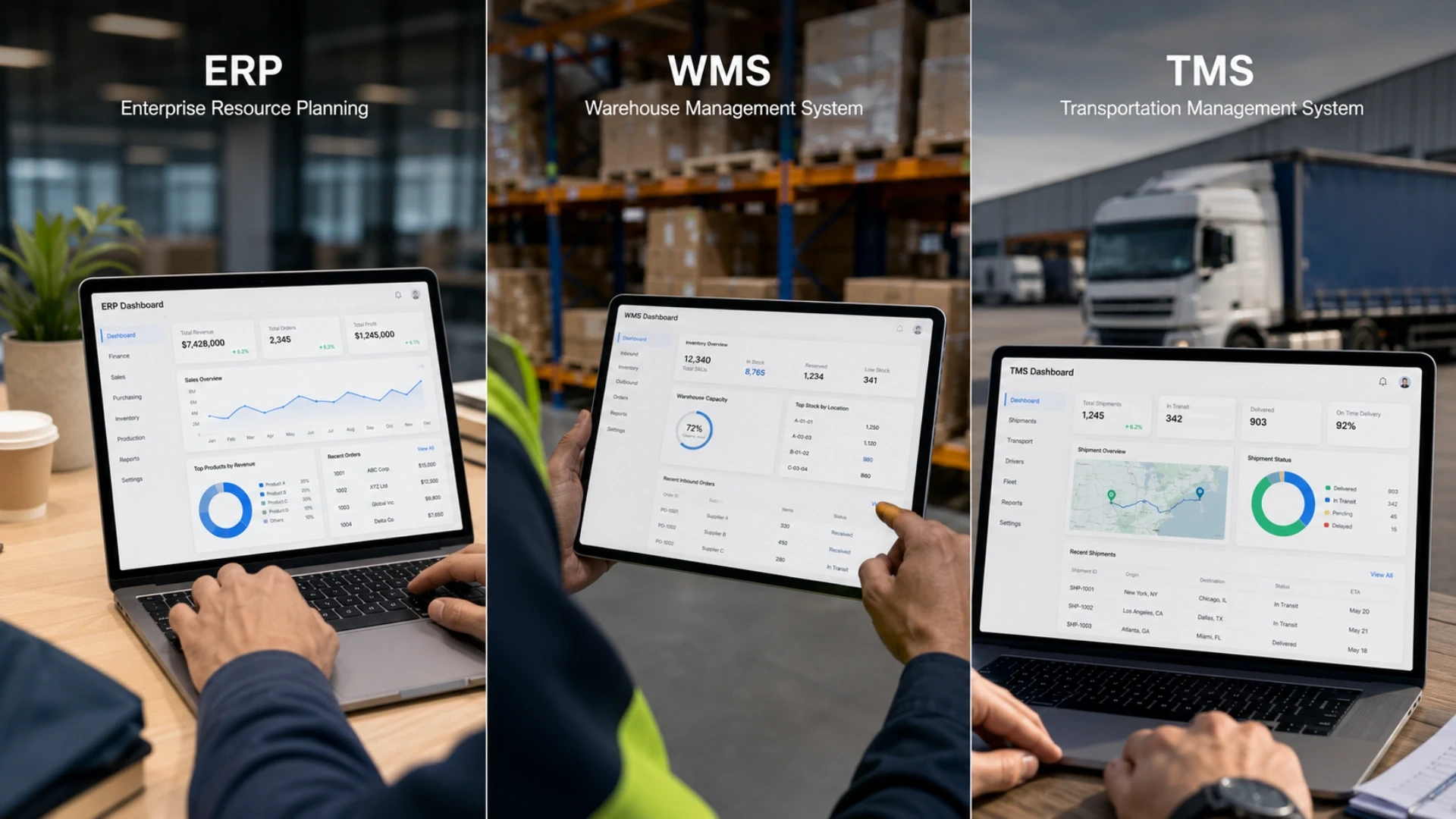
A planning platform is only as good as its data, which means it must connect to the systems that hold that data: the ERP for orders and finance, the WMS for real stock positions, and the TMS for transport cost and lead time. Integration depth is usually the real differentiator, not algorithm cleverness.
The data flow runs both ways: actuals flow up from ERP, WMS, and TMS into the plan, and the agreed plan flows back down as production orders, stock targets, and procurement signals. Fragmented data silos and inconsistent formats are the most common reason planning projects stall, so the integration layer must be designed first.
Acquaint Softtech's Laravel developers build the ERP, WMS, and TMS integrations.
Teams without an in-house function can run the full build through software development outsourcing. How the execution side connects back to the plan is covered in our article guide on how transportation management systems work.
Case study: a multi-country operations platform
The clearest proof of connected planning is a real multi-country build. This engagement, verified on Clutch, shows demand, production, and inventory aligned across four countries in one system instead of disconnected spreadsheets.
Case Study: A 4-Country Production and Inventory Planning Platform
Custom manufacturer aligning demand, production, and stock across a UK factory, US showrooms, a Brooklyn warehouse, and a Poland finishing facility
The Challenge
• Demand, production, and stock planned on disconnected spreadsheets per site
• No single view of what to make, where, or when across four countries
• Custom orders and forecasts lost in email between teams
• Overstock in one location while another ran short on the same item
What Acquaint Softtech Built
→ A single platform aligning custom order demand with production and finishing capacity
→ Centralized product and stock data shared across all four locations
→ Automated handoff of orders and plans between sites, replacing email
→ One view of demand, work in progress, and inventory across the network
Measured Outcomes
One aligned plan
Demand from any showroom flowed straight into production and finishing plans, so every site worked from the same numbers.
Issues caught early
When the Poland facility flagged a finishing issue on a batch, it looped back into the plan immediately, avoiding downstream shortages
"Their ability to translate real manufacturing and planning processes into intuitive digital workflows stood out. We had worked with agencies before who struggled to understand how demand, production, and stock connect across a multi-location operation. Acquaint Softtech picked this up surprisingly well, and delivery milestones were met consistently." - CEO, Custom Manufacturing Company (UK, USA, and EU operations)
Read verified reviews and case studies: acquaintsoft.com/case-studies
What makes this instructive is the single plan: a custom order logged in one country flowed straight into production and finishing capacity in others, and a flagged issue looped back into the plan before it caused a downstream shortage, exactly the S&OP, demand, and inventory linkage from Sections 02 through 06.
Acquaint Softtech's product development team specializes in this kind of multi-site planning platform. For complex multi-region builds, the dedicated software development teams model keeps the same engineers on the platform for the full lifecycle.
Planning across countries? Build one platform that aligns them all.
Acquaint Softtech builds multi-region, multi-currency planning platforms for clients across the USA, UK, Europe, UAE, and India at $25 to $49 per hour, up to 40 percent below Western agency rates, with 95 percent on-time sprint delivery.
Build vs buy, and what custom planning software costs in 2026
Enterprise planning suites like Kinaxis, Blue Yonder, o9, and SAP IBP are powerful but expensive, slow to implement, and force your process into their model. A custom build wins when your planning logic is specific, your data lives in systems the suite cannot easily reach, or licensing for a large user base becomes prohibitive.
Dimension | Enterprise suite | Custom planning platform |
Time to live | 6 to 18 months implementation | 3 to 9 months for a focused build |
Cost model | High annual per-user licensing, forever | One-time build; you own the asset |
Process fit | You adapt to the suite | Built around your exact planning logic |
Best for | Very large, standard enterprises | Mid-market and specific multi-site needs |
On cost: a custom planning platform typically ranges from about $80,000 for a focused demand-and-inventory MVP to $400,000 or more for a full S&OP, demand, and inventory suite with deep integrations, driven by data readiness and integration count. A Clutch-verified India-based team delivers the same engineering quality as a Western agency at up to 40 percent lower cost.
Teams extending an existing system can add a vetted engineer through staff augmentation services within 48 hours. Those starting lean can scope a first module through AI development services focused on demand forecasting. For the regional rate context behind the cost gap, see our article guide on Python development cost by industry.
Join 200+ companies that fixed their planning with Acquaint Softtech.
1,300+ projects. 70+ engineers. 4.9/5 Clutch rating from 50+ verified clients. Clutch Premier Verified. Official Laravel Partner. Your first planning engineer deploys within 48 hours of brief.
Frequently asked questions
-
What is supply chain planning?
Supply chain planning is the process of deciding what to make, buy, and stock, and when, by aligning forecast demand with available supply. Software does this across three linked layers: S&OP, demand planning, and inventory optimization, replacing siloed spreadsheets with one shared plan.
-
How does S&OP work?
S&OP works by bringing sales, finance, and operations together on a regular cadence to agree one plan. It runs in five steps: gather data, build the demand plan, build the supply plan, reconcile them against finance, then hold an executive review to approve a single operating plan.
-
What features matter for demand planning?
The features that matter are collaborative input from sales and marketing, statistical and machine-learning forecasting, what-if scenario testing, and the ability to model new product launches and phase-outs. The strongest setups combine ML pattern detection with human judgment.
-
How much does supply chain planning software cost?
Planning Platform Type
Estimated Cost
Focused MVP
Starting from $80,000
Full S&OP, Demand & Inventory Suite
$400,000+
-
What is the difference between S&OP and S&OE?
S&OP is the medium-term plan balancing demand and supply over months. S&OE is the short-term execution layer that adjusts production, logistics, and inventory in real time to keep that plan on track when something changes next week.
-
What is inventory optimization?
Inventory optimization calculates the right stock level and location for every item to hit a target service level at the lowest total cost. It models demand, lead time, and supplier performance to set optimal safety stock and reorder points, instead of using flat rules.
-
Should I build or buy supply chain planning software?
Buy an enterprise suite if you are a very large, standard enterprise. Build custom if your planning logic is specific, your data lives in systems a suite cannot reach, or per-user licensing is prohibitive. Mid-market and multi-site operators often find custom fits better and costs less long term.
-
How does Acquaint Softtech build planning software?
Acquaint Softtech starts with a discovery workshop mapping data and integrations, then builds the forecasting, inventory, and S&OP layers in 2-week sprints, integrating ERP, WMS, and TMS. The first engineer deploys within 48 hours. Verified 4.9/5 on Clutch.
I lead technology and client success at Acquaint Softtech with one goal in mind. Deliver work that feels personal, reliable, and worthy of long term trust. I stay close to both our clients and our developers to make sure every project moves with clarity, quality, and accountability.
Table of Contents
Get Started with Acquaint Softtech
- 13+ Years Delivering Software Excellence
- 1300+ Projects Delivered With Precision
- Official Laravel & Laravel News Partner
- Official Statamic Partner
Related Blog

The Complete Guide to Logistics & Supply Chain Software Development in 2026
Logistics and supply chain software development in 2026 is not a single discipline. It is six distinct product categories, each with its own integration burden, operational perimeter, and cost curve.

Acquaint Softtech
May 1, 2026
How Warehouse Management Systems Work: Architecture, Modules, and Data Flow Explained
A Warehouse Management System is not a spreadsheet with barcode readers attached. It is a structured operational platform that owns inventory location, pick sequence, worker task allocation, and carrier handoff in one controlled environment.
Manish Patel
May 8, 2026
Transportation Management Systems: Carrier Selection, Rate Shopping & Load Optimization
A Transportation Management System is not a tracking map with extra buttons. It is a structured freight operations platform that owns carrier selection, rate negotiation, load planning, dispatch, and proof-of-delivery capture in one governed workflow.
Manish Patel
May 18, 2026India (Head Office)
203/204, Shapath-II, Near Silver Leaf Hotel, Opp. Rajpath Club, SG Highway, Ahmedabad-380054, Gujarat
USA
7838 Camino Cielo St, Highland, CA 92346
UK
The Powerhouse, 21 Woodthorpe Road, Ashford, England, TW15 2RP
New Zealand
42 Exler Place, Avondale, Auckland 0600, New Zealand
Canada
141 Skyview Bay NE , Calgary, Alberta, T3N 2K6