

Flask vs Django: Which Python Framework Fits Your Project?
Choose Django for full web applications that need users, an admin panel, a database, and strong security out of the box. Choose Flask for small services, APIs, and products where you want to pick every component yourself. Neither is better overall; the right choice depends on scope, team, and how fast you need to ship.

Chirag Daxini
Anyone who has rented a flat in a new city knows the choice. A furnished flat means you arrive with a suitcase and sleep in a proper bed that night. An unfurnished one means more freedom, but the first weeks are spent buying, assembling, and waiting for deliveries. When founders ask me whether to build on Flask or Django, or whether to bring in a Django development company, I usually start with that flat, because it explains the decision better than any benchmark.
So which one should you choose? Django is the furnished flat: authentication, an admin panel, an ORM, migrations, forms, and security protections are ready on day one, which makes it the stronger choice for full web applications, SaaS products, and anything with users and data. Flask is the unfurnished flat: a small, flexible core where you choose every component, which suits APIs, microservices, prototypes and focused tools. Neither is better in general. The right choice depends on what you are building, who will build it, and how long it needs to live.

- You are choosing a Python framework for a new web app, SaaS product or API.
- You want a straight answer to "is Flask better than Django?" for your situation.
- You care about speed, security, hiring, and long-term cost, not just syntax.
- You are a startup deciding how to build an MVP without creating technical debt.
As a Technical Project Manager at Acquaint Softtech, I sit in a lot of early project conversations where this choice is made, often in a single meeting and often for the wrong reason. Teams pick Flask because it feels lighter, then spend months rebuilding things Django would have given them for free. Others pick Django for a tiny service and carry more framework than the job needs. Both mistakes are expensive, and both are avoidable.
This guide compares the two frameworks the way we compare them on real projects: what each one includes, how fast each really is, how they handle security, scale and AI workloads, what they cost to build and hire for, and how to decide in practice. It also includes a real Django build from our own work, so you can see what the framework choice looks like once a product is live.
EXPERT INSIGHT "The framework that feels lightest on day one is not always the lightest in month twelve. Count everything your product will need by launch, then ask which framework already has it." Chirag Daxini, Technical Project Manager, Acquaint Softtech |
Flask vs Django at a Glance
If you only have a minute, this is the comparison that matters most.
Factor | Flask | Django |
Philosophy | Minimal core, add what you need | Batteries included |
Best for | APIs, microservices, prototypes | Full web apps, SaaS, portals |
Admin panel | Not included | Built in |
Database layer | Choose your own | Built-in ORM and migrations |
Authentication | Via extensions | Built in |
Learning curve | Faster to start | More to learn upfront |
Structure | You decide | Clear conventions |
Also weighing FastAPI for an API-first product? Our three-way guide to Django vs FastAPI vs Flask covers that comparison in depth. This article goes deep on the Flask and Django decision specifically.
What Are Flask and Django?
What is Flask?
Flask is a lightweight Python web framework, first released in 2010, built around a small core for routing, request handling, and templates. It deliberately leaves out a database layer, an admin panel, and user management, so developers add exactly the extensions they need, such as SQLAlchemy for databases, Flask-Login for sessions, and Flask-WTF for forms and CSRF protection. The latest release at the time of writing is Flask 3.1.3, published in February 2026, which supports Python 3.9 and newer.
What is Django?
Django is a full-featured Python web framework, open-sourced in 2005, that follows a "batteries included" philosophy. It ships with an ORM, schema migrations, an automatic admin interface, authentication and permissions, forms, caching, internationalisation and strong security defaults.
Django releases on a predictable schedule: Django 6.1 arrived in August 2026, the 6.1.2 security release followed on 6 October 2026, and Django 5.2 is the current long-term support version, with security fixes until April 2028. Django 6.0 and later require Python 3.12 or newer.
Both are mature, open-source, and actively maintained. The difference is not quality. It is how much each framework decides for you.
Furnished or Unfurnished: The Real Difference Between Django and Flask
Go back to the flat. The furnished one is not better because the furniture is beautiful. It is better because you can start living immediately, and because the pieces were chosen to work together. The bed fits the room, the kitchen has pans, and nobody has to coordinate six deliveries. Django works the same way. Its admin, authentication, ORM, and security features were designed together, so they fit together, and a team can spend its first weeks building the product rather than assembling the foundations.
The unfurnished flat has a different appeal, and it is real. You get exactly the desk you want, the room is not crowded with things you will never use, and changing a piece later is easy because nothing was fixed in place. That is Flask. For a focused API, a microservice, or an internal tool, its small core is a genuine advantage: less to learn, less to load, and fewer opinions to work around.
The trouble starts when people choose the empty flat for a family home. A team picks Flask for a full SaaS product because it "feels simpler", then spends weeks choosing and wiring together extensions for users, permissions, admin screens, migrations and forms. Each choice is reasonable.
Together, they become a custom framework the team now has to maintain, document, and teach to every new developer.
The opposite mistake happens too, though less often. A small service that only accepts webhooks and returns JSON does not need an admin panel, a template system and a full ORM. Building it on Django is like renting a fully furnished four-bedroom flat to store a bicycle. So the useful question is never "which framework is better?" It is "how much of the furniture will we actually use?"
Is Flask Better Than Django?
Flask is not better than Django, and Django is not better than Flask. Each is better at a different job. Flask is better when you want a small, explicit codebase and full control over every component. Django is better when your product needs users, roles, data management and security from the start, and when you want a structure every new developer recognises.
A simple test to decide
A simple test helps. List what your product needs by launch. If the list includes user accounts, permissions, an internal admin, relational data with many models and forms, Django will usually get you there faster and with fewer moving parts. If the list is a handful of API endpoints, a background worker and a single data source, Flask will usually feel lighter and clearer.
The first week vs the first year
Where teams go wrong is judging by the first week instead of the first year. Flask almost always wins the first week. Django often wins the year, because the features you will eventually need are already there, documented and secured.
Not sure which framework fits your product?
Share your feature list, team setup, and timeline. Our Python architects will recommend Flask or Django with clear reasons, and tell you honestly if a different option fits better.
Which Is Faster, Flask or Django?
In raw benchmarks, Flask is usually faster than Django because it does less work on each request. In real applications, the difference rarely decides anything. For a typical database-backed product, response time is dominated by database queries, external API calls, caching, and how the code is written, not by the few milliseconds of framework overhead.
Django's extra layers, such as middleware for security and sessions, cost a little time per request but do useful work you would otherwise add yourself in Flask. Once a Flask application has equivalent features for authentication, sessions, CSRF protection, and database access, much of the gap closes.
Both frameworks are traditionally synchronous and run on standard Python web servers. Django supports async views and ASGI deployment, and its ORM offers async query methods. Flask supports async view functions too, but its own documentation notes that its async support is less performant than async-first frameworks. If your product needs very high-concurrency APIs or long-lived connections, that is the moment to consider an async-first framework alongside either of these.
What actually makes a Python web app fast?
• Efficient database queries and the right indexes.
• Caching for repeated reads, at the page, query, or object level.
• Background jobs for slow work such as emails, reports, and AI calls.
• Sensible deployment: enough workers, a good application server and a CDN for static files.
Get those right, and either framework will comfortably serve a large product. Get them wrong, and no framework choice will save you.
Flask vs Django: Feature-by-Feature Comparison
Architecture and structure
Django gives every project the same structure: apps, models, views, templates, and URL configuration, following a model-template-view pattern. Any Django developer can open an unfamiliar project and find their way around quickly. Flask gives you an application object and leaves structure to you, usually organised with blueprints. That flexibility is pleasant for small codebases and risky for large ones, because every team invents its own conventions.
Database and ORM
Django includes its own ORM and a migrations system that tracks every schema change, with support for PostgreSQL, MySQL, MariaDB, SQLite and Oracle. Flask has no database layer; most teams add SQLAlchemy, a very capable ORM, plus Alembic for migrations. SQLAlchemy offers more fine-grained control for complex queries, while Django's ORM is quicker to use and tightly integrated with forms and the admin.
Admin panel
This is Django's most underrated advantage. Register a model, and you get a secure, permission-aware admin interface for viewing and editing data. For many products, that replaces weeks of internal tooling. Flask has admin extensions, but nothing as deeply integrated.
Authentication and security
Django includes user accounts, groups and permissions, secure password hashing, and built-in protection against CSRF, cross-site scripting, SQL injection and clickjacking. Django 6.0 added native Content Security Policy support as well. Flask auto-escapes templates to reduce cross-site scripting, but authentication, CSRF protection, and permissions come from extensions you choose, configure, and keep updated. Both can be secure; Django is secure by default, while Flask is as secure as the choices your team makes.
APIs
Flask is a natural fit for small JSON APIs, with very little code needed to expose endpoints. Django pairs with mature API toolkits that add serialisation, authentication, permissions, pagination, and browsable documentation, which pays off when an API grows to dozens of endpoints with real access rules.
Background work
Django 6.0 introduced a built-in Tasks framework, giving a standard way to define and queue background work, though you still need a worker backend to run tasks in production. Flask has no equivalent built-in; teams typically add a task queue library. Either way, slow work such as emails, reports, and AI calls belongs outside the web request.
Learning curve and ecosystem
A developer can build a working Flask endpoint in minutes, which makes it popular for learning and prototyping. Django takes longer to learn, but the knowledge transfers between projects. Both have large ecosystems; Django's is centred on reusable apps that plug into its structure, while Flask's is a wider set of independent extensions.
Flask or Django for a Startup?
When Django is the better startup choice
For most startups building a product with user accounts, a dashboard, and data, Django is the safer default. It removes weeks of foundational work, enforces a structure that survives team changes, and includes the security a first enterprise customer will ask about. That matters more to a startup than a few milliseconds of response time.
When Flask is the better startup choice
Flask is the better startup choice when the product is genuinely small or API-first: a single-purpose API, a lightweight integration service, a proof of concept to test one idea, or a backend for a mobile app with a narrow feature set. It is also a good fit when the founding team already knows Flask well and has a settled set of extensions.
Choosing for the roadmap, not the demo
The trap is choosing for the demo instead of the roadmap. An MVP that wins customers will need accounts, roles, billing, admin tools, and audit trails within months. Our guide to Python MVP development without technical debt explains how to keep the first version small without painting yourself into a corner.
Timelines follow the same logic. A Django MVP often reaches a usable admin and authentication layer in days rather than weeks. For realistic phase-by-phase estimates, see how long Python web application development takes.
Which Framework Do Large Companies Use?
Large organisations use both. Django is common in content-heavy platforms, marketplaces, data-rich products and internal business systems, where its admin, ORM and conventions keep large teams consistent. Flask is common for microservices, internal tools, API layers and machine-learning model serving, where small, focused services are easier to own and deploy independently. Many larger engineering teams run both: Django for the core application and Flask for smaller services around it.
What matters more than the framework at scale
For a large application, the framework matters less than three things: clear architecture, disciplined testing, and predictable upgrades. Django has an advantage on the last point, with published release schedules and long-term support versions that give enterprises a known window to plan around. Flask is smaller and changes less, but each extension you rely on has its own maintainers and release cycle, which large teams need to track.
Permissions, audits and compliance
If your organisation needs strict permissions, audit trails and compliance controls, Django's built-in authentication, permissions and admin give you a stronger starting point. Flask can meet the same requirements, but you will design more of that layer yourself.
Flask vs Django for AI and Data-Heavy Products
Python is the default language for AI and data work, so both frameworks are common in AI products. The right choice depends on what part of the product the framework is serving.
Matching the framework to the AI workload
Serving a single model or prediction endpoint: Flask is lightweight and quick to wrap around a model, which is why it appears often in data science teams.
Building a full AI product: Django suits products where AI sits inside a larger application with users, permissions, billing, history, and admin tools.
High-concurrency AI APIs: an async-first framework may fit better, often alongside a Django application.
Habits that matter more than the framework
Whatever you choose, keep model calls out of the web request where possible, track usage and cost per user, and log every AI decision for review. Those habits matter far more than the framework.
If AI is central to your roadmap, our AI development services build production AI features in Python, from predictive analytics to automation, with your code, models and data remaining yours.
Cost, Hiring and Team Fit
Where the hidden costs sit
Framework choice affects cost in ways that rarely show up in the first estimate. Flask projects often look cheaper upfront because the framework is smaller, but the team must select, integrate and maintain more components. Django projects carry a steeper learning curve, but they reuse built-in features that would otherwise be custom code.
Hiring is another hidden cost. Django developers share common conventions, so a new developer can be productive in an existing Django codebase quickly. Flask codebases vary much more, because each team makes its own structural choices, which can slow down onboarding.
Published rates for Django and Python developers
Engagement | Price | Best for |
Part-time (up to 4 hrs/day) | From $22/hr | Support and small features |
Full-time dedicated | $3,200/month (176 hrs) | Ongoing product work |
Fixed-scope project | From $5,000 | Clearly defined builds |
These are Acquaint Softtech's published rates. Senior developers can start within 48 hours when you hire Django developers, with a trial period and a clear replacement policy.
For a fuller picture of budgets by project type, see what a Python development project actually costs.
Need Python developers who know both frameworks?
Our in-house Python engineers work across Django and Flask. Share your stack and timeline, and we will send matched developer profiles within 24 hours.
How to Choose: A Practical Decision Guide
Use this table as a starting point. If two rows apply and they point in different ways, the row closest to your long-term roadmap should win.
Decision table
Your situation | Choose | Why |
SaaS product with users and roles | Django | Auth, permissions, admin built in |
Content-heavy site or portal | Django | ORM, admin and templates together |
Small JSON API or webhook service | Flask | Minimal core, quick to ship |
Serving one ML model | Flask | Lightweight wrapper |
Regulated or audit-heavy product | Django | Secure defaults, clear structure |
Team already expert in one | That one | Experience beats theory |
Five questions to ask before you decide
What must the product do by launch, and what will it need within twelve months?
Do you need user accounts, roles, and an internal admin?
How many developers will work on it, and how often will the team change?
What security and compliance questions will your customers ask?
Which framework does your team, or your development partner, know best?
If most answers point to a growing product with users and data, Django is the safer choice. If they point to a small, stable service, Flask will serve you well.
Can You Switch Later?
What a migration involves
Yes, but it is rarely cheap. Moving from Flask to Django usually means rebuilding the data layer around Django's ORM, replacing extension-based authentication, and restructuring the code into Django apps. Moving from Django to Flask is less common and usually happens when teams split a large application into smaller services.
Running both side by side
The more practical pattern is coexistence. Keep a Django application as the core product and add small Flask services where they genuinely help, for example, a lightweight model-serving endpoint or an integration worker. That gives you Django's structure where it matters and Flask's simplicity at the edges.
Before you decide to rewrite
If you suspect you picked the wrong framework, do not rewrite in a hurry. Map the features you are rebuilding by hand, estimate what they cost to maintain, and compare that with a phased migration. Sometimes the right answer is to stay put and tidy the architecture instead.
Case Study: An EdTech Platform Built on Django
Framework choices are easiest to judge once a product is live. One of our builds shows what Django's "furnished flat" looks like in practice. An EdTech platform connecting students and teachers asked Acquaint Softtech to build an interactive, scalable eLearning website.
A team of 5 to 7 professionals, including two Python developers on the backend, invested more than 1,500 hours in the project, built on Python, Django, PostgreSQL, and AWS. Read the full eLearning platform case study.
What the Django build delivered
Product need | What the Django build delivered | Status |
Platform control | Admin dashboard for subscriptions, teachers, and courses | Verified |
User access | Registration plus social login options | Verified |
Live learning | Live video classes that students can join and record | Verified |
Revenue | Online payments and digital certificates | Verified |
What the build shows about framework choice
Look at that list through the flat analogy. Nearly every requirement, from class approval in an admin dashboard to user accounts and course management, maps onto something Django already provides or makes straightforward. The team could spend its effort on the hard, product-specific problems, such as customising live class recording, rather than building admin screens and authentication from scratch.
The case study does not record why Django was chosen over other frameworks, so we will not claim a reason it does not state. What it does show is the outcome: the client received a good response after launch, and the platform helped them gain approval for the funding they were seeking.
How Acquaint Softtech Helps You Choose and Build
Acquaint Softtech has 70+ in-house engineers and more than 1,300 delivered projects. Our Python development services cover web applications, APIs, data and AI work in both Django and Flask, so our recommendation is driven by your product, not by a single framework we happen to prefer.
How we work with your team
In practice, that means we start by mapping what your product needs at launch and in its first year, then recommend the framework, architecture, and team shape to match. Developers can join your team within 48 hours, work in your tools and standups, and stay with the product after launch.
Choosing between Flask and Django is a lot like choosing that first flat. Neither option is wrong; what goes wrong is choosing for the first night instead of the year ahead. Count the furniture you will really need, be honest about who will maintain it, and the right framework usually becomes obvious.
Ready to build on the right Python framework?
Tell us what you are building. In a free 30-minute consultation, our team will recommend Flask or Django, outline the architecture and give you an honest view of timeline and cost.
Frequently Asked Questions
-
Is Flask better than Django?
No framework is better overall. Flask is better for small APIs, microservices, and prototypes. Django is better for full web applications that need users, an admin panel, a database, and built-in security.
-
Which is faster, Flask or Django?
Flask is usually faster in raw benchmarks because it does less per request. In real applications, database queries, caching and code quality matter far more than framework overhead.
-
Which framework do large companies use?
Both. Large organisations commonly use Django for core platforms and data-rich products, and Flask for microservices, internal tools and model-serving APIs.
-
Is Flask or Django better for a startup?
Django is the safer default for startups building products with users and data. Flask suits small, API-first products or proofs of concept.
-
Is Django harder to learn than Flask?
Yes, at first. Flask is quicker to start, while Django has more concepts to learn. Django knowledge transfers well between projects because its structure is consistent.
-
Can I use Flask and Django together?
Yes. Many teams run a Django application as the core product and add small Flask services for focused tasks such as model serving or integrations.
With over 11 years of experience in web application development and project management, I excel in leading cross-functional teams to deliver innovative digital solutions. My expertise spans eCommerce platforms, ERP systems, and JS & PHP-based frameworks, including WordPress, React JS, and Laravel. As a Technical Project Manager, I specialize in strategic planning, system design, and end-to-end project execution, transforming complex ideas into scalable, high-impact applications.
Table of Contents
Get Started with Acquaint Softtech
- 13+ Years Delivering Software Excellence
- 1300+ Projects Delivered With Precision
- Official Laravel & Laravel News Partner
- Official Statamic Partner
RELATED READING
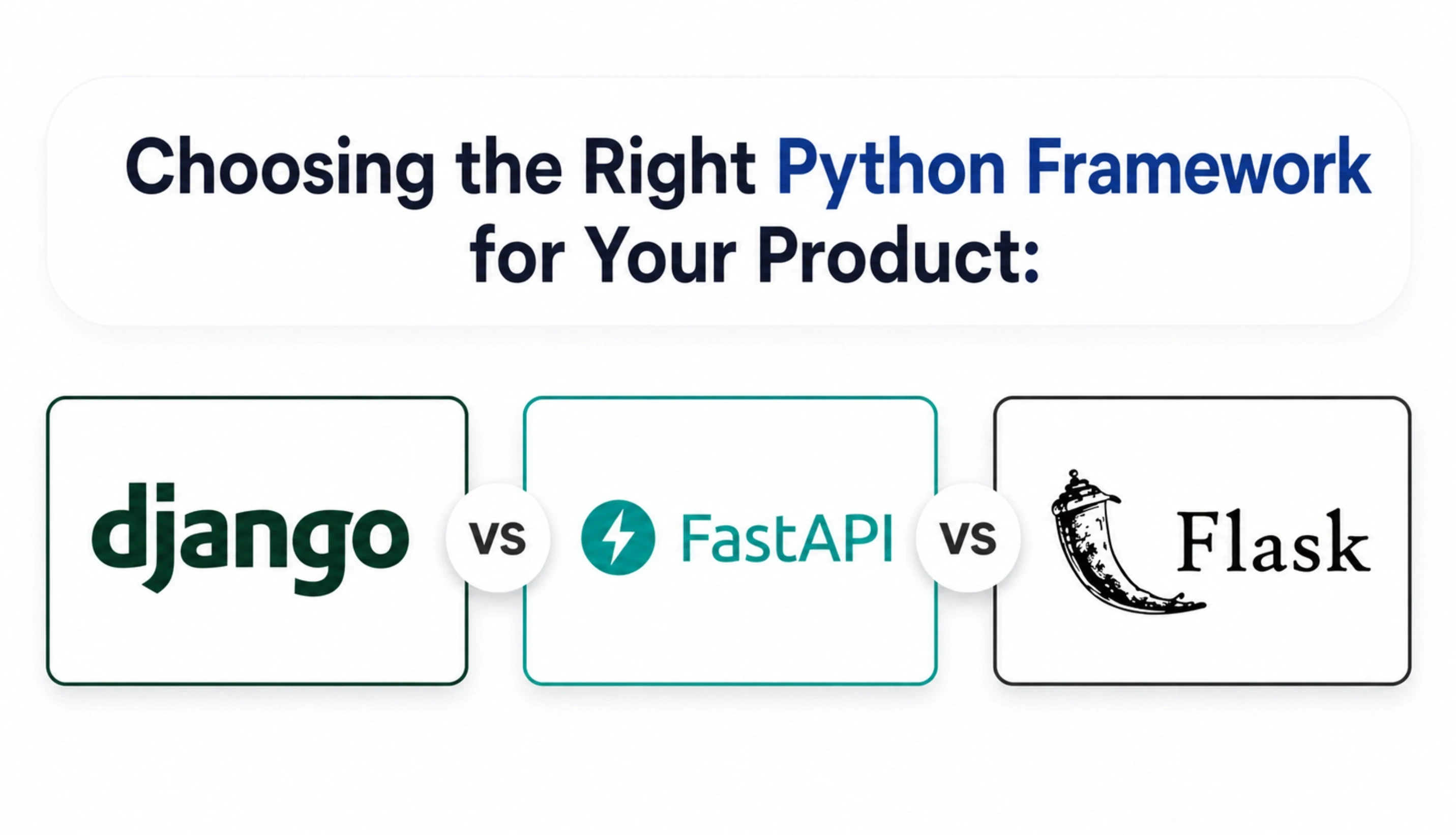
Django vs FastAPI vs Flask: Choosing the Right Python Framework for Your Product
FastAPI hits 20,000 RPS. Django ships admin panels in hours. Flask lets you build exactly what you need. This guide breaks down Django vs FastAPI vs Flask with real 2026 benchmarks, a 15-dimension comparison, and a 12-scenario decision matrix.

Acquaint Softtech
April 28, 2026
Python MVP Development How to Ship Fast Without Building Technical Debt
How to build a Python MVP in 2026 that ships fast without creating the technical debt that traps your V1. Scope, architecture, and engineering practices.
Acquaint Softtech
June 17, 2026
What Does a Python Development Project Actually Cost? A Breakdown by Type
Discover the real cost of a Python development project in 2026, broken down by type. From MVPs and automation to AI/ML platforms. Includes fresh data, expert sources, and Acquaint Softtech pricing starting at $20/hr.
Acquaint Softtech
March 13, 2026India (Head Office)
203/204, Shapath-II, Near Silver Leaf Hotel, Opp. Rajpath Club, SG Highway, Ahmedabad-380054, Gujarat
USA
7838 Camino Cielo St, Highland, CA 92346
UK
The Powerhouse, 21 Woodthorpe Road, Ashford, England, TW15 2RP
New Zealand
42 Exler Place, Avondale, Auckland 0600, New Zealand
Canada
141 Skyview Bay NE , Calgary, Alberta, T3N 2K6