

How Long Does Python Web Application Development Actually Take?
How long does Python web application development actually take in 2026? Real timelines by project type: MVPs, SaaS, enterprise, internal tools, and AI.

Acquaint Softtech
Introduction: The Question Every Founder Asks First
The first question every founder, CTO, and product leader asks a Python development partner is the same one: how long will this actually take. The answers they get from different vendors usually vary by a factor of three, and almost none of them turn out to be accurate. One vendor promises eight weeks. Another quotes six months for what sounds like the same product. The founder picks somewhere in the middle, signs the contract, and discovers two months in that the realistic timeline was always longer than the optimistic quote and shorter than the conservative one, depending on five specific factors nobody asked about during the sales conversation. This blog is the honest answer to the timeline question, broken down by the project types that Python development actually covers in 2026.
The data on software project timelines is sobering. According to a 2026 software development timeline guide by Stratagem Systems, 50 to 70% of software projects miss their original deadlines, and the gap is not because developers are incompetent. It is because initial estimates are unrealistic, scope creeps, requirements change, and unexpected technical challenges emerge mid-build. The same analysis identifies the variables that explain most of the variance: requirements clarity moves timelines by 40 percent in either direction, team experience produces a 2 to 3x speed difference between senior and junior teams, the technology stack contributes 25 to 40 percent variance, and custom design adds 2 to 6 weeks. None of these factors are mysterious. They are just rarely discussed before the contract gets signed.
This guide gives you the realistic Python web application development timeline by project type, with phase breakdowns showing where the time actually goes. It covers MVPs, mid-complexity SaaS platforms, enterprise applications with compliance, internal tools, and AI/ML-integrated applications, with the specific drivers that compress or expand each. It is written for founders, technical co-founders, CTOs, and product managers preparing to commit to a Python build who want a defensible timeline before they sign anything.
If you are also evaluating who should build the project, the complete guide to hiring Python developers in 2026 sets the wider context on engagement models, rates, and the team composition that affects timelines as much as the product complexity does.
Lean Python MVP
The lean MVP is the most common Python web application project type for startups in 2026. It validates a product hypothesis with the smallest feature set that demonstrates the core value proposition. Done right, it ships in 8 to 12 weeks with 3 to 5 core features, basic authentication, a simple admin interface, and one or two third-party integrations.
Phase Breakdown: Lean MVP (8 to 12 weeks total)
Phase | Duration | What Happens |
|---|---|---|
Discovery and scoping | 1 to 2 weeks | Requirements, wireframes, technical decisions |
Design and prototyping | 1 to 2 weeks | UI/UX, user flows, design system |
Core development | 4 to 6 weeks | Backend, frontend, primary user flows |
Testing and refinement | 1 to 2 weeks | QA, bug fixes, performance baseline |
Launch preparation | 1 week | Deployment, monitoring setup, soft launch |
What Compresses Lean MVP Timelines
Pre-validated requirements (saves 1 to 2 weeks of discovery rework)
Component libraries instead of custom design (saves 2 to 3 weeks)
Managed services for auth, payments, email (saves 1 to 2 weeks per service)
Single experienced team that owns design through deployment (saves 1 to 2 weeks of handoff friction)
What Expands Lean MVP Timelines
Scope creep mid-build (adds 2 to 6 weeks)
Custom payment logic instead of Stripe Checkout (adds 2 to 3 weeks)
Real-time features added late (adds 3 to 4 weeks)
Compliance discovered partway through (HIPAA, PCI-DSS, GDPR) — adds 4 to 8 weeks and may push it out of MVP territory entirely
The companion analysis on Python MVP development without building technical debt walks through the scope and architecture discipline that consistently keeps lean MVPs in the 8 to 12 week range without producing the V1 codebase the team has to rewrite a year later.
Mid-Complexity Python SaaS Platform
Mid-complexity SaaS is the second-largest category of Python web application work. It is a multi-tenant platform with subscription billing, user management with roles and permissions, a substantive feature set, and an admin interface that internal team members actually use. Most B2B SaaS products fall here, and most ship in 4 to 6 months with an experienced team.
Phase Breakdown: Mid-Complexity SaaS (4 to 6 months total)
Phase | Duration | What Happens |
|---|---|---|
Discovery and architecture | 3 to 4 weeks | Multi-tenancy design, billing model, integrations |
Design system and core flows | 3 to 4 weeks | Design system, key screens, user research |
Foundation build | 4 to 6 weeks | Auth, multi-tenancy, billing, base infrastructure |
Feature development | 6 to 10 weeks | Core SaaS features in iterative sprints |
Integration and polish | 2 to 3 weeks | Third-party integrations, QA, performance |
Launch and stabilization | 1 to 2 weeks | Deployment, monitoring, early-customer support |
Why SaaS Adds Time Over MVPs
Multi-tenancy must be designed in from day one (4 to 6 weeks of foundation work)
Subscription billing is more than Stripe Checkout; it includes plan management, proration, trials, dunning, and refund flows (2 to 4 weeks)
Role-based access control across multiple user types (1 to 2 weeks)
Admin interface for internal team operations (2 to 3 weeks)
Scalability considerations for the architecture that supports growth (built in during foundation, not retrofitted)
The architectural decisions made during a SaaS build determine whether the platform can scale to thousands of customers or whether it hits a rewrite cycle within 12 months. The framework decisions that affect this directly are covered in the analysis on Python development architecture and frameworks, which walks through when Django is the right choice for SaaS versus when FastAPI or a hybrid approach delivers better long-term outcomes.
Need a Defensible Timeline for Your Python Web App?
Acquaint Softtech delivers Python web applications across MVPs, SaaS platforms, enterprise systems, internal tools, and AI/ML-integrated products, with timeline commitments grounded in the realistic phase-by-phase work each project type actually requires. Senior engineers, 8 to 16 week MVPs from $15,000, transparent pricing from $20/hour.
Enterprise Python Application with Compliance
.webp "Enterprise Python Application with Compliance")
Enterprise Python applications with compliance requirements (HIPAA, PCI-DSS, SOC 2, GDPR) sit at the high end of timeline complexity. These are not just bigger SaaS projects; the compliance architecture, integration with legacy enterprise systems, security hardening, audit trails, and approval cycles fundamentally extend timelines beyond what feature scope alone would suggest. Most run 6 to 12 months, with the longer end driven by compliance certification timelines that no engineering team can compress.
Phase Breakdown: Enterprise Python with Compliance (6 to 12 months total)
Phase | Duration | What Happens |
|---|---|---|
Discovery, compliance, architecture | 6 to 10 weeks | Compliance scoping, security architecture, integration mapping |
Design and approval cycles | 4 to 6 weeks | UX design, security review, stakeholder sign-off |
Foundation with compliance built in | 8 to 12 weeks | Auth, encryption, audit logging, RBAC, infrastructure |
Feature development | 10 to 16 weeks | Core features built within compliance constraints |
Integration with legacy systems | 4 to 8 weeks | ERP, CRM, EHR, or other enterprise system integrations |
Compliance testing and certification | 4 to 8 weeks | Penetration testing, audit prep, certification |
Launch and handover | 2 to 4 weeks | Production deployment, training, knowledge transfer |
What Makes Enterprise Different
Compliance is non-negotiable and architectural. HIPAA, PCI-DSS, SOC 2 cannot be retrofitted cheaply; they must be designed in from the first sprint. This alone adds 20 to 35% to base timeline.
Integration with legacy systems takes longer than greenfield work. Legacy ERP, CRM, or EHR systems have unpredictable APIs, undocumented behaviors, and slow vendor response cycles that compress estimates rarely survive.
Stakeholder approval cycles consume real time. Security review, legal review, procurement approval, and executive sign-off can add 4 to 8 weeks across the project lifecycle.
Certification timelines are mostly outside engineering control. SOC 2 Type II takes 6 to 12 months to complete the audit period. HIPAA audits run their own schedules. Build the timeline assuming certification is parallel work, not blocking.
The scalability and architecture patterns that distinguish enterprise Python applications that hold up under production load are covered in detail in the analysis on how to build a scalable Python backend that handles 100,000 users, which walks through the foundation decisions that enterprise applications need from week one.
Internal Tool or Dashboard
Internal Python tools (operations dashboards, internal admin interfaces, data visualization platforms, custom workflow tools) are the fastest category to ship because they bypass much of the polish, security, and UX work that customer-facing applications require. They are not customer-facing, so they do not need pixel-perfect design or pristine error handling. They just need to work reliably for a known audience of internal users.
Phase Breakdown: Internal Tool / Dashboard (4 to 10 weeks total)
Phase | Duration | What Happens |
|---|---|---|
Discovery and scoping | 3 to 5 days | Requirements gathering, stakeholder interviews |
Design (often minimal) | 3 to 5 days | Wireframes, basic UI using Django admin or Streamlit |
Core development | 2 to 6 weeks | Backend, data connections, primary workflows |
Iteration with users | 1 to 2 weeks | Real users provide feedback, quick adjustments |
Deployment and handover | 3 to 5 days | Production setup, documentation, training |
What Keeps Internal Tools Fast
Django admin or similar low-code admin interfaces eliminate weeks of UI work
No external compliance requirements (most cases)
Direct user feedback loop with internal team accelerates iteration
Pragmatic 'works well enough' standard rather than customer-facing polish
When Internal Tools Take Longer
Heavy data integrations from multiple legacy sources (adds 2 to 4 weeks)
Complex business logic that requires extensive validation (adds 2 to 3 weeks)
Real-time updates or streaming data (adds 2 to 4 weeks)
Custom visualizations beyond standard dashboard widgets (adds 1 to 3 weeks)
The cost breakdown across project types, including how internal tools compare to other Python project categories, is covered in the analysis on what a Python development project actually costs by type, which complements this timeline view with detailed pricing context.
AI/ML-Integrated Python Application

AI and ML-integrated Python applications are the fastest-growing category in 2026, and they have their own timeline rhythm. The added complexity is not just model training; it is the data pipeline that feeds the model, the serving infrastructure that exposes it as an API, the monitoring that catches degradation, and the user experience that surfaces AI capabilities in ways users can actually use. Most ship in 4 to 8 months, with the longer end driven by training data quality issues rather than engineering complexity.
Phase Breakdown: AI/ML-Integrated Python App (4 to 8 months total)
Phase | Duration | What Happens |
|---|---|---|
Discovery, data audit, ML scoping | 3 to 5 weeks | Use case validation, data quality, model selection |
Data pipeline build | 3 to 6 weeks | ETL, cleaning, training data preparation |
Model development and training | 4 to 8 weeks | Model selection, training, evaluation, iteration |
Web application foundation | 4 to 6 weeks | Auth, UI, core flows alongside model work |
ML serving infrastructure | 2 to 4 weeks | FastAPI endpoints, model versioning, deployment |
Integration and UX | 3 to 5 weeks | Embedding AI into the user experience |
Monitoring, testing, launch | 2 to 4 weeks | Model drift monitoring, A/B testing, deployment |
Why AI/ML Adds Time
Data quality is the long pole. Poor or insufficient training data extends timelines unpredictably. Many AI projects that look like 4-month builds become 8-month builds because the data needs serious cleaning and augmentation work.
Model iteration cycles are slower than feature iteration. Each model retraining round can take days, not hours. Plan for 3 to 5 iteration cycles minimum to reach production-acceptable accuracy.
Serving infrastructure is its own engineering category. Production ML serving (FastAPI endpoints with PyTorch or TensorFlow, model versioning, A/B testing infrastructure) takes meaningful additional time over standard web app deployment.
Integrating LLM APIs (OpenAI, Anthropic) is faster than training custom models. If your AI use case can be served by Claude, GPT-4, or similar APIs, your timeline compresses by 4 to 6 weeks compared to custom model development. This is the most common 2026 acceleration pattern.
What Actually Compresses or Expands Your Python Timeline
Across all five project types, the same forces compress or expand timelines. According to a 2026 web application development cost estimation guide by Bricks Tech, the Cone of Uncertainty principle quantifies why timeline estimates vary so wildly: at the idea stage, estimates can be up to 400% off, while estimates after the design phase narrow to 10 to 25% accuracy. The discovery phase is the single biggest variance reducer in any Python web application project, which is why partners who skip discovery to look cheap or fast almost always deliver projects that exceed their original timeline by 30 to 50%. The 1 to 4 week discovery investment is the cheapest insurance you can buy against a 6 to 16 week timeline overrun.
The 5 Things That Compress Python Timelines
Invest in discovery. A documented scope before development starts eliminates the rework that consumes 30 to 50% of sprint capacity in unscoped projects. Spend 1 to 4 weeks on discovery to save 4 to 12 weeks of rework downstream.
Use managed services aggressively. Stripe for payments, Auth0 or Clerk for auth, SendGrid for email, PostHog for analytics. Every managed service replaces 1 to 2 weeks of engineering work that does not differentiate your product.
Senior-led team beats junior-heavy team on total timeline. Senior Python engineers are 2 to 3 times faster on the same work, with better architecture and fewer bugs to fix. A senior-led team at higher per-hour rates ships in less total cost than a junior-heavy team at lower rates.
Decision-making within 24 to 48 hours on the client side. Slow decisions cause 25% of all project delays in industry post-mortems. Designate a single decision-maker on the client side who can resolve open questions same-day during the build.
Lock scope at the sprint boundary, not within the sprint. Scope changes mid-sprint create rework that compounds. Save change requests for sprint planning so they get prioritized into future sprints rather than disrupting current work.
The 5 Things That Expand Python Timelines
No discovery phase. Teams skipping discovery spend 30 to 50% more on rework during development, which translates to roughly the same percentage timeline expansion.
Compliance discovered partway through. HIPAA, PCI-DSS, GDPR, or SOC 2 requirements surfaced after foundation is built require retrofitting that costs 2 to 3x what designed-in compliance would have. This consistently adds 4 to 8 weeks.
Custom design instead of component libraries. Custom design adds 3 to 4 weeks compared to component-library or template-based approaches. For an MVP, this can be the difference between 8 weeks and 12 weeks.
Real-time features added late. Real-time chat, live updates, presence indicators, or collaborative editing each add 3 to 4 weeks. Adding them mid-build is significantly more expensive than building them in from the start.
Slow stakeholder decisions or sign-off cycles. If every product decision takes a week of stakeholder review, the project will run 30 to 50% longer than its baseline timeline regardless of how fast the engineering team can move.
The cost implications of these timeline drivers are documented in the analysis on the minimum budget required to start a Python development project, which shows how the discovery investment that compresses timelines also reduces total project cost by eliminating the rework that quietly consumes most over-budget engagements.
How Acquaint Softtech Delivers Python Web Apps to Timeline
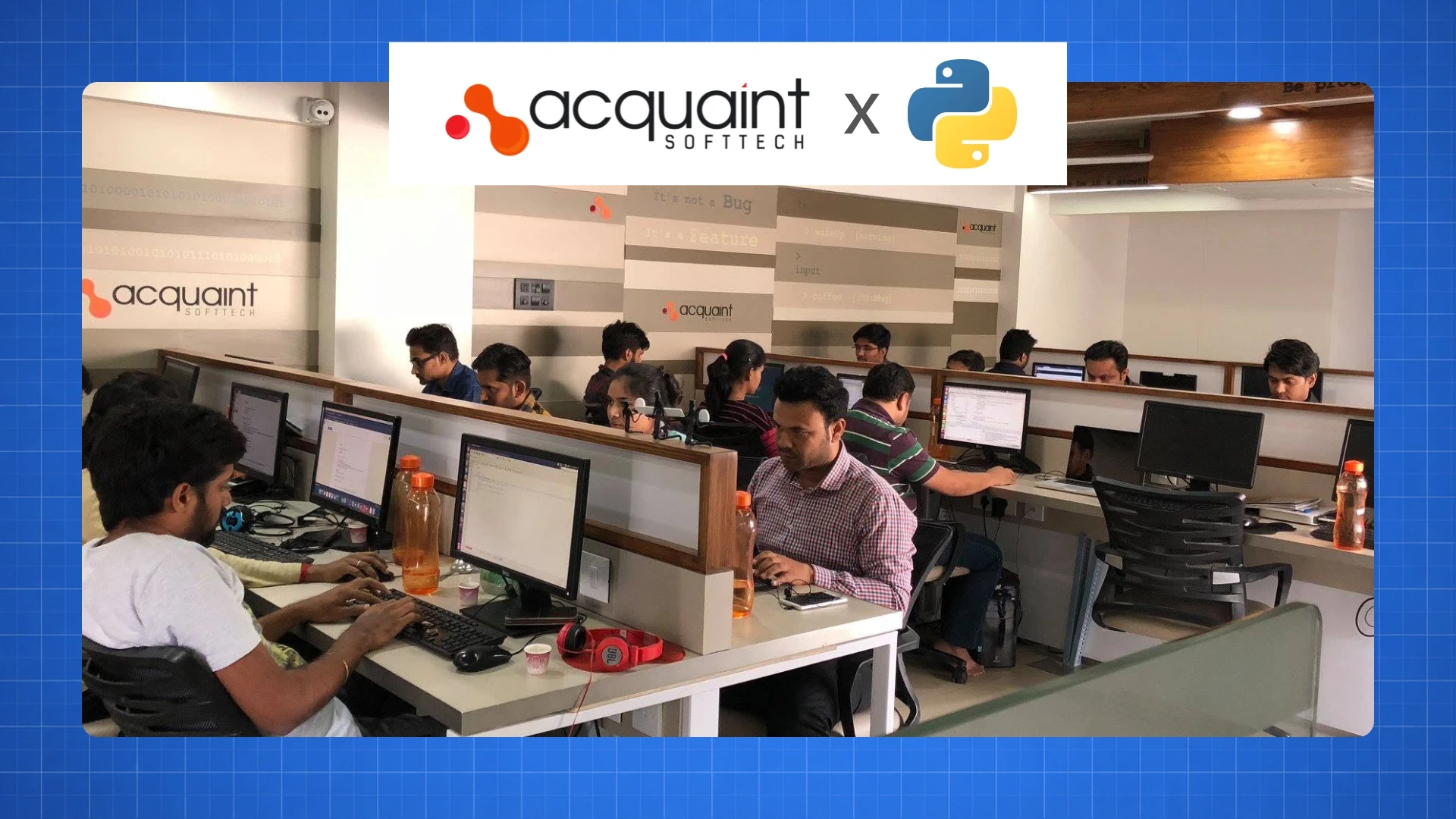
Acquaint Softtech is a Python development and IT staff augmentation company based in Ahmedabad, India, with 1,300+ Python projects delivered globally across MVPs, SaaS platforms, enterprise applications, internal tools, and AI/ML systems. Our delivery model follows the framework in the complete guide to hiring Python developers, with senior engineers, structured discovery, and the engineering discipline that consistently delivers Python web applications within the realistic timeline ranges this guide describes.
Discovery-first methodology. Every engagement starts with a structured discovery phase (1 to 4 weeks depending on project complexity), producing the documented scope and architecture decisions that protect the rest of the timeline from the rework that derails most projects.
Senior-led engineering teams. Senior Python engineers with multi-version Django, FastAPI, async architecture, AI/ML serving, and production scale experience. Our engineers ship 2 to 3 times faster than junior teams on the same work, which translates to faster total delivery and lower total cost.
Sprint-based delivery with locked scope. Two-week sprints with scope locked at sprint boundaries, weekly demos to stakeholders, and 24 to 48 hour decision turnaround commitments on both sides. This is the operational rhythm that consistently keeps projects in their realistic timeline ranges.
Transparent pricing from $20/hour. Lean Python MVPs from $15,000 in 8 to 12 weeks. Dedicated Python engineering teams from $3,200 per month per engineer, roughly 40% less than equivalent US in-house hiring. Full IP assignment and NDA from day one with a free replacement guarantee on dedicated engagements.
The detailed evaluation criteria for choosing a Python development partner who actually delivers within committed timelines is covered in the analysis on what to look for when hiring a Python development company, which walks through the signals that distinguish vendors who deliver on schedule from those whose timelines slip predictably.
To get senior Python engineers committed to a realistic timeline backed by structured discovery and sprint-based delivery, you can hire Python developers with profiles shared in 24 hours and a defined onboarding plan within 48.
Need a Defensible Timeline Before You Sign?
Book a free 30-minute timeline consultation. Tell us your project scope, target launch, and constraints, and we will give you an honest answer: which project category your build falls into, the realistic timeline range for your specific scope, what would compress or expand it, and what discovery investment makes sense. No sales pitch. Just senior engineers who have delivered Python web applications across every category this guide covers.
Frequently Asked Questions
-
How long does a Python MVP actually take to build?
Most lean Python MVPs ship in 8 to 12 weeks with a senior team and locked scope of 3 to 5 core features. The fast end (8 weeks) assumes managed services for auth and payments, component-library design, and a single decision-maker on the client side. The slower end (12 weeks) covers MVPs with 5 features, custom workflows, or one or two complex integrations. Anything claiming faster than 8 weeks is either a no-code prototype, smaller scope, or a build that will hit a rewrite cycle inside the first year.
-
Why do Python web app development timelines vary so much?
Project Driver
Impact on Timeline & Cost
Scope Clarity
Clear requirements can reduce timelines by up to 40%
Team Experience
Senior teams can deliver 2–3x faster than junior teams
Integrations
Each major integration may add 2–3 weeks
Design Complexity
Custom UI/UX can add 3–4 weeks compared to standard components
Client Decision Speed
Delayed approvals can cause ~25% of project delays
-
What is the Cone of Uncertainty and why does it matter?
The Cone of Uncertainty is a software estimation principle showing that timeline estimates at the idea stage can be up to 400% off, while estimates after the design phase narrow to 10 to 25% accuracy. This is why the discovery phase is the single biggest variance reducer in any Python web app project. Partners who skip discovery to look fast or cheap are almost always delivering estimates from the wide end of the cone, which is why their projects consistently exceed original timelines by 30 to 50%.
-
How long does a mid-complexity Python SaaS platform take?
Most mid-complexity Python SaaS platforms ship in 4 to 6 months with experienced teams. Multi-tenancy must be designed in from day one (4 to 6 weeks of foundation work). Subscription billing with plan management, proration, and dunning takes 2 to 4 weeks. Role-based access control adds 1 to 2 weeks. The admin interface for internal operations takes 2 to 3 weeks. Add an integration layer for third-party services, polish, and stabilization, and a realistic SaaS timeline lands at 16 to 24 weeks.
-
Why do enterprise applications with compliance take so much longer?
Compliance is architectural, not feature-level. HIPAA, PCI-DSS, SOC 2, and GDPR must be designed in from the first sprint and add 20 to 35% to base timeline. Integration with legacy enterprise systems (ERP, CRM, EHR) takes longer than greenfield work due to unpredictable APIs and slow vendor response. Stakeholder approval cycles add 4 to 8 weeks across the project lifecycle. And certification timelines (SOC 2 Type II at 6 to 12 months, HIPAA audits on their own schedules) are largely outside engineering control. Most enterprise Python apps with compliance run 6 to 12 months.
-
Can AI tools like GitHub Copilot compress Python development timelines?
Modestly. AI coding assistants like Copilot and Cursor speed up routine coding by roughly 20 to 30% for standard patterns, but this rarely translates to 20 to 30% project compression because someone still needs to review and test generated code, time saved on coding is offset by time spent on architecture and integration, and AI is better at standard patterns than complex system design. Realistic compression from AI tools at the project level is 5 to 15%, not the 50% that aggressive marketing sometimes suggests.
-
What is the single best way to keep my Python project on timeline?
Invest in proper discovery before development starts. A documented scope, validated requirements, and clear acceptance criteria eliminate the rework that consumes 30 to 50% of sprint capacity in unscoped projects. The 1 to 4 week discovery investment routinely saves 4 to 12 weeks of rework downstream, which is the highest-leverage timeline decision in any Python web application engagement. Pair discovery with a senior-led team, sprint-locked scope, and a single client-side decision-maker who can resolve open questions within 24 to 48 hours, and your project will run within its realistic timeline range.
We’re Acquaint Softtech, your technology growth partner. Whether you're building a SaaS product, modernizing enterprise software, or hiring vetted remote developers, we’re built for flexibility and speed. Our official partnerships with Laravel, Statamic, and Bagisto reflect our commitment to excellence, not limitation. We work across stacks, time zones, and industries to bring your tech vision to life.
Table of Contents
Get Started with Acquaint Softtech
- 13+ Years Delivering Software Excellence
- 1300+ Projects Delivered With Precision
- Official Laravel & Laravel News Partner
- Official Statamic Partner
Related Blog
How to Hire Python Developers Without Getting Burned: A Practical Checklist
Avoid costly hiring mistakes with this practical checklist on how to hire Python developers in 2026. Compare rates, vetting steps, engagement models, red flags, and more.
Acquaint Softtech
March 30, 2026
Total Cost of Ownership in Python Development Projects: The Full Financial Picture
The build cost is just the beginning. This guide breaks down the complete TCO of Python development projects across every lifecycle phase, with real benchmarks, a calculation framework, and 2026 data.
Acquaint Softtech
March 23, 2026
Python Developer Hourly Rate: What You're Actually Paying For
Python developer rates range $20-$150+/hr in 2026. See what experience, specialisation & hidden costs actually determine the price. Save 40% with vetted offshore talent.
Acquaint Softtech
March 9, 2026India (Head Office)
203/204, Shapath-II, Near Silver Leaf Hotel, Opp. Rajpath Club, SG Highway, Ahmedabad-380054, Gujarat
USA
7838 Camino Cielo St, Highland, CA 92346
UK
The Powerhouse, 21 Woodthorpe Road, Ashford, England, TW15 2RP
New Zealand
42 Exler Place, Avondale, Auckland 0600, New Zealand
Canada
141 Skyview Bay NE , Calgary, Alberta, T3N 2K6
Your Project. Our Expertise. Let’s Connect.
Get in touch with our team to discuss your goals and start your journey with vetted developers in 48 hours.