

HIPAA-Compliant Cloud Hosting: AWS HIPAA vs Azure HIPAA vs GCP Healthcare
For most healthcare software, AWS, Azure, and Google Cloud are all HIPAA-eligible, sign a Business Associate Agreement, and run on a shared responsibility model, so the right choice depends on fit, not raw compliance. AWS: best for large custom builds. Azure: ideal for Microsoft ecosystems. GCP: strong for data and healthcare. Security depends on configuration, not the provider alone.

Ahmed Ginani
I help agencies and founders at Acquaint Softtech scale their tech teams, and most of that work is serious custom software product development for healthcare, where choosing a HIPAA-compliant cloud is the very first real decision. The question I field most from clients at the buying stage is blunt: AWS HIPAA or Azure HIPAA for healthcare, and where does Google Cloud fit? It is the right question to ask before you commit, because the platform shapes your cost, your compliance work, and your ceiling for years.
The honest answer surprises people. All three hyperscalers clear the compliance bar, so this is not a hunt for the one compliant option. It is a fit decision. This article is a straight AWS HIPAA vs Azure HIPAA vs GCP comparison for medical software, written for buyers, and getting the platform choice right is what turns whichever cloud you pick into a system that actually passes an audit.

- A CEO, CTO, or COO choosing a HIPAA-compliant cloud for a healthcare product.
- Comparing AWS HIPAA and Azure HIPAA pros and cons for medical software.
- Trying to decide which is better, AWS HIPAA or Azure HIPAA, for your use case.
- Weighing hyperscalers against managed HIPAA hosts or compliance PaaS.
- Budgeting AWS HIPAA healthcare development cost versus Azure HIPAA.
- Considering a switch from AWS HIPAA to Azure HIPAA, or the reverse.
Choosing a platform is only half the job; configuring it correctly is the other half, and that is where audits are won or lost. Our HIPAA compliance checklist for developers is the companion to this article and covers the safeguards every one of these clouds expects you to implement yourself.
If the cloud is destined to run a virtual care product, it also helps to see the wider system it will support. Our telemedicine mobile app development guide shows how hosting, video, and records fit together, so your platform decision serves the architecture rather than constraining it.
Not sure which cloud fits your product?
Tell us what you are building and where your users are. You get a straight recommendation on AWS, Azure, or GCP, a compliance checklist for your regions, and a clear scope, with no obligation.
Which cloud services are HIPAA compliant?
A cloud service is HIPAA compliant when the provider will sign a Business Associate Agreement covering that specific service, and you configure it correctly under the shared responsibility model. No cloud is compliant by default, and no service is compliant just because the provider is; only the services named in the BAA count.
AWS, Azure, and Google Cloud all publish a list of HIPAA-eligible services and will sign a BAA at no premium. Beyond the hyperscalers, managed hosts and compliance platforms also offer BAAs, which matters if you want more handled for you. The rule that never changes is simple: if a service is not in the BAA, protected health information must never touch it.
Getting that scoping right, keeping PHI inside covered services and out of everything else, is exactly the kind of foundational decision that must be locked down before any code is written, because a single misconfigured service is how most breaches begin.
AWS HIPAA vs Azure HIPAA vs GCP: the head-to-head
AWS wins on breadth and ecosystem, Azure wins on Microsoft integration and the simplest BAA, and GCP wins on healthcare data and analytics, and all three sign a BAA at no extra cost. The table below is the AWS HIPAA vs Azure HIPAA vs GCP comparison buyers actually need, side by side.
Factor | AWS HIPAA | Azure HIPAA | GCP Healthcare |
BAA | Self-service via Artifact | Built into standard terms | Included for all, no premium |
Best for | Custom, large-scale builds | Microsoft-stack enterprises | Data, analytics, ML |
Standout | Widest eligible service list | Entra ID governance | Cloud Healthcare API, FHIR |
Learning curve | Steepest | Familiar to MS Teams | Moderate |
Region coverage | Broadest globally | Strong, many US regions | Strong, growing |
The pattern is consistent across every comparing-AWS-HIPAA-and-Azure-HIPAA conversation I have with clients: the compliance features are near-identical, and the deciding factors are your existing stack, your team's skills, and what you plan to do with the data. The right approach maps those three against your roadmap before recommending a platform, rather than defaulting to a favorite.
Pros and cons of each platform
AWS HIPAA pros and cons
AWS offers the widest list of HIPAA-eligible services, the deepest partner ecosystem, and the most reference architectures, which makes it the default for custom, large-scale medical software. The trade-off is complexity: it has the steepest learning curve and the most ways to misconfigure, so it rewards teams with real cloud expertise or a strong partner.
Azure HIPAA pros and cons
Azure folds its BAA into standard contract terms, integrates tightly with Microsoft Entra ID for access governance, and feels familiar to any team already on the Microsoft stack. Its main drawback is that some service eligibility and pricing details are less transparent for teams new to the platform, so scoping needs care.
GCP Healthcare pros and cons
Google Cloud stands out for data-heavy healthcare work through its Cloud Healthcare API and BigQuery, with strong support for clinical standards like FHIR and DICOM, and its BAA is included for everyone at no premium. The trade-off is a smaller healthcare partner ecosystem than AWS, so specialist help can be harder to source, though a partner such as Acquaint Softtech closes that gap. Teams that lean on Google's data stack often hire Python developers to build the pipelines around it.
Is AWS more secure than Azure for medical apps?
No, AWS is not inherently more secure than Azure or GCP for medical apps; all three provide the same class of controls, and real security comes from how you configure the environment. This is the single biggest misconception in the whole AWS HIPAA vs Azure HIPAA performance and security comparison.
Each platform offers strong encryption, identity and access management, logging, and threat detection. The breaches that make headlines rarely trace to a platform weakness; they trace to a public storage bucket, an over-permissive role, or an unencrypted backup, all customer-side configuration. Follow the official HHS HIPAA guidance for the safeguards you owe regardless of platform.
That is why the platform matters less than the team configuring it, and why disciplined engineering beats brand choice. The safest setups I see come from experienced DevOps practice, so many clients hire DevOps developers to harden the cloud, automate compliance checks, and keep the configuration audit-ready as it evolves.
Want your cloud hardened and audit-ready?
Our team can review or build your AWS, Azure, or GCP environment against HIPAA safeguards, close the configuration gaps, and hand you a documented, audit-ready setup with a clear cost and timeline.
Managed and specialized HIPAA hosts
If you want less compliance overhead than a raw hyperscaler, managed HIPAA hosts and compliance platforms bundle the safeguards for you, at the cost of some control and a price premium. A best HIPAA-compliant cloud hosting comparison should weigh these against the big three, not just the big three against each other.
The three categories of HIPAA hosts
Hyperscale clouds (AWS, Azure, GCP). Best for custom, large-scale architectures and full developer control; robust frameworks and BAAs, but you own secure configuration.
Compliance platforms and PaaS (Aptible, MedStack, Heroku Shield). Best for digital health and SaaS teams that want encryption, isolation, and audit logging built in, which cuts compliance overhead sharply.
Specialized managed hosts (Atlantic.Net, HIPAA Vault). Best for teams needing dedicated support, active log monitoring, and incident response tailored for healthcare.
Where WordPress and niche hosts fit
For a content site or patient portal on WordPress, HIPAA-compliant WordPress hosting from a specialist gives you an isolated, encrypted environment without assembling it yourself. On any Reddit-style HIPAA-compliant cloud hosting comparison, you will also see names like HIPAA Vault come up, usually with questions about HIPAA Vault pricing and how the HIPAA Vault login and managed dashboard work in practice.
These managed options trade control for convenience, which is the right call for some teams and the wrong one for others, and a good partner helps you tell which camp you are in.
Development cost by platform and market
HIPAA cloud infrastructure costs are broadly similar across AWS, Azure, and GCP; the bigger variable is the development and compliance work to build and configure it correctly. The question of AWS HIPAA healthcare development cost vs Azure HIPAA is answered less by the cloud bill and more by engineering effort, which is where market rates dominate.
The ranges below are typical 2026 planning estimates for building and hardening a HIPAA-compliant environment plus the application on top, priced in each market's currency. They are estimates to confirm against a real scope, not fixed quotes.
Target market | HIPAA setup and hardening | Fully compliant build |
United States / New York City | $25,000 to $60,000 | $120,000 and up |
United Kingdom | GBP 20,000 to 48,000 | GBP 95,000 and up |
Europe (EU) | EUR 23,000 to 55,000 | EUR 110,000 and up |
Australia | AUD 38,000 to 90,000 | AUD 180,000 and up |
New Zealand | NZD 40,000 to 95,000 | NZD 195,000 and up |
The cloud bill itself is roughly comparable between providers for the same workload, so do not choose on sticker price alone. You can cut the build cost substantially by outsourcing the software development to a vetted healthcare team rather than hiring locally at several times the rate.
The core HIPAA hosting requirements checklist
Whatever platform you choose, four requirements are non-negotiable: a signed BAA, encryption everywhere, strict access controls, and a clear grasp of shared responsibility. This is the checklist to hold any HIPAA-compliant cloud hosting comparison against.
Mandatory BAA. The vendor must explicitly agree to sign a Business Associate Agreement; no other feature matters without this legal baseline.
Encryption. Data must be encrypted both at rest and in transit, without exception.
Access controls. Implement unique user identification, automatic logoffs, and strict audit logging.
Shared responsibility. A compliant host only secures the underlying infrastructure; your application-layer configuration must still pass internal and external risk audits.
Meeting these across several regions at once, from the US and New York City to the UK, Europe, Australia, and New Zealand, takes deliberate design, and it is the sort of work a discovery workshop is built to lock down before development begins.
How to choose, and how to switch
Choose the platform that matches your existing stack, your team's skills, and your data strategy, and only switch when a concrete need, not fashion, justifies the migration cost. A move from AWS HIPAA to Azure HIPAA, or the reverse, is a real project, not a toggle.
Choosing the right fit
Pick AWS if you want maximum flexibility and have or can hire strong cloud expertise. Pick Azure if you already live in the Microsoft ecosystem and value governance through Entra ID. Pick GCP if your product is built around data, analytics, or machine learning and benefits from the Healthcare API. For most aws-hipaa-azure-hipaa healthcare use cases, that single filter settles it.
Switching platforms safely
If you do need to switch, treat it as a migration with its own plan: re-sign BAAs for the new platform, re-map services so PHI stays in covered scope, re-test every security control, and cut over in stages. This is delicate work on a live clinical system, so most teams hire remote developers with migration experience rather than risk it on a first attempt.
Client snapshot: picking a HIPAA cloud
Rather than a long narrative, here is how a real platform decision played out, in the compact snapshot format we use in our own advisory notes, verified against our public Clutch reputation.
Snapshot: a digital health SaaS choosing its cloud
Profile: A digital health SaaS serving clinics across the US and UK, small in-house team, data-heavy roadmap.
Options weighed: AWS for breadth, Azure for Microsoft fit, GCP for analytics.
Decision driver: The roadmap centered on analytics and FHIR data exchange, and the team had no Microsoft dependency.
Choice: GCP Healthcare, for the Cloud Healthcare API and BigQuery, with a hardened, BAA-scoped configuration.
Outcome: Live in weeks on a documented, audit-ready environment, with analytics that would have cost more to build elsewhere.
The lesson generalizes: the winning platform was the one that matched the data strategy, not the one with the biggest name. Had the same team been all-in on Microsoft, Azure would have won on the same logic.
Company-wide proof is public: Acquaint Softtech has delivered 1,300 or more projects over 13 or more years with 70 or more in-house engineers and a public 5-star rating on Clutch, as an Official Laravel Partner serving founders across the USA, UK, Europe, Australia, and New Zealand.
Why build your HIPAA cloud with Acquaint Softtech
Choose a partner fluent in all three clouds, with healthcare compliance depth and an in-house team, and you get a platform decision made on fit rather than favoritism. I spend my days helping agencies and founders scale their tech teams with dedicated developers, and we work across AWS, Azure, and GCP, so our recommendation is never a disguised sales pitch for the one stack we know. Most clients save 40 to 75 percent versus hiring equivalent talent in the US, UK, or Australia.
Cloud-neutral: real experience on AWS, Azure, and GCP, so the advice fits your product, not our habits.
Compliance first: HIPAA, GDPR, encryption, and audit logging handled from the first sprint.
Verified trust: 5-star Clutch rating and 1,300 or more delivered projects.
Global reach: serving healthcare founders across the USA, UK, Europe, Australia, and New Zealand.
Whether you need to build fresh, harden an existing environment, or migrate between clouds, Acquaint Softtech can staff the work with engineers who have shipped compliant healthcare platforms before, so the risk sits with us, not you.
Final Thoughts
AWS HIPAA, Azure HIPAA, and GCP Healthcare all clear the compliance bar, so the real decision is fit: your stack, your skills, and your data strategy. AWS rewards flexibility and scale, Azure rewards Microsoft-native teams, and GCP rewards data and analytics, and none is meaningfully more secure than the others once configured well.
Pick on fit, configure with discipline, and treat the BAA as the floor rather than the finish line, and any of the three becomes a solid foundation for healthcare software that lasts.
Ready to choose and build the right way?
Talk with our team about your healthcare product. You leave with a clear AWS, Azure, or GCP recommendation, a HIPAA configuration plan for your regions, and a fixed scope, timeline, and cost.
Frequently Asked Questions
-
Which cloud services are HIPAA compliant?
A cloud service is HIPAA compliant when the provider signs a BAA covering that specific service, and you configure it correctly. AWS, Azure, and Google Cloud all publish lists of HIPAA-eligible services and sign a BAA at no premium.
-
Which web hosting services are HIPAA compliant?
Managed hosts like Atlantic.Net and HIPAA Vault, compliance platforms like Aptible and MedStack, and the hyperscalers all offer HIPAA-eligible hosting with a signed BAA. General shared hosting is not compliant unless the provider signs a BAA and meets the safeguards.
-
Is AWS hosting HIPAA compliant?
AWS is HIPAA-eligible: it signs a BAA and offers a documented list of eligible services. It becomes compliant only when you keep PHI inside those services and configure encryption, access, and logging correctly under the shared responsibility model.
-
Is GoDaddy hosting HIPAA compliant?
No, standard GoDaddy shared hosting is not HIPAA compliant, and GoDaddy does not sign a BAA for it, so it must not store or transmit PHI. For healthcare, use a HIPAA-eligible cloud or a specialized managed HIPAA host instead.
-
Which is better, AWS HIPAA or Azure HIPAA for healthcare?
Neither is universally better; AWS suits custom large-scale builds while Azure suits Microsoft-stack teams. Choose based on your existing stack, your team's skills, and your data strategy rather than raw compliance, which is comparable.
-
What are the pros and cons of AWS HIPAA vs Azure HIPAA?
AWS offers the widest services and ecosystem but the steepest learning curve, while Azure offers the simplest built-in BAA and strong Microsoft governance but less transparent scoping for newcomers. Both sign a BAA at no premium.
-
Is AWS HIPAA more secure than Azure HIPAA for medical apps?
No, both provide the same class of encryption, access, and monitoring controls. Real security depends on your configuration, since almost all breaches come from customer-side misconfiguration rather than a platform flaw.
-
How much does AWS HIPAA development cost compared to Azure HIPAA?
The cloud bills are broadly comparable for the same workload, so the cost difference is mostly development and configuration effort, not the platform. Expect roughly similar totals on either, with region and scope driving the number.
I help agencies and founders scale their tech teams with the right developers at the right time. At Acquaint Softtech, I focus on building long term partnerships and making remote hiring simple, predictable, and results driven. My goal is straightforward to help businesses grow faster with reliable dedicated developers.
Table of Contents
Get Started with Acquaint Softtech
- 13+ Years Delivering Software Excellence
- 1300+ Projects Delivered With Precision
- Official Laravel & Laravel News Partner
- Official Statamic Partner
Related Blog

HIPAA Compliance for Software Developers: The Complete 2026 Checklist
HIPAA is not a security features module you bolt on before launch. It is a pattern of engineering decisions that starts at repository creation and never stops. This checklist is the one Acquaint Softtech applies to every healthcare build: 12 rules, 7 technical safeguards, and the 2026 penalties for ignoring them.

Sanjay Prajapati
May 25, 2026
Remote Patient Monitoring App Development: From Wearable to Dashboard
Remote patient monitoring (RPM) app development connects wearable and medical devices to a clinical dashboard using IoT data pipelines, real-time alerting, and HIPAA-compliant cloud infrastructure. A production RPM system collects biometric data via Bluetooth or cellular, transmits it through an encrypted MQTT or HTTPS pipeline, stores it in a time-series database, and surfaces it in a clinical dashboard with threshold-based alerts, trend visualisation, and EHR write-back via HL7 FHIR.
Ahmed Ginani
June 9, 2026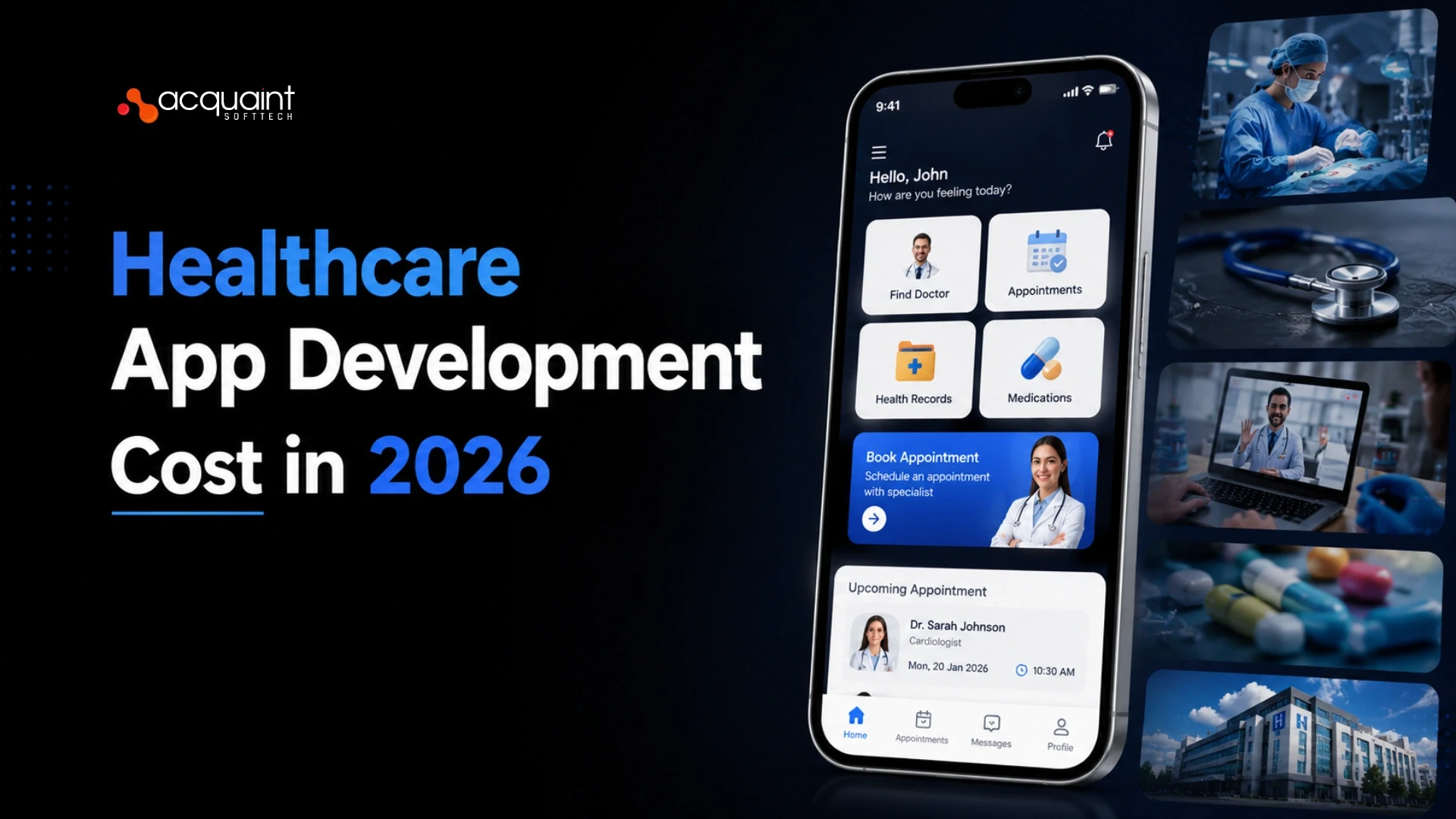
Healthcare App Development Cost in 2026: Real Numbers by Feature and Complexity
Healthcare app development cost in 2026 ranges from $25,000 for a lean HIPAA-compliant MVP to over $500,000 for an enterprise platform with AI, EHR integration, and multi-platform support. HIPAA compliance adds 20 to 50% to the base cost. Offshore HIPAA-trained teams in India deliver 40 to 60% savings versus US agencies.
Ahmed Ginani
June 17, 2026India (Head Office)
203/204, Shapath-II, Near Silver Leaf Hotel, Opp. Rajpath Club, SG Highway, Ahmedabad-380054, Gujarat
USA
7838 Camino Cielo St, Highland, CA 92346
UK
The Powerhouse, 21 Woodthorpe Road, Ashford, England, TW15 2RP
New Zealand
42 Exler Place, Avondale, Auckland 0600, New Zealand
Canada
141 Skyview Bay NE , Calgary, Alberta, T3N 2K6