

Healthcare App Development Cost in 2026: Real Numbers by Feature and Complexity
Healthcare app development cost in 2026 ranges from $25,000 for a lean HIPAA-compliant MVP to over $500,000 for an enterprise platform with AI, EHR integration, and multi-platform support. HIPAA compliance adds 20 to 50% to the base cost. Offshore HIPAA-trained teams in India deliver 40 to 60% savings versus US agencies.

Ahmed Ginani

- You received three wildly different quotes and cannot explain the gap.
- You need to know exactly what HIPAA compliance adds before you budget.
- You want a real MVP vs full-build cost breakdown, not a vague range.
- You are evaluating offshore development teams and need a trust framework.
- You need to know which features drive cost and which are safely deferrable.
Introduction
Every healthcare founder faces the same problem: they send the same brief to three agencies and get back quotes of $80,000, $180,000, and $320,000 for what looks like the same product. The gap is not random. It reflects whether HIPAA compliance infrastructure is included or deferred, whether EHR integration is scoped or assumed to be simple, and whether the team has actually shipped HIPAA-compliant products before. A quote that excludes HIPAA infrastructure is not a low-cost option; it is a deferred expense that will cost 30 to 50% of the original build budget when discovered mid-project.
The average cost to develop a healthcare app in 2026 ranges from $25,000 for a lean MVP to over $500,000 for an enterprise platform. But the average obscures the decision. Understanding which cost factors apply to your specific product is what Acquaint Softtech's healthcare software development services are built around: transparent, compliance-first pricing with no mid-project surprises.
Healthcare data is ten times more valuable on the dark web than financial data. A healthcare data breach costs an average of $7.42 million per incident (IBM Security, 2025). The global digital health market reached $660 billion in 2026. These facts explain why HIPAA compliance is not a feature to add later, it is an architecture constraint that must be designed from sprint one or paid for twice.
The HHS Office for Civil Rights (OCR) publishes enforcement data, penalty schedules, and HIPAA compliance guidance and the penalty for willful neglect reaches $2.13 million per violation category per year.
This article provides real numbers by feature, type, and complexity, the cost factors that vendors consistently obscure, verified data from Acquaint Softtech's 60 or more completed HealthTech projects, and a seven-question framework for evaluating any development quote. For the complete healthcare software development context covering all eight product categories, start with the Complete Guide to Healthcare Software Development, which provides the strategic and regulatory context for every product type covered in the cost tables below.
Why Healthcare App Costs Are Higher Than Standard Apps

How much does healthcare app development cost more than a standard SaaS app? Approximately 30 to 80% more, and the reasons are architectural, not cosmetic. Three constraints make healthcare development fundamentally different: regulated data handling, compliance infrastructure, and third-party integration complexity.
Regulated data handling means every architectural decision the database schema, the API authentication model, the audit logging system, the encryption key strategy- must be designed with PHI handling in mind from the first sprint. Healthcare apps serve multiple user roles simultaneously (patient, clinician, administrator, billing staff, external auditor) with different data access rights, different notification requirements, and different compliance obligations per data type. Standard SaaS apps rarely face this multi-role compliance complexity.
Third-party integration complexity adds substantial cost on top of the core application. A telemedicine app without EHR integration is a consumer tool. A telemedicine app with EHR integration is a clinical system. A single Epic or Cerner integration adds $30,000 to $80,000 independently of the rest of the build. Acquaint Softtech's virtual CTO services include a cost structure analysis as the first engagement deliverable for all healthcare app projects, mapping every cost driver before any development contract is signed.
Healthcare App Development Cost by App Type: 2026 Real Numbers
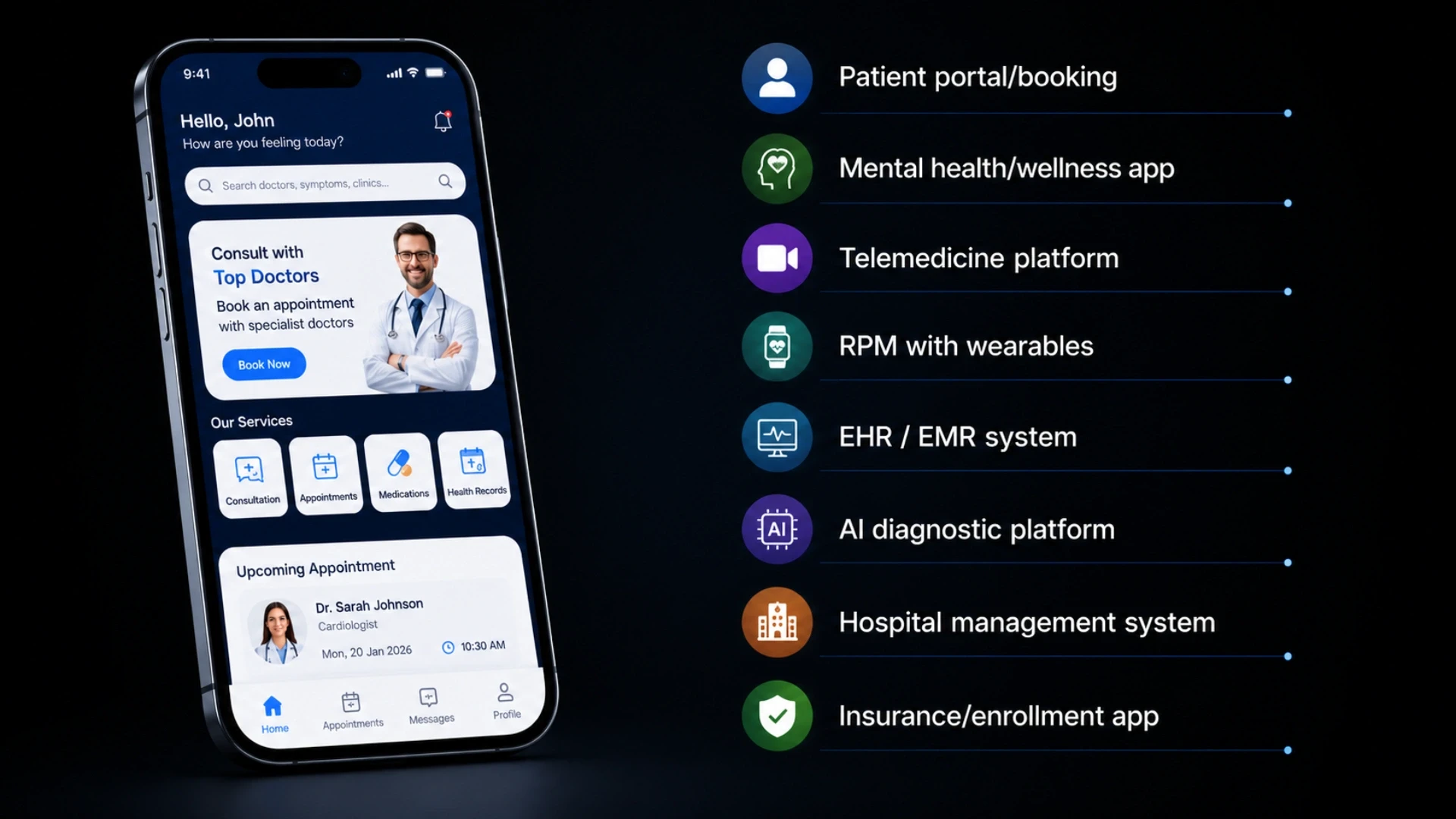
Healthcare app development pricing guide 2026: costs below are drawn from Acquaint Softtech's project portfolio and corroborated by Excellent Webworld (May 2026), Liqteq (April 2026), and Premium App Developer (May 2026). All ranges include HIPAA compliance infrastructure.
App Type | MVP Cost | Full Build + EU Context |
Patient portal/booking | $25k–$45k | $50k–$90k, GDPR compliance required |
Mental health/wellness app | $40k–$80k | $80k–$200k, EU privacy regulations apply |
Telemedicine platform | $60k–$120k | $120k–$350k, HIPAA + EU GDPR compliance |
RPM with wearables | $60k–$120k | $150k–$350k, EU MDR may apply |
EHR / EMR system | $120k–$200k | $250k–$500k, FHIR + EU interoperability standards |
AI diagnostic platform | $150k–$300k | $350k–$800k+, EU AI Act + MDR compliance |
Hospital management system | $200k–$350k | $400k–$1M+, multi-country EU compliance |
Insurance/enrollment app | $80k–$150k | $200k–$450k, GDPR + financial compliance |
A healthcare app MVP is typically 40 to 60% of the full build cost (April 2026). An $80,000 MVP does not become a $160,000 product. It becomes a $250,000 to $350,000 product when the features deferred from MVP scope, EHR integration, AI, multi-platform support, and advanced analytics are scoped and priced correctly.
For teams building patient-facing mobile apps, Acquaint Softtech's React Native developers build cross-platform healthcare mobile apps from a single shared codebase, reducing iOS plus Android plus web cost by 30 to 40% versus three separate native builds. The discovery workshop services produce a phased build plan identifying exactly which features belong in MVP scope and which are safely deferrable.
Cost by Complexity: Simple, Mid-Tier, and Enterprise
Healthcare app development cost breakdown by complexity is where most budget conversations start. Complexity in healthcare is not about design aesthetics or feature count. It is about data architecture depth, integration surface area, and compliance scope.
Simple healthcare app: $25,000 to $80,000
A narrow use case without complex integrations: appointment booking, basic patient portals, prescription reminders, or health information platforms. No EHR integration, no real-time clinical data processing, limited PHI handling. HIPAA compliance covers user authentication, basic data encryption, and standard access controls. Development timeline: 2 to 4 months. Single platform (iOS or Android), one user role, no video or wearable features.
Mid-tier healthcare app: $80,000 to $300,000
The most common category for HealthTech startups. Real-time clinical features (video consultation, live biometric monitoring, multi-provider scheduling), one or more EHR system integrations, and a complex multi-role architecture. HIPAA compliance at this tier requires comprehensive audit logging, RBAC across multiple user types, BAA execution with multiple vendors, and a documented risk analysis. Development timeline: 5 to 10 months.
What pushes mid-tier apps to the upper range: EHR integration (adds $30,000 to $80,000), cross-platform mobile (adds 40 to 60% to frontend cost if not on a shared codebase), and real-time video. For teams building for both iOS and Android, Acquaint Softtech's React Native developers avoid the platform cost premium by building from a shared codebase.
Enterprise healthcare platform: $300,000 to $1,000,000+
Multi-facility health systems, multi-tenant SaaS products for large provider networks, or heavily regulated AI-assisted clinical tools potentially requiring FDA SaMD clearance alongside HIPAA. Multiple integrated subsystems, AI components with clinical validation requirements, and infrastructure designed for high-volume concurrent users. Development timeline: 10 to 18 months or more.
For teams scoping enterprise healthcare platforms, Acquaint Softtech's dedicated software development teams provide the multi-discipline engineering capability (backend, mobile, DevOps, AI, FHIR integration) needed for enterprise-tier healthcare products.
Feature-by-Feature Cost Breakdown
Healthcare app development cost breakdown by feature is where budgets are built or broken. The following data is drawn from Acquaint Softtech's project delivery records and corroborated by market data published in 2026.
Feature | Cost to Add | Key Compliance / Cost Factor |
MFA user authentication | $2k–$6k | HIPAA + EU GDPR security requirements |
Appointment booking | $5k–$15k | Scheduling logic + EHR sync |
HIPAA-compliant video consultation | $15k–$40k | Encrypted video + BAA + GDPR |
Secure in-app messaging | $8k–$20k | PHI encryption + audit logging |
EHR integration | $30k–$80k | FHIR mapping + EU interoperability |
Wearable / IoT integration | $10k–$35k | Device sync + data normalisation |
AI chatbot/symptom checker | $25k–$80k | AI validation + safety guardrails |
Custom clinical AI model | $80k–$500k+ | FDA SaMD + EU AI Act compliance |
E-prescribing | $20k–$50k | Pharmacy + regulatory integration |
Insurance billing | $25k–$70k | CPT coding + payer integrations |
HIPAA audit logging | $5k–$15k | Secure long-term compliance storage |
Patient portal | $20k–$50k | Consent management + GDPR support |
These costs are additive and the integration cost between features is consistently underestimated. Testing the interaction between the video layer and the audit log, or between the scheduling system and the billing engine, adds 10 to 15% of the total development cost and rarely appears as a separate line item in initial quotes.
For a detailed technical breakdown of what each of these features requires at the architecture level, the How to Build a Professional Healthcare guide covers each component with implementation-level detail.
HIPAA Compliance Cost: What It Actually Adds
HIPAA compliance adds 20 to 50% to base development cost depending on whether it is designed from sprint one or retrofitted after the application is built (Excellent Webworld, May 2026). This is the cost question teams ask too late and the one with the highest variance between vendor quotes.
HIPAA Component | Built In From Day One | Retrofitted After Build |
AES-256 encryption (at rest) and TLS 1.3 (in transit) | $3,000 to $8,000 | $15,000 to $40,000 |
RBAC and access control architecture | $5,000 to $12,000 | $20,000 to $60,000 |
Audit logging infrastructure | $3,000 to $8,000 | $10,000 to $30,000 |
HIPAA-eligible cloud configuration | $4,000 to $10,000 | $8,000 to $20,000 |
BAA execution with all PHI-touching vendors | $1,000 to $4,000 | Same cost, but delay costs more |
Third-party penetration test | $5,000 to $20,000 | $5,000 to $20,000 |
Pre-launch compliance QA audit | $8,000 to $25,000 | $8,000 to $25,000 |
Total HIPAA overhead | $29,000 to $87,000 (15 to 25% of build) | $67,000 to $199,000 (30 to 50% of build) |
Ongoing annual HIPAA compliance costs: $10,000 to $40,000 per year for risk assessments, workforce training, penetration testing, and policy updates. HIPAA is not a one-time certification. It is an ongoing programme that must be budgeted for every year the product is in production.
Key Insight
The most expensive HIPAA scenario: an agency that quotes low by excluding compliance infrastructure, then adds it as change orders mid-project. A $120,000 quote that becomes $200,000 when HIPAA is scoped correctly is not a budget overrun. It is the real project cost. Ask every vendor: is your quote inclusive of HIPAA cloud configuration, audit logging, and BAA execution with all PHI-touching vendors?
Team Location and Hourly Rates: The Biggest Cost Variable
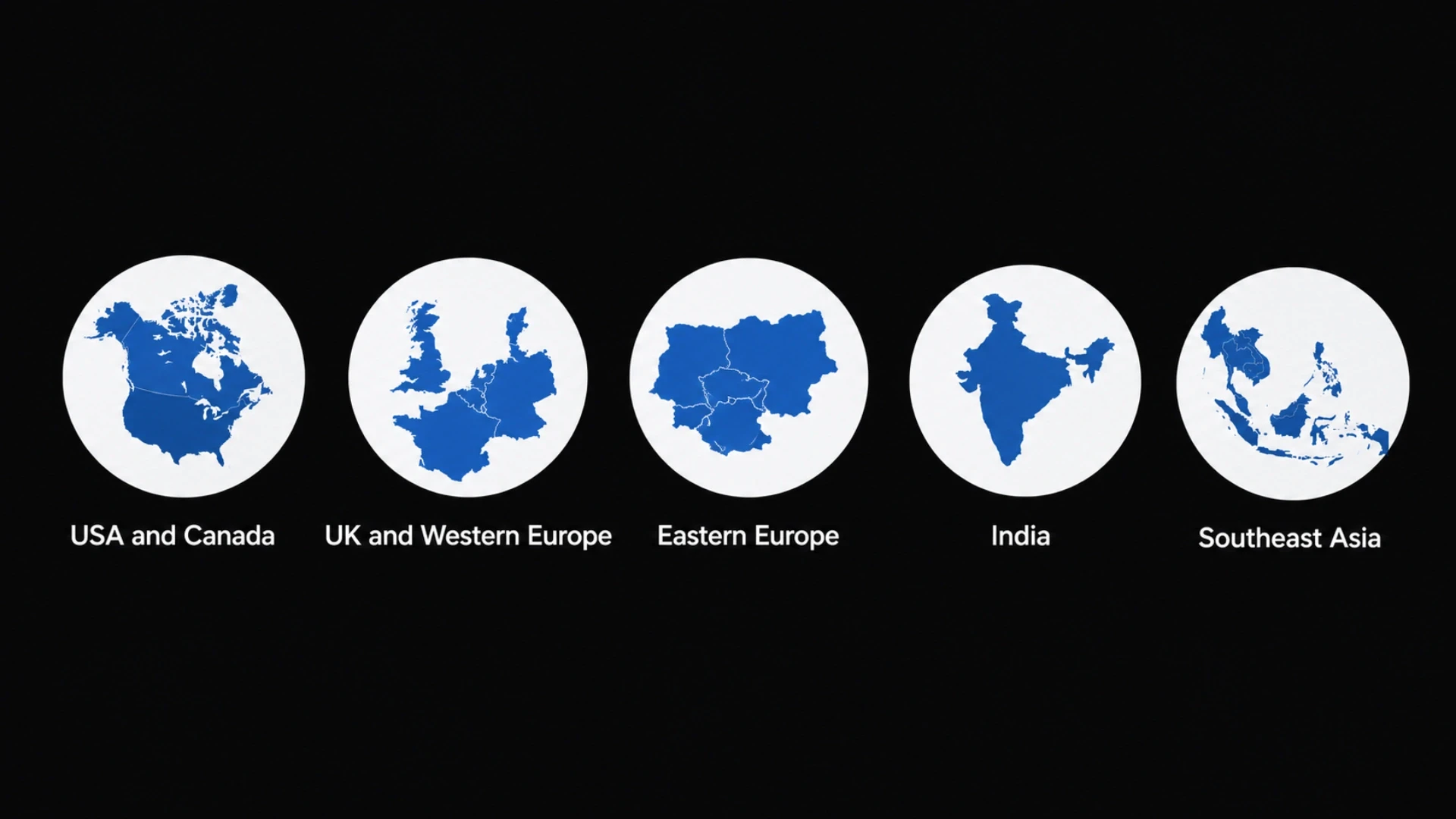
Team location is the largest single variable in healthcare app development cost, with a 5x to 10x difference in hourly rates between the highest and lowest cost markets. Healthcare app development pricing comparison 2026 confirms this gap persists even as offshore quality has improved significantly.
Development Region | Senior Dev Rate | Healthcare Track Record Note |
USA and Canada | $150 to $250/hour | Highest rates. Local HIPAA expertise. Best time-zone alignment for US clients. |
UK and Western Europe | $100 to $180/hour | Strong GDPR expertise. Variable HIPAA-specific experience, vet per firm. |
Eastern Europe | $60 to $100/hour | Strong development quality. Verify HIPAA implementation track record carefully. |
India, Tier 1 (Clutch-verified, HIPAA-trained) | $25 to $49/hour | Best value for quality. Acquaint Softtech rate, Clutch-verified. 40 to 60% savings. |
Southeast Asia | $25 to $45/hour | Variable quality and HIPAA knowledge. Vet healthcare compliance track record. |
Offshore healthcare app development is 40 to 60% cheaper for equivalent quality (Liqteq, April 2026). The savings are real. The risk is selecting a team without verified HIPAA implementation experience. A developer without HIPAA-specific experience does not save money. They create an expensive remediation project.
The five-point verification framework for evaluating any offshore healthcare team:
(1) references from completed healthcare projects that passed a third-party HIPAA audit,
(2) willingness to sign a BAA as a standard engagement term,
(3) verified Clutch or G2 reviews from healthcare clients,
(4) demonstrated HIPAA infrastructure configuration experience,
(5) at least 5 delivered healthcare projects with named clients.
Hidden Costs in Healthcare App Development That Blow Budgets
These are the hidden costs in healthcare app development that appear after contract signing and before launch. Understanding them before you sign converts a budget overrun into a planned expenditure.
EHR integration discovered mid-project
Teams that scope a telemedicine app without scoping EHR integration discover it mid-project when the clinical team insists notes must flow into Epic. A single EHR vendor integration adds $30,000 to $80,000 and 2 to 4 months independently of the rest of the project. Scope this explicitly before signing any development contract.
Multi-platform scope expansion
A product scoped for iOS only becomes web plus iOS plus Android when the clinical team needs desktop dashboard access. Each additional platform adds 40 to 60% to frontend development cost if not built from a shared codebase. React Native shared codebase avoids most of this premium.
AI model training and clinical validation
Teams that add an AI symptom checker discover that the AI feature itself is the smallest cost. Training a model on clinical data requires dataset labelling ($0.05 to $2.00 per labelled medical item), clinical validation by a licensed professional, and if the AI influences clinical decisions, potential FDA SaMD pathway documentation. An AI feature costing $40,000 in engineering may require $100,000 in clinical validation and dataset costs.
State-by-state telemedicine licensing verification
US telemedicine apps that expand beyond one state discover each state has different physician licensing requirements, prescribing laws, and telehealth practice standards. Building a state-specific compliance verification layer is a separate engineering effort. Scope it explicitly or plan it as a Phase 2 item.
Post-launch annual HIPAA compliance
HIPAA requires ongoing annual compliance: risk assessments, workforce training, penetration testing, and policy updates costing $10,000 to $40,000 per year. Apps that are not budgeted for this consistently fall out of compliance within 18 months of launch. The HIPAA Compliance for Software Developers checklist covers the full annual compliance programme. Acquaint Softtech's software support and maintenance services include ongoing HIPAA maintenance as a standard post-launch engagement option.
Healthcare app fixed-price proposal: scoped correctly in two weeks.
Acquaint Softtech's discovery workshop delivers a fixed-scope proposal, compliance cost breakdown, and phased build plan in two weeks. No compliance surprises mid-project. 60 or more HealthTech projects delivered. $25 to $49/hour, Clutch-verified.
Case Study: BIANALISI SPA Clinical Analytics Platform, Italy
.webp "Case Study")
The following is drawn from a verified Clutch client review submitted February 22, 2026. All outcomes are client-reported and publicly verifiable on the Acquaint Softtech Clutch profile.
Client: BIANALISI SPA, Italy's largest integrated diagnostics group (1,001 to 5,000 employees)
Reviewer: Giovanni Gianolli, CEO, BIANALISI SPA
Project: Clinical Data Analysis and Predictive Health Intelligence Platform
Tech Stack: Python, FastAPI, PostgreSQL, React.js dashboard, European-compliant cloud infrastructure
Project Value: $10,000 to $49,999 (verified Clutch project value, mid-complexity engagement)
Duration: April to November 2025: 7 months, all milestones delivered on schedule
Clutch Rating: 5.0 out of 5.0 across Overall, Quality, Schedule, and Cost | Verified: February 22, 2026
Three cost lessons this project teaches every HealthTech team
First: compliance-first architecture is cheaper than compliance-retrofitted architecture. Acquaint Softtech integrated European data protection safeguards into the model training workflow and data ingestion pipeline from the first sprint. The alternative, building the analytics platform and adding compliance later, would have required rebuilding the data model after the application code was written against it. That remediation typically costs 30 to 40 per cent of the original build budget. BIANALISI paid for compliance once.
Second: the cost of building clinical trust into the product is a real line item that must be budgeted. Laboratory directors at BIANALISI validated every predictive model output before deployment. That clinical validation is a genuine development cost that cannot be deferred. Platforms that skip clinical validation discover the cost during failed adoption, not during the build.
Third: milestone-based delivery within a fixed budget is achievable when scope is correctly defined before development begins. Every project milestone was delivered on schedule despite mid-project regulatory clarifications that required scope adjustments. That predictability comes directly from the compliance architecture review conducted before development started.
Offshore vs Local Development: Is It Actually Cheaper?
Is offshore healthcare app development cheaper? Yes, by 40 to 60% for equivalent quality when the team has verified HIPAA implementation experience. The savings are real. The risk is selecting a team without the specific healthcare compliance knowledge required to build safely.
Factor | US/UK/Europe Agency | India Offshore (Acquaint Softtech) |
Senior developer rate | $150–$250/hour | $25–$49/hour |
5-developer team (6 months) | $600k–$900k | $130k–$250k |
Compliance support | HIPAA + GDPR varies by firm | HIPAA + GDPR-ready workflows |
Delivery performance | Depends on agency | High on-time sprint delivery |
Third-party verification | Varies | Clutch-verified healthcare expertise |
BAA / legal agreements | Varies | Standard for healthcare projects |
Get healthcare app development quote requests should always ask: is your quote for a HIPAA-compliant system or a system with HIPAA added later? The difference between those two answers is 30 to 50% of total project cost, and the lower quote is not cheaper - it is a deferred expense.
For affordable healthcare app development in India, Acquaint Softtech delivers at $25 to $49 per hour with full HIPAA compliance included as standard. Teams can scale using the staff augmentation model for flexible headcount across intensive integration phases.
How to Get an Accurate Healthcare App Quote
The cheapest way to build a healthcare app is not to find the lowest quote. It is to find the most complete quote. A quote that excludes HIPAA infrastructure, assumes single-platform, and defers EHR integration will produce a more expensive final project than one scoped correctly from the start.
Seven questions every vendor must answer before you sign
1. Is your quote inclusive of HIPAA-compliant cloud infrastructure, audit logging, and BAA execution with all PHI-touching vendors? If not, what is the separate cost?
2. Which specific HIPAA technical safeguards from 45 CFR 164.312 are included in this scope? Ask for the explicit list.
3. Is this quote for iOS only, Android only, or cross-platform? If cross-platform, is it shared codebase or separate native builds?
4. Does this quote include a pre-launch HIPAA compliance QA audit and third-party penetration test?
5. What is the cost of EHR integration with our target vendor (Epic, Cerner, AthenaHealth), and is it in this quote?
6. What does your annual HIPAA compliance maintenance programme cost and what does it include?
7. How many healthcare products have you delivered that passed a third-party HIPAA audit? Can you provide specific client references?
Any vendor that cannot answer questions 1, 2, 4, 5, and 7 with specific verifiable answers is not equipped to produce an accurate healthcare app development quote. The estimate they provide will not reflect the real project cost.
Acquaint Softtech's discovery workshop services produce a comprehensive scoping document answering all seven questions above, including a phased build plan, compliance cost breakdown, and fixed-scope proposal with milestone-based delivery, before a development contract is signed.
Affordable healthcare app development India - HIPAA from sprint one, never as a surprise.
Healthcare app development cost comparison offshore vs local: Acquaint Softtech delivers at $25 to $49/hour with full HIPAA compliance, verified EHR integration capability, and a 4.9/5 Clutch rating from 61 reviews. 40 to 60% savings vs US agencies. 1,300 or more projects in 13 or more years.
Frequently Asked Questions
-
How much does healthcare app development cost in 2026?
Healthcare App Type
Estimated Cost
HIPAA-Compliant MVP
$25,000 – $45,000
Telemedicine or EHR-Integrated App
$80,000 – $300,000
Enterprise Healthcare Platform (AI + Multi-Facility Support)
$300,000 – $1M+
-
What factors affect healthcare app development pricing?
The biggest cost factors are HIPAA compliance, EHR integration, AI features, app complexity, platform scope, and development team location. Regulatory security and third-party healthcare integrations often consume a major portion of the total budget.
-
Is offshore healthcare app development cheaper?
Yes. Offshore HIPAA-trained teams can reduce healthcare app development costs by 40–60% compared to US or European agencies while maintaining compliance and development quality. The key is selecting vendors with verified healthcare experience and security expertise.
-
What is the cheapest way to build a healthcare app?
The most cost-effective approach is building HIPAA compliance from day one, using cross-platform frameworks like React Native, delaying advanced AI features, and working with experienced offshore healthcare developers. Early planning prevents expensive redevelopment later.
-
How much does HIPAA compliance add to healthcare app cost?
HIPAA compliance adds roughly 15–25% to healthcare app development costs when planned early. Retrofitting compliance after development can increase expenses by 30–50% because major architecture and security changes may be required.
-
How long does it take to build a healthcare app?
Simple healthcare apps take 2–4 months, mid-tier telemedicine or EHR apps require 5–10 months, and enterprise healthcare platforms with AI can take 10–18+ months. Compliance reviews and healthcare integrations are the biggest timeline factors.
-
How much does EHR integration cost in a healthcare app?
EHR integration with platforms like Epic or Cerner typically adds $30K–$80K per vendor and increases development timelines by 2–4 months. Most integrations require HL7 FHIR standards and secure healthcare authentication workflows.
-
How much does AI cost in a healthcare app?
Adding AI APIs or chatbots costs around $15K–$40K, while custom clinical AI models can start at $80K and exceed $500K depending on regulatory and data requirements. AI systems influencing clinical decisions may also require FDA SaMD compliance.
-
What is the biggest healthcare app development cost driver?
HIPAA compliance, EHR integration, and custom AI development are usually the largest cost drivers because they require advanced security, regulatory documentation, and clinical validation. Enterprise-scale infrastructure and multi-platform support also increase costs significantly.
-
How can healthcare startups reduce app development costs?
Healthcare startups can lower costs by launching an MVP first, using shared cross-platform codebases, limiting integrations initially, and choosing experienced HIPAA-trained offshore development teams. A phased rollout strategy helps reduce upfront investment and project risk.
I help agencies and founders scale their tech teams with the right developers at the right time. At Acquaint Softtech, I focus on building long term partnerships and making remote hiring simple, predictable, and results driven. My goal is straightforward to help businesses grow faster with reliable dedicated developers.
Table of Contents
Get Started with Acquaint Softtech
- 13+ Years Delivering Software Excellence
- 1300+ Projects Delivered With Precision
- Official Laravel & Laravel News Partner
- Official Statamic Partner
Related Blog
The Complete Guide to Healthcare Software Development in 2026
Healthcare software development in 2026 is not a single discipline. It is six distinct product categories, each with its own compliance perimeter, integration burden, and cost curve.

Acquaint Softtech
May 1, 2026
How Telemedicine Apps Work: Architecture, Data Flow, and System Design Explained
A telemedicine app is not a video call with a medical logo. It is a distributed system that moves protected health information between four environments in under 200 milliseconds while staying inside HIPAA boundaries. Here is exactly how it works, layer by layer, with the tech stack, the data flow, and the numbers that matter.

Manish Patel
May 8, 2026
EHR vs EMR: What's the Actual Difference and Which Should You Build
Most people use EHR and EMR interchangeably. They are not the same system. One is a digital filing cabinet for a single practice. The other is a longitudinal health record that follows the patient across their entire care journey. Picking the wrong one costs founders 9 to 14 months of rework. Here is how to choose correctly the first time.
Ahmed Ginani
May 15, 2026India (Head Office)
203/204, Shapath-II, Near Silver Leaf Hotel, Opp. Rajpath Club, SG Highway, Ahmedabad-380054, Gujarat
USA
7838 Camino Cielo St, Highland, CA 92346
UK
The Powerhouse, 21 Woodthorpe Road, Ashford, England, TW15 2RP
New Zealand
42 Exler Place, Avondale, Auckland 0600, New Zealand
Canada
141 Skyview Bay NE , Calgary, Alberta, T3N 2K6