

Hotel Direct Booking Strategy: Building a Website Booking Engine That Competes With OTAs
A balanced mix of both hotel direct booking engines and Online Travel Agencies (OTAs) provides the most profitable distribution strategy for modern hoteliers. OTAs win discovery and reach; a fast, conversion-focused website booking engine wins profit, guest data, and loyalty. The goal is not to leave OTAs, but to convert the guests they send you into direct, repeat bookers.

Zubair Pateljiwala
As Marketing Manager at Acquaint Softtech, I watch hotels pour money into OTA visibility and then lose the profit on commission, which is why a direct booking engine is one of the highest-return software product development projects a property can fund. Every guest you convert to direct is revenue you keep and a relationship you own.
This is a build-and-strategy article, not another pros-and-cons list. Most articles on direct booking vs OTA end at the comparison. This one takes you into the build: the features, the price match module, the recovery emails, and the cost, so a technical team can ship a website booking engine that actually competes.

- A hotel or group leader tired of losing 15 to 30 percent of revenue to OTA commission.
- A CTO scoping a website booking engine that converts as well as Booking.com.
- A product owner mapping price match, loyalty incentives, and abandoned booking recovery.
- A revenue leader building a direct booking strategy to reduce OTA commission over time.
- A team weighing an off-the-shelf engine against a custom direct booking platform.
For where this fits in the bigger picture, our complete guide to travel and hospitality software development maps how the booking engine connects to search, pricing, and distribution. Direct booking is where all of that turns into kept revenue.
For the engine mechanics underneath the strategy, our article on how hotel booking engines work covers availability, pricing, and reservation architecture. Here we focus on winning the guest away from the OTA.
Paying OTAs for guests who found you first?
If 15 to 30 percent of every booking disappears into commission, your website is the cheapest sales channel you own, if it converts. Tell us your property size, current site, and channels, and we will map the exact booking engine, price match, and recovery flow you need, with a realistic timeline you can act on.
Direct booking vs OTA: the core trade-off
Direct booking vs OTA is a trade-off between reach and profit. OTAs bring visibility at a 15 to 30 percent commission; direct bookings cost you marketing and technology but keep the margin and the guest relationship.
Online Travel Agencies (OTAs)
What they are: third-party global platforms like Booking.com or Expedia that list multiple properties.
Advantages: huge international reach, instant market visibility, and built-in traveler trust.
Disadvantages: high commission fees ranging from 15% to 30%, strict platform rules, and limited access to true guest data.
Direct booking websites and engines
What they are: the hotel's own software and website interface (powered by a hotel booking engine) where guests reserve rooms directly.
Advantages: zero third-party commissions, full ownership of guest contact data for re-marketing, and higher long-term profitability.
Disadvantages: requires steady marketing investment (SEO, paid ads) and technical upkeep to drive consistent web traffic.
The economics favor direct once you convert. Industry benchmarks put the effective cost of a direct booking near 4 to 8 percent of the reservation, against 15 to 25 percent for an OTA, so building the engine well is a data-driven hire MERN stack developers decision, not a cosmetic one.
OTAs vs direct booking engines, side by side
The clearest way to see the trade-off is a direct comparison. OTAs win on reach and effort; direct wins on cost, data, and lifetime value.
Factor | OTA booking | Direct booking engine |
Cost per booking | 15% to 30% commission | Roughly 4% to 8% all-in |
Reach | Global, instant | Built through SEO and ads |
Guest data | Owned by the OTA | Owned by the hotel |
Loyalty and remarketing | Limited | Full control |
Setup effort | Low | Ongoing build and marketing |
Long-term profit | Lower per booking | Higher per booking |
Neither channel is a loser; they play different roles. Acquaint Softtech builds the direct side of that mix so a hotel can keep using OTAs for discovery while shifting repeat demand to its own site.
How to increase direct hotel bookings
To increase direct hotel bookings, make the direct rate at least as good as the OTA, add value only you can offer, remove booking friction, and recover guests who abandon. The tactics below compound.
Guarantee the best rate direct. Match or beat the OTA price so a guest who compares has no reason to leave your site.
Add direct-only value. Free breakfast, late checkout, or a room upgrade costs less than commission and moves the booking.
Remove friction. A fast, mobile-first, few-step checkout converts far better than a slow multi-page form.
Capture and recover. Collect the email early and send an abandoned booking recovery email to bring window shoppers back.
Reward loyalty. A simple member rate or points scheme turns a first direct booking into repeat direct bookings.
Roughly a fifth of hotel bookings now come direct, and many of those guests first saw the property on an OTA, so capturing that window shopper is the whole game. Building the conversion tooling to do it is where teams hire Python developers for the backend logic behind rates, incentives, and recovery.
How to build a direct booking engine, step by step
To build a direct booking engine, connect availability, build a fast checkout, add rates and incentives, wire payments, and layer on recovery and analytics. Here is the build in six steps.
Connect availability and rates. Integrate the PMS or channel manager so the engine always shows live rooms and prices.
Build the checkout flow. Create a fast, mobile-first, few-step reservation path with a clear room, rate, and total.
Add rate and incentive logic. Support best-rate messaging, direct-only perks, promo codes, and a price match guarantee module.
Wire payments securely. Integrate a PCI-compliant gateway with cards and wallets, and handle deposits and cancellations.
Layer on recovery and loyalty. Capture the email early, trigger abandoned booking recovery, and support member rates or points.
Instrument everything. Track conversion, drop-off, and channel so you can improve the funnel with real data.
The checkout and recovery layers are where conversion is won or lost, so they deserve real AI development services attention for personalization and timing once the core is live.
Scoping the funnel up front is what a product discovery workshop is for, and many groups then hire remote developers to build the engine while their marketing team owns traffic and offers.
Not sure whether to buy a booking engine or build one?
Off-the-shelf engines are quick but generic; a custom build converts better but costs more up front. We map your property, brand, and channels to the right path, off-the-shelf, customized, or fully custom, with a fixed scope, clear milestones, and IP that is yours from day one. You interview the engineers before you commit.
The features that make a booking engine convert
A booking engine that competes with OTAs is defined by conversion features, not just a calendar: speed, a short mobile checkout, best-rate messaging, direct perks, and trust signals that reassure the guest.
Fast, mobile-first checkout with the fewest possible steps and no forced account creation.
Clear best-rate and direct-only perk messaging so comparison shoppers stay.
Real-time availability and pricing pulled straight from the PMS, never stale.
Trust signals: reviews, secure-payment badges, and a transparent total with taxes and fees.
Promo codes, member rates, and upsells that add value without breaking parity rules.
Speed is not a nice-to-have; a slow engine loses the exact guest an OTA is ready to capture. Keeping it fast and reliable in production is why teams hire DevOps engineers to own performance, uptime, and safe deploys.
Price match guarantee: how to implement it
A price match guarantee module promises guests the lowest rate on your own site, then backs it with logic: monitor OTA prices, compare against your direct rate, and either auto-adjust or honor a claim at checkout.
Implementation has two paths. The stronger one connects to a rate-monitoring feed so the engine knows the live OTA price and can display or match it automatically. The simpler one lets a guest submit a claim with a screenshot, which staff verifies, which is cheaper to build but slower for the guest.
Either way, the module needs a rules engine so a promise never breaches a contract or erodes margin unintentionally. Building that logic cleanly is where teams hire Django developers to wrap the comparison and claim workflow in a stable API. Acquaint Softtech builds price match as a rules-driven feature, not a marketing slogan, so it holds up under real bookings.
Loyalty incentives and abandoned booking recovery
Two features quietly drive the most direct revenue: a loyalty incentive that rewards direct bookers, and an abandoned booking recovery email that brings back guests who left mid-checkout.
A loyalty incentive for direct booking can be as simple as a member-only rate or a points balance, and it turns one direct stay into a habit. It also gives you a reason to collect the email, which powers everything downstream.
Abandoned booking recovery is often the highest-return feature in the whole engine: capture the email early, detect the drop-off, and send a timed reminder with the exact room and rate. Keeping those triggers tested and on time is why teams hire automation engineers so the recovery path never silently breaks.
Direct booking engine tech stack
A dependable direct booking stack pairs a fast front end with a reliable backend, a secure payment gateway, a durable database, and integrations to the PMS and marketing tools.
Layer | Common choice | Why |
Front end | React or Next.js | Fast, mobile-first checkout |
Backend | Node.js or Django | Rates, rules, and reservations |
Database | PostgreSQL | Reliable booking records |
Payments | Stripe or Adyen | PCI-compliant cards and wallets |
Integrations | PMS, channel manager, CRM | Live availability and guest data |
Marketing | Email and analytics tools | Recovery, loyalty, and attribution |
For a polished, filter-heavy front end, teams often hire MEAN stack developers to build the checkout and guest dashboard.
Because gateway APIs, PMS connectors, and tax rules change, ongoing version upgrade services keep the engine current without breaking live bookings.
How to compete with Booking.com without matching its budget
You do not out-spend Booking.com; you out-convert it on your own turf. When a guest lands on your site, a faster checkout, a matched or better rate, and a direct-only perk beat a platform that treats you as one option among many.
An OTA reduces your property to a row in a list, differentiated mostly by price. Your own site is the one place you control the whole story, the photos, the perks, and the checkout, so the strategy is to win the guest at the moment they compare, not to fight for reach you cannot afford.
For hotels that want a senior architect to set that conversion strategy before building, virtual CTO services provide that hand early. Many operators also use software development outsourcing to ship a competitive engine without a large in-house team.
The changing rules: parity and free booking links
Two shifts make direct booking easier than it used to be. In the EEA, OTA parity clauses are now banned, so you can price lower on your own site. And Google Free Booking Links let hotels show direct rates next to OTAs at no cost.
The European Commission confirmed that, as a designated gatekeeper, Booking must comply with the Digital Markets Act, which prohibits parity clauses across the EEA. In practice, that restores the most obvious direct-booking incentive: a lower price on your own website.
On the visibility side, Google's free booking links for hotels place your direct rate alongside OTAs in search at no click cost, which is a rare free channel to compete on. Wiring your rates into that feed and keeping them accurate is integration work a dedicated software development team can own end to end.
Direct booking engine cost by market
Direct booking engine cost depends on scope and where your team sits. A hosted engine on your existing site is far cheaper than a fully custom platform with price match, loyalty, recovery, and deep PMS integration.
The ranges below are 2026 planning estimates at local agency rates, not fixed quotes. Offshore delivery from India typically lands well below these numbers.
Target market | Booking engine MVP | Full custom platform |
United States / New York | $20,000 to $45,000 | $70,000 to $180,000+ |
United Kingdom | GBP 16,000 to 36,000 | GBP 56,000 to 144,000+ |
Europe (EU) | EUR 18,000 to 40,000 | EUR 62,000 to 160,000+ |
Australia | AUD 32,000 to 68,000 | AUD 105,000 to 270,000+ |
New Zealand | NZD 34,000 to 72,000 | NZD 112,000 to 285,000+ |
The biggest lever is engineering rate, not the feature list, which is why many teams add IT staff augmentation from India to build the same engine at a fraction of local cost.
Real case study: a conversion-focused platform rebuild
No two builds are identical, but the closest documented parallel from our own work is Lampoo, a Milan-based retailer for which Acquaint Softtech rebuilt the checkout flow, cleaned the codebase, and sped up the site. Reducing dropped carts and surviving a high-traffic sale are the same conversion goals a hotel direct booking engine must hit.
Dimension | Lampoon (conversion-focused platform rebuild, Clutch verified 5.0 / 5.0) |
The client | Lampoo, a Milan second-hand luxury fashion platform, founder and CEO Enrico Trombini. |
The problem | A slow site and a leaky checkout were dropping carts and frustrating both buyers and sellers. |
The approach | Acquaint Softtech redesigned product pages, rebuilt the checkout flow, cleaned old code, and added a seller dashboard, testing from both buyer and seller views. |
The impact | Faster site, longer average session on product pages, fewer dropped carts, fewer support queries, and a major sale handled without slowdown. |
The delivery | Weekly updates, tasks tracked in one place, same-day fixes, and changes explained in plain terms for a non-technical team. |
Why it maps here | Checkout speed, cart-abandonment reduction, and peak-traffic reliability are exactly what a direct booking engine needs to beat an OTA on conversion. |
You can see this and other projects on our case studies page and read verified reviews on our Clutch profile.
Why teams struggle, and what to check before you hire
Most direct booking projects do not fail at the design. They fail at conversion and integration, where a slow checkout, a broken PMS sync, or a missing recovery email quietly hands the guest back to the OTA.
Before you commit to a partner for a direct booking build, check for these:
Do they build for conversion, with a fast mobile checkout and measured drop-off, not just a pretty page?
Is availability pulled live from the PMS, so the engine never shows a room that is gone?
Do they include price match, loyalty, and abandoned booking recovery, not just a calendar?
Do they have verifiable e-commerce and booking-conversion delivery experience?
That last point is where track record matters. Acquaint Softtech has delivered 1,300 or more projects over 13 or more years with 70 or more in-house engineers and 50 or more Clutch reviews, and can deploy vetted developers within 48 hours. After launch, conversion is a moving target, so ongoing support and maintenance services keep the checkout, integrations, and recovery flows healthy.
Ready to keep the commission you are giving away?
Every month, OTA-only distribution is margin you will not get back. Share your property size, current website, and channel mix, and we will give you a straight read on whether an off-the-shelf engine, a customized one, or a full custom platform fits, with the scope and cost to match. No sales pitch, just honest engineering advice.
Frequently asked questions
-
How do you increase direct hotel bookings?
Guarantee the best rate on your own site, add direct-only value like free breakfast or late checkout, remove checkout friction with a fast mobile flow, capture the guest's email early to recover abandoned bookings, and reward repeat direct bookers with a member rate or loyalty points.
-
Should you build a website booking engine or just use an OTA?
Use both. OTAs are the most cost-effective way to reach new travelers, while a website booking engine keeps the margin, the guest data, and the loyalty. The profitable strategy is to use OTAs for discovery and convert those guests into direct, repeat bookers over time.
-
How do you compete with Booking.com?
Not by out-spending it, but by out-converting it on your own site. When a guest lands on your page, a faster checkout, a matched or better direct rate, and a perk only you can offer beat a platform that lists you as one option among many. Own the moment they compare.
-
How do you implement a price match guarantee?
Two ways. The stronger path connects a rate-monitoring feed so the engine knows the live OTA price and can display or auto-match it. The simpler path lets a guest submit a claim with proof that staff verifies. Both need a rules engine so the promise never breaks a contract or margin.
-
Is it better to book a hotel through a website or directly?
Booking directly on the hotel's own website is usually better for the guest: often the same or a lower rate, more flexible cancellation, and better service, because the hotel keeps the full value instead of paying commission. OTAs are handy for comparing options during discovery.
-
What is the best booking engine for hotels?
There is no single best. Mews, SiteMinder, Cloudbeds, and Little Hotelier suit hotels that want a ready product, while a custom build wins when conversion, branding, price match, and deep integrations matter most. The best engine is the one your guests complete a booking on.
-
Which software is best for hotel booking?
It depends on your size and goals. Off-the-shelf platforms like Mews or SiteMinder are fast to launch; a custom direct booking engine gives full control over checkout, incentives, and data. Many hotels start hosted and move to custom as direct revenue and specific needs grow.
I am Zubair Pateljiwala, a digital marketing professional with 15+ years of experience in SEO, content marketing, and performance marketing. As the Marketing Head at Acquaint Softtech, I focus on helping technology businesses improve their online visibility through SEO, GEO, AEO, and AI-driven content strategies. I enjoy transforming complex software development concepts into practical, easy-to-understand content that helps businesses make informed technology decisions.
Table of Contents
Get Started with Acquaint Softtech
- 13+ Years Delivering Software Excellence
- 1300+ Projects Delivered With Precision
- Official Laravel & Laravel News Partner
- Official Statamic Partner
Related Blog
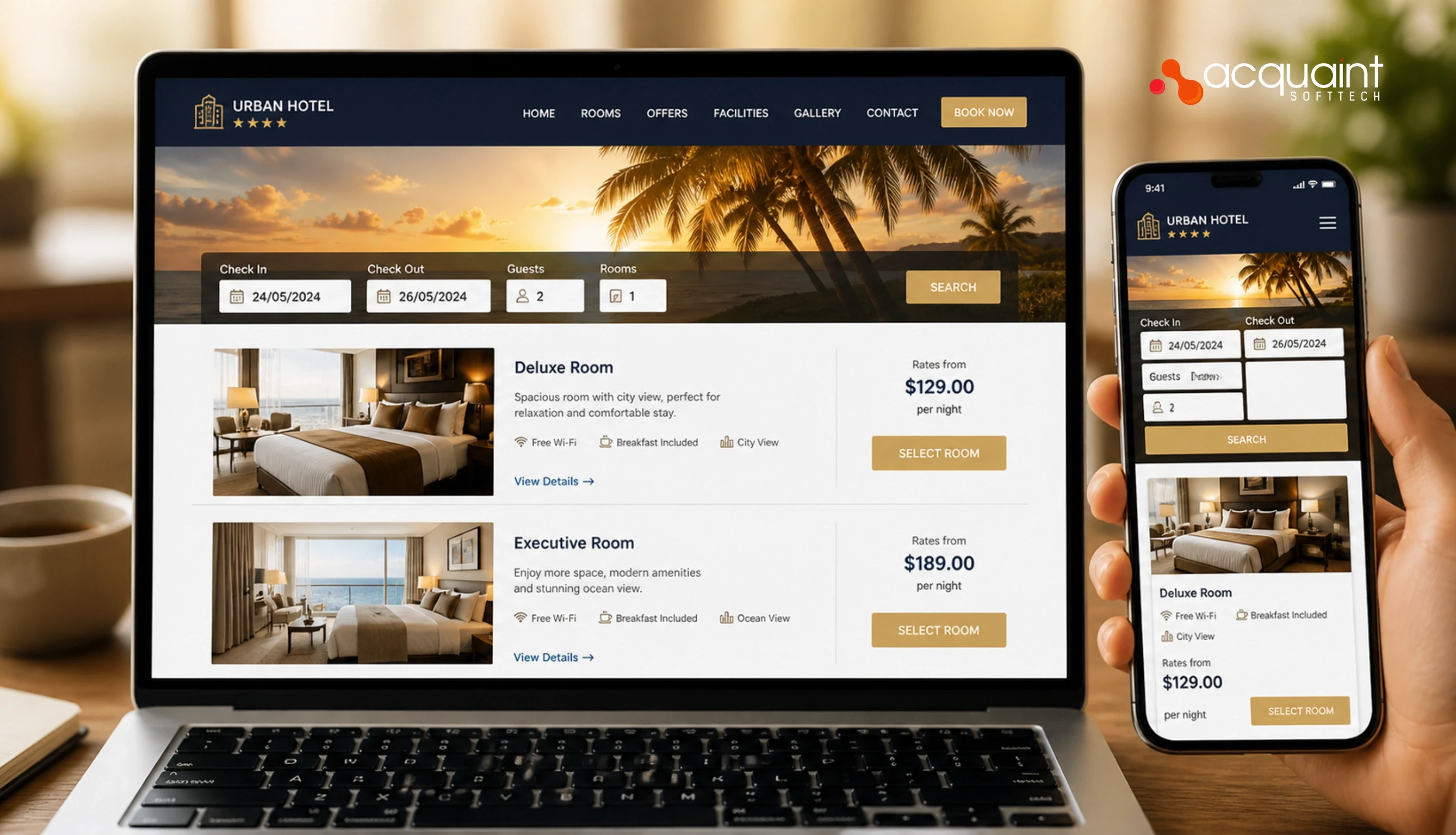
How Hotel Booking Engines Work: Search, Availability, Pricing, and Reservation Architecture
A hotel booking engine is not a search bar. It is an availability engine, a pricing decision system, a payment pre-authorisation layer, and a channel inventory synchroniser, all running simultaneously. This guide explains every architectural layer and how each one connects in a production system.

Manish Patel
May 12, 2026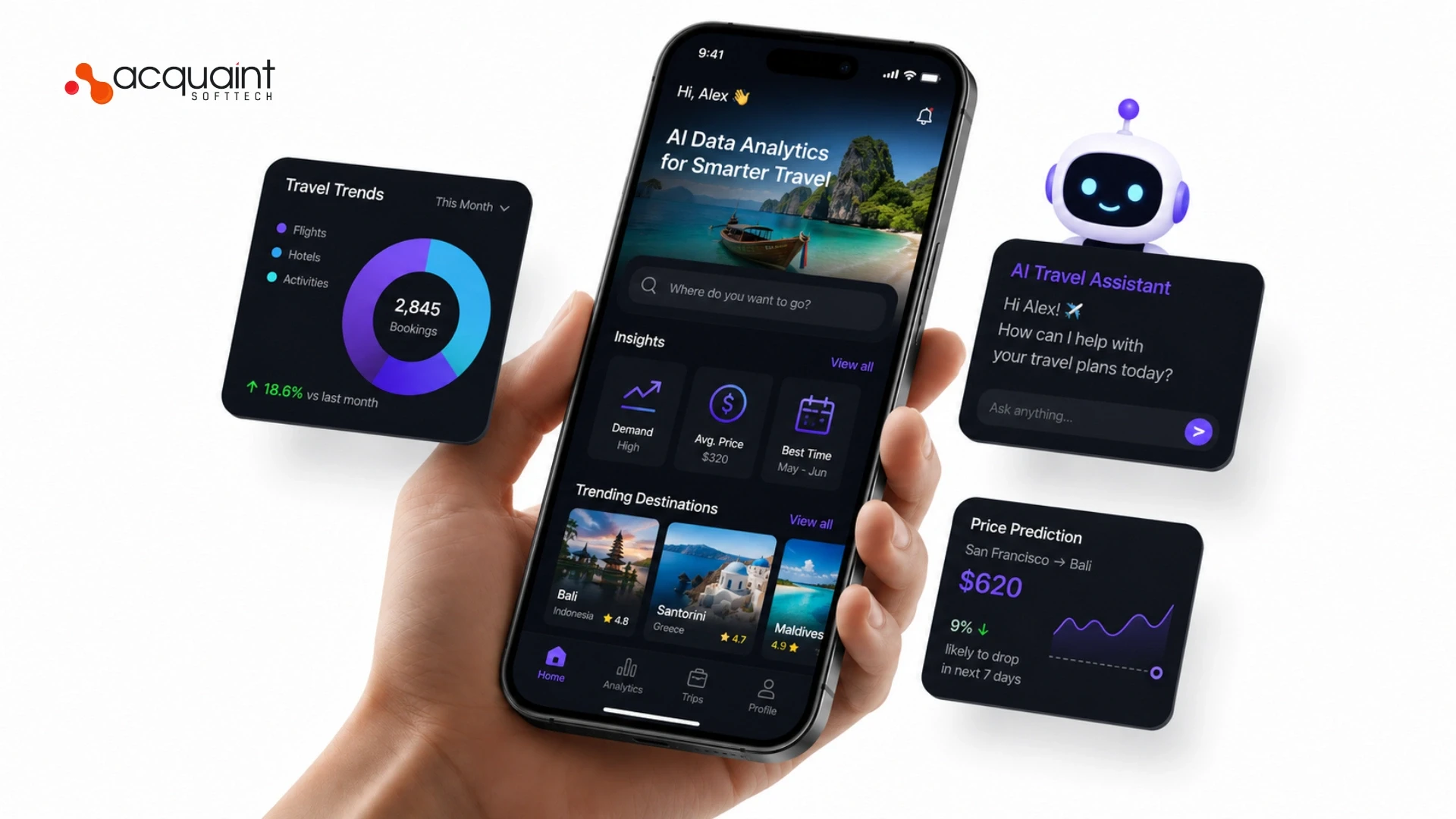
AI and Data Analytics in Travel: Demand Forecasting, Price Optimization, and Customer Intelligence
AI and data analytics in travel use machine learning to turn booking, search, and customer data into revenue. The three core engines are demand forecasting, which predicts future occupancy and bookings; price optimization, which sets the best price in real time based on demand; and customer intelligence, which identifies high-value travellers and predicts who will book or cancel. Hotels using AI-driven pricing report revenue gains of 5 to 14%.
Manish Patel
June 29, 2026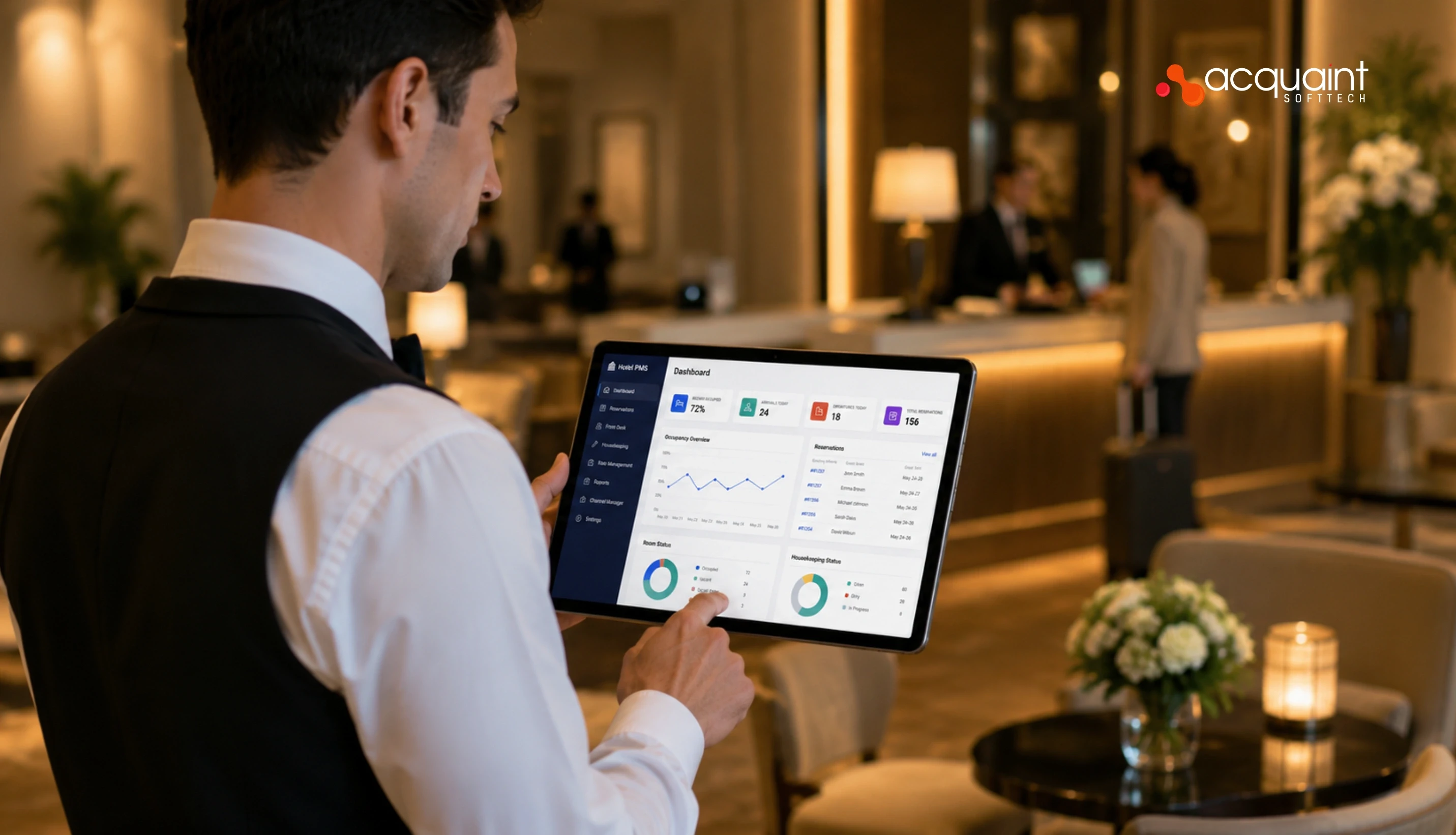
Hotel PMS Development: Front Desk, Housekeeping, and Guest Management in One System
A hotel PMS is not a booking system. It is the operational backbone connecting every department in real time. Here is what it includes, how each module is built, and what it costs in 2026.
Manish Patel
May 20, 2026India (Head Office)
203/204, Shapath-II, Near Silver Leaf Hotel, Opp. Rajpath Club, SG Highway, Ahmedabad-380054, Gujarat
USA
7838 Camino Cielo St, Highland, CA 92346
UK
The Powerhouse, 21 Woodthorpe Road, Ashford, England, TW15 2RP
New Zealand
42 Exler Place, Avondale, Auckland 0600, New Zealand
Canada
141 Skyview Bay NE , Calgary, Alberta, T3N 2K6