

Mental Health App Development: Therapy Matching, Journaling, and Mood Tracking
A mental health app offers mood tracking, therapy, journaling, telehealth, and AI support. Development typically costs $40,000–$400,000, and HIPAA compliance is required when handling patient data in the USA.

Zubair Pateljiwala
Over one billion people worldwide experience mental health disorders, yet 75 per cent receive no treatment because of access barriers, cost, and stigma. The global mental health app market is projected to reach $10.06 billion in 2026, driven by a chronic shortage of licensed therapists, rising rates of anxiety and depression, and growing user acceptance of digital-first mental health support (2026). The opportunity is real, and so is the failure rate. Most mental health apps do not fail because of bad technology.
They fail because founders build features that look good in demos but do not create clinical habit, treat HIPAA compliance as a pre-launch checklist rather than a sprint-one architecture decision, or ship AI features without understanding where the safe boundary ends and the FDA-regulated zone begins. Building a mental health app that retains users and survives regulatory scrutiny requires getting all three right from the start. Acquaint Softtech's custom healthcare and mental health app development services cover every stage from compliance scoping through cross-platform React Native delivery for clients across the USA, UK, Australia, and Europe.

- You are building a mental health or therapy app from scratch in 2026.
- You need to understand HIPAA, FTC, and FDA rules before choosing a tech stack.
- You want to know which features drive daily retention and which cause churn.
- You need verified cost data before presenting a mental health app budget.
- You are deciding between React Native and Flutter for a mental health product.
The FTC Health Breach Notification Rule (updated February 2024) applies to mental health apps even when HIPAA does not: any app handling individually identifiable health data that is not a HIPAA-covered entity must notify users within 60 days of any unauthorised disclosure. There is no wellness-app exemption. The FDA's guidance on Software as a Medical Device applies to mental health apps that make diagnostic or treatment claims for a specific condition, and is. Both must be read before a line of code is written.
This guide covers the five types of mental health apps, therapy matching architecture, mood tracking and journaling design, crisis safety requirements, the three-regulation compliance map, AI safety guardrails, React Native tech stack, real cost data, and a verified case study. For the full healthcare software development context, read the guide to Healthcare Software Development. For HIPAA technical architecture requirements that every PHI-handling mental health app must implement, the HIPAA Compliance for Software Developers: The Complete 2026 Checklist covers every safeguard required under 45 CFR 164.312.
Building a mental health app? Start with a HIPAA-compliant React Native team.
Acquaint Softtech has built mental health platforms, teletherapy tools, and clinical wellness apps for clients across the USA, UK, and Europe — all on React Native cross-platform. 1,300 or more projects. 4.9/5 on Clutch from 50 or more verified reviews.
The Mental Health App Opportunity in 2026: Market Size and the Compliance Trap

What is mental health app development in 2026? It is the intersection of clinical psychology, mobile engineering, and regulatory compliance, where digital platforms are increasingly used for primary care delivery by health systems, employers, and insurers. For teams looking to accelerate delivery, many also choose to hire Python developers to build secure, scalable, and compliant healthcare-grade applications. Understanding the market and its risks is the starting point for any serious build.
Market Metric | Figure |
Global Mental Health App Market (2026) | $10.06 Billion |
Global Mental Health App Market CAGR | 18% through 2030 |
VC Investment in Mental Health Startups (2024) | $4 Billion+ |
Growth in Top US Mental Health App Downloads (2024 YoY) | 35%+ |
US Mental Health Practitioner Shortage | 8,000+ Unfilled Positions |
HIPAA Non-Compliance Fine Ceiling | Up to $1.9 Million per Violation Category per Year |
Mental health app benefits for healthcare extend beyond the individual user: apps reduce pressure on therapist waitlists by providing structured support between sessions, create longitudinal mood and symptom data for clinical review, and make mental health support accessible in contexts where in-person care is impractical or unaffordable.
Mental health app trends 2026 include passive mood detection from device usage patterns, AI-personalised CBT content delivery, wearable integration for physiological stress markers, and employer-funded platforms that eliminate individual consumer acquisition cost.
Why mental health apps matter for hospitals and clinics in 2026 is fundamentally a capacity argument: the shortage of licensed therapists cannot be solved by training alone. Digital platforms extend the reach of the practitioners who exist. Acquaint Softtech's AI and ML engineering services build the AI personalisation and content recommendation layers that make mental health apps clinically effective at scale, beyond simple mood tracking.
Five Types of Mental Health App: Choose Before You Scope
How to build a mental health app correctly starts with identifying which of the five types applies to your project. Each type has a distinct feature set, regulatory exposure, and unit economics. Building the wrong type is not just a product mistake; it is a compliance and financial planning error.
App Type | Core Function | Compliance |
Self-Management App | Mood tracking, journaling, meditation | FTC health data rules |
Therapist Marketplace | Therapist discovery and booking | HIPAA, telehealth licensing |
Teletherapy Platform | Video therapy, notes, billing | HIPAA, 42 CFR Part 2 |
AI CBT / Digital Therapeutic | AI-guided therapy and interventions | HIPAA, FDA SaMD (if treatment claims) |
Employer / EAP Platform | Employee wellness and benefits | HIPAA, GDPR, EAP confidentiality |
Choosing the wrong type has a direct cost consequence: a Type 1 wellness app costs $40,000 to $80,000; a Type 3 teletherapy platform costs $120,000 to $300,000; a Type 4 digital therapeutic pursuing FDA clearance costs $400,000 or more. Founders who start building one type and discover mid-development that their intended features require a different type routinely overspend by 50 to 100 per cent.
The HealthTech idea validation guide covers the five-gate validation framework, including regulatory scoping as Gate 2- that every mental health app founder should complete before committing to a scope. Acquaint Softtech's discovery workshop services deliver the app type classification, regulatory pathway assessment, and Phase 1 MVP scope in a fixed 2-week engagement.
Therapy Matching Architecture: How to Connect Patients With the Right Therapist
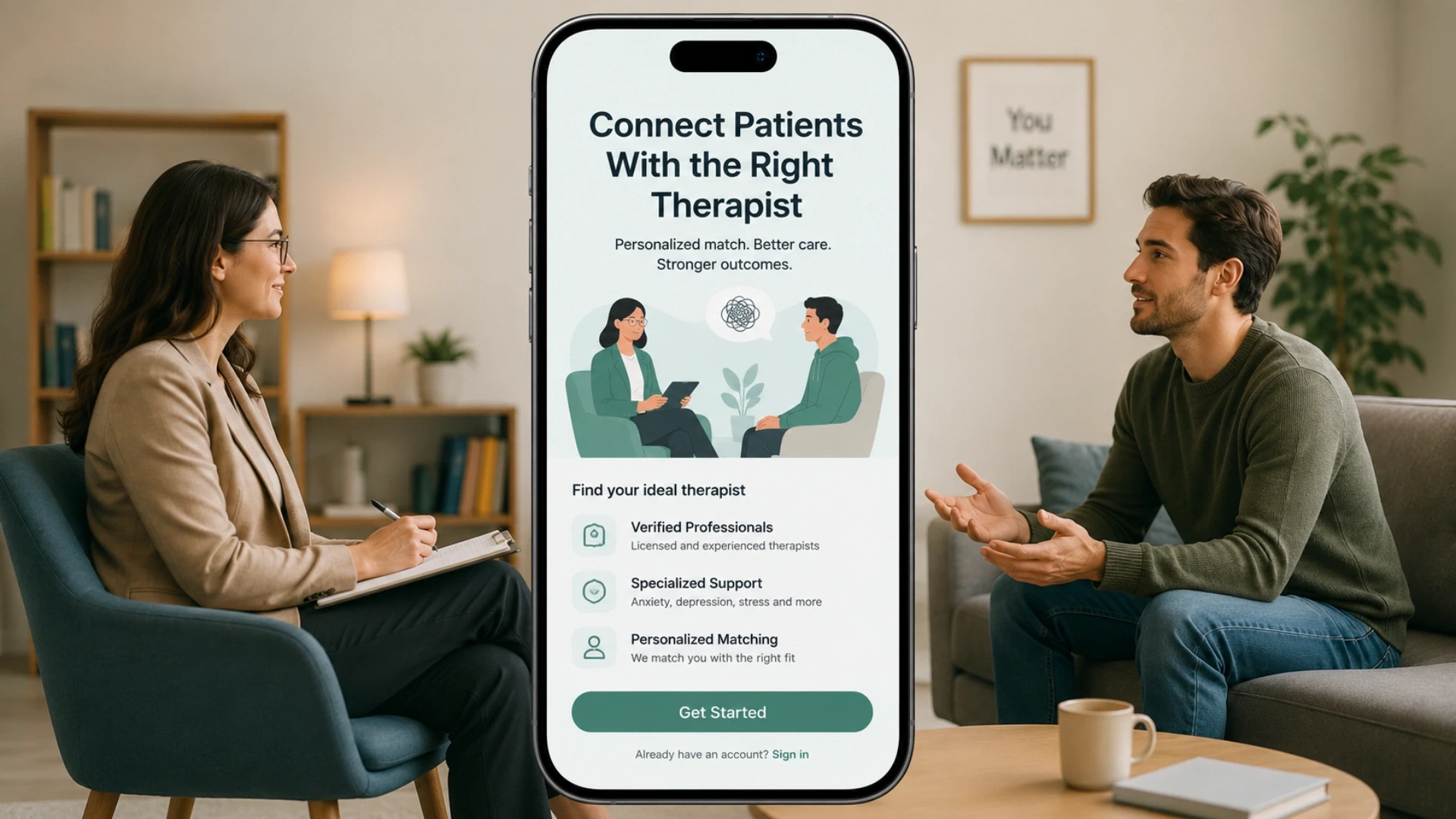
Therapy matching is the highest-stakes feature in a mental health marketplace app. The matching outcome, whether a patient finds a therapist they trust and who can actually help them, is the single biggest predictor of subscription retention in this category. A mismatched therapist is the most common cause of early churn.
The five matching dimensions that determine clinical fit
Speciality and presenting issue. Generalised anxiety, trauma, OCD, and depression require different therapeutic approaches. The intake questionnaire must map presenting symptoms to therapist specialities using a validated clinical taxonomy, not a free-form text field.
Availability and scheduling compatibility. A perfectly matched therapist who cannot see the patient for six weeks creates more frustration than a slightly less-matched therapist with a next-week opening.
Insurance and payment compatibility. For US markets, matching must account for the patient's insurance plan and whether the therapist is in-network. Out-of-pocket cost is the leading cause of abandonment after an initial match.
Preferred modality. Video, phone, or text-only are not interchangeable preferences. Some patients cannot or will not use video for mental health consultations. Surfacing this preference in the intake flow prevents mismatches at booking.
Language, cultural context, and demographic preferences. For patients who specifically need a therapist sharing their cultural background or primary language, this filter must be a first-class matching criterion, not buried in an advanced filter panel.
Algorithmic vs curated vs self-directed matching
Model | Mechanism | Best For |
Algorithmic | Rules-based or ML scoring on speciality, availability, insurance, language. | Platforms with 50 or more therapists. Scales without clinical overhead. |
Curated | Clinical coordinator reviews intake and makes the assignment. | Premium platforms, complex presentations, early-stage networks. |
Self-directed browsing | Users browse profiles and self-select. | Markets where user autonomy drives acquisition. Lower retention than algorithm-first. |
Most platforms in 2026 use a hybrid: algorithm for initial filtering, then self-selection from a curated shortlist of 3 to 5 profiles. Full automation without user agency produces lower retention than giving patients the final choice.
Acquaint Softtech's React Native developers build the therapist profile and matching interface as a cross-platform mobile product from a single codebase, while the backend matching logic runs in Laravel with a configurable rules engine that clinical administrators can tune without a code deployment.
Mood Tracking and Journaling: The Retention Engine of Every Mental Health App
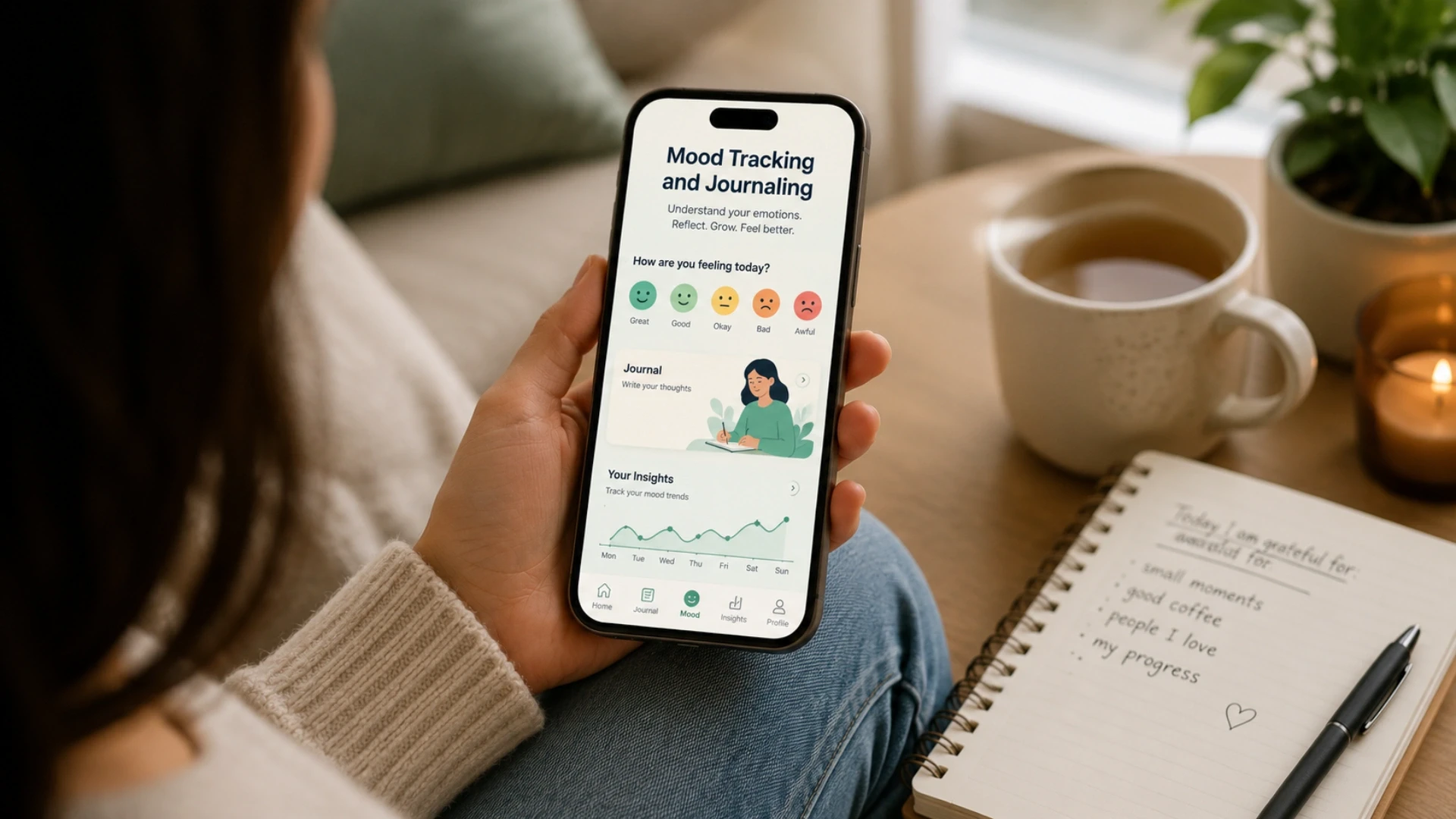
Mood tracking and journaling are the backbone of daily retention in mental health apps and the features most correlated with long-term user outcomes. They are also the features most founders underinvest in, because they appear simple. A mood tracker that takes longer than 30 seconds to complete will not be used daily. A journal feature without structured prompts will be abandoned by more than 80 per cent of users within two weeks.
Mood tracking: the minimum viable implementation
One-tap entry as the primary interaction. A visual mood scale — emoji, colour gradient, or numeric, completed in a single tap. This is the MVP. Everything that follows is enhancement, not a prerequisite.
Optional context tags after the mood entry. Sleep, stress, exercise, relationships, work. These take 5 to 10 additional seconds and produce the analytical signal that makes mood trend data useful. They must be optional.
Trend visualisation over 7, 30, and 90 days. Users return to see their patterns. The chart must be interpretable without explanation: colour-coded mood bands, trend lines, and markers for coping tool usage.
Optional free-text note. A text field after tags allows depth when the user needs it. Required text fields at mood entry are the single biggest contributor to mood-tracking abandonment.
Journaling: structured prompts outperform blank pages
Evidence-based journaling uses structured prompts drawn from CBT thought records, gratitude frameworks, and DBT distress tolerance exercises. A blank journal field achieves fewer than 20 per cent adoption among users who encounter it. A rotating daily prompt achieves 3 to 5 times higher daily usage (December 2025). Guided journaling with prompts adapted to the user's recent mood history is the 2026 baseline for any mental health app that wants journaling to contribute to retention.
AI journaling in 2026 adds: voice-to-text with automatic transcription, pattern recognition identifying recurring themes, and prompts that adapt to mood history. These features add $20,000 to $50,000 in engineering cost and require a clinical review of AI output guidelines before launch. For the AI architecture behind these features, Acquaint Softtech's AI development services cover NLP-based journaling analysis, mood pattern detection, and the clinical safety documentation required before AI output goes to users.
Crisis Safety Architecture: The One Feature You Cannot Compromise
A crisis safety feature is not a product decision. It is an ethical and legal requirement for any mental health app serving users who may experience suicidal ideation, self-harm urges, or acute psychiatric emergencies. The design of this feature must be reviewed by a licensed mental health clinician before the app goes live.
One-tap access from every screen. The crisis resource must be reachable with no more than one tap from any screen in the app. Navigation to a settings menu, a help section, or a profile page before reaching crisis resources is clinically dangerous. The safety button belongs in the persistent navigation header.
Verified crisis resources only, never AI-generated alternatives. Display nationally verified hotlines: 988 Suicide and Crisis Lifeline (USA), Crisis Text Line (text HOME to 741741), and SAMHSA National Helpline (1-800-662-4357). Never route a user in active crisis to an AI chatbot as the primary response; this is both ethically wrong and a regulatory risk.
Minimum of three pathways. Provide a phone number, a text-based option, and a direction to the nearest emergency service for acute imminent risk. Different users reach out differently. A single pathway excludes the users who cannot use it.
Escalation pathway to assigned therapist. If the app connects users with therapists, build a mechanism for the user to trigger a non-emergency escalation notification to their assigned therapist when they need same-day support but are not in immediate danger.
Monthly resource verification by a named owner. Crisis hotline numbers change. Assign a clinical review owner who verifies all crisis resource accuracy monthly. A disconnected phone number in a crisis flow is a patient safety failure and a potential liability event.
The FDA’s 2025 guidance on AI-based mental health tools requires strict human escalation pathways, ensuring AI cannot replace clinical intervention in crises. To build compliant healthcare platforms, experienced backend teams such as Acquaint Softtech’s Laravel developers Hire Laravel Developers are often engaged to design secure, regulated architectures with proper safety controls and clinical oversight before launch.
HIPAA, FTC, and FDA: Three Regulations, One Compliance Map
Mental health app development process step by step always begins with regulatory scoping. Three overlapping frameworks govern the compliance obligations, and which ones apply depends entirely on what the app does, who it serves, and whether it makes clinical claims. The most dangerous assumption is that a wellness app requires no compliance architecture.
Regulation | Applies When | Key Requirement |
HIPAA (USA) | Handling PHI for covered entities | Encryption, RBAC, audit logs, BAAs |
FTC Health Breach Rule | Health data outside HIPAA scope | User breach notification within 60 days |
42 CFR Part 2 | Substance use treatment records | Enhanced patient consent controls |
FDA SaMD | Diagnostic or treatment claims | FDA regulatory approval/documentation |
GDPR (EU/UK) | Collecting EU/UK user data | Consent, data protection, right to erasure |
HIPAA compliance adds 25 to 35 per cent to development cost: non-compliance adds 1900 per cent in fines
HIPAA compliance adds approximately 25 to 35 per cent to development costs when built from day one (March 2026). Retrofitted after build, it adds 40 to 60 per cent. Non-compliance can result in fines up to $1.9 million per violation category annually (Purrweb, March 2026). The FTC Health Breach Notification Rule applies to consumer wellness apps regardless of HIPAA status. The safest approach for any mental health app handling user health data is to build to HIPAA standards from sprint one; it protects users, builds enterprise trust, and costs far less than remediation.
Acquaint Softtech's DevOps engineers configure HIPAA-eligible AWS infrastructure for all mental health app builds as a standard first-sprint deliverable, before any application code is written. The infrastructure is defined as Terraform code, reproducible, version-controlled, and auditable for HHS or OCR investigations.
AI Safety Guardrails: What Is Safe to Build and What Requires FDA Clearance
AI features in mental health apps occupy a safety spectrum from high-value and clinically safe to legally prohibited without FDA clearance. The 2026 line is drawn at clinical claims: AI that supports a user's wellbeing is a tool; AI that autonomously diagnoses or prescribes for a named mental health condition is a medical device.
AI Feature | Safety Classification | Key Constraint |
Personalised content recommendation | Safe (non-clinical) | Suggestions only, not medical prescriptions |
Mood pattern detection | Safe (analytical) | Insights only, no diagnosis |
AI journaling prompts | Safe (review-based) | For reflection, not clinical decisions |
AI emotional support chatbot | Safe (bounded use) | Must escalate on risk signals |
Predictive crisis detection | High risk | Human review required, no autonomous action |
AI diagnosis or treatment advice | Not permitted | Requires FDA SaMD approval |
Every AI feature's user-facing copy must be reviewed by a licensed mental health clinician before launch. The distinction between 'we noticed your mood has been lower this week, here is a breathing exercise' (safe) and 'our AI has detected symptoms consistent with major depressive disorder' (FDA SaMD) lives in the language, not in the underlying algorithm. A single sentence of copy can determine whether an app is a wellness tool or an uncleared medical device.
Acquaint Softtech's AI and ML engineering services produce clinical boundary documentation for every AI feature as a required pre-deployment deliverable, specifying inputs, outputs, intended use, and FDA SaMD exclusion confirmation, while also providing scalable development support through their team of hired MERN stack developers for building compliant healthcare applications.
Tech Stack for Mental Health App Development in 2026
Mental health app architecture and tech stack choices are constrained by three requirements: cross-platform mobile delivery for reach, HIPAA-compliant infrastructure for clinical data, and real-time communication quality for teletherapy sessions. The following stack reflects Acquaint Softtech's production choices for mental health mobile platforms built for the US, UK, and EU markets.
Layer | Technology | Mental Health Reason |
Mobile App | React Native | Single codebase, cost-saving, HIPAA-friendly architecture |
Backend API | Node.js / Laravel | Real-time therapy + structured clinical workflows |
Video Teletherapy | Twilio Video / Daily.co | HIPAA-compliant video with BAA support |
Secure Messaging | Twilio / WebSockets (TLS 1.3) | Encrypted therapist–patient communication |
Database | PostgreSQL (AES-256) | Secure storage of PHI with encryption |
Mood & Journals | TimescaleDB / InfluxDB | Efficient mood tracking and trend analysis |
AI & NLP | Python (Hugging Face, OpenAI) | Sentiment analysis and personalisation |
Cloud Infrastructure | AWS HIPAA-eligible | Secure hosting, audit logs, compliance controls |
Most mental health apps in 2026 are built cross-platform using React Native or Flutter, with React Native having broader healthcare-specific library support for HIPAA-compliant integrations (Purrweb, March 2026). Flutter is growing in share for apps where visual design differentiation is the primary differentiator.
Acquaint Softtech's React development team builds mental health apps as cross-platform products with HIPAA compliance logic unified across iOS and Android. AWS HIPAA-eligible infrastructure defined as Terraform code is deployed before any application feature is written — ensuring compliance is a foundation, not a retrofit.
Case Study: Verified Clinical Platform Delivery: BIANALISI SPA, Italy
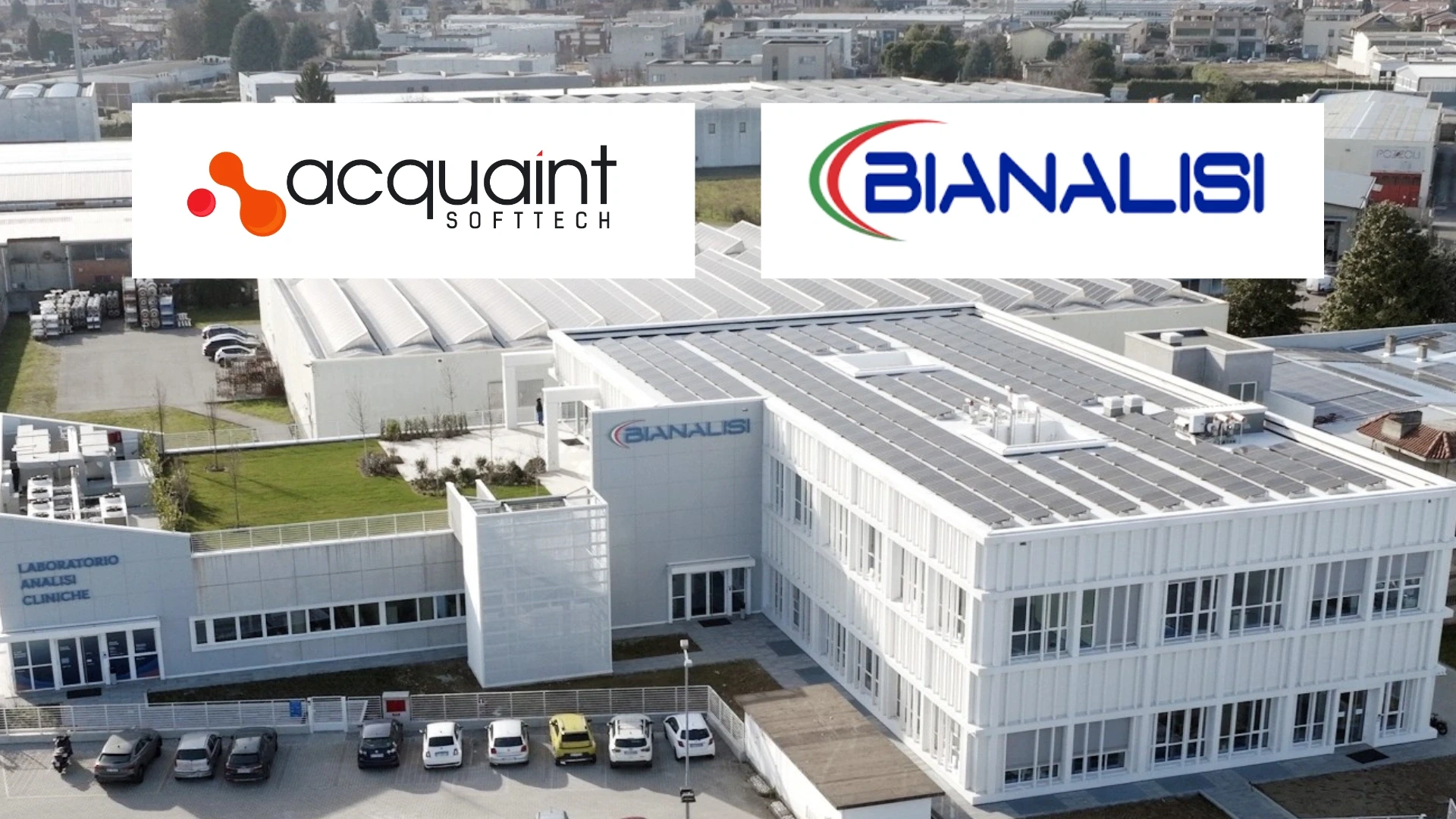
The following is drawn from a verified Clutch client review submitted February 22, 2026. All outcomes are client-reported and publicly verifiable.
Client: BIANALISI SPA, Italy's largest integrated diagnostics group (1,001 to 5,000 employees)
Reviewer: Giovanni Gianolli, CEO, BIANALISI SPA
Project: Clinical Data Analysis and Predictive Health Intelligence Platform — cross-facility analytics with role-specific user dashboards
Technology: Python (pandas, scikit-learn, FastAPI), PostgreSQL, React.js dashboard, European-compliant cloud infrastructure
Duration: April to November 2025 — 7 months. All milestones on schedule despite mid-project regulatory scope changes.
Clutch Rating: 5.0 out of 5.0 across Overall, Quality, Schedule, and Cost | Verified: February 22, 2026
Three lessons from this engagement that apply to mental health app development
Compliance from sprint one is cheaper than compliance from sprint 10. European data protection requirements were integrated into the data pipeline before any user-facing feature was built. This approach, compliance architecture first, application features second, is identical to the HIPAA-first build pattern required for US mental health apps. Teams that defer compliance discovery to pre-launch spend 40 to 60 per cent more and miss their launch dates.
Clinical trust requires clinical validation. Every predictive output from the BIANALISI platform was reviewed by BIANALISI’s clinical specialists before being surfaced to users, reflecting the same principle used in regulated AI healthcare systems where outputs must be reviewed by licensed clinicians before deployment, not after. For building such compliant systems, teams often hire experienced full-stack experts like Hire MEAN Stack Developers to ensure secure architecture, auditability, and healthcare-grade implementation from the start.
Role-specific UX drives adoption. Medical directors and clinical supervisors needed different interfaces to the same underlying data. Getting this right is what drove platform adoption across the BIANALISI network. The same principle applies to mental health apps: therapist-facing interfaces and patient-facing interfaces must be designed independently for their respective user workflows, not as one interface split by a role toggle.
Mental health app development company in India, proposal in 2 weeks, HIPAA from sprint one.
Acquaint Softtech builds mental health apps: React Native cross-platform, HIPAA-compliant video (Twilio/Daily.co), AI journaling features, crisis safety architecture, and therapy matching engines. $25 to $49/hour. 50 or more Clutch reviews. 95 per cent on-time delivery.
Mental Health App Development Cost in 2026
Mental health app development cost 2026 ranges from $40,000 for a simple wellness MVP to $400,000 or more for a full teletherapy platform with AI integration and HIPAA billing. The data below is drawn from Acquaint Softtech's project portfolio.
App Scope | Cost (USD / EUR) | Timeline |
Wellness MVP (mood tracking, journaling, basic HIPAA) | $40K–$80K (€37K–€74K) | 2–4 months |
Mid-tier (therapist matching, messaging, video, scheduling) | $80K–$200K (€74K–€185K) | 4–8 months |
Full teletherapy (AI, CBT, EHR, billing) | $200K–$400K (€185K–€370K) | 8–14 months |
Digital Therapeutic (DTx, FDA SaMD, clinical validation) | $400K–$1M+ (€370K–€925K+) | 18–36 months |
Costs that mental health app projects consistently underestimate
HIPAA compliance adds 25 to 35 per cent to development cost when designed from sprint one. Retrofitted post-build: 40 to 60 per cent. Always scope compliance as a sprint-one deliverable.
HIPAA-compliant video therapy (Twilio or Daily.co with BAA) adds $15,000 to $40,000 and 4 to 8 weeks above core app scope.
Clinical content creation: CBT exercise libraries, guided meditation audio, and evidence-based journaling prompts are not engineering line items but must be budgeted separately. A clinically reviewed content library costs $10,000 to $50,000.
AI feature engineering: NLP journaling analysis and mood pattern detection add $20,000 to $60,000. Clinical review of AI response guidelines before deployment adds 3 to 6 weeks of non-engineering time.
App Store review latency: Apple App Store mental health category reviews take 2 to 4 weeks longer than standard apps. Include this in go-live timeline planning.
Hire developers for mental health app through Acquaint Softtech at $25 to $49 per hour (Clutch-verified). This represents 40 per cent average cost savings versus US agency rates. HIPAA infrastructure is included as a standard first-sprint deliverable for all healthcare app engagements. Flexible scale-up via the staff augmentation model allows adding React Native engineers and AI specialists for intensive feature phases.
Custom mental health app software development services — clinically safe, compliant, delivered.
Acquaint Softtech builds mental health apps with crisis safety architecture, therapy matching engines, HIPAA-compliant video, AI journaling features, and mood tracking on React Native from a single codebase. 4.9/5, 50 or more Clutch reviews, Premier Verified. 1,300 or more projects.
Frequently Asked Questions
-
What features does a mental health app need?
A mental health app needs mood tracking, CBT-based journaling, crisis hotline access (e.g., 988), guided content like meditation and breathing exercises, push notifications, and optional therapist support with secure messaging and video. These features help users monitor emotional health and access support in real time.
-
How much does mental health app development cost in 2026?
Costs range from $40,000 to $80,000 for an MVP, $80,000 to $200,000 for a mid-tier therapy platform, and $200,000 to $400,000+ for AI-based teletherapy apps. Digital therapeutics may exceed $1 million. Pricing depends on features, compliance, and integrations.
-
How long does it take to build a mental health app?
Development takes 2 to 4 months for MVPs, 4 to 8 months for mid-tier apps, and 8 to 14 months for full teletherapy platforms. FDA-regulated digital therapeutics can take 18 to 36 months. Timelines also depend on compliance and app complexity.
-
What is the best tech stack for a mental health app?
A modern stack includes React Native or Flutter, Node.js or Laravel backend, PostgreSQL with AES-256 encryption, Python for AI features, and AWS HIPAA-eligible cloud with Twilio or Daily.co for video therapy. This ensures scalability and healthcare-grade security.
-
Does a mental health app need HIPAA compliance?
Yes, if it handles PHI for healthcare providers. Even wellness apps often follow HIPAA standards to improve security, enable partnerships, and reduce regulatory risk. Compliance also builds trust with users and organisations.
-
What features are required for teletherapy apps?
Teletherapy apps require therapist profiles, scheduling, secure messaging, HIPAA-compliant video calls, payment integration, and patient progress tracking. These features ensure smooth virtual care delivery between patients and therapists.
-
What are the safest AI features in mental health apps?
Safe AI features include mood trend analysis, personalised content, journaling prompts, and supportive chatbots. AI cannot diagnose or claim treatment without FDA approval. These features enhance engagement without clinical risk.
-
What is the difference between a mental health app and a digital therapeutic?
A mental health app supports general wellness, while a digital therapeutic provides clinically validated treatment and requires FDA Software as a Medical Device (SaMD) clearance. The difference lies in medical claims and regulatory requirements.
-
What is the most important feature in a mental health app?
The most important feature is one-tap crisis support with verified hotlines and immediate access to emergency help resources. This ensures users can get urgent assistance during critical situations.
-
Why are mental health apps important?
Mental health apps improve emotional well-being, support stress and anxiety management, increase access to care, and provide early intervention tools for users. They make mental health support more accessible and continuous.
I am Zubair Pateljiwala, a digital marketing professional with 15+ years of experience in SEO, content marketing, and performance marketing. As the Marketing Head at Acquaint Softtech, I focus on helping technology businesses improve their online visibility through SEO, GEO, AEO, and AI-driven content strategies. I enjoy transforming complex software development concepts into practical, easy-to-understand content that helps businesses make informed technology decisions.
Table of Contents
Get Started with Acquaint Softtech
- 13+ Years Delivering Software Excellence
- 1300+ Projects Delivered With Precision
- Official Laravel & Laravel News Partner
- Official Statamic Partner
Related Blog
The Complete Guide to Healthcare Software Development in 2026
Healthcare software development in 2026 is not a single discipline. It is six distinct product categories, each with its own compliance perimeter, integration burden, and cost curve.

Acquaint Softtech
May 1, 2026
How Telemedicine Apps Work: Architecture, Data Flow, and System Design Explained
A telemedicine app is not a video call with a medical logo. It is a distributed system that moves protected health information between four environments in under 200 milliseconds while staying inside HIPAA boundaries. Here is exactly how it works, layer by layer, with the tech stack, the data flow, and the numbers that matter.

Manish Patel
May 8, 2026
EHR vs EMR: What's the Actual Difference and Which Should You Build
Most people use EHR and EMR interchangeably. They are not the same system. One is a digital filing cabinet for a single practice. The other is a longitudinal health record that follows the patient across their entire care journey. Picking the wrong one costs founders 9 to 14 months of rework. Here is how to choose correctly the first time.

Ahmed Ginani
May 15, 2026India (Head Office)
203/204, Shapath-II, Near Silver Leaf Hotel, Opp. Rajpath Club, SG Highway, Ahmedabad-380054, Gujarat
USA
7838 Camino Cielo St, Highland, CA 92346
UK
The Powerhouse, 21 Woodthorpe Road, Ashford, England, TW15 2RP
New Zealand
42 Exler Place, Avondale, Auckland 0600, New Zealand
Canada
141 Skyview Bay NE , Calgary, Alberta, T3N 2K6