

How to Build a Multi-Vendor Marketplace?
A multi-vendor marketplace is an online platform where multiple vendors sell products to multiple customers in one place, similar to Amazon or eBay. To build one, choose a niche and revenue model, select a platform (open-source, SaaS, or custom), and launch an MVP with essential features such as vendor and customer accounts, dashboards, product listings, search, cart, secure payments, ratings, and an admin panel. Development costs usually range from $30,000 to $150,000, depending on the features and scale.

Mukesh Ram
As the Founder and CEO at Acquaint Softtech, I have watched multi-vendor marketplaces grow from a niche idea into one of the most reliable business models in eCommerce. A multi-vendor marketplace is a place where consumers connect with many different vendors to find the right product, and almost all of us are familiar with giants like Amazon and eBay. Our eCommerce software development team builds these platforms for businesses across the USA, UK, Europe and Australia.
There are many factors to consider when developing such a solution, since there are several types of marketplaces, various monetisation strategies you can implement, and multiple ways to build it.

- You are an entrepreneur or business planning a multi-vendor marketplace.
- You want the exact features, monetisation models and tech involved.
- You want a realistic cost range and a clear build process.
- You are weighing open-source, SaaS or custom development.
- You are launching across the USA, UK, Europe or Australia.
This guide walks through what a multi-vendor marketplace is, how it differs from a single-vendor store, the benefits, challenges, must-have features, the development approaches, a step-by-step process, honest cost, monetisation, and a real client case study.
What Is a Multi-Vendor Marketplace?
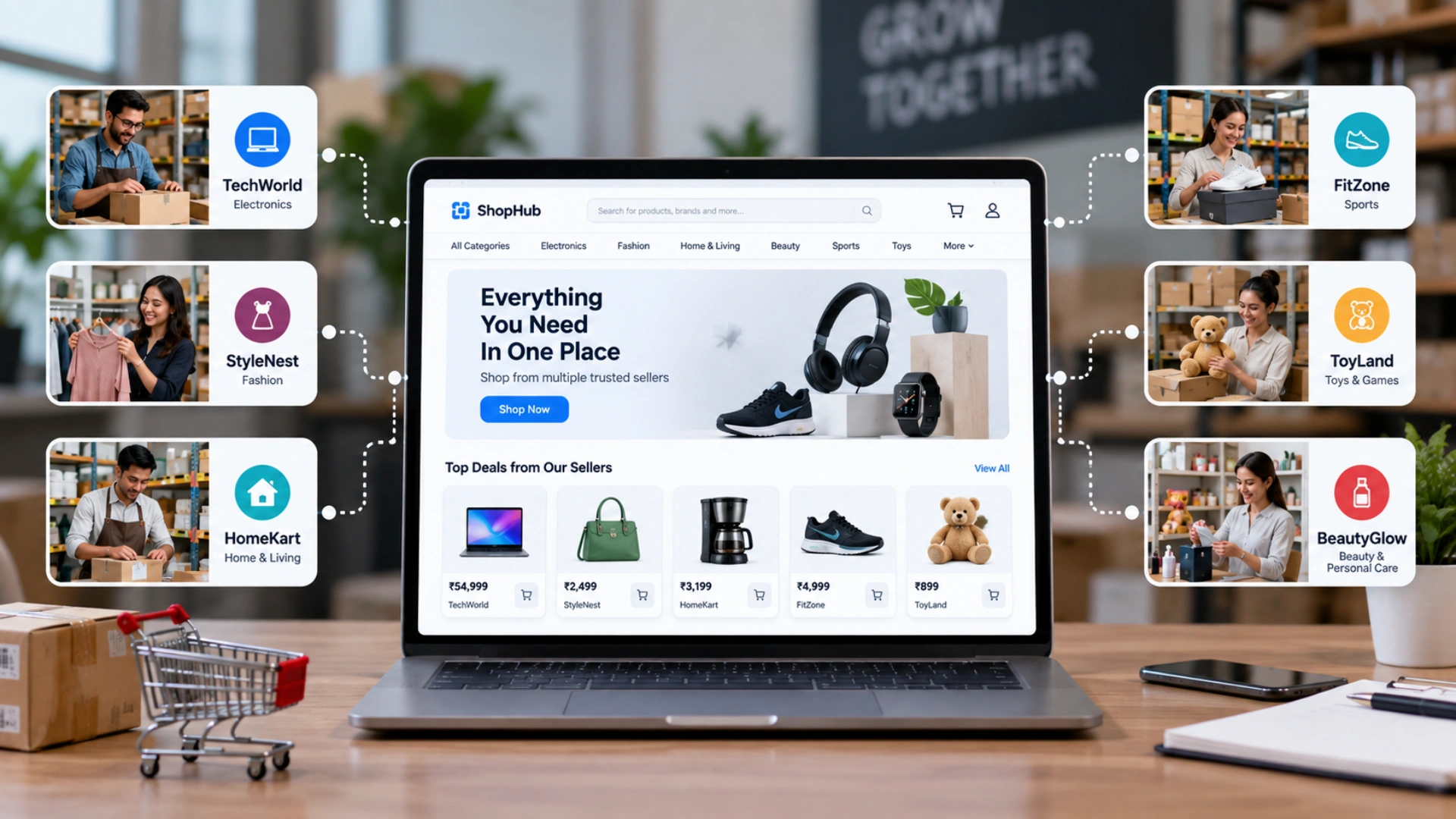
A multi-vendor marketplace is an online platform where many vendors sell a wide range of products to many customers in one place.
The multi-vendor marketplace has evolved from eCommerce stores and is essentially an online platform where the consumer can access multiple vendors and buy a wide range of products. Amazon and eBay are the best-known examples.
It fits electronic products, groceries, household items, furniture, and much more, and it also works for services like airline tickets, bus travel, and hiring professional help. The marketplace hosts the vendors, the vendors list and fulfil orders, and the platform earns a share through commission, subscriptions, ads, or other models.
Multi-Vendor vs Single-Vendor Marketplace
A single-vendor store sells one business's products; a multi-vendor marketplace hosts many vendors, adding an extra user type and shared control.
The two popular types of marketplaces are single-vendor and multi-vendor. A single-vendor marketplace is custom-developed for one business selling a fixed range of products, with only two user types, sellers and buyers, and the business has complete control of the store.
A multi-vendor store adds a third user type, the vendors, alongside customers and the admin, and control is shared: each vendor manages their own store while the admin oversees the platform.
Aspect | Single-vendor | Multi-vendor |
User types | Buyer, seller | Buyer, vendor, admin |
Control | One business owns all | Shared vendor + admin |
Best for | One brand's catalogue | Many sellers, wide range |
Benefits of a Multi-Vendor Platform

A multi-vendor marketplace gives vendors a ready-made store and customers a wide choice, while the owner earns without holding inventory.
More people prefer shopping online, and consumer behaviour involves researching products and comparing stores before buying. A marketplace serves that behaviour, and vendors need not spend heavily to set up shop online. The main benefits include:
Vendors gain a store with quick checkout, flexible payments and a large consumer base.
Vendors avoid platform maintenance and its cost.
Consumers get access to many vendors offering similar products at good rates.
A high consumer base lets buyers read other customers' reviews before purchasing.
Set-up cost is not very high, so an entrepreneur can hire the right development firm and market it to grow.
The demand is real: the eCommerce market continues its double-digit growth in 2026, and multi-vendor models capture a rising share of it, per Grand View Research. A well-built marketplace is a strong bet on where online retail is heading.
Your niche has vendors ready; give them a marketplace worth selling on.
Tell me your product category and target region, and within 48 hours I will send a feature map, monetisation model and launch plan tailored to your marketplace. No cost, no obligation.
Common Challenges (and How to Solve Them)

The biggest challenges are attracting both vendors and buyers, building trust, and getting payments, checkout, and UX right.
Building a marketplace means solving a two-sided problem: you need vendors to attract buyers, and buyers to attract vendors. This is a highly competitive market, so a clear go-to-market strategy matters as much as the build.
A smooth payment and checkout system and an appealing, trustworthy UI/UX are hard to get right, and security is non-negotiable because you are handling money and personal data. The solution is to launch a focused MVP, seed one side of the market first (often vendors), and invest early in trust signals, performance, and a frictionless checkout.
Main Features of a Multi-Vendor Marketplace
Core features span accounts, vendor dashboards, product pages, search, cart, secure payments, reviews, notifications, and admin control.
A marketplace must feel effortless for three groups at once: customers, vendors, and admins. The table groups the essentials, with detail below.
Feature group | Examples | Who it serves |
Selling tools | Vendor dashboard, inventory, reports | Vendors |
Buying experience | Search, wishlist, cart, checkout | Customers |
Trust & control | Ratings, reviews, notifications, admin | All + admin |
Easy register/login for both customers and vendors to create and manage accounts.
Custom vendor dashboard to track shipments, manage inventory and run the store.
Detailed product pages with rich descriptions, image galleries and optional videos.
Wishlist so customers can save products to buy later.
Flexible payment gateway supporting multiple methods for a simple payment process.
Secure platform built with reliable technologies and techniques.
Ratings and reviews so users can rate and review purchased products.
Notifications for availability, price watch, offers, and discounts.
Simple, fast checkout, including quick checkout.
Accessible 24x7 support plus a detailed FAQ section.
Reports and analysis for vendors and admins to optimise sales and performance.
Robust product search with filters, and an appealing, easy-to-navigate interface.
Factors to Consider Before You Build
Clarify your purpose, research the industry and audience, study competitors, and plan the model, budget, tech, and unique features.
Establish the main purpose of your marketplace, which guides design and branding.
Research thoroughly, since a lack of consumer demand is a major cause of failure.
Research the industry and identify your target audience and their buying triggers.
Talk to potential vendors to understand what matters to them.
Study successful competitors and the approaches that work.
Study the challenges you may face, and plan the business model, investment, tech, and unique features.
Development Approaches Compared
You can build with open-source, buy into SaaS, or develop custom; the best approach balances speed, control, and cost.
There are several ways to build a marketplace, and the right one depends on your goals. Open-source frameworks such as Laravel development, or eCommerce solutions like Bagisto, let you build a custom platform from the ground up. SaaS platforms work on a subscription basis and get you live fast with less control.
Fully custom development gives maximum control and differentiation. Whichever you choose, launching as an MVP first is the fastest way to reach the market, study your audience, and reduce risk.
Approach | Best for | Trade-off |
Open-source/custom | Differentiation, full control | More build effort |
SaaS platform | Speed, low upfront cost | Less flexibility |
MVP first | Fast launch, lower risk | Fewer features at start |
How to Build It: Step-by-Step Process

Building a marketplace follows a clear sequence from research to a launched MVP you can grow.
Research and define the niche: validate demand, pick a category and identify your audience and vendors.
Choose model and monetisation: decide C2C or B2C and how you earn (commission, subscription, ads).
Select the approach and stack: open-source, SaaS or custom, based on control and speed.
Design the three experiences: clear flows for customers, vendors and admins.
Build a secure MVP: ship the core features first, then test payments, search and checkout hard.
Launch, acquire and grow: onboard vendors and buyers, then market with SEO, content, PPC, social media and media buying.
Cost to Build a Multi-Vendor Marketplace

A multi-vendor marketplace typically costs 30,000 to 150,000 USD and up, driven by features, integrations, and scale.
It is hard to give an exact figure because cost depends on the complexity of requirements, the platform and features, the technology, integrations, and the development partner and its location. Startups can control cost by launching an MVP first. The table shows directional 2026 ranges.
Build type | What it includes | Cost (USD) |
MVP marketplace | Accounts, vendor dashboard, catalogue, cart, payments | 30,000 – 70,000 |
Full marketplace | Web + mobile, reviews, analytics, admin, integrations | 70,000 – 130,000 |
Advanced platform | Scale, multi-currency, AI search, custom features | 130,000 – 150,000+ |
To control cost and speed, launch a lean MVP development and scale, and consider IT staff augmentation or software development outsourcing to build a feature-rich solution within budget.
Monetisation Strategies
Common ways to earn include commission, subscriptions, listing fees, ads, your own store, and lead fees.
Subscriptions: charge a routine fee for access, so earnings are independent of vendor sales.
Commission: take a cut of every transaction, so revenue rises with sales.
Listing charge: charge vendors a fee to list products or services.
Own store: sell your own goods on the platform and earn from those sales.
Ads: sell ad placements to vendors and third parties.
Lead fee: charge for providing qualified leads, which suits some business types.
Not sure which monetisation model fits your marketplace?
Share your niche and target vendors, and I will recommend the revenue model and feature set that will actually make you money, with a scoped plan and honest cost in 48 hours.
Client Case Study
Acquaint Softtech improved a live eCommerce marketplace (Lampoo), raising site speed and session time, cutting dropped carts, and handling high sales traffic.
Case Study: Lampoo, eCommerce marketplace optimisation
Client: Lampoo, an online marketplace (founder Enrico Trombini).
Challenge: Improve performance, seller onboarding and reliability, and handle heavy traffic during sales.
Solution: Acquaint Softtech optimised the platform, streamlined the seller upload process, and hardened it for scale.
Result: Improved site speed, higher average session duration on product pages, fewer dropped carts, a smoother seller upload process, fewer update queries, and stable performance under high sales traffic.
Proof: Verified 5-star review on Clutch
This is one example of a standard reflected in a 5-star Clutch rating across 60+ reviews, 1,293+ clients on Upwork with a 98% success rate, and 1,300+ projects delivered by 70+ in-house engineers over 13+ years. Explore more in our case studies.
Why Work With Acquaint Softtech
You get an experienced eCommerce team that builds secure, scalable marketplaces, launches you lean, and supports you as you grow.
The multi-vendor marketplace is the future of online shopping, and we have deep eCommerce experience across Bagisto, Magento, Shopify, BigCommerce, and WooCommerce. We understand the industry, use tried-and-tested methods and a dedicated QA team to keep the platform bug-free, and implement the latest technologies. Whether you need to hire eCommerce developers for a custom build or ongoing support and maintenance, we help turn your marketplace idea into a profitable platform.
To Sum Up
A high percentage of people now prefer to shop online for a wide range of products, and the number with access to smartphones, laptops, and tablets keeps rising. That makes a multi-vendor marketplace a smart, future-proof investment. Success comes from a sharp niche, the right monetisation model, and a secure, scalable, well-designed platform, ideally launched as an MVP and grown from there. Our experienced eCommerce team can build yours for businesses across the USA, UK, Europe and Australia.
Let's turn your marketplace idea into a shippable plan.
Book a free 30-minute call with our team. We will scope the MVP, features, monetisation and cost, and you leave with a plan you can act on — even if you build it elsewhere.
Frequently Asked Questions
-
What is a multi-vendor marketplace?
A multi-vendor marketplace is an online platform where many independent vendors sell to many customers in one place, like Amazon or eBay. The platform hosts the vendors, who list and fulfil their own orders, while the owner earns through commission, subscriptions, ads or other models.
-
How do you build a multi-vendor marketplace?
Define your niche and monetisation model, choose an approach (open-source such as Laravel or Bagisto, SaaS, or custom), then design and build a secure MVP with accounts, vendor dashboards, product pages, search, cart, payments, reviews and an admin panel. Test payments and checkout, launch, then acquire vendors and buyers.
-
How much does it cost to build a multi-vendor marketplace?
An MVP marketplace typically costs 30,000 to 70,000 USD; a full web and mobile platform runs 70,000 to 130,000, and an advanced platform starts around 130,000 and up. Feature depth, integrations, scale, and the development team's location are the main cost drivers.
-
How do multi-vendor marketplaces make money?
Common models include commission on each sale, vendor subscriptions, listing fees, advertising, running your own store on the platform, and lead fees. Many marketplaces combine two or three, such as commission plus subscriptions, based on their niche and vendor base.
-
Which is better, single-vendor or multi-vendor?
It depends on your goal. A single-vendor store suits one brand selling its own catalogue with full control. A multi-vendor marketplace suits hosting many sellers and offering wide choice, and it can scale revenue without holding inventory, but it needs to attract both vendors and buyers.
-
What is the best way to build a marketplace quickly?
Launch an MVP first, with only the core features, so you reach the market fast, study real users, and reduce risk. You can use an open-source base like Laravel or Bagisto to speed development, then add advanced features once the model is proven.
I love to make a difference. Thus, I started Acquaint Softtech with the vision of making developers easily accessible and affordable to all. Me and my beloved team have been fulfilling this vision for over 15 years now and will continue to get even bigger and better.
Table of Contents
Get Started with Acquaint Softtech
- 13+ Years Delivering Software Excellence
- 1300+ Projects Delivered With Precision
- Official Laravel & Laravel News Partner
- Official Statamic Partner
Related Blog
.webp "MVP Chapter #6")
MVP Chapter #6: How to Build an MVP?
To build an MVP, identify a core user problem, isolate your riskiest assumption, and build only the essential features needed to test it. Focus on speed with simple tools or no-code platforms, launch quickly to real users, and gather data to iterate. In short: define the problem and user, cut scope to the must-haves, then build and launch fast to learn.
Mukesh Ram
August 31, 2022
Python Vendor Evaluation Scorecard: A Downloadable Framework for Side-by-Side Comparison
Python vendor evaluation scorecard for side-by-side vendor comparison. 10 criteria, weighted scoring, tier classification, and free downloadable framework 2026.
Mukesh Ram
July 22, 2026
How to Switch Software Development Vendors Without Losing 3 Months of Progress
By the time you decide to switch dev vendors, you have 4 months of budget invested and no appetite for another 3 months of disruption. The structured handover below cuts the transition from 10 weeks to 3.

Ahmed Ginani
April 10, 2026India (Head Office)
203/204, Shapath-II, Near Silver Leaf Hotel, Opp. Rajpath Club, SG Highway, Ahmedabad-380054, Gujarat
USA
7838 Camino Cielo St, Highland, CA 92346
UK
The Powerhouse, 21 Woodthorpe Road, Ashford, England, TW15 2RP
New Zealand
42 Exler Place, Avondale, Auckland 0600, New Zealand
Canada
141 Skyview Bay NE , Calgary, Alberta, T3N 2K6