

How to Build a Cross-Border Payment Platform: Corridors, FX, and Settlement
A cross-border payment platform enables international money transfers through routing, currency conversion, and settlement. It uses multiple payment rails and compliance checks to deliver fast and secure transactions.

Ahmed Ginani
What if cross-border payments could be completed in seconds instead of days?
As Head of Sales and Partnerships at Acquaint Softtech, I have seen how expert software product development services help fintech companies build secure, scalable cross-border payment platforms that streamline FX, compliance, and settlement. The challenge is not moving money across borders. It is orchestrating multiple payment rails, regulations, and currencies into a seamless, transparent transaction.
The opportunity is large, and the inefficiency is real. The cross-border payments market is projected to grow from around $238 billion in 2026 to $336 billion by 2031, yet the average cost of sending money still sits above 6%, far above the 3% global target, according to market and World Bank data.

- You want to build a remittance, payout, or B2B platform that moves money across borders.
- You need to understand corridors, FX, and settlement before briefing a development team.
- You want to know which payment rails to use and how multi-rail routing actually works.
- You are choosing target corridors across the USA, UK, Europe, UAE, and India.
- You need the tech stack, cost, and timeline to scope a build with confidence.
Acquaint Softtech has delivered 1,300+ software projects across 20+ industries in 13+ years, with 70+ in-house engineers, and clients in the USA, UK, Europe, Australia, and New Zealand deploy fintech products within 48 hours of a brief. That depth is what turns a corridor strategy into a working, compliant platform.
This article breaks down what the platform does, its three core components, how to choose corridors across five key markets, the payment rails, FX, settlement models, compliance, and the real tech stack, cost, and timeline. For the broader context on building and scaling fintech products end to end, start with the guide to software product development, the master pillar this article supports.
What a Cross-Border Payment Platform Actually Does
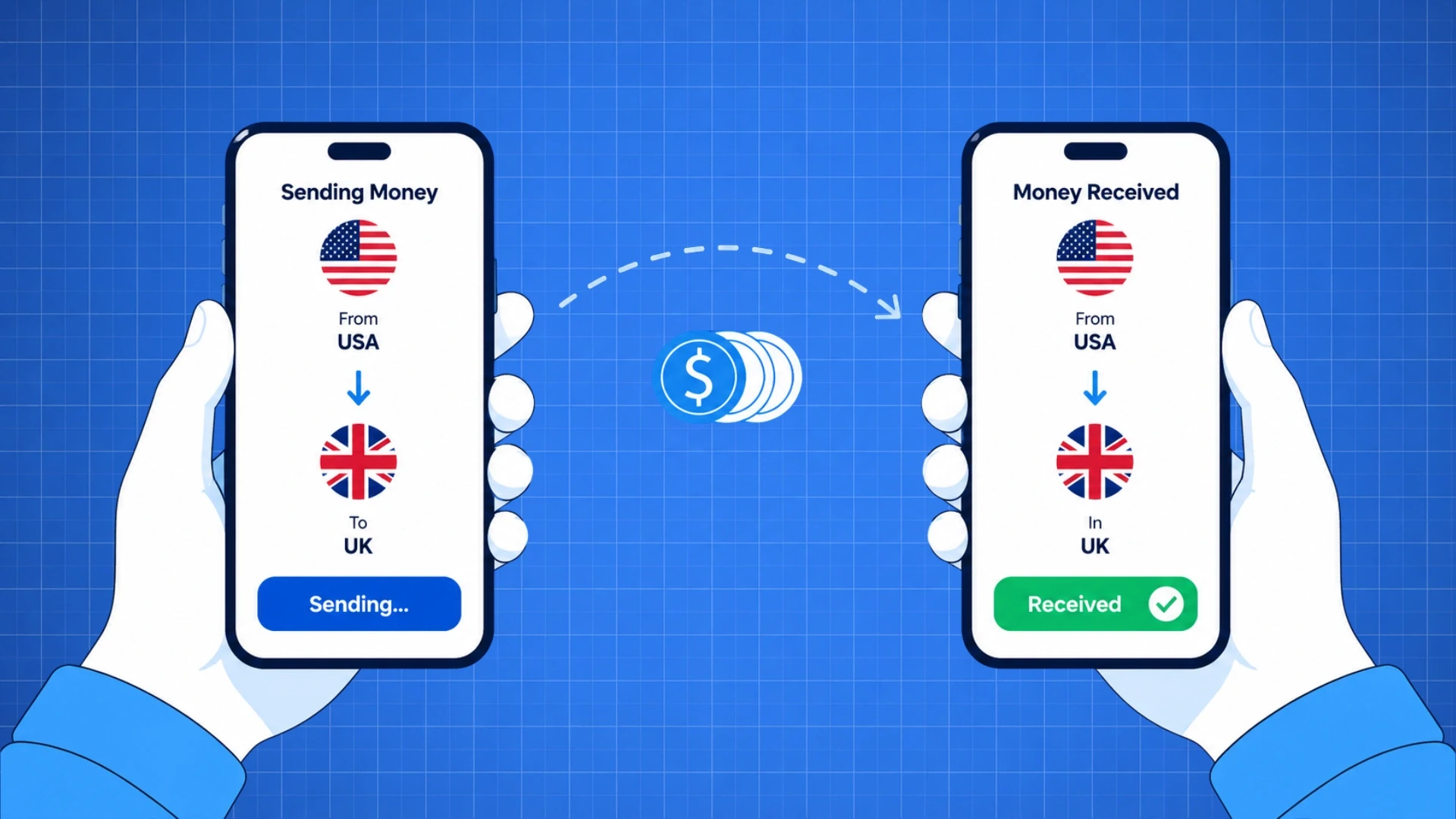
A cross-border payment platform moves value from a payer in one country to a payee in another, handling currency conversion, routing, settlement, and compliance along the way. It sits on top of underlying payment rails and adds the orchestration that decides how each payment travels. The legacy way, correspondent banking, chains multiple banks together with manual checks, which is why it is slow, opaque, and expensive. A modern platform replaces that with API-first, cloud-native routing across many rails. Teams that hire dedicated developers with payments experience build the orchestration layer rather than wiring up correspondent banks one by one.
The core shift in 2026 is from fragmented, batch-based processes to multi-rail strategies that select the fastest, most cost-effective route for each corridor. Interoperability between systems, currencies, and partners has become the key competitive advantage, and richer standards like ISO 20022 and SWIFT's CBPR+ are pushing the whole industry toward immediate processing. Building this interoperability is a core software product engineering services discipline.
Whether the platform serves consumer remittances, B2B payouts, payroll, or marketplace settlements changes the priorities, but the underlying machinery is the same. For a wider view of how payment and fintech delivery partners are evaluated, this roundup of MERN stack development companies in India breaks down the criteria that matter.
What are cross-border payments?
Cross-border payments are financial transactions between a payer and payee in different countries, used for international trade, e-commerce, remittances, and global business. They almost always involve foreign-exchange conversion plus differing rules and fees by country and method, which historically made them slow and expensive. A cross-border payment platform orchestrates the conversion, routing, settlement, and compliance to make these transfers faster and cheaper.
Building a Cross-Border Payment Product?
Acquaint Softtech builds cross-border payment platforms with corridor routing, FX, multi-rail settlement, and compliance from sprint one. Deploy your first fintech engineer within 48 hours of the brief.
The Three Core Components: Corridors, FX, and Settlement
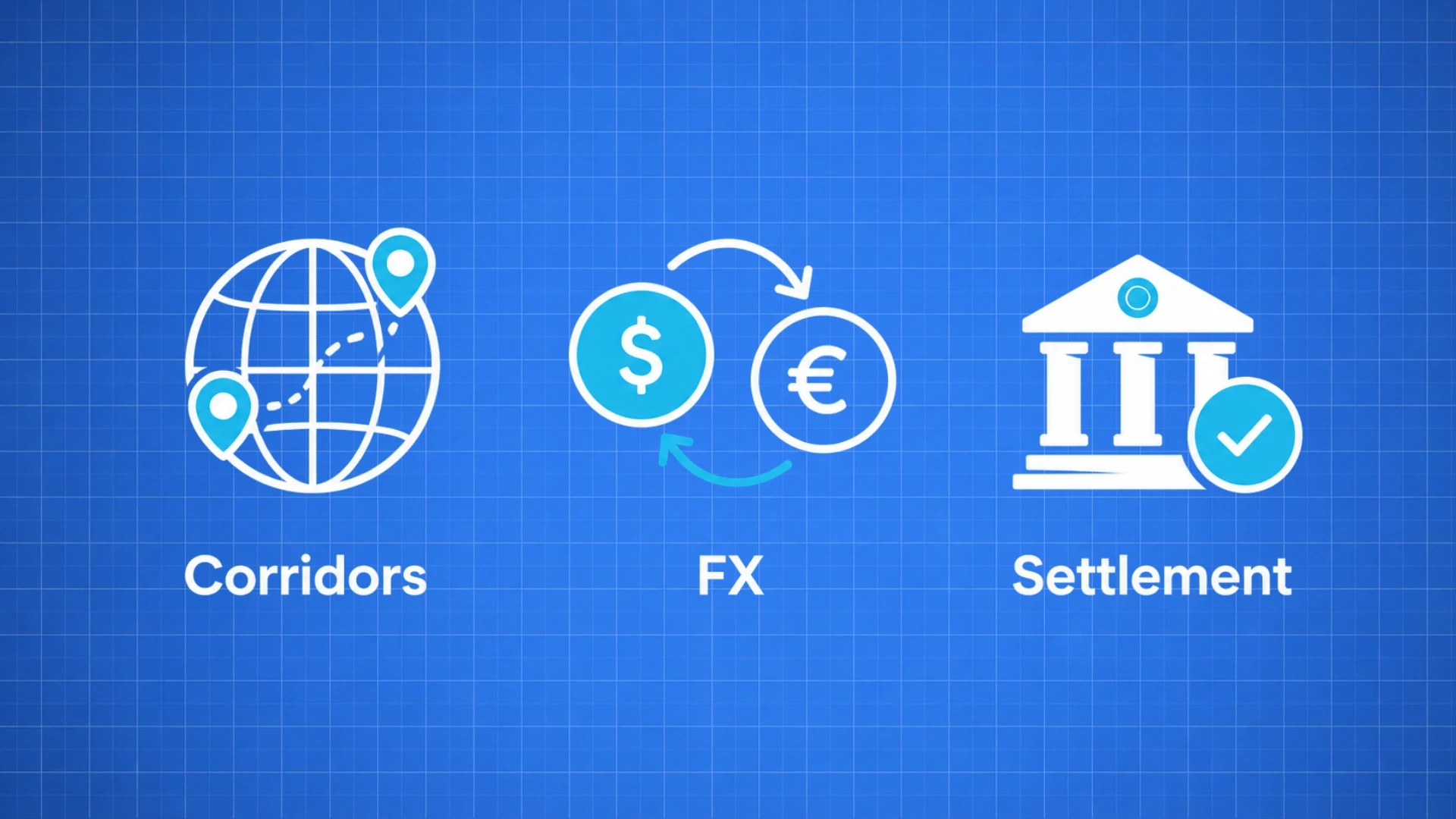
Every cross-border platform rests on three components: corridor routing, foreign exchange, and settlement, plus compliance screening that wraps all three. Corridor routing decides the path a payment takes between a specific send and receive market. FX converts the value between currencies. Settlement is how the money is actually funded and moved between participants. Get these three right and everything else is detail. Acquaint Softtech's Python developers build each component as a discrete service so they can evolve independently.
A service-based architecture is what makes this work, allowing FX, settlement, and screening to plug together cleanly rather than tangling into one monolith. The complexity that domestic payments avoid liquidity, jurisdictional boundaries, and settlement timing across multiple participants and currencies, is exactly what this architecture has to manage, which is why it benefits from software development outsourcing to a team that has built payment systems before.
Component | Job | Key Decision |
Corridor routing | Pick the path | Which rail per lane |
Foreign exchange | Convert currency | Liquidity source, markup |
Settlement | Fund and move money | Pre-fund vs. netting |
Compliance | Screen every payment | Sanctions, travel rule |
Treating these as separate, composable services is also what lets a platform add a new corridor or rail without rebuilding, the flexibility that defines a scalable design. The architecture patterns behind composable payment services are explained in this complete MERN stack development guide.
What are the main components of a cross-border payment system?
A cross-border payment system has three core components plus compliance: corridor routing, which selects the path between send and receive markets; foreign exchange, which converts the currency; settlement, which funds and moves the money between participants; and compliance screening, which checks every payment against sanctions and travel-rule requirements. A service-based architecture lets these components integrate cleanly and scale.
Choosing Corridors: USA, UK, Europe, UAE, and India
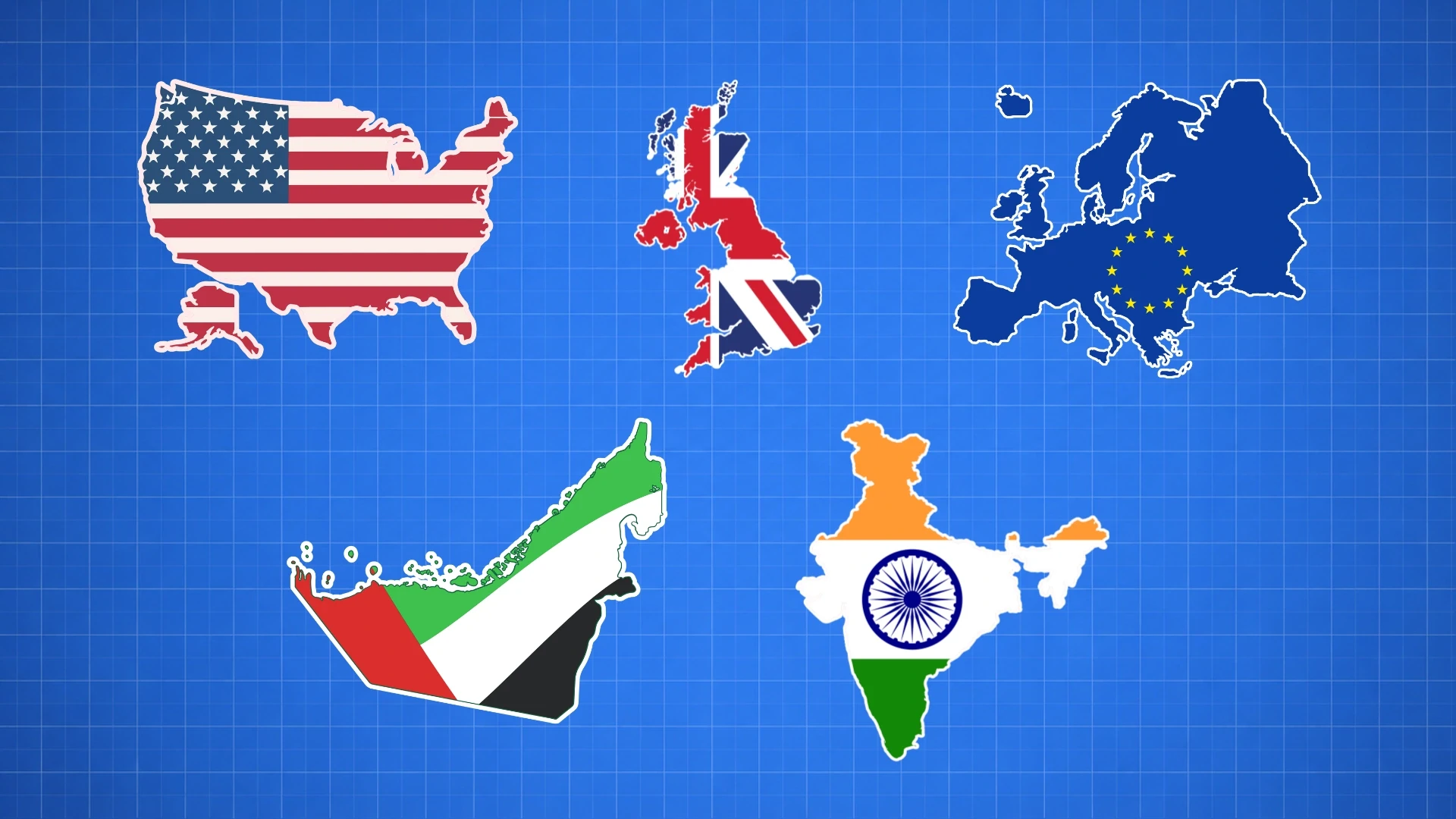
A corridor is a specific send-to-receive lane, like UK to India, and choosing the right ones is the most important strategic decision in the build. Volume alone should not decide it, because the highest-volume corridors are also the most competitive, where incumbents have already compressed margins. Acquaint Softtech's development teams help founders translate a corridor strategy into the routing and licensing the platform needs.
USA: the largest send market, with corridors like USA to India and USA to Mexico, but intensely competitive; sending requires an MSB registration.
UK: a major send market, with UK to India among the world's largest corridors; sending requires FCA registration as a payment or e-money firm.
Europe: instant rails like SEPA Instant make intra-EU corridors fast and cheap, and a single license can passport across the EEA.
UAE: one of the four dominant global send markets, with UAE to India a top remittance corridor driven by a large expatriate workforce.
India: the world's largest receive market, projected near $27.8 billion in 2026, with inbound remittances needing specific correspondent or central-bank arrangements.
The largest global corridors, USA to India, USA to Mexico, UAE to India, and UK to India, are heavily contested, so a new entrant competing on price alone gets squeezed. The smarter play is to own a specific gap on a corridor: a faster payout method, a better rate on an underserved lane, or B2B volume where consumer competition is fierce. Reading these dynamics correctly is where software development outsourcing to a multi-region partner pays off. The offshore, MVP-first approach that suits multi-corridor launches is documented in this story on how a startup saved $60K a year on remote hiring.
Market | Role | Licensing Note |
USA | Top send market | MSB registration |
UK | Major send market | FCA registration |
Europe | Instant rails (SEPA) | EEA passporting |
UAE | Dominant send hub | Central bank license |
India | Largest receive market | Correspondent / RBI rules |
What are the biggest cross-border payment corridors?
The largest global remittance corridors are USA to India, USA to Mexico, UAE to India, and UK to India. The four dominant send markets are the USA, UAE, Saudi Arabia, and the UK, while India, Mexico, and the Philippines dominate the receive side. These high-volume corridors are intensely competitive, so new entrants usually win by owning a specific gap rather than competing on price alone.
Payment Rails: SWIFT, Local Rails, and Stablecoin
A payment rail is the underlying network that actually moves the money, and a modern platform uses several. SWIFT remains the global default for bank-to-bank transfers but is slower, typically one to three days. Local rails like SEPA in Europe, ACH in the US, SPEI in Mexico, PIX in Brazil, and UPI in India settle same-day or instantly and far more cheaply within their markets. Stablecoin rails settle in seconds at very low cost. Acquaint Softtech’s Python developers integrate and orchestrate across these rails through a single routing layer, along with supporting capabilities like version upgrade services to keep the platform continuously modernized.
The power comes from multi-rail routing: a single engine that routes each payment across SWIFT, local rails, and stablecoins, automatically picking the fastest, cheapest path per corridor. Platforms like Routefusion cover 185-plus countries this way, with local-rail access in 50-plus markets giving same-day or instant settlement and SWIFT as the fallback. Building this routing engine is a core software product engineering services task, because the routing logic is where the cost and speed advantage lives.
Stablecoin settlement is the fast-rising option: blockchain finality of seconds eliminates the multi-day correspondent chain, and platforms report costs of 0.1 to 0.5% versus 2 to 7% for traditional wires. The open-banking and account-to-account rails that increasingly feed these platforms are explained in this guide on how to build a digital lending platform, which covers the same API-first connectivity.
Rail | Speed | Best For |
SWIFT | 1 to 3 days | Global bank fallback |
Local (SEPA, UPI) | Instant to same-day | In-market, low cost |
Card push | Fast | Card-linked payouts |
Stablecoin | Seconds | Low-cost, high-volume |
What payment rails do cross-border platforms use?
Cross-border platforms use several rails: SWIFT for global bank-to-bank transfers (1 to 3 days), local rails like SEPA, ACH, SPEI, PIX, and UPI for fast, low-cost in-market settlement, card push payments, and increasingly stablecoin rails that settle in seconds at 0.1 to 0.5% cost. A multi-rail routing engine automatically selects the fastest, cheapest rail for each corridor.
Build Multi-Rail Routing at Lower Cost
Acquaint Softtech delivers cross-border payment builds at up to 40% lower cost than Western agencies, at $25 to $49 per hour, with 95% on-time sprint delivery and a 4.9/5 rating from 50+ verified Clutch reviews. Deploy your first fintech engineer within 48 hours of brief.
How FX Conversion and Pricing Work
Foreign exchange is where a cross-border platform makes much of its money and where customers feel the cost most. The platform sources FX liquidity, the ability to buy one currency and sell another, then applies a markup over the mid-market rate, the true interbank price. Competitive platforms charge 0.5 to 1% above mid-market on major corridors; exotic-currency lanes can carry 5 to 8% all-in. Acquaint Softtech MEAN Stack Developers Python developers build the rate engine and liquidity integrations that price each conversion correctly.
Aggregating FX liquidity across multiple venues is what lets fintech challengers trim spreads, sometimes by up to 60 basis points on major corridors, pulling volume away from banks that quote one fixed rate. The platform must also manage FX risk: a rate guaranteed to the customer at the moment of payment but settled minutes or hours later creates exposure that has to be hedged or priced in. Managing this is a specialized software development outsourcing task, not a generic integration.
Transparency is now a competitive feature, not just a regulatory ask: SWIFT's new scheme targets upfront fee transparency and full-value delivery, so hidden FX markups are losing their cover. The data-handling patterns behind real-time rate engines are covered in this MERN stack complete guide.
How does FX work in cross-border payments?
In cross-border payments, the platform sources FX liquidity and converts the payer's currency to the payee's, applying a markup over the mid-market interbank rate. Competitive platforms charge 0.5 to 1% above mid-market on major corridors. The platform also manages FX risk when a rate is guaranteed to the customer but settled later, and aggregating liquidity across venues lets it offer tighter spreads than a single bank.
Settlement Models: Pre-Funding, Netting, and Real-Time
Settlement is how money actually moves between participants, and the model you choose shapes liquidity, cost, and speed. The two classic models are pre-funding and netting. Pre-funding holds money in a nostro account in the destination country so payouts are instant, but it ties up liquidity. Netting offsets payment obligations over time and settles only the net balance, which improves efficiency but needs robust legal and risk arrangements. Acquaint Softtech's Python developers build the ledger and reconciliation logic these models require.
The industry is moving toward real-time settlement, driven by linked instant-payment networks, prefunded corridors, and richer messaging standards. Real-time links like UPI-PayNow and the rollout of instant rails compress settlement windows from days to seconds, and corporates are migrating volume to these instant channels. Designing for real-time settlement from the start, rather than retrofitting it onto batch infrastructure, is a core software product engineering services decision.
Settlement also carries the highest operational risk in the chain, because a confirmation failure can leave money in limbo, so exception management and reconciliation are first-class features, not afterthoughts. The deployment and reliability patterns that keep settlement dependable under load are detailed in this MERN stack app deployment guide.
What is settlement in cross-border payments?
Settlement is how funds are actually moved between participants in a cross-border payment. The two classic models are pre-funding, holding money in a nostro account in the destination country for instant payout but tying up liquidity, and netting, which offsets obligations over time and settles only the net balance. The industry is shifting toward real-time settlement via linked instant-payment networks.
Compliance: Sanctions, Travel Rule, and Licensing
Compliance is not a layer you add at the end; it wraps every payment from the first sprint. Each transaction must be screened against sanctions lists, checked for anti-money-laundering risk, and, for many transfers, accompanied by sender and recipient information under the Financial Action Task Force travel rule. Platforms that meet travel-rule requirements gain access to institutional liquidity pools that less-regulated actors cannot reach. Acquaint Softtech's Python developers build the screening, monitoring, and reporting that make a platform compliant by design.
Licensing is corridor-specific and binding. The send side needs the right registration in each send market, an MSB in the USA, FCA registration in the UK, and equivalent permissions elsewhere, while the receive side can impose its own rules, with markets like India requiring specific correspondent relationships or central-bank approvals for inbound remittances. Mapping this licensing surface before building is essential, and it is a core part of a fintech discovery workshop, because an unlicensed corridor is a dead corridor.
This audit-ready, compliance-first discipline across banking and payment operations is exactly what verified clients highlight about Acquaint Softtech, as covered in this overview of the company's Clutch recognition and verified results.
What compliance is needed for cross-border payments?
Cross-border payments need sanctions screening and AML checks on every transaction, plus FATF travel-rule data (sender and recipient information) for many transfers. Licensing is corridor-specific: the send side needs registration like an MSB in the USA or FCA registration in the UK, and the receive side can require correspondent relationships or central-bank approval, as India does for inbound remittances.
Tech Stack, Cost, and Timeline to Build
The tech stack for a cross-border platform is API-first and cloud-native: Python or Node.js for the routing, FX, and settlement services, PostgreSQL for an auditable ledger, and integrations to payment-rail and FX-liquidity providers rather than rebuilding networks from scratch. Sanctions-screening and KYC providers plug in for compliance. Acquaint Softtech assembles this through Python development services that connect cleanly to rails and liquidity partners, along with React Native development services to support cross-platform mobile builds.
Cost depends on corridor count, rails, and compliance scope. A focused MVP on one or two corridors using existing rail and FX providers typically runs $60,000 to $150,000, while a multi-corridor, multi-rail platform with its own routing engine and broad licensing runs significantly higher.
The pragmatic path is to launch on one or two well-chosen corridors through existing providers, prove the unit economics, then add corridors, rails, and direct integrations as volume grows. Founders building these platforms are often Python developers with payments experience to move quickly without compromising compliance.
Layer | Recommended Tech | Role |
Services | Python or Node.js | Routing, FX, settlement |
Ledger | PostgreSQL | Auditable records |
Rails / FX | Provider APIs | Movement and liquidity |
Compliance | Screening, KYC APIs | Sanctions, travel rule |
How much does it cost to build a cross-border payment platform?
A focused MVP on one or two corridors using existing payment-rail and FX providers typically costs $60,000 to $150,000, while a multi-corridor, multi-rail platform with its own routing engine and broad licensing costs significantly more. India-based teams at $25 to $49 per hour cut total build cost by up to 40% versus US agencies. Launching on a few corridors first keeps cost and risk under control.
How Acquaint Softtech Builds Cross-Border Payment Platforms
Acquaint Softtech has delivered 1,300+ software projects across 20+ industries in 13+ years, with 70+ in-house engineers across Python, Node.js, Laravel, React, and DevOps. Payments and cross-border fintech engineering is a core capability, spanning corridor routing, FX, multi-rail settlement, and compliance for clients across the USA, UK, Europe, UAE, and India. Engagements begin with a discovery and scoping phase that maps the corridors, rails, settlement model, and licensing surface before development starts.
Example: Hybopay Finance, Dublin, a compliant payments platform
Hybopay Finance, a Dublin-based financial-technology client led by CEO Gerhard Drobits, engaged Acquaint Softtech to build an AI-driven financial platform with the compliance, explainability, and audit-ready decisioning that a cross-border payment system depends on, the same disciplines of screening, traceability, and reconciliation. The engagement sits among Acquaint Softtech's verified banking and fintech projects, collected in the Laravel and fintech case studies, with the full library at Acquaint Softtech’s case studies.
Read all 50+ verified client reviews, where Acquaint Softtech holds a 4.9/5 rating with Premier Verified status, and for context on how the company ranks among engineering partners, see this list of the best software product engineering companies in 2026.
The Acquaint Softtech 4-Phase Cross-Border Build Framework
1. Discovery and corridor mapping (weeks 1 to 2): fix the target corridors, rails, settlement model, and send and receive licensing before any code.
2. Core services (sprints 1 to 3): build the routing, FX, and settlement services on an API-first, auditable ledger foundation.
3. Rails, FX, and compliance (sprints 3 to 6): integrate rail and liquidity providers and the sanctions, AML, and travel-rule screening layer.
4. Launch and expand (sprints 6 onward): launch on the first corridors, then add corridors, rails, and direct integrations as volume grows.
Build Your Cross-Border Platform With Acquaint Softtech
From corridor routing and FX to multi-rail settlement and compliance, this is the foundation every cross-border payment product needs. Join 200+ tech companies who scaled with Acquaint Softtech: 4.9/5 on Clutch from 50+ verified reviews, 95% on-time delivery, and fintech engineers deployed within 48 hours of brief.
Frequently Asked Questions
-
How much does it cost to build a cross-border payment platform?
A focused MVP for 1–2 corridors costs $60,000–$150,000 (4–8 months) using existing FX and payment rails, while full multi-rail platforms take 12+ months and significantly higher budgets. Using India-based teams at $25–$49/hour can reduce costs by up to 40%, especially when starting with limited corridors.
-
What features does a cross-border payment platform need?
Core features include multi-rail routing, FX conversion engine, AML/KYC compliance, sanctions screening, FATF travel-rule support, multi-currency accounts, auditable ledger, and real-time transaction tracking. The key differentiator is a smart routing engine that selects the best payment rail per corridor.
-
How long does it take to build a cross-border payment platform?
An MVP takes 4–8 months, while a full-scale multi-rail system takes 12+ months, depending on compliance and licensing. Starting with 1–2 corridors first helps reduce complexity, cost, and delivery risk.
-
What is the best tech stack for a cross-border payment platform?
A modern stack is API-first and cloud-native, using Python or Node.js for core services, PostgreSQL for ledger management, and third-party APIs for FX, KYC, and compliance. ISO 20022 support is important for global interoperability instead of building payment networks from scratch.
-
What is a payment corridor?
A payment corridor is a country-to-country payment route, like UK→India or USA→Mexico. Each corridor has different fees, regulations, liquidity, and demand, making corridor selection one of the most critical scaling decisions.
-
How fast are cross-border payments compared to SWIFT?
Traditional SWIFT payments take 1–3 days, while modern systems using local rails (UPI, SEPA, PIX) or stablecoins can settle in seconds to under a minute, depending on the corridor and routing efficiency.
I help agencies and founders scale their tech teams with the right developers at the right time. At Acquaint Softtech, I focus on building long term partnerships and making remote hiring simple, predictable, and results driven. My goal is straightforward to help businesses grow faster with reliable dedicated developers.
Table of Contents
Get Started with Acquaint Softtech
- 13+ Years Delivering Software Excellence
- 1300+ Projects Delivered With Precision
- Official Laravel & Laravel News Partner
- Official Statamic Partner
Related Blog
.webp "The Complete Guide to FinTech Software Development in 2026")
The Complete Guide to FinTech Software Development in 2026
Complete guide to fintech software development 2026: all five verticals, compliance architecture, real build sequences, AI capabilities, and fintech development cost, from 1,300+ delivered projects.

Acquaint Softtech
May 6, 2026
How Payment Gateways Work: Transaction Flow, APIs, and Settlement Explained
A payment gateway is not a checkout button. It is a 7-step transaction pipeline that authenticates, routes, scores, and settles every card payment in under 2 seconds. Here is exactly how it works.
Ahmed Ginani
May 11, 2026
How to Build a Neo Bank: Licensing, Architecture, KYC AML, and Launch Roadmap
Building a neo-bank in 2026 starts with one decision that determines everything else: BaaS consumer or direct licence. This guide covers both paths, licensing, ledger design, KYC/AML, feature roadmap, tech stack, and real cost data.

Manish Patel
May 18, 2026India (Head Office)
203/204, Shapath-II, Near Silver Leaf Hotel, Opp. Rajpath Club, SG Highway, Ahmedabad-380054, Gujarat
USA
7838 Camino Cielo St, Highland, CA 92346
UK
The Powerhouse, 21 Woodthorpe Road, Ashford, England, TW15 2RP
New Zealand
42 Exler Place, Avondale, Auckland 0600, New Zealand
Canada
141 Skyview Bay NE , Calgary, Alberta, T3N 2K6