

How to Build an EdTech Startup: From Idea Validation to MVP and Scale
To build an EdTech startup, validate the learning problem, build a focused MVP, and scale after achieving product-market fit. Successful startups test demand before investing in full development.

Chirag Daxini
What if the success of your EdTech startup depended more on validation than on the idea itself? As a Project Manager at Acquaint Softtech, I have seen founders use structured software product development services to validate concepts, prioritize the right features, and build compliant EdTech products from day one. The challenge is not having a great idea. It is executing with the right strategy, product roadmap, and regulatory considerations before writing the first line of code.
A great idea is not a startup yet; EdTech is one of the most exciting markets to build in, and one of the easiest to fail in. The global EdTech market was valued at roughly USD 189 billion in 2025 and is projected to reach USD 214.58 billion in 2026, growing toward USD 588.72 billion by 2034 at a 13.45% compound annual growth rate, according to Fortune Business Insights. That much opportunity attracts a flood of founders, most of whom build the wrong thing first.

- You have an EdTech idea and want to build it the right way.
- You need to validate demand before you spend on development.
- You are scoping an MVP and unsure what to build first.
- You want a realistic cost, stack, and timeline to plan around.
- You are deciding how to fund and grow your platform.
This article walks the founder journey: validating the idea, defining the MVP, choosing a stack, going to market, funding, and scaling. It sits under our complete EdTech software development guide, which frames the wider learning technology landscape.
Acquaint Softtech has delivered 1,300+ software projects across 20+ industries in 13+ years, with a team of 70+ in-house engineers. Clients across the USA, UK, Europe, Australia, New Zealand, and India deploy their first dedicated engineer within 48 hours of the brief.
EXPERT INSIGHT “Most EdTech founders fall in love with features before they have proof anyone wants the product. The ones who succeed do the opposite: they validate a single painful problem with real learners, build the smallest thing that solves it, and only then spend on scale. An MVP is not a smaller version of your dream product; it is the fastest honest test of whether the dream is real.” Chirag Daxini, Technical Project Manager, Acquaint Softtech |
Why most EdTech startups fail, and what winners do

Most EdTech startups fail not because the technology is hard, but because they build a product nobody needed badly enough to pay for or keep using. They confuse interest with demand, ship too many features, and run out of money before finding the right learners. The winners prove the need first, build narrow, and often rely on experienced technical leadership, such as Virtual CTO services, to validate product decisions and avoid costly mistakes early on.
Three failure patterns repeat. Founders build for themselves rather than a real, identified learner; they treat distribution as an afterthought and assume a good product will market itself; and they raise or spend money before they have evidence the idea works. Each of these is avoidable, and each is far cheaper to fix at the idea stage than after a year of building.
How do you start an EdTech startup?
You start by picking one specific learner with one painful problem, then proving they will use and pay for a solution before you build it fully. An edtech startup guide worth following treats validation as step one and code as step two, not the other way around.
Turning a rough idea into a testable plan is exactly the work that a structured discovery workshop exists for, replacing guesswork with a clear problem, audience, and first release. Founders who lack an in-house team often validate and prototype by partnering through software development outsourcing, which keeps early costs low while they test the idea.
Understanding what learning products actually require before you commit is easier with our guide to developing virtual classroom and e-learning software, which lays out the real components.
Validate the idea before you build anything

Validation means getting evidence that real learners want your solution before you spend on development. This is the cheapest insurance a founder can buy, because it is far less painful to change a landing page than to rebuild a product after launch. The goal is proof of demand, not applause from friends.
How do you validate an EdTech idea?
To validate an EdTech idea, talk to your target learners, run a simple landing page or waitlist, and offer a manual or low-tech version of the solution to see if people use it. If you cannot get strangers to sign up, pay, or come back, no amount of polished software will fix that later.
Structuring these experiments and reading the signals correctly is part of a good discovery workshop, which turns scattered interviews into a clear go or no-go decision. When a prototype is needed to test demand, founders often build it fast through staff augmentation rather than hiring a permanent team before the idea is proven. Knowing how the underlying learning engine works helps you design a realistic test, which our guide on how learning management systems work explains in plain terms.
Define the MVP: what to build first

The MVP is the smallest product that delivers your core value and lets real users prove the idea. It is not a stripped-down version of everything; it is the one workflow that solves the painful problem, built well enough to charge for and learn from. Everything else waits.
What features does an EdTech MVP need?
Most edtech MVP features come down to four: a way to access learning content, a way to track progress, a simple way to assess or practice, and a way to pay or sign up. Anything that does not directly serve the core learning loop belongs in a later release, not the MVP.
Scoping that first release tightly is where most founders need help, and disciplined software product development is what keeps an MVP from quietly turning into a bloated version one. A JavaScript-based build is a common starting point because it scales cleanly from MVP to platform, which is why many founders begin with MERN stack development for the first version.
Seeing how a real learning platform is assembled end to end is easier with our guide to building a virtual classroom platform, which shows what an early build includes.
Ready to scope and build your EdTech MVP?
Acquaint Softtech runs a discovery workshop to validate and scope your MVP, then builds it with a dedicated team, for founders across the USA, UK, Europe, Australia, New Zealand, and India. Your first engineer deploys within 48 hours of the brief.
1,300+ projects • 70+ engineers • 48-hr deployment • 4.9/5 Clutch (50+ reviews)
Choosing a tech stack for a learning platform

The right tech stack for a learning platform is the one that ships your MVP fast and scales without a rewrite. For most EdTech products, that means a modern JavaScript stack for the web and APIs, a reliable database, and a cloud setup that grows with usage, rather than chasing the newest framework.
What is the best tech stack for an EdTech platform?
There is no single best tech stack for learning, but a common, proven choice is a JavaScript stack such as MERN for web, React Native for mobile, and Python where data, AI, or heavy processing is involved. The best stack is the one your team can build and maintain quickly, not the trendiest one.
A JavaScript-first approach keeps web, API, and later mobile in one language, which is why MERN stack development is a frequent default for EdTech founders who want speed without lock-in. Where adaptive learning, recommendations, or analytics are core, a dedicated Python development team usually owns those data-heavy parts of the stack.
How stack choices affect cost and hiring is laid out in our Laravel developer hiring and cost guide, a useful reference when you weigh options.
Build the MVP without overbuilding
Building the MVP is an exercise in restraint: ship the core learning loop, instrument it to learn from real usage, and resist every feature that does not move your one key metric. The fastest path to a dead startup is a beautiful product that took a year to build and that no one was waiting for.
Speed and feedback beat polish at this stage. Launch the smallest useful version, watch what learners actually do, and let their behavior, not your roadmap, decide what to build next. Every week spent building in silence is a week not spent learning. Keeping the build lean and focused is where an experienced Laravel development team earns its keep, shipping a clean core fast instead of gold-plating features no one asked for.
Founders without a permanent team often build the MVP through staff augmentation, scaling engineering up for the build and down once it is live.
Pricing and business models for EdTech
EdTech makes money in a handful of proven ways: subscriptions, one-time course sales, freemium with paid upgrades, B2B licensing to schools or companies, and marketplace commissions. The right model depends on who pays- the learner, an institution, or an employer- and how often they get value.
Pricing is a product decision, not an afterthought. The model you choose shapes what you build, how you market, and how investors value you, so it deserves a real experiment early rather than a number picked the week before launch.
Match the model to who actually pays. Individual learners suit low-friction subscriptions or course sales, schools and universities want annual institutional licensing and procurement-friendly terms, and employers expect per-seat B2B pricing tied to outcomes. Trying to serve all three with one price almost always underprices the buyer who would have paid more and scares off the one who needed flexibility. Building flexible billing, trials, and tiers correctly is real engineering, the kind a dedicated development team handles so revenue logic always reconciles.
Personalizing offers and predicting churn to protect revenue is increasingly the work of an AI development team once a startup has enough usage data.
Go-to-market: getting your first users
Go-to-market for EdTech is about earning the first hundred users who genuinely care, not chasing vanity downloads. Founders win early by going narrow: one channel, one audience, one clear message, then doubling down on whatever actually brings learners who stay.
Distribution is often harder than the product. A strong go-to-market edtech plan picks a beachhead, a specific school, course category, or employer type, and dominates it before expanding, because a focused base of happy users is worth more than a broad base of indifferent ones. Scaling the product to support growth without breaking is why teams add capacity through software development outsourcing as early traction starts to build.
A note from the Acquaint Softtech education team We have watched brilliant EdTech ideas die in a year of quiet building, and modest ideas grow into real companies because the founder validated first and built narrow. A startup is not the product in your head; it is the evidence that real learners want it, the smallest version that proves it, and the discipline to scale only once it works. Validate before you build, ship the core learning loop, protect learner data from day one, and let usage decide what comes next. Get that right and the market, which is enormous and growing, has room for what you make. Chirag Daxini and the Acquaint Softtech Team | Helping EdTech founders go from idea to MVP to scale across the USA, UK, Europe, Australia, New Zealand, and India |
Funding: bootstrapping, grants, and investors
EdTech funding usually starts with bootstrapping and revenue, followed by angels or venture capital once the product gains traction. Investors look for proof that the business works, which is why a validated MVP is critical. Many founders choose to hire MEAN stack developers to build and launch scalable MVPs faster, helping them attract investment through real results rather than just ideas.
Scaling from product-market fit to growth
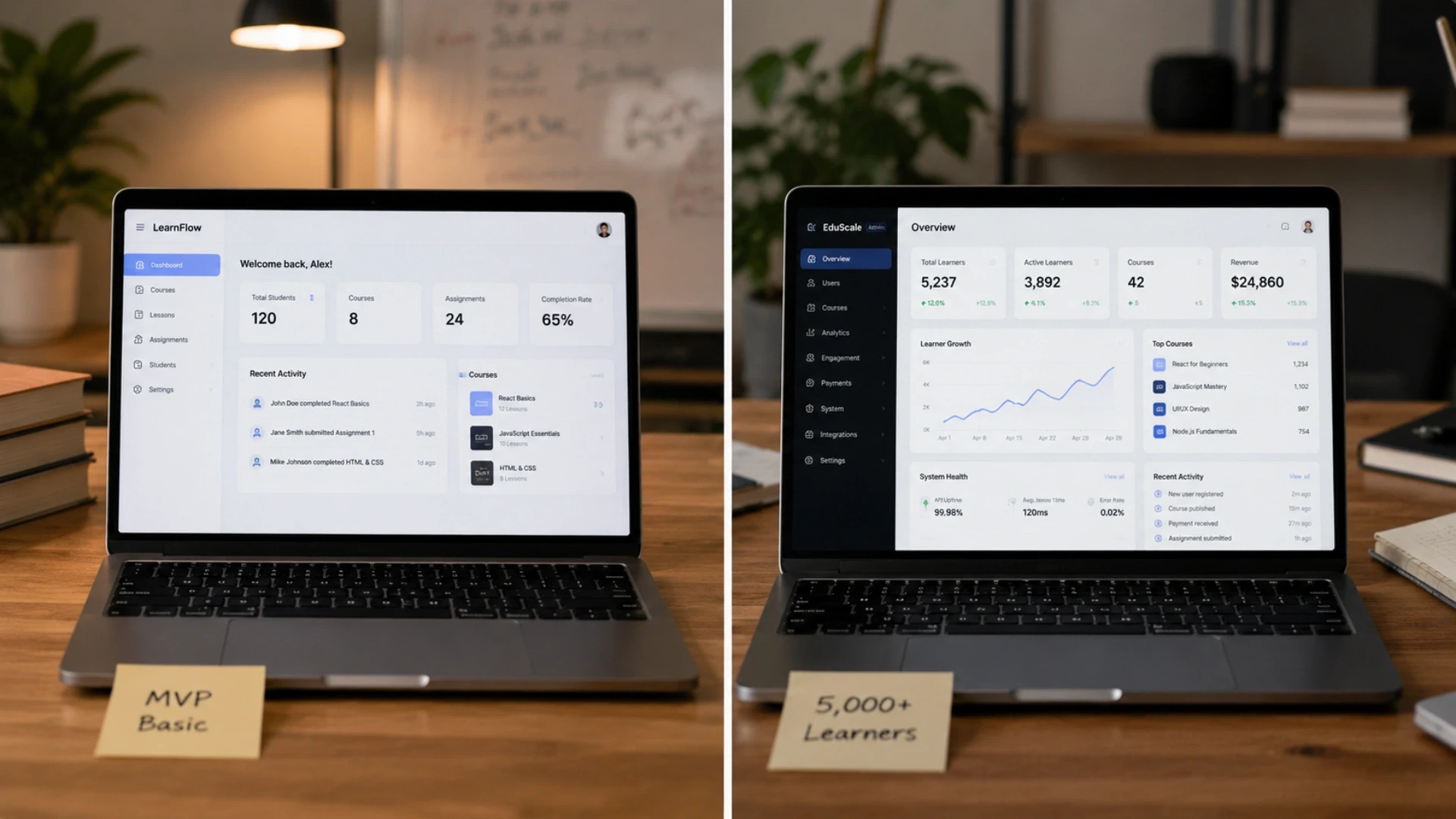
Scaling begins only after product-market fit, when learners keep coming back, and growth feels pulled rather than pushed. Scaling too early, pouring money into marketing or features before retention is solid, is one of the fastest ways to burn a promising startup out.
At scale, the hard problems shift from finding users to keeping the platform fast, reliable, and personalized for many of them at once. The architecture that carried the MVP often needs to mature, and the team has to grow without losing the speed that made the startup work.
Retention is the signal that you are ready to scale, not revenue or signups. If learners come back week after week and tell others, growth spending compounds; if they churn after the first session, more marketing just fills a leaking bucket faster. The discipline is to fix retention until the curve flattens, then pour fuel on a fire that is already burning.
Adding a mobile experience is a common scale-stage move, which a React Native development team can deliver from one codebase across both app stores. Personalization and adaptive learning, the features that improve retention at scale, are increasingly built by an AI development team.
Compliance and trust: data privacy from day one
EdTech startups handle sensitive data, including data about minors, so privacy and trust are foundations, not features to add later. Building compliance in from the first sprint is cheaper and safer than retrofitting it after a school, parent, or regulator raises a concern.
Where your platform serves schools, grades and progress can count as education records under FERPA, so how you store, share, and expose that data becomes a compliance question from the start.
Trust is also a growth lever, not just a legal box. Schools, parents, and enterprises buy from EdTech companies they believe will protect learner data, so clear privacy practices and secure design become a real competitive advantage when you sell. Hardening a young platform to meet privacy and security expectations is specialist work, often supported by a dedicated development team that knows the requirements.
Modernizing an early prototype into a compliant, secure product is handled through structured legacy version upgrade and migration services as the startup matures.
What it costs to build an EdTech startup

Building an EdTech startup typically costs between USD 40,000 and USD 350,000 from MVP to a scaled platform, depending on features, audiences, and how much AI or compliance you need. The MVP is the cheapest and most important investment because it provides the evidence needed for future growth. Many founders also reduce development costs and speed up delivery by partnering with a white-label software development company to launch faster and focus on validating their product idea.
How much does EdTech development cost?
A focused EdTech MVP usually costs USD 40,000 to USD 120,000 and takes three to six months, while a scaled platform with mobile, AI, and integrations runs higher. Building with a verified team in India can reduce that by up to 40% against comparable Western agency rates.
Stage | Typical timeline | Indicative cost |
MVP: core learning loop | 3 to 6 months | $40k to $120k |
Growth: mobile + payments | 6 to 9 months | $120k to $220k |
Scale: AI + integrations | 10+ months | $220k to $350k+ |
Location is the major cost lever. Building with a verified team in India runs at roughly USD 25 to 49 per hour, against USD 120 or more for comparable Western agencies- the source of the up to 40% cost savings and a common reason founders hire a dedicated team for an EdTech MVP.
Keeping continuity from MVP through scale is cheaper than rebuilding context each time, which is why founders often phase the work through structured software development rather than restarting with new vendors.
Want a realistic cost and timeline for your startup?
Acquaint Softtech scopes your EdTech build against your actual idea, MVP, and scale plans, then deploys engineers at USD 25 to 49 per hour, up to 40% below comparable Western agency rates. Book a call for a phased cost and timeline.
Up to 40% cost savings • 95% on-time sprint delivery • 48-hr deployment • 4.9/5 Clutch
A founder's first 90 days: a practical roadmap
The first 90 days decide momentum. The goal is not a finished product; it is a validated idea, a scoped MVP, and a small group of real users who prove the concept, so you enter the build with evidence instead of hope.
A realistic sequence runs in four steps: weeks one to three for learner interviews and a workshop to lock the problem and audience, weeks four to six to define and design the MVP, weeks seven to twelve to build the core loop, then a small launch to real users.
Pacing the spend to evidence keeps risk low, which founders manage by scaling the team through staff augmentation only as each step proves out, with engineers deployed within 48 hours of brief and work running in two-week sprints at a 95% on-time delivery rate.
Discipline in these 90 days is the whole game. Validate before you build, build only the core, and let real usage, not your roadmap, decide what comes next, and you will avoid the trap that catches most EdTech founders.
Build your EdTech startup with a verified team
From idea validation to MVP and scale, Acquaint Softtech helps founders build EdTech products that get to market and grow. Join the founders who built with a Clutch Premier Verified partner and deploy your first engineer within 48 hours.
1,300+ projects • 13+ years • Official Laravel Partner • 4.9/5 Clutch (50+ reviews)
Frequently Asked Questions
-
How do you start an EdTech startup?
You start by validating one painful learning problem with real users before you build, then define a focused MVP that solves it. Founders who succeed prove demand first and write code second, not the other way around.
-
What features does an EdTech MVP need?
An EdTech MVP usually needs four things: access to learning content, progress tracking, a simple way to assess or practice, and sign-up or payment. Anything outside that core learning loop belongs in a later release.
-
What is the best tech stack for an EdTech platform?
There is no single best stack, but a proven choice is a JavaScript stack like MERN for web, React Native for mobile, and Python where AI or heavy data is involved. The best stack is the one your team can ship and maintain fast.
-
How much does EdTech development cost?
A focused EdTech MVP typically costs USD 40,000 to USD 120,000 and takes three to six months, while a scaled platform runs higher. Building with a verified team in India can cut that by up to 40% against Western agency rates.
-
How do you validate an EdTech idea?
Talk to target learners, run a landing page or waitlist, and offer a manual version of the solution to see if people actually use it. If strangers will not sign up or pay, polished software will not fix that.
-
How long does it take to build an EdTech MVP?
A focused MVP covering the core learning loop usually takes three to six months. Phasing the build lets you launch lean, learn from real users, and add features only once they prove worth building.
-
How do EdTech startups make money?
Through subscriptions, one-time course sales, freemium upgrades, B2B licensing to schools or companies, or marketplace commissions. The right model depends on who pays and how often they get value.
-
How does Acquaint Softtech help EdTech startups?
Acquaint Softtech runs a discovery workshop to validate and scope the MVP, then builds it with a dedicated team deployed within 48 hours, shipping in two-week sprints at a 95% on-time rate. It is Clutch Premier Verified with a 4.9/5 rating from 50+ reviews.
With over 11 years of experience in web application development and project management, I excel in leading cross-functional teams to deliver innovative digital solutions. My expertise spans eCommerce platforms, ERP systems, and JS & PHP-based frameworks, including WordPress, React JS, and Laravel. As a Technical Project Manager, I specialize in strategic planning, system design, and end-to-end project execution, transforming complex ideas into scalable, high-impact applications.
Table of Contents
Get Started with Acquaint Softtech
- 13+ Years Delivering Software Excellence
- 1300+ Projects Delivered With Precision
- Official Laravel & Laravel News Partner
- Official Statamic Partner

How Learning Management Systems Work
An LMS is not a video library with a login screen. It is a structured system that owns enrollment, progress, assessment, and certification in one traceable architecture. Teams that treat it as a file folder spend 12 months rebuilding what should have been designed correctly in week one. This guide shows exactly how each layer works, and what it actually costs to build.

Manish Patel
May 13, 2026
The Complete Guide to EdTech Software Development in 2026
Complete guide to EdTech software development in 2026. LMS architecture, virtual classroom tech stack, AI tutoring system design, MVP timeline, and cost.

Acquaint Softtech
May 4, 2026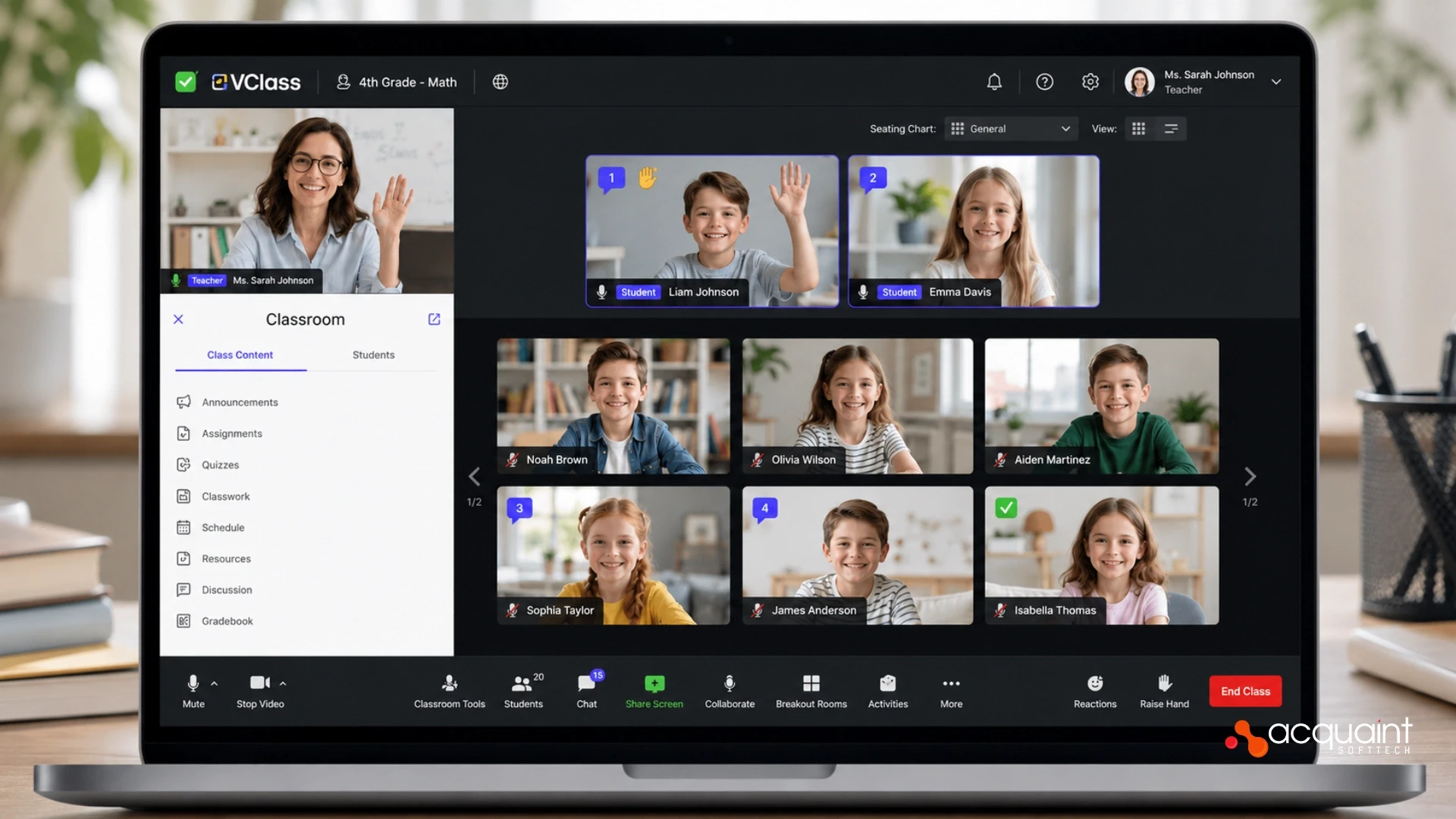
Building a Virtual Classroom Platform: Video, Whiteboard, Breakout Rooms, and Attendance Tracking
A virtual classroom is not a Zoom call with a class roster. It is a purpose-built live learning environment where video, whiteboard, breakout rooms, session recording, and attendance verification are engineered to work together as a single platform. Teams that build each feature independently spend 8 to 14 months in integration loops. Teams that design the architecture correctly from the start ship in 4 to 6 months. This guide shows you how.
Manish Patel
May 20, 2026India (Head Office)
203/204, Shapath-II, Near Silver Leaf Hotel, Opp. Rajpath Club, SG Highway, Ahmedabad-380054, Gujarat
USA
7838 Camino Cielo St, Highland, CA 92346
UK
The Powerhouse, 21 Woodthorpe Road, Ashford, England, TW15 2RP
New Zealand
42 Exler Place, Avondale, Auckland 0600, New Zealand
Canada
141 Skyview Bay NE , Calgary, Alberta, T3N 2K6