

Building a QR Code Payment System for Merchants
QR code payment system development involves creating a secure software architecture where a user scans a code with a smartphone to transfer funds. It needs four core parts working together: a customer scanner app or web interface, a merchant portal for transactions and code generation, a payment gateway and API to route money between banks or wallets, and a real-time database and ledger, all built to financial data security standards.

Zubair Pateljiwala
At Acquaint Softtech we build merchant payment products for a living, and QR is the request that keeps growing. Because the customer-facing scanner is mobile-first, most of this work starts with hired React Native development, paired with a solid backend that never loses a rupee, dollar, or pound.
QR payment system explained in one line: it lets a customer scan a code with their phone and pay a merchant directly, with no card terminal in between. For founders in the USA, UK, Europe, Australia, and New Zealand, QR is how you accept payments without renting expensive hardware.

- A founder or CEO building a merchant QR payment product.
- A CTO scoping components, tech stack, security, and cost.
- A product owner deciding static vs dynamic QR.
- A team weighing whether to build in house or hire developers for a QR payment system.
If you want the wider picture first, this guide sits inside our FinTech app development guide, the master resource that maps how payments, compliance, and product decisions fit together across a fintech build.
The market backs the investment. Juniper Research projects global QR code payment value will rise about 50 percent, from 5.4 trillion dollars in 2025 to more than 8 trillion by 2029, driven by national QR schemes and account-to-account payments. This article covers what a QR payment system is, the static-versus-dynamic choice, the core components, a step-by-step build, the tech stack, security, 2026 trends, and honest cost ranges.
What is a QR code payment system?
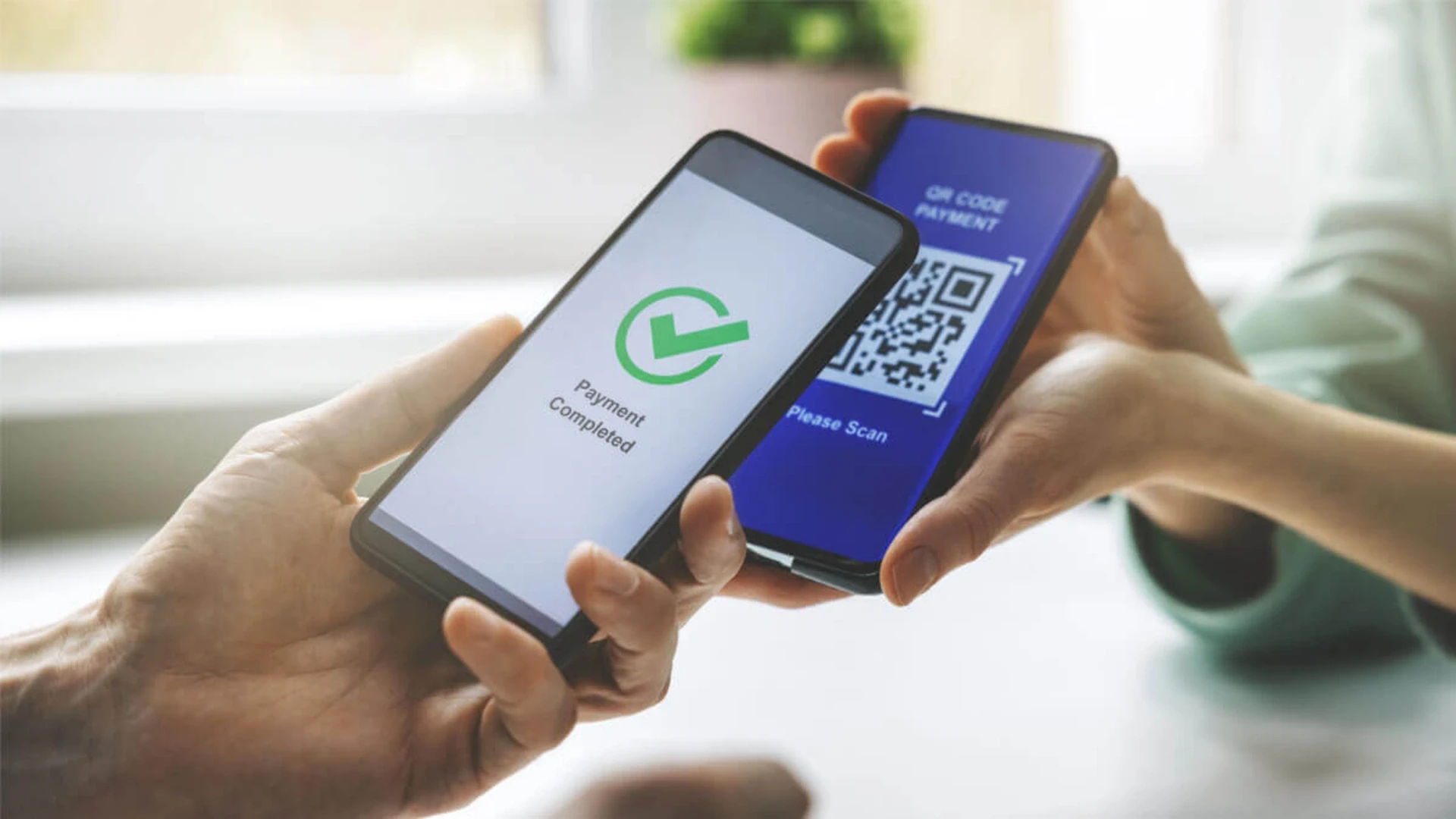
A QR code payment system is software that lets a merchant accept payments through a scannable code instead of a card machine. The customer scans it with a banking or wallet app, confirms, and money moves from their account to the merchant’s.
This is what is meant by a QR code in banking: the code encodes the merchant’s payment details, and sometimes the amount, in a machine-readable pattern. A UPI QR code is the Indian version of the same idea, tied to the Unified Payments Interface, while EMV QR codes power merchant payments across many other markets.
How does a QR code payment actually work?
The flow is short: the system encodes payment details into a QR image, the customer scans it and their app reads the encoded data, the request routes through a payment gateway to the bank or wallet, and both sides get a confirmation once settled. It is also how customers now pay a bill with a QR code printed on an invoice or shown at a counter. When QR sits inside a larger product, it belongs in proper software product development rather than living as a detached feature.
Static vs dynamic QR: which model for merchants?
There are two QR models. A static QR code is fixed to the merchant, and the customer types the amount. A dynamic QR code is generated per transaction with the exact price embedded, which is safer and better for tracking. Dynamic codes made up roughly 65 percent of QR format revenue in 2025.
Model | Best for | Trade-off |
Static QR | Small shops, fixed counters | User types amount, no per-sale tracking |
Dynamic QR | Retail, e-commerce, QR code POS | Needs backend to generate each code |
For anything beyond a single till, dynamic QR is the right default because it removes typing errors and gives you per-transaction analytics. The formats follow the EMV QR specification published by EMVCo, which is the standards body worth following for interoperability. Teams that want to lock the model and scope first often start with a product discovery workshop.
The four core components of a QR payment system
Every merchant QR system has four moving parts: a customer scanner, a merchant portal, a payment gateway and API, and a database with a real-time ledger. Get these four right and the rest is detail.
User app or scanner. The mobile interface where customers capture the code and authorize the payment.
Merchant portal. A dashboard to view transactions, configure store details, and generate static or dynamic codes.
Payment gateway and API. The engine that securely routes payment requests between banks or wallets.
Database and ledger. Real-time storage tracking balances, transaction history, and status logs.
The merchant portal and ledger are the parts that must never drift, which is why teams hire MERN stack developers who have built financial-grade data models before. When design, mobile, and backend need to move together, founders set up software dedicated teams rather than stitching single hires into a payments build.
How to build a QR code payment system, step by step

To build a QR code payment system: choose your QR model, integrate a PSP or bank rails, build the merchant portal and ledger, implement security, then test and verify compliance. Here is the development guide in six steps.
Choose static or dynamic. Pick the model per use case; most merchants need dynamic codes generated on the backend.
Integrate the rails. Connect a trusted Payment Service Provider, or build direct bank rails, to route and settle funds.
Build the merchant portal. Create the dashboard for codes, transactions, refunds, and store configuration.
Add the ledger and webhooks. Track every credit and debit, and confirm settlement through signature-verified webhooks.
Implement security. Add encryption, tokenization, multi-factor authentication, and anti-fraud controls.
Test and comply. Run penetration tests and verify compliance with your regional financial regulations.
How can I accept card payments for free?
You cannot make card fees vanish, but QR on open-banking or account-to-account rails gets close: there is no terminal to buy, and bank-to-bank payments bypass the card networks, so per-transaction cost drops sharply and settlement is often instant. Keeping those six steps on schedule across a squad is a job in itself, so it helps to hire a project manager who tracks the portal, ledger, and security work to a plan.
For teams without a senior payments architect in house, virtual CTO services provide the experienced hand to set the model and architecture before the first sprint.
Want this built without the guesswork?
Our engineers have shipped scanner apps, merchant portals, ledgers, and fraud tooling for payment clients. Tell us your use case and we will map a custom QR payment system solution, with a fixed scope and clear milestones.
QR payment system features list
A production-grade QR payment system features list spans the customer, the merchant, and the admin. The basics earn trust; the rest drive adoption.
Customer and merchant features
Scan-to-pay with static and dynamic QR, plus a QR code POS mode.
Instant payment confirmation and receipts.
Merchant dashboard for codes, transactions, and refunds.
Real-time balance, settlement view, and transaction history.
Trust and growth features
Encryption, tokenization, and multi-factor authentication.
Fraud detection and signed, expiring dynamic codes.
Loyalty, cashback, and bill-payment support.
That is a broad surface to build alone, so many founders use software development outsourcing to ship the core fast. As card networks and schemes evolve, version upgrade services keep the system compliant without breaking live payments.
QR payment system tech stack
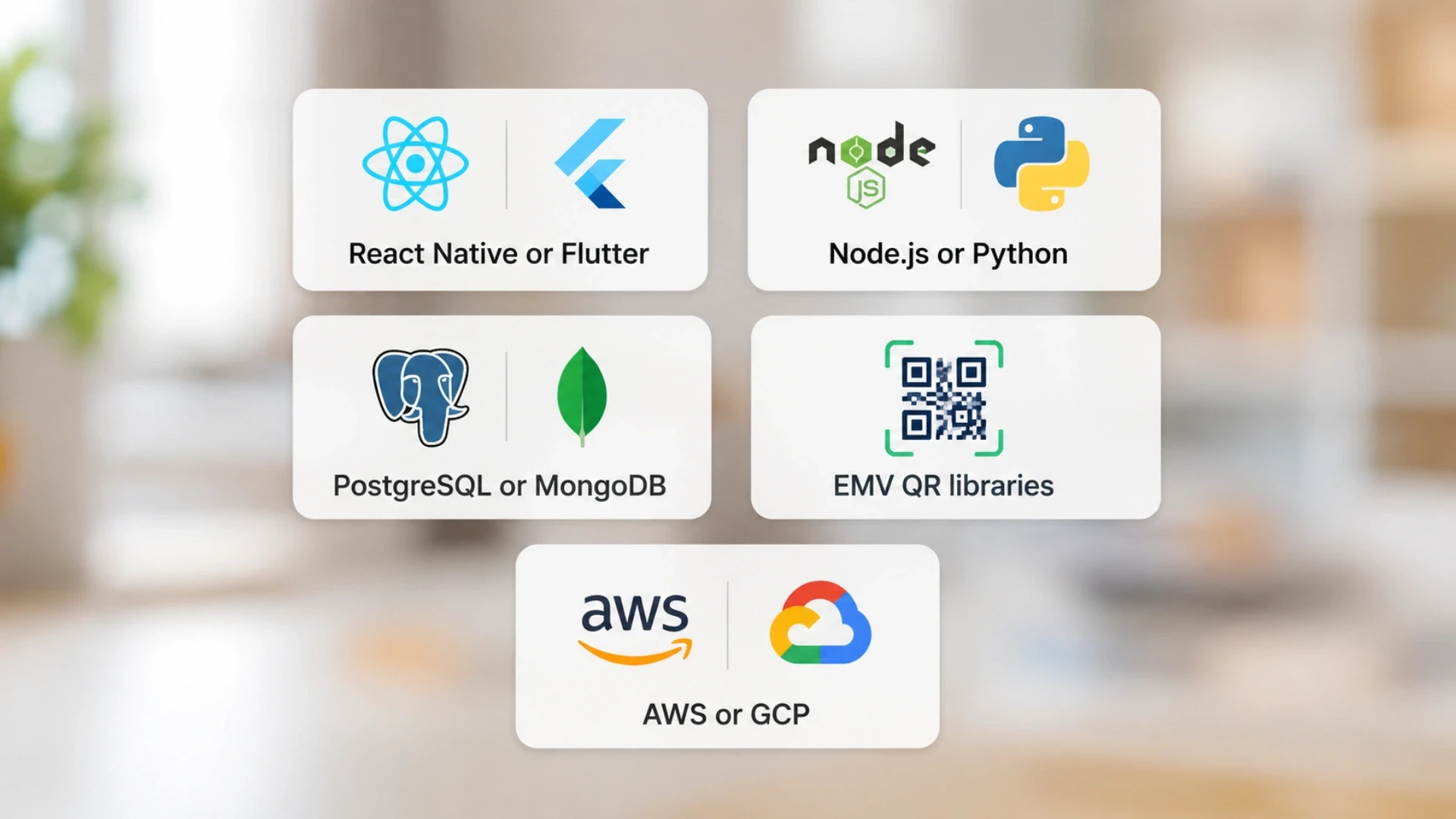
The best tech stack for a QR payment system pairs a cross-platform mobile scanner with a scalable, secure backend, durable databases, and QR generation libraries. Your choices decide how fast you build and how well you scale.
Layer | Common choice | Why |
Mobile | React Native or Flutter | Fast, camera-ready scanner UX |
Backend | Node.js or Python | Real-time code and ledger logic |
Database | PostgreSQL or MongoDB | Durable transaction records |
QR generation | EMV QR libraries | Standards-compliant codes |
Cloud | AWS or GCP | Elastic, compliant infrastructure |
What is the best tech stack for a QR payment system?
React Native or Flutter for the scanner, Node.js or Python for the backend, and PostgreSQL or MongoDB for records is the reliable default. For heavier ledger and risk logic, a Python team can hire Python developers to build it, and teams that need to move fast bring in IT staff augmentation to add payment-experienced engineers for the build and handover.
Security and fraud prevention

QR security is layered: encryption, tokenization, multi-factor authentication, and signed dynamic codes that expire. The threat is real, with QR-related fraud rising as attackers swap or overlay fake codes.
Signed, expiring dynamic codes. Generate each code server side with a short lifetime to block reuse and tampering.
Tokenization. Replace sensitive bank or card details with tokens so raw data never sits in the app.
Server-side verification. Confirm every payment through a signature-verified webhook, never the client alone.
Anti-overlay checks. Validate merchant identity so a swapped counter code cannot redirect funds.
Card handling is governed by the Payment Card Industry Data Security Standard, and the PCI Security Standards Council publishes the requirements your storage and processing must meet. Because these paths are repetitive to test, it pays to hire automation engineers who keep every payment and fraud path covered on each release.
QR payment system benefits for businesses
The QR payment system benefits for businesses are concrete: no hardware to buy, lower fees than cards, instant or fast settlement, and first-party transaction data. QR turns any surface into a checkout.
Benefit | What it means |
No hardware | No card terminals to buy or maintain |
Lower fees | Bank-to-bank rails skip card networks |
Faster cash flow | Instant or short settlement cycles |
First-party data | Per-transaction insight for growth |
Fast rollout | A printed code turns any counter into a till |
Agencies and banks that want to launch a merchant QR product under their own name can use white label development services to ship faster. Acquaint Softtech builds both custom and white-label systems, and keeps the ledger and fraud layer solid from day one.
QR payment system trends 2026
The main QR payment system trends 2026 are the rise of account-to-account and open-banking QR, national scheme standardisation, and the convergence of QR with NFC in contactless payment systems. Building with these in mind future-proofs your product.
Open banking and A2A. Bank-to-bank QR cuts fees and settles instantly, the biggest 2026 driver.
National schemes. Standardised schemes like UPI and Pix keep expanding merchant acceptance.
NFC and QR together. An NFC QR code fallback lets one checkout serve tap and scan users.
AI fraud scoring. Real-time models flag swapped or suspicious codes before funds move.
Smarter, adaptive fraud checks are a natural fit for AI development services once the core system is live. For a related build, our UPI payment integration guide shows how QR sits alongside intent and collect flows in a national scheme.
QR payment system development cost by market

QR payment system development cost depends on scope and where your team sits. An MVP system is far cheaper than a full merchant platform with a portal, ledger, fraud tooling, and multi-bank rails.
Target market | MVP system | Full merchant platform |
United States / New York | $25,000 to $60,000 | $90,000 to $250,000+ |
United Kingdom | GBP 20,000 to 48,000 | GBP 72,000 to 200,000+ |
Europe (EU) | EUR 24,000 to 55,000 | EUR 82,000 to 230,000+ |
Australia | AUD 38,000 to 90,000 | AUD 135,000 to 380,000+ |
New Zealand | NZD 40,000 to 95,000 | NZD 145,000 to 400,000 |
The biggest lever is engineering rate, not the feature list. That is why many founders hire remote developers from a QR payment system development company in India, where the same build costs a fraction of local rates. Reliable scaling and deployments are a good reason to also hire DevOps engineers who keep the system fast under real load.
Real case study: a payment-processing firm
Here is a real, verified project from our public Clutch profile that maps closely to a merchant QR build: securing a live payment platform without slowing it down.
Proof of work: FLIQA Payments (Payment processing, Slovenia) • 5.0 on Clutch, Verified
FLIQA Payments, a firm that collects money and pays out by bank, hired Acquaint Softtech to harden its platform between March and November 2025. Six to ten of our engineers worked in defined phases.
Before
Investigating a financial event was slow and manual, internal access was loose, and the team needed stronger security and clearer audit trails without rewriting the platform or slowing collections and payouts.
After
We added encrypted storage for sensitive banking data, structured audit logs capturing actions, actors, and outcomes, stronger API authentication, and role-based access, and we optimized background processes so logging and encryption did not affect transaction speed. As the client reported, investigating events became straightforward, compliance reviews grew calmer and more structured, and support resolved issues faster, with no new friction in collections or payouts.
The same discipline, secure ledgers, clean audit trails, and fraud-aware APIs that stay fast, is exactly what a merchant QR system needs. You can browse more work on our case studies page and read verified reviews on our Clutch profile.
Why teams struggle, and what to check before you hire

Most QR systems do not fail at the scan. They fail at the ledger, reconciliation, and fraud model, the parts customers never see but regulators and attackers do.
If you are deciding whether to build in house or hire developers for a QR payment system, check for these before you commit:
Have they shipped a real ledger and reconciliation, not just a scanner demo?
Do they generate signed, expiring dynamic codes by default?
Is their API layer authenticated, tokenized, and PCI-aware?
Can they show verifiable payments delivery and a public reputation?
That last point is where track record matters. Acquaint Softtech has delivered 1,300 or more projects over 13 or more years with 70 or more in-house engineers, 48 or more Clutch reviews, more than 1,290 Upwork jobs, and can deploy vetted developers within 48 hours. Real-time fraud and anomaly scoring on top of the payment layer is a good fit to hire AI/ML engineers for.
After launch, these controls need care as volumes grow, which is where ongoing support and maintenance services keep reconciliation, fraud models, and integrations healthy.
Get a free QR payment system consultation
Share your merchant use case or a short brief. We will review your QR model, components, and security, then hand back a prioritised plan and a scope you can act on. This is the last step before you commit engineering time.
Frequently Asked Questions
-
How to make a QR code payment system?
Choose a static or dynamic QR model, integrate a Payment Service Provider or direct bank rails, build a merchant portal and a real-time ledger, add encryption, tokenization, multi-factor authentication, and fraud controls, then run penetration tests and verify regional compliance before launch.
-
What is a QR code payment system?
It is software that lets merchants accept payments through a scannable code instead of a card machine. The customer scans it with a banking or wallet app, confirms, and funds move from their account to the merchant’s through a payment gateway.
-
Can a QR code be used for payment?
Yes. A QR code can encode a merchant’s payment details and, with dynamic codes, the exact amount. The customer scans it, authorizes the payment in their app, and the money is routed and settled through a payment gateway or bank rail.
-
What is a QR code payment method?
It is a contactless payment method where a code, either shown by the merchant or by the customer, carries the payment data. Scanning it triggers a bank or wallet transfer, avoiding cards, cash, and dedicated terminal hardware.
-
How much does a QR payment system cost to build?
An MVP system typically runs from the mid tens of thousands into six figures at local agency rates, while a full merchant platform with a portal, ledger, and fraud tooling costs more. Offshore delivery is materially cheaper.
-
What features does a QR payment system need?
Static and dynamic scan-to-pay, a merchant portal for codes and transactions, a real-time ledger, instant confirmations and receipts, refunds, encryption, tokenization, multi-factor authentication, fraud detection, and settlement reporting.
-
How long does QR payment system development take?
A focused MVP usually takes about two to four months, while a full merchant platform with a portal, ledger, and compliance work can run six to twelve months depending on scope and integrations.
-
What is the best tech stack for a QR payment system?
React Native or Flutter for the scanner, Node.js or Python on the backend, PostgreSQL or MongoDB for records, EMV QR libraries for standards-compliant codes, and AWS or GCP for infrastructure, all connected to a PSP or bank rail.
I am Zubair Pateljiwala, a digital marketing professional with 15+ years of experience in SEO, content marketing, and performance marketing. As the Marketing Head at Acquaint Softtech, I focus on helping technology businesses improve their online visibility through SEO, GEO, AEO, and AI-driven content strategies. I enjoy transforming complex software development concepts into practical, easy-to-understand content that helps businesses make informed technology decisions.
Table of Contents
Get Started with Acquaint Softtech
- 13+ Years Delivering Software Excellence
- 1300+ Projects Delivered With Precision
- Official Laravel & Laravel News Partner
- Official Statamic Partner
Related Blog
How to Build a Cross-Border Payment Platform: Corridors, FX, and Settlement
A cross-border payment platform enables international money transfers through routing, currency conversion, and settlement. It uses multiple payment rails and compliance checks to deliver fast and secure transactions.

Ahmed Ginani
August 3, 2026.webp "How to Build a Digital Lending Platform: Complete 2026 Guide")
How to Build a Digital Lending Platform: Complete 2026 Guide
A digital lending platform is four workflow systems that must all work flawlessly: origination, underwriting, disbursement, and servicing. This guide builds each one, with AI credit scoring, compliance mapping, and real 2026 cost data.
Ahmed Ginani
May 25, 2026
KYC Automation: Building Identity Verification Workflows That Take Seconds, Not Days
KYC automation is the end-to-end digital process of verifying a customer's identity without manual review at every step. A workflow chains document capture and OCR, tamper and authenticity checks, biometric liveness and face matching, AML and sanctions screening, and automated risk scoring, routing only uncertain cases to a human.

Sanjay Prajapati
June 25, 2026India (Head Office)
203/204, Shapath-II, Near Silver Leaf Hotel, Opp. Rajpath Club, SG Highway, Ahmedabad-380054, Gujarat
USA
7838 Camino Cielo St, Highland, CA 92346
UK
The Powerhouse, 21 Woodthorpe Road, Ashford, England, TW15 2RP
New Zealand
42 Exler Place, Avondale, Auckland 0600, New Zealand
Canada
141 Skyview Bay NE , Calgary, Alberta, T3N 2K6