

Building a Rental Marketplace Like Airbnb: Short-Term Rental Platform With Booking and Reviews
Vrbo, Booking.com, and Houfy are the top short-term rental marketplaces that function just like Airbnb. To build your own, a rental marketplace like Airbnb needs five core parts: dual host and guest profiles, a listing engine with photos and pricing, a booking calendar that prevents double bookings, a payment layer that holds money in escrow until check-in, and a two-way review system that builds trust. Ship those as a focused MVP first, wire in secure payments and messaging, then scale to more cities and property types.

Manish Patel
As the person who leads technology and client success at Acquaint Softtech, I have watched founders go from a rental marketplace like Airbnb short-term booking 2022 idea to a live product, and the winners treat it as serious software product development rather than a clone project.
A rental marketplace like Airbnb is a two-sided platform where hosts list short-term rentals and guests search, book, pay, and review them. The opportunity is real: travelers keep looking for sites like Airbnb but cheaper, and every niche, from unique stays Airbnb UK travelers love to sites like Airbnb for long-term stays, is a chance for a focused competitor.

- A founder building a short-term or vacation rental marketplace.
- A CTO scoping a booking calendar, payments, and a review system.
- A COO or agency owner entering a rental niche or region.
- A team weighing a custom build against an off-the-shelf script.
If you want the wider category picture first, our PropTech software development guide shows where a rental marketplace sits inside the property technology landscape.
This is a build article, not a listicle of apps. It covers the core components, the booking and availability engine, payment escrow for vacation rentals, the host-guest review system, a step-by-step build, a tech stack, and honest cost.
What is a rental marketplace like Airbnb?
A rental marketplace like Airbnb is short-term rental software that connects two audiences: hosts who list space and guests who book it. The platform earns a fee on each booking, so its whole job is to make listing, booking, paying, and reviewing feel safe and simple for both sides.
Unlike a single hotel site, a marketplace never owns the inventory. That means trust, availability accuracy, and secure money movement matter more than anything, because the platform is standing between strangers and their cash.
Because that two-sided product has a lot of moving parts, founders building vacation rental booking software often hire MERN stack developers who have shipped marketplaces before.
Popular alternatives to Airbnb, and what to learn from them
Studying the field tells you where a new platform can win. These are the sites like Airbnb and Vrbo that travelers already use, and the gaps they leave open.
Vrbo. Focuses heavily on entire vacation homes, cabins, and large coastal properties rather than shared spaces.
Booking.com. Offers a massive global network of apartments and short stays, with a very strong presence across Europe.
Houfy. Operates as a direct-booking platform where guests can search properties and message hosts without paying high platform service fees.
Expedia. Integrates vacation rentals alongside traditional hotel bookings to give travelers more lodging choices.
The key differences to consider are fees, since platforms charge different guest service fees and host commissions; property types, since some specialize in whole homes while others mix rooms, apartments, and boutique hotels; and geographic reach, since some apps work best in specific regions, such as Booking.com in Europe or niche local platforms like Cozy Cozy UK.
Many of these run a guest app as well as a website, so teams that want the same reach often hire React Native developers to ship iOS and Android from one codebase.
The five core components
Every rental marketplace has five moving parts: dual profiles, a listing engine, a booking calendar, a payment layer, and a review system. Get these right, and the rest is refinement.
Dual profiles. Separate host and guest accounts with verification, so both sides know who they are dealing with.
Listing engine. Photos, descriptions, amenities, house rules, and pricing that hosts control and guests search.
Booking calendar. Real-time availability that prevents double bookings and syncs across channels.
Payment layer. Secure checkout that holds funds in escrow and pays the host after check-in.
Review system. Two-way ratings that build the trust a marketplace runs on.
The search, matching, and pricing logic behind those components is data-heavy work, so teams often hire Python developers for the recommendation and dynamic-pricing layer.
Coordinating a two-sided build across design, backend, and payments needs a steady hand, which is why founders hire a project manager to keep the MVP on track.
Deciding exactly which of these ship in the first release is best settled in a product discovery workshop before a line of code is written.
The booking calendar and availability engine
How booking actually works. The booking calendar availability engine is the heart of the platform, and its one job is to never sell the same night twice.
How does a booking calendar for rentals work?
Each listing has a calendar of available dates, nightly prices, and rules such as minimum stay. When a guest requests dates, the system locks them briefly, checks for conflicts, confirms payment, then marks them booked so no one else can grab the same nights. Channel sync keeps that calendar aligned if the host also lists on Airbnb or Vrbo. Acquaint Softtech treats double-booking protection as a correctness requirement, not a nice-to-have, because one oversold night can cost a host forever.
Holding, releasing, and syncing calendar state reliably is background work that must never fail, so teams hire automation engineers to own the availability jobs and channel updates.
At scale, thousands of concurrent searches and bookings need infrastructure that stays fast, which is why teams hire DevOps engineers to run the caching, queues, and databases behind the calendar.
Payments and escrow for vacation rentals

The money flow. Payment escrow vacation rental logic means the platform collects the guest payment at booking, holds it, and releases it to the host after check-in, minus the platform fee. That hold is what protects both sides if something goes wrong.
You build this on a payment provider that supports split payments and delayed payouts, tokenize cards so you never store raw details, and add refunds, cancellations, and payout schedules on top. Handling other people’s money also brings rules you cannot skip.
In the US, marketplaces that hold and route funds fall under money-transmission and consumer-protection oversight from the Federal Trade Commission, so the escrow and refund flow has to be built to comply, not just to work.
The split-payment, payout, and webhook layer around a provider is exactly the kind of backend work teams hire Laravel developers to build and keep tested.
UK platforms face parallel rules, and government guidance on tenant deposits and payments published at GOV.UK is a useful reference when you design refunds and payouts for that market.
The host and guest review system
How trust is engineered. A host-guest review system lets both sides rate each other after a stay, and it is the single feature that makes strangers comfortable transacting.
How do you design a host-guest review system that stays honest?
Use double-blind reviews: neither side sees the other’s rating until both submit or a window closes, so no one trades nice reviews or writes revenge ones. Tie every review to a completed, paid booking so listings cannot be gamed, and show aggregate scores prominently on each listing.
Detecting fake reviews and surfacing the most helpful ones is a pattern problem, so teams hire AI/ML engineers to score authenticity and rank reviews well.
The same models can power smarter search and personalized recommendations, which is where AI development services turn a plain listing feed into a relevant one.
Want the booking, payments, and reviews built as one clean platform?
Our engineers have shipped booking systems, payment integrations, review management, and central reservation logic for rental clients. Tell us your niche and how hosts and guests should transact, and we will map a rental marketplace MVP with a fixed scope and clear milestones.
How to build a rental marketplace, step by step
To build a rental marketplace, define the niche, build dual profiles and listings, add the booking calendar, wire escrow payments, layer reviews, then launch a focused MVP. Here is the build in six steps.
Pick a niche and MVP scope. Choose a region or property type and the smallest feature set that lets a real booking happen.
Build dual profiles and listings. Create host and guest accounts, verification, and a listing engine with photos and pricing.
Add the booking calendar. Build real-time availability, minimum-stay rules, and double-booking protection.
Wire escrow payments. Collect at booking, hold in escrow, and release to the host after check-in, minus your fee.
Layer messaging and reviews. Add host-guest messaging and a double-blind review system tied to completed stays.
Launch and iterate. Ship the MVP in one market, learn from real bookings, then expand cities and property types.
If your core team is small, IT staff augmentation adds vetted marketplace engineers so the MVP ships on time.
For founders without a technical co-founder, virtual CTO services set the architecture and payment approach before the first sprint.
As payment APIs and channel integrations change, version upgrade services keep the platform current without breaking live bookings.
Tech stack for a short-term rental platform
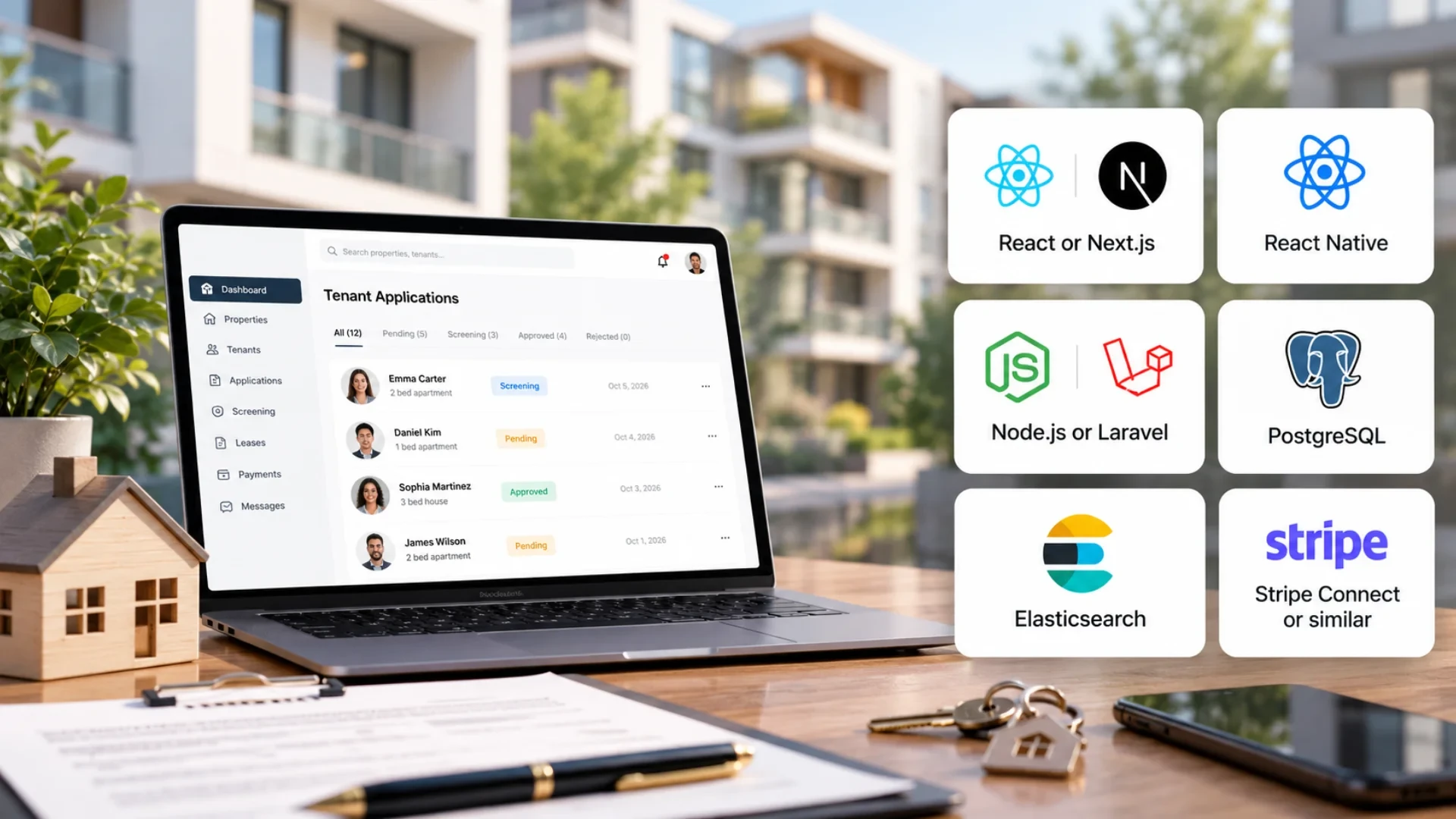
The best stack for a rental marketplace pairs a fast front end with a reliable transactional backend, a search index, and a proven payments provider. Trust and correctness matter more than novelty. Acquaint Softtech picks the stack to fit the team and the payment model, not the other way around.
Layer | Common choice | Why |
Frontend | React or Next.js | Fast listing and checkout pages |
Mobile | React Native | Guest and host apps from one codebase |
Backend | Node.js or Laravel | Bookings, payments, and webhooks |
Database | PostgreSQL | Accurate bookings and ledgers |
Search | Elasticsearch | Fast filtered and map search |
Payments | Stripe Connect or similar | Split payments and escrow payouts |
The dashboard and messaging front end has to feel instant for both hosts and guests, so teams often hire MEAN stack developers for that interactive layer.
Rental marketplace cost by market

Rental marketplace cost depends on scope and where your team sits. A single-region MVP with booking and payments is far cheaper than a global platform with apps, channel sync, and dynamic pricing.
The ranges below are 2026 planning estimates at local agency rates, meant as starting points to confirm against a real scope, not fixed quotes. Offshore delivery from India typically lands well below these numbers.
Target market | MVP marketplace | Full platform |
United States / New York | $30,000 to $70,000 | $120,000 to $280,000+ |
United Kingdom | GBP 24,000 to 56,000 | GBP 96,000 to 220,000+ |
Europe (EU) | EUR 28,000 to 62,000 | EUR 110,000 to 250,000+ |
Australia | AUD 46,000 to 105,000 | AUD 180,000 to 420,000+ |
New Zealand | NZD 48,000 to 110,000 | NZD 190,000 to 440,000+ |
The biggest lever is engineering rate, not the feature list, which is why many founders hire remote developers to build the same platform for a fraction of local cost.
To ship the MVP lean and expand from a proven core, software development outsourcing is a common route, and a custom vacation rental India delivery model keeps that spend under control.
For a marketplace that keeps growing after launch, a dedicated software development team keeps bookings, payments, and reviews consistent from MVP through scale.
Real case study: a homestay booking platform
No two builds are identical, and a close documented parallel from our own work is a homestay booking platform that needed the same core a rental marketplace does: booking, payments, and reviews. The panel below shows the brief and the result.
Proof of work: Hiran Holidays (homestay booking platform)
The brief: a website with an online booking system, payment integration, a review management system, and a central reservation system, plus SEO to bring in demand.
What Acquaint Softtech built: the booking engine, the payment flow, the review management system, and the central reservation system, delivered design-first, then developed and tested with a small dedicated team and a named project manager.
The result: after launch and SEO work, the client grew site traffic by 40 to 50 percent, with bugs fixed by the next day and 5.0 ratings for quality, schedule, and cost.
In their words: our experience with them was great, so we were pretty happy with their services.
You can browse this and other projects on our case studies page to see the delivery details behind the summary above.
Why teams struggle, and what to check before you build

Most rental marketplaces do not fail at the listing page. They fail at the booking calendar, the escrow flow, and trust, where a double booking or a stuck payout burns the reputation a marketplace lives on.
If you are choosing between a custom build and an off-the-shelf script, check for these before you commit:
Does the calendar truly prevent double bookings under concurrent load?
Is payment held in escrow and released only after check-in, with clean refunds?
Are reviews double-blind and tied to completed, paid bookings?
Do they have verifiable marketplace and payments delivery, not just slides?
That track record is where it matters. Acquaint Softtech has delivered 1,300 or more projects over 13 or more years with 70 or more in-house engineers, 48 or more Clutch reviews, more than 1,290 Upwork jobs, and can deploy vetted developers within 48 hours.
After launch, payment rules and channel APIs shift, which is where support and maintenance services keep bookings, payouts, and reviews healthy.
For firms that want to offer a branded marketplace to many operators at once, white label development services deliver the multi-tenant version as a productized offering.
And when smarter search and dynamic pricing become the priority, Acquaint Softtech treats them as a later phase, once the booking, payment, and review core is proven and stable.
Ready to turn your Airbnb-style idea into a bookable MVP?
Share your niche, your region, and how hosts and guests should transact, or a short brief. We will review your booking, payment, and review needs, then hand back a prioritised plan and a scope you can act on. This is the last step before you commit engineering time.
Frequently Asked Questions
-
How do you build an Airbnb-like platform?
Build five core parts: dual host and guest profiles, a listing engine, a booking calendar that prevents double bookings, escrow payments that release to the host after check-in, and a two-way review system. Ship a single-region MVP first, then expand cities and property types once real bookings prove the model.
-
How does a booking calendar for rentals work?
Each listing holds available dates, nightly prices, and rules like minimum stay. When a guest requests dates, the system locks them, checks for conflicts, confirms payment, and marks them booked so no one else can take the same nights. Channel sync keeps it aligned with Airbnb or Vrbo.
-
How do you build a host-guest review system?
Use double-blind reviews, where neither side sees the other’s rating until both submit or a window closes, and tie every review to a completed, paid booking. This stops revenge reviews and fake ratings, and it gives each listing a trustworthy aggregate score.
-
How much does a rental marketplace cost to build?
A single-region MVP typically runs from the low tens of thousands into six figures at local agency rates, while a full platform with apps, channel sync, and dynamic pricing costs more. Engineering rate is the main driver, so offshore delivery is materially cheaper for the same scope.
-
What is a good alternative to Airbnb?
Vrbo, Booking.com, and Houfy are the strongest alternatives. Vrbo focuses on whole homes, Booking.com has huge global inventory and strong European reach, and Houfy is a direct-booking marketplace with low or no guest service fees. The best choice depends on property type, region, and fees.
-
What is the best short-term rental website?
There is no single best site; it depends on what you want. Airbnb leads on inventory and brand, Vrbo suits whole-home family stays, Booking.com wins internationally, and Houfy appeals to travelers seeking sites like Airbnb but cheaper through direct booking.
-
What site to use instead of Airbnb?
For whole homes, use Vrbo; for global reach, Booking.com; for lower fees, Houfy; and for hotels plus rentals in one place, Expedia. UK travelers also use comparison tools such as Cozy Cozy UK to search many of these at once.
-
Who is Airbnb’s biggest competitor?
Booking.com is Airbnb’s biggest competitor by inventory and global bookings, with Vrbo a close rival in the whole-home vacation rental segment. Expedia Group, which owns Vrbo, is the largest corporate competitor across travel overall.
I lead technology and client success at Acquaint Softtech with one goal in mind. Deliver work that feels personal, reliable, and worthy of long term trust. I stay close to both our clients and our developers to make sure every project moves with clarity, quality, and accountability.
Table of Contents
Get Started with Acquaint Softtech
- 13+ Years Delivering Software Excellence
- 1300+ Projects Delivered With Precision
- Official Laravel & Laravel News Partner
- Official Statamic Partner
Related Blog

How to Build a Real Estate Marketplace Platform
Building a real estate marketplace isn't a listings website; it's a live system where buyers, agents, and data connect in real time. Auto-routing leads, refreshing listings instantly, and giving every agent a full working environment inside the platform. One architecture decision in week one determines whether you scale to 1,000 listings or 1,000,000.
Manish Patel
May 19, 2026
The Complete Guide to PropTech Software Development in 2026
PropTech is not a real estate website with a login. It is a system of record that manages listings, leases, ledgers, and work orders on a single accountable platform. Here is what it costs, how it is built, and how to pick a partner in 2026.

Acquaint Softtech
May 4, 2026
Hotel PMS Development: Front Desk, Housekeeping, and Guest Management in One System
A hotel PMS is not a booking system. It is the operational backbone connecting every department in real time. Here is what it includes, how each module is built, and what it costs in 2026.
Manish Patel
May 20, 2026India (Head Office)
203/204, Shapath-II, Near Silver Leaf Hotel, Opp. Rajpath Club, SG Highway, Ahmedabad-380054, Gujarat
USA
7838 Camino Cielo St, Highland, CA 92346
UK
The Powerhouse, 21 Woodthorpe Road, Ashford, England, TW15 2RP
New Zealand
42 Exler Place, Avondale, Auckland 0600, New Zealand
Canada
141 Skyview Bay NE , Calgary, Alberta, T3N 2K6