

How to Conduct a HIPAA Risk Assessment for Your Healthcare Application
A HIPAA risk assessment is a required evaluation of risks to electronic protected health information (ePHI) in your application. It identifies threats, assesses security controls, prioritizes risks, documents remediation, and should be reviewed annually to maintain HIPAA compliance.

Chirag Daxini
Is your HIPAA risk assessment ready for investor, hospital, or regulatory scrutiny? As the project manager at Acquaint Softtech, I have seen many healthcare teams treat risk assessments as paperwork until due diligence exposes critical gaps. In reality, a strong Security Risk Analysis is one of the first things regulators review.
This guide explains how to build a continuous HIPAA risk management process that protects patient data, supports compliance, and helps your healthcare application avoid costly security and regulatory failures.

- You are building a healthcare app and need to pass an OCR review.
- You have been asked for a Security Risk Analysis and do not know where to start.
- You want the exact six steps OCR expects, not vague advice.
- You need to know the real penalties for skipping a risk assessment.
- You want to budget HIPAA compliance correctly before development begins.
At Acquaint Softtech, I have learned that a defensible risk assessment follows a repeatable method any team can run before they ship. Done early, it shapes the architecture instead of indicting it later. That is why our healthcare software product development practice builds the risk assessment into the very first sprint, so compliance is designed in rather than bolted on.
This is a compliance guide in the HIPAA cluster. For the full technical safeguard checklist this assessment validates, the HIPAA Compliance for Software Developers is the companion reference.
What Is a HIPAA Risk Assessment and Why Does OCR Care So Much?
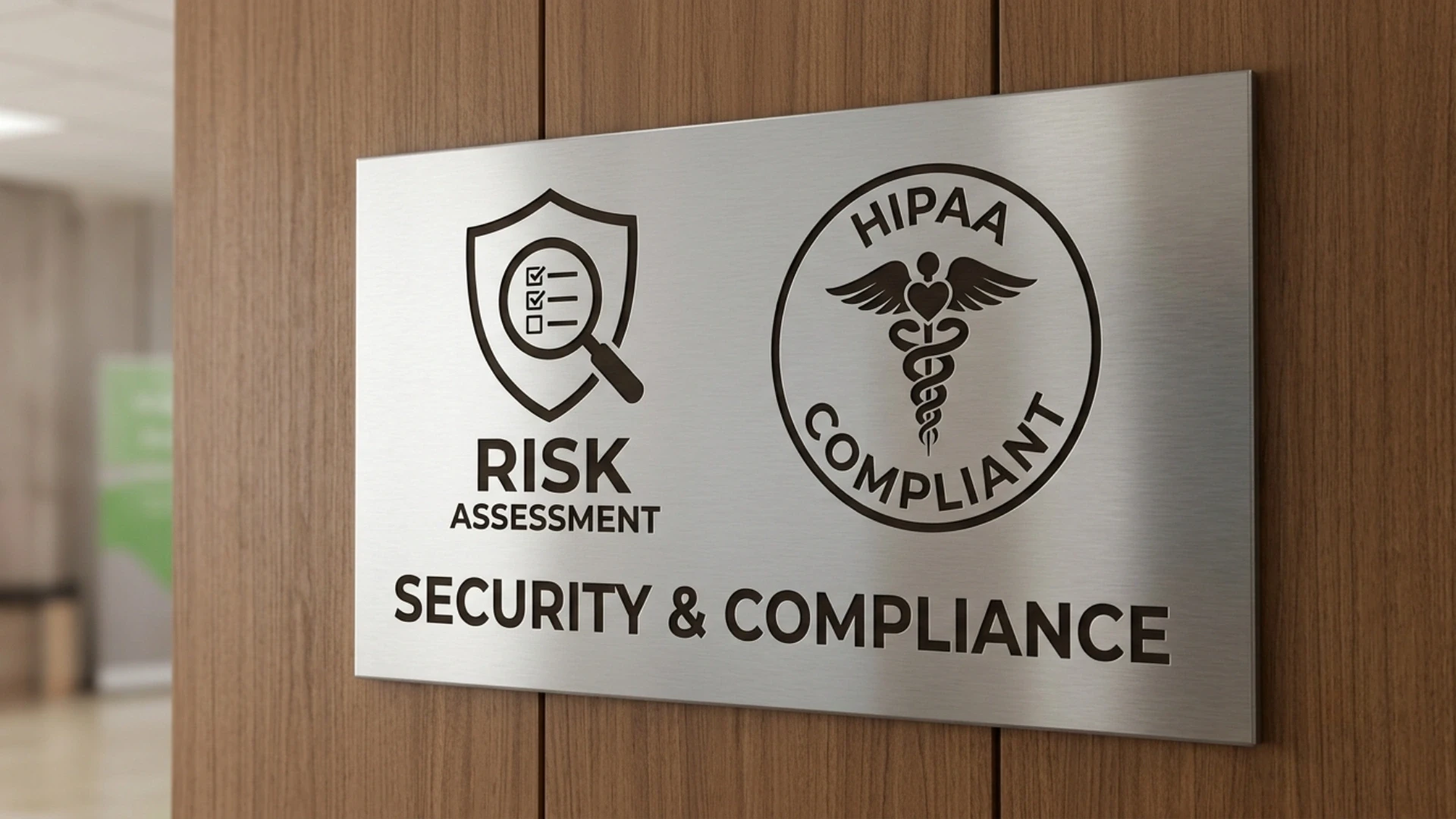
A HIPAA risk assessment, formally a Security Risk Analysis (SRA), is a documented evaluation of all threats and vulnerabilities to the confidentiality, integrity, and availability of electronic protected health information. It is required under 45 CFR 164.308(a)(1)(ii)(A), and OCR has endorsed NIST SP 800-30 as the gold-standard methodology. It is the single most important HIPAA requirement and the one most frequently cited in enforcement.
Why it sits at the centre of enforcement
OCR treats the SRA as the foundation of every other safeguard: you cannot choose the right encryption, access controls, or audit logging without first knowing where your ePHI lives and what threatens it. An assessment that misses ePHI locations is incomplete and indefensible to OCR. Organisational size offers no shield; OCR has acted against solo practices and small business associates alike.
For founders without an in-house security leader, the assessment is also a strategic exercise, not just a compliance one. A virtual CTO service gives you the senior judgement to interpret findings and prioritise remediation, rather than a checklist filled in by someone who has never faced an OCR review.
The assessment is only credible if the infrastructure behind it is real. The guide to healthcare software Developmentsets the wider context, and our DevOps engineers build the logging, encryption, and access controls the SRA expects to find.
What Happens If You Skip It? The Real Penalties

Skipping or botching the risk assessment exposes you to the full HIPAA penalty range: $100 to $50,000 per violation, up to $1.5 million per category per year, and a willful-neglect finding at $73,011 per day, per violation. Criminal penalties can reach 10 years' imprisonment. The average healthcare data breach exceeds $10 million in total cost.
Violation Tier | Penalty Range | Trigger |
Unknowing | $100 to $50,000 per violation | Did not know and could not reasonably have known |
Reasonable cause | Higher within range | Knew or should have known, but not willful neglect |
Willful neglect (corrected) | Substantial per violation | Conscious failure, corrected within 30 days |
Willful neglect (uncorrected) | $73,011 per day, per violation | Conscious failure, not corrected |
Key Insight
The financial case is straightforward: a managed risk assessment costs a fraction of even the lowest penalty tier. A proactive SRA that costs a few thousand dollars prevents penalties that start in the tens of thousands and a breach that averages over $10 million.
Penalties also follow corrective action plans that consume management attention for years after the original violation. Keeping the assessment current through ongoing support and maintenance services turns a one-time scramble into a maintained program, which is exactly what OCR now expects.
The most common gap OCR finds is an assessment that was never updated after the app changed. The Healthcare App Development Cost guide puts compliance spend in budget context, and our Laravel developers build the audit trails that make an assessment defensible.
Get the free HIPAA Security Risk Analysis template OCR expects to see.
Download the SRA framework aligned to NIST SP 800-30 and 45 CFR 164.308: the ePHI asset-inventory worksheet, the threat-and-vulnerability catalogue, and the likelihood-impact scoring grid. Built from healthcare delivery across the USA, UK, and Europe, backed by 50 or more verified Clutch reviews.
How Do You Conduct a HIPAA Risk Assessment Step by Step?
You conduct a HIPAA risk assessment in six documented steps that follow the NIST SP 800-30 method OCR endorses. The order matters: you cannot assess risk before you know where ePHI lives, and you cannot prioritise remediation before you score risk.
Organisations that build healthcare applications with experienced teams, such as those that hire MEAN stack developers, often find it easier to maintain accurate asset inventories and security documentation. Skipping the asset inventory is the most common reason assessments fail an OCR review.
The Six-Step HIPAA Risk Assessment Method (NIST SP 800-30)
Step 1: Inventory all ePHI. Map every system, device, and location where ePHI is created, received, maintained, or transmitted: databases, patient portals, email, cloud storage, mobile devices, backups, and third-party integrations. An assessment that misses a location is indefensible.
Step 2: Identify threats and vulnerabilities. Catalogue every natural, human, and environmental threat that could exploit a flaw in your architecture, from stolen laptops and phishing to misconfigured cloud buckets and over-privileged accounts.
Step 3: Assess current safeguards. Document what is already in place: encryption, access controls, audit logging, MFA, and backup procedures, and how effective each control actually is.
Step 4: Determine likelihood and impact. For each threat-vulnerability pair, rate how likely it is to occur and how severe the impact would be on ePHI confidentiality, integrity, and availability.
Step 5: Calculate and prioritise risk. Combine likelihood and impact into a risk level, then rank risks so the highest are remediated first. Document the rationale for every rating.
Step 6: Document remediation and review. Record the corrective actions, owners, and timelines, then review the assessment at least annually or whenever the app changes materially.
The discipline that separates a passing SRA from a failing one is documentation: OCR wants to see the method, the evidence, and the decisions, not just a conclusion. Running this as a structured discovery workshop at the start of a project produces the documented method OCR expects and shapes the build around it.
Steps 1 and 2 depend on actually understanding your data flows, which is engineering work, not paperwork. This shows how to map ePHI across a system, and our Python developers trace data lineage so no ePHI location is missed.
How Do You Calculate Risk: The Likelihood-Impact Formula

HIPAA risk is calculated as the relationship between a threat and a vulnerability, expressed as likelihood times impact (NIST SP 800-30). A high-likelihood, high-impact pairing is a critical risk that must be remediated first; a low-likelihood, low-impact pairing can be accepted and documented. The formula turns a vague worry into a ranked, defensible priority list.
Likelihood x Impact | Risk Level | Action |
High likelihood, high impact | Critical | Remediate immediately before launch |
High likelihood, low impact | Moderate | Remediate on a defined timeline |
Low likelihood, high impact | High | Add compensating controls, monitor |
Low likelihood, low impact | Low | Accept and document the rationale |
The point of scoring is not mathematical precision; it is defensible prioritisation. OCR does not expect zero risk; it expects you to have identified, ranked, and addressed risk reasonably. AI features raise new threat-vulnerability pairs, such as model access to training data, that older assessments never considered. Acquaint Softtech's AI development services include AI-specific risk scoring so model pipelines are assessed alongside the rest of the app.
Documenting the rationale for every rating is what makes the assessment survive scrutiny. It lists the controls that lower each risk score, and our MERN stack developers implement those controls in React and Node.js platforms.
What Technical Safeguards Does a Healthcare App Need to Pass?
To pass a HIPAA risk assessment, a healthcare app needs AES-256 encryption at rest, TLS 1.3 in transit, role-based access control, multi-factor authentication, tamper-evident audit logging, automatic session timeout, and signed Business Associate Agreements with every vendor touching ePHI. These are the technical safeguards under 45 CFR 164.312 that the assessment verifies are present and effective.
The technical safeguard checklist
AES-256 encryption for all ePHI at rest, TLS 1.3 in transit
Role-based access control enforcing the Minimum Necessary standard
Multi-factor authentication for all user and admin access
Tamper-evident audit logging of every ePHI access, retained six years
Automatic session timeout and secure session management
Signed BAAs with cloud, analytics, and all PHI-touching vendors
Tested backup and disaster-recovery with encrypted backups
The assessment does not just check that a control exists; it checks that the control is effective and monitored. A consistent team that knows your system end to end is far better placed to maintain these safeguards than a rotating cast. A dedicated software development team learns your ePHI flows once and keeps the safeguards current as the app evolves.
Mobile apps add their own risks: device theft, local data caching, and screen exposure. This shows how sensitive mobile health data is protected, and our React Native developers build encrypted local storage and secure session handling into mobile clients.
How Much Does HIPAA Compliance Add to Development Cost?

HIPAA compliance adds roughly 25 to 35 per cent to development cost when designed from the first sprint, and 40 to 60 per cent when retrofitted after build. A standalone risk assessment costs around $2,000 to $5,000 for a small app and $20,000 or more for a large healthcare system. The cheapest path is always to build compliance in, not bolt it on.
Compliance Activity | Cost (USD) | Equivalent |
Standalone SRA, small app | $2,000 to $5,000 | GBP 1.6K to 4K / EUR 1.8K to 4.6K |
Standalone SRA, large system | $20,000 or more | GBP 16K+ / EUR 18K+ |
HIPAA built into MVP (added to base build) | 25 to 35% of build cost | Designed in from sprint one |
The retrofit penalty is real: changing a data model, adding encryption, and rebuilding access control after launch costs far more than designing them correctly at the start. For teams that need to add compliance-experienced engineers without a permanent hire, staff augmentation brings in HIPAA-experienced developers for the assessment and remediation phases.
Offshore delivery lowers the absolute cost without lowering the standard when the partner is properly vetted. The Custom EHR Development guide shows the build-versus-buy economics, and software development outsourcing delivers HIPAA work at $25 to $49 per hour, roughly 40 per cent below US agency rates.
The HIPAA Risk Assessment Readiness Checklist
Run this before you call your app OCR-ready. Every unchecked box is a finding waiting to happen. This is the checklist Acquaint Softtech uses to prepare healthcare apps for audit.
Complete ePHI asset inventory across systems, devices, cloud, and integrations
Threat-and-vulnerability catalogue documented for each asset
Current safeguards assessed for presence and effectiveness
Risk scored as likelihood times impact, with rationale recorded
Remediation plan with owners and timelines for every high and critical risk
AES-256, TLS 1.3, RBAC, MFA, and audit logging verified in production
Signed BAAs in place with every PHI-touching vendor
Assessment reviewed within the last 12 months or after the last major change
Documentation organised and retrievable for an OCR request
A continuous risk-management program, not a one-time binder
Treat the assessment as a living program, because that is the bar OCR now applies. Whenever the app changes materially, a version upgrade service should trigger a fresh review so the SRA never falls out of date with the live system.
AI features especially need re-assessment as models and data change. This applies the same evidence-first discipline at the idea stage, and our AI and ML engineers extend the risk method to model training and inference.
Proof point: audit-ready compliance delivery
Client: Affordable Medicines Europe, a pharmaceutical association representing 120 or more companies across 23 EU/EEA countries
Relevance: Acquaint Softtech delivered a secure platform with fine-grained access control, secure APIs, and a full audit trail explicitly built to facilitate audits, the same audit-readiness a HIPAA risk assessment demands
Verification: Clutch verified
"The platform raised our confidence in handling sensitive data, automating access checks, streamlining onboarding, and facilitating audits."- Senior Policy Advisor, Affordable Medicines Europe | Clutch Verified Review
Book a HIPAA risk assessment consultation and get your gap report within 48 hours.
Send us your app and stack. We will run the NIST 800-30 method, map your ePHI, score your risks, and return a prioritised remediation plan OCR would accept. A managed assessment costs a fraction of the lowest penalty tier. 4.9/5 across 50 or more Clutch reviews, Premier Verified, $25 to $49 per hour.
Frequently Asked Questions
-
What does HIPAA require for healthcare apps?
HIPAA requires a Security Risk Analysis, encryption, access controls, MFA, audit logs, and signed BAAs with vendors handling ePHI. Risk assessment is the foundation of HIPAA compliance. Healthcare organisations must also maintain ongoing monitoring and security documentation.
-
How do you make a health app HIPAA compliant?
Conduct a risk assessment, implement encryption and access controls, enable MFA and audit logging, sign BAAs, and document all compliance measures from the start. Building compliance into the development process reduces risks and long-term costs.
-
What are the penalties for HIPAA violations?
HIPAA penalties range from $100 to $50,000 per violation, with annual fines reaching $1.5 million. Serious violations may also result in criminal penalties and imprisonment. Organisations can reduce exposure through regular audits and risk management.
-
How much does HIPAA compliance add to development cost?
HIPAA compliance typically increases development costs by 25%–35% when planned early and 40%–60% when added after development. Early compliance planning is usually the most cost-effective approach.
-
How often should a HIPAA risk assessment be updated?
HIPAA risk assessments should be reviewed annually and whenever significant changes are made to the application, infrastructure, or integrations. Continuous risk management helps maintain compliance as systems evolve.
With over 11 years of experience in web application development and project management, I excel in leading cross-functional teams to deliver innovative digital solutions. My expertise spans eCommerce platforms, ERP systems, and JS & PHP-based frameworks, including WordPress, React JS, and Laravel. As a Technical Project Manager, I specialize in strategic planning, system design, and end-to-end project execution, transforming complex ideas into scalable, high-impact applications.
Table of Contents
Get Started with Acquaint Softtech
- 13+ Years Delivering Software Excellence
- 1300+ Projects Delivered With Precision
- Official Laravel & Laravel News Partner
- Official Statamic Partner
Related Blog
The Complete Guide to Healthcare Software Development in 2026
Healthcare software development in 2026 is not a single discipline. It is six distinct product categories, each with its own compliance perimeter, integration burden, and cost curve.

Acquaint Softtech
May 1, 2026
How Telemedicine Apps Work: Architecture, Data Flow, and System Design Explained
A telemedicine app is not a video call with a medical logo. It is a distributed system that moves protected health information between four environments in under 200 milliseconds while staying inside HIPAA boundaries. Here is exactly how it works, layer by layer, with the tech stack, the data flow, and the numbers that matter.

Manish Patel
May 8, 2026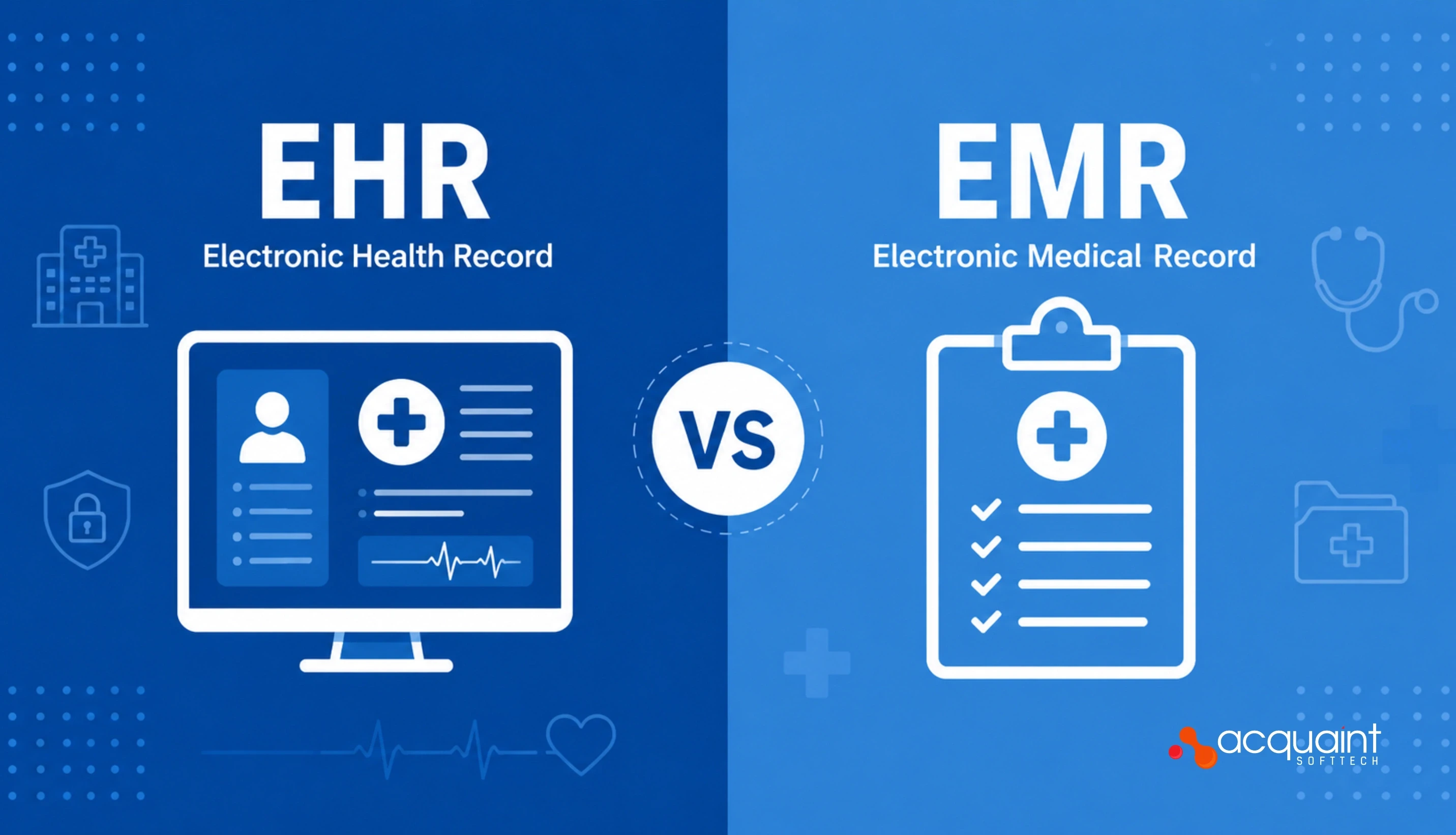
EHR vs EMR: What's the Actual Difference and Which Should You Build
Most people use EHR and EMR interchangeably. They are not the same system. One is a digital filing cabinet for a single practice. The other is a longitudinal health record that follows the patient across their entire care journey. Picking the wrong one costs founders 9 to 14 months of rework. Here is how to choose correctly the first time.

Ahmed Ginani
May 15, 2026India (Head Office)
203/204, Shapath-II, Near Silver Leaf Hotel, Opp. Rajpath Club, SG Highway, Ahmedabad-380054, Gujarat
USA
7838 Camino Cielo St, Highland, CA 92346
UK
The Powerhouse, 21 Woodthorpe Road, Ashford, England, TW15 2RP
New Zealand
42 Exler Place, Avondale, Auckland 0600, New Zealand
Canada
141 Skyview Bay NE , Calgary, Alberta, T3N 2K6