

MVP Chapter #4: How to Plan an MVP
Planning an MVP means finding the core problem, choosing only the essential features to solve it, and launching fast to learn from real users. It stops you from wasting time and money on things people do not want. The proven flow: talk to users and pin down the problem, pick must-have features, choose your MVP type, set goals and a short timeline, then launch and listen.

Mukesh Ram
Introduction
As the Founder and CEO at Acquaint Softtech, a leading software product development company, I can tell you that building an MVP and utilizing its purpose is the best thing you can do for the success of your business idea, and I have seen it work for founders across the USA, UK, Europe, Australia, and New Zealand. The majority of entrepreneurs skip this crucial step only to see their startup dooming later.
Fortunately, some do acknowledge building an MVP but do so without any plan and thus end up doing so poorly. That is why today we will show you how to plan an MVP to its finest in just 5 steps. But first, let's take a recap.

- You want a clear, step-by-step way to plan an MVP.
- You are a founder, CEO, or CTO about to build a new product.
- You want an MVP planning template you can follow today.
- You are deciding which core features and MVP type to pick.
- You want the real cost of building an MVP.
- You want a proven partner to plan and build your MVP.
Good MVP planning is simple in theory: find the core problem, choose only the essential features to solve it, and launch fast to learn from real users. That is the whole game, and the five steps below turn it into a repeatable process you can start today.
If you would rather plan it with experts beside you, our discovery workshop services turn a rough idea into a validated MVP plan in days, not months.
What is an MVP?
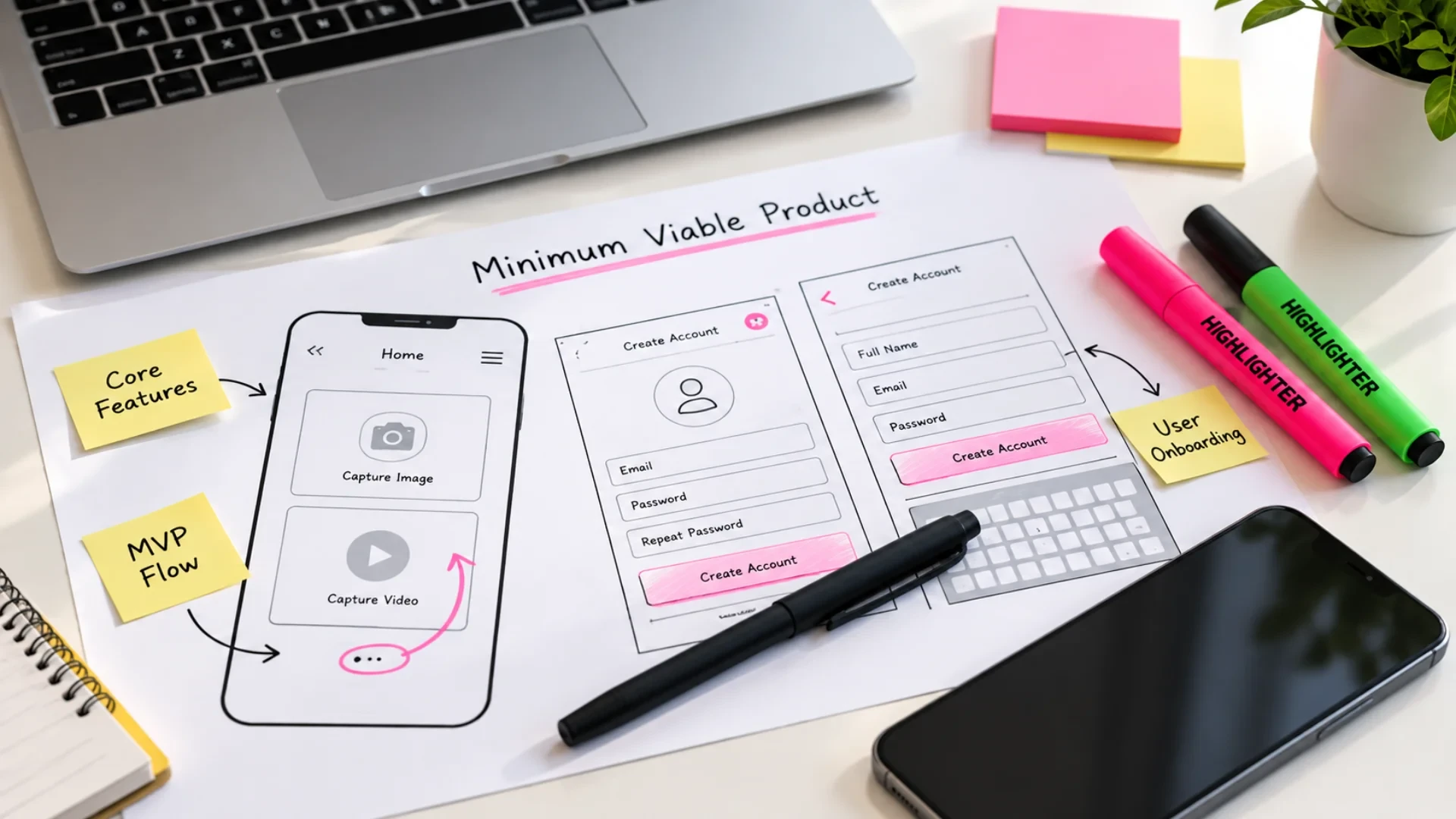
MVP stands for Minimum Viable Product. It represents your product with the minimum possible features required to solve the core problem you are targeting. This makes it quicker to launch your product and saves you from being tangled up in extraneous features that don't add much value.
I won't dig deeper into this as we have already written a post on What is MVP?. If you are looking for more, I recommend that you check it. Now, let's understand the steps you need to take to plan your MVP successfully.
How to plan your MVP in five steps?
Step 1: Identify your target audience and their needs
You need to identify your target audience, to whom you will sell your product. You cannot sell anything to anyone, but you can definitely sell something to someone. You need to define that "someone" and their pain points (which you will eventually solve with your product).
Ask yourself how you stumbled upon this problem in the first place. Is it faced by a big enough audience? If yes, then who are they? Gather as much information about them as you can.
Are there any competitors? Having competitors is a good sign, as it tells you that people are paying them for the same problem you are eyeing to solve.
Step 2: Seek opportunity
You cannot get away with being the same as others. You need to be unique in some way. And for that, you need to find the shortcomings of your competitors. This is where the opportunity lies.
1. What is it that they have failed to solve?
2. Can you provide a better or cheaper product?
3. Can you provide it in a better way?
For this, it is essential to know your audience. Find them, talk to them, and listen to their pain points and their buying journey. You can even spread out a survey form for them to fill out. This will reveal a goldmine of insights and opportunities you can exploit.
Step 3: Decide on which features to build
Have you sincerely followed the first two steps? Then it would be much easier to decide which essential features to load in your MVP.
If you are still confused, you can use feature prioritization of features. In addition to helping you focus on building the most important feature(s), it will also give you a sense of relief that other bonus features won't be left out. They are just shifted to a later date. When you are ready to build, our dedicated software development teams focus only on those must-have features.
Step 4: Decide on the technologies you will use to develop your MVP
The technology you choose to develop your MVP matters a lot as it determines the quality of the MVP, the development time, expansion opportunities, etc.
I recommend that you go with Laravel, Python, or NodeJS. They are highly scalable, and you can also easily find developers for these technologies as well. For a Laravel MVP, you can hire Laravel developers from Acquaint Softtech, onboarded within 48 hours.
If your MVP is data-heavy or AI-driven, you can also hire Python developers experienced in fast, scalable builds.
Step 5: Refine your MVP
Once you have developed your MVP, your job isn't done. It's just started. Collect feedback from your target audience.
Is it better than other similar products? If yes, then how?
Is it a reliable solution?
Does it provide the best user experience?
This feedback will reveal the positives and the negatives of your MVP. Use this to refine it further and continue the cycle. Our support and maintenance services keep the MVP stable while you iterate.
How to Plan an MVP (Quick Template)
.webp "How to Plan an MVP")
Here is a simple how-to-plan-an-MVP template you can copy: problem, users, must-have features, MVP type, success metric, and timeline. Fill each row in one line, and you have a plan.
Planning Step | What to Write | Example |
Core problem | One clear pain point | Booking a cleaner is slow |
Target users | Who feels it most | Busy urban households |
Must-have features | 2 to 4 max | Search, book, pay |
MVP type | No-code, concierge, or landing | Landing page first |
Success metric | One number | 100 signups in 30 days |
Timeline | Weeks, not years | 6 to 8 weeks |
This is the same lean approach taught in the Y Combinator Startup Library guide on how to build an MVP (often searched as "how to build an MVP YC"). The idea is universal, whether it is an MVP in software, an MVP in a project, or even the core-loop thinking behind an MVP in games: solve one problem well, then expand. If you want minimum viable product examples, think of a simple landing page that tested demand before a single feature was built.
Choose Your MVP Type
Pick the lightest MVP type that can still test your idea: no-code, concierge, or a landing page. You do not always need to build software to learn what you need.
No-code / low-code: use basic tools to build a working test fast.
Concierge / Wizard of Oz: do the work manually behind the scenes instead of building automated software.
Landing page: show a simple page to see if people sign up or show interest.
For a no-code or rapid prototype that you later turn into real software, our software product development services bridge the gap from test to product.
Set Goals and Timeline
Decide what success looks like and give yourself a short deadline. Clear goals keep an MVP from sprawling into a full product.
Define success: pick a clear metric, such as number of signups, user retention, or direct sales.
Set a short timeline: a few weeks to a couple of months maximum, then launch.
Then launch and listen: put the product in front of real users quickly, watch how they use it, and change, improve, or drop features based on what you learn. If you need senior direction on these calls, our virtual CTO services give founders on-demand technical leadership.
How Much Does It Cost to Build an MVP?

An MVP usually costs $5,000 to $40,000+, based on your features, complexity, and requirements. At Acquaint Softtech, fixed-project MVP development starts from $5,000, and our MVP calculator gives you a quick, free estimate.
MVP Type | Estimated Cost (2026) | Typical Timeline |
Landing / no-code test | $5,000 to $10,000 | 2 to 4 weeks |
Standard MVP | $10,000 to $30,000 | 6 to 12 weeks |
Advanced MVP | $40,000+ | 3 to 6 months |
You can lower the cost by outsourcing software development to a vetted team instead of hiring locally.
Prefer to extend your in-house team instead? Our IT staff augmentation services place vetted engineers within 48 hours.
Want your MVP planned and built for $5,000 to start?
Tell Acquaint Softtech your core problem and features, and we will turn your plan into a fixed-price MVP, timeline, and launch schedule within 48 hours.
Case Study: A Verified MVP Build
Here is how the plan-then-build approach plays out on a real project. This account reflects our verified reputation on Clutch.
Lean MVP, shipped fast
The founder had an idea but no proof anyone wanted it. We planned the MVP, built only the core features, and launched quickly.
Who: A founder validating a brand-new idea
The plan: One core problem, a short must-have feature list, a fixed timeline
What we built: A lean product with core features and a clean, scalable base
How we worked: A dedicated team, transparent process, regular check-ins
Company-wide proof: Acquaint Softtech has delivered 1,300+ projects over 13+ years with 70+ in-house engineers and a 5-star rating across 60+ reviews on Clutch, as an Official Laravel Partner.
Why Choose Acquaint Softtech to Plan and Build Your MVP
Choose a partner with public proof, an in-house team, and affordable MVP pricing, and Acquaint Softtech offers all three. Most clients save 60 to 75% versus hiring equivalent talent in the US, UK, or Australia, without cutting quality.
Affordable MVPs: fixed-project MVP development starts from $5,000.
Verified trust: 5-star Clutch rating across 60+ reviews and 1,300+ delivered projects.
In-house talent: 70+ full-time engineers, deployable within 48 hours.
Global reach: serving founders across the USA, UK, Europe, Australia, and New Zealand.
Agencies that want to resell a finished MVP can use our white label software development to launch under their own brand.
To Wrap Up
Building an MVP is a reliable way to enter the market with your product. But this takes planning. The good news is that you can expedite the process of MVP development, as we are an MVP development company in business for over 15 years. That is exactly the kind of work the team at Acquaint Softtech enjoys, so contact us to start building your MVP now.
Ready to turn your plan into a product?
Talk directly with Acquaint Softtech's founder in a free 30-minute session. You will leave with a clear MVP plan, a fixed budget from $5,000, and honest advice on your idea.
Frequently Asked Questions
-
What are the steps to building an MVP?
Identify your target audience and their needs, seek opportunity by studying competitors, decide which core features to build, choose the technology, then launch and refine with real feedback. In short: problem, users, features, build, learn.
-
How do I design an MVP?
Start with the core problem, pick only the must-have features that deliver your main value, choose the lightest MVP type (no-code, concierge, or landing page), set a success metric and a short timeline, then launch to real users and improve.
-
What is an MVP strategy?
An MVP strategy is a plan to test your idea with the least time and money: solve one core problem, ship only essential features, measure real user response, and use that data to decide what to build next.
-
How long does MVP development take?
There is no specific answer to this. It depends upon your requirements, the complexity of the task, and the number of people working to develop it. Many MVPs ship in a few weeks to a couple of months.
-
How much does it cost to build an MVP?
MVP costs vary based on your features, complexity, and requirements. At Acquaint Softtech, fixed-project MVP development starts from $5,000, and you can use our MVP calculator for a quick estimate.
-
Is it essential to know my target audience?
If you are serious about launching a successful product, then yes. Knowing your target audience is a must these days, as it will help you to better fulfill their needs. The more you know them, the more of an edge you have over your competitors.
-
Why is developing an MVP important?
It reduces risk, helps you determine market needs, helps you know your audience and gather their feedback, and simplifies the process of product development. We have a detailed blog post on this that I recommend you check out.
I love to make a difference. Thus, I started Acquaint Softtech with the vision of making developers easily accessible and affordable to all. Me and my beloved team have been fulfilling this vision for over 15 years now and will continue to get even bigger and better.
Table of Contents
Get Started with Acquaint Softtech
- 13+ Years Delivering Software Excellence
- 1300+ Projects Delivered With Precision
- Official Laravel & Laravel News Partner
- Official Statamic Partner
Related Blog
-(2026-update).webp "MVP Chapter #1: What Is a Minimum Viable Product (MVP)? (2026 Update)")
MVP Chapter #1: What Is a Minimum Viable Product (MVP)? (2026 Update)
A minimum viable product (MVP) is the simplest version of a new product that has just enough core features to satisfy early users. It lets teams test a business idea in the real market and learn what customers want without spending time and money on a full build. In software, an MVP means shipping only the key features that solve one core problem, launching to real users, then improving with their feedback.
Mukesh Ram
July 11, 2022.webp "MVP Chapter #2: What Is the Difference Between POC and MVP? (2026 Update)")
MVP Chapter #2: What Is the Difference Between POC and MVP?
A Proof of Concept (PoC) tests whether an idea or technology can be built. A Minimum Viable Product (MVP) is a functional, bare-bones version of a product released to real users to test market demand and business viability. In short, a PoC answers "Can we build this?" while an MVP answers "Should we build this, and do people want it?" You usually build a PoC first, then an MVP once feasibility is confirmed.
Mukesh Ram
July 20, 2022.webp "Why Should You Pick Laravel For Web Development? (2026 Update)")
Why Should You Pick Laravel For Web Development? (2026 Update)
Laravel is widely chosen for web development because it drastically accelerates production timelines while providing robust, enterprise-grade security out of the box. It removes repetitive boilerplate so developers can focus on unique business logic. The primary reasons to build with Laravel are accelerated time-to-market, ironclad security and reliability, a maintainable and scalable MVC architecture, and a rich ecosystem that supports business growth.
Mukesh Ram
March 23, 2022India (Head Office)
203/204, Shapath-II, Near Silver Leaf Hotel, Opp. Rajpath Club, SG Highway, Ahmedabad-380054, Gujarat
USA
7838 Camino Cielo St, Highland, CA 92346
UK
The Powerhouse, 21 Woodthorpe Road, Ashford, England, TW15 2RP
New Zealand
42 Exler Place, Avondale, Auckland 0600, New Zealand
Canada
141 Skyview Bay NE , Calgary, Alberta, T3N 2K6