

What Is a Landing Page and How Does It Work? A 2026 Guide
A landing page is a standalone web page built for a single goal, usually one conversion such as a sign-up, a booking, or a purchase. It works by matching one message to one audience with no navigation to distract them, so the visitor either takes the action or leaves. That focus is what separates it from a homepage, which serves many audiences and many goals at once. A good landing page is measured by its conversion rate and improved through testing, not designed once and left alone.

Mukesh Ram
As the Founder and CEO at Acquaint Softtech, I want to start by clearing up the confusion that this article originally added to. A landing page is not just any page a visitor arrives on, and it is definitely not your homepage. It is a page built for one purpose, aimed at one audience, with everything that does not serve that purpose stripped out, including the navigation menu.
The moment a page tries to be your homepage, your about page, and your conversion page at the same time, it has stopped being a landing page and started being a compromise. Most pages that underperform do so because nobody made that distinction, and across our software product development work, the highest-converting pages are always the most ruthlessly focused ones.

- You are running ads or campaigns and sending traffic to your homepage.
- You have a landing page and no idea whether it converts well or badly.
- You want to know what actually makes a page convert, not colour folklore.
- You are choosing between a page builder and a custom-built page.
- You are about to spend on traffic and want the page to be worth it.
That focus is the whole idea, and everything else follows from it. This rewrite keeps the parts of the original that were sound, the emphasis on copy, interface, and a clear call to action, and corrects the parts that were not, starting with the definition.
It then adds what the original left out entirely: how you tell whether a landing page is any good, and how you make it better, because a landing page you cannot measure is just a page with opinions attached.
What a Landing Page Actually Is
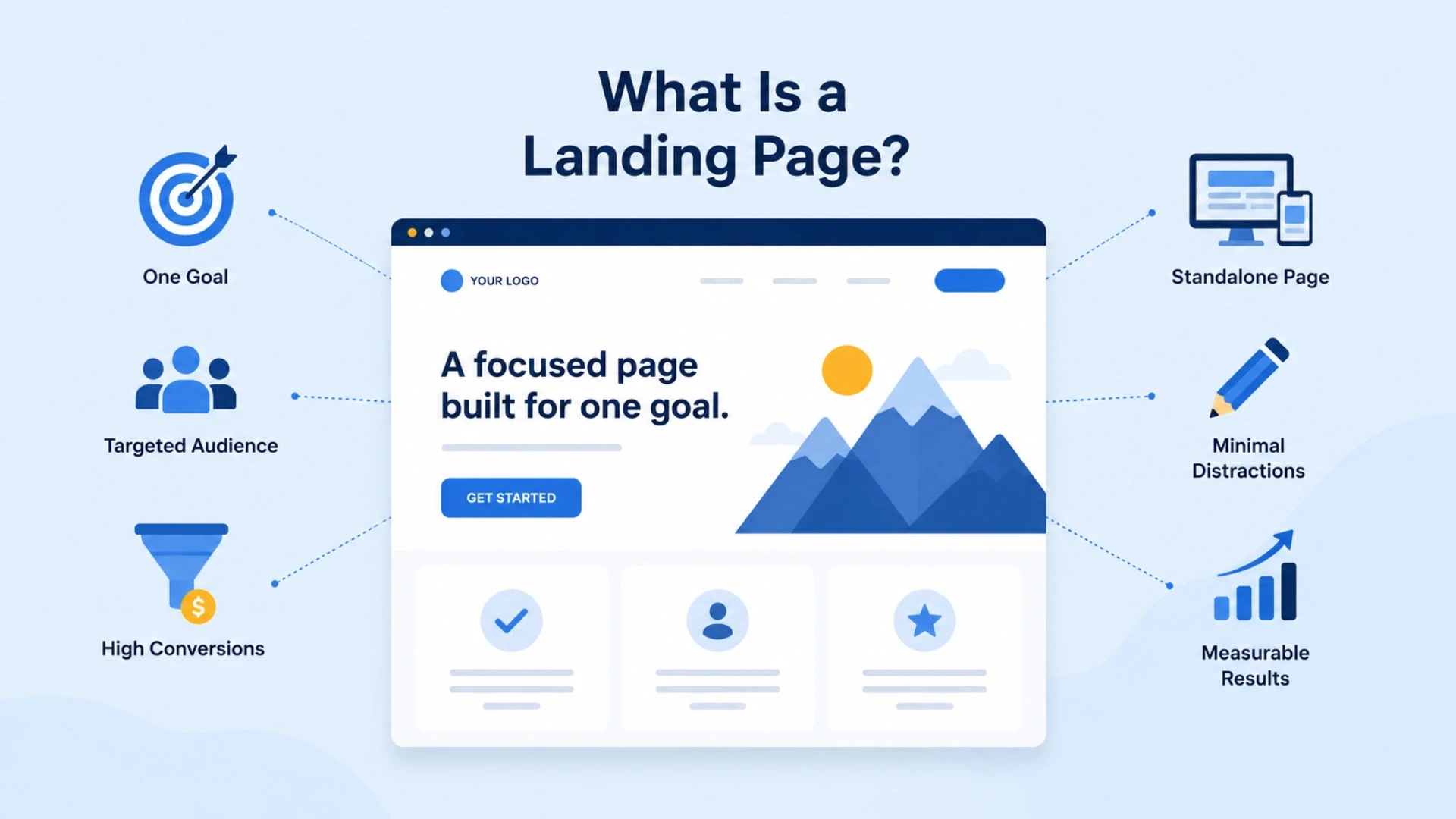
A landing page is a standalone page with a single conversion goal and no competing links. Everything on it exists to move one specific visitor toward one specific action, and everything that does not serve that action is removed.
That is the definition the original blurred. It listed a service page, a contact page, a home page, and an about page as examples of landing pages, but those are ordinary website pages that serve many purposes.
A real landing page is purpose-built for a campaign: someone clicks an ad about a specific offer, arrives on a page about exactly that offer, and is asked to do exactly one thing. The tighter the match between what was promised and what appears, the better it converts. The word static, also used in the original, is misleading too, since strong landing pages are tested and refined continuously rather than set once.
Landing Page vs Homepage
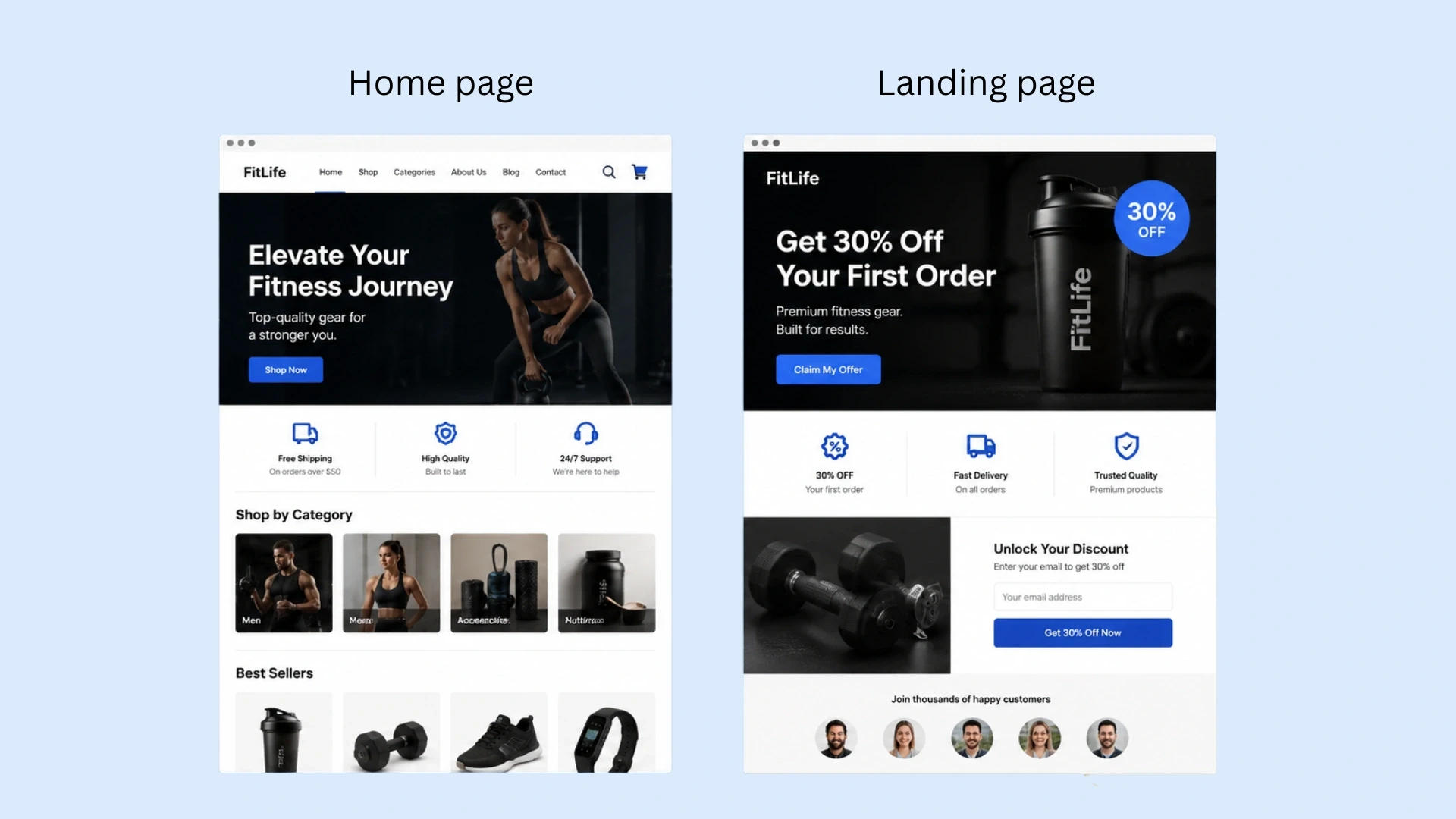
A homepage serves everyone; a landing page serves one person with one intent. That single difference explains why sending paid traffic to a homepage wastes money.
Feature | Homepage | Landing page |
Audience | Everyone who finds you | One campaign's traffic |
Goals | Many, competing | One, singular |
Navigation | Full menu | None, or minimal |
Message | Broad and general | Matched to the ad |
Links out | Dozens | One call to action |
Measured by | Overall traffic | Conversion rate |
A visitor who clicked an ad for a specific service and lands on a general homepage has to find their way to what they were promised, and many will not bother. Every extra link is an invitation to leave. The landing page removes the maze by having exactly one path, which is why a dedicated page routinely converts several times better than the homepage for the same campaign.
The Anatomy of a Page That Converts
A converting landing page is built from a small number of elements that each do one job. The original named three of them; here is the full set with what each is actually for.
Message match
The headline must echo the promise that brought the visitor there. If the ad said one thing and the page says another, the visitor feels a jolt of doubt and leaves. This is the single highest-impact element and the one most often ignored, because it requires the page and the campaign to be designed together rather than separately. Copy here is not a clever one-liner, as the original suggested, but a clear restatement of the exact thing the visitor was looking for.
One call to action
A landing page has one action and asks for it clearly, more than once, in the same words each time. The original was right that the call to action matters; the refinement is that competing actions destroy conversion. A page offering a free trial should not also invite you to read the blog, follow on social media, and browse the pricing tiers. Every alternative you offer is a way of not doing the one thing you actually want.
Reduced friction
Every form field, every required decision, and every second of load time is friction, and friction is where conversions leak away. Ask for the least information you genuinely need, since each additional field measurably lowers completion.
Proof
People convert when they believe you, and belief comes from evidence: testimonials, review scores, recognisable client names, concrete numbers, guarantees. A claim about yourself persuades far less than the same claim made by a customer, which is why the strongest section of many landing pages is the one you did not write about yourself.
Sending paid traffic to a page that does not convert?
Send me your landing page URL and the ad driving it, and I will tell you where the message breaks, where the friction is, and what I would change first.
How to Measure a Landing Page
A landing page is measured by its conversion rate, the share of visitors who take the action, and nothing else really matters. This is the half of the subject the original article skipped entirely, and it is the half that decides whether the page earns its keep.
What a good rate looks like
Conversion rates vary enormously by industry, offer and traffic quality, so treat any single benchmark with caution. A low-commitment action like an email sign-up converts far higher than a high-commitment one like a paid purchase, and a page fed by well-targeted traffic converts better than one fed by broad clicks. The useful number is not an industry average but your own page's rate over time, because the only benchmark that matters is whether this week beats last week.
How to improve it
Test one change at a time. A/B testing shows one version to half your visitors and another to the other half, then measures which converts better. Change the headline, or the call to action, or the form length, but not all three at once, or you will not know which change did the work.
Run each test until the result is statistically trustworthy rather than stopping the moment one version looks ahead, since early leads reverse constantly. Setting up reliable measurement and testing is standard work for the hire MERN stack developers who build and instrument your front end.
Speed and Accessibility Are Conversion Features
A slow or inaccessible landing page loses conversions and rankings at the same time, which makes both business concerns rather than technical ones. Neither appeared in the original, and both now materially affect results.
Speed
Every additional second of load time costs conversions, and the effect is largest on mobile where much campaign traffic now arrives. Google's Core Web Vitals measure loading, responsiveness, and visual stability, and they influence both the visitor's experience and your search visibility.
A landing page that loads slowly is paying twice: once in visitors who leave before it renders, and again in rankings. Keeping it fast is often a job for whoever you hire DevOps engineers to handle delivery and hosting.
Accessibility
A page that some visitors cannot use is a page that cannot convert them, and accessibility is both a legal expectation in many markets and simply a wider audience. Building to the Web Content Accessibility Guidelines means sufficient colour contrast, keyboard operability, labelled form fields and readable text, all of which also improve conversion for everyone.
The original's advice to pick colours by industry, orange or red for food, is folklore; sufficient contrast for a real human to read the text is the actual requirement.
How to Build One, and What to Build It With

You can build a landing page with a page builder or have one built custom, and the right choice depends on volume and stakes. Both are legitimate; choosing wrong wastes either money or opportunity.
Your situation | Best route | Why |
Testing an idea quickly | Page builder | Live in hours, low cost |
Occasional campaigns | Builder or WordPress | Cheap, easy to change |
High-spend paid traffic | Custom-built | Small lift pays for itself fast |
Complex logic or integrations | Custom-built | Builders hit their limits |
Part of a larger product | Custom, in your stack | Consistency and control |
The economics are simple. When you are spending little on traffic, a page builder is the sensible choice and a custom build is overkill. When you are spending heavily, a small improvement in conversion rate returns more than the cost of building the page properly, so custom work pays for itself quickly.
For campaigns on WordPress, a capable team can move fast, which is a common reason businesses hire WordPress developers, while product-integrated pages usually belong in your main stack. Deciding which you actually need is a short conversation we often have in a discovery workshop.
Proof: Pages Built to Convert
A landing page is only as good as what it delivers, so the relevant proof is a record of building things that work and get maintained. Ours is verifiable.
Acquaint Softtech, verifiable delivery record 1,300+ delivered projects across 13+ years. 95% on-time sprint delivery. 4.9 out of 5 across verified Clutch reviews. NDA signed before work begins and 100% client ownership of everything produced. For landing-page work, the relevant point is that we build pages you own outright and can keep testing, not templates you rent and cannot change. |
The ownership point matters more for landing pages than it first appears. A page you own is a page you can test, rebuild, and improve indefinitely, whereas a page locked inside a proprietary builder is only as flexible as the builder allows.
Since the entire value of a landing page comes from improving it over time, owning it outright is what lets that improvement continue. Our software case studies and client testimonials show the delivery record behind that, and the kind of proof section that itself belongs on a converting page.
Want a landing page you own and can keep improving
Book a free 30-minute call, and I will scope a page built around your campaign, your offer and your stack, with testing built in from the start.
What a Landing Page Costs

A landing page's cost should be judged against the traffic spend it supports, not in isolation. This table prices each part by what it lifts rather than by size alone.
What you are paying for | What it lifts | Cost (USD) |
Builder page, self-serve | Speed to launch | 0 to 500, plus tool fees |
Custom single page | Conversion and speed | 1,500 to 6,000 |
Page with copy and design | Message match and clarity | 3,000 to 12,000 |
A/B testing setup | Ongoing conversion gains | 1,500 to 6,000 |
Speed and accessibility work | Rankings and reach | 1,500 to 7,000 |
Campaign of several pages | Per-audience relevance | 8,000 to 30,000 |
The decision is a ratio, not a number. If you spend little on traffic, keep the page cheap. If you spend heavily, the page is the multiplier on all of that spend, and a small conversion improvement returns more than the build cost many times over. Paying for a good page while sending it expensive traffic is the easiest win in digital marketing, and skipping it is the most common waste.
Where the work is done | Senior rate | Relative cost |
New York, USA | USD 110 to 200 / hour | Highest |
United States (national) | USD 90 to 170 / hour | Very high |
Australia | AUD 110 to 200 / hour | High |
United Kingdom | GBP 65 to 130 / hour | High |
Europe (EU) | EUR 70 to 140 / hour | High |
India (Acquaint Softtech) | USD 25 to 49 / hour | Up to 40% lower |
Because a landing page is a small, well-defined deliverable, it is an easy piece of work to hand to an offshore team at a fraction of the onshore cost, with results you can see directly in the conversion rate. Where you need a run of pages for several campaigns, adding capacity through IT staff augmentation is often the quickest route, and our guide to web application development cost covers how this sits in a wider budget.
Turn your ad spend into conversions, not bounces
Book a free 30-minute call, and I will scope a page matched to your campaign, with a fixed cost and timeline in your own currency.
Frequently Asked Questions
-
What is a landing page?
A standalone web page built for a single goal, such as a sign-up or purchase, with no navigation to distract the visitor. Everything on it serves one action.
-
What is the difference between a landing page and a homepage?
A homepage serves many audiences and goals with full navigation. A landing page serves one campaign's traffic with one message and one call to action, and converts far better for paid traffic.
-
How does a landing page work?
It matches one message to one audience, removes distractions, and asks for one action. The visitor either converts or leaves, which makes the page easy to measure and improve.
-
What is a good landing page conversion rate?
It varies widely by industry, offer, and traffic quality, so ignore single benchmarks. The number that matters is your own page's rate improving over time through testing.
-
What makes a landing page convert well?
Message matches the ad: a single clear call to action, minimal form friction, believable proof, and fast load times. Message match is usually the highest-impact element.
-
Should I send ad traffic to my homepage?
No. A homepage has many competing links and a general message, so much of the paid traffic leaks away. A dedicated landing page matched to the ad converts several times better.
-
How many form fields should a landing page have?
As few as you genuinely need. Every additional field measurably lowers completion, so ask only for what you will actually use and defer the rest.
-
Does landing page speed affect conversions?
Yes. Every extra second of load time loses conversions, most heavily on mobile, and slow pages also rank worse, so speed affects both traffic quality and volume.
-
Should I use a page builder or build custom?
A builder for quick tests and low traffic. Custom for high ad spend or complex needs, where a small conversion lift pays for the build many times over.
-
How do I improve a landing page?
A/B test one change at a time, such as the headline or call to action, and run each test until the result is trustworthy. Improvement over time is where the value is.
I love to make a difference. Thus, I started Acquaint Softtech with the vision of making developers easily accessible and affordable to all. Me and my beloved team have been fulfilling this vision for over 15 years now and will continue to get even bigger and better.
Table of Contents
Get Started with Acquaint Softtech
- 13+ Years Delivering Software Excellence
- 1300+ Projects Delivered With Precision
- Official Laravel & Laravel News Partner
- Official Statamic Partner
Related Blog
Rome Was Not Built in a Day: The Journey to Developing a Unicorn SaaS
Building a unicorn SaaS company is a marathon, not a sprint. Just like Rome, great products aren’t built overnight. From refining your MVP to scaling for growth.
Mukesh Ram
September 26, 2024
Bootstrap vs Material
Develop a state-of-the-art solution by picking the best technology after reading more about Bootstrap and Material UI

Shivang P
September 4, 2023
10 Must Follow Steps of Mobile App Development Process
The mobile app development process is a structured set of 10 steps that moves an idea from concept to a published app: ideation, target audience and monetization, choosing the platform, UI/UX design, picking tools, choosing the right partner, fast development, testing and deployment, marketing, and post-launch maintenance. Following the steps in order, rather than rushing to publish, is what separates apps that get downloads from the ones that get ignored.
Mukesh Ram
July 29, 2019India (Head Office)
203/204, Shapath-II, Near Silver Leaf Hotel, Opp. Rajpath Club, SG Highway, Ahmedabad-380054, Gujarat
USA
7838 Camino Cielo St, Highland, CA 92346
UK
The Powerhouse, 21 Woodthorpe Road, Ashford, England, TW15 2RP
New Zealand
42 Exler Place, Avondale, Auckland 0600, New Zealand
Canada
141 Skyview Bay NE , Calgary, Alberta, T3N 2K6