

Multi-Currency Property Management for International Real Estate Portfolios
How to build multi-currency property management for international portfolios: currency conversion, cross-border income, tax compliance, reporting, and cost.

Ahmed Ginani
As Business Development Lead at Acquaint Softtech, I have watched property groups outgrow single-currency tools, and the ones that scale treat multi-currency property management as serious software product development rather than a currency field bolted onto an old system.
Multi-currency property management is the tracking, conversion, compliance, and reporting of rent and expenses across properties held in different countries and currencies. The moment a portfolio crosses a border, exchange rates, local tax, and fragmented banking turn simple bookkeeping into a real engineering problem.

- A founder building software for an international real estate portfolio.
- A CTO scoping currency conversion, tax compliance, and consolidation.
- A COO or CFO managing cross-border property income across countries.
- A team weighing a custom platform against generic accounting software.
If you want the wider category picture first, our PropTech software development guide shows where multi-currency management sits inside a full property platform.
This is a build article, not a banking pitch. It covers the capabilities you need, currency conversion on rent, the tax compliance module, multi-country reporting, a step-by-step build, and honest cost. Acquaint Softtech has built accounting and compliance backends like this, and the lesson repeats: get the ledger right and the reports take care of themselves.
What is multi-currency property management?

Multi-currency property management is software that records, converts, and reports property income and costs across several currencies and jurisdictions. Its core promise is one honest number: what the whole portfolio is worth and earning, in your base currency, right now.
The hard part is not the currency symbol; it is the timing. A rent booked in euros, paid three weeks later, and reported in pounds involves three different exchange rates, and getting cross-border property income right means recording every one of them.
Converting, revaluing, and consolidating those amounts under accounting rules is precise financial logic, so teams often hire Python developers for the conversion and reporting engine.
The ledger, invoices, and payment records that wrap that engine are core backend work teams hire Laravel developers to build and keep tested.
Key capabilities required
Three capabilities separate real multi-currency software from a spreadsheet with a currency column. Each maps to a distinct part of the build.
Unified multi-currency accounting. Automatically process foreign currency conversions under standard accounting rules like IFRS or GAAP without manual math.
Local compliance. Manage regional tax frameworks, local payroll, and tenant payment compliance for every country where you operate.
Global banking and collections also matter: localized receiving accounts or multi-currency business accounts, such as those, let you collect rent and pay international suppliers smoothly.
Wiring those bank feeds, rate pulls, and scheduled conversions so they run untouched is background work teams hire automation engineers to own.
Popular software platforms
Before you build, it helps to know what large groups already use, because a custom platform should beat these on fit, not reinvent them. Three come up most often.
For very large international property groups, NetSuite offers robust multi-currency engines, global consolidation architecture, and multi-book accounting.
Purpose-built for property, the RIOO App is designed to run multi-currency, multi-entity real estate portfolios inside a single platform.
For cross-border portfolios specifically, Trace Solutions provides full multi-currency functionality explicitly designed for that use case.
Currency conversion at booking and on rent
How conversion is actually engineered. Currency conversion at booking means every transaction stores three things: the original amount and currency, the exchange rate used, and the resulting base-currency value. Never store only the converted number, or you can never audit or restate it.
Rent then needs revaluation. Because a lease signed in one month is paid in another, the system pulls a daily rate, records gains or losses on the difference, and keeps the original currency intact so reporting can show either view. That discipline is what makes currency conversion rent figures trustworthy.
Choosing sensible rates, flagging unusual swings, and forecasting FX exposure is a modeling task, which is where AI development services add value on top of the raw conversion.
Pulling reliable rates from providers on schedule and caching them is an infrastructure job, so teams hire DevOps engineers to run those feeds dependably.
Cross-border income and the tax compliance module

Multi-country tax. An international tax compliance module applies each country’s rules to the income earned there, because rent in Spain, the UK, and the UAE is taxed, withheld, and reported differently, and one global rule set will always be wrong somewhere.
The pattern that works is a rules engine: each jurisdiction is a configurable set of tax rates, filing formats, and withholding rules, so adding a country is configuration, not a rewrite. Every entity keeps its own books, and the platform consolidates upward.
The compliance dashboards where finance teams review filings by country are front-end work that teams hire MERN stack developers to build.
Mapping each country’s rules correctly before coding them is exactly what a product discovery workshop is for, because a missed withholding rule is expensive to fix later.
Multi-country portfolio reporting
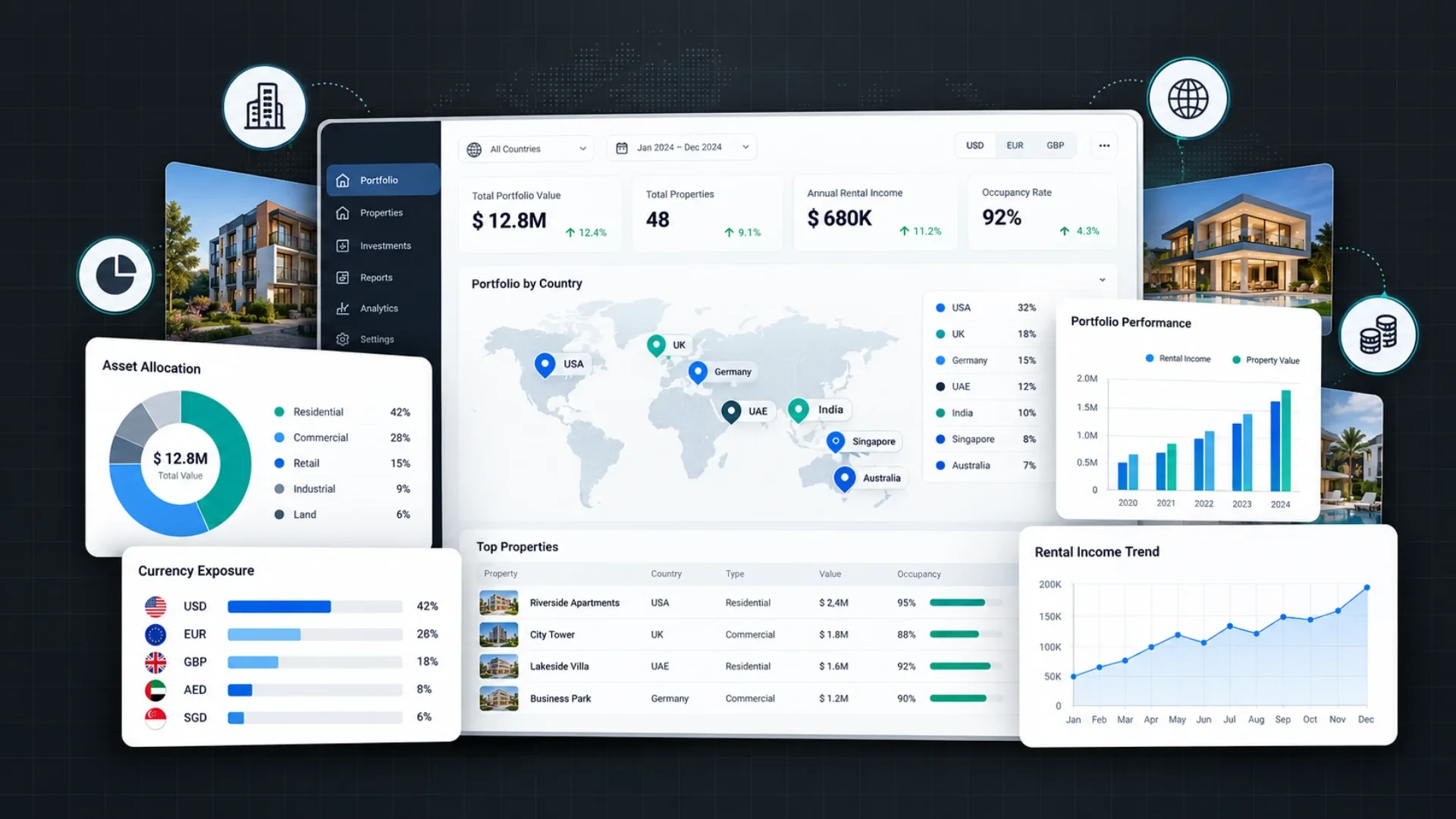
Multi-country portfolio reporting rolls every property, entity, and currency up into one base-currency view, while still letting you drill down into a single country in its local currency.
This needs a consolidation layer that converts each entity to the base currency at the right rate, eliminates inter-entity transfers, and presents both a group view and a local view. Done well, a CFO sees the whole portfolio and a country manager sees their own numbers, from the same data.
Forecasting income and FX exposure across the portfolio is a modeling problem, so teams hire AI/ML engineers to project cash flow by country and currency.
The interactive dashboards that make consolidation explorable are front-end work teams often hire MEAN stack developers to deliver.
Want conversion, compliance, and consolidation as one platform?
Our engineers have built accounting engines, compliance systems, and consolidated dashboards for finance and property clients. Tell us your countries and currencies, and we will map a multi-currency platform with a fixed scope and clear milestones.
How to build a multi-currency platform, step by step
To build multi-currency property management, model currency-aware data, add the conversion engine, layer compliance and consolidation, then report. Here is the build in six steps.
Model currency-aware data. Store original amount, currency, rate, and base value on every transaction, per entity and country.
Build the conversion engine. Pull daily rates, convert under IFRS or GAAP, and record revaluation gains and losses.
Add the compliance rules engine. Make each country a configurable set of tax, withholding, and filing rules.
Wire global banking. Connect local receiving accounts and multi-currency accounts for rent and supplier payments.
Build consolidation and reporting. Roll every entity into a base-currency group view with local drill-down.
Launch and expand by country. Go live in one or two countries, then add each new jurisdiction as configuration.
Coordinating accounting, compliance, and banking across sprints needs a steady hand, so founders hire a project manager to keep the plan on track.
If your core team is small, staff augmentation adds vetted finance-software engineers so the build keeps pace.
For founders without a finance-tech co-founder, virtual CTO services set the accounting architecture before the first sprint.
Tech stack for international property management
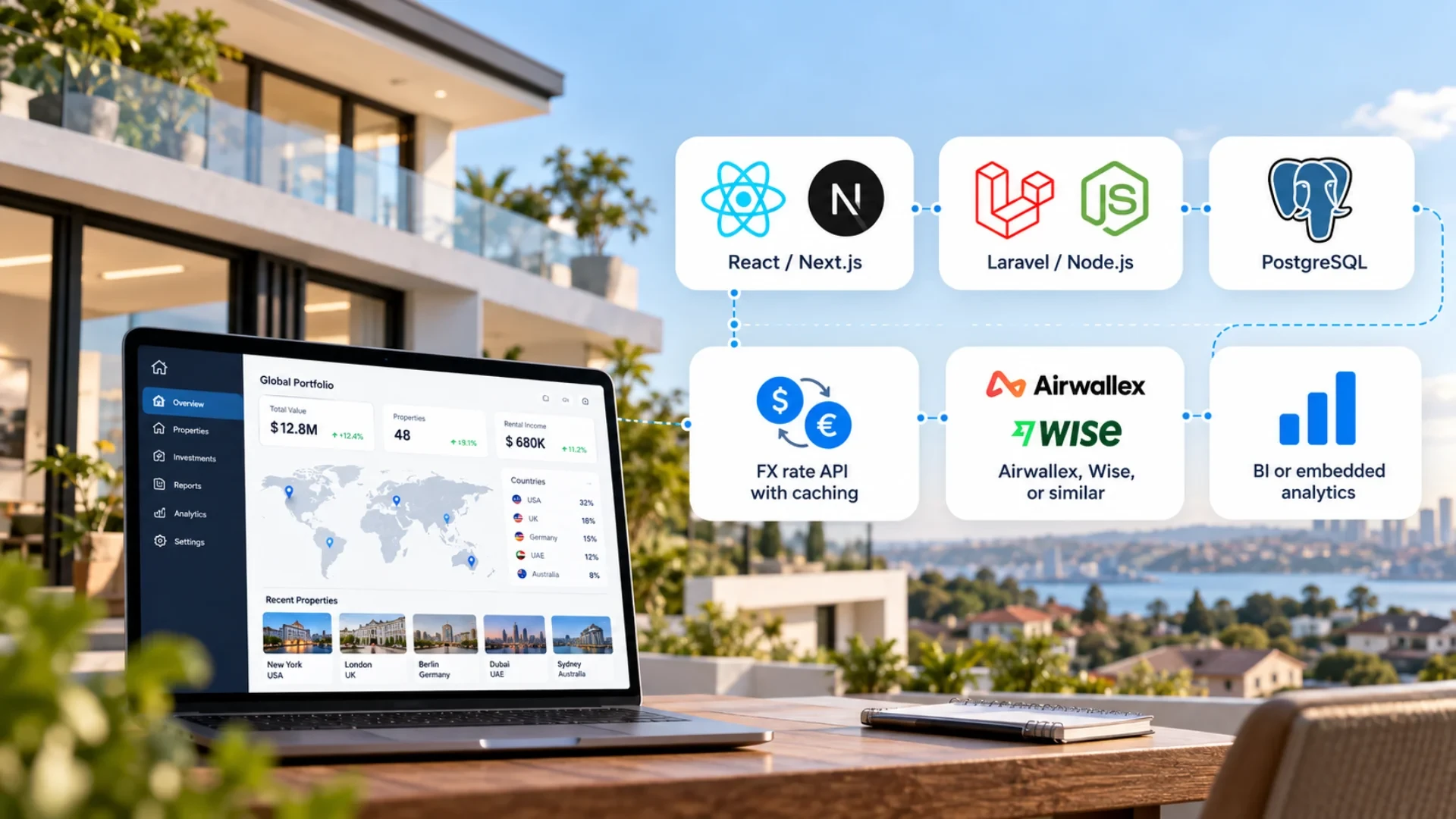
The best stack for multi-currency management pairs a precise accounting backend and database with reliable rate feeds and clear dashboards. Correctness and auditability matter more than novelty.
Layer | Common choice | Why |
Frontend | React or Next.js | Consolidated and country dashboards |
Backend | Laravel or Node.js | Ledger, conversion, compliance |
Database | PostgreSQL | Auditable multi-currency ledger |
Rates | FX rate API with caching | Daily conversion and revaluation |
Banking | Airwallex, Wise, or similar | Local collections and payouts |
Reporting | BI or embedded analytics | Group and local consolidation |
The biggest lever on budget is engineering rate, not the feature list, which is why many teams hire remote developers to build the same platform for a fraction of local cost.
As accounting standards and bank APIs change, version upgrade services keep conversion and compliance current without breaking live reporting.
Multi-currency PM cost by market

Multi-currency PM cost depends on scope and where your team sits. A two-country accounting core is far cheaper than a global platform with a compliance rules engine, banking integrations, and consolidation.
The ranges below are 2026 planning estimates at local agency rates, meant as starting points to confirm against a real scope, not fixed quotes. Offshore delivery from India typically lands well below these numbers.
Target market | Core (2 countries) | Full global platform |
United States / New York | $35,000 to $80,000 | $140,000 to $320,000+ |
United Kingdom | GBP 28,000 to 64,000 | GBP 112,000 to 260,000+ |
Europe (EU) | EUR 32,000 to 72,000 | EUR 128,000 to 290,000+ |
Australia | AUD 54,000 to 120,000 | AUD 210,000 to 480,000+ |
New Zealand | NZD 56,000 to 125,000 | NZD 220,000 to 500,000+ |
To ship a two-country core first and expand, software development outsourcing keeps the build lean, and a custom cross-border India delivery model is a common way to control that spend.
For a platform that keeps adding countries, a dedicated software development team keeps accounting, compliance, and reporting consistent from launch through scale.
After launch, tax rules and rates change constantly, which is where support and maintenance services keep the platform accurate across every country.
Real case study: global compliance automation
No two builds are identical, but the discipline behind a multi-currency platform, handling country-specific rules inside strict data boundaries, is exactly what we built for a firm that powers invoicing compliance across more than 30 countries.
Proof of work: DDD Invoices (global invoicing compliance)
The challenge: a lean team was buried in repetitive questions about country-specific invoicing and compliance rules, with routine onboarding and validation tasks eating senior time.
The approach: Acquaint Softtech built an AI-driven system connected to the client’s knowledge base, API documentation, and compliance rules, with strict data-access boundaries so sensitive partner and compliance information stayed protected.
The outcome: internal back-and-forth dropped, and mid-level staff could confidently handle tasks that used to require escalation, with each sprint delivered on schedule and 5.0 ratings for quality, schedule, and cost.
In their words: they adapted quickly without creating friction.
The same pattern powers international property software: encode each country’s rules once, keep the data boundaries tight, and let the system carry the complexity so people do not have to.
You can browse this and other projects on our case studies page to see the delivery detail behind the summary above.
Why teams struggle, and what to check before you build
Most multi-currency tools do not fail at the dashboard. They fail at the ledger, where storing only the converted amount, or applying one tax rule everywhere, quietly corrupts every report built on top.
If you are choosing between a custom build and generic accounting software, check for these before you commit:
Does every transaction store its original currency, rate, and base value?
Is each country a configurable rule set, not a hard-coded assumption?
Can you see a group base-currency view and a local view from the same data?
Are revaluation gains and losses recorded, not silently absorbed?
That track record is where it matters. Acquaint Softtech has delivered 1,300 or more projects over 13 or more years with 70 or more in-house engineers, 48 or more Clutch reviews, more than 1,290 Upwork jobs, and can deploy vetted developers within 48 hours.
For firms that want to offer a branded platform to many property groups at once, white label development services deliver the multi-tenant version as a productized offering.
When executives want the consolidated view on the move, teams hire React Native developers to ship the reporting app for iOS and Android.
Acquaint Softtech has built the accounting, compliance, and reporting layers this kind of platform depends on, and the lesson repeats: get the ledger right first, and everything above it becomes reliable.
Ready to run every country and currency from one clean platform?
Share your countries, currencies, and how you consolidate, or a short brief. We will review your accounting, compliance, and reporting needs, then hand back a prioritised plan and a scope you can act on. This is the last step before you commit engineering time.
Frequently Asked Questions
-
How do you manage international properties?
Manage international properties with software that records rent and costs in each local currency, converts to a base currency under IFRS or GAAP, applies each country’s tax rules, and consolidates everything into one portfolio view. Local receiving accounts collect rent, and a group dashboard shows the whole picture with country-level drill-down.
-
How does multi-currency rent tracking work?
Each rent transaction stores its original amount and currency, the exchange rate used, and the resulting base-currency value. Because rent is often paid weeks after it is due, the system revalues it at a daily rate and records the gain or loss, keeping the original currency intact so reporting can show either view.
-
How does cross-border property reporting work?
A consolidation layer converts each entity to the base currency at the correct rate, removes inter-entity transfers, and presents both a group view and a local view. A CFO sees the entire international portfolio in one currency, while each country manager sees their own numbers in local currency, from the same data.
-
What is international portfolio management software?
It is a platform that tracks property income and expenses across countries and currencies, converts them under standard accounting rules, applies local tax compliance, connects to global banking, and consolidates reporting. Good software makes adding a new country a configuration change rather than a rebuild.
-
What are the top 5 property management companies?
Global leaders often cited include CBRE, JLL, Cushman & Wakefield, Colliers, and Savills. They are the largest commercial real estate and property management firms by revenue and reach. For international portfolios, what matters more than the brand is whether the underlying software handles multi-currency accounting and local compliance.
-
Which accounting standard applies to currency conversion?
Most international portfolios convert foreign currency under IFRS, specifically the rules for foreign currency transactions and translation, while US-based groups often use GAAP. Both require recording transactions at the rate on the date they occur and revaluing balances at period-end, which is why every transaction must store its original currency and rate.
-
How do you collect rent in multiple currencies?
Use local receiving accounts or a multi-currency business account so tenants pay in their own currency without costly conversions, then hold or convert funds centrally. Providers such as Airwallex or Wise, or dedicated SPV payment accounts, let a portfolio collect rent locally and pay international suppliers from one place.
-
Can one platform handle tax in several countries?
Yes, if it uses a compliance rules engine where each country is a configurable set of tax rates, withholding, and filing formats. That way each entity keeps its own compliant books and the platform consolidates upward, so adding a new jurisdiction is configuration rather than a code rewrite.
I help agencies and founders scale their tech teams with the right developers at the right time. At Acquaint Softtech, I focus on building long term partnerships and making remote hiring simple, predictable, and results driven. My goal is straightforward to help businesses grow faster with reliable dedicated developers.
Table of Contents
Get Started with Acquaint Softtech
- 13+ Years Delivering Software Excellence
- 1300+ Projects Delivered With Precision
- Official Laravel & Laravel News Partner
- Official Statamic Partner
Related Blog

The Complete Guide to PropTech Software Development in 2026
PropTech is not a real estate website with a login. It is a system of record that manages listings, leases, ledgers, and work orders on a single accountable platform. Here is what it costs, how it is built, and how to pick a partner in 2026.

Acquaint Softtech
May 4, 2026
How to Build a Real Estate Marketplace Platform
Building a real estate marketplace isn't a listings website; it's a live system where buyers, agents, and data connect in real time. Auto-routing leads, refreshing listings instantly, and giving every agent a full working environment inside the platform. One architecture decision in week one determines whether you scale to 1,000 listings or 1,000,000.

Manish Patel
May 19, 2026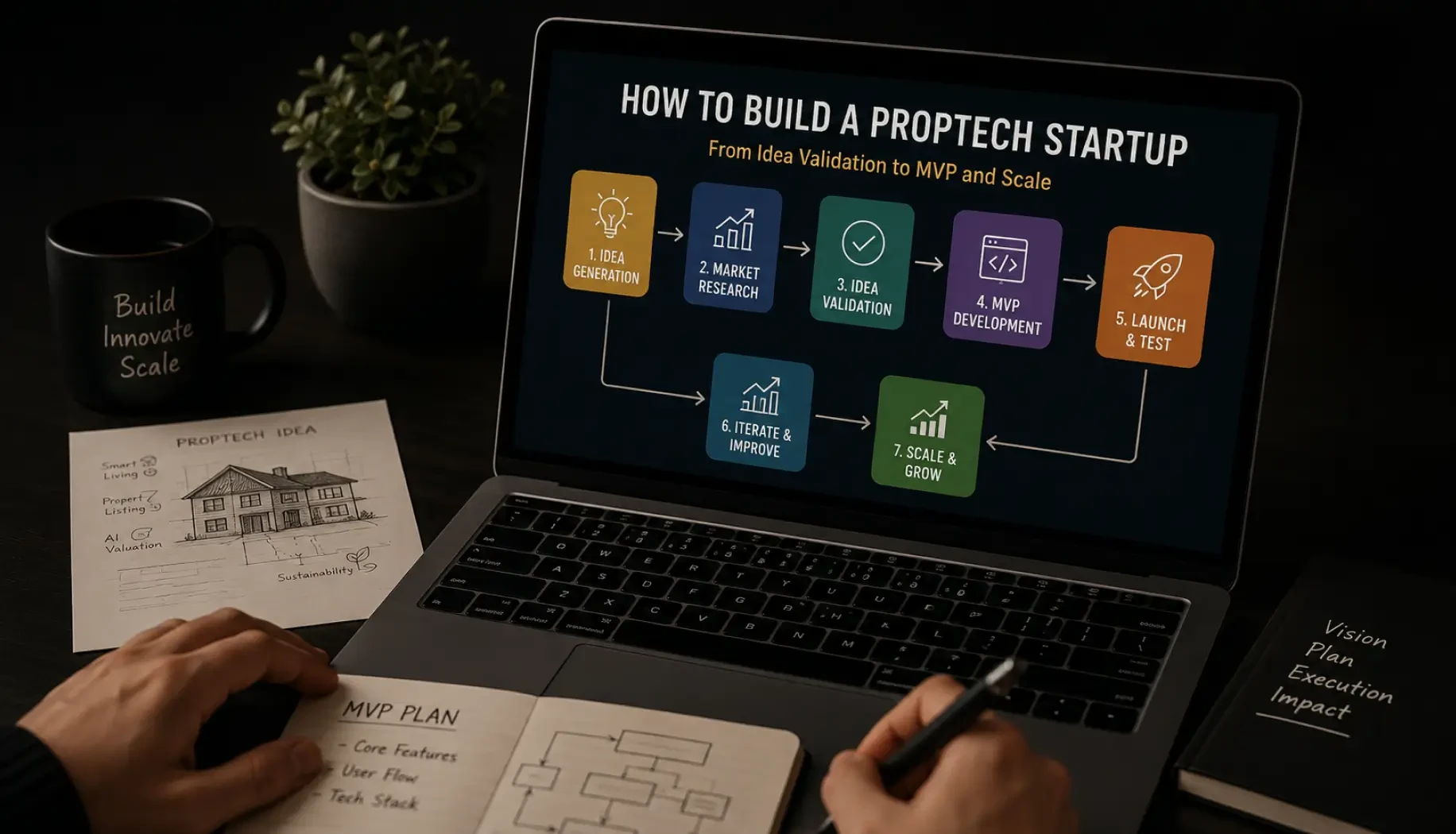
How to Build a PropTech Startup: From Idea Validation to MVP and Scale
To build a PropTech startup, validate the property problem with real users before writing code, then build a lean MVP that solves one core problem well, launch it to a small market to gather real usage data, and scale only after the data proves demand. The sequence is validate, build MVP, measure, then scale.

Chirag Daxini
June 12, 2026India (Head Office)
203/204, Shapath-II, Near Silver Leaf Hotel, Opp. Rajpath Club, SG Highway, Ahmedabad-380054, Gujarat
USA
7838 Camino Cielo St, Highland, CA 92346
UK
The Powerhouse, 21 Woodthorpe Road, Ashford, England, TW15 2RP
New Zealand
42 Exler Place, Avondale, Auckland 0600, New Zealand
Canada
141 Skyview Bay NE , Calgary, Alberta, T3N 2K6