

Multi-Property Booking Engine: Building Centralized Reservation Systems for Hotel Chains
A multi-property booking engine is a direct-booking software solution that allows guests to search for availability, compare rates, and book across two or more locations within a hotel chain from a single interface. It sits on top of a central reservation system (CRS) that holds inventory, rates, and guest profiles centrally, so one team manages the whole portfolio instead of one property at a time.

Manish Patel
As Director of Engineering at Acquaint Softtech, I have learned that a hotel chain's hardest problem is rarely one property; it is keeping ten or a hundred of them consistent, which is why a centralized reservation system is one of the most demanding software product development builds in hospitality. Get the architecture right and one team runs the whole portfolio; get it wrong and every property fights its own fires.
This is an architecture guide, not a vendor comparison. Most articles on this topic describe what a multi-property engine does, then point you to an RFP. This one goes into how it is built: the CRS backbone, the cross-property search, the central rate control, and the cost, so a technical team can scope a chain-level system with confidence.

- A hotel group or chain leader who needs one booking flow across every property.
- A CTO scoping a centralized reservation system with cross-property search and central rate control.
- A product owner mapping centralized inventory, unified guest profiles, and multi-hotel management.
- A revenue leader who wants one team to control rates and promotions across the portfolio.
- A team weighing a custom chain-level booking platform against a product like SiteMinder Multi-Property.
For where this fits in the bigger picture, our complete guide to travel and hospitality software development maps how a chain-level engine connects to PMS, channel managers, and payments. Centralization is the layer that ties the portfolio together.
For the single-property mechanics underneath, our guide on how hotel booking engines work covers availability and reservation architecture. Here we scale that to a whole chain.
What is a multi-property booking engine?
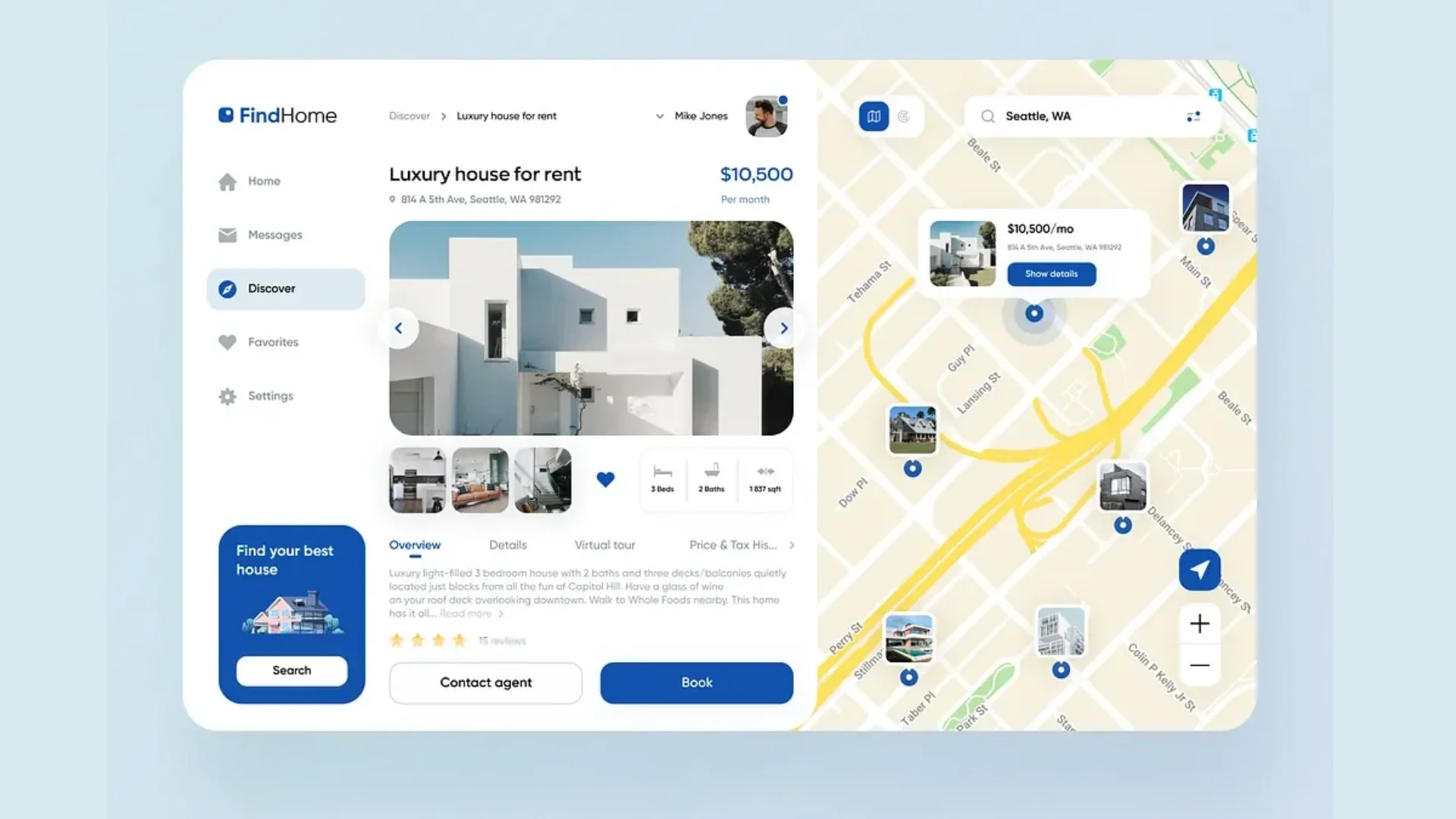
A multi-property booking engine is a single, branded booking flow that lets guests search, compare, and book across every hotel in a chain, backed by a central reservation system that manages inventory, rates, and guest data for the whole portfolio at once.
Key features
Cross-property search: enables visitors to view live rates and availability across all chain locations in one place.
Centralized inventory and rates: connects directly with a central reservation system (CRS) to manage room inventory and pricing synchronously.
Alternative recommendations: instantly suggests nearby sister properties if a chosen hotel is sold out, reducing reservation drop-off.
Unified guest profiles: merges guest data, history, and preferences across the entire portfolio for personalized marketing and service.
Those four features are the difference between a chain and a folder of separate hotels. Building the CRS that powers them is deep backend work, which is why teams hire Python developers who have built multi-tenant, high-consistency systems rather than single-site sites.
Key features and benefits for hotel chains
For a chain, a multi-property engine drives direct booking growth, operational efficiency, and frictionless management. It keeps guests in the brand and lets one central team run the portfolio.
Direct booking growth: keeps potential guests within the brand's ecosystem rather than losing them to third-party OTAs.
Operational efficiency: allows a single central team to control rates, promotions, and reporting across all properties.
Frictionless management: works alongside a SiteMinder Multi-Property setup or multi-property PMS to maintain rate parity and seamless distribution.
The cross-sell alone can justify the build: when one property sells out, the engine moves the guest to a sister hotel instead of an OTA. Acquaint Softtech treats that alternative-recommendation logic as core, not a nice-to-have, because it is where a chain recaptures revenue it would otherwise lose.
How hotel chains manage bookings centrally
Hotel chains manage bookings centrally through a central reservation system (CRS) that sits above every property's PMS. The CRS holds one source of truth for inventory, rates, and guest profiles, and pushes updates out to each property and channel.
In practice, a booking made on any property's page, or on the chain's cross-property flow, writes to the CRS first, which then syncs the relevant PMS and channel manager. That is what lets a single team change a promotion once and have it apply everywhere, and what keeps a guest's history consistent across the portfolio.
The hard part is keeping that sync correct and fast at scale, so teams often hire AI/ML engineers for demand forecasting and personalization once the central data is unified. A multi property booking engine hotel chain centralized reservation login for staff then becomes a single console for the whole group.
Multi-property booking architecture

Multi-property booking architecture is a hub-and-spoke design. A central reservation system is the hub holding inventory, rates, and profiles; each property PMS and channel is a spoke; the booking engine and APIs connect them.
The CRS is the single source of truth. Above it sits the guest-facing engine with cross-property search; below it sit the property PMS systems, the channel manager, and payments, all kept in sync through event-driven updates. Guest profiles live centrally so one identity spans every property.
Multi-tenancy is the architectural spine: each property is a tenant with its own rooms, rates, and rules, under one shared platform and data model. Designing that cleanly is where teams hire Django developers to build the central API and admin, and it is the decision that determines whether the system scales from three hotels to three hundred.
How to build a multi-property booking engine, step by step
To build a multi-property engine, design the central data model, build the CRS, add cross-property search, wire central rate control, and connect properties and channels. Here is the build in six steps.
Design the multi-tenant data model. Model properties, rooms, rates, and one central guest identity so data stays consistent across the portfolio.
Build the CRS core. Create the central store of inventory, rates, and availability that every property and channel reads from.
Add cross-property search. Let guests search and compare live rates across all locations, with alternative sister-property suggestions.
Wire central rate and inventory control. Give one team chain-level rate management, promotions, and stop-sells that apply everywhere at once.
Connect properties and channels. Sync each PMS and the channel manager through event-driven updates to prevent overbooking.
Unify profiles and reporting. Merge guest profiles and roll up reporting so the group sees performance across the whole portfolio.
The sync and consistency layer is where these builds succeed or fail, so it deserves serious AI development services and data engineering attention rather than a quick integration.
Scoping the data model up front is what a product discovery workshop is for, and many groups then hire remote developers to build the CRS and APIs while their revenue team owns rates and promotions.
Not sure your architecture will scale past a few hotels?
A design that works for three properties can collapse at thirty if multi-tenancy and sync were an afterthought. We map your portfolio, PMS mix, and growth plan to a CRS architecture built to scale, with a fixed scope, clear milestones, and IP that is yours from day one. You interview the engineers before you commit.
Cross-property availability search and comparison
Cross-property search lets a guest query availability across the whole chain at once and compare rates side by side, then book, or, if their first choice is sold out, be offered a nearby sister property instead of leaving.
Done well, this turns a portfolio into an itinerary tool: a guest moving between a city hotel and a coastal one can book both in a single flow. Done badly, it creates choice overload, where a dozen properties dumped on a guest with weak filtering stalls the booking and buries niche hotels.
The fix is strong filtering, clear comparison, and smart defaults, which is front-end and search work, so teams hire MERN stack developers to build a fast comparison interface over the central search API. Acquaint Softtech designs cross-property search to guide, not overwhelm, so conversion holds up at the individual-property level.
Centralized rate and inventory management
Centralized rate management lets one team set rates, promotions, and restrictions once and apply them across the portfolio, while still allowing property-level overrides. It is the operational payoff of a CRS.
A central team can push a chain-wide promotion, set stop-sells during a citywide event, or roll out a new rate plan to every property in minutes, not days of per-property edits. Property managers keep the ability to override locally where market conditions demand it, within guardrails the center sets.
Keeping those updates fast, reliable, and race-condition-free across many properties is production infrastructure work, so teams hire DevOps engineers to run the queues, sync workers, and monitoring behind central rate control. Acquaint Softtech treats sync correctness as non-negotiable, because a rate that updates in one place and not another is how overbooking starts.
Unified guest profiles and the data question
Unified guest profiles merge each guest's data, history, and preferences across the whole portfolio into one identity, so a guest recognized at one property is recognized at all of them. That power comes with a data-protection duty.
A single profile enables personalization and cross-property loyalty, but it also concentrates personal data, which raises obligations under the EU's data protection rules for businesses under the GDPR. Consent, data-minimization, and clear controller responsibilities need to be designed in from the first sprint, not bolted on.
For chains operating across the US, UK, EU, and beyond, getting that architecture right early avoids expensive retrofits, which is why a virtual CTO service is often worth engaging to set the data and compliance approach before building.
Multi-property booking engine tech stack
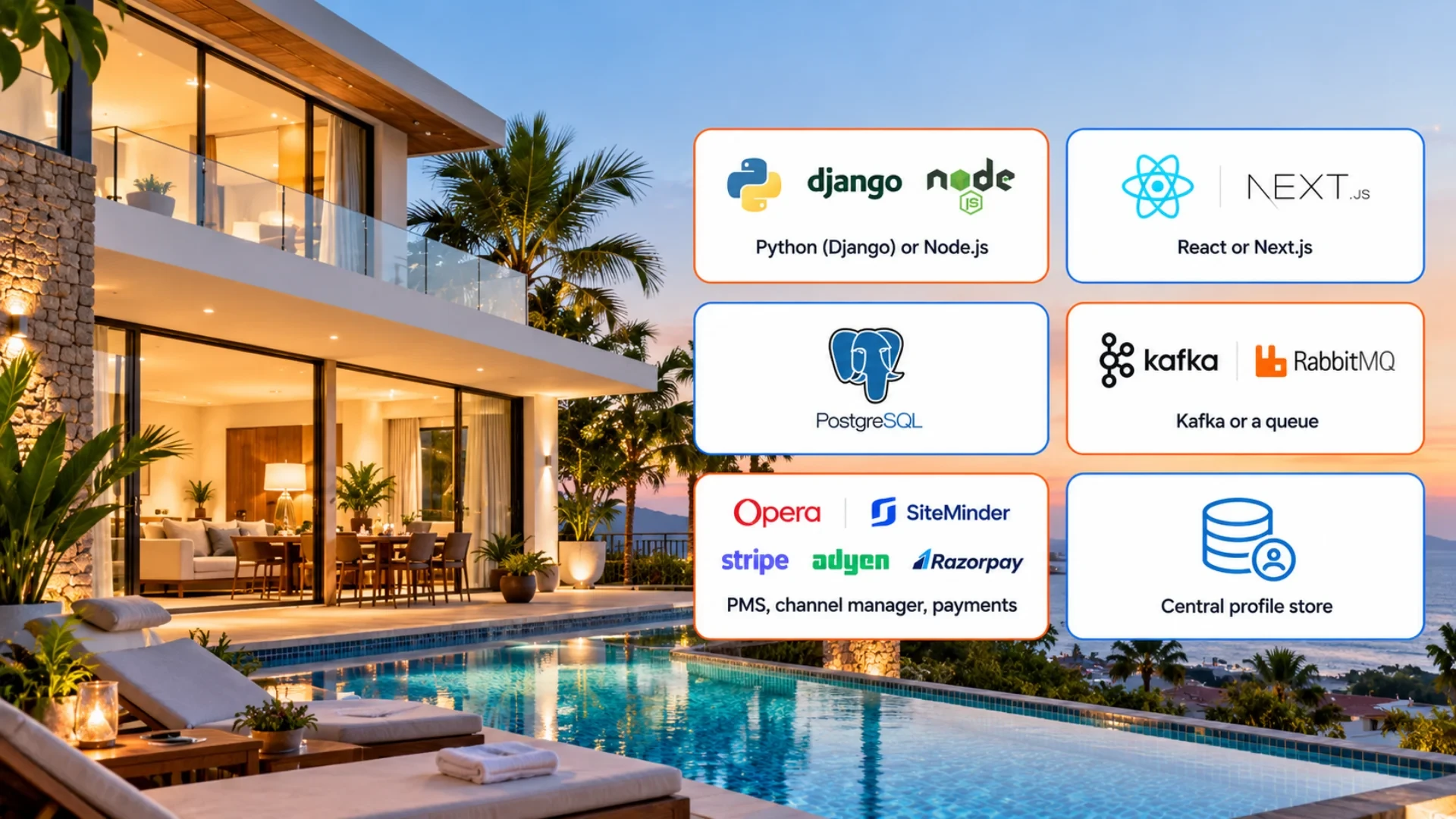
A dependable multi-property stack pairs a scalable backend for the CRS with a fast front end, a durable database, an event bus for sync, and integrations to every property PMS and channel.
Layer | Common choice | Why |
CRS backend | Python (Django) or Node.js | Central inventory, rates, and profiles |
Front end | React or Next.js | Cross-property search and checkout |
Database | PostgreSQL | Consistent multi-tenant records |
Event bus / sync | Kafka or a queue | Reliable updates across properties |
Integrations | PMS, channel manager, payments | Keep every property in sync |
Guest data / CRM | Central profile store | One identity across the portfolio |
For chains that already run a JavaScript-heavy admin, teams often hire MEAN stack developers to build the central management console over the CRS API.
Because PMS and channel APIs evolve, ongoing version upgrade services keep every connector current so the portfolio never falls out of sync.
Build vs buy: custom vs SiteMinder and other platforms
Buy an off-the-shelf platform when standard multi-property features fit and speed matters; build custom when your portfolio, brand flow, or cross-property logic is beyond what a product allows. Most chains start hybrid.
Products like SiteMinder Multi-Property, Cloudbeds, and Sabre SynXis get you running fast with proven CRS and distribution. Before committing, chains weigh SiteMinder pricing and the way pms SiteMinder integrations fit their stack, and whether SiteMinder sales terms scale with the portfolio. The trade-off is fit: a product bends only so far to unusual brand or booking logic.
Distribution rules also shape the choice. In the EEA, the European Commission confirmed that, as a designated gatekeeper, Booking must comply with the Digital Markets Act, which ends parity clauses and gives chains more freedom to favor their own direct engine. Where a product cannot express that strategy, many chains use software development outsourcing to build the custom layer that a platform cannot.
Multi-property booking engine cost by market
Multi-property booking cost depends on portfolio size, integrations, and where your team sits. A small-chain CRS is far cheaper than an enterprise platform with deep PMS integration, unified profiles, and central rate control.
The ranges below are 2026 planning estimates at local agency rates, not fixed quotes. Offshore delivery from India typically lands well below these numbers.
Target market | Small-chain CRS | Enterprise multi-property platform |
United States / New York | $40,000 to $90,000 | $150,000 to $400,000+ |
United Kingdom | GBP 32,000 to 72,000 | GBP 120,000 to 320,000+ |
Europe (EU) | EUR 36,000 to 82,000 | EUR 135,000 to 360,000+ |
Australia | AUD 60,000 to 135,000 | AUD 225,000 to 600,000+ |
New Zealand | NZD 64,000 to 145,000 | NZD 240,000 to 640,000+ |
The biggest lever is engineering rate, not the feature list, which is why many chains add IT staff augmentation from India to build the same platform at a fraction of local cost.
Real case study: a centralized multi-property platform
No two builds are identical, but the closest documented parallel from our own work is Heimstaden, a leading European residential operator for which Acquaint Softtech built centralized software to manage units, tenant requests, and payments across a vast portfolio. Managing roughly 162,000 homes across nine countries from shared tooling is the same centralization challenge a hotel chain faces with rooms and reservations.
Stage | What happened (Heimstaden Group, Clutch verified 5.0 / 5.0) |
1. The client | Heimstaden, a Copenhagen-based European residential real estate operator (Co-CEO and CIO Christian Fladeland) with about 162,000 homes across nine countries. |
2. The problem | Staff and tenants had no unified way to track unit updates, requests, and payments across a large, multi-country portfolio. |
3. The build | Acquaint Softtech built a clean central dashboard for requests with photos, a redesigned payment flow, a task system to assign and track work across teams, and a full cleanup of legacy code. |
4. The outcome | Fewer stuck payments, fewer tenant misunderstandings, and less time lost searching old tickets, with stable, transparent delivery. |
5. Why it maps here | Central dashboards, portfolio-wide task and payment flows, and one source of truth across many locations are exactly what a chain-level reservation system needs. |
You can see this and other projects on our case studies page and read verified reviews on our Clutch profile.
Why teams struggle, and what to check before you hire
Most multi-property builds do not fail at one property. They fail at consistency and sync, where a rate that updates on the CRS but not the PMS, or a guest profile that splits across properties, quietly breaks trust and causes overbookings.
Before you commit to a partner for a chain-level build, check for these:
Do they design real multi-tenancy, so the system scales from a few properties to hundreds?
Is the CRS the single source of truth, with reliable event-driven sync to every PMS and channel?
Do unified guest profiles respect GDPR and cross-border data rules by design?
Do they have verifiable multi-tenant, high-consistency platform experience?
That last point is where track record matters. Acquaint Softtech has delivered 1,300 or more projects over 13 or more years with 70 or more in-house engineers and 50 or more Clutch reviews, and can deploy vetted developers within 48 hours. As a chain grows and adds properties, the platform must keep pace, so ongoing support and maintenance services keep the CRS, sync, and integrations healthy. For long-running programs, a dedicated software development team keeps that architecture consistent as the portfolio expands.
Weighing a custom CRS against an off-the-shelf platform?
The wrong call here means either years of platform fees you outgrow or a stalled custom build. Share your property count, PMS mix, and growth plans, and we will give you a straight read on whether a product, a custom CRS, or a hybrid fits, with the scope and cost to match. No sales pitch, just honest engineering advice.
Frequently Asked Questions
-
How do hotel chains manage bookings centrally?
Through a central reservation system (CRS) that sits above every property's PMS and holds one source of truth for inventory, rates, and guest profiles. A booking on any property writes to the CRS first, which then syncs the relevant PMS and channels, so one team runs the whole portfolio.
-
How does cross-property availability search work?
A guest queries availability across the whole chain at once through the CRS, sees live rates side by side, and books. If their first choice is sold out, the engine suggests a nearby sister property instead of losing them, turning the portfolio into a single itinerary tool.
-
What is centralized rate management?
It lets one central team set rates, promotions, and restrictions once and apply them across every property, while still allowing local overrides within guardrails. A chain-wide promotion or stop-sell rolls out in minutes instead of property-by-property edits.
-
What is multi-property booking architecture?
A hub-and-spoke design: a central reservation system is the hub holding inventory, rates, and unified guest profiles; each property's PMS, the channel manager, and payments are spokes; the booking engine and APIs connect them, with multi-tenancy as the spine so it scales.
-
What are the three types of reservations?
In hotels, reservations are commonly grouped as guaranteed (secured with a deposit or card, held all night), confirmed (acknowledged but only held until a cut-off time), and waitlisted or tentative (pending availability or a hold). A CRS should support all three consistently across properties.
-
What are some examples of central reservation systems used in hotels?
Widely used central reservation systems include Sabre SynXis, Amadeus, SiteMinder, Cloudbeds, and RateGain's UNO, alongside custom-built CRS platforms. The right one depends on portfolio size, distribution needs, and how much bespoke cross-property logic a chain requires.
-
What is the best hotel reservation system?
There is no single best. SynXis and Amadeus suit large enterprise chains, SiteMinder and Cloudbeds fit small-to-mid chains, and a custom CRS wins when cross-property search, unified profiles, or brand-specific logic must go beyond what a product allows.
I lead technology and client success at Acquaint Softtech with one goal in mind. Deliver work that feels personal, reliable, and worthy of long term trust. I stay close to both our clients and our developers to make sure every project moves with clarity, quality, and accountability.
Table of Contents
Get Started with Acquaint Softtech
- 13+ Years Delivering Software Excellence
- 1300+ Projects Delivered With Precision
- Official Laravel & Laravel News Partner
- Official Statamic Partner
Related Blog
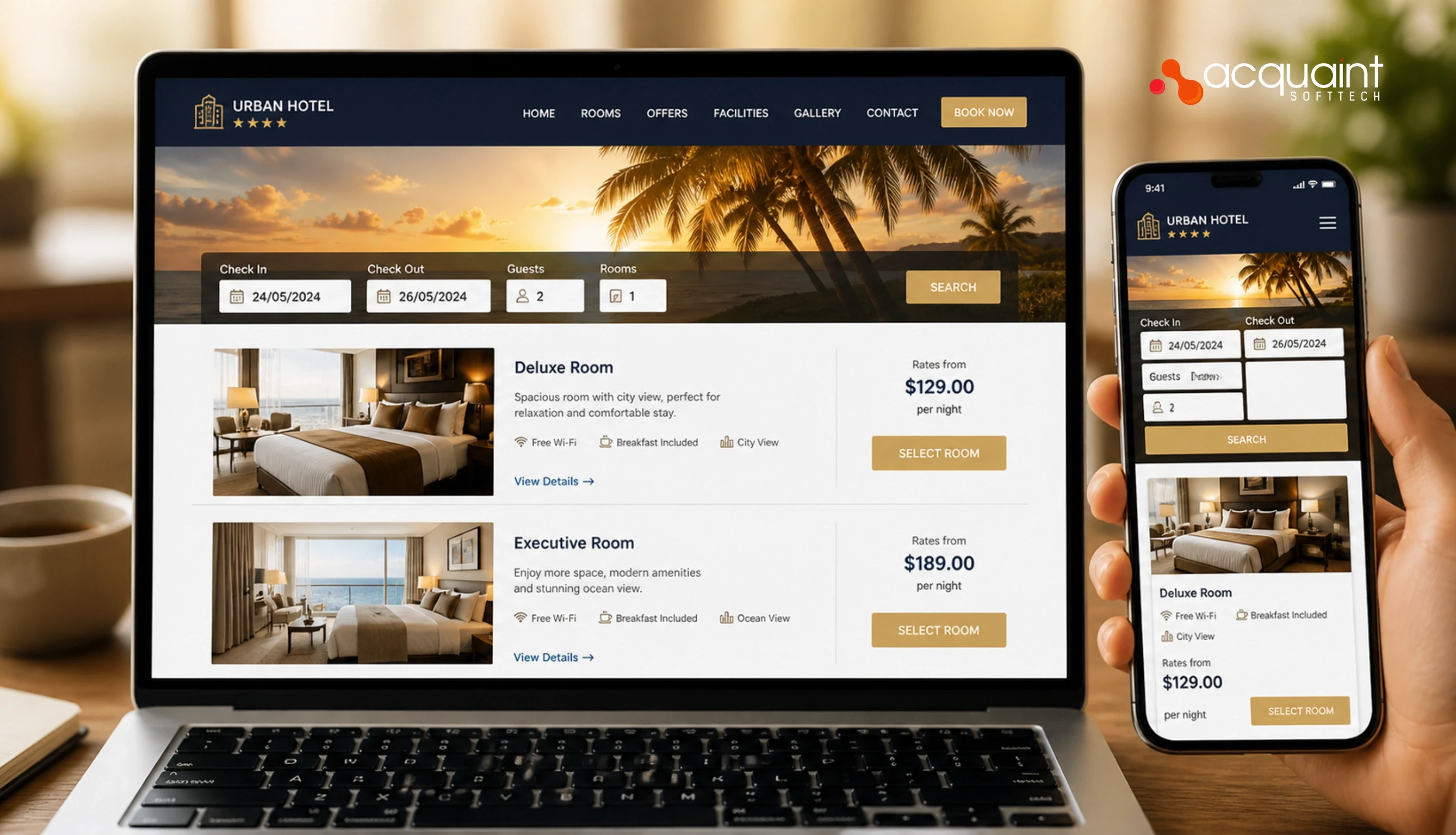
How Hotel Booking Engines Work: Search, Availability, Pricing, and Reservation Architecture
A hotel booking engine is not a search bar. It is an availability engine, a pricing decision system, a payment pre-authorisation layer, and a channel inventory synchroniser, all running simultaneously. This guide explains every architectural layer and how each one connects in a production system.
Manish Patel
May 12, 2026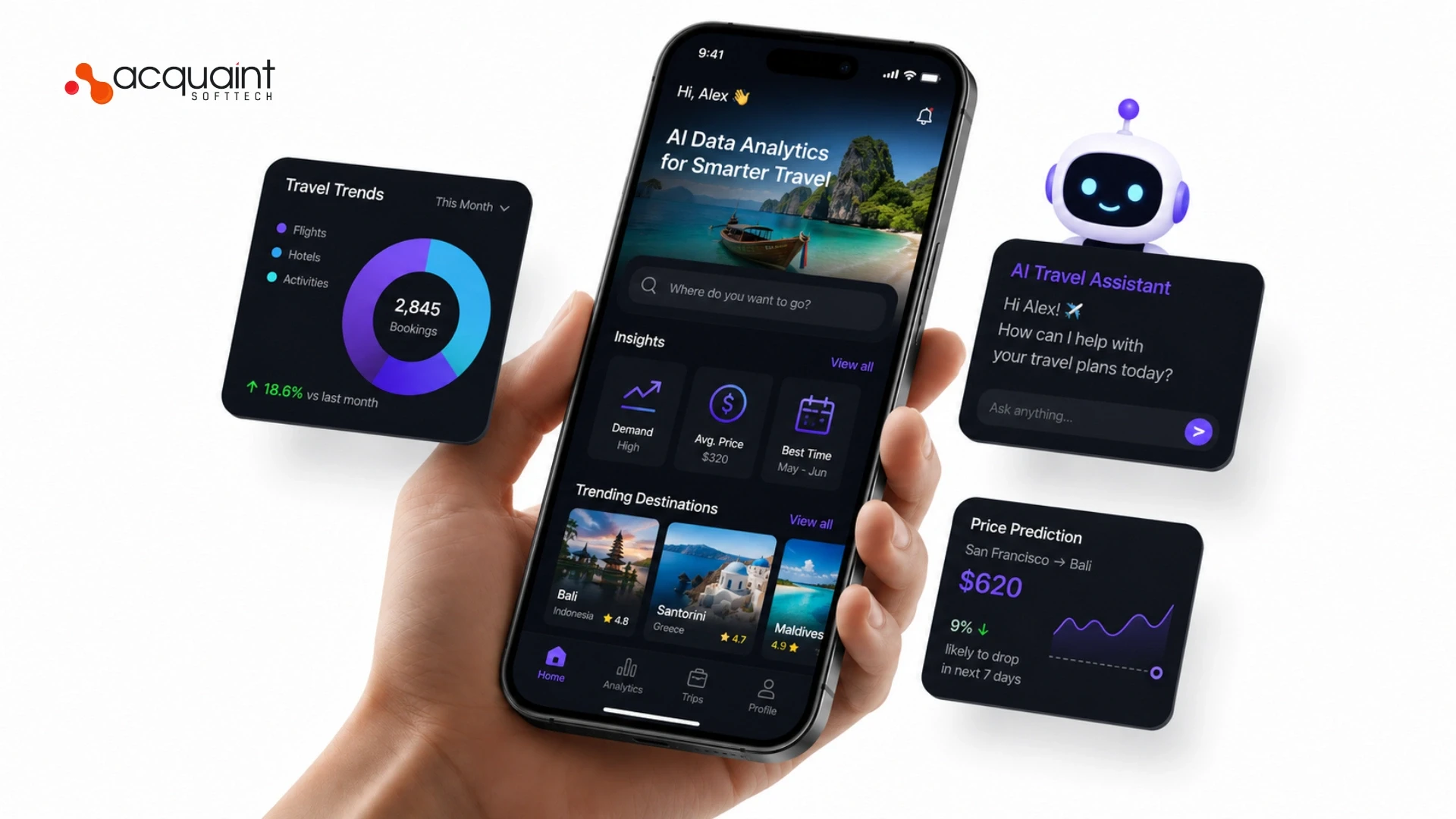
AI and Data Analytics in Travel: Demand Forecasting, Price Optimization, and Customer Intelligence
AI and data analytics in travel use machine learning to turn booking, search, and customer data into revenue. The three core engines are demand forecasting, which predicts future occupancy and bookings; price optimization, which sets the best price in real time based on demand; and customer intelligence, which identifies high-value travellers and predicts who will book or cancel. Hotels using AI-driven pricing report revenue gains of 5 to 14%.
Manish Patel
June 29, 2026
How to Build an OTA: Online Travel Agency Architecture for Flight, Hotel & Package Booking
Most OTA builds fail not on the booking logic but on the integration layer. Here is the complete architecture map, GDS, hotel aggregation, package bundling, payments, and what each module actually costs to build in 2026.
Manish Patel
May 27, 2026India (Head Office)
203/204, Shapath-II, Near Silver Leaf Hotel, Opp. Rajpath Club, SG Highway, Ahmedabad-380054, Gujarat
USA
7838 Camino Cielo St, Highland, CA 92346
UK
The Powerhouse, 21 Woodthorpe Road, Ashford, England, TW15 2RP
New Zealand
42 Exler Place, Avondale, Auckland 0600, New Zealand
Canada
141 Skyview Bay NE , Calgary, Alberta, T3N 2K6