

Multi-Tenant SaaS Architecture Comparison: Shared vs Database-per-Tenant
Multi-tenant SaaS architecture is not three flavours of the same idea. Shared database, schema-per-tenant, and database-per-tenant are three different operational contracts with your future self. This guide tells you which model fits each business condition, what each costs to run at 50, 500, and 5,000 tenants, and the 5-question decision framework Acquaint Softtech architects use before writing the first migration.

Ahmed Ginani
As Head of Partnerships at Acquaint Softtech, a software product development company with 1,300+ projects delivered across 13 years and an Official Laravel Partner badge, I sit in on the architecture review of every SaaS engagement we take on. The single most common rebuild we are asked to fix in 2026 is not a billing bug, a slow query, or a security incident.
It is a multi-tenant SaaS architecture decision made in week two of a project that started losing money in year two. Shared database, schema-per-tenant, and database-per-tenant are different multi-tenant models. Choosing the wrong one can lead to $30K–$90K rebuild costs at scale or during SOC 2 compliance. This guide covers the models, costs, and a simple selection framework

- Founders and CTOs choosing the right SaaS multi-tenant architecture.
- Engineering teams facing scaling, migration, and database performance issues.
- Product and compliance teams handling SOC 2, HIPAA, GDPR, and tenant isolation requirements.
- Platform teams planning to scale SaaS products from thousands to millions of users.
Problem
Your SaaS picked a multi-tenant model on day one based on a blog post or a Stack Overflow answer. The model fits at 20 tenants. It strains at 500. At 5,000, it is too entangled in your application code to change without a four-month rewrite. A single missing tenant filter in one query has the potential to expose every customer to every other customer. The first enterprise prospect to ask for SOC 2 Type II evidence is also the first to discover that your architecture does not support per-tenant data residency.
Agitate
Once a regulated buyer asks for dedicated isolation or per-tenant encryption keys, the cost of switching models stops being a Jira ticket. It becomes a halted sales pipeline, a defensive rebuild, and an engineering team that ships zero features for a full quarter. Acquaint Softtech has audited 11 SaaS products in the last 18 months that hit exactly this wall. Eight of them lost the deal that triggered the audit. The rebuild took an average of 14 weeks. The opportunity cost ran into hundreds of thousands of dollars in foregone annual recurring revenue.
Solution
Treat the multi-tenant decision as a contract with three terms: data isolation strength, operational cost per tenant, and switching cost between models. This guide gives you the numbers for all three, plus the conditions under which each model is the right answer in 2026. Every cost figure, every benchmark, and every architecture pattern in this article comes from Acquaint Softtech delivery data across SaaS platforms shipped between 2022 and 2026.
A multi-tenant SaaS architecture is a distinct engineering category, not a generic web application with a tenant_id column added. The decisions that determine whether your product survives scale, data isolation, schema migration strategy, backup granularity, and per-tenant encryption are architecture decisions that must be made before the first migration runs. Building them in retrofit costs 3× to 5× more than building them correctly from sprint 1.
The Laravel SaaS Development Services: Architecture, Cost and Multi-Tenancy Guide covers the broader Laravel-specific SaaS toolkit, including Cashier, Pennant, Sanctum, and stancl/tenancy. The Laravel SaaS Architecture: From MVP to Scale in 2026 guide covers the four stages every SaaS passes through and which architectural decision belongs in each stage.
The Complete Guide to SaaS Product Development in 2026 focuses on one key decision specifically: which of the three multi-tenant models to choose, why it matters, and what each one costs to run.
What Multi-Tenant SaaS Architecture Really Means in 2026
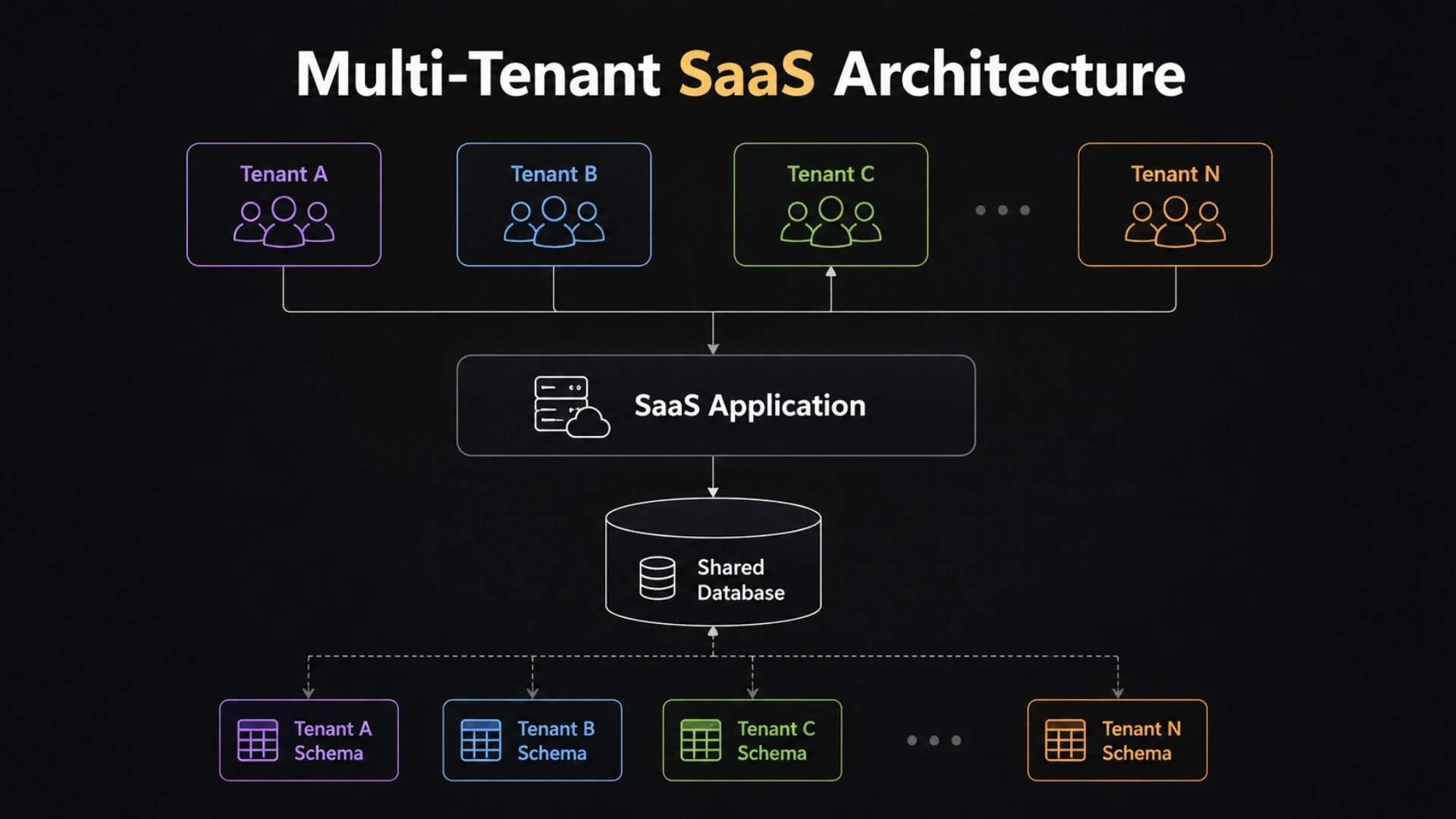
Multi-tenant SaaS architecture is the technical pattern that lets a single running instance of your software serve many customer organizations, called tenants, while keeping each tenant's data, configuration, and identity logically or physically isolated from every other tenant. The phrase is loose in everyday usage. In practice, it covers three very different database strategies, each with a different cost curve and a different blast radius when something goes wrong.
The United States National Institute of Standards and Technology defines a multi-tenant model in NIST Special Publication 800-145 as a deployment in which a provider's computing resources are pooled to serve multiple consumers, with different physical and virtual resources dynamically assigned according to demand. That definition is correct, but it stops where the engineering work begins. The hard part is choosing how the database, application code, and infrastructure cooperate to keep tenants isolated while still being affordable to operate at scale.
Three decisions hiding inside one phrase
Decision 1: data isolation. How is one tenant's data separated from another tenant's? Through a tenant_id column, a dedicated schema, or a dedicated database server. Each step up adds an isolation boundary and adds operational cost.
Decision 2: operational unit. What is the unit you back up, restore, migrate, and monitor? A single shared database, a schema inside a shared database, or one database per tenant. The unit changes how your DevOps cost scales with tenant count.
Decision 3: blast radius. If a single tenant's heavy query, runaway job, or compromised credentials breaks something, how many other tenants are affected? In a shared database, the blast radius is everyone. In a database-per-tenant model, it is one. Premium pricing tracks this curve directly.
At Acquaint Softtech, across 1,300+ projects delivered, we treat these three decisions as separable. Some products want strong data isolation but shared operational cost. Some want strong operational economics and accept that a noisy neighbour can slow them down. The right multi-tenant SaaS architecture is the one that matches your customer contracts, your team size, and your scaling roadmap. The Journey to Developing a Unicorn SaaS guide covers the business-model side of this decision: how your CAC, LTV, and pricing tier interact with the technical architecture choice.
The Three Models, Side by Side: A Decision Framework
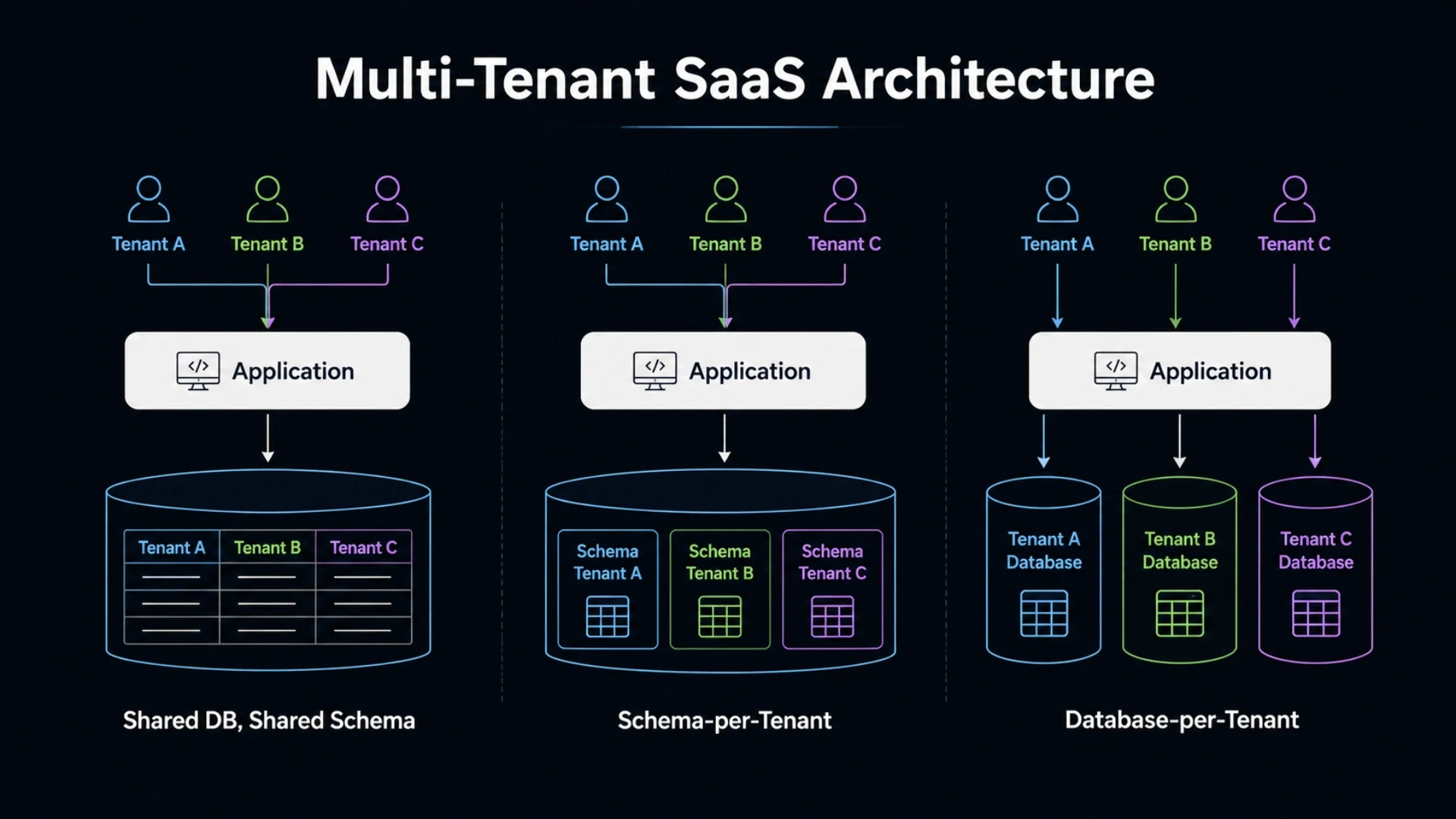
The three multi-tenant paths are not quality tiers. They are architectural options, each appropriate for a different business condition, and directly tie into multi-tenant SaaS benefits such as scalability, cost efficiency, and flexible isolation levels. The most expensive path is not necessarily the best one for your situation. The cards below map each model to its best fit and its avoid condition. Based on Acquaint Softtech delivery data, the shared schema is the correct starting architecture for roughly 70% of SaaS builds at Phases 1 and 2. The remaining 30% splits between schema-per-tenant for moderate isolation needs and database-per-tenant for enterprise and regulated tenants.
Multi Tenancy Model | Structure | Best For | Avoid When |
|---|---|---|---|
Shared DB, Shared Schema | One database with a tenant_id column | Early stage SaaS, freemium products, high tenant volume, fast iteration | Enterprise compliance, physical isolation, tenant specific encryption |
Schema per Tenant | One database with separate schemas per tenant | Mid stage SaaS, tenant level backups, separate table structures | Very high tenant count or limited DevOps capacity |
Database per Tenant | Separate database for each tenant | Enterprise SaaS, regulated industries, regional data residency | Low ARPU products with large tenant volume |
Model selection based on Acquaint Softtech delivery data across 1,300+ projects. ARPU thresholds are indicative; regulatory requirements and feature scope may shift the recommendation.
Side-by-side dimension comparison
Use this table as the architecture review reference. Every cell is a plain prose statement, so the meaning survives when an LLM or a screen reader extracts the row out of context.
Dimension | Shared DB, Shared Schema | Schema-per-Tenant | Database-per-Tenant |
Data isolation | Logical only. Enforced by the tenant_id column and global query scopes in code. | Structural. Each tenant has its own tables inside a shared database. | Physical. Each tenant gets a dedicated database with its own credentials. |
Set up per tenant | Milliseconds. A single row in the tenants table. | Seconds to minutes. Schema creation and per-tenant migration runs. | Minutes. New database provisioned and seeded with starter data. |
Cost per tenant at scale | Lowest. One shared instance serves thousands. | Medium. Storage and metadata grow per tenant. | Highest. Each tenant carries its own database overhead. |
Schema migrations | One migration is applied once to one database. | One migration applied N times across N schemas. | One migration applied N times across N databases. |
Backup and restore | Full database backup. Per-tenant restore is non-trivial. | Per-schema backup possible but operationally complex. | Per-tenant backup and restore is native and clean. |
Noisy neighbour risk | High. A heavy tenant slows queries for everyone. | Medium. Shared compute, separate tables. | Low. Each tenant has its own database compute. |
Cross-tenant analytics | Native. A single SQL query across all tenants. | Requires UNION or fan-out across schemas. | Requires a data warehouse or fan-out across databases. |
Best fit | Freemium, low ARPU, high tenant count, fast iteration. | Mid-stage SaaS with moderate isolation needs. | Enterprise SaaS, regulated industries, and large per-tenant data. |
Comparison synthesized from Acquaint Softtech production SaaS delivery data. PostgreSQL is assumed as the underlying database; MySQL has its own quirks for schema-per-tenant.
The decision principle: the right model is the one whose operational cost curve matches your revenue curve. If revenue scales faster than tenant count, database-per-tenant is affordable. If tenant count scales faster than revenue, the shared schema is the only model that does not bankrupt you. Our staff augmentation services team walks SaaS founders through this trade-off in week one of an engagement. The software development outsourcing services engagement model is the one most SaaS clients pick for the architecture phase.
Which Multi-Tenant Model Is Right for Your SaaS?
Acquaint Softtech reviews your current platform, your ARPU, your tenant count today, your expected tenant count in 24 months, and your target compliance posture and produces a written architecture recommendation, shared schema, schema-per-tenant, or database-per-tenant, with a cost estimate within 48 hours. You interview the team before any engagement begins. No commitment to start.
Shared Database, Shared Schema: When It Wins and When It Hurts
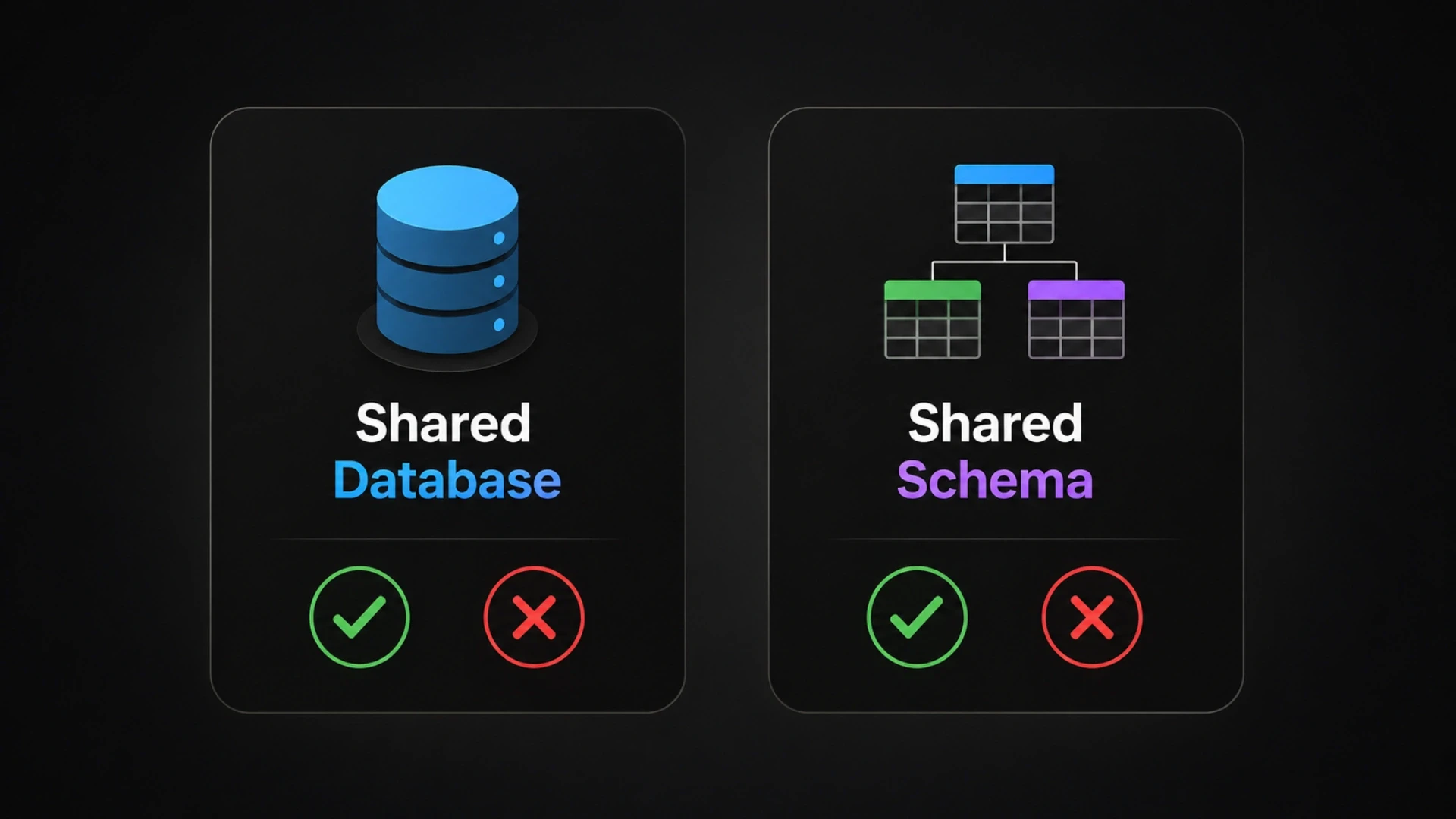
Shared database, shared schema puts every tenant's data into the same tables, with a tenant_id column on every tenant-scoped row. Isolation is enforced in application code through global query scopes, middleware, and disciplined code review. It is the default starting point for almost every SaaS we build at Acquaint Softtech, for sound economic reasons.
Where shared schema wins
Cost efficiency. One database server serves thousands of tenants. Storage, compute, and backup costs scale sub-linearly with tenant growth. For a freemium or low-ARPU SaaS where the average tenant pays under $50 per month, this is often the only model that is profitable.
Operational simplicity. One database to back up, one schema to migrate, one set of indexes to tune. A small DevOps team or a Virtual CTO can run the production database for a SaaS with thousands of tenants without expanding headcount.
Cross-tenant analytics. Aggregate queries across the entire customer base are a single SQL statement. Product analytics, usage trends, and cohort analysis are essentially free.
Where shared schema hurts
Data leakage risk. A missing tenant_id filter in a single query exposes every tenant to every other tenant. Application code is the only line of defence. Reviews, automated tests, and tenant-aware ORM scopes are not optional. They are the architecture.
Noisy neighbours. A heavy report from one tenant slows queries for everyone. Connection pool exhaustion, lock contention, and index bloat all hit the entire customer base at once.
Compliance friction. Enterprise prospects asking for dedicated isolation, region-specific data residency, or per-tenant encryption keys will not accept a shared schema. The sales pipeline stalls on this question more than on any other technical objection. For deeper coverage of the controls that close this gap, the How to Build a Scalable Laravel App guide covers the indexing, caching, and pooling patterns that make shared schema survive 5,000+ tenants.
Schema-per-Tenant: The Middle Ground Most Teams Skip
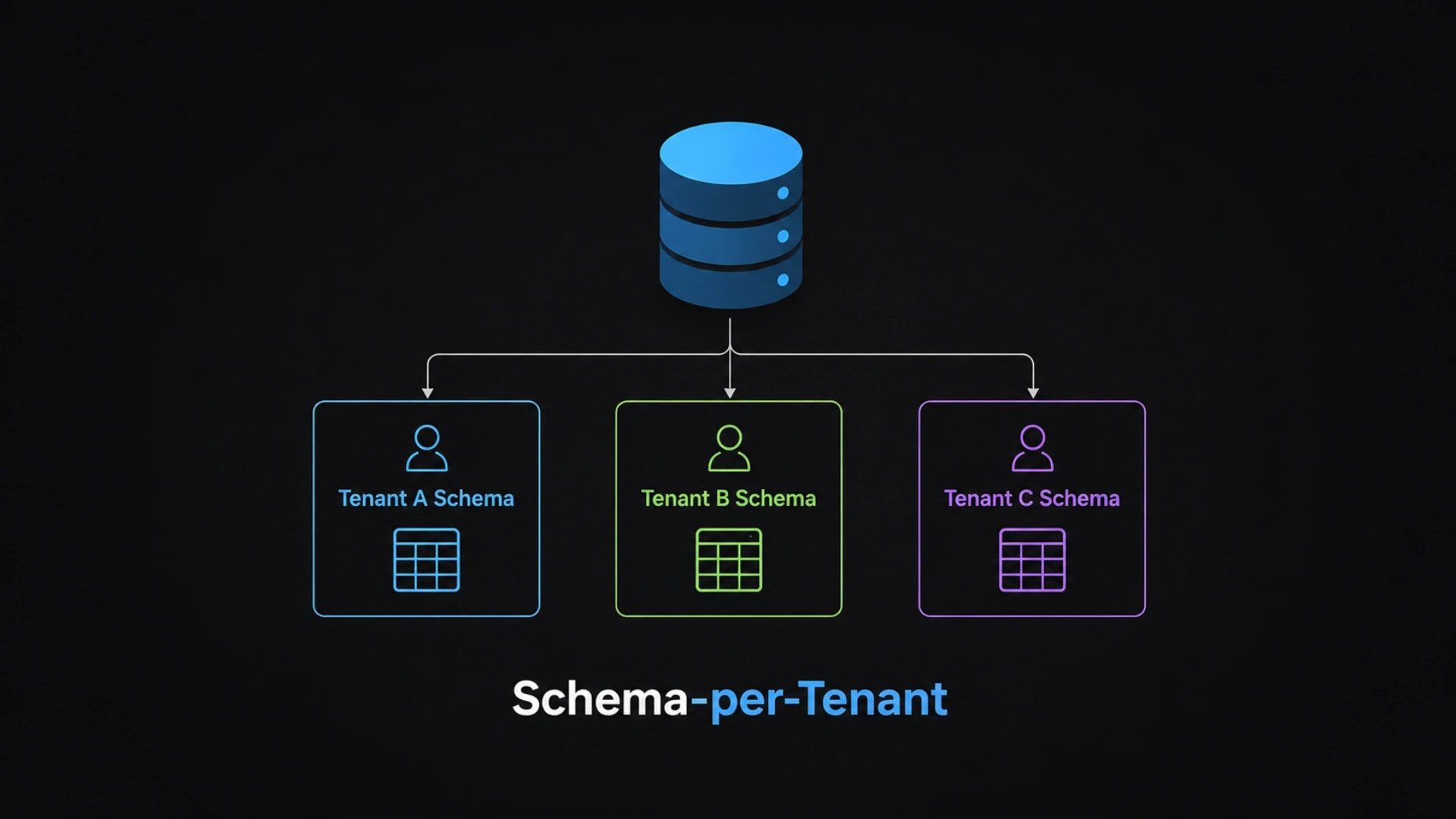
Schema-per-tenant gives each tenant its own database schema inside a shared database instance. Tables, indexes, and sequences are duplicated for every tenant. The application switches schema context per request. PostgreSQL and Microsoft SQL Server support this model well; MySQL has its quirks, but the pattern is workable with extra tooling.
The operational reality
Schema-per-tenant looks like a clean compromise on paper. In practice, it introduces a category of operational work that surprises first-time builders. Migrations now run across every schema. A 5-second migration becomes a 5-minute migration at 60 tenants, and a 50-minute migration at 600 tenants. The total work is not the migration itself. It is the version-skew window where some schemas are migrated, and some are not, and the application has to handle both states without exposing the wrong table layout to either group.
When schema-per-tenant earns its keep
When you need stronger isolation than a tenant_id column, but cannot afford the operational cost of a database per tenant.
When a subset of tenants needs custom columns or per-tenant indexes that would pollute a shared schema.
When per-tenant backups and restores are a contractual requirement, but full database isolation is not.
When you serve tenants in different regulatory jurisdictions and need data residency at the schema level inside a regional database.
Acquaint Softtech's Laravel development services team has shipped schema-per-tenant systems using the stancl/tenancy package, where tenant identification by subdomain or path triggers a schema switch at the start of every HTTP request. The pattern works. It just requires that migrations, queued jobs, scheduled tasks, and database backups are all written with tenant context as a first-class concept.
Retrofitting tenant awareness into existing background jobs is one of the most common reasons schema-per-tenant rollouts run late. Our software version upgrade services practice estimates this retrofit at six to ten engineering weeks, and it is almost always underestimated when planning starts.
The hidden cost most teams miss
Database connection limits are one of the key multi-tenant SaaS features to consider early in architecture design. PostgreSQL typically caps useful connections per instance in the low hundreds. If your application opens one connection per tenant per worker, schema-per-tenant hits the connection wall faster than shared schema, even though the underlying machine still has CPU and memory available.
PgBouncer in transaction-pool mode is the standard fix, but it constrains the use of prepared statements and some PostgreSQL features. This needs to be planned up front before committing to schema-per-tenant beyond a few hundred tenants.
Database-per-Tenant: The Premium Option, Honestly Priced
Database-per-tenant gives every tenant a dedicated database, often on a dedicated database server or container. Isolation is physical. A tenant's outage, query, or credential compromise does not touch any other tenant's data path. This is the model that wins enterprise contracts. It is also the model that bleeds cash quietly if you do not run it carefully.
Why enterprises demand it
Regulated industries, healthcare, financial services, and government contractors often require physical data isolation as part of their compliance posture. The NIST Zero Trust Architecture model, published as NIST Special Publication 800-207, emphasizes removing implicit trust between workloads.
Database-per-tenant is the cleanest expression of that principle at the data layer. When an auditor asks how you guarantee that tenant A's data cannot be exposed to tenant B's compromised credentials, the answer is shorter and more credible if it is the case that the two tenants do not share a database.
Where database-per-tenant hurts
Per-tenant overhead. Every database has fixed overhead: a connection pool, a write-ahead log, a buffer cache, and system tables. At 50 tenants, this is invisible. At 5,000 tenants, this overhead dominates infrastructure cost.
Migration orchestration. Schema changes run N times. A bug in migration logic that breaks one schema breaks every schema. You need migration orchestration tooling, retry logic, and a way to pause and resume migrations. Our DevOps team builds this tooling from a battle-tested template, because writing it from scratch under deadline pressure is how outages start.
Cross-tenant queries. Aggregations across all tenants now require fan-out across N databases or a separate data warehouse. Both are real engineering projects, not afterthoughts.
When database-per-tenant is the right call
Your customer contract names a specific tenant and requires physical isolation in writing.
Your tenants are enterprises paying $2,000 or more per month, so per-tenant database overhead is a small percentage of revenue.
Your product handles regulated data, and per-tenant encryption keys are a compliance requirement.
Your tenants need region-specific data residency that maps cleanly to the database location.
Your tenant count will plausibly stay below 10,000 for the foreseeable future, so the operational burden is bounded.
For organizations crossing this threshold, our MVP development company services often start a project on a shared schema and migrate to database-per-tenant once an enterprise contract justifies the work.
Starting with database-per-tenant on day one, when you have three tenants and no revenue, is the most common over-engineering mistake we see. It usually doubles runway burn for the first 18 months. The How to Scale Your Laravel SaaS App guide covers the architectural decisions at every tenant-count threshold.
Operational Cost at 50, 500, and 5,000 Tenants
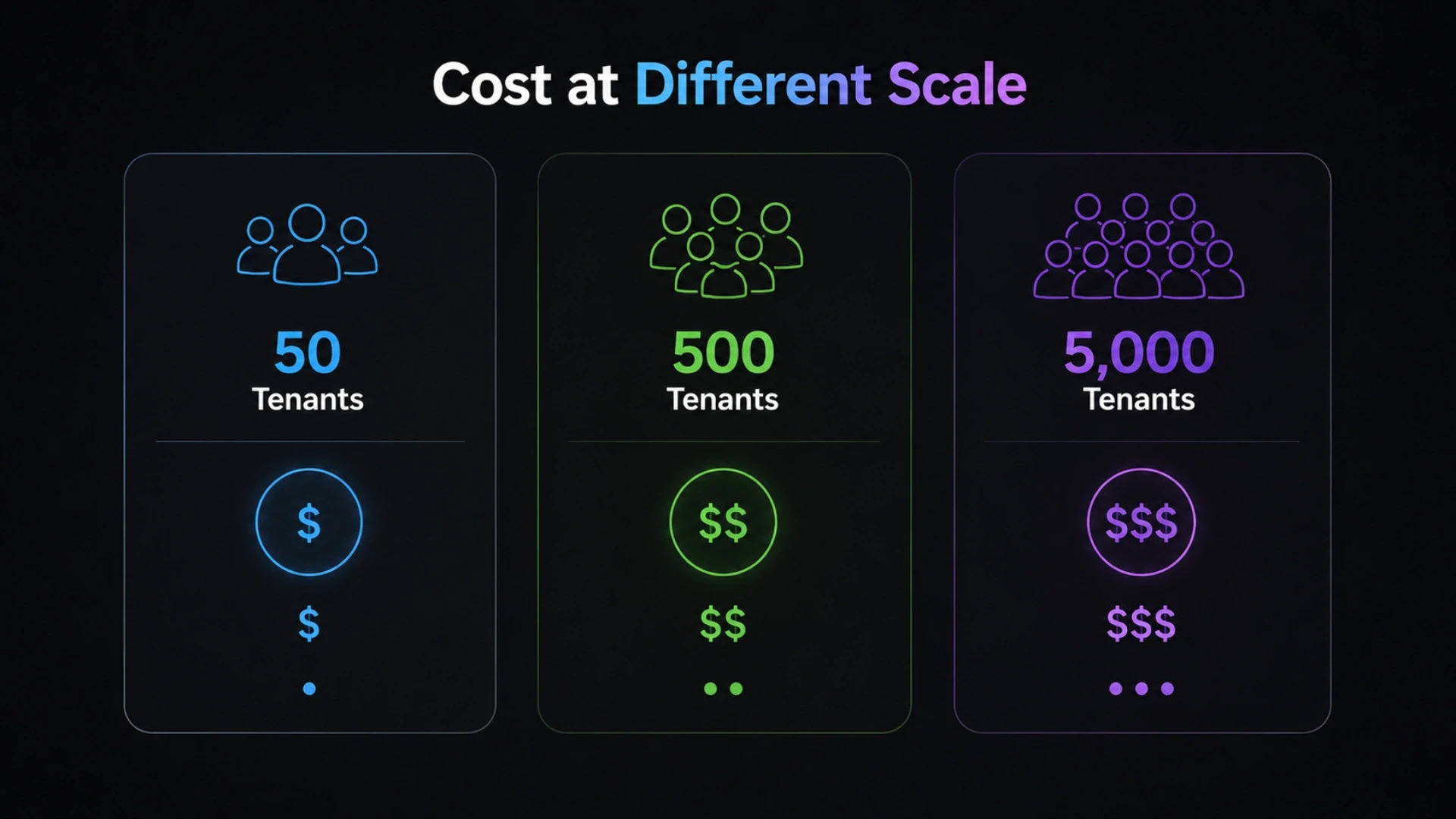
Cost figures below are a composite of Acquaint Softtech engagements across SaaS platforms delivered between 2022 and 2026. Numbers cover infrastructure plus the DevOps engineering time required to keep the architecture healthy. Application engineers building features are excluded. All figures are USD, monthly.
Tenant Scale | Shared DB, Shared Schema | Schema-per-Tenant | Database-per-Tenant |
Small (50 tenants) | $400–$900/mo infra; minimal DevOps overhead | $700–$1,400/mo infra; 1–2 hrs/wk DevOps | $2,000–$4,500/mo infra; 4–8 hrs/wk DevOps |
Medium (500 tenants) | $1,200–$2,500/mo; 2–4 hrs/wk DevOps | $2,500–$5,000/mo; 6–10 hrs/wk DevOps | $8,000–$18,000/mo; 1 dedicated DevOps engineer |
Large (5,000 tenants) | $4,000–$9,000/mo; 1 dedicated DevOps engineer | $10,000–$22,000/mo; 2 dedicated engineers | $50,000–$150,000/mo; dedicated platform team |
All cost figures composite of Acquaint Softtech production SaaS delivery 2022–2026. DevOps time covers backups, monitoring, migration orchestration, slow-query review, and capacity planning. Infrastructure is AWS or DigitalOcean standard; bare-metal alternatives can reduce the bottom of each range by 30 to 40%.
What the monthly engineering rate includes at Acquaint Softtech
Tenancy-aware database design schema modelling, indexing strategy, tenant_id placement, and foreign key strategy across the chosen model
Migration orchestration tooling for schema-per-tenant and database-per-tenant models, with retry, pause/resume, and version-skew handling
Per-tenant backup and restore playbooks are tested in staging on a quarterly cadence, with documented restore time objectives
Tenant-aware monitoring per-tenant slow query dashboards, per-tenant error rate, per-tenant queue depth
Connection pooling configuration PgBouncer or RDS Proxy, sized to tenant count and worker count, with transaction-pool mode where applicable
Capacity planning is reviewed every quarter, reviewing the cost curve against tenant growth and flagging the next threshold
ADR documentation, Architecture Decision Records covering the tenancy model and the conditions under which it would be revisited
The rate the client pays is the rate. No additional employer overhead on top. For SaaS companies that want to add a fractional senior engineer rather than hire one full-time, our hire dedicated developers in India model places vetted engineers within 48 hours, with interviews before any commitment. For Laravel-heavy stacks, the same applies through our hire Laravel developers practice.
Want a Scoped Cost Estimate for Your Multi-Tenant SaaS?
Share your tenant count today, your expected tenant count in 12 months, and your average revenue per tenant. We will return a written infrastructure and engineering cost projection within 48 hours, mapped against all three multi-tenant SaaS architecture models. You interview the architects before any engagement begins. No engagement starts without your approval.
Security, Compliance, and the Isolation Spectrum
Tenancy is a security architecture decision before it is a database one. Every SaaS data breach we have studied in the last three years either began with a missing tenant filter in a query, a misconfigured connection string, or a permission boundary that was implicit in code rather than enforced at the database. The model you choose decides which of those failure modes you remain exposed to. The Scalable and Robust Laravel Solutions guide covers the application-layer controls; this section covers the database-layer ones.
Compliance support across the three models
Compliance / Capability | Shared DB, Shared Schema | Schema-per-Tenant | Database-per-Tenant |
SOC 2 Type II | Workable with strong controls + audit logging | Easier to evidence isolation | Strongest evidence path |
HIPAA-grade workloads | Possible with row-level security + audit | Standard pattern | Preferred for large hospital tenants |
GDPR data residency | Limited needs partitioning | Per-region schemas in regional DBs | Native - one DB per region |
PCI DSS cardholder data | Not recommended without isolation | Workable in a narrow scope | Standard pattern for CDE separation |
Per-tenant encryption keys | Application-layer only | Schema-level with limitations | Native - separate KMS key per DB |
Tenant export on offboarding | Custom export job required | pg_dump per schema | pg_dump per DB - clean handover |
Audit log granularity | Application-level only | Schema-level audit possible | Database-level audit native |
The compliance framework that pulls the decision hardest is GDPR data residency. If tenants in different EU countries need data stored in their country, the tenancy model must map to geography. Database-per-tenant with regional databases is the cleanest answer. Schema-per-tenant with regional databases is the next-cleanest. Shared schema is workable only with table partitioning by region, which adds operational complexity. The Benefits of SaaS guide covers the broader compliance posture that buyers expect from a 2026 SaaS vendor.
The 5 Questions That Decide Your Tenancy Model
Acquaint Softtech architects use this five-question test before recommending any model. Each question has a clear branch. Skipping any one of these is how SaaS teams end up paying for a rewrite in year two.
Q1. Is your average revenue per tenant above $200/month?
Yes → Schema-per-tenant or database-per-tenant becomes economically viable. Choose based on compliance pressure.
No → Shared schema is the only model that survives. Per-tenant database overhead would consume your margin entirely.
Q2. Does any contracted buyer require physical data isolation in writing?
Yes → Database-per-tenant is forced on you, at least for those tenants. A hybrid model, shared schema for the long tail, dedicated DB for regulated tenants, is the most common production pattern.
No → You have flexibility. Choose based on operational cost and tenant count.
Q3. How many tenants will you realistically have in 24 months?
Yes → Above 5,000, shared schema is the only model that stays affordable without a dedicated platform team.
Some → 500 to 5,000, schema-per-tenant becomes painful around 1,500; choose shared schema or commit to database-per-tenant tooling.
No → Below 500, all three models are operationally viable. Choose based on isolation needs.
Q4. How heterogeneous is per-tenant data and behaviour?
Yes → Highly heterogeneous (custom fields, custom workflows, custom integrations per tenant), schema-per-tenant or database-per-tenant earns its keep by letting schemas diverge cleanly.
No → Homogeneous (same schema for every tenant), shared schema is simpler and faster to evolve as your product changes.
Q5. How much operational complexity can your team absorb?
Yes → You have a dedicated platform engineering team, any model is workable; choose for isolation.
No → Small team, no dedicated DevOps, shared schema keeps the operational surface small enough to manage without burning the team out.
Answered Differently on Each of the 5 Questions? Talk to an Architect.
The model that wins depends on which trade-off you can least afford. Acquaint Softtech architects walk through your five answers, map them to a recommended multi-tenant SaaS architecture, and return a written decision document within 48 hours. You interview the architect before any engagement begins.
How Acquaint Softtech Builds Multi-Tenant SaaS Platforms
Every multi-tenant SaaS engagement at Acquaint Softtech follows the same four-phase build pattern, refined across more than 80 SaaS platforms delivered. The phases are sequential, but the architecture decision in Phase 1 carries through to every later phase.
Phase 1: Architecture Decision Record
Week one of every engagement produces a written Architecture Decision Record covering the tenancy model, the trade-offs considered, and the conditions under which the team would revisit the decision. The ADR is signed by the founder or CTO and kept in the codebase. This single document has prevented more rework than any other practice we run.
Phase 2: Tenant-aware foundations
Every model needs a foundation of tenant-aware patterns: middleware that resolves tenant context from the request, global query scopes that automatically apply tenant filtering, queue jobs that carry tenant context through async work, and logging that tags every entry with tenant ID. Skipping this foundation is the single most common reason multi-tenant SaaS rewrites are needed two years later. For Laravel stacks, this maps directly to Laravel AI development patterns when AI features get added per tenant. The 10 Laravel 13 Features Every Developer Must Know guide covers the framework primitives that make these patterns clean.
Phase 3: Operational tooling
Before tenant 100 lands, the platform team builds per-tenant backup and restore tooling, tenant-aware monitoring with per-tenant slow-query dashboards, automated migration orchestration for schema-per-tenant or database-per-tenant models, and a tenant provisioning API that creates a new tenant in under 60 seconds. These tools are not optional. They are the difference between a SaaS that scales and one that does not. For ongoing reliability, our support and maintenance services team takes over these playbooks once Phase 4 is reached.
Phase 4: Scale review every 10× tenant growth
At 50, 500, and 5,000 tenants, we run a scale review: query plans on the slowest endpoints, connection pool utilization, backup duration, restore duration, and migration duration. The numbers tell you whether the original tenancy decision still fits. Most products need one model change in their first five years. Teams that plan for it ship the change in eight weeks. Teams that did not plan for it lose a full quarter.
A recent engagement
Rafal Styczen, Chairman of Ailleron, asked Acquaint Softtech to re-architect a multi-tenant AI workflow product that had outgrown its original shared-schema design. The team migrated tenant-by-tenant to a hybrid model: high-value enterprise tenants on dedicated databases, long-tail tenants on shared schema, all behind a single application code path.
Report generation time dropped from four days to one day. The platform now saves the operations team approximately 200 hours per week. A comparable operational architecture in a different regulated domain is documented in the Aviation Safety Software case study.
Frequently Asked Questions
-
How much does multi-tenant SaaS development cost in 2026?
A production-grade multi-tenant SaaS built on a shared database, shared schema starts at $25,000 to $60,000 for an MVP, with a four to six month timeline. Schema-per-tenant adds 20 to 30 percent. Database-per-tenant adds 40 to 60 percent because of orchestration tooling. Figures cover application code, database design, tenant onboarding, basic billing, and core security controls. They exclude marketing, compliance audits, and third-party tooling.
-
How long does it take to build a multi-tenant SaaS platform?
From kickoff to production for a shared schema MVP: four to six months with a team of four to six engineers. Schema-per-tenant adds two to four weeks for operational tooling. Database-per-tenant adds four to eight weeks. Most of the extension is not application code; it is migration orchestration, tenant provisioning automation, per-tenant backup tooling, and the tenant-aware monitoring stack.
-
Can I start with a shared schema and migrate to database-per-tenant later?
Yes, and this is the path Acquaint Softtech recommends for most early-stage SaaS. The migration is real engineering work, typically six to twelve weeks at 500 to 1,000 tenants but it is a known pattern. The key is that your application code is written tenant-aware from day one. Migrating tenant-aware code to dedicated databases is much cheaper than retrofitting tenant awareness into code that assumes a shared schema.
-
What is the best tech stack for multi-tenant SaaS?
There is no single best stack. Laravel with Stancl/tenancy is excellent for fast-moving teams. Django with django-tenants is the Python equivalent. Node.js with Prisma works well at smaller tenant counts. PostgreSQL is the database we recommend across all three application stacks because of its schema and row-level security features. The stack matters less than the discipline of tenant-aware code and clean migration tooling.
-
How is tenant isolation enforced in a shared schema model?
Through three layers. First, every tenant-scoped table has an indexed and foreign-keyed tenant_id column. Second, the application framework applies global query scopes that automatically add a tenant_id filter to every query. Third, automated tests verify that endpoints cannot return data from a different tenant even when given a forged ID. PostgreSQL Row-Level Security can add a database-enforced fourth layer for teams that want defence in depth.
-
What happens if a customer demands physical data isolation later?
If your application is tenant-aware from day one, you can move that single customer from shared schema to a dedicated database in two to four weeks. The application code does not change. Only the connection routing changes. If the application is not tenant-aware, the migration becomes a four to six-month project. The discipline you put in on day one is what makes this conversation easy or impossible later.
-
Why hire Acquaint Softtech for multi-tenant SaaS development?
Three reasons. First, we have shipped multi-tenant SaaS across all three models, so we will not push the model that fits us best; we recommend the one that fits the customer. Second, we are an Official Laravel Partner and Statamic Partner, with 70+ multi-stack engineers, so the recommended model can be built by the same team that designed it. Third, we deploy a team within 48 hours with interviews before any commitment. Every proposal is returned in writing.
I help agencies and founders scale their tech teams with the right developers at the right time. At Acquaint Softtech, I focus on building long term partnerships and making remote hiring simple, predictable, and results driven. My goal is straightforward to help businesses grow faster with reliable dedicated developers.
Table of Contents
Get Started with Acquaint Softtech
- 13+ Years Delivering Software Excellence
- 1300+ Projects Delivered With Precision
- Official Laravel & Laravel News Partner
- Official Statamic Partner
Related Blog
The Complete Guide to SaaS Product Development in 2026
SaaS product development in 2026 is five interlocking decisions: architecture, billing, compliance, AI, and team model, each with a costly alternative if made in the wrong order. This guide covers all five with specific cost ranges, comparison tables, and real delivery data from 1,300+ projects.

Acquaint Softtech
May 7, 2026.webp "PHP vs Python vs Node.js for SaaS in 2026: The Stack Decision You Make Before You Hire")
PHP vs Python vs Node.js for SaaS in 2026: The Stack Decision You Make Before You Hire
The stack debate in 2026 is not about which framework is technically superior. It is about talent depth, hiring cost, and ecosystem maturity against your runway. Here is the real comparison.

Chirag Daxini
April 15, 2026
Top Benefits of Choosing To Develop An SaaS Solution
Discover how SaaS can revolutionize your business operations. SaaS offers flexibility, cost savings, and scalability by providing cloud-based software solutions.

Mukesh Ram
September 24, 2024India (Head Office)
203/204, Shapath-II, Near Silver Leaf Hotel, Opp. Rajpath Club, SG Highway, Ahmedabad-380054, Gujarat
USA
7838 Camino Cielo St, Highland, CA 92346
UK
The Powerhouse, 21 Woodthorpe Road, Ashford, England, TW15 2RP
New Zealand
42 Exler Place, Avondale, Auckland 0600, New Zealand
Canada
141 Skyview Bay NE , Calgary, Alberta, T3N 2K6