

AI Data Intelligence PropTech 2026: Valuation, Forecasting & Smart Insights
AI and data intelligence in PropTech is the application of machine learning, geospatial analysis, IoT sensor pipelines, and NLP to property valuation, rental analytics, tenant prediction, and buyer-property matching.

Manish Patel

- You are building or evaluating an automated property valuation system
- You want predictive analytics for vacancies and tenant retention
- You are a PropTech founder or CTO exploring AI-driven property matching or recommendations
- You need IoT-based data architecture for smart building management
- You are selecting a PropTech AI development partner globally (India, UK, USA, UAE, Europe)
The property industry generates massive daily data from transactions, listings, sensors, leases, searches, and maintenance logs, but most of it has traditionally been stored in disconnected systems as historical records. With AI and data intelligence, especially through structured software product development, this data transforms into a real-time decision engine that predicts outcomes instead of just recording them.
According to the National Association of Realtors' 2025 research, 96 percent of property buyers in the USA used the internet in their property search. The portals they used, the matching engines that surfaced results, and the valuation tools that set price expectations are all AI-driven products. PropTech AI is no longer a premium feature. It is the baseline that any platform competing in a developed market must meet.
This article covers how AI in PropTech works in practice: valuation models, predictive analytics, smart property matching, IoT data pipelines, and geospatial intelligence. The patterns, costs, architectures, and failure modes described here come from Acquaint Softtech's direct experience delivering AI development services across 1,300+ software projects for real estate clients in the USA, UK, UAE, Europe, Australia, and New Zealand across 13+ years.
PropTech AI drives measurable gains by cutting vacancy time, boosting conversion rates, and reducing maintenance costs through predictive insights. Even small performance improvements translate into significant revenue and cost savings when the system is properly implemented. For the complete picture of PropTech platform development, from property management software and real estate marketplaces to construction management and smart buildings, read the complete guide to propTech software development. This sub-pillar covers AI and data intelligence specifically: the highest-value technical layer in any modern PropTech product.
The five core AI applications covered in this guide are: automated valuation models (AVM) for instant property pricing; predictive tenant analytics for reducing vacancy and churn; smart property matching engines for improving buyer and renter conversion; IoT smart building data pipelines for predictive maintenance and energy optimisation; and geospatial market intelligence for investment scoring and location analysis. Each section explains what the application does, how it is built, what it costs, and what it requires to work correctly in production.
What Is AI and Data Intelligence in PropTech?

PropTech AI applies machine learning, geospatial analytics, IoT, and NLP to transform real estate search, valuation, operations, and investment decisions. Unlike traditional reporting, it predicts outcomes such as property prices, tenant churn, buyer conversion, and equipment failures. The industry is rapidly scaling, with global PropTech expected to exceed $86B by 2032 and most property searches already driven by AI-powered platforms.
Core applications include valuation intelligence, operational forecasting, and property matching, each requiring strong data pipelines and different models. Success depends less on complex algorithms and more on clean, structured, geocoded data, making data engineering the foundation of accurate and scalable PropTech AI systems. Organizations also increasingly scale capability by choosing to hire AI/ML engineers to accelerate development and deploy production-ready models faster.
Automated Valuation Models: How Property Pricing AI Works
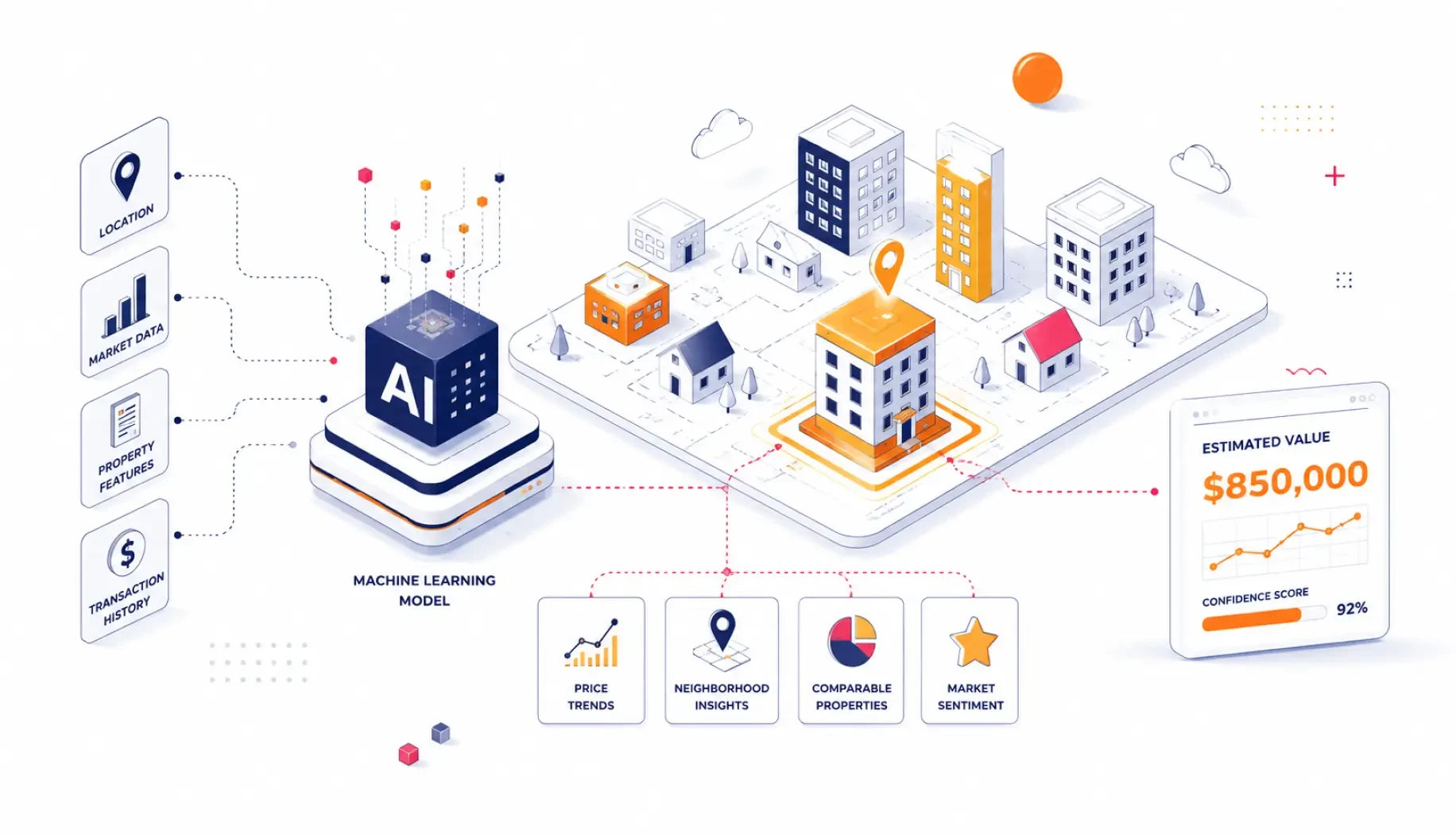
Automated Valuation Models (AVMs) estimate property prices using sales data, location, and property features without human appraisers. They combine machine learning and spatial analysis to generate accurate valuations with confidence ranges. Commonly used by lenders, portals, insurers, and investors, AVMs rely on high-quality geocoded transaction data to ensure reliable pricing across markets.
Key AVM technical components
AVM Component | Requirement | Typical Stack |
Transaction data pipeline | Daily ingestion, deduplication, normalization from multiple sources | Python ETL, PostgreSQL + PostGIS, BigQuery |
Spatial feature engineering | Geocoding, distance to CBD, schools, transit, crime, amenities | PostGIS, Google Maps API, H3 grid system |
Comparable selection | Finding similar sold properties by size, type, age, location | Python, Elasticsearch, PostGIS geo_distance |
ML valuation model | Training XGBoost or LightGBM on engineered features | Python, scikit-learn, XGBoost, LightGBM |
Confidence interval layer | Prediction intervals based on market data density | Python, quantile regression, conformal prediction |
Explainability panel | Feature importance and comparables for each valuation | SHAP values, React.js dashboard |
Audit & compliance log | Full trace of inputs, timestamps, and model versions | PostgreSQL audit tables |
The biggest failure mode in PropTech AI engagements is teams building models before cleaning the data. Property transaction data arrives with inconsistent area measurements, addresses that do not geocode cleanly, and duplicate records from multiple listing sources. A data engineering sprint of four to six weeks before model development begins consistently produces 15 to 30 percent better production accuracy than skipping that step.
For teams unfamiliar with the scope of data pipeline work required, the detailed guide on Automated Property Valuation With Machine Learning: Building AVM Engines covers the full AVM build process from data ingestion to production deployment.
Acquaint Softtech's Python development team builds all AVM model training pipelines, inference APIs, and explainability layers. The MERN stack developers build the front-end valuation widget, confidence interval display, and comparable evidence panel.
For dedicated AVM teams that require end-to-end ownership of the data pipeline through model deployment, Acquaint Softtech's dedicated development teams provide a cross-functional squad deployable within 48 hours of a brief.
Predictive Analytics for Property Management and Investment
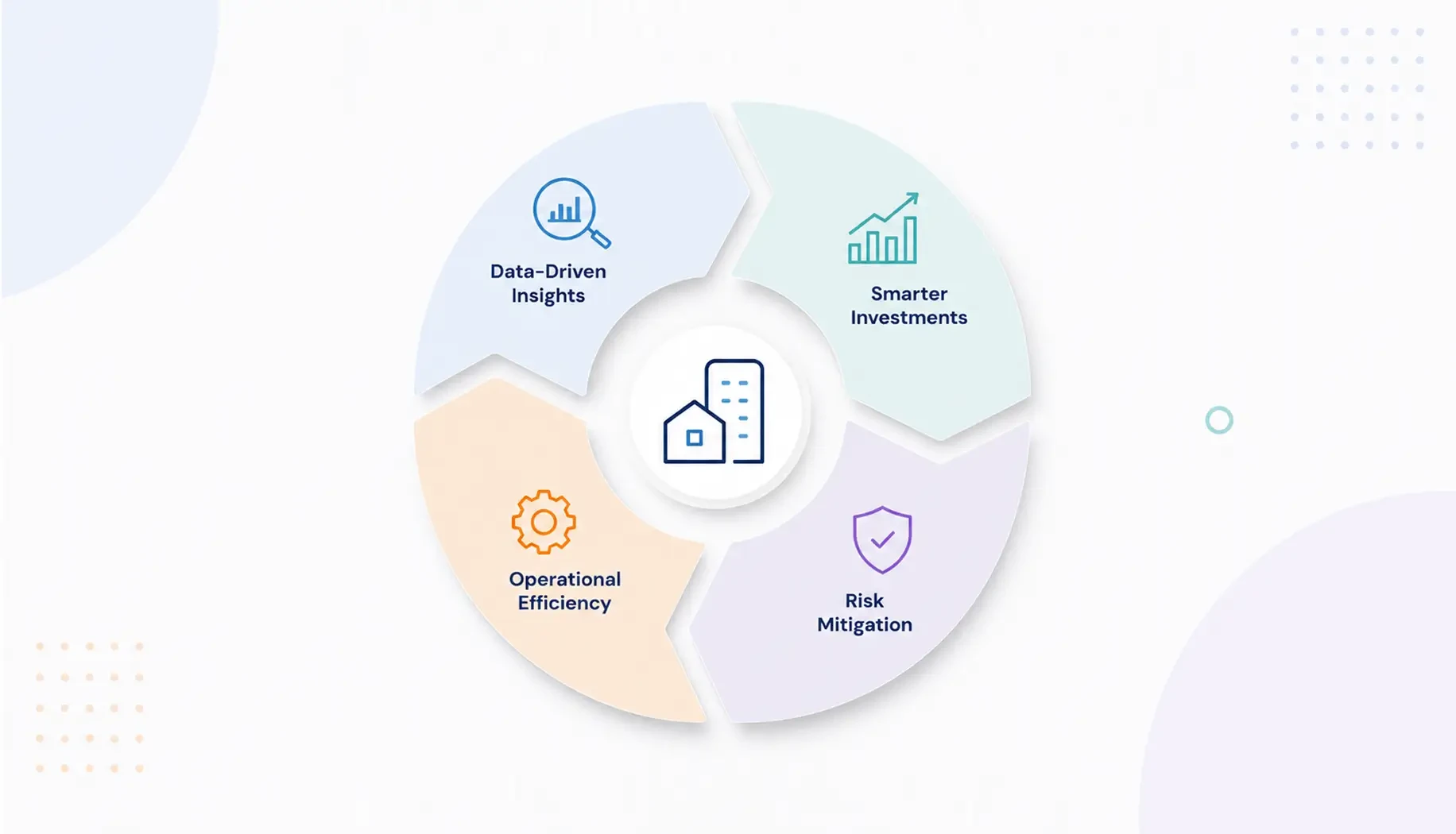
Predictive analytics for property management converts historical behavioral data into forward-looking operational signals: which tenants are likely to leave before their lease ends, which HVAC units are likely to fail before the next service cycle, and which rental units are priced above or below market equilibrium.
Each prediction reduces a specific operational cost. Tenant churn costs a landlord one to two months of lost rent per vacancy plus re-letting fees. Predictive maintenance reduces emergency repair spend by 20 to 40 percent. Dynamic rent optimization improves yield on available units by 8 to 12 percent in competitive markets.
Tenant churn prediction
The Tenant Churn Prediction: Using ML to Identify At-Risk Tenants system uses historical lease and payment behavior, maintenance request frequency, tenant communication patterns, and comparable market rent data to generate a monthly churn probability score per tenancy. Landlords managing 200 or more units can use this score to prioritise proactive retention outreach, offer early renewal incentives to at-risk tenants, and sequence vacancy marketing to minimise the gap between move-out and re-let.
Acquaint Softtech's AI development team builds tenant churn models using logistic regression or gradient boosting on structured tenant data. Feature engineering covers payment consistency (days late per month), maintenance submission rate changes, lease-to-market-rent spread, and building-level factors including manager responsiveness scores. For platforms with limited historical data, transfer learning from prior Acquaint Softtech training sets can bootstrap model accuracy before the client's own data volume reaches statistical significance. Teams can also be quickly scaled through services like hiring MEAN stack developers when additional backend and analytics capacity is required.
Predictive maintenance from IoT sensor data
Predictive maintenance uses IoT sensor streams from HVAC compressors, elevator motors, water pressure sensors, and electrical panels to detect anomaly patterns that precede failures. A model trained on historical failure events and the sensor readings from the 48 to 72 hours before each failure learns to recognise the signature of imminent breakdown and generates a maintenance work order recommendation before the failure occurs.
Acquaint Softtech has delivered predictive maintenance systems for commercial building clients in the UAE and UK that reduced emergency repair events by 35 percent in the first operational year. The technology stack uses MQTT for sensor data ingestion, InfluxDB or TimescaleDB for time-series storage, Python for model training and inference, and a React.js dashboard for facility managers.
Predictive analytics for investment decisions
Property investment analytics platforms aggregate transaction data, rental yield data, demographic shifts, infrastructure development schedules, and employment data to score investment opportunities by risk-adjusted return potential. The UK Land Registry provides open transaction data for England and Wales that forms the foundation of investment analytics platforms for the UK market. Acquaint Softtech has built ingestion pipelines from the Land Registry Price Paid Data that clean, geocode, and enrich every residential transaction record with census demographics, planning application proximity scores, and transport accessibility indices.
Institutional investors in Europe and the USA increasingly use property data warehouses that combine transactions, planning data, mortgage signals, and rental benchmarks for both historical analysis and predictive modelling. Acquaint Softtech builds these architectures using Snowflake, BigQuery, or PostgreSQL based on infrastructure needs, while also developing tenant credit scoring models using alternative data to reduce defaults and improve portfolio returns. These capabilities can also be extended through white label software development for scalable, branded PropTech solutions.
Build Your PropTech AI Platform With a Team That Has Done It 40+ Times
Acquaint Softtech's PropTech AI team has delivered valuation models, churn predictors, and IoT analytics for real estate clients in the USA, UK, UAE, Europe, Australia, and New Zealand. Dedicated teams deploy within 48 hours of a brief at up to 40% lower cost than local agency rates. 1,300+ projects. 4.9/5 on Clutch from 50+ verified reviews.
Smart Property Matching and Recommendation Engines

Smart property matching engines analyse a buyer's or renter's search behavior, saved listings, inquiry history, and stated preferences to surface properties they are most likely to convert on, before they explicitly search for them. A well-designed matching engine improves portal engagement significantly: users who receive personalised recommendations visit 2.3 times more listings per session and convert to inquiries at 3 to 4 times the rate of users relying on keyword search alone.
Collaborative filtering versus content-based matching
Two model families dominate property matching. Collaborative filtering identifies users with similar search patterns and recommends properties that similar users have inquired on or converted. It performs well when behavioral data is dense but degrades on new user profiles. Content-based matching builds a property feature vector from structured listing data and matches it against a buyer preference profile derived from their search history and saved properties. Production matching engines combine both approaches in an ensemble: collaborative filtering provides the broad discovery signal, content-based filtering refines it for precision, and a re-ranking layer applies real-time signals to produce the final ordered recommendation.
Acquaint Softtech's MERN stack development team builds the React.js recommendation display components, notification systems, and A/B testing dashboards that measure personalisation lift. Properties displayed through personalised recommendation surfaces convert 3 to 4 times better than standard search results across every portal segment Acquaint Softtech has instrumented.
The AI engineering team builds and maintains the model pipeline, feature store, and fast inference APIs with continuous retraining to keep recommendations accurate as market conditions change. For rental platforms, NLP-based lease abstraction extracts key terms from documents and converts them into structured data for matching tenants with suitable properties. The backend systems handle ingestion and normalization of lease data to power real-time recommendation engines.
Matching system comparison
System | Use Case | Technical Approach |
Buyer-property matching | Portal recommendation for properties not yet searched | Collaborative + content-based ensemble, Elasticsearch, Python |
Tenant-unit matching | Matching renters to available units by preference | Content-based filtering, constraint satisfaction, Python |
Dynamic rent optimisation | Adjusting prices from demand, season, and comparable data | Prophet/LSTM time series, pricing ML model, Python |
Investment property scoring | Scoring acquisition targets by risk-adjusted return | Multi-factor scoring, geospatial features, Python |
AI listing description | SEO-optimised copy from structured property data | OpenAI API, prompt engineering, Python, CMS integration |
Generative AI for real estate content
Generative AI is transforming property platforms by automatically creating SEO-optimised listings, agent briefs, and market reports from structured data like area, location, and amenities. It cuts content creation time by 70–80% and ensures consistent, high-quality output across all listings. It also generates automated Comparative Market Analysis (CMA) reports with pricing insights and visuals in minutes instead of hours. These AI content systems are built on OpenAI APIs with custom integrations, and ongoing performance, updates, and optimization are handled through Acquaint Softtech’s support and maintenance services.
IoT Data Platforms and Smart Building Intelligence
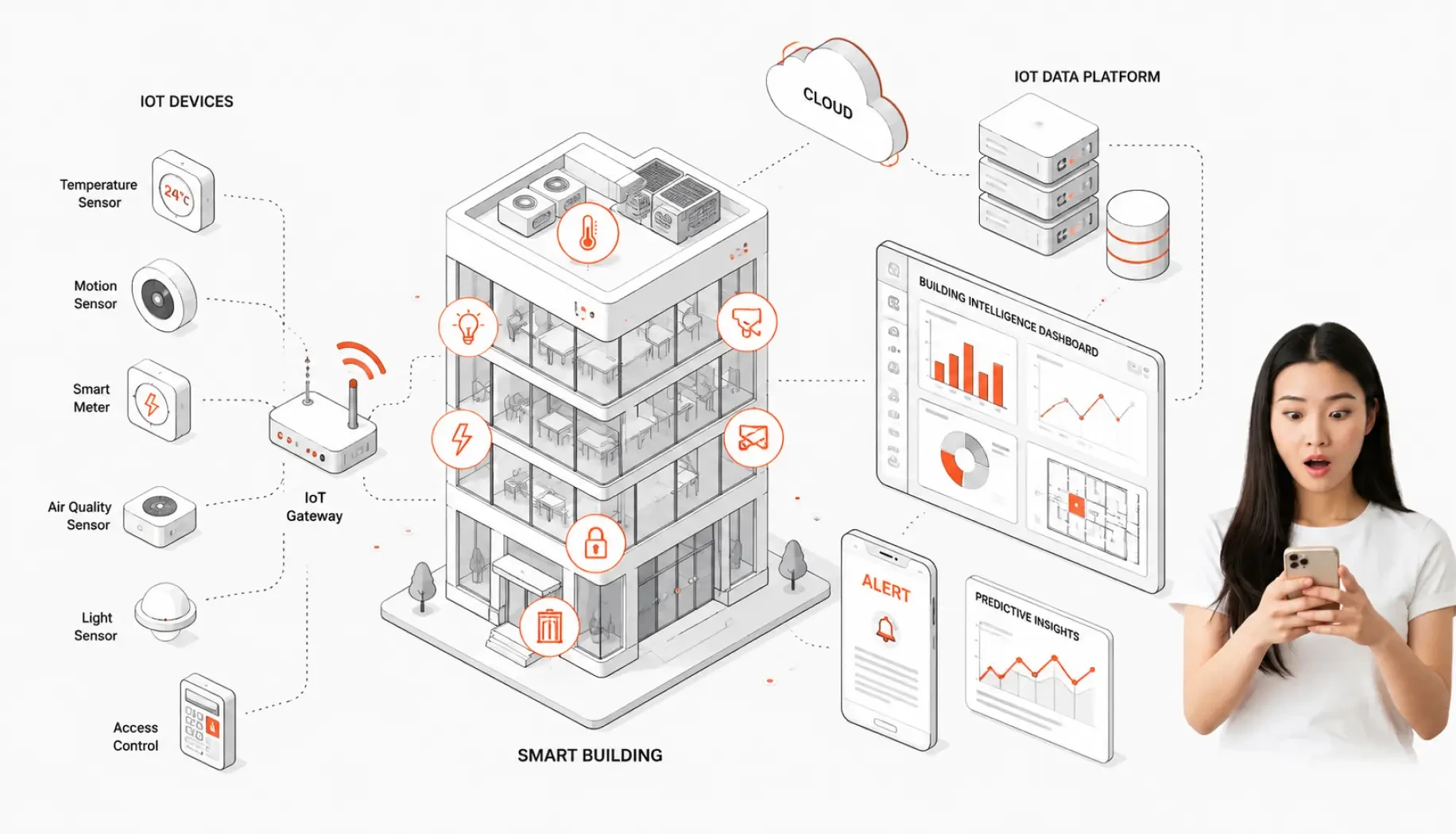
IoT building data platforms collect and process sensor data from systems like HVAC, lighting, meters, and elevators to generate real-time operational insights. They ingest high-frequency data via MQTT, store it in time-series databases, and display it through live dashboards for facility management. The typical stack includes MQTT or AWS IoT Core, InfluxDB or TimescaleDB, Python for processing, Redis for caching, and React for dashboards, with Kafka used in large-scale deployments for higher reliability and scalability.
Energy monitoring and ESG dashboards
Smart energy monitoring aggregates electricity, gas, and water consumption data from IoT meters across a building or portfolio. AI-driven HVAC optimisation learns occupancy patterns and adjusts temperature setpoints proactively, reducing energy consumption by 15 to 30 percent in commercial buildings. ESG dashboards calculate building carbon footprints from utility data, track LEED or BREEAM compliance milestones, and generate the automated reporting packages that institutional property owners need for ESG-linked financing.
Acquaint Softtech's Python and DevOps engineering team has built MQTT-based IoT pipelines on AWS IoT Core and Azure IoT Hub for smart building clients in the UAE and UK. These pipelines handle multi-tenant sensor data isolation, data quality monitoring that flags sensor malfunction early, and alert suppression logic that prevents false maintenance triggers from noisy sensors. The DevOps engineering team designs the cloud infrastructure, including auto-scaling for traffic spikes and disaster recovery for sensor data continuity during outages.
Occupancy analytics and space utilisation
Occupancy analytics in commercial buildings uses IoT sensors like people counters, CO2 monitors, and desk booking systems to track space usage in real time. These insights help optimize HVAC, cleaning schedules, floor planning, and lease decisions. Mobile apps for facility and security teams also support IoT-based operations, especially in environments with unstable connectivity.
Smart access control and visitor intelligence
Smart access control replaces physical keys with mobile credentials, OTP entry, and biometrics, with every access event logged for security and analytics. In residential buildings, QR-based visitor passes enable pre-approved entry with full audit tracking, while in commercial spaces, badge and IoT integrations help monitor occupancy and optimize energy use through automated HVAC control.
Acquaint Softtech's React Native development team builds offline-first resident and security guard mobile apps that function in underground car parks, elevator lobbies, and other areas with limited connectivity. The offline-first architecture queues events locally and syncs to the cloud when connectivity is restored, so gate access and visitor logs are complete even when the network drops. For residential societies and apartment complexes in India and the UAE, these visitor management systems have replaced manual logbook processes and reduced unauthorized entry incidents significantly in deployed locations.
PropTech AI Development at 40% Less Than Western Agency Rates
Acquaint Softtech's dedicated PropTech AI teams include Python ML engineers, data pipeline architects, IoT specialists, and React.js dashboard developers. Clients in the USA, UK, and Europe save up to 40% versus local agency rates with no penalty to code quality or sprint delivery. 50+ verified Clutch reviews confirm track record.
Geospatial Analysis, Location Scoring, and Market Intelligence
Geospatial analysis is the intelligence layer beneath every high-quality PropTech product. It powers location scoring for walkability, schools, safety, and infrastructure, combining multiple datasets into a single livability index, while demand heatmaps and catchment analysis reveal micro-market patterns and support targeted property marketing. For building such data-heavy platforms, teams often rely on experienced backend engineering support, such as hiring Laravel developers to implement scalable geospatial and analytics systems. The core stack includes PostGIS on PostgreSQL for spatial queries, Google Maps or Mapbox for mapping, and Python with GeoPandas and H3 for advanced spatial analytics and consistent market segmentation.
Rental market intelligence platforms
Rental market intelligence platforms benchmark rents, vacancy rates, and yield by micro-market using aggregated data from listing portals, transaction records, and property management systems. These platforms serve institutional landlords, REITs, and family offices that need to make acquisition and pricing decisions from objective market data rather than broker opinions. Acquaint Softtech has built rental intelligence products that combine listing-price data, confirmed transaction data, and vacancy rate signals into a single micro-market comparison dashboard for property fund managers in the UK and Australia.
Property data enrichment
Property data enrichment augments basic listing data with government records, census demographics, planning application proximity, satellite imagery analysis, and school catchment data. For Indian platforms, Acquaint Softtech builds data enrichment pipelines that combine RERA project data, municipal planning records, Census of India demographic data, and Google Earth Engine satellite imagery to produce micro-market risk-adjusted valuations.
For generative AI applications, LLM-based listing description generators that take structured property data and produce SEO-optimised, tone-configurable listing copy reduce agent content creation time by 70 to 80 percent while improving copy consistency and keyword coverage across large listing inventories.
Fraud and anomaly detection in property transactions
Fraud detection in property platforms uses AI anomaly detection models to identify suspicious listings, pricing outliers, and fake buyer or tenant applications such as forged documents or duplicate identities. It also helps detect rental fraud, pre-sale misrepresentation, and fake property listings using a mix of statistical models like isolation forests and rule-based systems. These systems can be extended with valuation model architecture to improve pricing accuracy and strengthen fraud signals by comparing estimated property value with the listed price. In regions like India and the UAE, government ID verification APIs further enhance trust and validation.
For PropTech platforms that have outgrown legacy PHP or older Python stacks and need to add AI fraud detection or geospatial intelligence to an existing codebase, Acquaint Softtech's version upgrade services cover the full migration path to a modern, AI-capable event-driven backend without disrupting live production data.
The Acquaint Softtech PropTech AI Delivery Framework
Over 40+ PropTech AI engagements, Acquaint Softtech has developed a structured six-phase delivery process that reduces the risk of data quality failures, model performance gaps, and production integration issues that account for 70 percent of PropTech AI project overruns.
Phase | What Happens |
Phase 1: Data Audit | Identify data sources, fix quality issues, and design ETL + data model |
Phase 2: ETL Pipeline | Build ingestion, cleaning, geocoding, and data warehouse |
Phase 3: Feature & Model Training | Create features, train ML models, and select the best-performing model |
Phase 4: API & Integration | Deploy inference APIs and connect AI outputs to platform |
Phase 5: Testing & Validation | Run accuracy, load, and integration testing with stakeholders |
Phase 6: MLOps & Governance | Monitor drift, retrain models, and maintain audit + SLA systems |
For PropTech teams who have not yet defined their data requirements or AI use case scope, Acquaint Softtech's discovery workshop delivers a 2-week engagement covering data availability assessment, AI use case prioritisation, architecture design, compliance mapping, and a fixed-price proposal before any model code is written.
The virtual CTO service provides ongoing fractional technical leadership for founders and engineering managers who need senior AI architecture guidance without a full-time hire. This is particularly valuable for PropTech founders with strong domain expertise who need a credible technical lead for investor due diligence conversations or team hiring decisions.
For PropTech companies scaling their engineering capacity alongside AI development, Acquaint Softtech's staff augmentation service allows specific AI and data engineering roles (Python ML engineer, data pipeline architect, MLOps specialist) to be added to an existing team within 48 hours, without the 3 to 6 month hiring cycle of a full-time hire in the USA, UK, or Europe.
Case Study: Property Intelligence Platform, New Zealand
CASE STUDY: Centralised Property Intelligence Platform
Client: Property Brokers, New Zealand's largest provincial real estate company with 850+ agents across 80+ locations nationwide.
The Challenge: The client managed property transaction data, listing activity, and regional market trends across multiple offices through disconnected spreadsheets and periodic manual market reports. Agents had no reliable tool for property valuations. Regional managers could not view demand patterns or pricing changes without days of manual compilation.
The Solution: A centralised property intelligence platform including a data ingestion system aggregating historical sales records, listing activity, and regional pricing from multiple sources; property price prediction models using location-based features and historical pricing patterns; and market intelligence dashboards for regional managers to track property movement, demand patterns, and pricing changes across their coverage areas.
Technology Stack: Python (ETL pipeline, feature engineering, XGBoost models), PostgreSQL with PostGIS, React.js dashboards, AWS hosting and data warehouse, Google Maps API for geocoding and mapping.
Results: Agent appraisal preparation time reduced by 60 percent. Regional managers gained real-time visibility into demand patterns. The platform improved daily operations measurably across all 80+ locations.
Client Feedback: Guy Mordaunt, Managing Director of Property Brokers, stated in his verified Clutch review: "The technology felt practical rather than experimental, which was exactly what we needed. Acquaint Softtech maintained regular communication and was quick to respond to our suggestions."
Full PropTech AI case studies: acquaintsoft.com/case-studies
Why Acquaint Softtech for PropTech AI Development
Three things make a PropTech AI project succeed: clean data pipelines, well-validated models, and MLOps that keep those models accurate after launch. Most development agencies do one well. Acquaint Softtech has built all three into a single integrated team, and has delivered that combination for real estate clients on five continents.
What makes Acquaint Softtech different for PropTech AI
01. Real projects, real clients, real outcomes
Not case studies written from a brochure. Property Brokers (New Zealand, 850+ agents) deployed a price prediction and market intelligence platform with Acquaint Softtech that cut agent appraisal preparation time by 60 percent. Heimstaden AB (Sweden, 162,000 homes across Europe) used Acquaint to build tenant-facing and internal property tools. Croisette Real Estate Partner (Iceland) got a modular property listings backend with structured financial audit trails aligned to European compliance standards. These are live, production systems used every day.
02. We start with data, not models
The most common cause of PropTech AI project failure is skipping the data audit and jumping straight to model training. Dirty property transaction data, inconsistent area measurements, and duplicate records from multiple listing sources degrade model accuracy by 15 to 30 percent before training even begins. Every Acquaint Softtech AI engagement starts with a 2-week data audit and ETL pipeline sprint. The model comes after the data is clean, not before.
03. We stay accountable after go-live
A property valuation model that starts at 85 percent accuracy and quietly degrades to 70 percent over six months is not a success. It is a liability. Acquaint Softtech includes MLOps as a standard part of every AI engagement: model drift monitoring, automated retraining triggers, data quality alerts, and SLA-backed support. Post-launch accuracy is not a bonus feature. It is the product.
"The technology felt practical rather than experimental, which was exactly what we needed. Acquaint Softtech maintained regular communication and was quick to respond to our suggestions throughout the project."
Guy Mordaunt, Managing Director, Property Brokers New Zealand | 850+ agents | Verified Clutch Review
Build Need | Delivery |
AVM | ML pipeline + model + API + dashboard |
Tenant churn | ML model + scoring API |
Predictive maintenance | IoT pipeline + anomaly alerts |
Property matching | Recommendation engine + API |
Geospatial intelligence | Spatial pipeline + dashboards |
Smart building IoT | IoT streaming + real-time dashboard |
Lease NLP tool | NLP extraction + API integration |
Every engagement begins with a 2-week discovery workshop that maps your data sources, prioritises AI use cases, designs the architecture, and produces a fixed-price proposal. To see live case studies, visit case-studies.
Join 200+ Tech Companies That Scaled With Acquaint Softtech
AVM, predictive analytics, IoT pipelines, smart matching. Production-ready PropTech AI at up to 40% lower cost than Western agencies. 1,300+ projects. 4.9/5 Clutch rating. Dedicated team deployed in 48 hours.
Frequently Asked Questions
-
What is AI and data intelligence in PropTech?
AI and data intelligence in PropTech is the use of machine learning, geospatial analysis, IoT sensor pipelines, and NLP to automate property valuation, predict tenant behavior, match buyers to properties, and monitor building performance. It converts raw property data into forward-looking decisions. Core applications include automated valuation models, tenant churn prediction, smart property matching, and IoT-driven predictive maintenance.
-
What is an automated valuation model (AVM) in real estate?
An automated valuation model (AVM) is a machine learning system that estimates property value from comparable sales data, location attributes, property characteristics, and micro-market trends, without a human appraiser. It outputs a point estimate and a confidence interval. AVMs are used in mortgage pre-approval, property portal valuation widgets, insurance underwriting, and investment platform scoring.
-
How accurate are automated property valuations?
In data-rich markets (USA, UK, Australia), residential AVMs achieve a median absolute percentage error of 3 to 7 percent. In emerging markets with fragmented transaction data (India, Southeast Asia, Middle East), typical error is 8 to 15 percent without data enrichment. Accuracy is determined primarily by data quality and spatial feature engineering, not model complexity.
-
How is AI used in real estate and property management?
AI is used in real estate for five main applications: automated property valuation (AVM), tenant churn prediction to reduce vacancy, predictive maintenance from IoT sensor data to cut emergency repairs, smart buyer-property matching to improve portal conversion, and dynamic rent optimisation. Each application requires a clean training data pipeline as the foundation before any model can be deployed.
-
How does smart property matching work?
Smart property matching analyses a buyer's or renter's search history, saved listings, and inquiry behavior to build a preference profile. A recommendation engine using collaborative filtering or content-based models then surfaces properties they have not yet searched but are statistically likely to act on. Personalised matching increases inquiry conversion rates by 3 to 4 times versus standard keyword search.
-
What is predictive maintenance for buildings?
Predictive maintenance for buildings uses IoT sensor data from HVAC compressors, elevator motors, and plumbing systems to detect anomaly patterns that precede failures. An ML model trained on historical failure events generates maintenance work order recommendations before the failure occurs. This approach reduces emergency repair events by 20 to 40 percent compared to reactive maintenance.
-
What tech stack is used for PropTech AI?
The standard PropTech AI stack is Python (XGBoost, scikit-learn, GeoPandas) for ML models; PostgreSQL with PostGIS for spatial property data; Elasticsearch for fast geospatial search; InfluxDB or TimescaleDB for IoT time-series data; React.js for data dashboards; and AWS, Google Cloud, or Azure for hosting. NLP applications (lease abstraction, listing generation) use the OpenAI API or a locally-hosted language model.
-
How much does PropTech AI development cost?
PropTech AI Solution
Estimated Cost
Automated Valuation Model or Tenant Scoring System
$20,000 to $60,000
Property Intelligence Platform with Multiple AI Modules
$60,000 to $150,000
Enterprise Platform with IoT, Real Time Analytics & MLOps
$100,000 to $300,000+
India based PropTech AI development teams can typically reduce costs by 40% to 60% compared to US and UK agencies.
-
What is geospatial analysis in real estate?
Geospatial analysis in real estate uses spatial data tools (PostGIS, H3, Google Maps API) to calculate walkability scores, generate demand heatmaps from transaction data, perform catchment area analysis, and measure proximity to schools, transport, and amenities. It provides the location intelligence layer beneath property search ranking, AVM feature engineering, and rental market intelligence platforms.
-
How long does it take to build a PropTech AI system?
A focused AVM or tenant scoring model with API integration takes 10 to 16 weeks from data audit to production. A full property intelligence platform with multiple AI modules takes 5 to 10 months. Timeline depends primarily on data availability and quality: projects with clean training data are significantly faster than those requiring new data pipelines. A dedicated PropTech AI team can be deployed within 48 hours of project brief.
I lead technology and client success at Acquaint Softtech with one goal in mind. Deliver work that feels personal, reliable, and worthy of long term trust. I stay close to both our clients and our developers to make sure every project moves with clarity, quality, and accountability.
Table of Contents
Get Started with Acquaint Softtech
- 13+ Years Delivering Software Excellence
- 1300+ Projects Delivered With Precision
- Official Laravel & Laravel News Partner
- Official Statamic Partner
Related Blog

The Complete Guide to PropTech Software Development in 2026
PropTech is not a real estate website with a login. It is a system of record that manages listings, leases, ledgers, and work orders on a single accountable platform. Here is what it costs, how it is built, and how to pick a partner in 2026.

Acquaint Softtech
May 4, 2026
How Hotel Booking Engines Work: Search, Availability, Pricing, and Reservation Architecture
A hotel booking engine is not a search bar. It is an availability engine, a pricing decision system, a payment pre-authorisation layer, and a channel inventory synchroniser, all running simultaneously. This guide explains every architectural layer and how each one connects in a production system.
Manish Patel
May 12, 2026
Hotel PMS Development: Front Desk, Housekeeping, and Guest Management in One System
A hotel PMS is not a booking system. It is the operational backbone connecting every department in real time. Here is what it includes, how each module is built, and what it costs in 2026.
Manish Patel
May 20, 2026India (Head Office)
203/204, Shapath-II, Near Silver Leaf Hotel, Opp. Rajpath Club, SG Highway, Ahmedabad-380054, Gujarat
USA
7838 Camino Cielo St, Highland, CA 92346
UK
The Powerhouse, 21 Woodthorpe Road, Ashford, England, TW15 2RP
New Zealand
42 Exler Place, Avondale, Auckland 0600, New Zealand
Canada
141 Skyview Bay NE , Calgary, Alberta, T3N 2K6