

Real Estate Digital Transformation
Digital transformation in real estate is the process of integrating modern digital technologies, data analytics, and cloud platforms into all areas of property operations, management, and customer service to replace legacy systems. It is powered by AI, VR and AR, IoT and digital twins, and transaction platforms, and it delivers operational efficiency, data-driven decisions, and a far better customer experience.

Mukesh Ram
As the Founder and CEO at Acquaint Softtech, a leading real estate software development company, I have helped property firms across the USA, UK, Europe, Australia, and New Zealand modernize. Digital transformation is essentially the big shift towards using digital technology for all aspects of a business. It is radically transforming a wide range of industries like education, travel, entertainment, and many more. There are 307.2 million Internet users in the USA as of July 2022, which amounts to 91.8% penetration. There are also 282.48 million mobile Internet users in the USA.
The real estate business is no exception, especially since the number of mobile phone and Internet users is on the rise. It is one of the oldest industries in the world, but with a high percentage of users trusting the Internet for research, information, and shopping, all businesses must consider this change. This article provides extensive information on digital transformation in the real estate industry.

- You want to understand digital transformation in the real estate industry.
- You are a CEO, CTO, or agency owner modernizing a property business.
- You want real estate digital transformation examples and technologies.
- You want to know how AI and real estate work together.
- You want the benefits, drawbacks, and a clear tech stack.
- You want a proven partner to build your real estate platform.
Whether you call it digital real estate, the digital transformation of real estate, or simply proptech, the goal is the same: use technology to serve buyers better, cut costs, and win in a crowded market. And with more of that journey now starting online, the firms that modernize are the ones that grow.
If you want expert help planning the move, our discovery workshop services turn your goals into a clear, build-ready digital roadmap.
What Is Digital Transformation In Real Estate?

Digital transformation is associated with many things, like going paperless and going green. It can do a great deal for the real estate industry as well and can be in the form of a feature-rich website or a fancy mobile application. One can expect a basic real estate website to consist of features like the ability to browse through the various property options, find a specific home based on their search criteria along with various filter options, and many more.
However, it is more than just a simple website or app. Besides ensuring customers have tons of features to simplify their search for the right property, it also incorporates several advanced technologies to help your firm gain the upper edge. This includes technologies like AR/VR, AI/ML, and many more to make it more appealing to users and simplify all the processes.
Real Estate Digital Transformation Examples
Ditching the brick-and-mortar office and adopting a remote workspace like a website or mobile app.
Implementing digital tools to analyze consumer behavior and optimize the property business.
Designing an automated customer service feature (chatbots) and re-skilling employees.
Using technologies like AR/VR and AI/ML to develop creative and innovative features for users to preview the property without actually visiting it.
Smart property search using apps with smart notifications of availability.
These real estate digital transformation examples are exactly the kind of features our dedicated software development teams build into modern property platforms.
Key Technologies Driving Change
Four technology groups drive real estate digital transformation: AI, VR and AR, IoT and digital twins, and transaction platforms.
Artificial Intelligence (AI): powers chatbots for 24/7 lead engagement, automated property valuations, and predictive market analytics.
Virtual and Augmented Reality (VR/AR): enables immersive 3D virtual tours and remote property staging through tools like Matterport.
Internet of Things (IoT) and Digital Twins: optimize smart-building energy efficiency, real-time utility tracking, and predictive maintenance.
Transaction Management Platforms: streamline compliance, e-signatures, and digital paperwork via systems like SkySlope.
Adding AI features the right way is where our AI development services help property firms move fast without overspending.
Core Benefits

Digital transformation delivers three core benefits: operational efficiency, data-driven decisions, and a better customer experience.
Benefit | What It Does | Example Tool |
Operational efficiency | Automates rent, maintenance, and work orders | Property management suite |
Data-driven decisions | Forecasts valuations, studies trends | Big-data platforms like CoStar |
Better experience | Remote booking, self-guided tours | Omnichannel and VR tools |
Operational efficiency automates rent collection, maintenance requests, and work orders so a single manager can oversee larger portfolios. Data-driven decisions leverage big-data platforms like CoStar to forecast valuations and study market trends accurately. An enhanced customer experience eliminates friction with remote booking, self-guided tours, and omnichannel communication.
Why Real Estate Digital Transformation Matters
It can be considered a form of modernization and reaping the benefits of advanced technologies like AR/VR, IoT, etc. Real estate businesses are always on the lookout to ensure good service and also to personalize customer experiences; consumers love a good experience as well. Digital transformation helps address this issue.
From a business point of view
This is the ideal method to gain a competitive advantage, increase revenue, improve customer experience, and decrease operating costs. One can save a lot of time, money, and effort by implementing advanced technologies like AR/VR and AI on online platforms like websites & apps.
From a customer point of view
Using a real estate website or mobile app allows one to browse through the properties faster using smart search options. It also allows them to preview the property in great detail (using virtual reality) and get to know the neighborhood, all from the comfort of their living room. Consumers can gain a more personalized user experience.
Develop a real estate website to better manage your business, gain more insights into your potential customers, and offer them a better service. When you are ready, you can hire Laravel developers from Acquaint Softtech to build it.
Digital Transformation Technologies In Real Estate

Big Data / Data Analytics
Digital transformation is vital to address the exponential rise in the use of the Internet. This is the same reason why it is also essential to analyze the data, since consumers & businesses tend to generate a lot of data online.
In fact, as per the studies conducted by Statista, the global data analytics market is expected to cross $68 billion by the year 2025. The real estate industry can benefit in many ways by incorporating this into its digital transformation solution.
Virtual Property View And Online Walk-through
Virtual reality is a technology that is now widely implemented in various industries. It is highly popular in the gaming, travel, and entertainment industries. This technology can also be very useful in the real estate industry, where users can perform breakthroughs on their shortlisted properties.
It is the ideal way to speed up the process of acquiring a property, and consumers can also save time and money in the process. This technology is appealing to both the younger and older generations. In fact, there is a percentage of users who will refuse to use an app or website that does not offer such a service. Including this feature can thus give you an edge.
Real-time Tracking
Implementing a solution like this also ensures better communication and tracking of transactions in real time. It also helps introduce several other features like eSignatures and smart contracts. Real estate transactions generate a lot of documents, and it is often hard to keep track of them or keep them secure. This is the perfect solution for your documents and for keeping track of eSignatures.
Smart contracts help establish a set of rules and agreements for a transaction. They cannot be tampered with, are highly secure, remove the middleman, and are cost-effective. Besides this, developing a system like this will make it easily traceable as well. Incorporating blockchain technology supports the change in consumer behavior further. It enables consumers to rely more on technology and eliminates the frequent need for face-to-face interaction.
Intelligent Chatbots
All consumers rate the importance of customer service very highly. By developing a solution that incorporates AI technology in the form of chatbots, it is possible to achieve this. Chatbots are essentially AI-driven chat sessions that ensure users get answers to their questions at any time of the day. It is possible to make it available 24x7, and it does not cost a great deal to implement it.
Real Estate Crowdfunding
Crowdfunding is a good method to attract investment from several potential investors. Real Estate crowdfunding opens doors to using various platforms like social media, newsletters, etc. Although crowdfunding is not a new concept, the advancement in technologies like Blockchain has helped increase the benefits of digital transformation.
Personalized Customer Experience
Consumers love when they get a personalized service; this applies to just about every field, especially eCommerce. It is equally appreciated by consumers in the real estate industry. Implementing a digital transformation solution that involves analyzing data and studying consumer behavior is usually quite popular with users. It can be optimized to suit consumer preferences, thus helping your business gain an upper edge.
Space as a Service (SPaaS)
Businesses tend to start in the strangest places, like a garage, home, etc. However, they eventually require some office space to grow and expand their operations. Buying office space can be expensive, and one of the main issues is ensuring that sufficient space is available for expansion as well.
We have just the solution for this: Space as a Service (SPaaS). This allows businesses to find a property that implements SPaaS, thus allowing them to take up only as much space as they currently require at a minimal cost, with the ability to expand as and when necessary. It implements the co-working space model to help reduce costs for a business. It is the ideal way to make your real estate business appealing to a wider range of customers.
Want these technologies in your platform?
Tell Acquaint Softtech which features you need, from VR tours to AI chatbots, and we will scope the build, timeline, and cost within 48 hours.
6 Real Estate Digital Transformation Elements
Digital transformation is essential for every real estate business to remain competitive due to the exponential rise in the use of electronic devices by consumers. It involves using various technologies like smart contracts, CRMs, etc. to cut costs. It also helps in making it more appealing for investors, simplifies the process for employees, and offers consumers a better consumer experience.
1. Enhance Consumer Experience
It helps ensure your consumers have a smooth and hassle-free experience while finding a property to either rent or purchase. Shifting into a new house or office is an exciting moment; however, the same cannot be said for the amount of effort it takes to find the perfect place. You can change this with the help of technology and by implementing the perfect digital transformation solution.
2. Relationships
It allows a real estate business to do more than simply provide users with a good platform to find the best property. It is also an opportunity to develop a long-term relationship by offering other services like a digital concierge service. (housekeeping, groceries, handyman, etc.)
3. Empowered Employees
There is more to a real estate business than meets the eye; it involves a great deal of documentation, research, and legwork. However, it is possible to make life easier for this type of business by opting for a digital solution. Advanced technologies can help reduce the amount of effort spent on documentation and other tasks, thus making your firm more productive.
4. Data-Based Decisions
Data is the heart of almost any organization, including a real estate business. Advancements in technology allow businesses to make better decisions based on generated reports. A business intelligence tool is the perfect example of a data-driven tool to ensure one makes accurate business decisions to gain the upper edge.
5. Additional Services
The process of digital transformation opens the doors to various other features and services. Some of the popular services include incorporating a parking management platform and implementing SPaaS (Space as a Service), which allows businesses to save on the amount they spend on business property.
6. Implementing Advanced Technologies
It is a good opportunity to implement several advanced technologies like AR, VR, AI, ML, IoT, Blockchain, Big Data, and many more. These technologies allow users to get a detailed preview of any property without leaving the comfort of their living room, ensure more secure transactions, and introduce automation. For a cross-platform app, you can hire React Native developers to run on both Android and iOS.
Real Estate Digital Transformation Benefits and Drawbacks

The decision to go ahead with digital transformation is a big one. However, at the end of the day, advanced technologies are creating an impact across all industries, and every business needs to adapt to these changes to remain competitive.
Advantages of Real Estate Digital Transformation
Low Cost: This type of solution helps reduce documentation and legwork and also saves time, making it the best method to reduce costs.
Automation Processes: Implementing automation is key to reducing human error and increasing productivity.
Better Data Security: This makes it possible to implement several advanced technologies to increase the level of security, like Blockchain.
Improved Customer Experience: one of the best ways to attract more consumers is to offer them a better and more personalized service.
Faster Response Time and Deal Closing: The use of technology helps speed up the process for the real estate agency as well as the customer.
Immediate Evaluation and Analysis: It streamlines the process of providing details after evaluation and analysis.
Potential Disadvantages of Real Estate Digital Transformation
Loss of Jobs: Not everyone can adapt to using new systems; besides, it can also make several positions redundant.
Slow Technology Adoption: Employees are often slow to adapt to new systems, which can affect the operation of a firm.
The bottom line being new technologies continue to evolve; hence, businesses that opt out of them are likely to lose their edge.
AI and Real Estate

AI is now central to real estate, powering valuations, lead engagement, and investment analysis. For AI and real estate development, machine-learning models predict which projects and locations will perform. For AI for real estate investors, the same models forecast rental yields, spot undervalued assets, and flag market shifts early. Paired with big data, AI turns raw listings and market feeds into clear, profitable decisions.
Building these smart features is exactly what our software development outsourcing model delivers, giving you a full AI-capable team without the overhead.
Important Industry Statistics
There have been several surveys and research studies conducted by many firms online, which also suggest that the real estate industry can benefit from digital transformation and that it is the future.
58% of real estate companies have already implemented a digital marketing strategy.
95% of buyers in 2021 used the Internet to find a home in the USA.
VR market is expected to generate over $2.6 billion by 2025.
The real estate software market in 2018 was $2.3 billion in the USA and is expected to grow at a 9.7% CAGR between 2021 and 2028.
72% of Realtors use Facebook, and 51.55% use LinkedIn.
73% of homeowners are more likely to list their property with realtors using advanced technologies like videos to sell.
92% of homes sold in the USA in 2021 were sold with the help of real estate agents.
Home buyers using print ads to find a house constitute less than 1% of all home buyers in the USA.
Case Study: A Verified Real Estate Build
Acquaint Softtech is all about making the latest technologies and creative minds accessible to all businesses without burning your pockets. We have successfully helped several real estate companies. Here is a simple snapshot, drawn from our verified reputation on Clutch.
Client | Great Colorado Homes, a US real estate agency. |
What we built | An easy-to-navigate, feature-rich website using PHP and Laravel. |
Standout features | A zip-code map and a school-district map for smarter property search. |
Other projects | Up Homes and Raleigh Realty, both stunning Laravel real estate platforms. |
Result | A highly impressed client and a website that helped grow the business. |
Company-wide proof: Acquaint Softtech has delivered 1,300+ projects over 13+ years with 70+ in-house engineers and a 5-star rating across 60+ reviews on Clutch, as an Official Laravel and Statamic Partner.
Consider Acquaint Softtech, Your Trusted Partner in Real Estate Development

Technology and property go hand in hand; in fact, there is a special term for this: "Proptech". It works in your favor to hire the best technology firm to help you gain a competitive advantage. There is no better online solution-providing firm than Acquaint Softtech to design the digital transformation solution for your real estate firm and help you strengthen your foothold in the property market. We offer a wide range of services:
Real estate website, Property rental management software, and mobile application.
Real estate CRM software and property rental and management software.
Real Estate IDX integration, MLS software, and HOA software development services.
SEO, automation, and cloud integration.
VR and AR tools for 3D tours, custom UI/UX design, testing, and support and maintenance.
If you only need to extend your own team, our IT staff augmentation services place vetted engineers within 48 hours.
Agencies can also resell a finished platform under their own brand with our white label software development.
To Wrap Up
There is a distinct change in consumer behavior with a shift towards using electronic devices for a wide range of activities. Businesses that fail to adapt to this change are likely to fail, especially due to advancements in technologies like AR/VR, automation, cloud computing, etc. Hire Acquaint Softtech as your real estate development partner, which has the expertise to guide your real estate firm through the process of digital transformation.
Ready to lead in proptech?
Talk directly with Acquaint Softtech's founder in a free 30-minute session. You will leave with a clear digital roadmap, the right tech stack, and honest advice on your real estate platform.
Frequently Asked Questions
-
What is the digitalization of real estate?
Digitalization in the real estate industry is the transition to the use of digital technologies and digital formats for all business processes. For example, it involves shifting to digital documents, images, and reports and tends to affect the business process, model, and culture.
-
What does digital transformation mean?
Digital transformation is the implementation of advanced digital solutions for every aspect of a business. For a real estate agency, this would mean allowing users to browse, search, and book or buy properties with the help of an online platform like a website or mobile application.
-
How does digital real estate work?
Digital real estate works by moving property search, viewing, and transactions online. Buyers browse listings, take VR or 3D virtual tours, e-sign documents, and communicate with agents through a website or app, while firms use data and AI to personalize and speed up the whole journey.
-
Who is the big 4 in real estate?
In commercial real estate services, the big players often referred to as leaders are CBRE, JLL (Jones Lang LaSalle), Cushman and Wakefield, and Colliers. They are the largest global brokerage and property-services firms.
-
What did Warren Buffett say about real estate?
Warren Buffett has long favored buying quality assets and holding them for the long term. He views good real estate as a productive, long-term asset rather than something to trade quickly, and he stresses buying at a sensible price and being patient.
-
What is the rule of 7 in real estate?
The rule of 7 is a marketing idea that a prospect usually needs to see or hear your message around seven times before they act. In real estate, it means staying consistently visible through listings, ads, email, and social media so buyers remember you when they are ready.
-
What is the highest paid job in real estate?
Among the highest-paid roles are real estate developers and commercial real estate brokers, along with senior positions like real estate investment (REIT) executives and portfolio managers, where large deal values drive high commissions and compensation.
-
What technology stack is used for digital transformation in real estate?
Common choices are AI/ML, IoT, Big Data, Blockchain, React Native, Flutter, Laravel, Python, and AR/VR. Laravel is popular for the web platform, while React Native or Flutter suits cross-platform mobile apps.
I love to make a difference. Thus, I started Acquaint Softtech with the vision of making developers easily accessible and affordable to all. Me and my beloved team have been fulfilling this vision for over 15 years now and will continue to get even bigger and better.
Table of Contents
Get Started with Acquaint Softtech
- 13+ Years Delivering Software Excellence
- 1300+ Projects Delivered With Precision
- Official Laravel & Laravel News Partner
- Official Statamic Partner
Related Blog
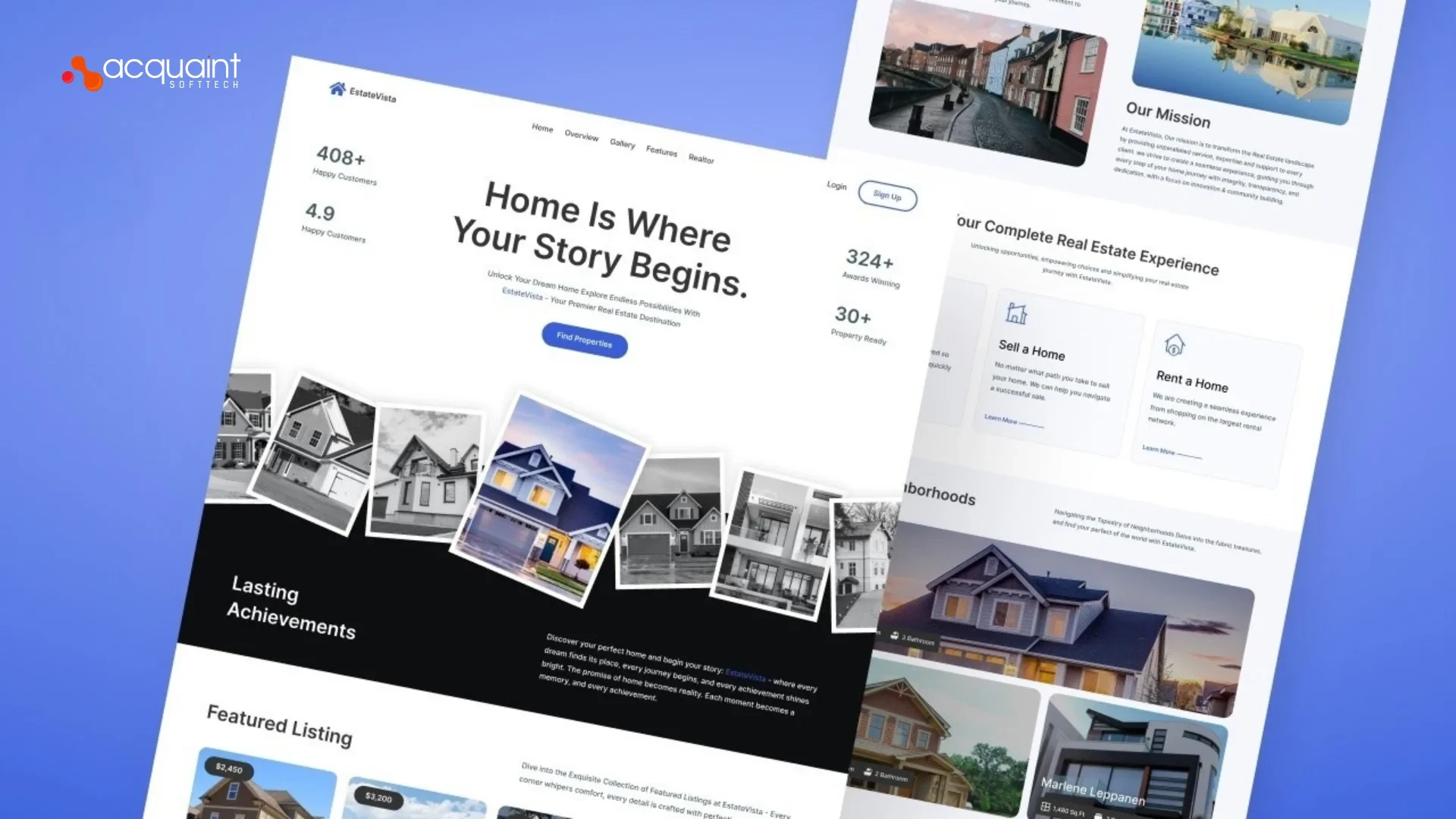
Develop Your Real Estate Website: Here Is Why and How (2026 Guide)
To build a real estate website, you need a clear plan, the right software, and useful features to attract buyers and sellers. A good site builds trust and helps people find homes fast. The core steps: pick a domain, get reliable hosting, choose a real-estate-ready platform, connect an MLS feed via IDX so live listings show on your pages, make it mobile-friendly, and add simple contact forms. In 2026, AI tools can even scaffold property grids, lead forms, and area guides in minutes.
Mukesh Ram
April 20, 2022
Why Should You Pick Laravel For Web Development? (2026 Update)
Laravel is widely chosen for web development because it drastically accelerates production timelines while providing robust, enterprise-grade security out of the box. It removes repetitive boilerplate so developers can focus on unique business logic. The primary reasons to build with Laravel are accelerated time-to-market, ironclad security and reliability, a maintainable and scalable MVC architecture, and a rich ecosystem that supports business growth.
Mukesh Ram
March 23, 2022
How to Build a Real Estate Marketplace Platform
Building a real estate marketplace isn't a listings website; it's a live system where buyers, agents, and data connect in real time. Auto-routing leads, refreshing listings instantly, and giving every agent a full working environment inside the platform. One architecture decision in week one determines whether you scale to 1,000 listings or 1,000,000.

Manish Patel
May 19, 2026India (Head Office)
203/204, Shapath-II, Near Silver Leaf Hotel, Opp. Rajpath Club, SG Highway, Ahmedabad-380054, Gujarat
USA
7838 Camino Cielo St, Highland, CA 92346
UK
The Powerhouse, 21 Woodthorpe Road, Ashford, England, TW15 2RP
New Zealand
42 Exler Place, Avondale, Auckland 0600, New Zealand
Canada
141 Skyview Bay NE , Calgary, Alberta, T3N 2K6