

The Future of EdTech 2026-2030: Trends, Predictions, and What to Build Now
To build an EdTech startup, validate the learning problem, build a focused MVP, and scale after achieving product-market fit. Successful startups test demand before investing in full development.

Mukesh Ram
What if the biggest EdTech opportunity over the next five years is not adopting every new technology, but investing in the right long-term shifts? As CEO of Acquaint Softtech, I have seen how strategic software product development services help EdTech companies build platforms that adapt to changing technology, learner expectations, and AI-driven innovation. The challenge is not predicting every trend. It is building a product that can evolve as the industry continues to transform.
Bet on the shift, not the gadget, EdTech is entering its most consequential five years. The global EdTech market was valued at roughly USD 189 billion in 2025 and is projected to reach USD 214.58 billion in 2026, growing toward USD 588.72 billion by 2034 at a 13.45% compound annual growth rate. But the size of the prize is not the story; the story is how fast the rules of building are changing.

- You are planning where to take your EdTech product next.
- You want to know which 2026 trends are real, not hype.
- You are deciding where to invest your build budget.
- You need to understand how AI is reshaping learning.
- You want a future-ready roadmap, not a feature list.
The US government's NIST AI Risk Management Framework exists precisely to help teams build trustworthy AI, and the EdTech companies that take it seriously will win the trust that sells.
This guide covers the seven trends shaping 2026 to 2030, a year-by-year roadmap, and what to build now. It sits under our complete EdTech software development guide, which frames the wider learning technology landscape.
Acquaint Softtech has delivered 1,300+ software projects across 20+ industries in 13+ years, with a team of 70+ in-house engineers. Clients across the USA, UK, Europe, Australia, New Zealand, and India deploy their first dedicated engineer within 48 hours of the brief.
Where EdTech stands going into 2026

EdTech in 2026 is past the pandemic boom and bust and into a more demanding phase: buyers expect results, not novelty. The market is large and growing, but it now rewards products that change behavior and prove outcomes, and punishes the broad content libraries that defined the last decade.
That discipline is healthy. The shakeout cleared out products that grew on emergency budgets and never proved value, leaving room for teams that solve a real problem and can show it. For founders, this means the bar is higher, but the noise is lower, and a genuinely useful product is easier to distinguish than it was three years ago.
What are the top EdTech trends for 2026?
The top EdTech trends for 2026 are AI-native learning, real adaptive personalization, immersive VR and AR training, micro-credentials tied to hiring, and a hard shift toward measurable outcomes. The common theme across this future edtech technology is that workflow and proof now beat content and features.
Reading these education tech trends correctly before committing budget is exactly what a structured discovery workshop helps founders do, separating durable shifts from passing hype. Acting on them without a standing team is why many companies move through structured software development outsourcing, scaling effort to the bets that prove out.
What learning products actually require to deliver on these trends is laid out in our guide to developing virtual classroom and e-learning software.
Trend 1: AI moves from feature to foundation

The biggest shift of the next five years is that AI stops being a feature you add and becomes the foundation you build on. Generative AI tutors, automated content creation, and intelligent assessment are moving from premium extras to baseline expectations, and products without them will feel broken to users by 2027.
How will AI change education?
AI changes education by making one-to-one tutoring affordable at scale: every learner gets real-time support, adaptive paths, and instant feedback that once required a human tutor. The global AI in education market reflects this, growing from about USD 8.3 billion in 2025 to USD 11.4 billion in 2026 and a projected USD 57.2 billion by 2033, a 25.9% compound annual growth rate, according to Grand View Research.
Building these capabilities well, rather than bolting a chatbot onto an old product, is the work of a dedicated AI development team that understands both models and pedagogy.
The data and model pipelines behind AI tutoring and grading are backend-intensive, often owned by a dedicated Python development team that can serve them reliably at scale.
AI-native means something specific, not just a chatbot in the corner. It means the product is designed around a model that can generate content, assess open answers, and adapt a path on the fly, with the data and guardrails to do it safely. Founders who retrofit AI onto a static product feel the seams; those who design for it from the data model up ship features competitors cannot copy quickly.
Planning your AI-native EdTech roadmap?
Acquaint Softtech helps founders and product leaders build AI-native learning products, from adaptive engines to intelligent assessment, for teams across the USA, UK, Europe, Australia, New Zealand, and India. Your first engineer deploys within 48 hours of brief.
Trend 2: Adaptive, personalized learning becomes default

Adaptive learning, where the platform adjusts content, pace, and difficulty to each learner in real time, moves from a premium feature to the default expectation. The one-size-fits-all course is becoming obsolete, replaced by paths that respond to how each person actually learns.
The results explain the momentum. Adaptive and personalized approaches have improved retention by 25 to 60% over traditional methods in studies, and AI-driven personalization has lifted course completion rates and exam scores in university pilots. These adaptive learning trends are why investors now ask about personalization before they ask about content.
Building a real adaptive engine, not a branching quiz, is specialist work for an AI development team that can model knowledge and predict the next best step for each learner. The scalable platform that serves those paths to many learners at once is the kind of architecture MERN stack development engineers design for high-traffic products.
How adaptive delivery connects to live and asynchronous learning is covered in our guide to building a virtual classroom platform.
Trend 3: Immersive learning with VR, AR, and simulation
Immersive learning is crossing from demo to deployment, especially where practice in the real world is expensive or dangerous. VR and AR let medical students rehearse surgery, technicians practice repairs, and employees run safety drills in realistic simulations, and the evidence shows immersive practice improves retention and confidence.
The numbers signal a real market, not a fad. The VR-in-education market, valued at nearly USD 17 billion in 2024, is projected to grow toward USD 65 billion by 2032, with roughly 18% of higher education institutions offering a VR-required course in 2026, rising toward 40% by 2028. This AI gamification VR forecast is strongest in STEM, medical, and vocational training.
Delivering immersive experiences across headsets and phones is demanding cross-platform work, often built by a React Native development team for the mobile and AR layer. Tying immersive modules into a coherent product is part of disciplined software product development, so the simulation is one feature, not a disconnected experiment.
The honest caveat is equity. Headsets and bandwidth remain unevenly distributed, and immersive learning risks creating a two-tier system where well-funded institutions get rich simulations and under-resourced ones do not. The pragmatic 2026 move is to treat VR and AR as a high-value bet for specific use cases, not a universal replacement, and to keep a non-immersive path so no learner is locked out.
Trend 4: Gamification and the science of engagement

Gamification is evolving beyond points and badges into a data-driven engagement strategy that keeps learners motivated through the right balance of challenge and achievement. With guidance from experienced teams offering Virtual CTO services, organizations can build smarter learning platforms that make education more rewarding and effective.
Engagement is the metric that decides whether any of the other trends matter, because the best adaptive, AI-powered, immersive product is worthless if learners stop opening it. This is why digital education transformation increasingly treats engagement design as core product work, not decoration.
The shift worth noting is from extrinsic to intrinsic motivation. Points and leaderboards still have a place, but the durable engagement comes from progress that feels meaningful, challenge tuned to the learner, and a clear sense that the effort is paying off. The platforms that master this will hold attention long after the novelty of any single feature fades.
Building engagement systems that adapt to each learner is increasingly the work of a senior Laravel development team pairing solid backend logic with behavioral design. Scaling engagement features without ballooning a permanent team is why companies add capacity through staff augmentation during heavy build phases.
Trend 5: Skills, micro-credentials, and the unbundled degree
The four-year degree is being unbundled into stackable skills and micro-credentials that map directly to jobs. Learners and employers increasingly value verifiable proof of a specific skill over a broad qualification, and EdTech products that connect learning to hiring will own the most valuable ground.
By the end of the decade, learning platforms are expected to act more like labor exchanges, where employers value blockchain-verified credentials and real performance over self-reported resumes. The learning innovation predictions converge here: credentials only matter when they connect to a job, a task, or a verified skill. Building verifiable credentialing and skills mapping is real engineering, the kind a dedicated development team sustains as standards evolve. How credential and cost models compare across builds connects to our Laravel developer hiring and cost guide.
For product builders, the implication is concrete: design learning around demonstrable skills from the start, tag every module to a competency, and make the proof portable. A course that ends in a vague certificate is worth less each year, while one that ends in a verified, shareable credential a hiring manager trusts becomes the product's strongest growth loop.
Trend 6: Learning analytics and proof of outcomes
The market is shifting from measuring activity to proving outcomes. Course completions and logins are giving way to evidence that learning changed performance, and the platforms that can demonstrate impact will command both higher prices and easier sales to schools and enterprises.
Predictive analytics is part of this shift. Platforms in 2026 can flag a learner at risk of dropping out weeks before they quit, letting a teacher or manager intervene early, which is the kind of measurable value buyers now demand before they pay.
Delivering accurate dashboards at scale is often phased through structured software development outsourcing so the numbers leadership sees can be trusted. How analytics connect to the learning engine is explained in our guide on how learning management systems work.
Proof is also a commercial weapon. When two products look similar, the one that can show a measurable lift in completion, retention, or performance wins the contract, especially with schools and enterprises under pressure to justify spend. Building EdTech technology in India through a verified partner lets founders fund this analytics depth at roughly 40% below Western agency rates, turning proof into an affordable advantage rather than a luxury.
Trend 7: Privacy, AI safety, and trust
As AI and analytics become more advanced, trust is becoming the biggest differentiator in EdTech. Companies that protect learner data, use AI responsibly, and build secure, scalable platforms with the support of experienced teams such as MEAN Stack developers are more likely to earn the confidence of institutions, parents, and learners. Those that compromise on security or governance risk losing that trust when issues arise.
AI safety is the newer frontier. Bias in adaptive systems, opaque grading, and ungoverned student data are real risks, and building against them deliberately, with human oversight and clear explanations, is what turns AI from a liability into a selling point.
Hardening a platform to meet privacy and AI-governance expectations is specialist work, often supported by a development team that knows the requirements. Modernizing older systems to current privacy and security standards is handled through structured legacy version upgrade and migration services as products mature.
The 2026 to 2030 roadmap: what changes when
The shift to AI-native, outcome-proven learning will not arrive all at once; it unfolds in phases. Understanding the sequence helps founders build at the right time, neither too early for the market nor too late to matter, and an edtech technology roadmap is the difference between leading and chasing.
Period | What matures | What to do |
2026 | AI personalization, VR pilots | Ship adaptive basics |
2027-2028 | Cognitive analytics, VR scales | Add immersion, depth |
2029-2030 | Skills-based hiring, verified credentials | Connect to outcomes |
Building to this sequence rather than all at once keeps spend aligned with the market, which founders manage by scaling teams through staff augmentation as each phase proves out. Mapping your own roadmap against these phases is exactly the work of a discovery workshop, which turns a trends report into a plan for your product.
What to build now: where the real opportunity is
The opportunity in 2026 is not a brand-new category; it is doing the durable things well before competitors do. The winning move is to build AI-native personalization, prove outcomes with analytics, and reduce the burden on teachers or managers, because those are the things buyers will pay for across the whole forecast period.
What should you invest in?
Invest first in AI-native personalization and outcome analytics, then in mobile and engagement, and treat immersive VR and AR as a focused bet in high-value niches rather than a broad spend. The safest investment is the durable shift toward personal, measurable, continuous learning, not whichever device is trending this quarter.
Priority | Why now | What to build |
AI personalization | Now expected by buyers | Adaptive engine |
Outcome analytics | Proof beats hype | Impact dashboards |
Mobile and engagement | Where learners are | Apps, habit loops |
Turning these priorities into a buildable plan is where founders hire an innovation-focused team rather than spreading a budget thin across every trend at once. Building these capabilities well, AI first, is the work of a development team that can ship personalization and analytics that actually hold up in production.
Want to know where to place your EdTech bet?
Acquaint Softtech helps founders turn EdTech trends into a buildable roadmap, then deploys engineers at USD 25 to 49 per hour, up to 40% below comparable Western agency rates. Book a call to scope what to build now.
Building future-ready: AI, stack, and the right partner
A future-ready EdTech product is one whose architecture can absorb new technology without a rewrite. That means a modular stack, an AI layer that can swap models as they improve, and a data foundation clean enough to power personalization and analytics, so next year's breakthrough is an upgrade, not a rebuild.
The build next-gen learning mindset favors flexibility over fashion. The exact framework matters less than whether your team can ship fast, integrate AI safely, and adapt as the roadmap unfolds. Many organizations also choose white label software development services to accelerate delivery, reduce development overhead, and launch scalable learning platforms under their own brand. This is why the choice of development partner often matters more than the choice of programming language.
A flexible, JavaScript-based foundation keeps web, API, and mobile aligned as the product evolves, which is why many future-ready teams build on MERN stack development. The AI layer that carries the next five years of features is best owned by a dedicated team that can evolve it as models advance.
Case Study: An Education Portal, Built and Validated
An online education company's learning and administration portal taken from concept to a live, validated product.
What the Client Needed
A scalable platform for course delivery and learner management
Secure online payments and virtual classroom integration
An admin portal to manage courses, content, and student activity
What Acquaint Delivered
Developed a custom LMS using Django, Python, and PostgreSQL
Integrated Zoom for live classes, Stripe for payments, and Accredible for certificates
Built a centralized admin dashboard for course and learner management
Delivered a secure, scalable solution ready for future growth
The relevance to the next five years is direct: a modular, well-architected product is the platform every future trend plugs into. The same standard applies to every build by our learning software product team. Teams that want one partner from today's product through the 2030 roadmap choose a dedicated development team model, keeping knowledge in place as technology shifts.
Build a future-ready EdTech product
From AI personalization to outcome analytics, Acquaint Softtech builds learning products designed to absorb what comes next. Join the founders who built with a Clutch Premier Verified partner and deploy your first engineer within 48 hours.
Frequently Asked Questions
-
What are the top EdTech trends for 2026?
The top trends are AI-native learning, real adaptive personalization, immersive VR and AR, micro-credentials tied to hiring, and a shift toward proven outcomes. The common thread is that workflow and proof now beat content and features.
-
How will AI change education?
AI makes one-to-one tutoring affordable at scale, giving every learner real-time support, adaptive paths, and instant feedback. It also automates content creation and grading, freeing teachers for mentorship rather than busywork.
-
What should you invest in?
Invest first in AI-native personalization and outcome analytics, then mobile and engagement, and treat VR and AR as a focused bet in high-value niches. The safest investment is the durable shift to personal, measurable, continuous learning.
-
What is the future of learning technology?
Learning is becoming personal, measurable, and continuous, with AI as the foundation rather than a feature. By 2030, platforms will connect learning directly to skills and hiring, and trust in how they use data and AI will decide who wins.
-
Will AI replace teachers?
Evidence points to augmentation, not replacement. Studies show most educators report higher job satisfaction and effectiveness with AI, because it removes busywork and frees them for the mentorship that machines cannot provide.
-
Is VR worth investing in for education now?
VR is worth a focused investment in high-value areas like medical, STEM, and safety training, where real practice is costly or dangerous. For broad consumer learning, it remains a niche bet rather than a core 2026 priority.
-
How big will the EdTech market be by 2030?
The EdTech market is projected to grow from about USD 214.58 billion in 2026 toward USD 588.72 billion by 2034 at roughly 13.45% a year, per Fortune Business Insights. The AI in education segment is growing even faster, at nearly 26% annually.
-
How does Acquaint Softtech help build future-ready EdTech?
Acquaint Softtech turns trends into a buildable roadmap through a discovery workshop, then builds with a dedicated team deployed within 48 hours, shipping in two-week sprints at a 95% on-time rate. It is Clutch Premier Verified with a 4.9/5 rating from 50+ reviews.
I love to make a difference. Thus, I started Acquaint Softtech with the vision of making developers easily accessible and affordable to all. Me and my beloved team have been fulfilling this vision for over 15 years now and will continue to get even bigger and better.
Table of Contents
Get Started with Acquaint Softtech
- 13+ Years Delivering Software Excellence
- 1300+ Projects Delivered With Precision
- Official Laravel & Laravel News Partner
- Official Statamic Partner
Related Blog
The Complete Guide to EdTech Software Development in 2026
Complete guide to EdTech software development in 2026. LMS architecture, virtual classroom tech stack, AI tutoring system design, MVP timeline, and cost.

Acquaint Softtech
May 4, 2026
How Learning Management Systems Work
An LMS is not a video library with a login screen. It is a structured system that owns enrollment, progress, assessment, and certification in one traceable architecture. Teams that treat it as a file folder spend 12 months rebuilding what should have been designed correctly in week one. This guide shows exactly how each layer works, and what it actually costs to build.

Manish Patel
May 13, 2026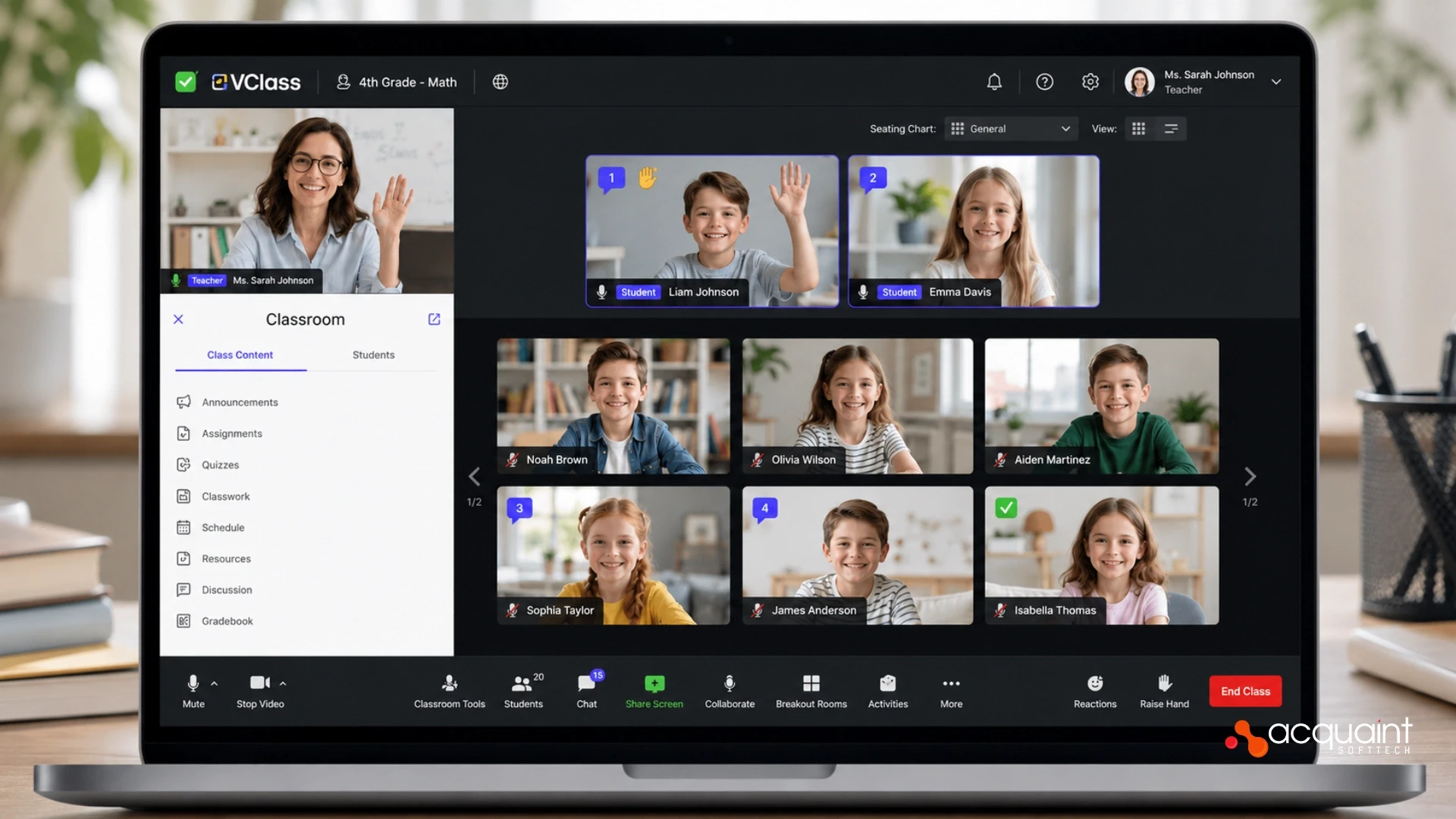
Building a Virtual Classroom Platform: Video, Whiteboard, Breakout Rooms, and Attendance Tracking
A virtual classroom is not a Zoom call with a class roster. It is a purpose-built live learning environment where video, whiteboard, breakout rooms, session recording, and attendance verification are engineered to work together as a single platform. Teams that build each feature independently spend 8 to 14 months in integration loops. Teams that design the architecture correctly from the start ship in 4 to 6 months. This guide shows you how.
Manish Patel
May 20, 2026India (Head Office)
203/204, Shapath-II, Near Silver Leaf Hotel, Opp. Rajpath Club, SG Highway, Ahmedabad-380054, Gujarat
USA
7838 Camino Cielo St, Highland, CA 92346
UK
The Powerhouse, 21 Woodthorpe Road, Ashford, England, TW15 2RP
New Zealand
42 Exler Place, Avondale, Auckland 0600, New Zealand
Canada
141 Skyview Bay NE , Calgary, Alberta, T3N 2K6