

Table of Contents
What Is The Role Of APIs In Machine-To-Machine Communication With Laravel?
Introduction
In Laravel, APIs act as the digital translator and protocol layer for machine-to-machine (M2M) communication. They let external servers, automated systems, IoT devices, and AI agents exchange data and run workflows automatically, with no human involved. Laravel provides a structured environment for building these secure, stateless, high-performance connections, which is the core of Laravel API development at Acquaint Softtech.
APIs, which stand for Application Programming Interfaces, play a very crucial role in enabling machine-to-machine interaction, serving as an important conduit through which different software systems exchange data and functionalities efficiently and securely. In a web development context using Laravel, a popular PHP framework, an API is important to facilitate M2M interaction, empowering developers to build robust, scalable web applications.
This answer looks at the role of APIs in M2M communication within Laravel, focusing on their importance, implementation, and benefits.
Why Is an API Important In M2M Communication?
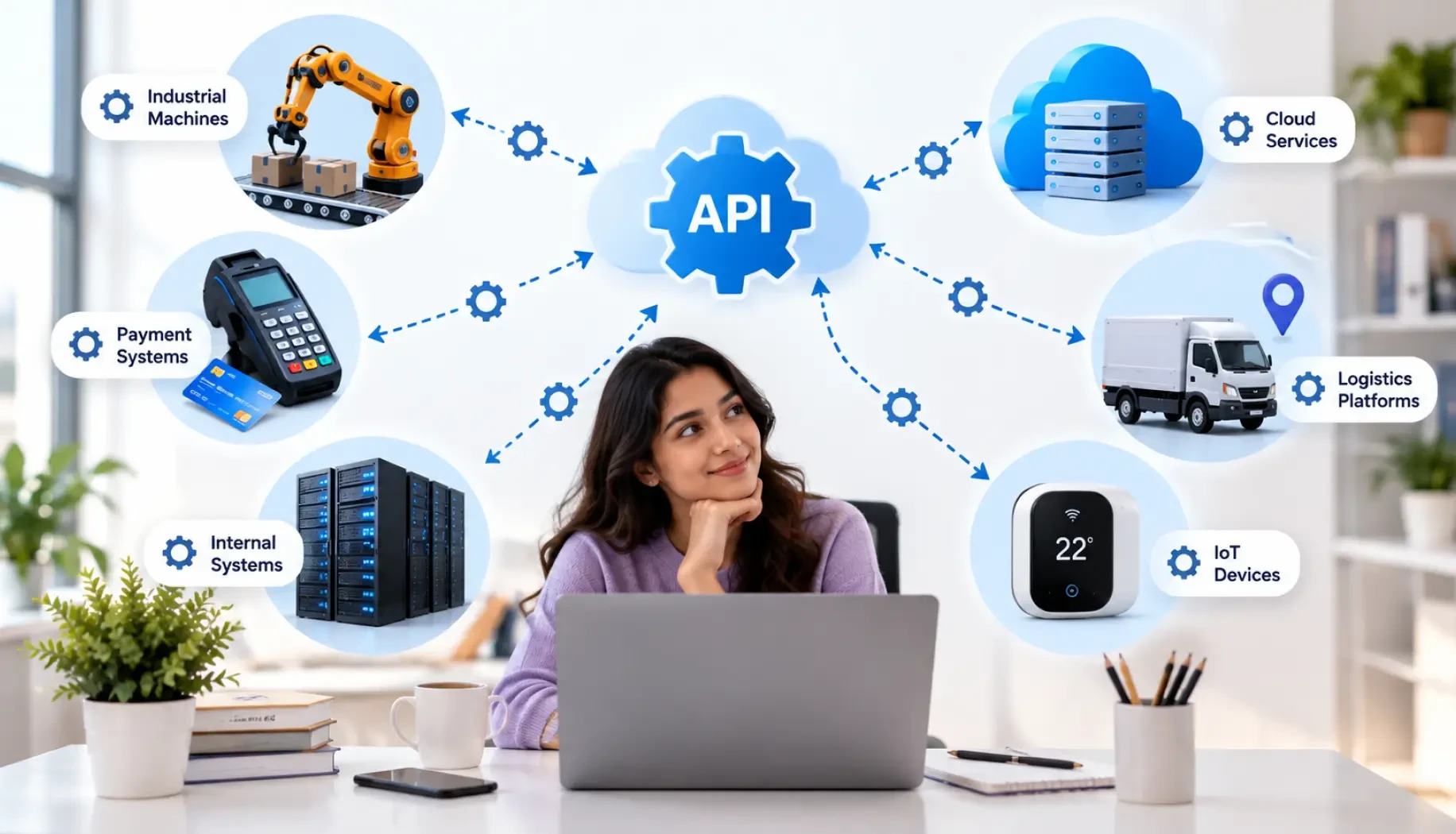
An API in Laravel is designed to enable seamless interaction between software systems without much user intervention. An API is like a common language that lets a machine, gadget, or program share information and work together, which is crucial for building a system where all parts cooperate without human help.
In Laravel, APIs are usually set up as RESTful services following the REST design approach, which creates simple, reliable, and scalable connections between devices, working well for M2M interactions. Using RESTful APIs, Laravel apps communicate smoothly with other online services, IoT devices, and outside systems, enabling practical applications like updating data automatically or monitoring and managing systems in real time.
Key Roles Of Laravel APIs In M2M
Beyond the basics, Laravel plays five specific roles in machine-to-machine communication:
Standardization via RESTful services: M2M needs strict predictability, so Laravel builds RESTful (or GraphQL) APIs using standard HTTP verbs, and Laravel API Resources act as a data transformer, turning database models into clean, uniform JSON that external machines can parse.
Machine-specific authentication: M2M uses stateless, token-based auth, not sessions and cookies. Laravel Sanctum handles fast token generation for internal services, while Laravel Passport provides a full OAuth2 server for enterprise B2B clients, as the official Laravel Sanctum documentation describes.
Rate limiting: built-in middleware throttles automated traffic, so you can cap a machine's token at a safe threshold (say, 60 requests per minute) to prevent accidental overload.
Asynchronous queue processing: for heavy payloads like bulk sync or IoT telemetry, the API returns a 202 Accepted status instantly and pushes the work to a background queue processed with tools like Laravel Horizon.
Graceful error handling and logging: on failure, Laravel returns a structured JSON error with machine-readable codes and logs the issue for audit trails and diagnostics.
How Laravel Facilitates M2M
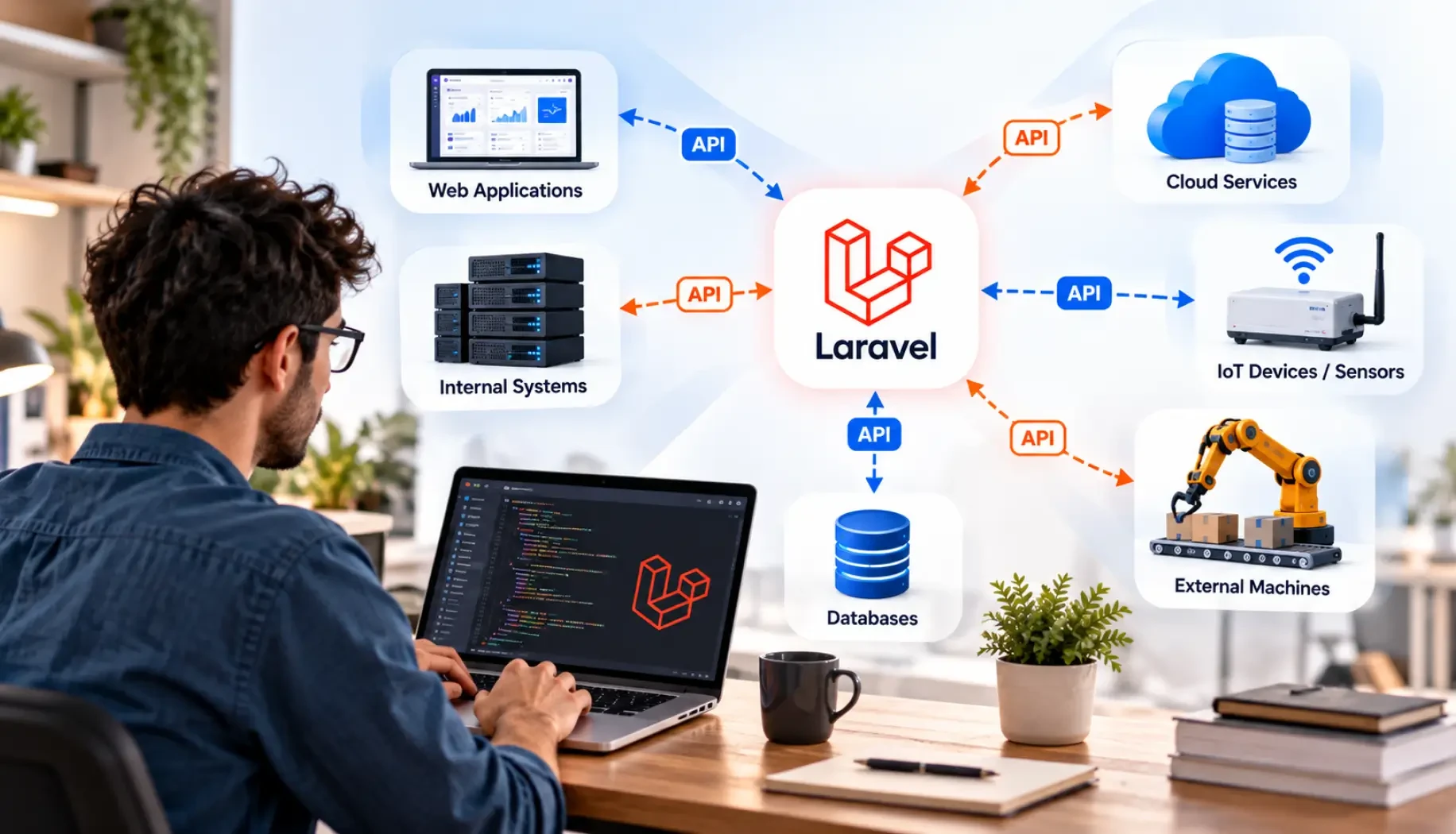
Under the hood, a few Laravel features carry most of the M2M load, and Acquaint Softtech relies on them when connecting systems through Laravel integration services:
Laravel feature | Role in M2M communication |
routes/api.php | Isolated, stateless routing that strips cookie/session bloat and prefixes endpoints with /api |
Middleware | Validates security signatures, handles CORS, and checks rate caps before processing |
Eloquent ORM | Secures database operations against SQL injection during automated mass-data updates |
API versioning | Lets you deploy updates (for example,/api/v2/) without breaking legacy machine webhooks |
How Can You Implement APIs In Laravel?
Laravel gives developers a strong set of tools to build APIs easily. You define API endpoints, the specific spots where web requests are received and processed, and middleware manages authentication, identity, and rate limiting.
A typical Laravel API setup starts by declaring a Laravel API resource route with Route::apiResource in routes/api.php, then shaping the Laravel API response with API Resources, which act as a clean wrapper around your models.
In Laravel 10 and Laravel 11, building a REST API for a new Laravel API project follows the same pattern. Laravel's ORM helps decide what data the API returns and how it looks, and it supports API tokens and OAuth2 so only allowed devices can use the API. The API-first approach behind this is explored in Laravel microservices and API-first SaaS.
Build Secure, Scalable APIs For Machine-To-Machine Communication
Acquaint Softtech builds token-secured, rate-limited Laravel APIs for IoT, AI, and B2B integrations. Book a free 30-minute consultation, no sales pitch, just honest advice.
Keeping M2M APIs Secure
Because machines hit endpoints far faster than humans, security and throttling matter more, not less. Token authentication, rate limits, CORS rules, and input validation keep automated traffic safe, as security practices for Laravel web applications explain.
What Are The Benefits Of APIs In Laravel?
Using APIs in Laravel for M2M brings several benefits. Interoperability lets different machines and systems interact and share information even with varied technologies. Automation lets machines communicate directly and complete tasks without human interference. Real-time interaction lets machines exchange and process information fast, reacting quickly to new situations.
And scalability means Laravel can manage more connections and data as needed without redesigning, thanks to its stateless, API-driven approach. These same qualities power AI-driven automation, which Acquaint Softtech builds through Laravel AI development.
What Is The Main Role Of An API?
The main role of an API is to let two software systems talk to each other. It is an intermediary with a defined contract: one program requests data or an action, and the other responds in a predictable format, without either side needing to know how the other works internally.
What Are The Four Types Of APIs?
By access level, APIs are commonly grouped into four types: public (open) APIs that anyone can use, partner APIs shared with specific business partners, internal (private) APIs used within an organisation, and composite APIs that bundle several calls into one. Most Laravel M2M work involves partner and internal APIs.
What Are The 5 Stages Of API Integration?
API integration usually moves through five stages: planning and design, building the endpoints, testing against real machine behaviour, deployment, and ongoing monitoring and maintenance. Handling this end-to-end for complex, high-volume systems is part of Laravel enterprise development.
Is Laravel Still Relevant In 2026?
Yes. Laravel 13 shipped in March 2026, and API-first, machine-to-machine use cases, mobile backends, IoT, and AI agents are among its biggest growth areas. A single Laravel mobile app backend can serve apps, devices, and partner systems at once, which keeps the framework highly relevant, and Acquaint Softtech builds exactly these backends.
Wrapping Up
An API serves as the backbone of machine-to-machine communication in Laravel, enabling different systems to interact and share data seamlessly. With its range of features, Laravel lets developers build secure, scalable, interoperable applications that pave the way for smooth M2M interactions.
To make implementation easier, rather than relying on a single freelancer or a Toptal Laravel developer, you can hire Laravel developers from Acquaint Softtech for a dedicated team that delivers seamless API integration.
India (Head Office)
203/204, Shapath-II, Near Silver Leaf Hotel, Opp. Rajpath Club, SG Highway, Ahmedabad-380054, Gujarat
USA
7838 Camino Cielo St, Highland, CA 92346
UK
The Powerhouse, 21 Woodthorpe Road, Ashford, England, TW15 2RP
New Zealand
42 Exler Place, Avondale, Auckland 0600, New Zealand
Canada
141 Skyview Bay NE , Calgary, Alberta, T3N 2K6