

7 Things to Consider Before Creating a Mobile Shopping App (2026 Guide)
Before developing a shopping app, evaluate seven core factors: target audience needs, intuitive UI/UX design, a frictionless checkout flow, robust data security, clear product navigation, strategic push notifications, and post-purchase order tracking. Get these right, and you turn browsers into buyers. In 2026, most retailers also weigh whether a native app or a Progressive Web App (PWA) fits best, since a PWA runs fast on all devices from a single codebase.

Mukesh Ram
Developing a shopping app demands an immense understanding of the market, because there are thousands of apps competing with each other. The most popular industries are fashion, lifestyle, and grocery. Investing in e-commerce can be profitable, but it needs to be well executed; otherwise, it is going to be worthless. Among the many ways to invest in e-commerce, creating a mobile application is the most profitable one, because traffic keeps shifting from websites to mobile.
As the Founder and CEO at Acquaint Softtech, a leading mobile app development company, I have helped many retailers turn a shopping idea into a profitable app for customers across the USA, UK, Europe, Australia, and New Zealand.

- You are a CEO, CTO, COO, or founder planning a mobile shopping or e-commerce app.
- You want to know how to create a mobile shopping app that actually converts.
- You run a retail business shifting from website to mobile.
- You are deciding between a native app and a Progressive Web App (PWA).
- You need real 2026 cost ranges and a clear checklist before you build.
- You want a proven partner for e-commerce app development.
People are inclined towards online shopping because it is easy, quick, and rewarding, and most users love to shop from their smartphones. The importance of mobile shopping apps grows every year, which encourages many newbie app owners to bring their ideas into the e-commerce market. Instead of building castles in the air, here is the bitter truth first: there are thousands of well-designed apps in the shopping category, so you must think about a USP that makes your app stand out.
This guide keeps the useful parts of the original article and updates everything for 2026. You will get the seven things to consider, a native-versus-PWA decision, popular platforms, real cost ranges, and verifiable proof of how we deliver.
What to Consider Before Building a Shopping App

The seven core factors fall into three groups: audience and market fit, design and usability, and performance and transactions. Here they are at a glance, so you can hold each one in mind as you read.
Audience and market fit: know your target audience, analyze competitors, and define a clear value proposition.
Design and usability: intuitive UI/UX, smooth navigation with search and filters, and simple onboarding with guest checkout.
Performance and transactions: secure checkout with trusted gateways, fast load speed, and real-time order tracking.
The 7 Things to Consider Before Creating a Shopping App
1. Ideation and Market Research
This is the most common mistake by stakeholders and newbie entrepreneurs: they refuse to brainstorm the idea, which leads to just another shopping app with no USP. Market research is crucial for any strategy, because it helps you identify the real competition and the project requirements. It also helps you find your target audience, and knowing your audience matters because they are the ones who will pay you. Plenty of audience data strengthens your marketing plan and content promotion.
There are mainly two types of users: commercial users, who intend to buy, and informational users, who come to gather resources. Optimize your idea and services for your target audience, and make sure it solves a real problem or offers something new. To determine the right audience, identify which users fit your business model, find the country and region to target, hit the right age group, and research competitor strategy and their audience.
Validating the idea before you build is exactly what our discovery workshop services are designed for, turning a rough concept into a tested plan.
2. Mobile Commerce and a Futuristic Approach
Internet traffic keeps shifting from websites to mobile apps, so dependence on mobile devices inclines shoppers to buy from their phones. "Mobile commerce," or m-commerce, simply means shopping via mobile devices. The point of watching m-commerce is to stay aware of the latest technologies and market changes, so your future app is compatible with upcoming smartphones and their UI design.
Aim for compatibility with foldable phones, notch and water-drop displays, dark mode UI, and button-less UI, and make sure the app works smoothly across different screen sizes. Social commerce is a related but different idea, giving users a marketplace experience inside a social platform.
3. Latest Mobile App UI Design Trends
Your app should reflect the latest technology and a futuristic approach, because fresh design trends make your app different and unique. Augmented Reality (AR) is widely used in shopping apps to enrich the experience and change how products are presented; brands like Amazon, Target, IKEA Place, Warby Parker, and ZeeKit use it well, and AR can be your USP.
Chatbots are another strong trend, improving user engagement with quick, relevant responses and the ability to talk to many users at once, which is why brands like Pizza Hut, Spotify, and Starbucks use them. Button-less UI, video, motion, and animation graphics round out a modern, engaging design. Businesses can also create comics to turn product ideas and promotions into engaging visual content.
Turning these trends into a polished product is where our software product development services bring design and engineering together from the first wireframe.
4. Dark Mode and Color Coding
Dark mode became a defining UI feature, and modern operating systems continue to support both system and forced dark modes. Beyond that, every shopping app should be designed around its business and audience, which makes the color palette a deciding factor.
To pick the right colors, review your business type and competitor app design, remember that each business has its own color language (a food app might use orange, red, and yellow), use white space to improve readability, and design engaging checkout and landing pages. The app UI is the first thing users notice, so getting it right builds trust immediately.
5. Choosing a Mobile App Development Company
Creating an online shopping app is challenging because of the competition, so your app must be unique in design, features, and offers. To create a masterpiece, you need a master, and a renowned development company by your side can turn your app into a profitable one.
To hire well, research the technology, process, and cost; identify your business needs and project requirements; shortlist companies that suit your project; and discuss features, process, and timeline before you commit.
Acquaint Softtech is a leading mobile app development company with deep experience in shopping apps, and our dedicated developers are experts at decoding complex ideas into profitable products. When you need to scale quickly, you can hire dedicated app developers from us, vetted and onboarded within 48 hours.
6. Easy and Robust Checkout Design
An easy, concise checkout is the key to a good customer experience, because shoppers dislike complex checkouts and abandon carts when they hit friction. Cut the unwanted steps, and pair a simple flow with a secure payment method that supports many options, since security elevates trust. New shopping apps struggle to earn trust, so add credentials like customer reviews and positive feedback near checkout. You can also use persuasive copywriting to reassure buyers, for example, telling them their checkout info is safe, that a popular item may sell out soon, or replacing a dull "Free Shipping" with "We will pay for your shipping."
Getting payment security and architecture right early is where our virtual CTO services guide founders through the high-stakes technical decisions.
7. Killer App Promotion Tactics
When your app is ready to launch, it is the right time to promote it, because building the app is only half the job. The promotion method decides how many users engage, and if your app does not reach the right audience, it will fail no matter how elegant the design. The popular promotion methods are App Store Optimization (ASO), social media marketing, content marketing and copywriting, referral programs and offers, and video, text, and carousel advertising.
A facebook management tool can also help businesses manage and schedule Facebook content more efficiently. ASO comes first: use keywords in the title and description with appealing screenshots, then build a brand and targeted audience on platforms like Facebook and Instagram. For brands focusing on Instagram, investing in audience growth can help build a stronger following around their content.
Keeping an app healthy and improving it after launch is where our support and maintenance services help, with monitoring, updates, and performance tuning.
Native App vs PWA: Which Works Best?
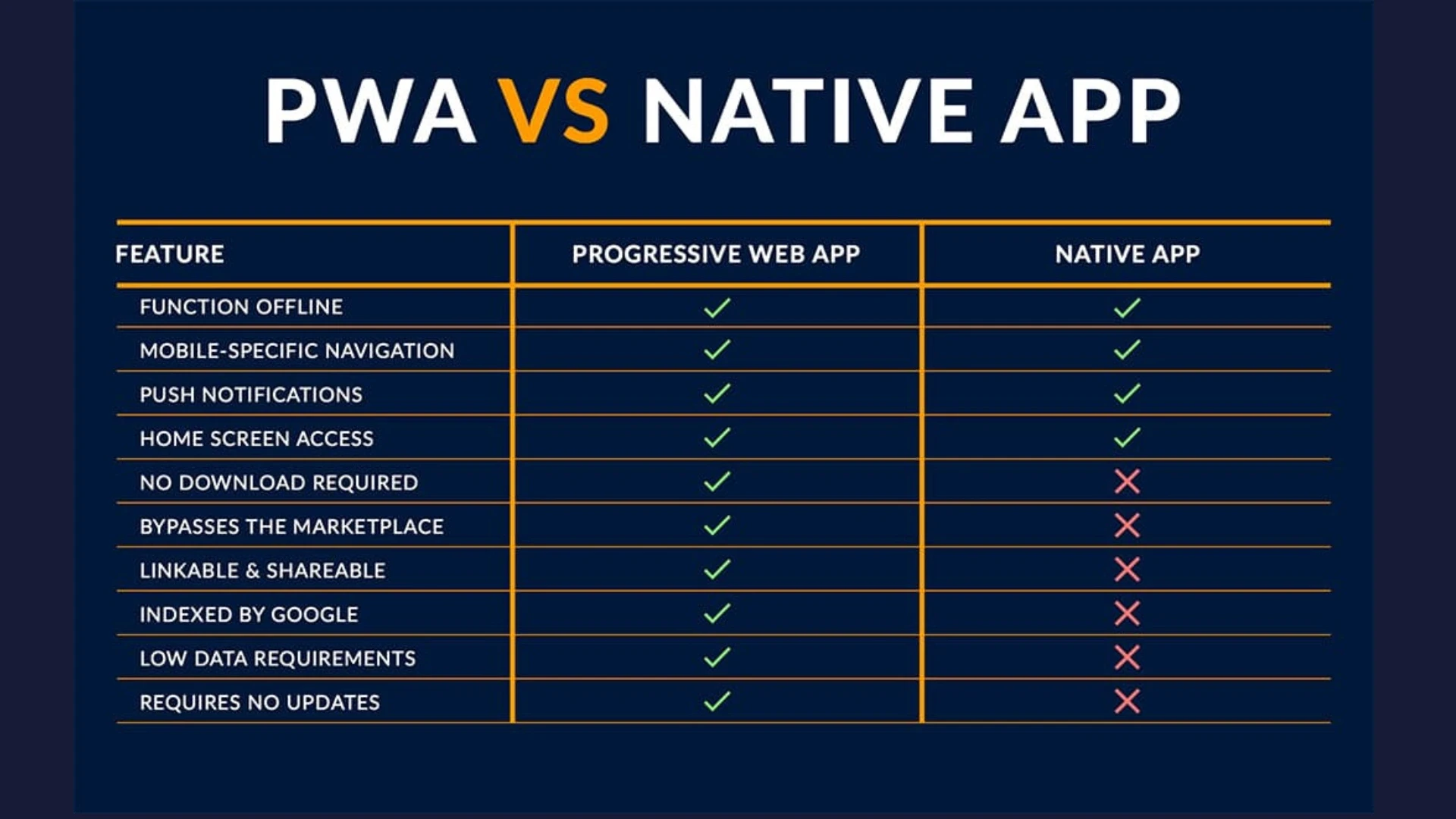
For a retailer who wants customers to shop quickly across many devices, a Progressive Web App (PWA) often works best because it runs fast on all devices from a single codebase. A native app still wins for deep device features and the richest experience, so the right choice depends on your goals. Here is the honest comparison.
Factor | PWA | Native App |
Devices | One web app for all devices | Separate iOS and Android builds |
Install | Just a web link, no store | Downloaded from app stores |
Cost | Lower (one codebase) | Higher (two codebases) |
Best for | Fast, wide-reach shopping | Deep features and richest UX |
Why a PWA works well for cross-device shopping: it runs smoothly in any browser on phones, tablets, and computers without separate downloads, uses modern caching to load pages instantly even on slow networks, offers an app-like feel with full-screen viewing and home-screen installation, and can save key data for offline browsing. For retailers, the benefits are lower cost (build and update one web app instead of three), higher reach (users click a link instead of visiting a store), and better speed, which keeps shoppers interested and reduces abandoned carts.
If a PWA fits your goals, our web application development services can build one that feels just like a native app.
Popular Ecommerce Platforms and Frameworks
The most popular platforms for shopping apps are Magento, Shopify, WooCommerce, and the Zend and Symfony frameworks. All are open-source and widely used for e-store development, and the right pick depends on your scale, budget, and customization needs.
Platform | Best For | Note |
Shopify | Fast launch, hosted | Great for smaller stores |
Magento | Large, custom stores | Powerful but heavier |
WooCommerce | WordPress-based shops | Flexible and popular |
Symfony / Zend | Custom PHP builds | Full control for developers |
For a WordPress-based store, you can hire WooCommerce developers who set up products, payments, and a smooth mobile checkout for you.
Best Online Shopping Apps in the USA
Classic examples worth studying include Amazon Shopping, eBay, OfferUp, Target, Etsy, Walmart, Zappos, Best Buy, and Zara. This list stands out for an attractive, easy UI, strong features, and clean presentation. Amazon is the ideal reference app for any mobile shopping product, crafted with an alluring UI and salient features that satisfy users, so every newbie owner should benchmark against it.
How to Create an App Like Amazon
Building an Amazon-style app follows a clear process. Start with market research and ideation, gather your tools, choose the right platform and features, then add robust search and filters, quick sign-in and easy checkout, credentials like feedback and reviews, multiple payment options, a better UI/UX, and regular updates for new features. Building a shopping cart app for iPhone is its own challenge, because the Apple audience expects a futuristic, attractive design.
For a single codebase across iOS and Android, many retailers hire React Native developers to ship faster and cut overall build cost.
How Much Does It Cost to Develop a Shopping App?

A shopping app usually costs about $15,000 for a simple MVP, $30,000 to $80,000 for a mid-complexity app, and $100,000+ for a large marketplace.
At Acquaint Softtech, fixed-scope project development starts from $5,000, with a focus on delivering high-quality development within the agreed scope. The final cost depends on features, authentication, payment methods, data security, platforms, backend development, and QA, while developer location and hourly rates can also significantly affect the budget.
App Type | Estimated Cost (2026) | Typical Timeline |
Simple MVP | $15,000 - $30,000 | 6 - 12 weeks |
Mid-complexity app | $30,000 - $80,000 | 3 - 5 months |
Large marketplace | $100,000+ | 6 - 9 months |
These ranges align with our public pricing. Verified Clutch data shows typical project costs around $12,000 to $13,000 for smaller builds and near $100,000 for larger clients. You can lower costs without lowering quality by outsourcing software development to a vetted team instead of hiring locally.
Want a feature-based estimate for your shopping app?
Tell Acquaint Softtech your features and target platforms, and we will scope the build, timeline, and cost within 48 hours, so you can plan with real numbers.
Case Study: Building for Trust and Scale
A shopping app must handle secure transactions, real-time data, and scale without breaking, which is exactly the kind of build Acquaint Softtech delivers. For one client, our team built native iOS and Android apps for a live, real-time business handling instant interactions and secure in-app purchases for a global user base- the same demands a busy shopping app places on a system. This account is drawn from the client's verified Clutch review.
Client | A global business needing secure, real-time mobile apps on iOS and Android. |
What we built | Cross-platform apps with secure in-app purchases, real-time updates, and a clean, responsive UI. |
Shopping relevance | The same engineering behind a strong shopping app: secure payments, real-time data, and scale. |
Client feedback | The team "surpassed expectations, both in terms of quality and speed," with responsiveness that set them apart. |
Delivery | A dedicated team with a transparent, proactive process and ongoing support after launch. |
Company-wide proof: Acquaint Softtech has delivered 1,300+ projects over 13+ years with 70+ in-house engineers and a 5-star Clutch rating across 60+ reviews, as an Official Laravel Partner.
You can explore more e-commerce, fintech, and SaaS builds on the Acquaint Softtech case studies page.
Why Choose Acquaint Softtech for Your Shopping App
Choose a partner with public proof, an in-house team, and e-commerce experience, and Acquaint Softtech offers all three. Most clients save 60 to 75% versus hiring equivalent talent in the US, UK, or Australia, without cutting quality.
If you already have a team and only need extra specialists, our IT staff augmentation services let you add vetted engineers to your project within 48 hours.
Verified trust: 5-star Clutch rating across 60+ reviews and 1,300+ delivered projects.
In-house talent: 70+ full-time engineers, deployable within 48 hours, not a freelancer marketplace.
Global reach: serving founders across the USA, UK, Europe, Australia, and New Zealand.
E-commerce depth: secure checkout, PWA or native, and scale built in from day one.
To Sum Up
The process for building a mobile shopping app is clear once you respect the seven things that matter: research and ideation, a futuristic m-commerce approach, modern UI trends, thoughtful color and dark mode, the right development partner, an easy and secure checkout, and strong promotion. Get these right, and you turn a crowded category into a real opportunity.
If you want to build a shopping app that is fast, secure, and profitable, that is exactly the kind of project the team at Acquaint Softtech enjoys. Share your idea, and we will help you scope and build it well.
Ready to build a shopping app customers love?
Talk directly with Acquaint Softtech's founder in a free 30-minute session. You will leave with a clear scope, a realistic budget, a native-or-PWA recommendation, and honest advice on what will make your store convert.
Frequently Asked Questions
-
What are the 7 steps to creating an app?
Plan and research your idea, define the audience and features, design the UI/UX, develop the frontend and backend, test thoroughly, deploy to the app stores or web, then maintain with updates. For a shopping app, add secure checkout and order tracking as core steps.
-
What are some important things to consider before developing an app?
Consider your target audience, a clear value proposition, intuitive UI/UX, a frictionless checkout, strong data security, the right platform (native or PWA), a realistic budget, and a plan for promotion and post-launch support.
-
Can ChatGPT build me an app?
ChatGPT can help write code, explain concepts, and prototype small pieces, but it cannot deliver a complete, secure, production-ready shopping app on its own. Real apps need architecture, security, testing, payments, and maintenance, which a professional team provides.
-
What are the requirements of developing an app?
You need a clear idea and audience, UI/UX designs, a tech stack (native or cross-platform), backend and APIs, secure payment integration, testing across devices, app store or web deployment, and ongoing maintenance.
-
An online retailer wants customers to shop quickly across many devices. What app type works best?
A Progressive Web App (PWA) usually works best, because it runs fast on all devices from a single codebase, needs no app-store download, and offers an app-like, offline-capable experience through the browser.
-
Do many productivity and shopping web apps support real-time collaboration?
Many modern web apps do support real-time features, such as live inventory, shared carts, and instant updates, using technologies like WebSockets. For shopping, real-time order tracking and stock updates improve trust and reduce abandoned carts.
-
How much does it cost to develop a shopping app?
Roughly $15,000 for a simple MVP, $30,000 to $80,000 for a mid-complexity app, and $100,000+ for a marketplace. Cost depends on features, payment methods, security, platforms, and the development region.
-
How do free shopping apps make money?
Through sponsored products, in-app ads (text, video, carousel), commissions from a marketplace of multiple sellers, and premium features. Many stores also use the app to drive repeat purchases and loyalty.
I love to make a difference. Thus, I started Acquaint Softtech with the vision of making developers easily accessible and affordable to all. Me and my beloved team have been fulfilling this vision for over 15 years now and will continue to get even bigger and better.
Table of Contents
Get Started with Acquaint Softtech
- 13+ Years Delivering Software Excellence
- 1300+ Projects Delivered With Precision
- Official Laravel & Laravel News Partner
- Official Statamic Partner
Related Blog
10 Must Follow Steps of Mobile App Development Process
The mobile app development process is a structured set of 10 steps that moves an idea from concept to a published app: ideation, target audience and monetization, choosing the platform, UI/UX design, picking tools, choosing the right partner, fast development, testing and deployment, marketing, and post-launch maintenance. Following the steps in order, rather than rushing to publish, is what separates apps that get downloads from the ones that get ignored.
Mukesh Ram
July 29, 2019.webp "Why Choosing the Right App Category Is a Game-Changer for a Successful Mobile Application")
Why Choosing the Right App Category Is a Game-Changer for a Successful Mobile Application
Mobile app categories are official groupings used by app stores like the Apple App Store and Google Play to classify software by its core purpose, target audience, and primary function: Social Networking, Productivity, Entertainment, Gaming, Health & Fitness, Finance, Shopping, Travel, Education, and Lifestyle & Utilities.
Mukesh Ram
August 27, 2019
The Best Flutter App Development Company For Your Dream Project
The best Flutter app development company depends on your project goals, but the top-rated partners all share three traits: a real portfolio of published Flutter apps, clean state management (BLoC, Provider, or Riverpod), and full lifecycle support from UI design to backend sync and CI/CD. In 2026, Flutter holds roughly 46% of the cross-platform developer market, so choosing a proven team, not the first Google result, is what protects your budget and timeline.
Mukesh Ram
July 5, 2019India (Head Office)
203/204, Shapath-II, Near Silver Leaf Hotel, Opp. Rajpath Club, SG Highway, Ahmedabad-380054, Gujarat
USA
7838 Camino Cielo St, Highland, CA 92346
UK
The Powerhouse, 21 Woodthorpe Road, Ashford, England, TW15 2RP
New Zealand
42 Exler Place, Avondale, Auckland 0600, New Zealand
Canada
141 Skyview Bay NE , Calgary, Alberta, T3N 2K6