

Building a Rate Parity Monitoring Tool: Tracking Pricing Across OTAs and Direct Channels
Rate parity monitoring is the automated process of tracking and comparing room prices across a hotel's direct website, Online Travel Agencies (OTAs), and wholesalers to detect unauthorized price undercutting. A monitoring tool crawls booking channels, normalizes identical room and stay conditions, then alerts revenue teams the moment a channel breaks agreed pricing.

Sanjay Prajapati
As Head of Business at Acquaint Softtech, I have seen hotels lose more margin to quiet rate leakage than to any marketing mistake, which is why we treat a rate parity tool as serious software product development, not a spreadsheet chore. When an OTA or a wholesaler undercuts your direct price, every booking that follows costs you commission you did not have to pay.
This is a build article, not a definition post. Most articles on this topic explain what rate parity is, then sell you a monitoring subscription. This one explains how to engineer the tool: the crawling, the normalization, the alerting, and the reports, so a technical team can build an OTA pricing tracker they own.

- A hotel or group leader watching direct bookings leak to cheaper third-party channels.
- A CTO scoping a rate parity monitoring tool with crawling, normalization, and alerts.
- A product owner weighing scraping vs API for rate monitoring and reporting.
- A revenue leader who needs price consistency across channels and clear disparity evidence.
- A team deciding whether to buy a parity checker or build a custom parity tracker.
For where this fits in the bigger picture, our complete guide to travel and hospitality software development maps how monitoring sits alongside booking, pricing, and distribution systems. Parity monitoring is the watchdog over all of them.
For the pricing engine this monitors, our guide on AI and data analytics in travel covers demand forecasting and price optimization. Here we focus on tracking whether those prices hold across channels.
What is rate parity for hotels?
Rate parity for hotels is the practice of showing the same price for the same room, stay dates, and conditions across every channel, from a hotel's direct site to OTAs like Booking.com and Expedia. Rate disparity is when those prices diverge.
Parity matters because a guest who sees a lower price on an OTA has no reason to book direct, and every OTA booking carries a commission that direct bookings do not. Rate parity in the hotel industry has long been shaped by OTA contract clauses, though those rules are now changing in Europe.
A parity monitoring tool is how a hotel keeps score. Building one well is a data-engineering problem, which is why teams hire Python developers who have built reliable crawling and normalization systems rather than brittle one-off scripts. Acquaint Softtech builds parity tools so the comparison logic holds up as channels change their pages.
How rate parity tracking works
Rate parity tracking works in three stages: automated web crawling of booking channels, data normalization so comparisons are fair, and discrepancy alerts the moment a channel breaks agreed pricing.
How rate parity tracking works
Automated web crawling: systems use bots to scan major booking channels (like Booking.com or Expedia) in real time.
Data normalization: software matches identical room categories, stay dates, occupancy levels, cancellation rules, and taxes to create accurate comparisons.
Discrepancy alerts: revenue teams receive instant notifications whenever an OTA or third-party bed bank breaks agreed-upon pricing limits.
Normalization is the part most teams underestimate. A raw price means nothing until you match room type, dates, occupancy, cancellation policy, and tax treatment, so building that matching logic is where teams hire AI/ML engineers to resolve fuzzy room-name matching across channels.
Why hotels monitor pricing
Hotels monitor pricing to protect direct bookings, enforce wholesaler contracts, maintain brand trust, and reduce commission loss. In short, parity monitoring defends both margin and reputation.
Protect direct bookings: prevents third-party channels from stealing direct traffic by displaying cheaper rates.
Enforce contracts: helps identify which specific wholesaler leaks discounted inventory to unauthorized secondary sites.
Maintain brand trust: ensures customers see fair, consistent pricing no matter where they search.
Reduce commission loss: minimizes costly OTA commission payouts caused by accidental or intentional price drops.
Those commissions are not small. OTA commissions typically run 15 to 30 percent per booking, so a single leaking channel can quietly move thousands in revenue off your direct site. Acquaint Softtech builds monitoring so that leak is visible within minutes, not at month-end.
Rate parity vs rate flexibility
Rate parity means the same price everywhere; rate flexibility means deliberately varying price by channel, region, or member status. The two are not opposites. Good monitoring tells intended flexibility apart from accidental disparity.
A hotel may legitimately offer a lower member-only or mobile rate, which is flexibility, not a violation. The tool's job is to encode your rules so it flags only unauthorized gaps, not the discounts you chose. This distinction is the difference between a useful alert and constant noise.
Encoding those rules cleanly is a product-design task before it is a coding one, which is why a product discovery workshop pays for itself early. Teams then often hire Django developers to turn those rules into a stable rules engine and API.
How to detect rate violations
To detect rate violations, compare each channel's normalized price against your direct rate for the same room and stay, apply a tolerance threshold, and flag anything cheaper than allowed. Add geo checks and test bookings to trace the source.
A violation is not simply a lower number; it is a lower number after normalization and after your allowed tolerance. Prices can also differ by country, so a parity monitoring OTA pricing tracking hotel reviews process should check rates from several geographies, because wholesalers often leak rates that only appear in certain regions.
When a gap appears, a test booking traced through your central reservation system often reveals which wholesaler leaked the rate. Automating that evidence trail is where teams hire automation engineers to keep the detection reliable under real traffic.
How to build a rate parity tool, step by step
To build a rate parity tool, collect rates, normalize them, compare against rules, alert, and report. Here is the build in six steps.
Collect rates. Crawl or call channel APIs for your property across the room types, dates, and geographies you care about.
Normalize the data. Match room category, occupancy, cancellation policy, and taxes so every comparison is like-for-like.
Store a rate history. Keep a time-stamped record of every observed rate so patterns and repeat offenders are visible.
Apply the rules engine. Compare each channel against your direct rate and tolerance, separating allowed flexibility from real violations.
Alert the team. Send instant notifications with the channel, room, date, and gap so revenue can act fast.
Generate reports. Produce automated parity reports by channel, market, and offender for management and OTA conversations.
The normalization and matching layer is where most builds succeed or fail, so it is worth real AI development services attention rather than a quick string match.
Many groups hire remote developers to build the crawling and pipeline while their revenue team owns the thresholds and reporting. For a build that spans months, a dedicated software development team keeps it consistent from first crawl to full dashboard.
Torn between scraping and paying for rate data?
Choose wrong, and you either fight constant crawler breakage or overpay for data you could source yourself. We map your channels, volumes, and budget to the right approach, scraping, official APIs, or a hybrid, with a fixed scope, clear milestones, and IP that is yours from day one. You interview the engineers before you commit.
Scraping vs API for rate monitoring
Not covered well by competitors: scraping vs API is the core build decision. APIs and paid rate feeds are stable but limited and priced per query; scraping is flexible and cheap at small scale but brittle, and must respect each site's terms and the law.
Approach | Best for | Trade-off |
Official channel APIs | Your own inventory, reliable data | Limited to channels that expose an API |
Paid rate-shopping feed | Broad OTA coverage, low maintenance | Recurring cost that scales with volume |
Custom crawling | Coverage a feed misses, tight budgets | Breaks on site changes; legal and terms care needed |
Hybrid | Most real deployments | More moving parts to maintain |
Most production tools end up hybrid: an API or feed for breadth, targeted crawling for gaps. Keeping crawlers alive as sites change is ongoing work, so teams hire DevOps engineers to run the schedulers, proxies, and monitoring that keep collection healthy. Acquaint Softtech treats crawler uptime as a product metric, because a dead crawler means silent, undetected disparity.
Rate disparity alerting and automated reports
A rate disparity alerting system turns raw price gaps into action: instant alerts when a channel breaks tolerance, and automated parity report generation that shows patterns and repeat offenders over time.
Good alerting is precise, not noisy. It names the channel, room, dates, and size of the gap, and it respects your flexibility rules so the team trusts it. Over time, a rate parity monitoring OTA pricing tracking hotel PDF export gives revenue managers evidence to take back to a wholesaler or OTA.
The reporting layer is also the interface executives actually read, so it deserves a clean front end. Teams often hire MEAN stack developers to build dashboards, and hire MERN stack developers when the same reports must feel instant in a React interface.
Rate parity tool tech stack
A dependable rate parity stack pairs Python for crawling and normalization with a time-series-friendly database, a scheduler, an alerting service, and a reporting front end.
Layer | Common choice | Why |
Collection | Python crawlers or API clients | Gather rates across channels |
Normalization | Python matching logic | Fair, like-for-like comparisons |
Database | PostgreSQL | Rate history and audit trail |
Scheduler | Airflow or a job queue | Repeatable crawl and compare jobs |
Alerting | Email, Slack, or webhooks | Instant disparity notifications |
Front end | React or Angular | Dashboards and parity reports |
Where a parity feed connects into an existing channel manager, that integration must stay current as partner APIs change, so ongoing version upgrade services keep the connectors from silently breaking.
Is rate parity still required? The legal picture
Rate parity is no longer contractually enforceable in the European Economic Area. Since November 2024, under the EU Digital Markets Act, Booking.com cannot impose parity clauses, so hotels there can price differently across channels. Rules differ by market, so monitoring still matters everywhere.
The European Commission confirmed that, as a designated gatekeeper, Booking must comply with the Digital Markets Act, which prohibits parity clauses across the EEA. In practice, that frees hotels to undercut the platform on their own site, but it makes monitoring more important, not less, because you now need to see where you can compete.
In the UK, the picture is shaped by the Competition and Markets Authority's monitoring of OTA pricing practices, where wide parity clauses have been challenged for years. Because rules vary by country and change over time, a monitoring tool that captures geo-based rates is how a group stays both compliant and competitive. For teams that want a senior architect to set that approach, virtual CTO services provide that experience before the first sprint.
Rate parity tool cost by market
Rate parity tool cost depends on channel coverage, geographies, and whether you crawl or buy data. A single-property monitor is far cheaper than a portfolio tool with geo checks, alerting, and reporting.
The ranges below are 2026 planning estimates at local agency rates, not fixed quotes. Offshore delivery from India typically lands well below these numbers.
Target market | Single-property monitor | Portfolio parity platform |
United States / New York | $18,000 to $40,000 | $60,000 to $150,000+ |
United Kingdom | GBP 14,000 to 32,000 | GBP 48,000 to 120,000+ |
Europe (EU) | EUR 16,000 to 36,000 | EUR 54,000 to 135,000+ |
Australia | AUD 28,000 to 60,000 | AUD 90,000 to 225,000+ |
New Zealand | NZD 30,000 to 64,000 | NZD 96,000 to 240,000+ |
The biggest lever is engineering rate, not the feature list, which is why many teams add IT staff augmentation from India to build the same tool at a fraction of local cost.
Real case study: an automated data-extraction and alerting pipeline
No two builds are identical, but the closest documented parallel from our own work is Hybopay Finance, a fintech lender for which Acquaint Softtech built an automated pipeline that ingests documents, extracts and normalizes structured data, and flags anything outside the threshold for human review. Swap documents for OTA rates, and that is precisely a rate parity monitoring architecture: ingest, normalize, and alert on discrepancies.
Proof of work at a glance
Question | Answer |
Who was the client? | Hybopay Finance Ltd, a Dublin-based fintech lender (CEO Gerhard Drobits), Clutch verified at 5.0 / 5.0. |
What did they need? | High-volume documents parsed, normalized, and validated fast, with errors caught before they reached scoring. |
What was the hard part? | Pushing automation as far as possible without relaxing accuracy, and isolating only the entries that truly needed a human. |
How did Acquaint Softtech solve it? | A scalable ingestion pipeline plus an asynchronous exception-handling layer that pauses low-confidence items into a review console while everything else keeps moving. |
What did it deliver? | Documents parsed within moments of arrival, data-entry errors effectively eliminated, every milestone hit on time. |
Why it maps to parity monitoring | Ingest, normalize, threshold, alert, and human review are the same building blocks a parity tool needs to flag rate violations reliably. |
Why teams struggle, and what to check before you hire
Most parity tools do not fail at the dashboard. They fail at normalization and freshness, where a mismatched room type or a stale crawl produces false alerts that teams learn to ignore, which is worse than no tool at all.
Before you commit to a partner for a parity monitoring build, check for these:
Do they normalize room type, occupancy, cancellation, and tax before comparing, not just match prices?
Do they separate intended rate flexibility from real violations, so alerts stay trustworthy?
Do they capture geo-based rates to catch region-specific leakage?
Do they have verifiable data-pipeline and alerting delivery experience?
That last point is where track record matters. Acquaint Softtech has delivered 1,300 or more projects over 13 or more years with 70 or more in-house engineers and 50 or more Clutch reviews, and can deploy vetted developers within 48 hours. After launch, channels and page structures change constantly, so ongoing support and maintenance services keep crawlers, normalization, and alerts accurate.
Not sure if you need a parity checker or a custom tool?
The wrong call here costs either monthly fees for coverage you do not need or a stalled custom build. Share your channels, geographies, and volumes, and we will give you a straight read on whether an off-the-shelf checker, a lean monitor, or a full custom parity tool fits, with the scope and cost to match. No sales pitch, just honest engineering advice.
Frequently Asked Questions
-
What is rate parity for hotels?
Rate parity is showing the same price for the same room, dates, and conditions across all channels, from a hotel's direct site to OTAs like Booking.com and Expedia. Rate disparity is when those prices diverge, often because a wholesaler or OTA undercuts the direct rate.
-
How do you monitor pricing across OTAs?
Crawl or call each channel for your property, normalize room type, dates, occupancy, cancellation, and taxes so comparisons are fair, store a rate history, then compare each channel against your direct rate and alert when one breaks your tolerance. Add geo checks for region-specific leaks.
-
What is the difference between rate parity and rate flexibility?
Rate parity means the same price everywhere; rate flexibility means deliberately varying price by channel, region, or member status. Good monitoring encodes your flexibility rules so it flags only unauthorized gaps, not the discounts you chose to offer.
-
How do you detect rate violations?
Compare each channel's normalized price against your direct rate for the same room and stay, apply a tolerance threshold, and flag anything cheaper than allowed. Check several geographies, and use a test booking traced through your reservation system to find which wholesaler leaked the rate.
-
What is the 15-5 rule in hotels?
The 15-5 rule is a guest-service standard, popularized by Marriott, where staff acknowledges a guest within 15 feet and greets them verbally within 5 feet. It is about hospitality etiquette and is unrelated to rate parity or pricing across channels.
-
Is rate parity still legally required?
It varies by market. In the EEA, the EU Digital Markets Act stopped Booking.com from enforcing parity clauses from November 2024, so hotels there can price differently across channels. Elsewhere, contractual or narrow parity terms may still apply, so monitoring remains important everywhere.
-
Scraping or an API: which is better for rate monitoring?
APIs and paid rate feeds are stable and low-maintenance but limited and priced per query; custom scraping is flexible and cheap at small scale but brittle and must respect each site's terms and the law. Most production tools are hybrid: a feed for breadth, targeted crawling for gaps.
I am Sanjay Parjapati, a developer at heart and a Head of business by work. My journey started with coding and helped me grow towards becoming a head of business which led me to focus on dual skills, i.e. technical know-hows and the business know-hows. My journey of 10+ years has helped me grow immensely from a professional viewpoint.
Table of Contents
Get Started with Acquaint Softtech
- 13+ Years Delivering Software Excellence
- 1300+ Projects Delivered With Precision
- Official Laravel & Laravel News Partner
- Official Statamic Partner
Related Blog
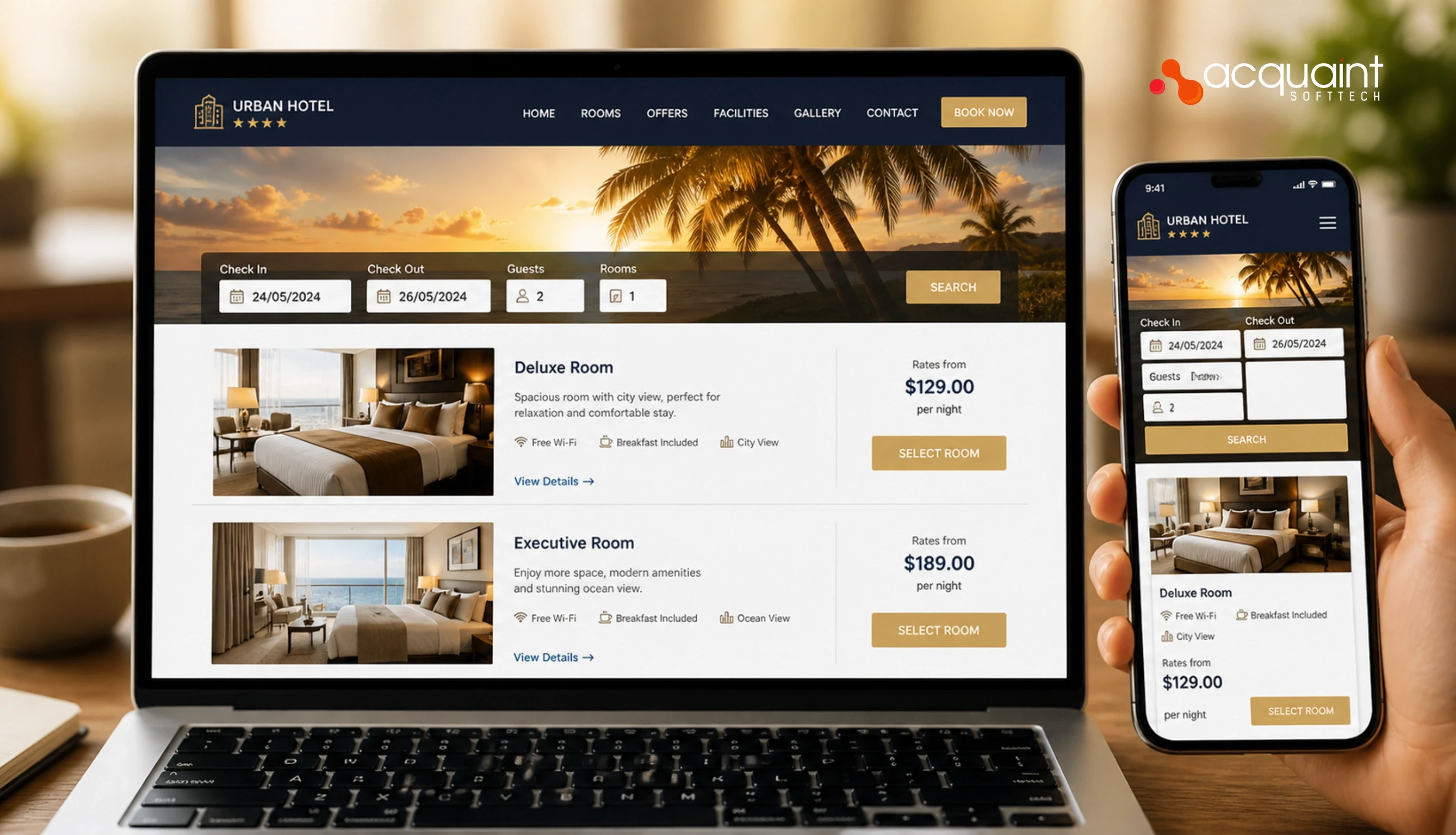
How Hotel Booking Engines Work: Search, Availability, Pricing, and Reservation Architecture
A hotel booking engine is not a search bar. It is an availability engine, a pricing decision system, a payment pre-authorisation layer, and a channel inventory synchroniser, all running simultaneously. This guide explains every architectural layer and how each one connects in a production system.

Manish Patel
May 12, 2026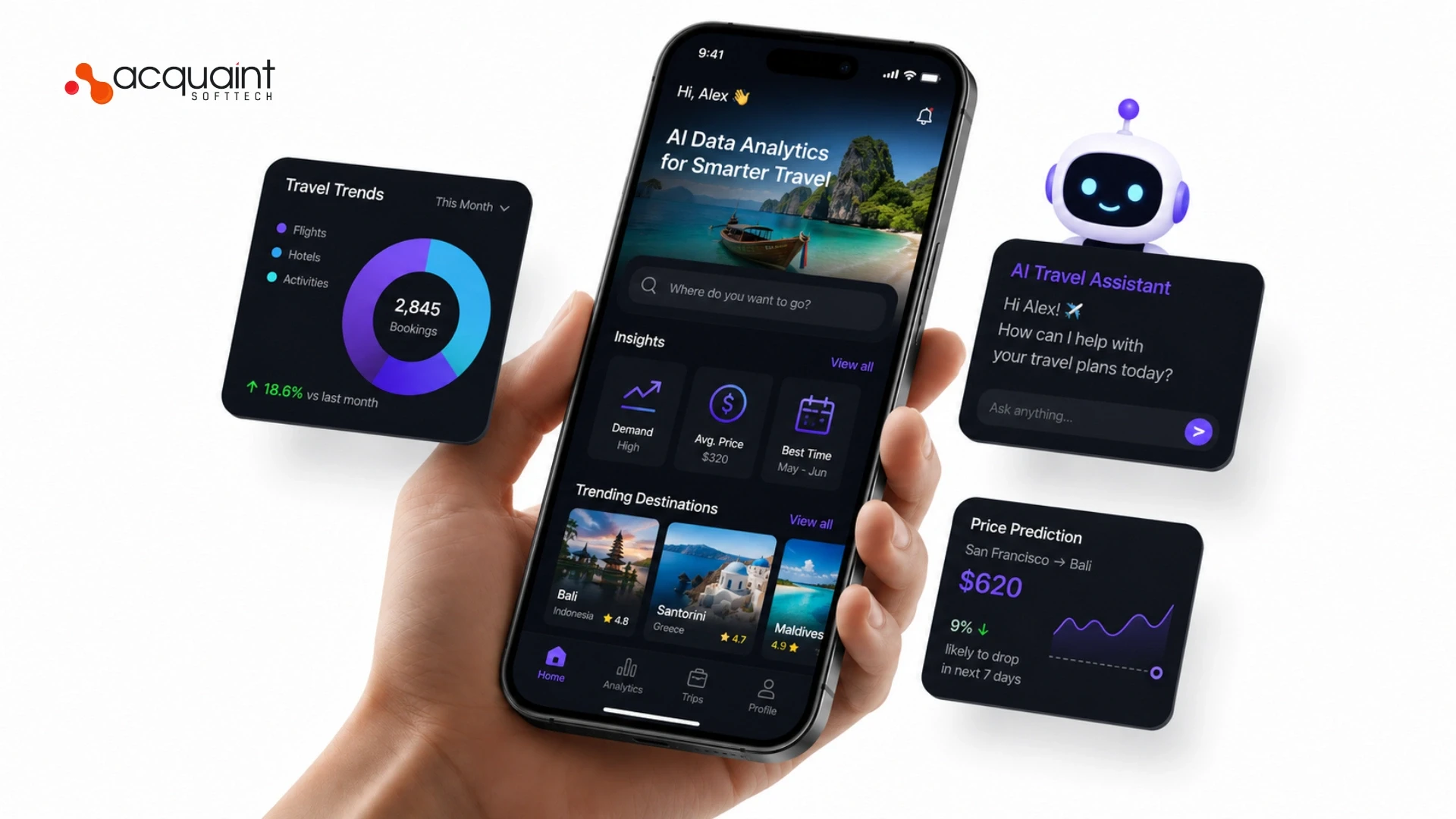
AI and Data Analytics in Travel: Demand Forecasting, Price Optimization, and Customer Intelligence
AI and data analytics in travel use machine learning to turn booking, search, and customer data into revenue. The three core engines are demand forecasting, which predicts future occupancy and bookings; price optimization, which sets the best price in real time based on demand; and customer intelligence, which identifies high-value travellers and predicts who will book or cancel. Hotels using AI-driven pricing report revenue gains of 5 to 14%.
Manish Patel
June 29, 2026
How to Build an OTA: Online Travel Agency Architecture for Flight, Hotel & Package Booking
Most OTA builds fail not on the booking logic but on the integration layer. Here is the complete architecture map, GDS, hotel aggregation, package bundling, payments, and what each module actually costs to build in 2026.
Manish Patel
May 27, 2026India (Head Office)
203/204, Shapath-II, Near Silver Leaf Hotel, Opp. Rajpath Club, SG Highway, Ahmedabad-380054, Gujarat
USA
7838 Camino Cielo St, Highland, CA 92346
UK
The Powerhouse, 21 Woodthorpe Road, Ashford, England, TW15 2RP
New Zealand
42 Exler Place, Avondale, Auckland 0600, New Zealand
Canada
141 Skyview Bay NE , Calgary, Alberta, T3N 2K6