

E-Commerce Checkout Payment Optimization: Building High-Converting Payment Flows
A checkout flow is not a UX project. It is an engineering system where every field, every API call, every gateway response path either recovers revenue or loses it. This article explains what conversion-optimised checkout engineering looks like in code, what it costs to build, and the 7 friction points your current checkout probably has right now.

Manish Patel
As Head of Tech and Client Success at Acquaint Softtech, a software product development company with 1,300+ projects delivered across 13+ years, I audit checkout and payment flows for e-commerce clients every month. The pattern is consistent: most checkout problems are not design problems. They are engineering problems. A forced account creation step is a session model decision. An unexpected delivery cost appearing at step 3 is a backend calculation timing decision.
A payment soft decline with no retry path is an error-handling architecture decision. Every one of these engineering decisions has a direct, quantifiable conversion impact. This article on e-commerce checkout payment optimization gives you the full engineering blueprint: the friction audit framework, the architecture of a conversion-optimised checkout, the payment gateway decision framework, and the cost to build it in 2026.

- Developers building or optimizing eCommerce checkout systems.
- CTOs and engineering leads are improving checkout conversion performance.
- D2C founders are fixing high cart abandonment with technical solutions.
- Product managers and agencies scoping checkout rebuilds or optimization projects.
Problem: Your checkout converts at less than 60% of sessions that reach it. The industry median, according to Baymard Institute's 2025 checkout usability study, is 69.82% cart abandonment across all e-commerce. A business at $3M GMV converting at 60% instead of 75% is losing approximately $750,000 in recoverable revenue per year, not to competition, but to a checkout that its own engineering team built.
Agitate: The most common response to low checkout conversion is a UX audit and a redesign sprint. The most common outcome of that sprint is a marginally nicer-looking checkout that converts at the same rate. That is because the friction is not in the colours or the button copy. It is in the session model, the shipping calculation timing, the payment flow design, the adapter error paths, and the fraud rules that decline recoverable transactions.
Solution: This guide gives you the engineering-level diagnosis and the implementation blueprint. Acquaint Softtech has built and audited checkout and payment flows for clients across the US, UK, Australia, and UAE. The conversion data and cost figures in this article come from that delivery data.
Checkout engineering is the highest-leverage technical work in e-commerce. A 5% improvement in checkout conversion rate at $3M GMV is worth $150,000 in additional revenue per year without increasing traffic or marketing spend. The work required to achieve that improvement is not a redesign.
It is a specific set of engineering changes: eliminating forced registration, implementing address autocomplete, embedding the payment element natively, building a retry path for soft declines, and moving shipping calculation to the cart stage rather than the checkout stage. Each of these is a 1 to 3 sprint engineering task. The complete guide to e-commerce and D2C software development covers the full platform architecture landscape. This article focuses specifically on the checkout and payment engineering layer.
The checkout module sits inside a larger commerce platform. How it connects to the cart, pricing engine, and order management system is covered in the custom e-commerce platform architecture guide. This article treats the checkout module as its own engineering domain and goes deep on conversion optimisation, payment gateway architecture, and abandonment recovery.
The Revenue Cost of a Broken Checkout: What the Data Shows
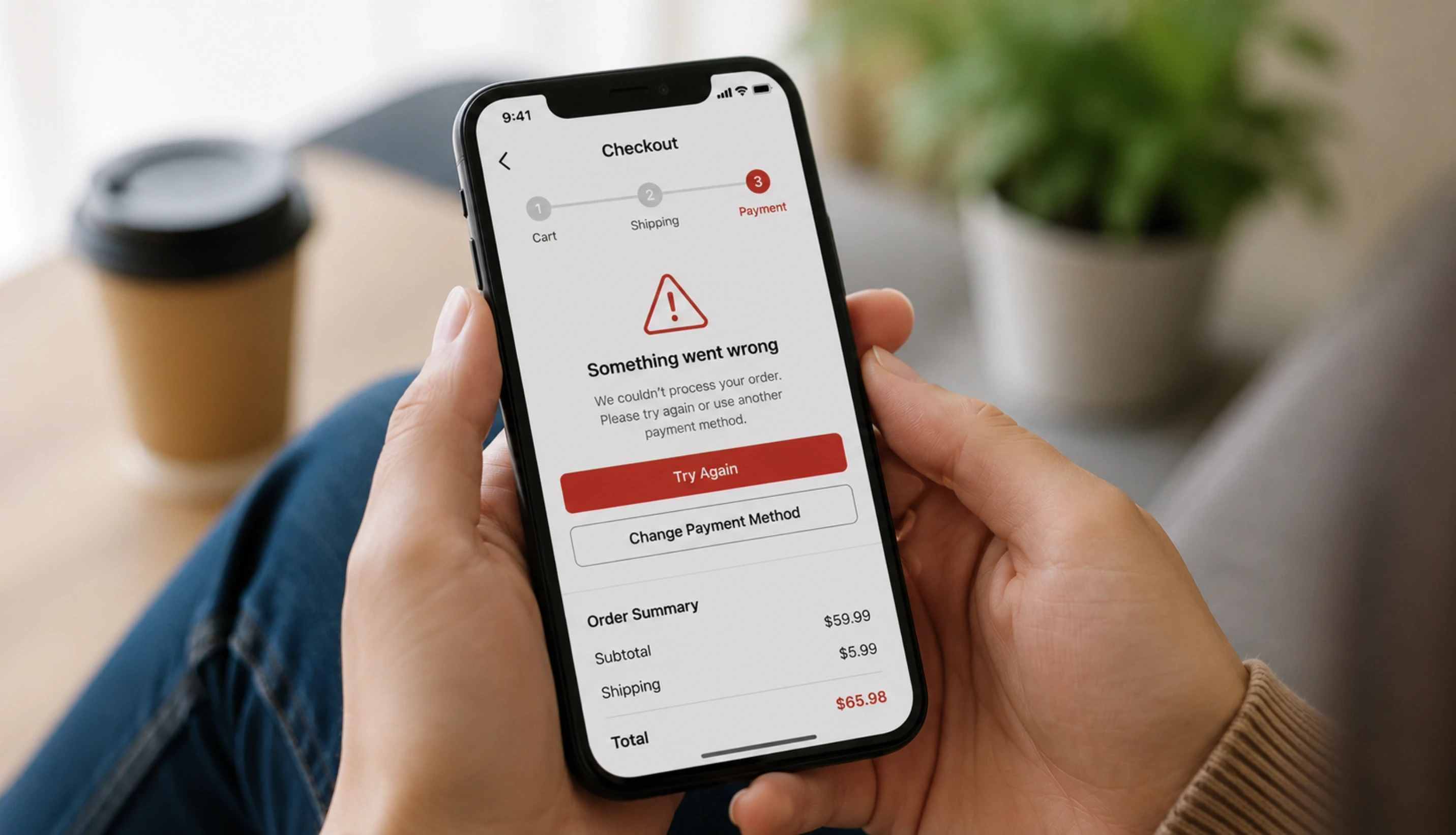
Before examining architecture, the business case must be precise. Checkout abandonment is not an abstract metric. It is a revenue number that can be calculated against any GMV figure. Every engineering change in the sections that follow maps to a specific recovery in that number.
A business at $3M GMV with a 70% cart abandonment rate is reaching 100 potential checkouts per day and completing 30 of them, highlighting a clear opportunity for cart abandonment reduction to significantly improve conversion performance. Engineering a checkout that reaches 80% completion rate, a number that Acquaint Softtech consistently achieves after a structured optimisation build, recovers 10 additional completed transactions per 100 sessions.
At an average order value of $85, that is $850 per day or $310,000 per year in recovered revenue. The engineering cost to achieve this is $34,000 to $65,000. The payback period is under 90 days. The impact of scalability on high-traffic e-commerce covers how the checkout engineering layer must be architected to maintain this performance under peak load.
The three conversion levers of engineering can move
Lever 1: Friction reduction. Removing steps, fields, and decisions from the buyer's path. Guest checkout, address autocomplete, and one-click payment for returning users. Engineering impact: 8 to 15% conversion uplift per major friction removed.
Lever 2: Payment success rate. Soft decline recovery, card updater service, and intelligent routing to a secondary gateway when the primary declines. Engineering impact: 3 to 8% additional completed transactions from the same initiated checkout count.
Lever 3: Abandonment recovery. Triggered email and SMS sequences for abandoned carts, session restore links, and time-limited promotional offers for recovery sessions. Engineering impact: 5 to 15% of abandoned carts recovered within 24 hours.
The 7 Checkout Friction Points and Their Engineering Causes
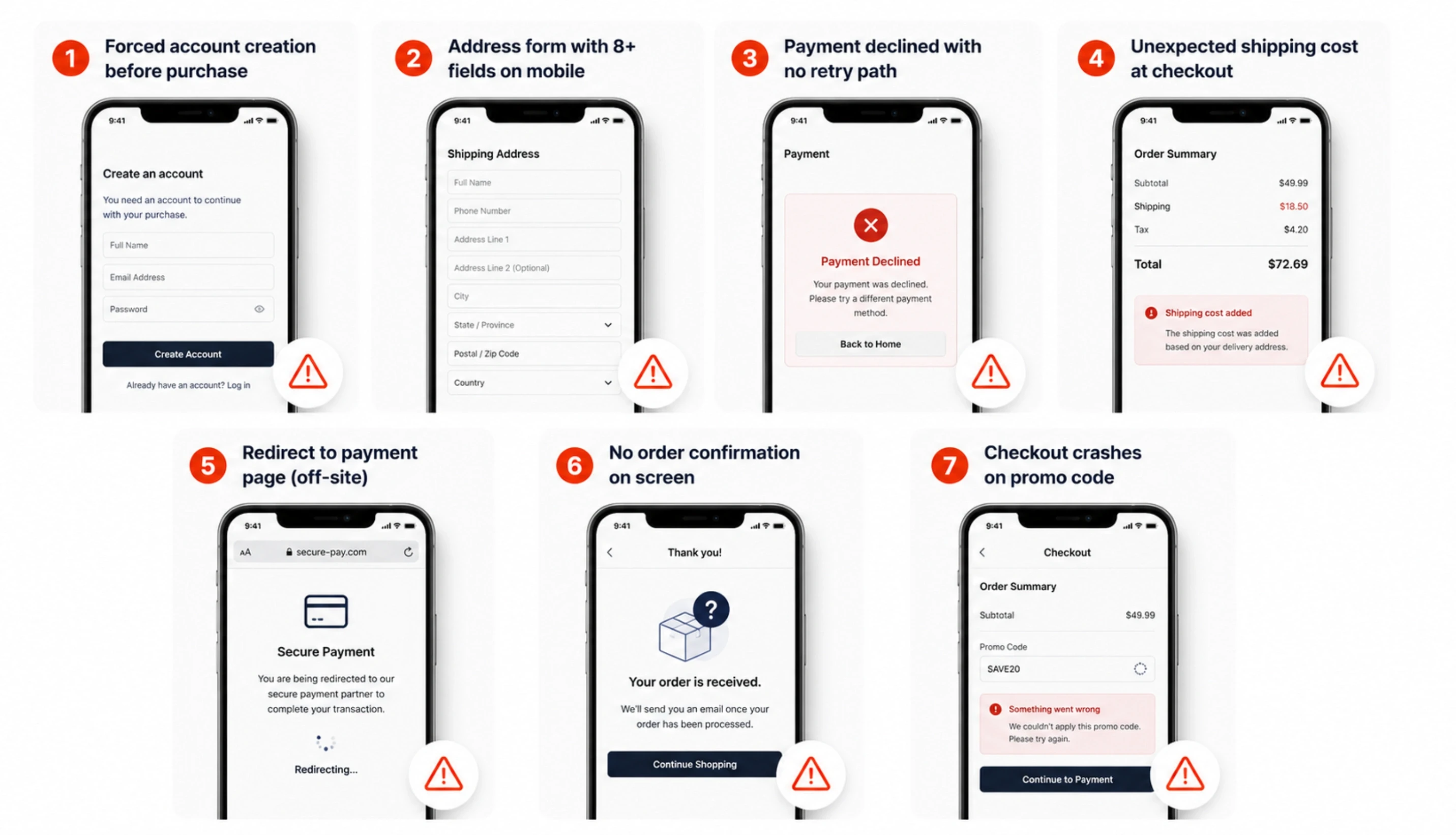
Every friction point in a checkout has a root cause in the engineering layer. Understanding the cause is the prerequisite for fixing it correctly. The following table maps the 7 most common friction points to their engineering cause and their measured conversion impact.
Based on Acquaint Softtech's checkout audits across clients at $500K to $15M GMV, these 7 points account for 85 to 95% of all recoverable abandonment. The product engineering vs software development services guide explains why checkout conversion work is product engineering, not feature development, a distinction that affects how it should be scoped and measured.
Friction Point | Engineering Cause | Conversion Impact |
Forced account creation before purchase | No guest checkout path in the session model | Baymard Institute: 24% of users abandon here, the largest single drop-off |
Address form with 8+ fields on mobile | No address autocomplete API integration | 2× higher abandonment on mobile vs desktop for forms with over 6 fields |
Payment declined with no retry path | No card-updater service or alternative method fallback | 40 to 60% of soft declines are recoverable with a retry or method switch |
Unexpected shipping cost at checkout | Shipping calculation deferred to the last step | 48% of cart abandons cite unexpected costs as the primary reason (Baymard 2025) |
Redirect to payment page (off-site) | No native payment element or embedded SDK | 3DS redirects that leave the site reduce conversion by 8 to 15% |
No order confirmation on screen | Async confirmation with no real-time feedback | Users refresh or retry, causing duplicate orders and increased support volume |
Checkout crashes on promo code | The discount engine is called synchronously on the UI thread | 12% of sessions that trigger this error result in permanent abandonment |
Engineering the Conversion-Optimised Checkout: A Step-by-Step Architecture
A conversion-optimised checkout is a sequence of engineering systems working together: session management, address resolution, shipping calculation, payment processing, order creation, and confirmation delivery. Based on Acquaint Softtech's software product engineering practice, here is the architecture that consistently achieves 78 to 85% completion rates.
Session Architecture: Guest and Authenticated Checkout Merge
The session model determines whether a buyer can complete a purchase without creating an account. The correct implementation: a guest cart session is created at add-to-cart using a UUID stored in a secure, HttpOnly cookie. When the user authenticates during checkout, the guest cart merges with the authenticated user's cart. This single engineering decision removes the largest single abandonment point from the checkout flow.
Address Resolution: Autocomplete and Validation Pipeline
Address autocomplete is not a UX feature. It is an accuracy and speed improvement with a direct conversion impact. A buyer completing an address in 3 keystrokes rather than 8 fields completes the address step in 12 to 18 seconds instead of 45 to 90 seconds. Address validation against a postal authority dataset at this stage prevents delivery failures downstream. Acquaint Softtech's Laravel development services include address resolution API integration as a standard checkout module component.
Shipping Calculation: Move It to the Cart Stage
Shipping cost appearing for the first time at checkout step 2 or 3 is responsible for 48% of abandonment. The engineering fix: calculate and display shipping cost at the cart stage before checkout begins, using the buyer's stored address or postcode, or a default rate for their detected geographic region. The shipping calculation API call is made at the cart view, not at checkout entry. Returning the exact cost before the buyer commits to the checkout flow removes the surprise that drives abandonment.
Payment Element: Native Embedding vs Redirect
The payment page must never leave the client's domain during payment collection, which is a key part of e-commerce checkout payment optimization. Stripe Elements, Braintree Drop-in UI, and Adyen Web Components all provide embedded payment UI components that render the card input inside the client's checkout page via iFrame, with card data transmitted directly to the payment processor without passing through the client's server.
This eliminates PCI-DSS (Payment Card Industry Data Security Standard) scope for card data while keeping the buyer on the domain throughout. Hosted payment pages that redirect the buyer reduce conversion by 8 to 15%. Hire dedicated Laravel developers to build payment adapters that implement native embedded payment elements.
Payment Response Handling: Soft Decline Recovery Path
A payment soft decline is a transaction rejected for a recoverable reason: insufficient funds, fraud flag on a legitimate transaction, card renewed since storage, or 3DS (3D Secure) authentication not completed. 40 to 60% of soft declines are recoverable.
The engineering requirement: the checkout payment handler must differentiate between hard declines and soft declines, and present a specific recovery path for each soft decline type. A checkout that returns a generic 'payment failed' message for all decline types treats recoverable revenue as permanently lost.
Order Creation: Idempotency and Confirmation Guarantee
Order creation must be idempotent: if the buyer submits the checkout form twice (double-click, slow connection), exactly one order must be created. The engineering implementation: each checkout session generates an idempotency key (UUID) at session creation. The order creation API endpoint checks the key against a recent-orders cache before processing. If the key exists, it returns the existing order ID rather than creating a duplicate. Acquaint Softtech's discovery workshop services include a checkout state machine design session as a standard deliverable for every commerce build.
Post-Checkout: Synchronous Confirmation and Downstream Triggers
The confirmation step must deliver three outputs synchronously: the on-screen order confirmation with order number and summary, the confirmation email dispatched via a queued job (not a synchronous SMTP call that blocks the response), and the downstream triggers to the OMS (Order Management System), inventory reservation confirmation, and fulfilment partner webhook. The DevOps and CI/CD strategy for Laravel covers the queue and worker configuration that keeps confirmation dispatch reliable under load.
Get a Checkout Architecture Review from Acquaint Softtech
Acquaint Softtech audits your current checkout flow, session model, payment adapter, decline handling, and confirmation architecture, and identifies the specific engineering changes that will produce the highest conversion impact. We deliver the audit report within 48 hours.
Payment Gateway Selection: Architecture Criteria and Cost Comparison
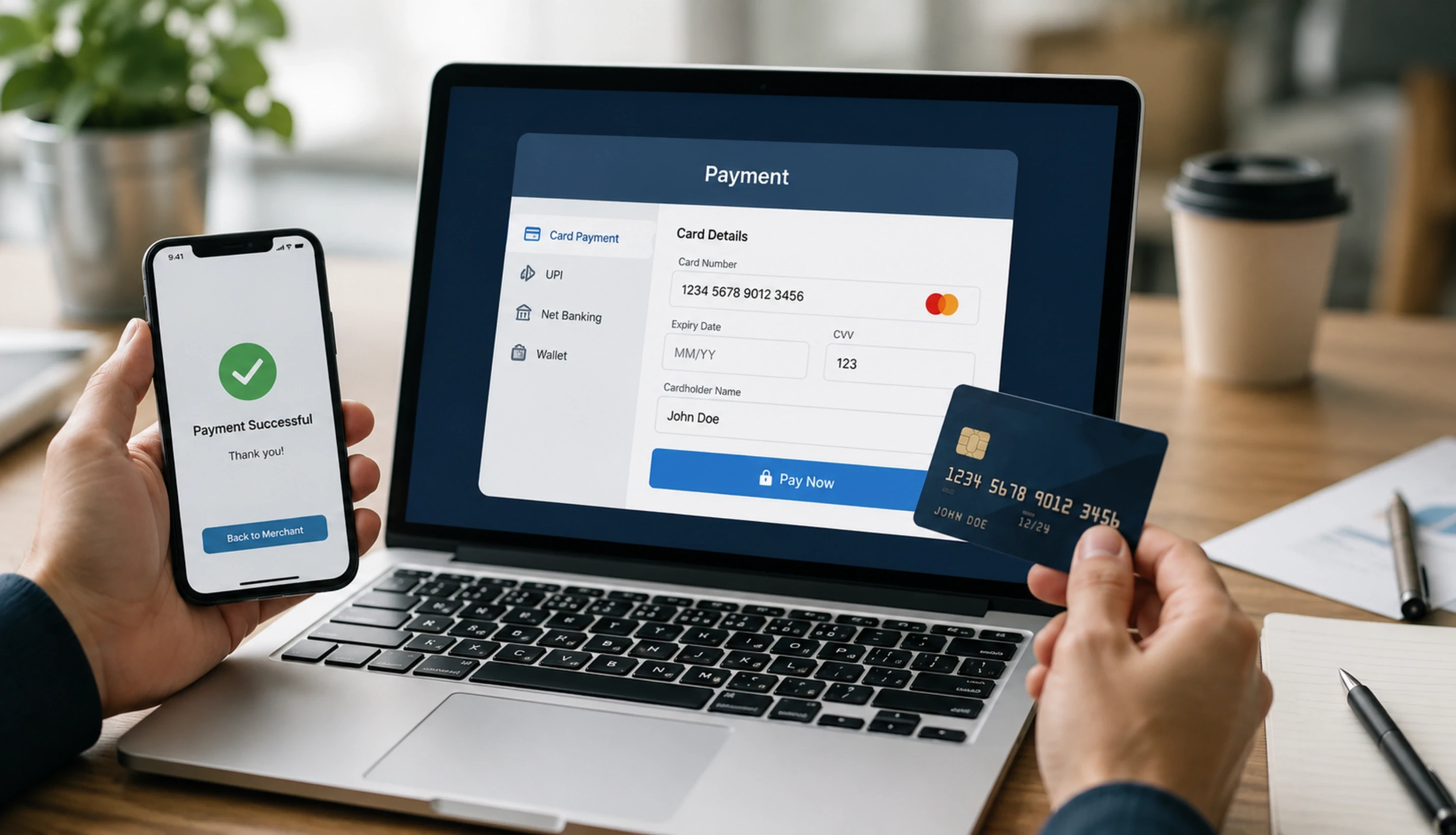
Payment gateway selection is an architecture decision, not a procurement decision. The gateway you choose determines your fraud tooling, your available payment methods, your settlement currency options, your 3DS implementation approach, and your dispute handling workflow. Selecting the wrong gateway for your market or your integration model creates technical debt that costs $20,000 to $60,000 to remediate when you outgrow it. The PHP vs Python vs Node.js for SaaS stacks covers the backend language layer that determines which gateway SDKs are most appropriate for your stack.
The 4 architecture criteria before selecting a gateway
Criterion 1: Payment method coverage for your markets.
Stripe covers cards and local payment methods in 46+ countries via a single integration. Germany requires SEPA Direct Debit support. The Netherlands requires iDEAL. India requires UPI and net banking. Verify the gateway's local payment method coverage against your target markets before selecting, not after.
Criterion 2: 3DS implementation model.
3D Secure 2 (3DS2) authentication is required for European transactions under PSD2 (Payment Services Directive 2) and is increasingly required globally. Gateways handle 3DS2 in two models: frictionless (where authentication is invisible to the buyer) or challenge-flow (where the buyer is redirected to their bank's authentication page). A gateway that defaults to frictionless authentication wherever possible produces better conversion outcomes than one that defaults to challenge-flow for all authenticated transactions.
Criterion 3: Webhook reliability and retry logic.
Payment confirmation must arrive via webhook, not via polling. Your payment adapter must handle webhook idempotency and implement retry handling for failed webhook deliveries. Gateways differ significantly in webhook delivery reliability. Stripe's webhook reliability is consistently rated higher in production deployments than PayPal's legacy webhook system.
Criterion 4: Chargeback and dispute tooling.
Chargebacks cost the merchant the transaction amount, a chargeback fee ($15 to $25 per dispute), and, above a chargeback ratio threshold of 1%, additional programme fees from Visa and Mastercard. Your gateway's dispute management tooling - the evidence submission interface, the representment automation, and the fraud scoring - directly affects your chargeback rate.
Payment gateway comparison for e-commerce builds in 2026
Gateway | Setup Fee | Transaction Fee | Markets | Payout Speed | Best For |
Stripe | $0 | 1.4%+20p (EU) / 2.9%+30¢ (US) | 46+ countries | 2 days | Global D2C, SaaS |
Razorpay | $0 | 2% domestic / varies | India primary | T+2 | India-first brands |
PayPal | $0 | 3.49%+fixed fee | 200+ countries | 1–3 days | Trust-sensitive markets |
Adyen | Custom | Interchange+ | Global enterprise | 2–3 days | $10M+ GMV enterprise |
Checkout.com | Custom | Interchange++ | Global | 1–3 days | High-volume custom |
Stripe Connect | $0 base | 25¢ per payout | 46+ countries | 1–3 days | Marketplaces |
The payment adapter pattern: regardless of which gateway you select, Acquaint Softtech implements a payment adapter layer that abstracts the gateway SDK behind a standard interface. This means the checkout module calls PaymentAdapter::charge(), not Stripe\PaymentIntent::create() directly. When the business requires a gateway change or a second gateway for failover routing, the adapter layer changes without touching the checkout module. This prevents the £30,000 to £60,000 gateway migration cost that merchants face when locked into a direct gateway integration. The custom Laravel build vs off-the-shelf SaaS guide covers the full build vs buy decision, including the payment layer at each GMV tier.
Need a Payment Gateway Recommendation for Your Market?
Acquaint Softtech maps your target markets, transaction volume, fraud risk profile, and local payment method requirements to the gateway architecture that produces the best conversion outcome. We send a recommendation with the integration architecture within 48 hours.
Cart Abandonment Recovery: The Engineering Stack That Brings Revenue Back
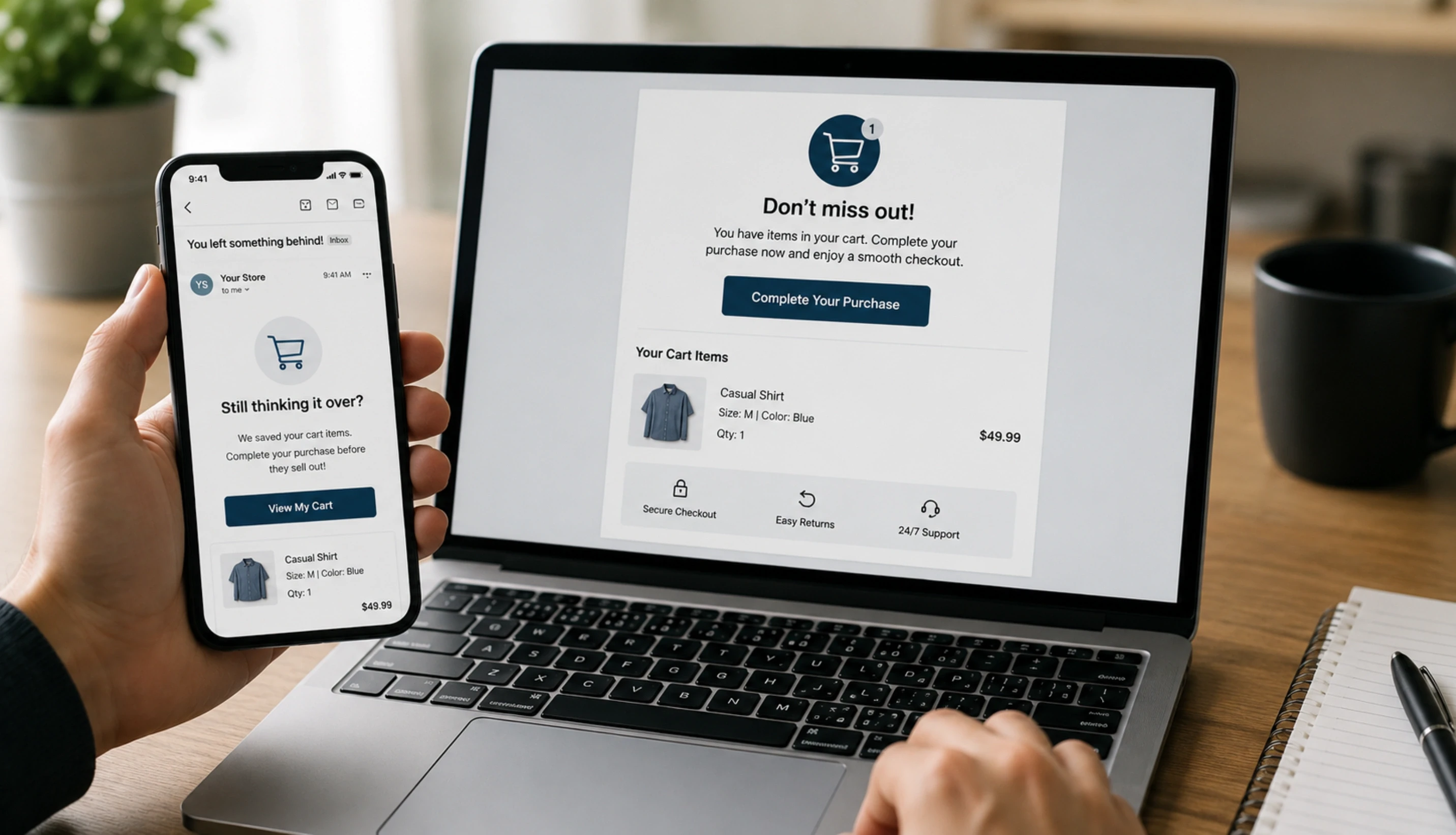
Cart abandonment recovery is the highest-ROI engineering investment in e-commerce after the checkout build itself. For every 100 abandoned carts, a properly engineered recovery stack recovers 5 to 15 within 24 hours. At $85 average order value and $3M GMV, that is $12,750 to $38,250 in monthly recovered revenue from a system that costs $8,000 to $18,000 to build. The online marketplace development guide covers the cart and session architecture that makes abandonment tracking possible in multi-seller environments.
The recovery event architecture
The abandonment recovery stack requires three engineering components: the abandonment detection trigger, the event queue, and the recovery sequence dispatcher.
Trigger Event | Delay Window | Recovery Action |
Cart with email, no checkout started | 1 hour | Email: 'Your cart is waiting' — no discount, product recap |
Checkout started, step 1 done, then idle | 30 minutes | Email: 'Having trouble?' — support link + continue button |
Payment step reached, then abandoned | 15 minutes | Email: 'Something went wrong?' — direct link to payment step with session restore |
First email opened, no conversion in 12 hrs | 12 hours from open | Email: '10% off for next 24 hours' — time-limited offer with session-bound promo code |
SMS consent given, email no conversion in 24 hrs | 24 hours from cart abandonment | SMS: Short message with session restore link — 12% conversion vs 3% for email-only |
Full sequence completed, no conversion in 72 hrs | 72 hours | Remove the cart from active recovery. Do not send beyond 3 touches. |
The session restore URL: the technical foundation of all recovery
Every recovery email and SMS must contain a session restore URL that returns the buyer to their exact checkout state: cart contents, saved address, selected shipping method. The implementation: the checkout session state is serialised to a server-side store (Redis with a 72-hour TTL) at each checkout step completion event.
The restore URL contains the session ID and an HMAC-signed timestamp that verifies the URL has not been tampered with and has not expired. Without a session restore URL, the recovery email takes the buyer back to an empty cart, and the majority do not rebuild it.
Discount control: the engineering constraint most teams miss
Recovery discounts must be controlled at the checkout level, not applied as blanket coupon codes. A blanket coupon code will be shared on discount aggregator sites within hours of its first use. The correct implementation: the recovery discount is tied to the specific cart session ID in the backend.
The discount is valid only for the cart that triggered the recovery sequence and only for the buyer's authenticated session or session-restore URL. Acquaint Softtech's AI development services include AI-powered discount optimisation: the recovery system tests whether a discount is necessary at all before offering one, based on the buyer's historical purchase behaviour, cart value, and time-to-abandon pattern.
What Does Checkout and Payment Engineering Cost in 2026?
The cost of a checkout and payment engineering build depends on the scope: whether you are building from scratch inside a custom commerce platform, rebuilding on an existing SaaS platform, or adding abandonment recovery and payment optimisation to an existing checkout.
All figures below reflect Acquaint Softtech's offshore delivery costs from India. Acquaint Softtech is an eCommerce development company with 70+ multi-stack engineers and an Official Laravel Partner. The 40% cost saving against equivalent in-house team costs is consistent across checkout engineering engagements.
Build Scope | Frontend Cost | Backend Cost | Total Range | Timeline |
Basic checkout | $6,000–$14,000 | $8,000–$16,000 | $14,000–$30,000 | 6–10 weeks |
Conversion-optimised checkout | $16,000–$30,000 | $18,000–$35,000 | $34,000–$65,000 | 12–20 weeks |
Enterprise payment stack | $28,000–$55,000 | $40,000–$80,000 | $68,000–$135,000 | 20–36 weeks |
What a checkout engineering engagement at Acquaint Softtech includes
Engineering deliverables:
Session architecture: guest cart, authenticated cart, merge logic, and session restore
Address resolution: Google Places API or Loqate autocomplete + postal validation
Shipping calculation: moved to cart stage with carrier API or rules engine integration
Payment adapter: gateway-agnostic interface with Stripe, Razorpay, or Adyen implementation
3DS2 handling: frictionless authentication with challenge-flow fallback
Soft decline recovery: differentiated error paths for hard vs soft declines
Idempotency layer: idempotency key implementation for order creation
Confirmation: synchronous on-screen confirmation with queued email dispatch
Abandonment recovery: event triggers, session serialisation, restore URL, email/SMS dispatcher
Fraud rules: gateway-level rules configured for the client's transaction profile
The rate the client pays is the rate. No additional employer overhead, contractor fees, or tool licensing costs on top. Acquaint Softtech's MVP development services allow clients to build and validate the checkout core before investing in the full payment stack.
What is NOT included in the build cost:
Payment gateway transaction fees (charged per transaction by Stripe, Razorpay, etc.)
Email/SMS delivery platform subscription (Klaviyo, Postmark, Twilio) - $200 to $800/month
Address autocomplete API usage (Google Places API - approximately $2.83 per 1,000 requests)
Fraud detection SaaS beyond gateway-native tools - enterprise only
Want a Scoped Cost Estimate for Your Checkout Build?
Tell Acquaint Softtech your current platform, your checkout abandonment rate, your target markets, and the payment methods you need to support. We send a scoped build estimate with team composition and timeline within 48 hours. You review the team profiles before any contract is signed.
Common Misconceptions About Checkout Optimisation
Checkout optimisation carries a persistent set of misconceptions that direct engineering effort toward the wrong changes. Clearing them before a checkout rebuild sprint begins prevents 2 to 3 wasted sprints. Acquaint Softtech observes these misconceptions consistently across new checkout engineering engagements, including those handled as software development outsourcing projects where a client has already invested in a UX redesign with little conversion improvement.
Misconception 1: Checkout conversion is primarily a design problem
The misconception
The checkout converts poorly because the design is confusing. A redesign sprint with a cleaner UI will fix the abandonment rate.
What the data shows
Of the 7 friction points in Section 2, 6 are engineering problems. Forced registration is a session model problem. Unexpected shipping cost is a calculation timing problem. Payment declined with no retry is an error-handling problem. A redesign does not change session models, calculation timing, or error paths. Clients who have already completed a UX redesign show the same abandonment rate before and after because the engineering layer was not touched.
Misconception 2: A one-page checkout always converts better than multi-step checkout
Misconception: One-page checkout is always the highest-converting layout. Multi-step checkout is outdated and slower.
Three things wrong with this:
Baymard Institute's 2025 research across 2,700 checkout flows found no statistically significant conversion difference between one-page and multi-step checkout when both are correctly implemented. The performance difference is in the absence of friction, not in the number of pages.
One-page checkouts can perform worse on mobile when all fields are visible simultaneously, increasing cognitive load. Mobile-optimised multi-step checkout outperforms mobile one-page checkout in 62% of measured implementations.
The engineering cost of a correctly implemented one-page checkout is higher than a multi-step checkout, because it requires real-time form validation, dynamic shipping calculation, and progressive payment field display on a single page without the ability to use page load as a natural validation checkpoint..
Misconception 3: Offering a discount in recovery emails always increases the recovery rate
"Send a 10% off email to everyone who abandons their cart. It will bring them back."- Common belief
Sending a discount to every abandonment session trains buyers to deliberately abandon to receive the discount. Acquaint Softtech's delivery data shows that for brands with above-average return customer rates (above 35% repeat purchasers), offering a discount in the first recovery touch reduces overall margin by 4 to 7% without meaningfully increasing the recovery rate compared to a non-discount first touch. The correct engineering approach: test whether a discount is necessary by first sending a non-discount recovery email, and only triggering a discount in the second touch for sessions that opened the first email but did not convert.
Discount-first recovery costs 4–7% margin vs non-discount first touch, for the same recovery rate on repeat purchaser brands
Misconception 4: SaaS checkout platforms handle all payment complexity for you
MYTH: Using Shopify Payments or Shopify's native checkout means all payment processing, fraud, and compliance is handled automatically by the platform.
FACT: Shopify Payments handles card processing for standard transactions. It does not handle: Buy Now Pay Later (BNPL) integrations beyond Shopify's approved partners, multi-currency settlement with local acquiring, custom fraud rules beyond Shopify's pre-built settings, split payment support for B2B invoice customers, or chargeback representment automation. At $2M+ GMV, the payment complexity a growing e-commerce business requires exceeds what any SaaS checkout platform handles natively.
The custom Laravel vs off-the-shelf SaaS guide covers the full build vs buy decision, including the payment layer. Acquaint Softtech's hire dedicated MERN stack developers page covers staffing for payment adapter builds across Stripe, Adyen, and regional gateways.
Frequently Asked Questions
-
How do I reduce cart abandonment in e-commerce?
The highest-impact engineering improvements for conversion are: adding guest checkout to reduce drop-offs, showing shipping costs in the cart to avoid surprise abandonment, using native embedded payments instead of redirects, and implementing soft decline recovery with retry and alternative payment options. These changes directly improve checkout performance and are engineering-focused, not just UI design fixes.
-
What is the best payment gateway for e-commerce in 2026?
For UK and European markets: Stripe, with Stripe Radar for fraud scoring and Stripe Elements for embedded payment UI. For India-first brands: Razorpay, which covers UPI, net banking, and card payments through a single API.
For enterprise merchants above $10M GMV processing internationally: Adyen, which provides local acquiring in 37 markets and interchange++ pricing at volume. For multi-seller marketplaces: Stripe Connect. The right gateway depends on your market, your volume, and your payment method requirements.
-
What does it cost to build a conversion-optimised checkout?
Checkout System Type
Estimated Cost
Timeline
Basic Checkout Module
$14,000 to $30,000
6 to 10 weeks
Conversion Optimized Checkout System
$34,000 to $65,000
12 to 20 weeks
Enterprise Payment Stack
$68,000 to $135,000
20 to 36 weeks
These estimates are based on Acquaint Softtech’s offshore delivery model from India.
-
How does payment gateway integration work technically?
A payment gateway integration has four parts: a payment adapter that standardizes gateway actions, a payment element for securely collecting payment details, a webhook handler for processing payment events, and an idempotency layer to prevent duplicate charges.
This setup ensures reliable and secure transaction processing. Acquaint Softtech uses a gateway-agnostic adapter pattern to keep the checkout system independent of any specific payment provider.
-
How do I reduce payment declines on my checkout?
Differentiate hard declines (invalid card, permanently blocked) from soft declines (insufficient funds, fraud flag, 3DS not completed). For soft declines: present a specific error message for each decline type, offer a retry with the same card after a short delay, offer an alternative payment method, and implement a card updater service that automatically updates stored card details when a customer's card is renewed by their bank. 40 to 60% of soft declines are recoverable with the correct retry and fallback architecture.
-
What tech stack does Acquaint Softtech use for checkout and payment builds?
Backend: Laravel with a custom payment adapter layer supporting Stripe, Razorpay, and Adyen. Queue layer: Laravel Horizon with Redis for asynchronous confirmation dispatch and abandonment event processing.
Frontend: React or Next.js with embedded Stripe Elements or Adyen Web Components for PCI-DSS-scoped payment capture. Address resolution: Google Places API or Loqate. Abandonment recovery: Klaviyo or Postmark for email dispatch, Twilio for SMS. Session storage: Redis with configurable TTL for cart and checkout session state.
-
Is PCI-DSS compliance required for a custom checkout?
Yes, but the PCI-DSS scope depends on your integration method. If you use embedded payment elements like Stripe Elements, Adyen Web Components, or Braintree Drop-in UI, card data goes directly to the payment provider without touching your server, keeping compliance with SAQ-A (the lowest level).
If you collect and send card data through your own server, you fall into a higher PCI scope, like SAQ-D or full audit. Acquaint Softtech uses embedded payment elements by default to reduce PCI-DSS compliance complexity for clients.
I lead technology and client success at Acquaint Softtech with one goal in mind. Deliver work that feels personal, reliable, and worthy of long term trust. I stay close to both our clients and our developers to make sure every project moves with clarity, quality, and accountability.
Table of Contents
Get Started with Acquaint Softtech
- 13+ Years Delivering Software Excellence
- 1300+ Projects Delivered With Precision
- Official Laravel & Laravel News Partner
- Official Statamic Partner
Related Blog
.webp "The Complete Guide to E-Commerce & D2C Software Development in 2026")
The Complete Guide to E-Commerce & D2C Software Development in 2026
Custom e-commerce software is not a more expensive version of Shopify. It is an entirely different accountability and ownership structure, with different economics and a different ceiling on what your platform can do. This guide explains every architecture type, every cost variable, and every decision checkpoint so you build the right thing in 2026.

Acquaint Softtech
May 6, 2026
How Custom E-Commerce Platforms Work: Architecture, Modules, and When to Build One
A custom e-commerce platform is not a bigger Shopify plan. It is a purpose-built commerce engine where every module answers to your business logic, not a vendor's roadmap. This article explains exactly how one is architected, what it contains, and the 5 operational signals that tell you when building your own beats, staying on SaaS.
Manish Patel
May 12, 2026
Impact of Scalability to Create High-Traffic Websites that Never Crash
Scalability and the impact of scalability on user experience are an unseen backbone that ensures the survival efficiency of your business platform under peak traffic spikes and workloads.
Acquaint Softtech
June 12, 2025India (Head Office)
203/204, Shapath-II, Near Silver Leaf Hotel, Opp. Rajpath Club, SG Highway, Ahmedabad-380054, Gujarat
USA
7838 Camino Cielo St, Highland, CA 92346
UK
The Powerhouse, 21 Woodthorpe Road, Ashford, England, TW15 2RP
New Zealand
42 Exler Place, Avondale, Auckland 0600, New Zealand
Canada
141 Skyview Bay NE , Calgary, Alberta, T3N 2K6