

E-Commerce SEO Architecture: URL Structure, Schema Markup, and Core Web Vitals Optimization
A high-performing e-commerce website relies on three interconnected pillars: logical site architecture, clean URL structure, and robust schema markup. Keep URLs short and keyword-focused, use Product and Breadcrumb Schema for rich results, and optimize Core Web Vitals (LCP <2.5s, INP <200ms, CLS <0.1) to improve crawling, rankings, AI visibility, and conversions.

Zubair Pateljiwala
As the Marketing Manager at Acquaint Softtech, I have inherited more than one store where SEO was treated as a plugin added the week before launch. The URLs were full of parameters, the product pages had no schema, and the images pushed Core Web Vitals into the red. Fixing that after the fact is expensive. Doing it as part of software product development is far cheaper, because e-commerce SEO architecture is a build decision, not a marketing task.
This guide unifies the three pillars most articles split apart: URL structure, schema markup, and Core Web Vitals. A strong e commerce seo strategy needs all three pointing the same way.

- A CTO or architect designing the URL, schema, and performance foundation of a new store.
- A technical founder who wants rich results and fast pages baked into the build.
- An SEO or growth lead fighting parameter bloat, missing schema, or failing Core Web Vitals.
- An agency owner scoping a performance-optimized store for a client.
Good seo for ecommerce starts with the e commerce website structure itself, so this is written for the people who design that structure, not the people who tune it later.
If you want the wider picture first, our guide on how custom e-commerce platforms work maps every module a store runs on. This article zooms into the SEO and performance layer that decides whether those modules ever get found.
What is e-commerce SEO architecture?
E-commerce SEO architecture is the set of structural decisions, URL design, structured data, internal linking, and page performance, that determine how easily search engines and AI answer engines can crawl, understand, and rank a store. It is the foundation every page inherits.
Unlike content SEO, which you tune per page, architecture is set once and touches everything. A clean URL pattern, correct schema, and fast templates apply to every product and category automatically. Get them wrong and you multiply the problem across thousands of pages; get them right and every new SKU launches already optimized. That multiplier effect is why architecture is the highest-return SEO work there is.
Acquaint Softtech treats these decisions as day-one build requirements, because retrofitting URL structure or schema across a live catalog means redirects, re-indexing, and lost rankings. The cheapest time to get SEO architecture right is before the first product page ships.
The best URL structure for e-commerce
The best url structure for ecommerce is clean, keyword-rich, and readable: domain.com/category/product-name, in lowercase, with hyphens between words, over HTTPS, and no session or tracking parameters. Keywords placed earlier in the path carry more weight. This url structure online store pattern is the base every other SEO decision builds on.
Do | Avoid |
domain.com/running-shoes/mens-trail-shoe | domain.com/product/987654 (no keywords) |
Lowercase, hyphen-separated words | Underscores (Google reads as one word) |
HTTPS everywhere | domain.com/p?sessionid=123 (crawl waste) |
Under 60 characters where possible | Five or more nested subdirectories |
One canonical URL per product | utm and sort parameters indexed |
Once a URL is indexed, changing it creates redirect chains and temporary ranking drops, so the ecommerce website url pattern is worth getting right before launch. A seo-friendly url structure places the category before the product name, adding topical context while keeping the product keyword prominent. Teams building a custom store often hire MERN stack developers who set clean routing at the framework level, so every URL is correct by default.
Flat vs deep site architecture
A flat architecture keeps every product within 3 to 4 clicks of the homepage; a deep one nests many subcategory levels. For most stores, 3 to 4 click depth is the sweet spot: enough structure to organize, shallow enough that link equity still reaches every page.
Flat wins for catalogs under about 1,000 products: the homepage passes more authority to each page and crawling is faster. Deep structures become necessary past 10,000 products, but each level dilutes link equity and slows discovery. The fix in both cases is strategic internal linking: link top sellers straight from the homepage so they bypass the strict hierarchy, and make sure no page is orphaned.
Breadcrumb navigation, marked up with BreadcrumbList schema, reinforces this hierarchy for both users and crawlers and earns extra space in search results. Designing an e commerce website structure that scales without re-platforming later is exactly the kind of decision our headless commerce architecture guide digs into.
Handling product variants and URL parameters
Handle product variants with one canonical URL and on-page selectors, not a separate URL per color or size. Handle parameters by keeping them out of core content and pointing any necessary parameter URL back to the clean version with a canonical tag.
A single URL such as domain.com/t-shirts/classic-tee, with dropdowns for size and color, avoids duplicate content and consolidates link equity. Only give a variant its own URL when it is genuinely a different product with its own search demand, such as iPhone 15 versus iPhone 15 Pro. For filters and sorting, use canonical tags and selective noindex so faceted navigation does not spawn thousands of thin, duplicate URLs.
Parameter bloat is the single most common crawl-budget killer we find on inherited stores. Getting canonicalization and faceted navigation right is detailed engineering, which is why teams hire Python developers who have solved it at scale rather than patching it per template.
Faceted navigation spawning thousands of junk URLs?
That is a crawl-budget leak that quietly caps your rankings. Tell us your platform and catalog size and we will map the canonical, noindex, and routing rules that fix it, as a build-ready technical plan.
Schema markup for e-commerce: the types that matter
The ecommerce schema types that matter are Product, BreadcrumbList, Organization, Review, and Merchant listing. Together they tell Google what each page is and unlock rich results such as price, availability, and star ratings. Schema is added as JSON-LD in the page head.
Schema type | What it marks up | Rich result it can unlock |
Product | Name, price, availability, image | Product snippet with price and stock |
Merchant listing | Sellable product with offer data | Shopping experiences and listings |
BreadcrumbList | Page hierarchy path | Breadcrumb trail in results |
Review / AggregateRating | Ratings and reviews | Star ratings in the snippet |
Organization | Business logo, contact, identity | Knowledge panel and brand signals |
Star ratings alone can lift click-through noticeably, which makes Review schema one of the fastest wins in seo for ecommerce. This structured data feeds both Google rich results and the AI models that surface product recommendations, so product page schema markup is now an answer-engine play as much as a search one. Acquaint Softtech bakes these types into the page templates so every product ships with valid markup.
Product schema JSON-LD
Here is a valid product schema JSON-LD block. It marks up the name, image, brand, price, currency, and availability, which is the minimum Google needs to show a product rich result. It goes in a script tag in the page head.
<script type="application/ld+json">
{
  "@context": "https://schema.org/",
  "@type": "Product",
  "name": "Waterproof Trail Running Shoe",
  "image": "https://example.com/img/trail-shoe.jpg",
  "description": "Lightweight trail shoe with grip outsole.",
  "brand": { "@type": "Brand", "name": "Acme" },
  "sku": "TRAIL-001",
  "offers": {
    "@type": "Offer",
    "url": "https://example.com/running-shoes/trail-shoe",
    "priceCurrency": "USD",
    "price": "89.00",
    "availability": "https://schema.org/InStock"
  },
  "aggregateRating": {
    "@type": "AggregateRating",
    "ratingValue": "4.6",
    "reviewCount": "128"
  }
}
</script>
Two details decide whether this validates: the price must be a plain number with a separate priceCurrency, and availability must be a full schema.org URL, not the word in stock. Keeping this markup accurate as prices and stock change is why teams hire Laravel developers to generate it from live product data rather than hard-coding it.
Merchant listing schema and rich results
Merchant listing schema is Product markup enriched with the offer, shipping, and return details Google needs to include a page in shopping experiences. It is what turns a plain product page into a listing eligible for rich shopping surfaces.
Where a basic product snippet shows price and rating, merchant listing schema adds fields such as shipping cost, delivery time, and return policy, so your listing can appear in the richer shopping results and price-comparison surfaces.
For stores that want visibility in Google's shopping experiences without paid feeds, this markup is the organic route. It pairs with an Organization block that carries your logo and business identity.
Because these fields must stay truthful and current, they are generated from the same data that powers checkout, not maintained by hand. Setting up that pipeline reliably is where a dedicated software development team keeps schema, pricing, and availability in lockstep, and it connects to the product-data work in our D2C platform development guide.
How to check your schema markup
To check your schema markup, run the page through Google's Rich Results Test or a schema markup validator. Both parse your JSON-LD, confirm it is valid, and list which rich results the page is eligible for, plus any errors or warnings to fix.
You can tell whether a website has schema markup in three ways: run its URL through the Rich Results Test, use the Schema.org validator, or view the page source and search for application/ld+json in the head. Search Console also reports schema coverage and errors across the whole site over time, which is how you catch a template that silently broke its markup after a deploy.
Validation is not a one-time step; every template change can break markup, so it belongs in the deploy pipeline. Keeping these checks automated is a good reason to hire automation engineers who wire schema validation into continuous integration alongside the rest of the tests.
Core Web Vitals: LCP, INP, and CLS
Core Web Vitals are three metrics Google uses as a ranking signal: LCP measures how fast the main content loads, INP measures how quickly the page responds to input, and CLS measures how much the layout shifts. The targets are LCP under 2.5 seconds, INP under 200 milliseconds, and CLS under 0.1.
Metric | What it measures | Good target |
LCP (Largest Contentful Paint) | Time to render the main content | Under 2.5 seconds |
INP (Interaction to Next Paint) | Responsiveness to user input | Under 200 milliseconds |
CLS (Cumulative Layout Shift) | Visual stability while loading | Under 0.1 |
Core web vitals e-commerce scores are measured per URL, per template, not site-wide, so test one of each type: homepage, category, product, and cart-adjacent. Product pages are the usual offenders because of large images, review widgets, and third-party scripts. Acquaint Softtech benchmarks each template separately, because a fast homepage tells you nothing about whether shoppers are waiting on the product page that actually converts.
Lazy loading and image optimization
Lazy loading image optimization is the single biggest Core Web Vitals lever for stores, because product images are usually the heaviest assets. Serve images in WebP, compress them, set explicit width and height, and lazy-load anything below the fold.
Use WebP or AVIF. Modern formats cut image weight sharply versus JPEG or PNG, improving LCP directly.
Lazy-load below the fold. Defer offscreen images so the visible content paints first, but never lazy-load the LCP image itself.
Set width and height. Explicit dimensions reserve space and prevent the layout shift that wrecks CLS.
Serve from a CDN. Deliver assets from servers near the shopper to cut load time in every market.
INP is improved separately, by trimming and deferring the JavaScript that blocks the main thread, especially third-party review and chat widgets. Getting a store to build performance-optimized store standards across every template is detailed work, so teams often use IT staff augmentation to add performance engineers for the sprint that hardens Core Web Vitals.
Category page optimization
Category page optimization is often the biggest missed opportunity in e-commerce SEO, because category pages target higher-volume keywords than individual products. Give each one unique intro copy, clean faceted navigation, and internal links to its top products.
A category page such as running shoes ranks for a broader, more valuable term than any single shoe. To win it, the page needs genuinely unique content, not a thin list, plus BreadcrumbList schema, a canonical that absorbs filter variations, and internal links that push equity to its best products. Faceted filters must be controlled so they help users without generating crawlable duplicate URLs.
Treating category pages as first-class SEO landing pages, not just navigation, is what separates stores that rank from stores that only convert existing traffic. The internal-linking and discovery patterns overlap with our freelance marketplace build guide.
How to build a performance-optimized store, step by step
To build SEO architecture into a store: set the URL pattern, add schema to every template, optimize images and Core Web Vitals, control faceted navigation, then validate and monitor. Here is the build in six steps.
Set the URL pattern. Define clean category/product routing, lowercase and hyphenated, at the framework level.
Add schema to every template. Generate Product, BreadcrumbList, Organization, and Review JSON-LD from live data.
Optimize images and Core Web Vitals. WebP, lazy loading, explicit dimensions, CDN, and deferred third-party scripts.
Control faceted navigation. Canonical tags and noindex so filters do not create duplicate URLs.
Validate. Run the Rich Results Test and a schema markup validator on each template.
Monitor. Track Core Web Vitals and schema coverage in Search Console after every deploy.
Keeping this on track across a large build is easier when you hire a project manager to own the plan, and the real-time monitoring patterns overlap with our on-demand app development guide.
E-commerce SEO cost by market
E-commerce SEO cost for architecture work depends on catalog size, platform, and how much has to be retrofitted. Building it into a new store is far cheaper than re-architecting URLs and schema across a live catalog.
The ranges below are 2026 planning estimates at local agency rates for SEO architecture and performance work. They are starting points to confirm against a real scope. Offshore delivery of custom SEO e-commerce work from India typically lands well below these numbers.
Target market | Architecture and schema | Full performance and SEO rebuild |
United States / New York City | $10,000 to $28,000 | $40,000 to $110,000+ |
United Kingdom | $9,000 to $26,000 | $38,000 to $100,000+ |
Europe (EU) | $10,000 to $28,000 | $40,000 to $105,000+ |
Australia | $11,000 to $30,000 | $42,000 to $115,000+ |
New Zealand | $11,000 to $31,000 | $42,000 to $118,000+ |
The biggest lever is engineering rate, not the fix list. That is why many teams that want to hire developers for SEO optimization choose custom SEO e-commerce India, where the same scope costs a fraction of local rates.
As Google's schema and Core Web Vitals guidance evolves, version upgrade services keep templates current, and a senior architect can set the approach up front through virtual CTO services.
Real case study: an SEO architecture rebuild
No two rebuilds are identical, but the closest documented parallel from our own work is a custom multi-vendor marketplace, similar to Amazon, where product data was served over an API to a storefront that had to be crawlable, fast, and eligible for rich results across thousands of listings. SEO architecture was structural to that build. The scorecard below shows the before-and-after across the three pillars.
Pillar | Before | After |
URL structure | Parameter-heavy, duplicate URLs per vendor | Clean category/product paths, canonicalized |
Schema | No structured data on product pages | Product and BreadcrumbList JSON-LD on every listing |
Core Web Vitals | Heavy images, layout shift on load | WebP, lazy loading, dimensions set, CLS controlled |
Result | A secure, feature-rich marketplace with a custom product page and per-vendor store design, delivered with weekend support | Crawlable, fast listings served over a clean API |
Why Acquaint Softtech | 13+ years, 1,300+ projects, 50+ Clutch reviews | Vetted developers deployable within 48 hours |
Why teams struggle, and what to check before you hire
Most stores do not fail at content. They fail at architecture, where parameter bloat, missing schema, and slow templates quietly cap rankings no amount of blog posts can lift.
If you are deciding whether to build in house or hire a partner for SEO architecture, check for these before you commit:
Do they set clean URL routing at the framework level, not per page?
Is schema generated from live data and validated in the deploy pipeline?
Do they benchmark Core Web Vitals per template, not just the homepage?
Is faceted navigation controlled with canonical and noindex rules?
That architecture layer is where experience shows. Acquaint Softtech has delivered 1,300+ projects over 13+ years with 50+ Clutch reviews and can deploy vetted developers within 48 hours. After launch, SEO architecture needs care as Google's guidance and your catalog change, which is where ongoing support and maintenance services keep URLs, schema, and performance healthy. Teams that want the approach pressure-tested first can start with a product discovery workshop before any code is written.
Two authoritative references are worth building against directly. Google's own ecommerce structured data documentation lists exactly which schema types are eligible for rich results, and the Schema.org vocabulary defines every property those types accept. Building templates straight from these sources avoids guesswork.
Get a free e-commerce SEO architecture consultation
Share your store, platform, or a short brief. We will review your URL structure, schema markup, and Core Web Vitals, then hand back a prioritized plan and a scope you can act on. This is the last step before you commit engineering time.
Frequently Asked Questions
-
Does schema markup help SEO?
Yes. Schema markup does not directly boost rankings, but it helps search engines understand your pages and makes them eligible for rich results such as price, availability, and star ratings. Those richer snippets take up more space and lift click-through, and the same structured data feeds AI answer engines that surface product recommendations, so it improves visibility across both search and AI surfaces.
-
What is the best URL structure for e-commerce?
The best URL structure is domain.com/category/product-name: clean, keyword-rich, lowercase, hyphen-separated, and served over HTTPS. Keep it under about 60 characters, place important keywords early, use one canonical URL per product with on-page variant selectors, and keep session and tracking parameters out of core content. This keeps pages crawlable and avoids duplicate content.
-
How do I improve Core Web Vitals?
Improve Core Web Vitals by targeting the three metrics: for LCP, serve WebP images from a CDN and never lazy-load the main image; for CLS, set explicit width and height on images and reserve space for ads and widgets; for INP, trim and defer JavaScript, especially third-party review and chat scripts. Measure each template separately, since scores are per URL, not site-wide.
-
How do you do SEO for category pages?
Treat category pages as primary landing pages, because they target higher-volume keywords than individual products. Give each unique intro copy rather than a thin list, add BreadcrumbList schema, set a canonical that absorbs filter variations, and internally link to the category's top products. Control faceted filters with canonical and noindex rules so they do not create duplicate URLs.
-
What is a schema markup for products?
Product schema markup is JSON-LD that describes a product to search engines: its name, image, brand, SKU, price, currency, and availability, often with an AggregateRating. Added in a script tag in the page head, it makes the page eligible for a product rich result showing price and stock. Merchant listing schema extends it with shipping and return details for shopping surfaces.
-
How do I know if my website has schema markup?
Check in three ways: run the page through Google's Rich Results Test, paste the URL into the Schema.org validator, or view the page source and search for application/ld+json in the head. Google Search Console also reports schema coverage and errors across your whole site, which is the best way to catch a template that broke its markup after a deploy.
-
How many types of schema markup are there in SEO?
Schema.org defines hundreds of types, but only a subset produces rich results in Google. For e-commerce the ones that matter are Product, ProductGroup, Merchant listing, BreadcrumbList, Review and AggregateRating, and Organization, plus FAQPage and HowTo for supporting content. You do not need every type; you need the handful that match your page's purpose and are eligible for rich results.
-
What are the 7 types of e-commerce?
The commonly cited types are B2C (business to consumer), B2B (business to business), C2C (consumer to consumer), C2B (consumer to business), B2A or B2G (business to administration or government), C2A (consumer to administration), and D2C (direct to consumer). The SEO architecture in this guide, clean URLs, schema, and Core Web Vitals, applies across all of them.
I am Zubair Pateljiwala, a digital marketing professional with 15+ years of experience in SEO, content marketing, and performance marketing. As the Marketing Head at Acquaint Softtech, I focus on helping technology businesses improve their online visibility through SEO, GEO, AEO, and AI-driven content strategies. I enjoy transforming complex software development concepts into practical, easy-to-understand content that helps businesses make informed technology decisions.
Table of Contents
Get Started with Acquaint Softtech
- 13+ Years Delivering Software Excellence
- 1300+ Projects Delivered With Precision
- Official Laravel & Laravel News Partner
- Official Statamic Partner
Related Blog

How Custom E-Commerce Platforms Work: Architecture, Modules, and When to Build One
A custom e-commerce platform is not a bigger Shopify plan. It is a purpose-built commerce engine where every module answers to your business logic, not a vendor's roadmap. This article explains exactly how one is architected, what it contains, and the 5 operational signals that tell you when building your own beats, staying on SaaS.

Manish Patel
May 12, 2026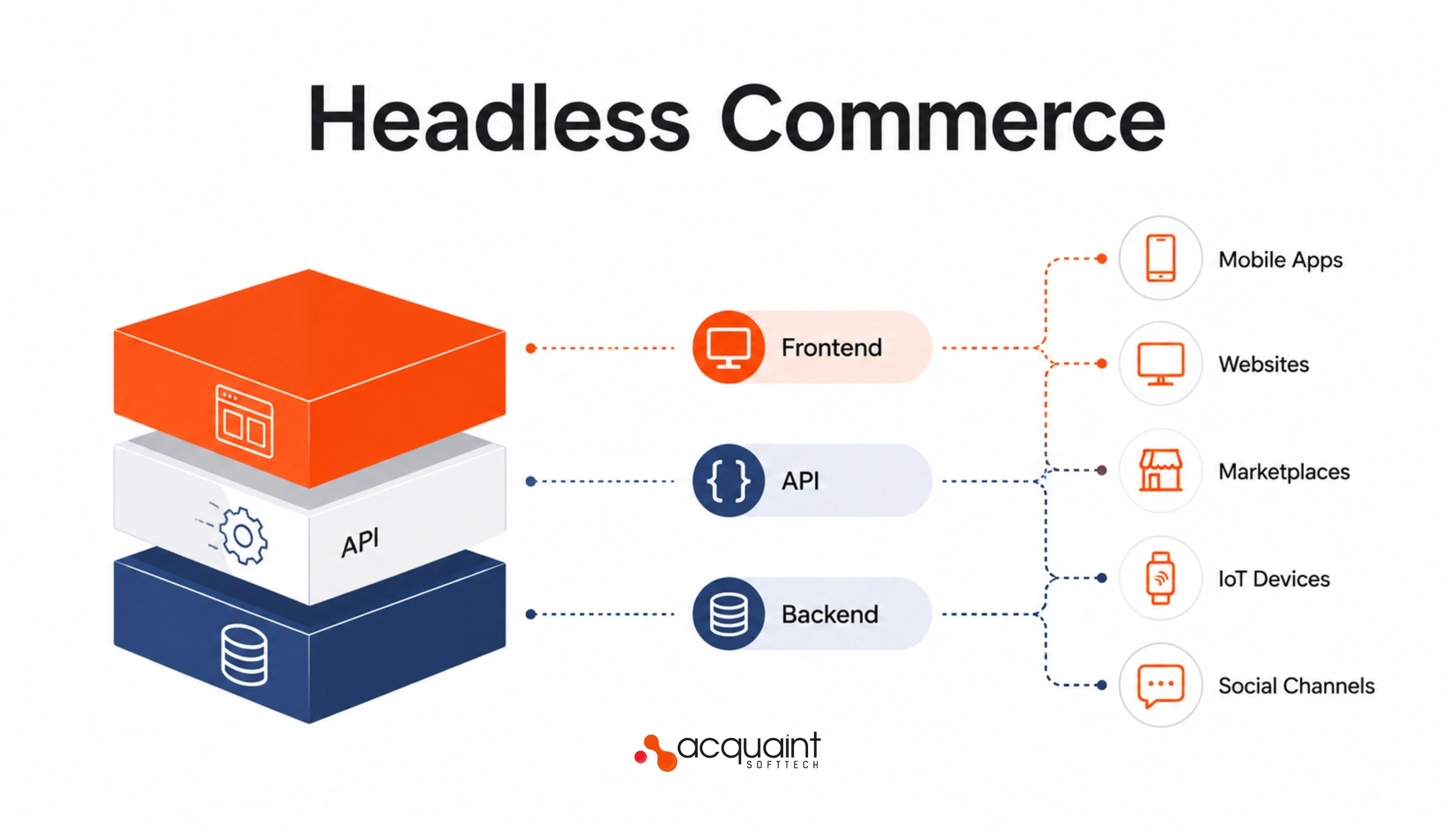
Headless Commerce Explained: Decoupled Architecture for Modern E-Commerce Development
Headless commerce is not a technology upgrade. It is a structural decision that separates the commerce engine from the storefront entirely. Done right, it gives you deployment freedom, channel flexibility, and a performance ceiling that no monolithic SaaS platform can match. Done wrong, it creates distributed systems complexity that your team is not ready for. This article tells you exactly which situation you are in.
Manish Patel
May 19, 2026
D2C Platform Development Guide 2026: Tech Stack, CX, and Growth Engine
A D2C brand platform is a custom-built digital infrastructure that lets a brand sell directly to consumers without retail intermediaries, combining a branded storefront, subscription engine, loyalty module, customer data layer, and fulfillment system in one owned technology stack.
Manish Patel
June 8, 2026India (Head Office)
203/204, Shapath-II, Near Silver Leaf Hotel, Opp. Rajpath Club, SG Highway, Ahmedabad-380054, Gujarat
USA
7838 Camino Cielo St, Highland, CA 92346
UK
The Powerhouse, 21 Woodthorpe Road, Ashford, England, TW15 2RP
New Zealand
42 Exler Place, Avondale, Auckland 0600, New Zealand
Canada
141 Skyview Bay NE , Calgary, Alberta, T3N 2K6