

Why Google Shut Down Google Plus, and What It Still Teaches in 2026
Google shut down the consumer version of Google+ on 2 April 2019, after disclosing a software bug that had exposed the private profile data of users to third-party developers. Low engagement made the platform hard to justify keeping, and the security flaw made it a liability. The lasting lesson is not about Google+ itself but about platform risk: any business that builds on a service it does not control can lose that service on someone else's schedule, so the durable protection is owning your own data and core systems.

Mukesh Ram
As the Founder and CEO at Acquaint Softtech, I am rewriting this article about an event that has long since happened. When it first appeared, Google+ was a few weeks from closing, and the piece was written in the anxious present tense of breaking news. That moment passed in April 2019. What did not pass is the reason the story is worth keeping, which has nothing to do with a social network almost nobody used and everything to do with what its closure demonstrated about depending on a platform you do not own.
That is a live problem for every business in 2026, and it is one we run into constantly in software product development when a client discovers how much of their operation rests on a service that could change or vanish.

- You remember Google+ and want the accurate account of why it closed.
- Your business depends on a third-party platform, API or login you do not control.
- You collect user data and want to handle it without becoming a liability.
- You are worried about what happens if a service you built on shuts down or changes terms.
- You want to understand platform risk before it becomes your emergency.
So this rewrite treats Google+ as a case study rather than a headline. It records accurately what happened and why, corrects a claim the article got wrong about how these companies actually make money, and then spends most of its length on the two questions the shutdown should make any business owner ask: what happens to me if a platform I rely on disappears, and how do I look after user data so that a breach never forces a decision like this on me.
What Actually Happened to Google+

Google closed the consumer version of Google+ on 2 April 2019, roughly seven years ago. An enterprise version continued for internal workplace use, but the public social network that competed with Facebook was retired entirely.
The trigger was a security disclosure. Google revealed that a bug in a Google+ programming interface had, for a period, allowed third-party applications to access private profile fields that users had not shared publicly.
A second, larger exposure was disclosed shortly afterwards. Neither showed evidence of widespread misuse, but combined with persistently low usage, the platform no longer justified the cost and risk of keeping it running, and Google chose to shut it down rather than maintain it.
Why It Really Shut Down
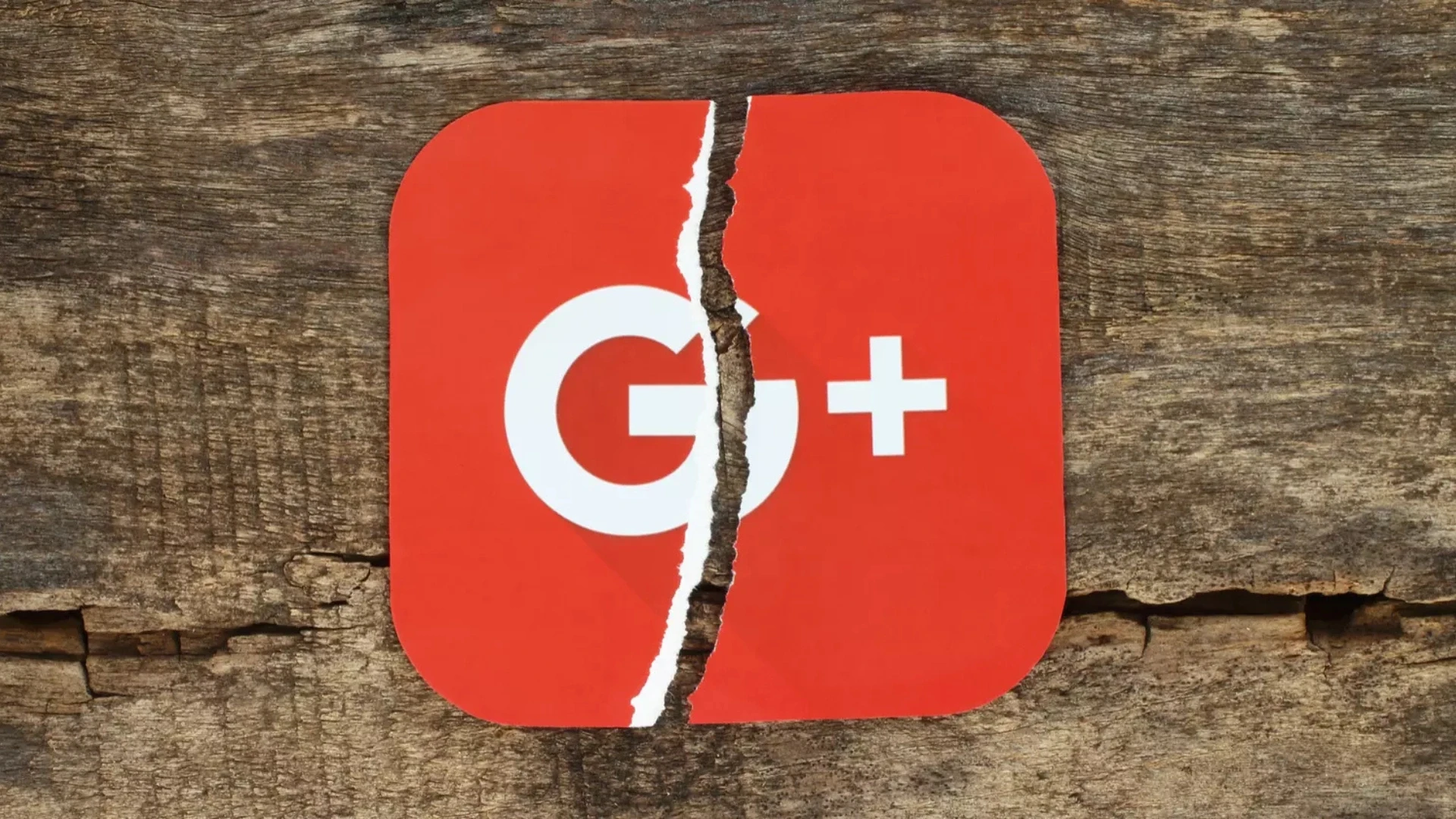
Two things closed Google+ together: almost nobody used it, and it had become a security liability. Either alone might have been survivable. Together they made the decision straightforward.
The engagement problem
Registered accounts were never the issue; genuine use was. A great many people had a Google+ profile only because it was attached to other Google services they actually wanted, and Google itself reported that the overwhelming majority of user sessions lasted only seconds. A platform that people are enrolled in but do not visit generates cost and risk without the engagement that would justify either.
The correction the original article needs
The 2019 version stated that Google seldom shuts products down. The opposite is closer to the truth, and it matters for the lesson here. Google has a long and well-documented history of retiring products, catalogued publicly on sites such as the Killed by Google archive, which lists hundreds of discontinued services. Treating a shutdown as a rare event leads businesses to build on platforms as though they are permanent. They are not, and planning as if they were is the mistake.
The Myth Worth Correcting: They Do Not Sell Your Data

The article said these platforms collect your data and sell it to third parties. That is the common belief, and it is inaccurate. Companies like Google and Meta do not sell your personal data because the data is the asset that makes their advertising valuable, and selling it would destroy the advantage.
What actually happens is that they sell advertisers the ability to reach people with particular characteristics, while keeping the underlying data themselves. You are not the product being sold so much as the audience being rented access to.
The distinction matters because it explains the Google+ breach precisely: the danger was never that Google would sell the exposed profile data, but that a flaw let third-party developers reach data users had chosen to keep private. The risk in these systems is leakage and misuse through access, not a sale, and understanding that changes how you protect against it.
That access is governed by terms that can change. Anyone whose product depends on another company's data through an interface is subject to that company's platform and API terms, which can be revised or withdrawn, as many developers who built on social login and social data have since discovered.
Worried how much of your product depends on a platform you do not control?
Send me a short description of your stack, and I will map where a third-party shutdown or terms change would hurt you, and what it would take to reduce that exposure.
The Real Lesson: Platform Dependency Risk
Google+ is a small example of a large problem: businesses build critical operations on platforms they do not own and cannot control. When the platform changes, the business built on it changes with it, often with little warning.
The pattern repeats across the industry. Companies build audiences on a social network, then a change to the feed algorithm halves their reach overnight. Products depend on a third-party interface, then its pricing multiplies or it is discontinued.
Businesses run on a service that is acquired and wound down. None of these are exotic events; they are the ordinary weather of building on someone else's foundation, and the Google+ closure was simply a visible instance of it.
What you depend on | How it can fail | Your exposure |
A social platform's reach | Algorithm or policy change | Audience access lost overnight |
A third-party API | Price rise, or shutdown | A core feature stops working |
Social or platform login | Terms change, service retired | Users locked out of accounts |
A single cloud service | Deprecation or acquisition | A rebuild on someone's timeline |
A platform's data feed | Access revoked | A product with no inputs |
The point is not to avoid third-party platforms, which would be impossible and foolish, but to know which of your dependencies would be fatal if they failed and to reduce those specifically. The parts of your business that must survive a platform change should run on foundations you control, and settling which those are is one of the first things we work through in a discovery workshop.
How to Protect a Business From a Shutdown

You cannot prevent a platform from closing, but you can make sure its closure is an inconvenience rather than a catastrophe. Four principles do most of the work.
Own your audience relationship
Followers on a platform are borrowed; an email list, or a direct relationship you hold in your own systems, is owned. Businesses that build their entire audience inside a single platform are one policy change away from losing contact with their customers. Move the relationships that matter into channels you control, so that if a platform disappears you can still reach the people who came through it.
Keep your own copy of your data
Anything a platform holds about your business or customers should also exist in storage you control. Export regularly rather than assuming you can when you need to, because export tools are often the first thing to degrade when a service winds down. Owning your data is what turns a migration into a project rather than a loss, and building that pipeline is routine work for anyone you hire data engineers to set up.
Abstract your integrations
When your code talks to a third-party service through a thin internal layer of your own rather than calling it directly everywhere, swapping that service later becomes a change in one place instead of a hundred. This is inexpensive to do at the start and expensive to retrofit, and it is a standard practice for the engineers who build and maintain your APIs.
Know your fatal dependencies
Write down every external service your business genuinely could not operate without, and for each one note what you would do if it vanished tomorrow. Most companies have never made this list, and making it is often the moment they discover a single point of failure they had not noticed. The exercise costs an afternoon and changes what you prioritise.
How to Protect User Data Properly

The Google+ breach happened because private data was reachable through an interface that should not have exposed it, which is a design failure rather than a policy one. Protecting user data well is mostly about a few disciplined habits.
Collect less than you can
The safest data is the data you never collected. Gather only what the product genuinely needs, keep it only as long as it is useful, and delete it on a schedule. Every field you hold is a field you must secure, justify and, under modern law, account for, so restraint at collection is the cheapest security measure available.
Control who and what can reach it
The Google+ failure was an access-control failure. Data that should have been private was reachable by third parties. Grant applications and people the minimum access they need, review those permissions regularly, and treat every interface that exposes user data as something to be audited rather than trusted. Most serious data incidents are access problems rather than encryption problems.
Treat privacy law as a floor, not a burden
Regulations such as the GDPR in Europe, along with comparable laws in the UK, Australia and several United States states, set out obligations around consent, access, deletion and breach notification. Building to those standards is not merely compliance; it is a reasonable definition of handling data responsibly, and a product built to meet them is generally a product users can trust. Where this becomes a formal engineering concern, our support and maintenance services treat data protection as ongoing work rather than a launch checkbox.
Proof: Owning Your Data and Systems
The antidote to platform risk is control of your own data and systems, and it is easier to show than to argue. Here is one example from our own client work.
Client: Ailleron, banking technology, Krakow Ailleron's data was scattered across disconnected sources, leaving no single place the business controlled and trusted. Acquaint Softtech consolidated it into a centralised data warehouse they own outright, with three BI and compliance dashboards and controlled access for different internal roles. Result: around 200 hours a week saved across reporting, report creation cut from four days to one, and a single source of truth the client controls rather than rents. The engagement holds a 5.0 out of 5 rating on Clutch. |
The relevance to this article is ownership. Ailleron's reporting no longer depends on scattered services, any one of which could change or disappear; it runs on a system they hold and can hand to anyone. That is the same principle at company scale that platform independence is at product scale.
We sign an NDA before work begins and clients hold 100% ownership of everything we build, which is the practical version of the lesson Google+ taught: control the things you cannot afford to lose. Our software case studies and client testimonials cover the engagements built on that basis.
Build on foundations you own, not ones you rent
Book a free 30-minute call, and I will show you where your critical systems could be brought under your own control and what it would take.
What Platform Independence Costs

Reducing platform dependency is a modest, deliberate cost set against a large, unpredictable one. This table prices the risk against the remedy.
The risk you carry | What it could cost you | What reducing it costs (USD) |
Audience only on a platform | Losing customer contact overnight | 2,000 to 8,000 to own the channel |
No copy of your own data | A shutdown becoming data loss | 3,000 to 12,000 for export pipelines |
Integrations hard-wired everywhere | A rebuild to swap one service | 4,000 to 18,000 to abstract them |
Unknown fatal dependencies | Discovering them during an outage | 1,500 to 5,000 for an audit |
Weak data access controls | A breach forcing a hard decision | 4,000 to 20,000 to harden |
Every figure on the right is smaller, and far more predictable, than the loss on the left. The value of this work is that it converts a potential catastrophe with no timeline into a manageable project with a known cost, which is the whole argument for doing it before you need to rather than during the emergency.
Where the work is done | Senior engineering rate | Relative cost |
New York, USA | USD 110 to 200 / hour | Highest |
United States (national) | USD 90 to 170 / hour | Very high |
Australia | AUD 110 to 200 / hour | High |
United Kingdom | GBP 65 to 130 / hour | High |
Europe (EU) | EUR 70 to 140 / hour | High |
India (Acquaint Softtech) | USD 25 to 49 / hour | Up to 40% lower |
Because this work is bounded and produces inspectable results, an export pipeline, an abstraction layer, and a dependency audit, it suits offshore delivery well and costs a fraction of the onshore equivalent.
Where capacity is the constraint rather than budget, adding an engineer through IT staff augmentation for a short period usually covers it, and our guide to web application development cost sets out how it fits a wider budget.
Find your single points of failure before they find you
Book a free 30-minute call, and I will help you list your fatal dependencies and put a plan and a cost against reducing the ones that matter.
Frequently Asked Questions
-
Why did Google Plus shut down?
Google closed the consumer version on 2 April 2019 after disclosing a bug that exposed private profile data to third-party apps. Combined with very low genuine usage, it was no longer worth maintaining.
-
When did Google Plus shut down?
The consumer version closed on 2 April 2019. A separate enterprise version continued for internal workplace use for a time.
-
Did Google Plus get hacked?
Not exactly. There was no evidence of a mass hack, but a software bug in an interface exposed private profile fields to third-party developers, which was the trigger for the shutdown.
-
Do Google and Facebook sell my data?
No. They sell advertisers access to audiences and keep the data themselves, because the data is what makes their advertising valuable. The risk is leakage through access, not a sale.
-
What is platform dependency risk?
The risk that a business built on a service it does not control loses that service when the provider changes terms, raises prices, or shuts it down. Google+ closing was one example.
-
How do I protect my business from a platform shutting down?
Own your audience relationships, keep your own copy of your data, route integrations through a thin internal layer, and list the dependencies you could not operate without.
-
How do I protect user data properly?
Collect only what you need, delete it on a schedule, control who and what can access it, and build to privacy laws like GDPR as a baseline rather than an afterthought.
-
What is Killed by Google?
A public archive listing the many products Google has discontinued. It is a useful reminder that platform shutdowns are common, not rare, and worth planning for.
-
Can I get my Google Plus data back?
No. Users were given a window before the 2019 shutdown to download their content. After the closure, the consumer data was deleted and is not recoverable.
-
What is the main lesson from the Google Plus shutdown?
Those platforms you do not control can disappear on someone else's schedule. Keep the things you cannot afford to lose, your data, audience, and core systems, under your own control.
I love to make a difference. Thus, I started Acquaint Softtech with the vision of making developers easily accessible and affordable to all. Me and my beloved team have been fulfilling this vision for over 15 years now and will continue to get even bigger and better.
Table of Contents
Get Started with Acquaint Softtech
- 13+ Years Delivering Software Excellence
- 1300+ Projects Delivered With Precision
- Official Laravel & Laravel News Partner
- Official Statamic Partner
Related Blog
Rome Was Not Built in a Day: The Journey to Developing a Unicorn SaaS
Building a unicorn SaaS company is a marathon, not a sprint. Just like Rome, great products aren’t built overnight. From refining your MVP to scaling for growth.
Mukesh Ram
September 26, 2024.webp "AI-Powered Guest Experience: Personalisation, Chatbots, and Predictive Service in Hospitality")
AI-Powered Guest Experience: Personalisation, Chatbots, and Predictive Service in Hospitality
AI-powered guest experience in hospitality is the use of machine learning, natural language processing, and predictive analytics to personalise every guest interaction from booking to checkout.

Manish Patel
June 1, 2026
10 Must Follow Steps of Mobile App Development Process
The mobile app development process is a structured set of 10 steps that moves an idea from concept to a published app: ideation, target audience and monetization, choosing the platform, UI/UX design, picking tools, choosing the right partner, fast development, testing and deployment, marketing, and post-launch maintenance. Following the steps in order, rather than rushing to publish, is what separates apps that get downloads from the ones that get ignored.
Mukesh Ram
July 29, 2019India (Head Office)
203/204, Shapath-II, Near Silver Leaf Hotel, Opp. Rajpath Club, SG Highway, Ahmedabad-380054, Gujarat
USA
7838 Camino Cielo St, Highland, CA 92346
UK
The Powerhouse, 21 Woodthorpe Road, Ashford, England, TW15 2RP
New Zealand
42 Exler Place, Avondale, Auckland 0600, New Zealand
Canada
141 Skyview Bay NE , Calgary, Alberta, T3N 2K6